
Navigating Organizational Politics and Business Analytics for Success
Last updated on Sep 14, 2026
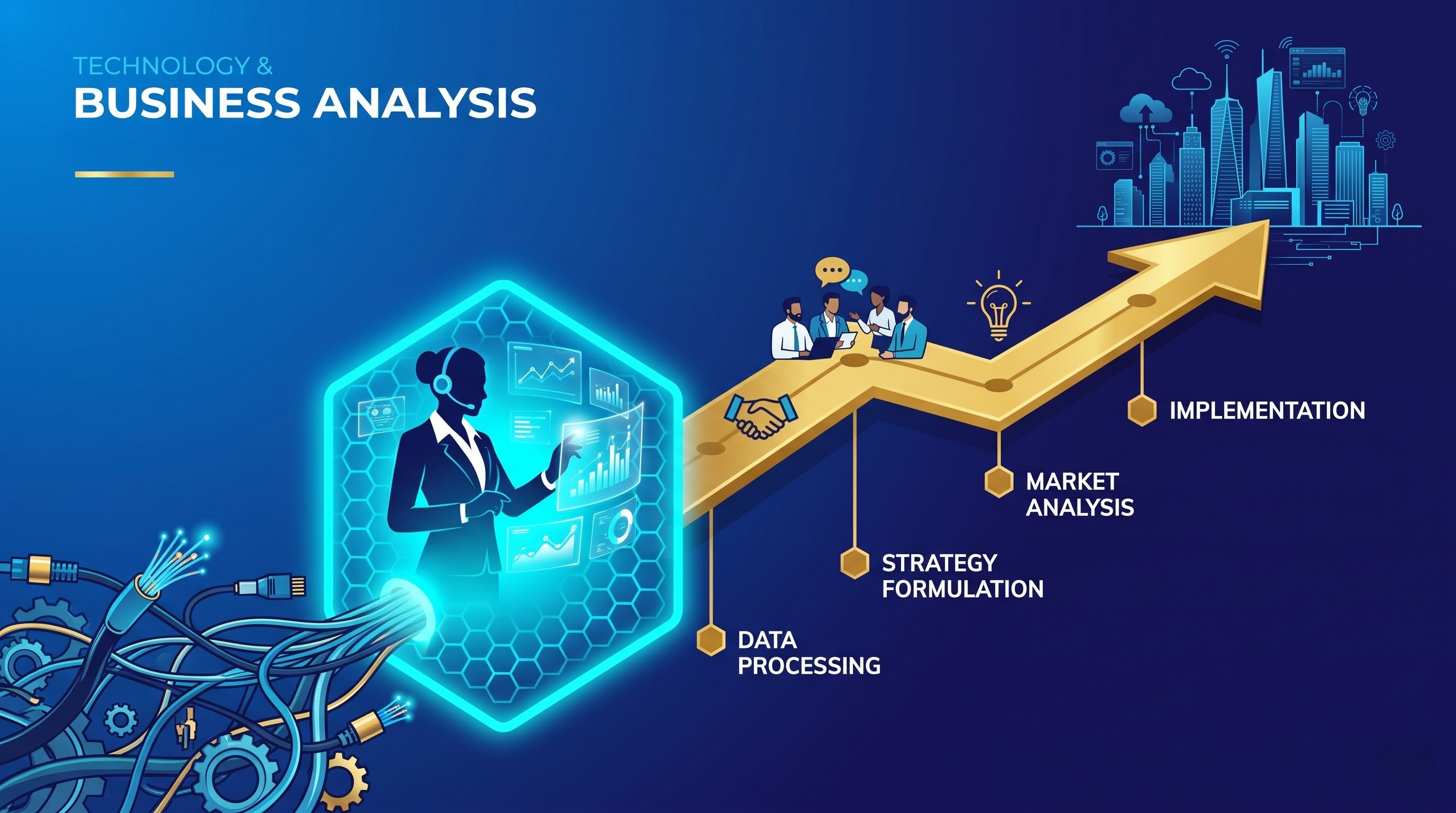
All business analysts eventually understand one lesson. The hardest part of transformation is not the technology involved, the data architecture or even budgetary constraints; it is the people who are involved. One can create the most extensive requirement document, diagram all the processes with impeccable precision and even implement state-of-the-art agile tools to monitor all the processes and stories. However, if one ignores the unseen forces of organizational politics, the project will either drift away from its objectives or fail completely.
Organizations are not solely mechanical assemblages based on some efficiency parameters; they are living systems made up of people with different interests, ambitions and fears. When a business analyst joins the project as a person responsible for assessing the present situation or making recommendations in regards to the future, they confront the present state of things, i.e. they start to shake the world developed in the company over the years.
The act of navigating reality does not render anybody manipulative or cynical but makes them efficient. Accomplished business analysis entails treating stakeholder dynamics and the politics of organization as critical considerations rather than things to be avoided.
While it is great to have reading about organizational politics, mastering the art of mixing technical process mapping capabilities and human diplomacy requires technical know-how and guidance. A successful ba online training pays attention to helping its students acquire the combination of technical and soft skills necessary for success.
Mapping Organizational Politics: The Politics of Power
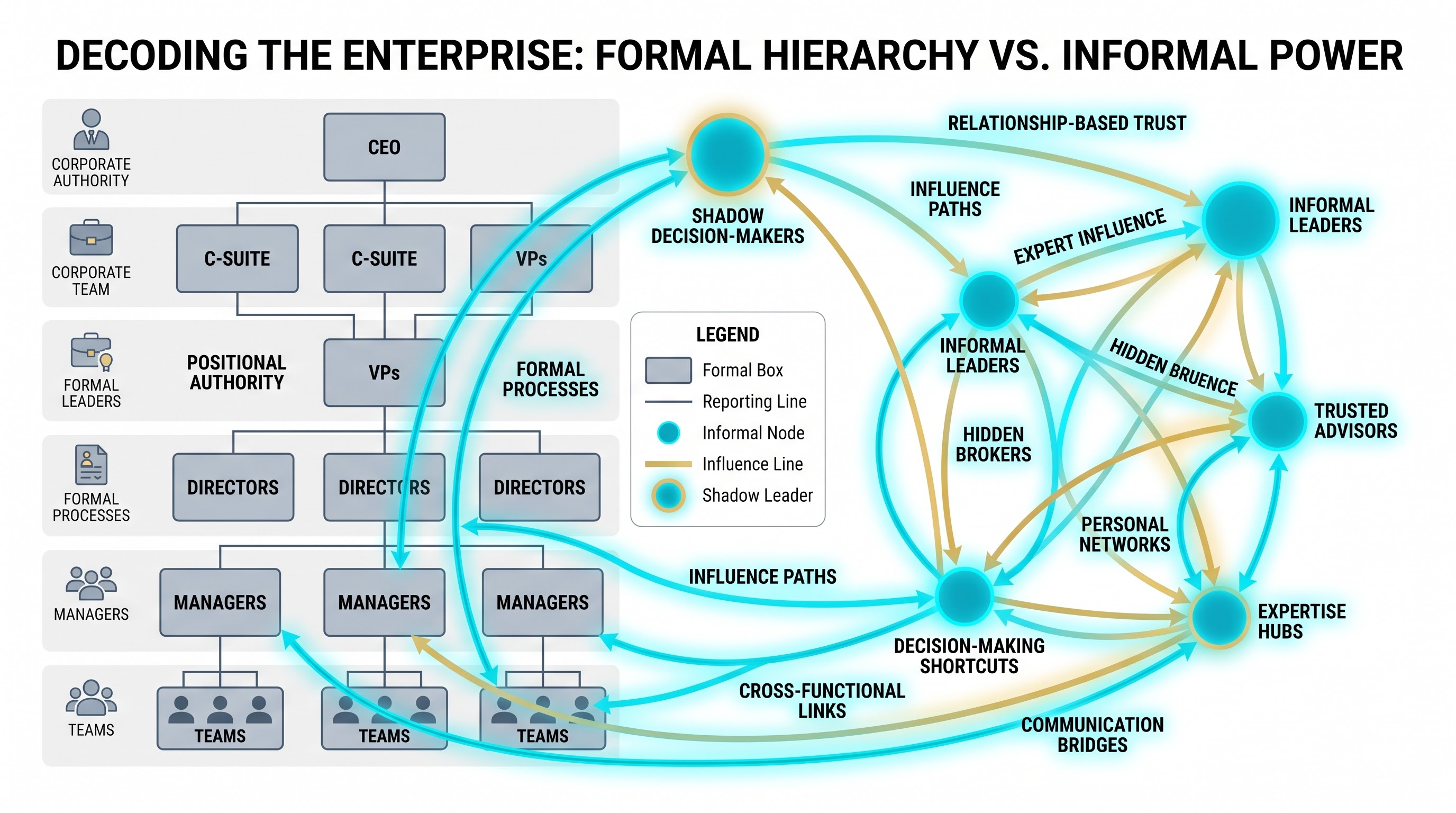
Before a person can navigate the organization’s politics, the person must first assess them. Just like mapping out complex data flows or multi-layered processes, people have to assess the political dynamics of the stakeholders involved. The formal organizational chart indicates who answers to whom; however, it rarely shows who really holds the power.
Formal Authority and Informal Power
In any organization, there is the formal organization chart that shows who reports and who answers to whom, and there is the real organization chart.
The structured organization indicates that the Vice President occupies the highest seat in hierarchy, followed by directors, managers, and operational personnel. Conversely, the unstructured organization reveals the existence of a veteran manager operating inside the company for over fifteen years with a lot to offer in terms of experience and knowledge, which is highly respected by the VP who relies fully on the advice of that person. When the project lead manages to obtain approval from the official decision-maker and ignores the informal leader, there will always be problems with implementation as the unofficial leader has a great influence among all company employees and may not approve of the idea in informal conversations when nobody is in public view.
In order to perform your duties as a business analyst, you need to conduct stakeholder analysis within the discovery phase of your project, paying attention to the individuals who have real power and influence.
The RACI Matrix from a Political Perspective
Every standard RACI matrix (Responsible, Accountable, Consulted, Informed) clarifies roles. However, once in a politically charged environment, it’s time to add behavioral awareness into the mix.
The first step is to determine who is actually Accountable for the delivery of the outcome as opposed to simply occupying that title for the glory of success.
Next, pay attention to whom to consult. These are often names of the people who can later sabotage a project in silence if they perceive that they have been excluded from the equation.
Be aware of the so-called “veto players” — people who, even though they might not be directly participating in creating the project, have to approve it in their department. Counting them as mere signature providers is a recipe for resistance.
Understanding Conflicting Stakeholder Priorities
One of the common challenges faced by a business analyst (BA) happens during requirements workshops where one department requests an automation of its processes that facilitates quick action while another department insists on a step-by-step approach that ensures compliance. Not only are both departments different in their demands but also they are certain that their positions are correct and depend on company strategic goals.
When such situations arise, the duty of a BA is not to take the side of one of the stakeholders. The main role of a BA is to reshape the emotional positions of stakeholders into solid business reasons.
Finding Out Why Stakeholders Oppose Each Other
When stakeholders disagree about one or another requirement, it can be mostly explained by one of them reacting to any fear that may concern them or trying to defend their KPI.
For example, by asking for instant access to customer data with no approvals from the others, the Sales department determines the speed of closing a deal and increasing revenues and the Legal department, in its turn, asks for a long process of verification to ensure risk compliance.
No party has it right; they are both just maximizing different areas of the corporate scorecard.
As a BA, your job is to hold meetings that aim to move the discussion from the details of how work gets done to the goals an organization wants to reach. In doing so, you ensure that the discussion is framed around organizational objectives like the growth of the company and the development of customer confidence—removing the emotional aspect of the argument. This is especially effective to help stakeholders stop defending their own domains and start working together on a joint problem.
The Third Way
Compromise usually leads to dissatisfaction among all involved parties. However, true consensus-building is about searching for the “Third Way”—a solution that meets both parties’ needs while achieving the main goals.
This is what takes an active listening approach. Instead of listening to answer or rushing to write down the first solution, listen for the restrictions that your stakeholders are dealing with. When a resisting stakeholder feels recognized and understood, they stop being defensive, which allows for productive collaboration.
Countering Resistance from Management-Level Managers
Resistance at the level of middle and senior management is perhaps the toughest hurdle to jump over. Unlike operational workers who can refuse a new; tool because it alters the way they do their job, management resistance is often related to loss of control, fear of downsizing, and general distrust springing from previous unused projects.
The Mindset of Middle Management Resistance
Middle managers have it rough, squeezed between executives demanding innovation and efficiency and being the ones facing major disruption from the bottom up.
When a BA introduces a new system or process, middle managers psych themselves as follows: "Will this make me look bad? Will we be downsizing the department as a result of implementing the new tool? Will I have to take the blame if this initiative fails?"
Ignoring their worries or labelling their resistance as "non-cooperation" will not help. There are many quiet ways of making progress come to a halt: procrastination, slow replying to emails, and discouraging their employees from participating actively in the workshops.
How To Win Over Skeptical Leadership
To convert resistant bosses into enthusiastic advocates, you must get them involved early, give them a sense of ownership, and protect their reputation.
Co-Create Instead of Dictating: You should never show a skeptic a ready-made solution, saying, "This is what we did for you." Even if the solution is great, their reaction will often be defensive as they have no part in developing this program. Start with offering them the raw data and problem description and encourage them to co-create the solution together. When they sense authorship over the project, they will become its most passionate advocates.
Talk About The Metrics They Care About: Know what performance indicators are used to evaluate your skeptical managers. If, for example, a manager’s bonus depends on the reduction of errors, and a new system may lead to a slight mismatch in the data during the transition period, they will definitely be against it. You should show them how your use of a new system will help them achieve their goals.
Create Safe Spaces: Give the option of piloting, sandboxing, or slowly introducing new initiatives in a phased way. They are more likely to approve of changes if they know they could always get out of it without getting burned.
Making Consensus Work When It Feels Impossible
Reaching consensus is not the same as getting unanimous and enthusiastic approval regarding every issue. It is unrealistic in large organizations to expect all parties to agree on everything. Real reaching consensus means that the important stakeholders are on the same page about the future direction of the project, they think their concerns were appropriately considered, and they do not actively sabotage the initiative even though it may not be what they wanted.
Being a Neutral Facilitator
As a business analyst, you occupy an unusual neutral position. You do not have budget authority, do not manage departments, and your responsibilities do not include the final profit and loss account. This neutrality is actually an advantage in your political work.
When conducting the high-stake alignment meetings:
Separate the individuals from the situation. De-polarize conflict. Approaching conversations from the angle of user needs, market pressures, and operational performance, instead of battling between departments.
Handling the environment. Controlling aggressive players making it harder to conduct conversations, while at the same time bringing attention to less active members of the event who may be storing valuable insights related to critical risks.
Document the proceedings honestly. Using visual methods of documentation in real time (for instance, using requirements or charts during the discussion) allows to establish objective truth regarding what has been said.
Managing hallway meetings culture
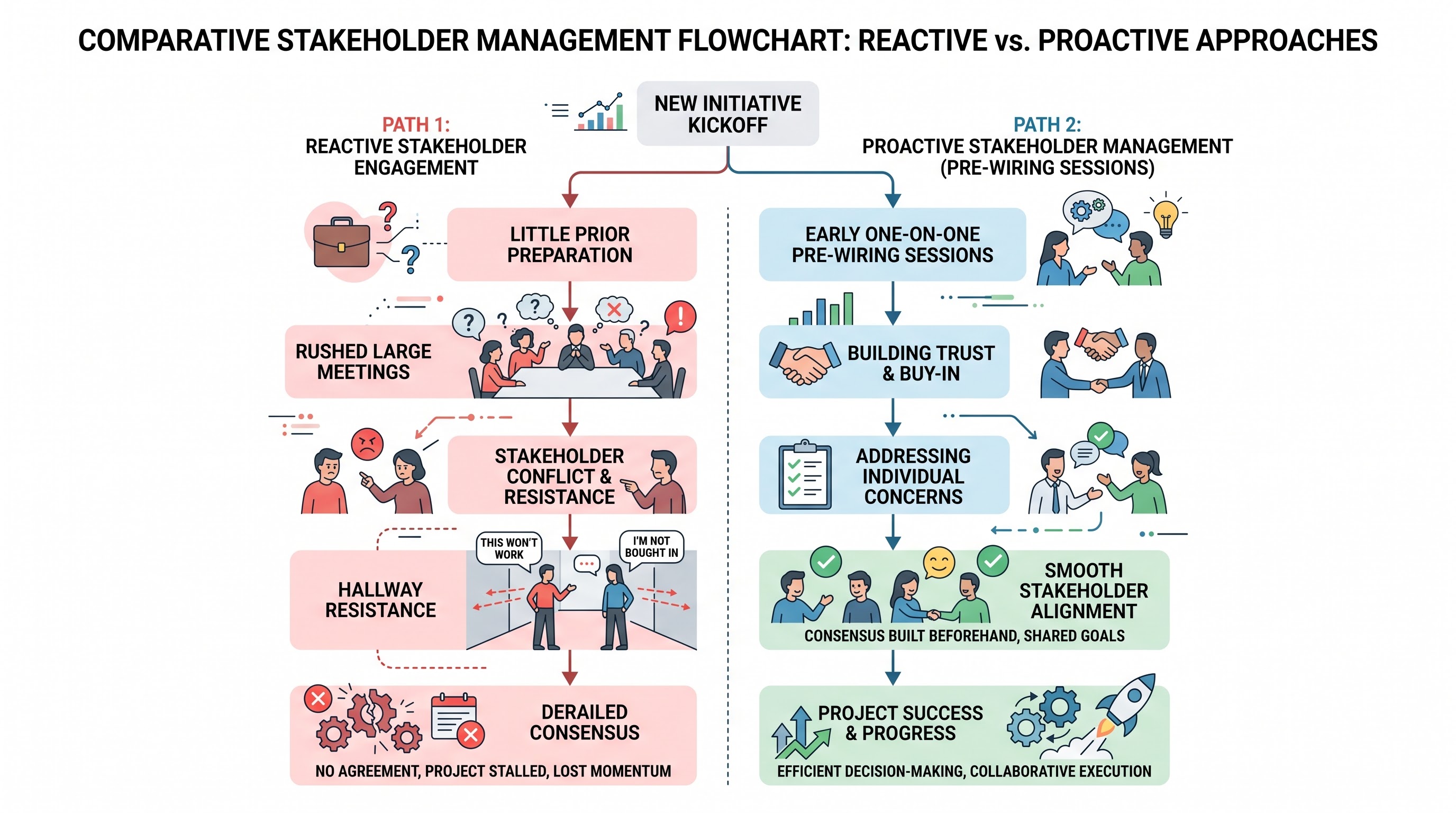
A telling indicator that indicates poor workplace politics is different meetings after meetings. One can attend a prolonged meeting of around two hours only to learn that a number of secret meetings are taking place right after this meeting in the corridor or through messaging.
To overcome this issue, it is important to become adept at doing pre-alignment checks (also known as pre-wiring). Before going to a formal steering committee meeting where major proposals or requirements are tabled, you should organize short one-on-one meetings with key stakeholders and probable blockers lasting 15 minutes.
There are many skills involved in leading high-stakes alignment meetings and handling the unpleasant 'hallway conversations'. If you want to improve your facilitation skills by learning how to establish rock-solid business consensus, then taking a BA analyst course online recognized by the industry may give you useful hands-on experience.
Lead them through your proposal
Ask them to give necessary feedback to you in a comfortable environment letting them express their concerns without fear of embarrassment in front of their colleagues.
Take into account their reasonable suggestions before the formal meeting.
Once you enter the meeting room, there should be no critical surprises. You will have already dealt with the problem areas in private and all that will be left to do is to formally align opinions.
Safeguarding Your Neutrality and Credibility
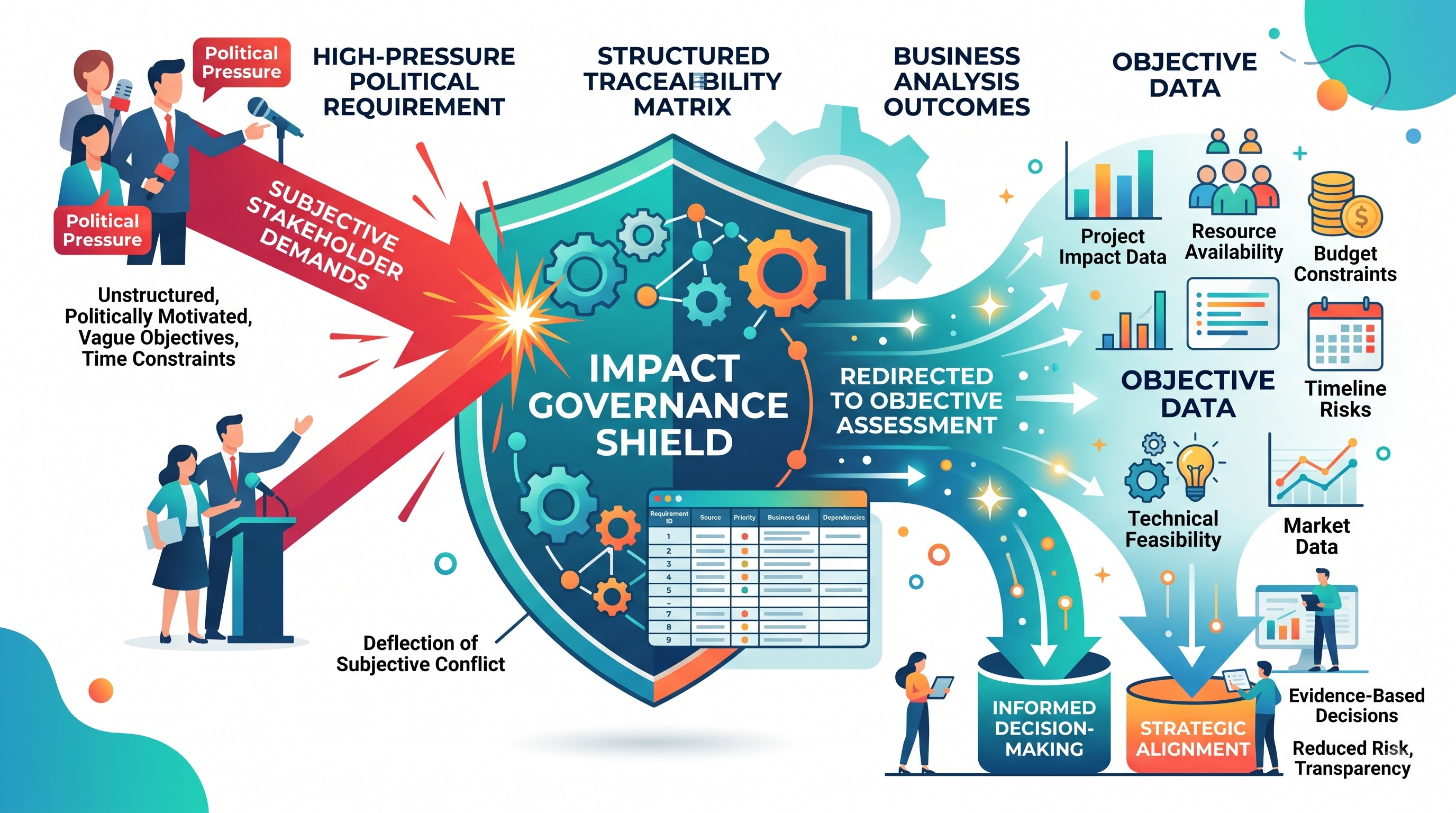
Since BAs are located at the crossroads of business strategy, operations, and technology, you often get dragged into political issues. Leaders from different departments may recruit you to support their ideas or blame you when there is a delay in the implementation of a project.
Hence, the preservation of your credibility and neutrality in the matters of politics is essential.
The Armor of Traceability
One of the best techniques to deal with the pressure of politics is traceability. In cases when a very strong stakeholder requests a change that contradicts the previous agreements or the scope of the project, don’t get into a heated debate about politics.
Instead, use your requirements traceability matrix or impact analysis technique.
Explain to your stakeholder the consequences: “If we decide to include the new request to introduce Feature X, it conflicts with Strategic Objective Y approved by the steering committee last month and ends up with testing being postponed for three weeks. We will need to consult with the sponsor regarding which priority should prevail.”
By resuming the dispute in accordance with the specified established governance protocols and rational impact data, you free yourself of the burden and relieve yourself from any responsibility. This gives you an opportunity to work as an unbiased advisor explaining the situation to your superiors.
Building Trust through Transparent Communication
Trust is essential in politics. When the situation gets complicated, people tend to hide unpleasant information or try to make their audience feel better. However, concealing the truth is always ineffective.
Be as transparent as possible when it comes to difficulties, dependencies, and political problems. While informing sponsors about project status, report not only the actual state of affairs in terms of deadlines and budget but also indicate the overall project alignment. For instance, if any business division is showing evidence of disengagement, mark it as a risk as soon as possible. Superiors always appreciate BAs who are able to foresee risks and avoid them.
Transforming Political Awareness into Professional Excellence
Dealing with organizational politics is not a deviation from serious business analysis; it is the core of it. You could have top-notch technological savvy, stunning flowcharts, and extensive knowledge of the industry; however, your skills will be in vain if you do not know the motivations and power structures of the people involved.
By changing your attitude from that of a simple order-taker to a politically proficient strategist, you can alter your understanding of your value. You will no longer be perceived merely as the writer of what everybody says, but rather as a valuable driving force behind positive changes in the organization.
When encountering an inflexible manager, conflicting stakeholder goals, or a tense meeting with many hidden tensions, keep in mind that you experience the raw material of human activities. Listen attentively and try to reveal the main motives.
The acquisition of these strategic, people-oriented skills distinguish mediocre order-takers from top professionals. If you want to gain this expertise from the ground up, then registering for a business analyst course online will give you the necessary practical frameworks to connect technical performance with the real-world interest of stakeholders.
The Hidden Costs of Ignoring Political Movements
Business analysts, when paying heed to the details of requirements collection, i.e., use cases, swimlane diagrams, backlog grooming, sometimes forget the severe impact of neglecting politics on the business. Projects do not fail in isolation; rather, failure is due to the fact that relations and instruments of motivation were treated as an unimportant background.
Take the example of a typical implementation of enterprise software that has been delayed for eighteen months, consuming millions of dollars in consulting and internal resources. If conducting a post-mortem analysis of failures, it is rarely revealed that the database schema was improperly normalized or that some field was missing in the user interface. Instead, one can see traces of passive resistance, such as a regional director instructing his/her employees not to abandon their spam spreadsheets for the fear of losing control; a department head who hid vital integration parameters as he/she felt ignored in the course of vendor selection; and an executive sponsor who withdrew his/her support without being asked after he/she found out that the new system changed the balance of power between departments.
When you overlook political currents, they turn into invisible drag forces that hamper project progress. Every requirement meeting turns into a forum for disputes, while every small change in scope leads to endless conflicts. This friction tires out the teams, which results in unwanted employee churn and constant cynicism toward modernization projects.
Being a business analyst, when you realize the 'hidden cost' of avoiding politics, you start acting differently. You understand that it is not a political game when you spend an hour having an off-the-record conversation with one of the skeptical stakeholders—it is a major step toward the mitigation of possible risks.
Navigating Cross-Functional Divides: Connecting the Huge Corporate Divisors
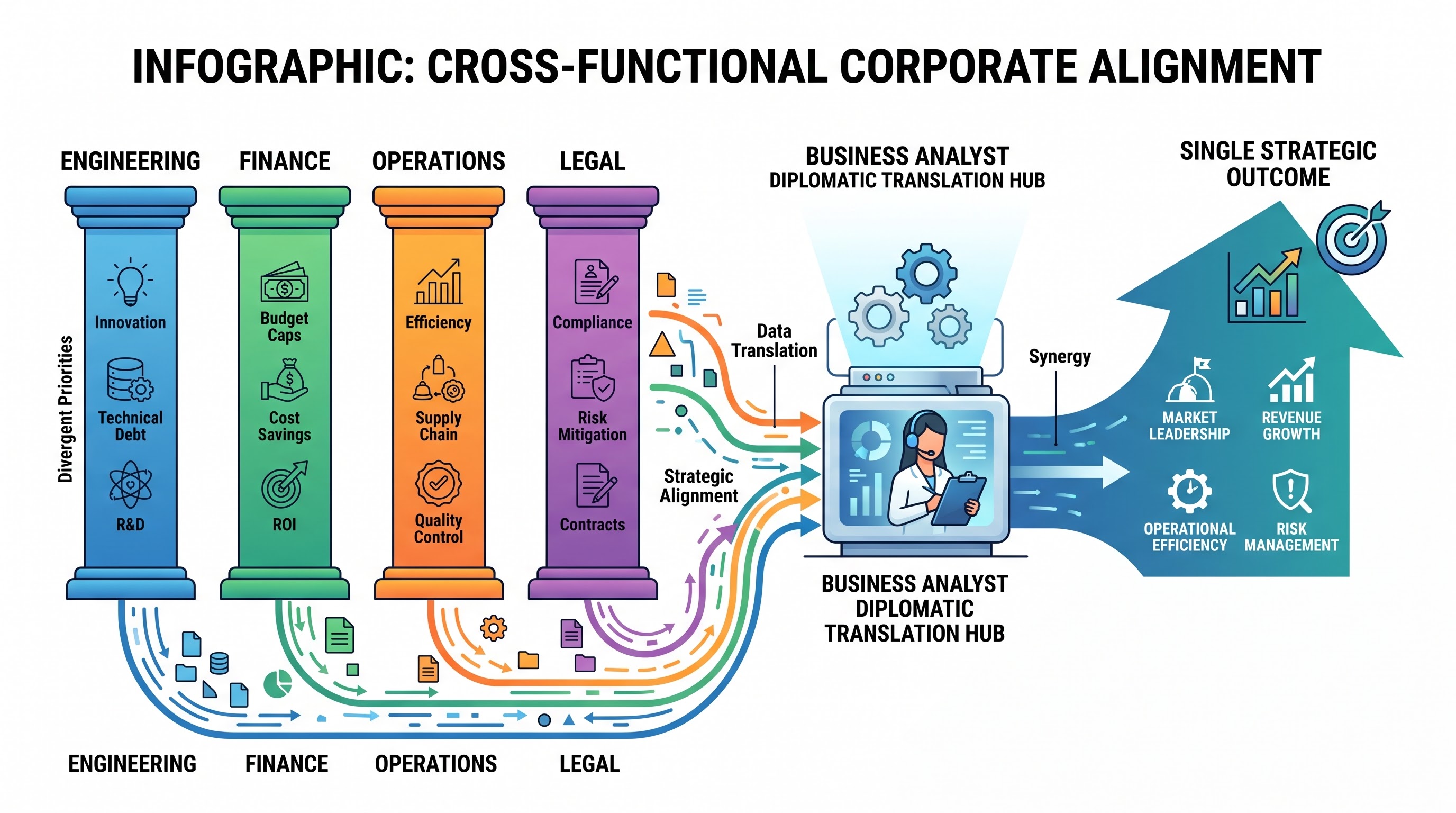
Companies tend to specialize, developing separate departments like Finance, Operations, Marketing, Legal, and Engineering. Such specialization results in many divisions having a well-defined culture and their own language, and focusing on their own metrics.
In case of an enterprise-wide business analysis project spanning different departments with the involvement of builders, the BA is called to fulfill a diplomatic role between divisions. Each department sees changes from its own angles:
Engineering deals with risks from the point of view of technology, architecture, and deadlines established by people who do not know how software is created.
Finances view every expense item in terms of ROI, controlling the costs, and risks, even regarding innovations as unnecessary financial risks.
Operations consider continuity of the business, staff training, and a drop of efficiency during the shift to the new system.
Compliance and Legal concentrate solely on risk, regulation, and audit, considering the speed and flexibility to be the weaknesses.
A rookie BA comes into this system equipped with the templates and attempts to push every stakeholder into the same requirements format only to face immediate resistance. A more experienced, politically savvy BA, instead, tackles the issue of organizational silos with anthropological curiosity. They take the time to sit in different departments, listen to their problems, learn their acronyms, and understand what worries their bosses.
Bridging these divides requires translation work. When Finance is talking about “optimizing capital expenditures,” and Engineering is talking about “refactoring legacy microservices,” the BA must convert those terms into a common language of business value that leadership and operations teams can relate to: “a quicker time-to-market of our product with strict regulatory compliance.” By taking on the role of a universal translator in the world of isolated tribes, the BA breaks down boundaries and forms a coalition of the willing.
To become a reliable organizational strategist instead of just an essential component that satisfies the requirements, it is important to acquire new skills. Many professionals from South Asia and various countries widen their career perspectives by enrolling in a specialized online ba analyst course India.
Perfecting the Timing of Executions
In the intricate chess game of organizational transformation, timing is similarly fundamental. You can present the perfect solution, focus on the most relevant variables and align with the appropriate strategic goals; but if you make your presentation at the wrong time during the calendar or in terms of the political context, it will be rejected immediately.
Political intelligence requires being sensitive to the rhythms and stress points of organizations. The crucial issue is the timing of various processes. Here are some of the key time factors:
The Fiscal Quarter-End Freeze: Imposing a disruptive requirement for additional work on the operational teams during the last two weeks of the high-stakes fiscal quarter represents a huge strategic mistake. At this time, the teams' thoughts, parameters and adrenaline are fully focused on hitting financial goals or closing the books. This inflexibility will result in all opposition in discussions.
Leadership Changes: Once a new Vice President or C-level executive joins the company, political instability is unleashed. A power struggle occurs as existing leaders try to re-establish themselves with the new leader's preferences. For business analysts, this can be both good and bad news: previously approved projects may lose support rapidly while the changes in authority may provide opportunities to participate in new initiatives.
Budget Cycle Windows: Strategic initiatives need to be aligned with the corporate financial calendar. Assuming that a new project can be proposed three months after the annual budgets have already been approved means that it will face immediate issues with resources, even if the business idea is great.
When you align the progress you make with an organization’s natural rhythm, you can be confident that their stakeholders are in the right mental state to absorb the recommendations.