
Overcoming MuleSoft Project Procrastination Through Actionable Micro-Goals
Last updated on Aug 1, 2026

Most students have experienced the sensation before. You open your assignment dashboard, see a great term paper, a lengthy research proposal, or an elaborate final project in front of you, and are hit by an outright wave of panic. The assignment seems enormous, the requirements seem unclear, and the deadline looks daunting. Instead of getting started, you clear the desk, go through your email, scroll through social media, or tell yourself that you will definitely get on with it "first thing tomorrow."
This kind of behavior is not a sign of being either lazy or stupid. Procrastination is actually an emotional problem at its heart, not a matter of time management. When faced with a challenge which seems too big and complicated, our brain regards it as a threat which may cause all sorts of problems: it creates stress and leads to negative feelings. As a result, in order to protect us from these negative feelings, we tend to indulge in activities that help diminish our anxiety in the short run.
To break this cycle, we need to change the way we think about large technical learning projects. If you are taking a mulesoft developer course or studying for the certification on your own, the answer is micro-goal setting. It is the process of breaking down intimidating projects into smaller tasks.
By adopting a large scale project frame such as "Write 15-Page Paper," the task becomes mentally heavy. One is burdened with thoughts regarding unwritten pages, sources to organize, and complicated ideas. However, the same task broken down into micro-goals such as "Download 3 relevant PDFs" or "Draft a thesis sentence" reduces emotional anxiety. The threshold is low enough that one no longer needs to fight against avoidance mechanisms of the brain.
By concentrating not on the huge end goal, but on one small action ahead of you, one manages to bypass the forces of resistance of the brain.
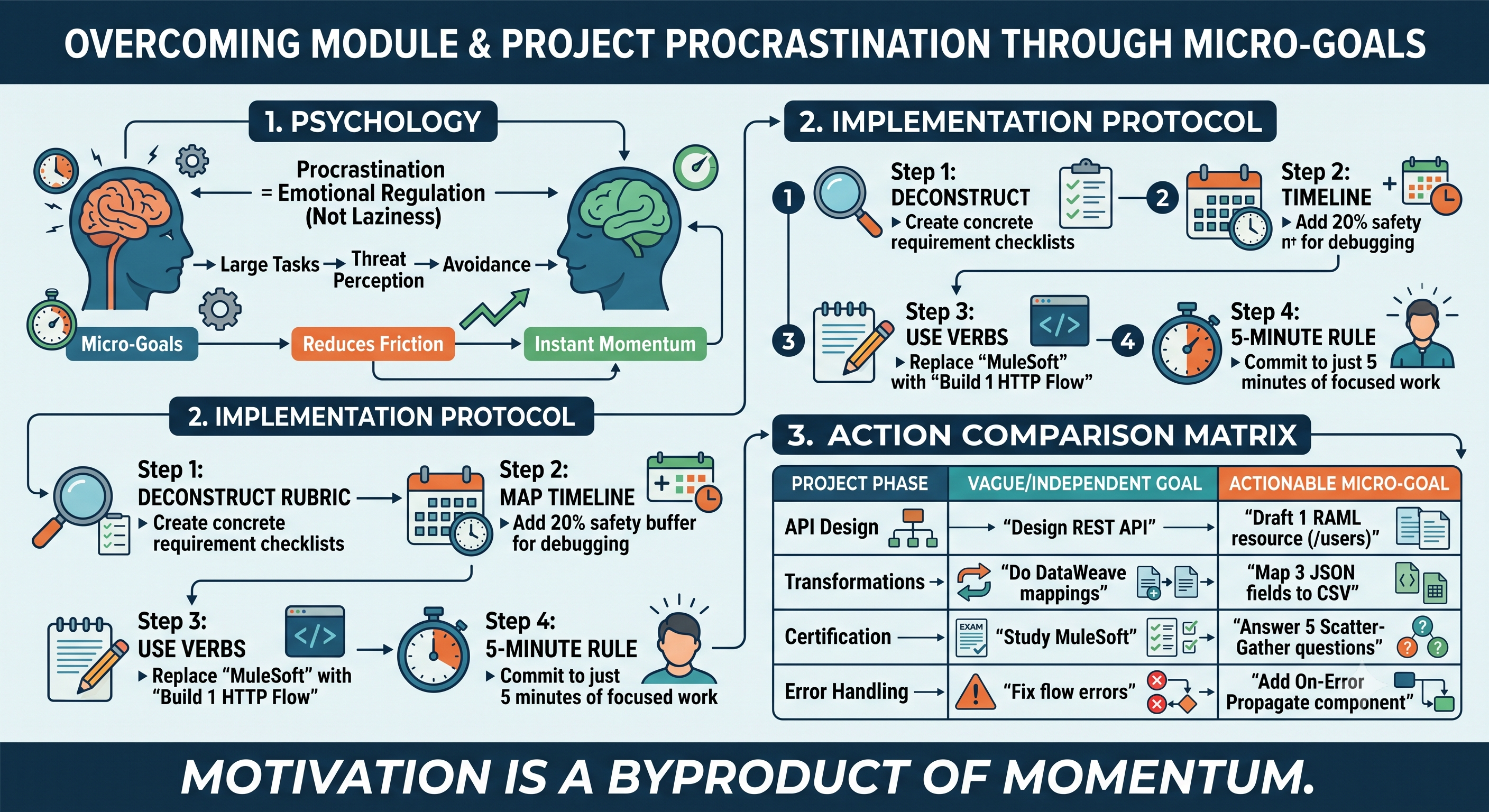
The Psychology of Academic Procrastination
1. The Emotion-Regulation Engine
Conventional wisdom has long said that procrastination is due to ineffective time management. However, research in psychology has shown that procrastination occurs when negative feelings about a task are stronger than the motivation to start or complete it.
Academic projects bring with them a certain set of emotional obstacles.
Fear of Failure: the belief that one’s performance will fail to meet expectations.
Perfectionism: the unrealistic belief that one's preliminary work has to be perfect.
Ambiguity: the presence of no clear ideas about where to begin or what ‘finished’ means.
Cognitive Overload: the feeling that one’s mind cannot comprehend the whole project at once.
When faced with these obstacles, one’s mind resorts to the use of emotional shortcuts—putting off the task instead of moving towards its completion.
2. The Planning Fallacy and Size of the Goal
People are generally bad at guessing how long a task will take - this is the Planning Fallacy. When you're studying for your mcd level 1 certification, if you have a vague goal like “Study MuleSoft”, then your brain sees this as one large block of work and not a number of separate actions.
The goal sounds vague and big:
You underestimate the amount of work required.
You have trouble getting started.
You procrastinate because it seems too hard to start.
The Basic Framework: Macro-Projects to Micro-Goals
To overcome the problem of getting started, you need a framework that enables you to break a vague project down into smaller, manageable steps.
The dismantlement of a big learning task follows a sequential process, which gradually changes a daunting goal into a simple and immediate deed. It all starts with Macro-Project first of all and it is the most general assignment, e.g. "Compose a 15-page research paper." As it is hard to look at such a score as one task, it is split into small manageable milestone stages. Milestone stages create a hierarchy of logical steps, starting from the first phase "Phase 1: Research & Sources."
So as to make implementation of these broader phases possible every milestone level is further divided into micro-goals. Micro-goals are certain straightforward goals with an achievable result. Finally, in order to erase the initial problems with action, the micro-goal can be minimized with the help of the so-called atomic action items. Atomic action items are very tiny tasks, so one can start with one simple deed, e.g. "Open Google Scholar and search for concept Z."
1. Identify the Macro Project
The Macro Project refers to the completed deliverable required by your instructor (for example, research paper with a length of 15 pages as well as coding assignments with duration of a semester). Keep the Macro project in mind for context but please do not use it as a to-do list item.
2. Create Milestone Levels
Divide the Macro Project into logical phases. For a research paper, these stages would be:
Topic specification and research limitations
Source collection and literature review
Thesis development and structuring of schema.
Writing in sections.
Editing, polishing, and formatting citations.
3. Breaking down into Micro Goals
Micro Goal Unit is a single, express accomplishment that takes between 15 and 45 minutes.
Vague goal: "Do a literature review".
Mini Goal: “Read two sources that cover [Topic X] and summarise the arguments.
When starting is hard and motivation is low, it may be necessary to decompose the goal further down into a more manageable unit of work called atomic action Step.
Mini Goal: Write a first paragraph.
Atomic Action Step: “Create a new document, write the title and a sentence about the topic.”
Step-by-step Micro Goal Action Plan.
Here is the game plan for how to achieve any academic assignment today.
First Step: Analyze the Rubric; Clarity precedes execution.
Read through the assignment and make a list of all the requirements (size, approach, number of works cited, questions to answer). Then make a checklist of what you need to do.
Second Step: Map the timeline; Develop the timeline.
Split your timeline into different stages of work, mark approximate dates to finish the phase and reserve 20% of your time in order to cope with unexpected delays.
Third Step: Use Verbs to Define Your Action Plan; Remove ambiguities.
Translate overarching objectives into clear tasks in elegant language and ensure clarity of thought. Avoid using the title of chemistry. For example, replace chemistry with: “Finish off practice problems 1-5 on page 102”.
Fourth Step: Implement the 5-Minute Rule
Start working without the necessary motivation. Make a resolution to spend just 5 minutes on a given action. Tell yourself you can stop after that. Once the action has been started, it is likely that you will continue with it without problems.
Real World Examples
Whether you take live, hands-on mulesoft classes or self-paced labs, breaking broad objectives into tangible micro-goals makes every phase easier to achieve:
Example A: Literature Review and Term Paper
Breaking down large academic tasks into micro-goals turns general, daunting goals into concrete, actionable steps for any area of study you might be pursuing, whether that's in the humanities or any branch of STEM. In particular, students often get stuck in the first step of doing research and writing. For example, when asked to “find research papers,” students can set one specific goal that gives them a direction at the start, instead of being paralysed by this vague command: to download five specific articles relevant to the research topic, basically it can be framed as downloading five specific PDFs related to the query called [Topic] + [Variable].
After the first step is done and the articles are collected, students go to the reading phase but again experience a cognitive overload, now when they have to read “sources.” In this case, students can immediately feel that writing "read sources" on their to-do list is not effective to reduce the complexity of the task. Which is why they need to break down what reading sources really means into such simple tasks as reading abstracts and conclusions of only one single paper and coming up with two main points from the reading.
The transition to the structural stage generates a significant advantage when "create an outline" is replaced with the following five section headings, with two citation examples for each. The drafting phase of writing is often plagued by students’ paralysis caused by concurrent writing and editing. Instead of telling students to "write body 1," instruct them to complete a 200-word paragraph discussing one idea while refraining from editing.
The polishing stage can be approached much better when the phrase "edit paper" becomes "read a section aloud in order to identify typos."
The goal of dividing coursework into micro-goals is also relevant for quantitative and STEM classes. The preparation time for a complicated unit usually starts with the vague goal of "studying Chapter 4," which is not impactful when it comes to measuring progress. Instead, the micro-goal of copying all essential equations from the chapter to one reference page helps keep working memory engaged while creating a useful reference for solving problems.
Whenever we approach problems, if we try to tackle everything in one go, it results in procrastination. However, if we instead focus on making diagrams and identifying variables needed for only 3 problems, it decreases the initiation efforts and allows us to start. The reviewing phase usually tends to be ignored in its simple form of “check the answers.” By redefining our actions and categorizing them as verifying obtained units with expected results, we make the phase accurate, unlike before.
Regardless of the field, meaningful micro-goals replace endless tasks.
Keeping the pace and controlling the friction.
After you have settled the plan with the micro-goals, the next step is to monitor and direct the surroundings that you work in.
1. The Implementation Intentions Approach
Research by psychologist Peter Gollwitzer shows that completion increases significantly when people use “If/Then” statements. Don't leave the execution to chance. Schedule when, where and how you will accomplish micro-goals.
If [Situation/Time X occurs], then I will [Execute Micro-Goal Y in Location Z].
If it’s a Tuesday at 10:00 A.M. then I will be at the library desk writing 150 words for Section 2.
2. Micro-Progress Visualization
Achieving small wins releases dopamine that helps to maintain your progress.
Keep a “Done” List: In addition to your to-do list, keep a record of all micro-goals you accomplished. Writing done micro-tasks allows seeing progress and boosts motivation.
Use Simple Digital Tools: The best way to keep track of your goals is to use simple to-do lists or Google Docs, rather than complex systems that require much setup time.
3. Minimizing the "Onboarding Cost"
Conclude each study session by setting up the groundwork for the following one:
Keep your document open on your computer.
Have your notebook laid on the right page.
Document the one atomic action you will take during your next session (for example: "Next step: Understand Term X").
Sources of Environmental Friction & Getting Back to Speed
1. Making the Environment as Low-Friction as Possible
While micro-goal architecture fights against psychological friction, it does not do anything about the physical and digital friction. Environmental friction refers to the unnecessary step, obstacle, or external stimulus that prevents one’s intention from being acted upon. This means that if one has to look for some lost notes before getting started with a task, clean the table, or wait for the laptop to finish the update, such a small delay contributes to mental resistance and emotional avoidance.
Set up your environment ahead of time to reduce the activation energy to almost zero:
Digital Environment: Close unused browser tabs, turn on website blockers, and close any app or document on your desktop except for the one you’ll be using in your study session.
Physical Workspace: Clear unrelated material from your desk at the end of each day. Get your necessary books, notebooks and writing materials so that they are physically prepared for your next atomic step.
2. Returning to the Swing of Things, After Interruptions
No productivity framework can completely eliminate off-days. Progress can be hindered by fatigue, unexpected interruptions, or challenging content. The biggest danger at such moments is the “what-the-hell effect,” a psychological distortion that leads you to throw your entire study schedule out the window after a minor lapse, because you feel guilty or frustrated.
In the event of a momentum breakdown, employ the Micro-Reset Protocol:
Practice Objective Self-Compassion Notice the interruption without harshness to yourself. Harsh self-criticism exacerbates the negative emotional state that causes procrastination in the first place.
Shrink the Goal Further: If you have a scheduled 30-minute micro-goal and it feels unmanageable after an interruption, shrink it down to an atomic action step immediately. Cut down "draft 150 words" to "write one sentence."
Favour consistency over production. When you’re low on energy, the goal isn’t to produce at maximum efficiency but to keep the habit of action alive. Even a two minute atomic task keeps the feedback loop active and prevents the cognitive barrier from rebuilding.
3. Long-term mastery: Moving from micro-goals to systems
With regular use, micro-goal architecture changes a fundamental part of your self-efficacy – your belief you can succeed. The identity change occurs as you rack up hundreds of completed atomic steps. You no longer see yourself as someone who freezes when faced with big academic challenges, but as someone who systematically breaks them down.
Academic success is seldom the result of spontaneous heroic efforts. It is the natural consequence of a reliable system that respects human psychology, that makes it easy to get started and that relies on steady, incremental momentum. Even the most daunting academic project can be tackled when you concentrate solely on the little, doable step right before you.
Conclusion: Motivation Before Action
“The trouble with the usual way of doing academic work is that it waits until you feel like doing something before you do it. Motivation is a prerequisite for a lot of students: an elusive spark that has to strike before they can crack open a textbook or start a draft. Motivation is rarely the reason for action in the first place. It is a byproduct of momentum.
Procrastination is basically an emotional regulation problem, not a time management issue. When you're staring at a huge, nebulous project -- a 20-page research paper, a comprehensive final exam, a complex coding assignment -- your brain perceives it as an imminent threat. The work itself causes cognitive overload, fear of failure and perfectionist anxiety. To protect you from these negative emotions, your brain nudges you toward instant comfort: social media, cleaning, or small administrative tasks.
The key to breaking this emotional defence mechanism down is to change the scale of your first entry point. You need to move from creating huge, scary goals to taking micro-goals – small, low-friction, highly specific tasks.
When the task is stated as “Write History Paper.” It takes a lot of activation energy to get started. You have dozens of pages that you have not written, citations that are missing, arguments that are not organised. But when you break that same project down into an atomic action step—say, “Open a blank document, write the title, and draft one thesis sentence”—the emotional threat disappears. The price of admission gets so low that your brain can’t be bothered to protect itself by avoiding it.
Deconstruct your biggest, scariest assignments into clearly defined, bite-sized micro-goals to remove the ambiguity and mental burden that lead to task paralysis. You give up trying to solve the entire problem all at once, and concentrate only on the one specific action that is right there in front of you.
The magic of this approach is after the first atomic step is taken. Action yields quick, tangible results. Even achieving the smallest micro-goal gives you a little hit of dopamine, telling your brain the task is okay, manageable and you’re in control. That small success lowers the resistance to the next step, replacing focus for anxiety.
You don’t have to be inspired to begin working. Just make the starting line small enough that you can step over it. Just focus on the micro-goal in front of you, take that one step, and let the momentum carry the rest of the way.