
Rethinking MongoDB: It Starts With How You Model Your Data
Last updated on Aug 14, 2026

MongoDB’s document model offers a different way to think about how application data is structured and managed. Instead of forcing every piece of information into a rigid table-based structure, developers can organize related data into flexible documents that reflect how applications actually use it. That approach can simplify development, but it also introduces important decisions around data modeling, querying, indexing, and application performance.
As applications grow, those decisions become even more significant. MongoDB’s capabilities around aggregation, indexing, replication, and sharding help developers address increasing data and workload demands, while newer capabilities such as Search and Vector Search are opening the door to AI-ready application experiences. This article explores how MongoDB moves from a flexible document model to a broader approach for building, optimizing, and scaling modern applications.
Why Application Data Modeling Matters More Than People Think
Most developers don't choose a data model. They inherit one. You start a project, you reach for whatever database your team already knows, and the shape of your data ends up being whatever that database prefers, not necessarily what your application needs. With relational databases, that means normalization: breaking information into small, related tables to avoid duplication. It's a genuinely good idea for a lot of problems, especially ones involving strict consistency across many interconnected entities, like banking ledgers or inventory systems with complex constraints.
But most applications aren't that. A blogging platform, a food delivery app, a fitness tracker, a customer support tool — these applications tend to read and write data in clumps. A user profile with its preferences. An order with its line items, shipping details, and status history. A workout session with its sets, reps, and notes. In the real world, you rarely fetch just one of these pieces in isolation. You fetch the whole clump, together, because that's how the application actually presents it to a person.
When your data model doesn't match that pattern, you pay for it constantly. Every screen load becomes a small negotiation between the database's structure and the application's needs. Developers write increasingly complex queries to reassemble data that was split apart for reasons that made sense on paper but not in practice. And every schema change, even a small one, risks touching multiple tables and their relationships.
This is the actual problem MongoDB set out to solve, and it's worth sitting with before jumping into what MongoDB does technically. The pitch isn't "NoSQL is faster" or "schemas are old-fashioned." The pitch is that data modeling should start from how your application uses information, not from a fixed table structure that has to be worked around.
How MongoDB Changes the Model
MongoDB stores data as documents rather than rows in tables. A document looks a lot like a JSON object: a set of key-value pairs, where values can be strings, numbers, arrays, or even other nested documents. Documents live inside collections, which are MongoDB's rough equivalent of a table, except a collection doesn't require every document inside it to share the exact same fields. Because documents are self-contained and behave like ordinary objects, developers can focus on the data they actually need to store and process, instead of spending their energy figuring out how to break that data apart across a set of rigid, interconnected tables.
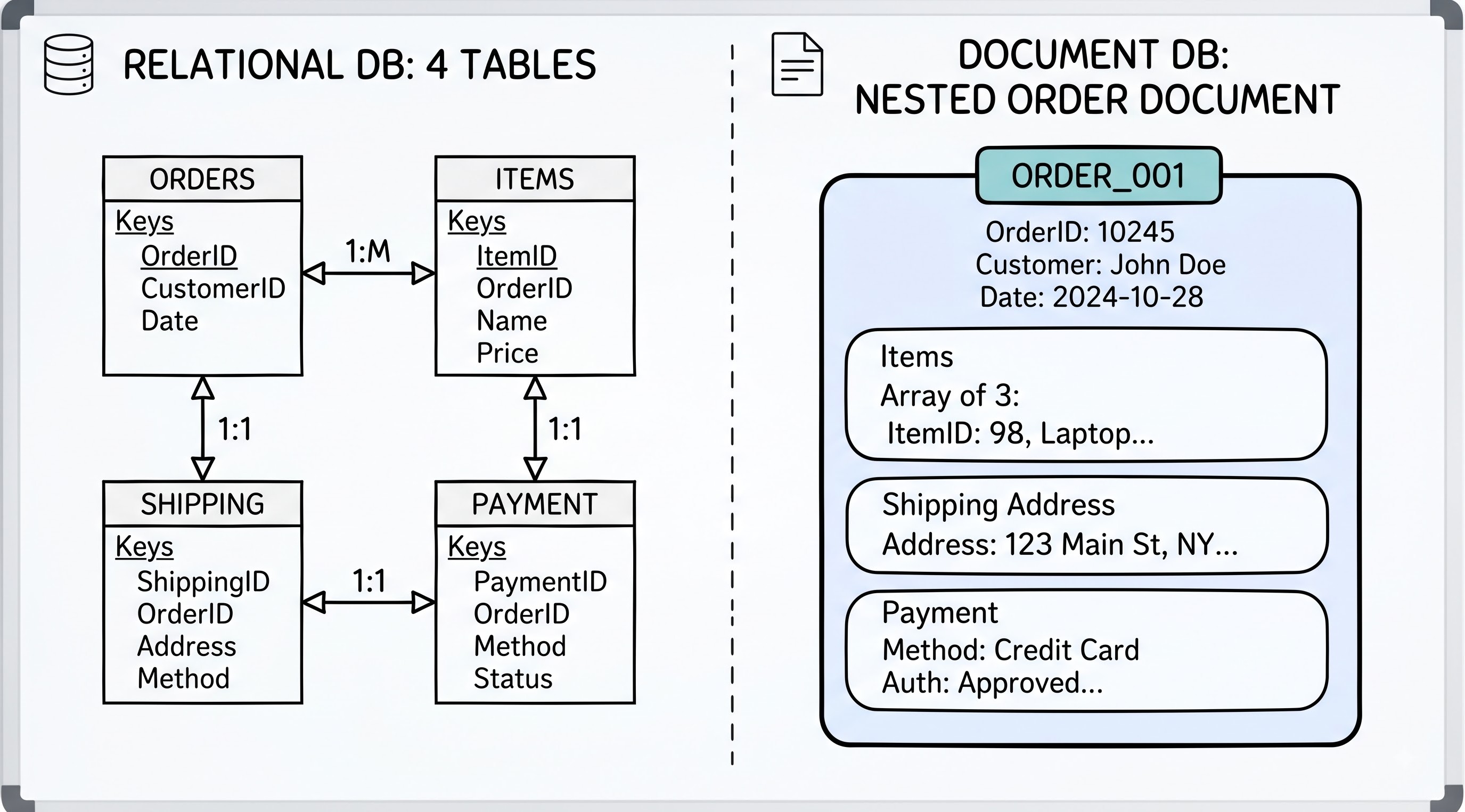
Take that order example again. In a relational setup, an order might be split across an orders table, an order_items table, a shipping_addresses table, and a payment_methods table, all connected by foreign keys. In MongoDB, that same order can live as a single document: the order details, the line items as an array, the shipping address as a nested object, all in one place. When your application asks for an order, it gets the whole thing in one read, no joins required.
There's a guiding principle that MongoDB engineers talk about a lot, and it's a useful way to think about this: data that's accessed together should be stored together. That's not a rule that applies everywhere — there are absolutely cases where splitting data into separate collections makes more sense, especially when pieces of data are reused across many different documents or updated independently at very different rates. But as a starting instinct, it flips the traditional approach on its head. Instead of asking "how do I avoid duplicating this data," you start by asking "how does my application actually read and write this data," and you let the model follow from that.
This flexibility also matters for a less glamorous but very real reason: change. Applications evolve. Requirements shift mid-project. A field that seemed optional becomes required, or a new attribute needs to be added to every user record without a lengthy migration. Because MongoDB doesn't enforce a rigid schema at the database level, adding a new field to new documents doesn't require rewriting a table definition or migrating existing rows first. That doesn't mean schema design stops mattering — it still matters a great deal, and sloppy schema design in MongoDB can cause just as much pain as a bad relational schema. It just means the flexibility is available when you genuinely need it, instead of fighting you by default.
How Developers Actually Work With the Data
Once the model is different, the daily experience of working with it changes too. Instead of writing SQL to select, join, and filter across tables, developers interact with MongoDB using queries that look and feel like working with the same JSON-like objects they already use throughout the rest of their application code. A find operation takes a query document describing what you're looking for, and MongoDB returns matching documents in that same shape. There's no translation layer where you mentally convert between "how the database stores this" and "how my application code represents this" — for a lot of everyday CRUD work, the two are nearly the same thing.
Beyond basic reads and writes, MongoDB's aggregation framework is where a lot of real application logic ends up living. It lets you build a pipeline of stages — filtering documents, grouping them, reshaping fields, joining in data from another collection when you genuinely need to — and each stage passes its output to the next. It's a different mental model than a single SQL statement, closer to a series of transformations than one big query, and once it clicks, it tends to be a very natural way to express "take this raw data and turn it into the shape my dashboard needs."
MongoDB also supports drivers for essentially every major programming language — Node.js, Python, Java, C#, Go, and more — so the day-to-day experience of connecting to a database, running queries, and handling results fits naturally into whatever stack a team is already using. This is part of why teams new to MongoDB often pick it up faster than they expected. A developer who's spent time in structured environments like mongodb classes usually finds that the concepts translate quickly, because a lot of what changes is the shape of the data, not the fundamental logic of building an application. The syntax is different, but the thinking is closer to plain object manipulation than to relational algebra.
How MongoDB Keeps Applications Fast as They Grow
Flexibility is only useful if it doesn't come at the cost of speed, and this is where a lot of MongoDB's engineering work actually lives. Indexes are the first and most important lever. Without an index, MongoDB has to scan every document in a collection to find matches, which is fine for a few thousand records and painfully slow for a few million. Indexes on the fields your application actually queries by — user IDs, timestamps, status fields — let MongoDB jump straight to relevant documents instead of scanning everything.
Compound indexes, which cover multiple fields at once, matter even more in practice, because real queries rarely filter on just one field. An e-commerce app querying "pending orders for this customer, sorted by date" benefits enormously from an index that matches that exact access pattern, versus separate indexes on customer ID and status independently. Getting this right requires actually understanding your application's query patterns, not just adding indexes reactively whenever something feels slow.
Under the hood, MongoDB uses a storage engine called Wired Tiger, which handles how data is actually written to and read from disk, including compression and how concurrent operations are managed. Recent versions have focused on tightening write throughput and reducing latency spikes under heavy load, which matters a lot for applications with high write volume — think logging systems, IoT data pipelines, or anything ingesting events continuously rather than just serving reads.
There's also the question of read and write patterns at the query level: using projections to fetch only the fields you actually need instead of entire documents, being deliberate about how deeply nested and how large individual documents get (MongoDB documents have a 16MB size cap, which is rarely hit but worth knowing about), and understanding when a query is using an index versus falling back to a full collection scan. Tools like the explain() method let developers see exactly how MongoDB is executing a given query, which is one of those unglamorous habits that separates people who've been through real mongodb training from people who are still guessing. Performance in MongoDB isn't automatic — it's the result of deliberately designing documents, indexes, and queries around how the application actually behaves in production, not just how it behaves in a demo.
How It Scales
Performance for one server is one problem. Performance for an application with millions of users, spread across regions, running around the clock, is a different problem entirely, and this is where MongoDB's architecture does a lot of quiet, structural work.
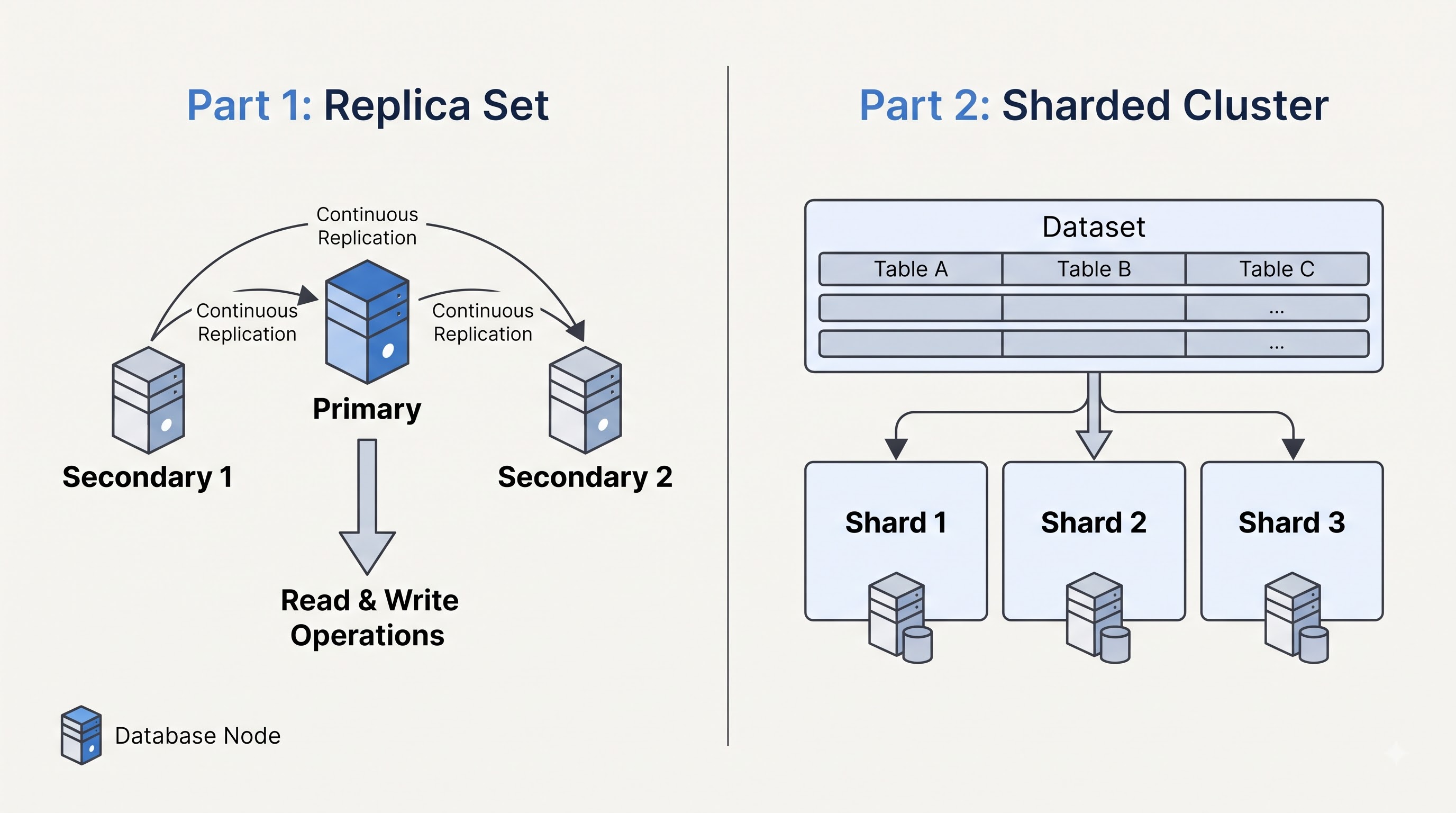
The first layer is replication. A MongoDB replica set keeps multiple copies of the same data across different servers — typically three or more. One server is the primary, handling writes, and the others are secondaries, continuously copying data from the primary. If the primary goes down, one of the secondaries is automatically elected to take over, usually within seconds, without a human needing to intervene at 3 a.m. This isn't just about disaster recovery. Secondaries can also handle read traffic, spreading load across multiple machines instead of hammering a single server with every request.
The second layer is sharding, which addresses a different problem: what happens when your data grows too large or your write load grows too heavy for any single server to handle, no matter how powerful it is. Sharding splits a collection's data across multiple servers based on a shard key, so that instead of one machine holding everything, the dataset is spread out and distributed. Put together, those distributed shards behave as one comprehensive database from the application's point of view, which is what allows a popular, fast-growing product to keep scaling without downtime as usage climbs. Choosing a good shard key is one of the more consequential decisions in a MongoDB deployment, because a poorly chosen one can create hotspots where most of the traffic still lands on one shard anyway, defeating the entire purpose.
Most teams today don't manage all of this by hand. MongoDB Atlas, the company's managed cloud service, handles replication, sharding, backups, and scaling through a dashboard and API rather than manual server configuration, which is a large part of why MongoDB adoption grew as fast as it did — teams could get production-grade reliability without hiring a dedicated database operations team from day one. For anyone building toward a role that involves designing these systems rather than just using them, this is usually the point where a structured mongodb course starts paying off, because replication and sharding decisions are much easier to reason about with guided practice than by trial and error against a live production system.
How MongoDB Is Expanding Into Search and AI Workloads
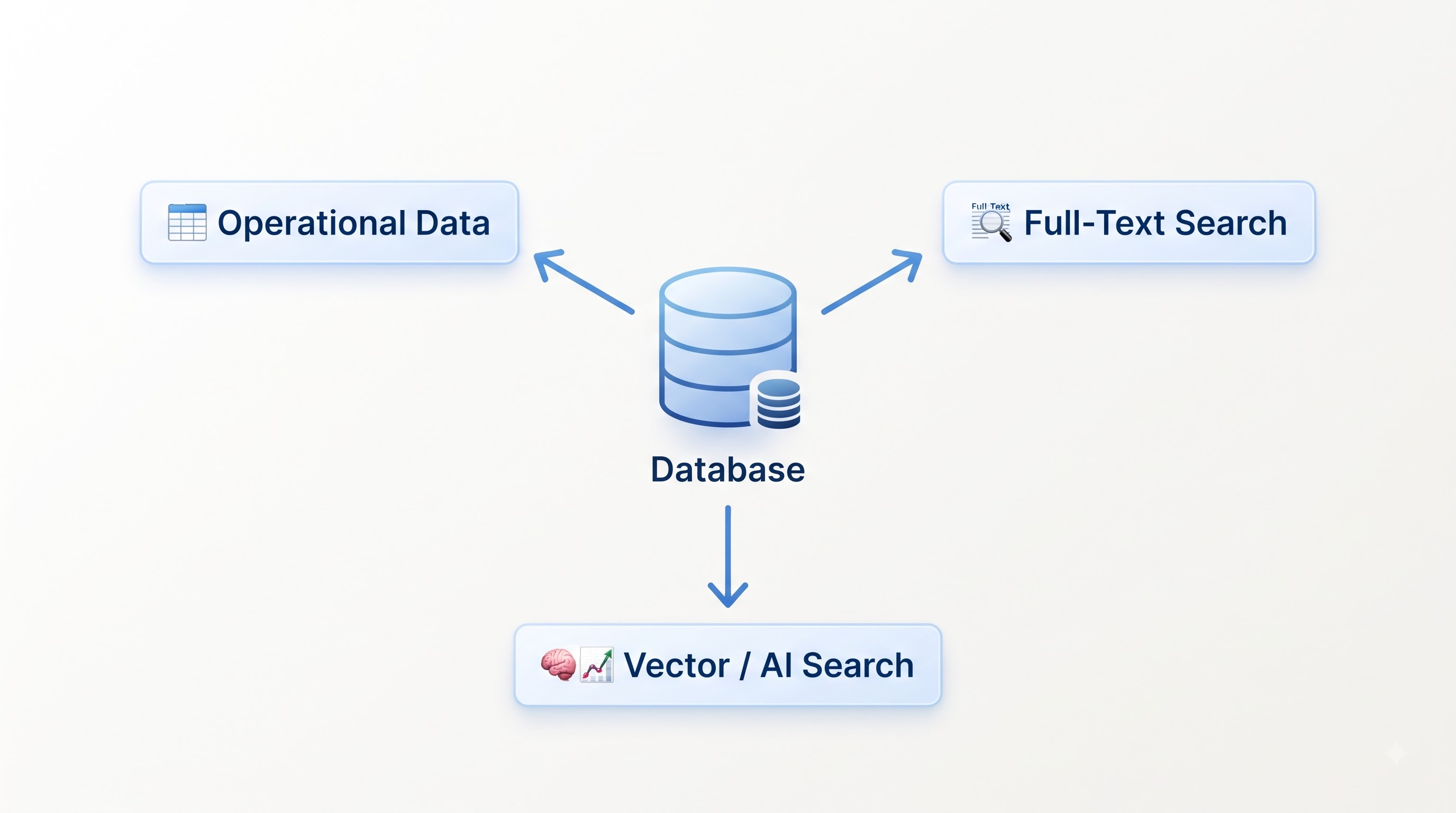
For most of its history, MongoDB's story was about operational data — the stuff applications read and write constantly to function. That story has been expanding, and the direction it's expanding in is search and AI, in a way that's changed fairly quickly over the last couple of years.
Atlas Search brought full-text search capabilities directly into MongoDB, letting developers build search experiences — autocomplete, fuzzy matching, relevance ranking — without standing up a separate search engine alongside their database and keeping the two in sync. That syncing problem is a real pain point in a lot of architectures: your primary database has the current data, your search index has a copy, and every write has to somehow update both without drifting out of sync over time.
The more recent shift is Vector Search, which stores and queries embeddings — the numerical representations of text, images, or other content that AI models use to find semantically similar items rather than just keyword matches. In practical terms, this means the same cluster already holding an application's everyday documents can also hold those embeddings, powering semantic search or retrieval-augmented generation workflows without a team having to stand up and maintain a completely separate vector database just so an AI feature can search and recall content. MongoDB's acquisition of the embedding-model company Voyage AI pushed this further, bringing retrieval and reranking expertise directly into the platform. The outcome has been an automated embedding capability inside Vector Search, letting developers store, index, and query embeddings without ever stepping outside the regular MongoDB driver they already use for everything else. Vector search has also stopped being something reserved for the paid Atlas cloud service — it's available in the free Community Edition too, which means a team can experiment with semantic search on their own laptop before deciding whether it's worth committing to cloud infrastructure.
The practical effect of this is that teams building AI features — chatbots that reference internal documentation, recommendation systems, agents that need some form of memory — don't necessarily need to bolt on a separate specialized database just to handle the AI-specific part of their stack. The operational data, the search layer, and the semantic search layer can live in the same place, queried through the same driver, which removes a meaningful amount of architectural complexity from a category of application that's becoming more common by the month, not less. It also lowers the barrier for smaller teams. Not every company building an AI feature has the resources to run and maintain a dedicated vector database alongside their main one, and for a lot of them, this convergence is the difference between shipping the feature and shelving it.
How Someone Should Actually Learn MongoDB
Given everything above, it's worth being honest about where people usually go wrong when picking this up. The most common mistake is learning MongoDB as a syntax swap, memorizing how find() replaces SELECT, how insertOne() replaces INSERT, and stopping there. That gets you functional but mediocre applications. The syntax is genuinely the easy part.
The harder and more valuable skill is data modeling: learning to look at an application's actual access patterns and design documents, collections, and indexes around them, rather than defaulting to habits carried over from relational databases. This is a skill that develops through building real things, hitting real performance problems, and going back to fix a schema after seeing what actually breaks under load — not something that clicks from reading documentation alone.
A sensible mongodb learning path usually starts with the basics: documents, collections, CRUD operations, and enough of the aggregation framework to reshape and summarize data. From there, indexing and query performance deserve real attention, because this is where a lot of self-taught developers plateau — they can write working queries but don't yet know how to make them fast at scale. After that, replication and sharding round out the picture for anyone building or maintaining production systems, followed by a look at Atlas Search and Vector Search for anyone whose work touches search or AI features, which is an increasingly large share of new development work.
There's no single "correct" order to learn all of this, and plenty of people pick it up through a mix of official documentation, hands-on projects, and structured guidance along the way. What matters more than the exact sequence is treating MongoDB as a way of thinking about data, not just another database to bolt onto a familiar workflow. The developers who get the most out of it are the ones who let their data model follow their application's real behavior, and everything else — the query patterns, the indexing decisions, the scaling choices — tends to fall into place once that first shift happens.
That, more than any single feature, is the real story of MongoDB. It isn't a database that happened to store JSON. It's a database built around a bet that most applications should be designed around how they use their data, not around a fixed structure inherited from a different era of software. Once that idea actually clicks, the rest of what MongoDB does — the indexing, the scaling, the AI integrations — stops looking like a list of separate features and starts looking like one consistent philosophy applied at every layer.
Conclusion: A Single Architectural Philosophy
That, more than any single feature, is the real story of MongoDB. It isn't a database that happened to store JSON. It's a database built around a bet that most applications should be designed around how they use their data, not around a fixed structure inherited from a different era of software.
Once that idea actually clicks, the rest of what MongoDB does — the indexing, the scaling, the AI integrations — stops looking like a list of separate features and starts looking like one consistent philosophy applied at every layer. By aligning your data storage directly with your application code, you eliminate unnecessary layers of abstraction, cut operational overhead, and build systems that are natively equipped to grow from early prototypes to distributed, AI-driven platforms.
.