
Salesforce Admin in 2026: Skills, Career Opportunities, Market Demand, and Future Scope
Last updated on Aug 18, 2026
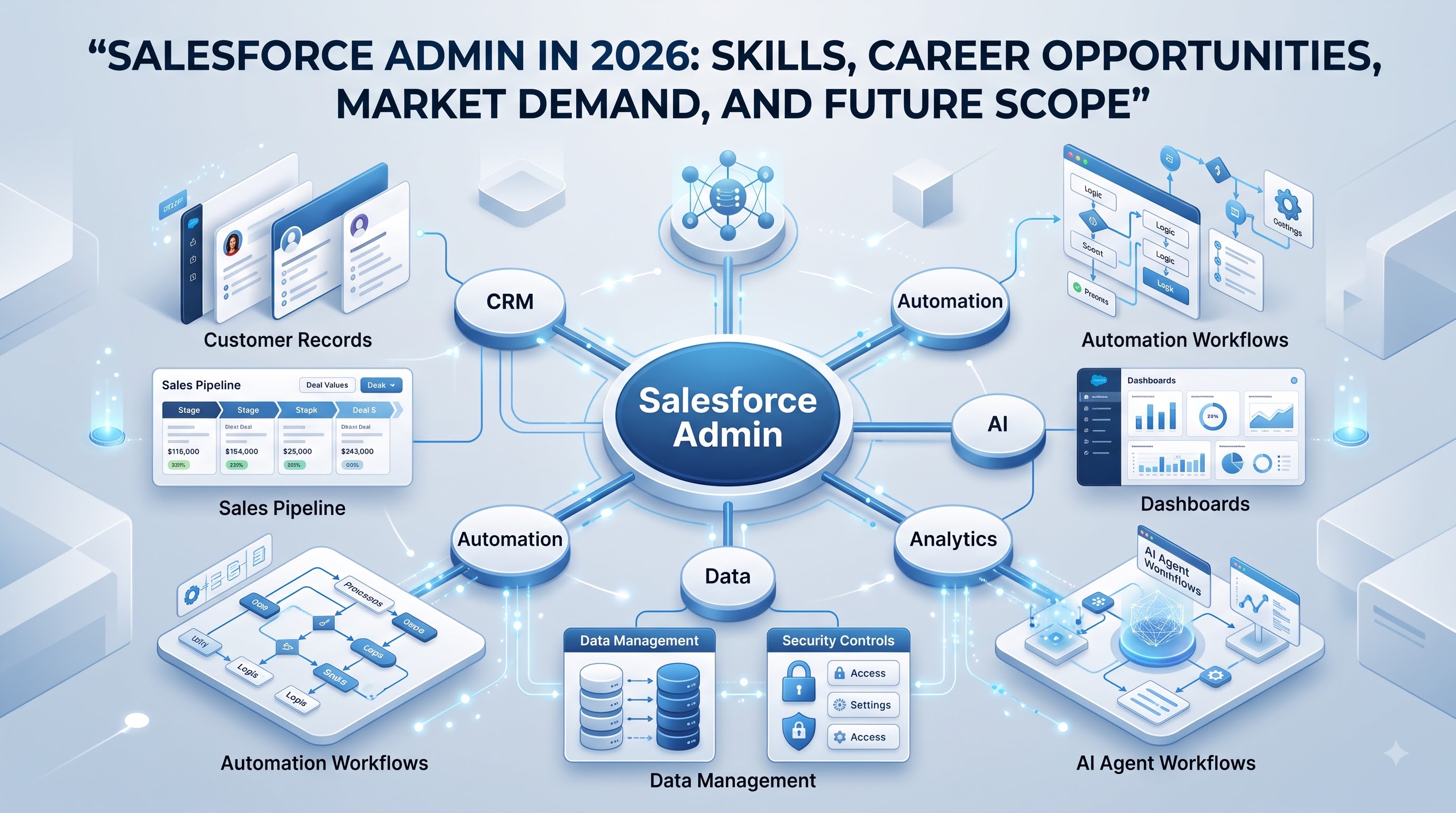
Salesforce has long been a major name in customer relationship management (CRM). However, the platform has evolved since its early days, when a Salesforce professional was mostly concerned with managing users, producing reports, and modifying fields. These days, Salesforce has moved closer to the center of customer data management, sales processes, automating things, analytics, and a more important role for artificial intelligence.
This change leads to a question for those wishing to work in the technology sector. Is Salesforce Administration going to be a relevant profession in 2026, or will it lose the edge over artificial intelligence?
To the short answer, Salesforce Administration has great career prospects nowadays, but the description of a good Salesforce Admin has changed. A contemporary Admin has to know not only configuration; they also should know business processes, data, automation, security, user experience, and how AI can help them in their work. Salesforce calls the Admin position an operational one, which means that a person here is engaged in configuring, automating, and optimizing the system while managing users, data, security, analytics, and products.
What Is a Salesforce Admin?
The Salesforce Administrator is responsible for ensuring that Salesforce operates efficiently and effectively. To give an example, consider a firm with many salespeople dealing with thousands of leads. If the CRM system is not configured properly, it is easy for information to get lost, records to be duplicated, follow-ups to be missed, and managers to not know what is happening. A Salesforce Administrator provides assistance in these matters.
The Administrator may set the system so that as soon as a new lead is created, it is sent to the appropriate salesperson immediately, a follow-up task is added, and the manager is notified about the change in value of the opportunity. Let us conclude by saying this job is a mixture of technical knowledge and business thinking. According to Salesforce, successful Administrators use technical and non-technical skills. Depending on the company, they may be working with programmers and use such methodologies as Flow, fields formulas, etc. This is a good possibility for people who wish to enter into the field of technology, but do not plan to become full-time programmers.
What Does a Salesforce Administrator Actually Do?
The title can sound straightforward, but the day-to-day responsibilities can be surprisingly broad.
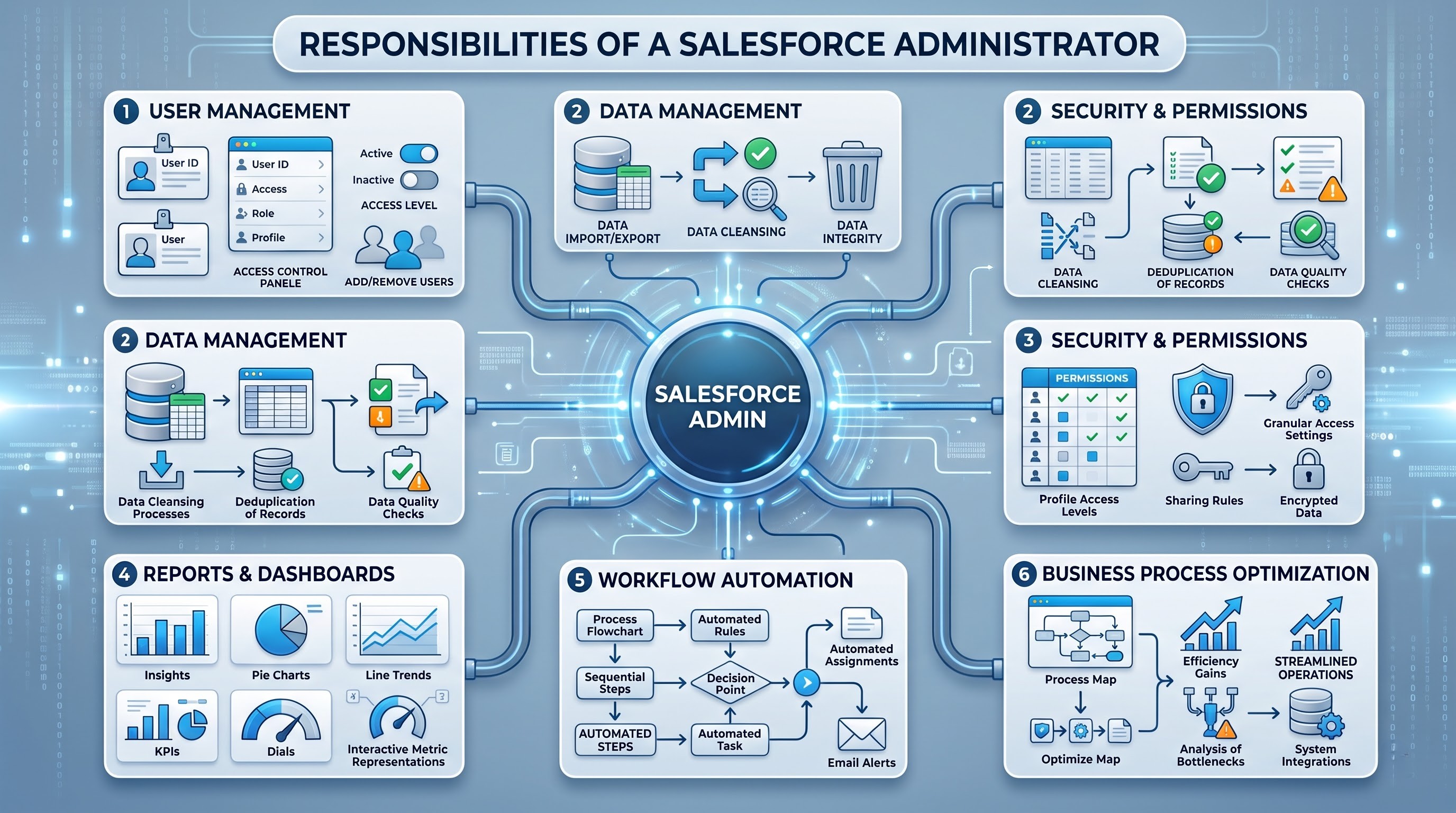
A Salesforce Administrator may be responsible for:
Managing users and access permissions
Creating and modifying fields
Configuring objects and relationships
Maintaining data quality
Creating reports and dashboards
Building automation with Flow
Setting up approval processes
Managing security
Supporting users
Troubleshooting Salesforce issues
Gathering business requirements
Testing new configurations
Supporting Salesforce releases
Working with developers and consultants
Improving existing business processes
Helping teams adopt new Salesforce features
The role also changes according to company size. At a smaller company, one Admin might handle almost everything related to Salesforce. In a larger enterprise, the Admin could work as part of a larger Salesforce team alongside Business Analysts, Developers, Architects, Consultants, Data Specialists, and project managers. That means there is no single version of the Salesforce Admin career.The skills you develop can eventually take you toward several different directions.
Why Businesses Continue to Need Salesforce Professionals
One of the biggest reasons Salesforce remains relevant is that companies do not simply buy CRM software and forget about it. A Salesforce implementation becomes part of everyday business operations. Sales teams use it to manage opportunities. Customer service teams use it to manage cases. Marketing teams may use customer information for campaigns and journeys. Managers use dashboards to monitor performance. Executives use business data to make decisions. Once a platform becomes deeply connected to these activities, someone needs to maintain it and continuously improve it.
Salesforce says more than 150,000 companies use its platform and that organizations need professionals who can manage and improve their Salesforce environments. It also points to a broader ecosystem involving customers, partners, consultants, developers, administrators, and other professionals. This is an important distinction when evaluating the career. The opportunity is not dependent only on jobs at Salesforce itself. A much larger employment ecosystem exists around organizations that implement, customize, integrate, support, and optimize Salesforce.
The Salesforce Market Is Bigger Than the Admin Job Title
When people search for Salesforce careers, they sometimes focus too heavily on the phrase "Salesforce Administrator." That can make the market appear narrower than it actually is. Salesforce skills can lead into roles such as:
Salesforce Administrator
Senior Salesforce Administrator
Salesforce Business Analyst
Salesforce Consultant
CRM Administrator
Salesforce Developer
Salesforce Platform Specialist
Salesforce Operations Specialist
Revenue Operations Specialist
Salesforce Data Specialist
Salesforce Solution Architect
Salesforce AI or Agentforce-focused roles
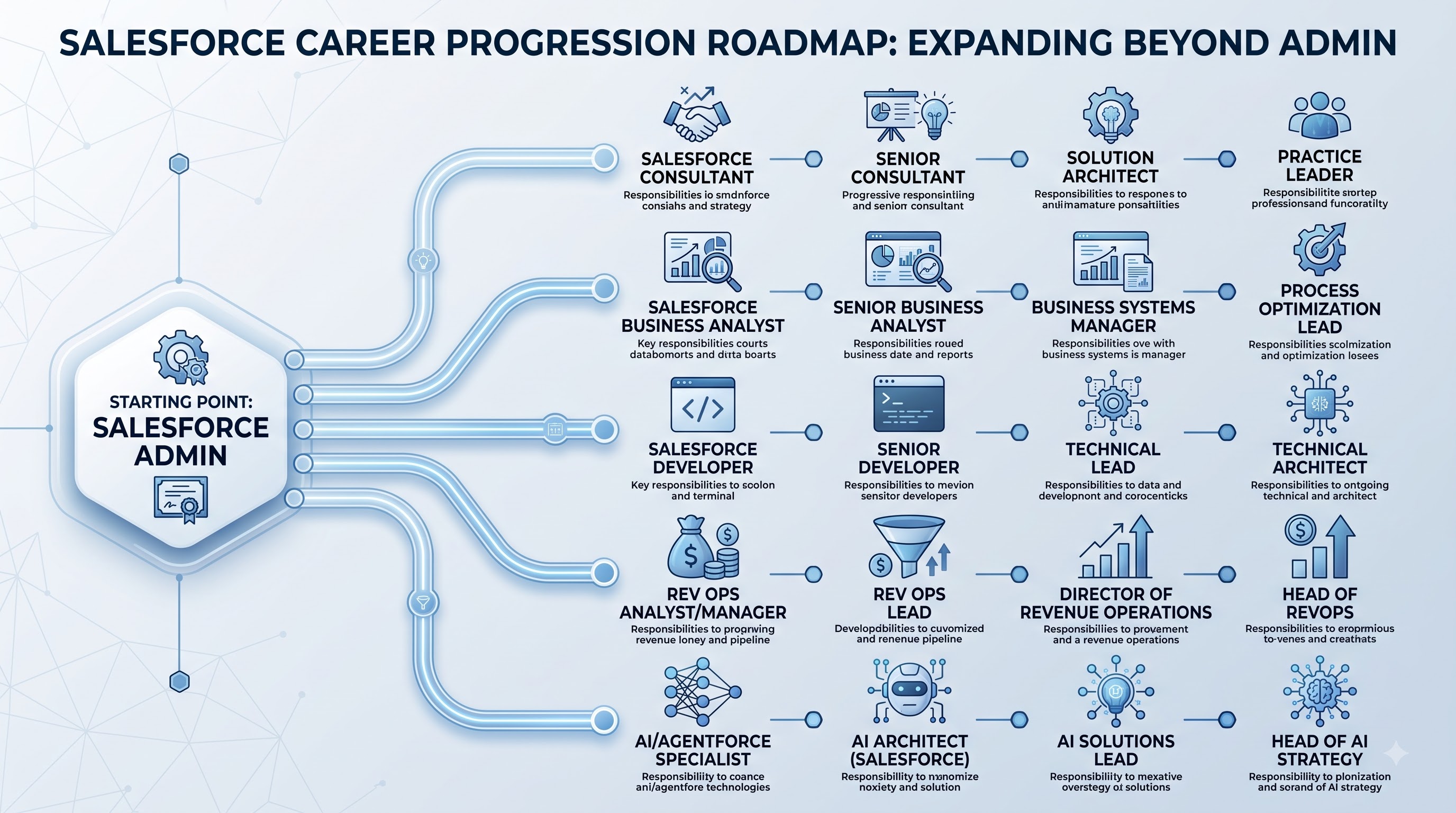
The Salesforce ecosystem itself includes multiple career paths, and Salesforce's career resources currently position Administration alongside other paths such as Business Analysis and technical roles. This means the Admin role can be treated as a starting point rather than a final destination. For someone entering the field, that is one of its strongest advantages.
Is Salesforce Administration a Good Career for Beginners?
For the right person, yes. One advantage of Salesforce is that you can begin learning the platform without becoming an expert programmer first.
A beginner can start with CRM fundamentals, objects, fields, relationships, reports, dashboards, security, and automation. A well-structured salesforce administrator course can help bring these concepts together through a practical learning path, allowing beginners to understand not just what each feature does, but how it is used to solve everyday business problems. From there, they can gradually move into more advanced concepts.
However, "doesn't require heavy coding" should not be confused with "doesn't require technical knowledge." A strong Salesforce Admin needs to understand how data is structured, how permissions work, how automation affects records, how different users interact with the system, and how a configuration change can affect other processes.
They also need communication skills. An Admin might spend the morning configuring Salesforce and the afternoon talking to a sales manager who says, "Our current process isn't working."Understanding what the manager actually needs can be more important than knowing where a particular Salesforce setting is located.That combination of technology and business knowledge is what makes the role valuable.
The Skills You Need to Become a Strong Salesforce Admin
Learning Salesforce is not simply about memorizing features. The strongest candidates build a combination of platform knowledge and transferable professional skills.
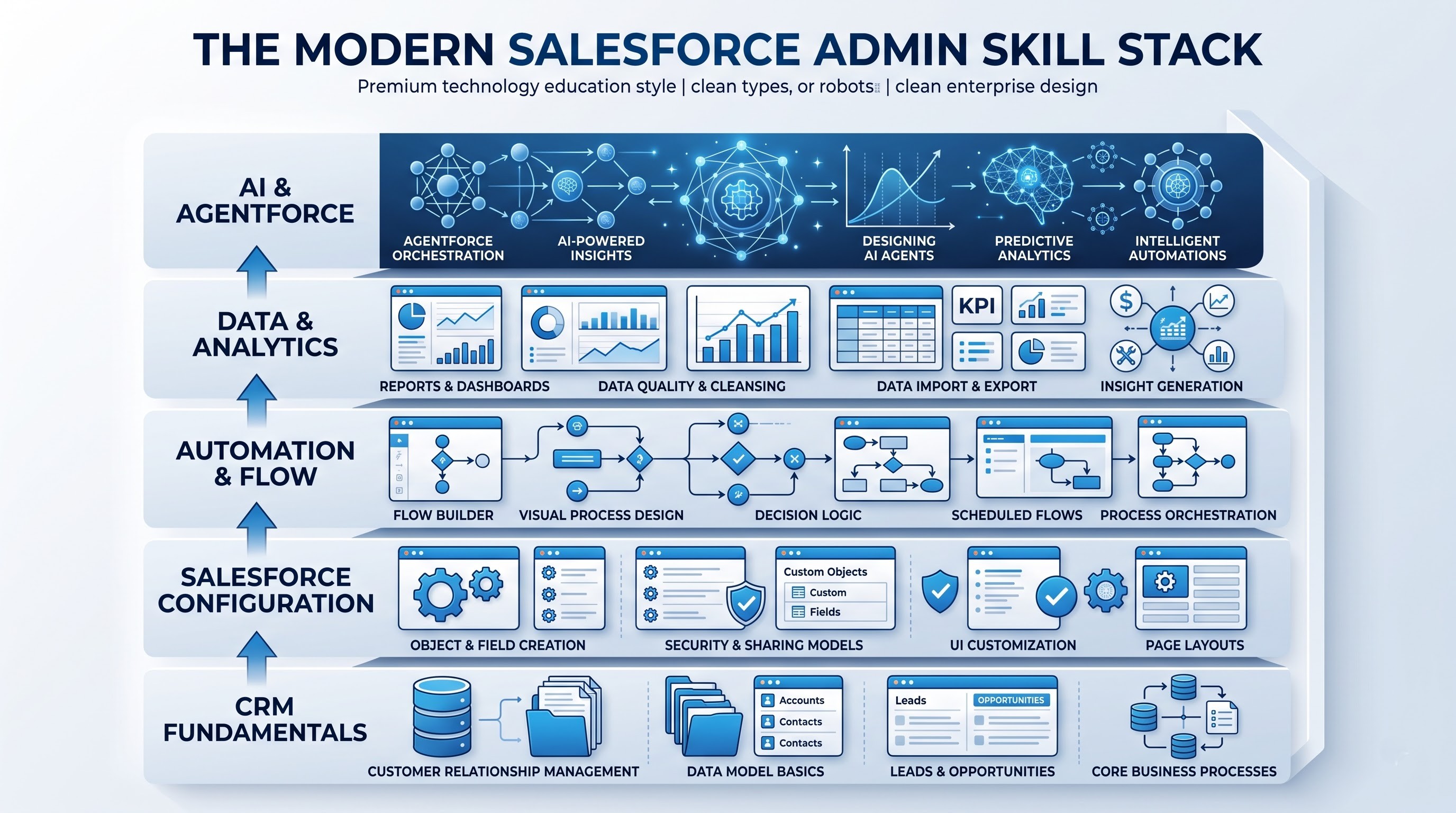
1. CRM Fundamentals
Start by understanding what CRM software actually does.
Learn concepts such as:
Leads
Accounts
Contacts
Opportunities
Activities
Cases
Sales pipelines
Customer journeys
If these concepts make sense, Salesforce becomes easier to understand because you can see the business purpose behind the platform.
2. Salesforce Configuration
This is the foundation of Administration. You should understand objects, fields, page layouts, record types, relationships, validation rules, formulas, profiles, permission sets, roles, and other configuration concepts. The goal isn't simply to know where these settings are. You should understand why and when you would use them.
3. Automation
Automation is one of the most valuable areas for a modern Admin. Salesforce Flow is particularly important because businesses want repetitive processes to happen automatically.
For example: A new opportunity is created → the system checks the opportunity value → assigns an approval process → creates a task → notifies the appropriate employee. A process like this can save employees from performing repetitive manual work.
4. Data Management
Bad data can make an excellent CRM almost useless. Admins need to understand data imports, duplicates, data quality, relationships, validation, access, and reporting. As businesses adopt AI, the importance of clean and trustworthy data becomes even greater.
5. Reporting and Analytics
A Salesforce Admin should be able to turn raw CRM information into something a manager can understand. That means learning how to create meaningful reports and dashboards rather than simply producing tables of information. A good dashboard should answer a business question.
For example:
How many opportunities are in the pipeline?
Which sales representatives are behind target?
Where are deals getting stuck?
How quickly are leads being followed up?
That is where Salesforce becomes a decision-making platform rather than just a database.
Where Do Salesforce Admin Courses Fit Into the Career Journey?
For someone starting from zero, structured learning can make the platform much less overwhelming. The best Salesforce admin course should not simply walk through Salesforce menus. It should teach the learner how the platform works as a business system.
The ideal learning path should include CRM fundamentals, Salesforce configuration, security, data management, reports and dashboards, Flow automation, practical scenarios, troubleshooting, and preparation for real-world projects. Salesforce also provides Trailhead learning resources and career paths for people entering the ecosystem.
The important thing is to avoid treating a course certificate as proof that you are job-ready. A certificate can demonstrate that you completed training. A portfolio can demonstrate that you know how to solve problems.
Certification: Is It Still Important?
Salesforce certification can be useful because it provides an external validation of your knowledge. The Salesforce Certified Platform Administrator credential remains one of the recognizable entry points into the Salesforce ecosystem.
However, certification should be treated as one part of your profile. A candidate who has a certification but cannot explain how to build a business process in Salesforce may struggle in an interview. A candidate who has certification, hands-on projects, strong understanding of Flow, good communication skills, and the ability to explain business scenarios presents a much stronger profile.
Salesforce also refreshed its Platform Administrator exam blueprint in December 2025. The update maintained the foundational Admin focus while adding essential AI understanding, reflecting how the role is evolving. That change tells us something important: learning Salesforce today should include an understanding of AI, not just traditional administration.
Salesforce Admin and Artificial Intelligence
This is probably the biggest question for anyone considering the field.
Will AI replace Salesforce Admins?
It is more accurate to say that AI will change the work.
Salesforce is moving toward an environment where AI agents can perform tasks and interact with business systems. Its Agentforce strategy is a major part of that transition. In FY2026, Salesforce reported $41.5 billion in revenue. It also reported $800 million in Agentforce annual recurring revenue and more than 29,000 Agentforce deals since launch.
By May 2026, Salesforce reported that combined Agentforce and Data 360 ARR had reached nearly $3.4 billion, with Agentforce ARR at $1.2 billion. These numbers do not mean every Salesforce Admin will suddenly become an AI specialist. They do indicate that AI is becoming part of the platform itself. Salesforce's own Admin team describes the role as evolving alongside the Agentic Enterprise, with Admins increasingly involved in AI enablement, governance, and adoption. That creates a new opportunity.
The Future Salesforce Admin May Look Very Different
Imagine a Salesforce environment five years ago. An Admin might spend significant time configuring workflows, maintaining records, responding to support requests, and creating reports. Now imagine the same organization adopting AI agents.
The Admin may increasingly be involved in questions such as:
What data should an AI agent access?
Which actions should an agent be allowed to perform?
What business rules must remain in place?
How should AI-generated actions be monitored?
How can sensitive data be protected?
When should an AI agent hand work back to a human?
How can organizations measure whether AI automation is actually improving productivity?
These are not purely technical questions. They require business judgment, governance, platform knowledge, data understanding, and communication.
That is why the future may favor Admins who understand AI, rather than eliminate the Admin role altogether.
Should You Learn Agentforce Alongside Salesforce Administration?
If you're starting in 2026, it makes sense.
You don't need to become an AI researcher. You do need to understand the practical side of AI within the Salesforce ecosystem. Good salesforce administrator training can provide the foundation for this by helping you understand Salesforce data, security, automation, and business processes before moving into AI-powered capabilities such as Agentforce.
That could include:
Agentforce fundamentals
AI-assisted workflows
Agent actions
Data grounding
Permissions and access
AI governance
Responsible AI practices
Prompt concepts
Automation
Data quality
Human-in-the-loop processes
The key is sequence. Don't jump directly into AI without understanding Salesforce fundamentals. A person who understands Salesforce data, security, automation, and business processes will have a much stronger foundation for understanding how AI agents should operate inside the platform.
Why Data Will Become Even More Important
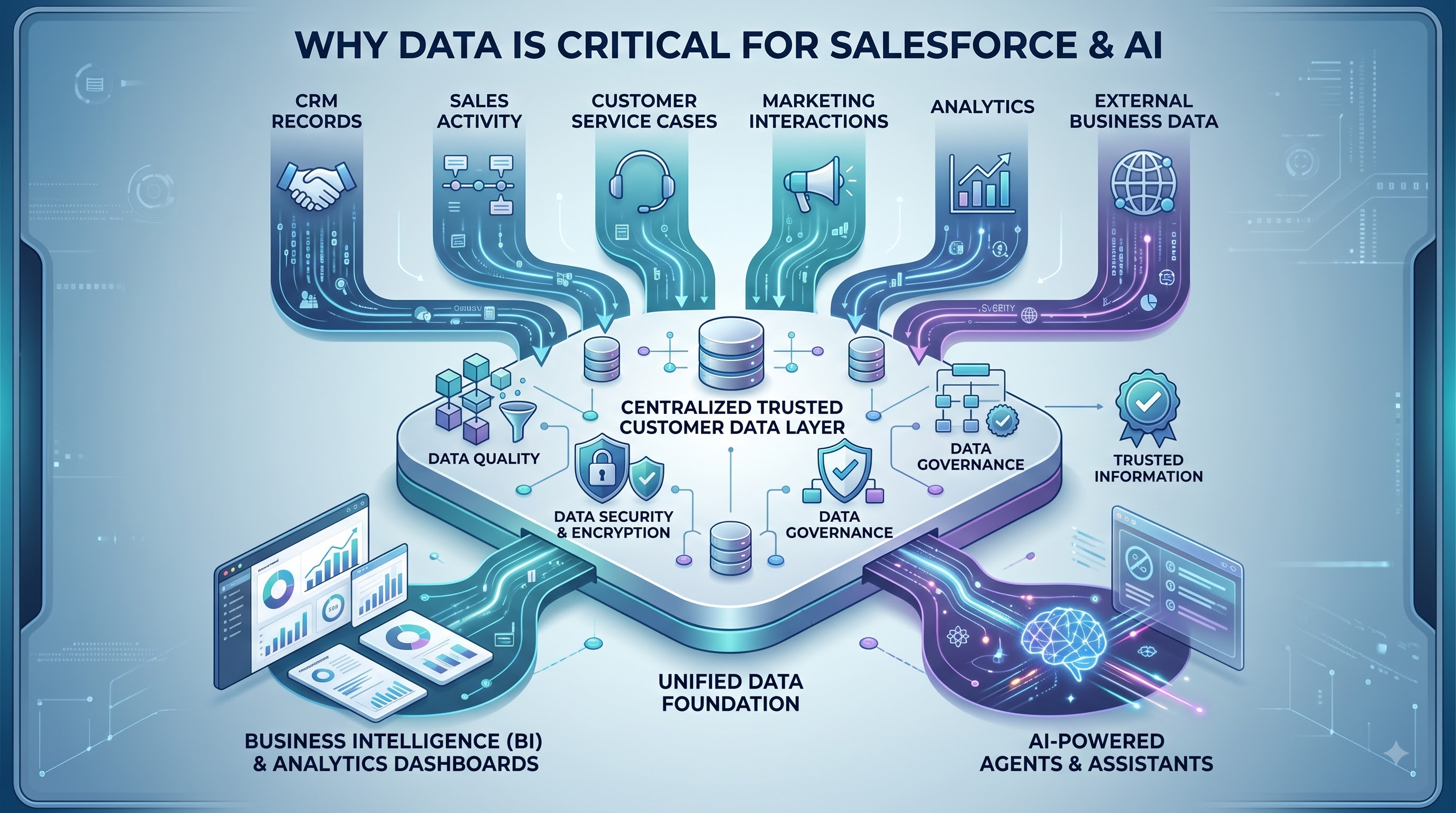
AI can only be as useful as the information it can access and trust. This makes data management one of the most strategically important skills for future Salesforce professionals. Salesforce reported that Data 360 ingested 112 trillion records during FY2026, up 114% year over year. The significance goes beyond the size of that number.
Businesses are increasingly trying to connect customer information from different sources so that employees and AI systems can work with a more complete picture of the customer. That means future Salesforce professionals should understand data architecture at a practical level. You don't necessarily need to become a database engineer.
But you should understand where data comes from, how it is structured, how it moves through systems, who can access it, and how poor-quality data can affect automation and AI.
What Should You Learn First?
A practical learning roadmap could look like this:
Stage 1: Salesforce Fundamentals
CRM concepts
Salesforce interface
Standard objects
Fields
Records
Relationships
Navigation
Basic data management
Stage 2: Core Administration
Users
Roles
Profiles
Permission sets
Security
Validation rules
Page layouts
Record types
Reports
Dashboards
Stage 3: Automation
Flow
Business rules
Approval processes
Notifications
Automated tasks
Process design
Stage 4: Real Projects
Build practical scenarios. For example, create a fictional sales organization and configure:
Lead Management → Assignment → Follow-up → Opportunity → Approval → Closed Deal → Reporting
This is far more useful than simply watching tutorials.
Stage 5: AI and Data
Once your foundation is strong, move toward:
Agentforce
Data 360
AI concepts
AI governance
Advanced automation
Integrations
Data quality
This gives you a profile aligned with where the platform is heading.
Is Salesforce Administration Still Valuable in 2026?
Yes, but the market is becoming more skills-focused. The Salesforce ecosystem is large, and Salesforce has continued investing heavily in its platform, AI, data, analytics, and automation capabilities. The company reported strong FY2026 performance and continued growth in its Agentforce and Data 360 businesses. At the same time, beginners should not assume that earning one certification automatically guarantees a job.
The entry-level market can be competitive.Employers increasingly want people who can demonstrate practical knowledge rather than simply list Salesforce terminology on a résumé. That makes hands-on practice extremely important.
How to Stand Out as a Beginner
If you're starting without professional Salesforce experience, build evidence of your skills.
For example, create three portfolio projects.
Project 1: Sales CRM
Build a fictional CRM for a small company.
Include:
Lead management
Opportunity tracking
Sales stages
User permissions
Reports
Executive dashboard
Project 2: Automated Sales Process
Create an automated process where:
New lead → assignment → follow-up task → notification → qualification → opportunity
Document why each automation exists.
Project 3: AI-Enabled CRM Scenario
Create a conceptual Agentforce use case.
Show:
Customer request → AI agent → trusted CRM data → defined action → human escalation
Then explain the security and governance considerations. A portfolio like this gives an interviewer something concrete to discuss.
Are Salesforce Admin Classes Worth Taking?
They can be, especially if you learn better through structured instruction and guided practice. But the quality of the class matters more than the label. Good salesforce admin classes should help you understand not only what a feature does but why a business would use it. Look for practical exercises, instructor feedback, realistic CRM scenarios, automation projects, reporting exercises, and exposure to current Salesforce capabilities.
If the entire class consists of watching someone click through Salesforce while you take notes, it may not prepare you adequately for the workplace. The strongest learning experience combines instruction with experimentation. Build something.That is how platform knowledge becomes practical skill.
Career Growth After Salesforce Admin
One of the most attractive aspects of Salesforce is the number of directions available after gaining experience. If you enjoy working with people and business processes, you might move toward:
Salesforce Business Analyst → Consultant → Senior Consultant
If you enjoy technical problem solving:
Salesforce Admin → Advanced Admin → Developer → Technical Architect
If you enjoy data:
Salesforce Admin → Data Specialist → Data/CRM Consultant
If you enjoy operations:
Salesforce Admin → CRM Operations → Revenue Operations
And if AI interests you:
Salesforce Admin → AI/Agentforce Specialist → Salesforce AI Consultant
There is no requirement to follow one fixed path. Your interests can determine where you specialize.
The Biggest Mistake New Salesforce Learners Make
The most common mistake is trying to memorize everything. Salesforce is enormous. You do not need to know every feature before you can start building useful skills. Salesforce Admins itself recently highlighted the challenge new Admins face because the platform has so many features and recommended focusing first on the capabilities that provide meaningful control and impact.
Instead of asking:
"How can I learn all of Salesforce?"
Ask:
"Can I solve this business problem using Salesforce?"
That change in mindset makes learning much more practical.
Conclusive Decision: Is It Advisable to Learn Salesforce Administration?
In 2026, if you wish to choose Salesforce Admin career path, you have an option, but you should be realistic. Salesforce Admin is not the way to get a high-paid IT job; rather, it is a career in a specific field that results in respect for your knowledge of technology and sound business thinking.
The right path is not:
Certification → Job
But:
Salesforce basics → Administration → Automation → Data → Business processes → Practical projects → Certification → AI/Agentforce
The Salesforce data shows that there is a big need in the job market in this sphere, while the product strategy increasingly often uses AI, data, automation, and agentic work. All this creates great possibilities for your career. For newcomers, becoming a Salesforce Admin can be an easy entrance into the world of enterprise technology; while for those with experience, it can be a way to reach consulting, business analysis, operations, architecture, data, or even AI professions in the field.