
Salesforce Agentforce empowers admins and developers with AI
Last updated on Aug 8, 2026

The enterprise cloud computing industry is going through a drastic shift in how it operates. For the past 20 years, Customer Relationship Management systems acted merely as database systems that hold customer interactions, operational information, and dashboards for users. The first step in the introduction of AI was made with the predictive analytics that helped in scoring leads and predicting future opportunities based on past experiences. The second development in AI was linked with generative AI for real-time responses like drafting mails, creating summaries, and conversational content with the help of people.
The introduction of the Agent Drid is linked with the arrival of the third wave, agentic AI. The difference between agentic AI and automation scripts or chatbots is that agentic AI can make decisions based on reasoning.
For people working as Salesforce Administrators and Developers, Agentforce does not behave like just one more feature or an application. This solution entirely changes the approach to developing, configuring, deploying, and managing applications in the Salesforce ecosystem. The conventional declarative logic and pro-code solutions are now enriched with cognitive assistants that can handle the processes from start to finish. It is imperative for Salesforce professionals to comprehend the workings and mechanisms of the architecture as well as to be knowledgeable on how to implement requisite capabilities along with ensuring maximum operational efficiency with the help of an organized salesforce course online.
The Shift in Architecture: From the Reactive Aid to the Agentic Independence
To comprehend Agentforce, it is important to compare conventional declarative automation and agentic actions.
Traditional Salesforce tools, including Record-Triggered Flows, Validation Rules, and Apex Triggers, are deterministic in nature. They are guided by strict logic: in response to the event, the system acts in line with the set of defined criteria and systematically completes a series of database transactions. In this case, if it happens that the builder has not foreseen an unusual situation, the outcome is either failure or error in the result.
The development of Generative AI tools such as Sales and Service Copilots marked the beginning of the era of stochastic language generation. But these assistants served only as copilots, meaning they acted in a passive way and waited for the user’s explicit command, formed first drafts or summaries, and depended on people to approve or carry out the first operational action.
The introduction of Agentic AI
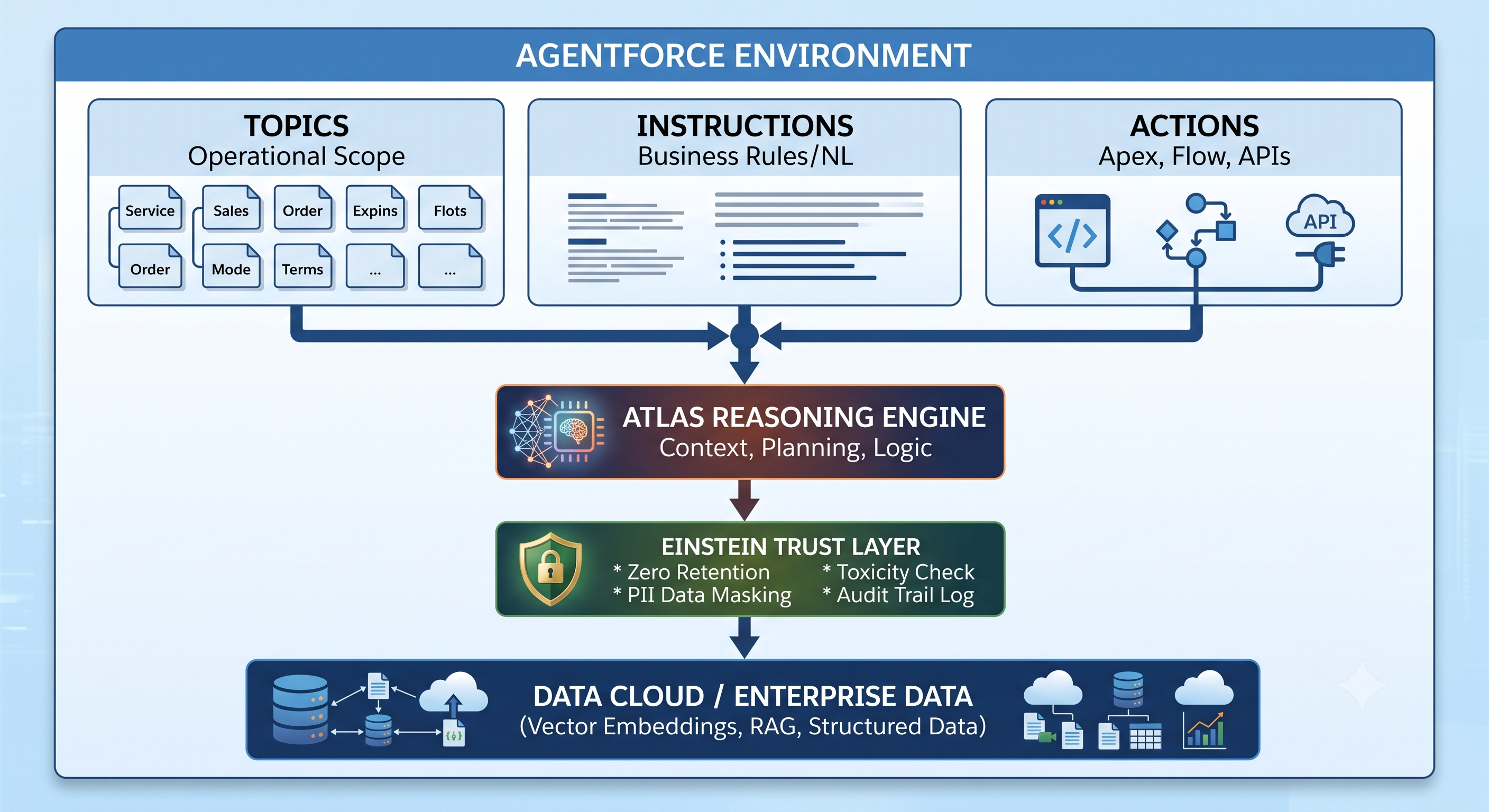
Agentforce makes a step beyond mere copilot assistance. An AI agent is given knowledge about a particular area of business (Topic), precise limitations (Instructions), as well as a set of effects it can use (Actions). When the agent receives a task such as resolving a dispute with a bill, rearranging the appointment of a maintenance worker, or qualifying an inbound client, it does not follow a standard algorithm. Instead, it identifies:
What the user or system event is telling it to do.
What actions need to be taken in order to fulfill the task successfully.
What the sequence of these actions should be.
Whether the result satisfies all the restrictions necessary for the company and whether it can be sent.
The lift in responsibility of the builders of platforms is that the admins and the developers don't only map out every narrow detail in a procedure flow anymore. The builders should develop the environment of autonomous intelligence allowing it to reason and act independently.
The Engine Operating Agentforce
Agentforce is powered by a brilliant orchestrator that is responsible for analysis of the user intent, restoring the context, making decisions and fulfilling actions.
Atlas Reasoning Engine
Agentforce's major brain is called the Atlas Reasoning Engine. The Atlas Reasoning Engine serves as a command center in each interaction of concrete agent. The same way the Order of Execution determines how the details are treated in Salesforce databases, the Atlas Reasoning Engine is responsible for how agents communicate with their inputs, think on their problems and execute the solutions.
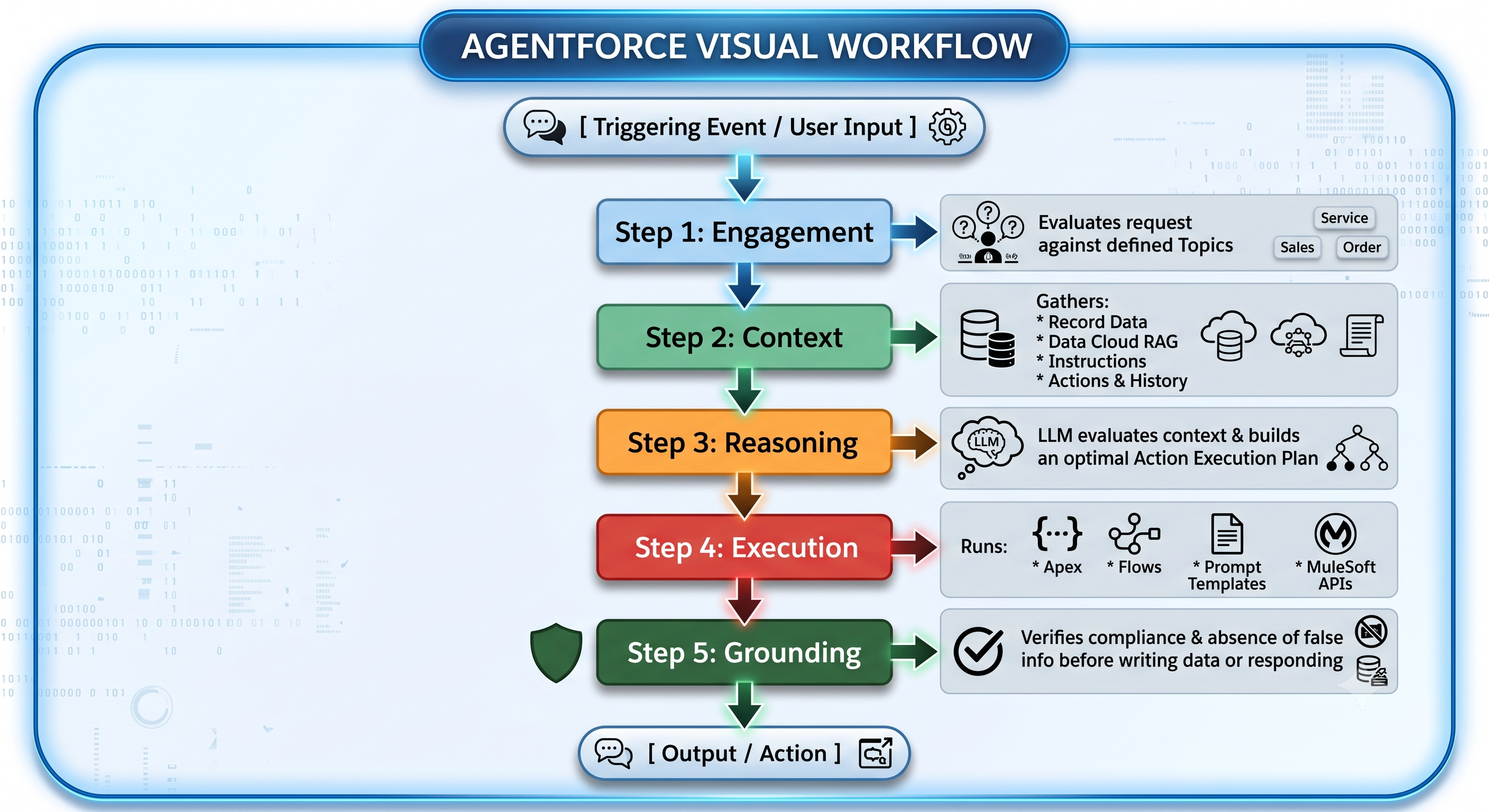
The process of executing the software goes in a sequence of actionary steps as follows.
Step 1: Engagement and topics: In case there is an event that triggers an agent, the inputs will be evaluated against the Topics assigned. The selected topic will be the one that will align with the request of the user.
Step 2: Context: After the topic is selected, the engine will gather the corresponding context, such as the definition of the topic, the business instructions, the actions available, the current record data, and any new information from Data Cloud and conversation history.
Step 3: Reasoning: The structured context will then be passed to the LLM. It won’t require any responses just yet but it will ask the engine to prepare the action plan.
Step 4: Execution: If any action is needed, an action will take place, such as running the Flow or executing any other action that includes obtaining the output and bringing it back to the thinking for further reasoning.
Step 5 Grounding Check and Response Generation: The system is required to run a grounding verification process before sending feedback to the client or writing anything to an object. Such a check makes sure that the answer matches the given guidelines and that no false information is supplied.
Three Fundamental Elements: Topics, Guidelines, and Actions
Developing an agent in Agentforce is founded upon three fundamental rules:
Topics: The broad areas of operation for an agent (such as "Order Management," "Case Escalation," or "Lead Qualification").Topics are the frameworks where agent activity is allowed and define the area of classification.
Instructions: The natural language commands connected to a topic and indicating the way the agent ought to operate. Instructions define the policy, tone, business rules, and step-by-step logic requirements (for example, “Always check the identity before changing the shipping address; do not issue refunds above $200 without getting approval first.”).
Actions: Tools the agent is equipped with. Actions enable the agent to read, write, and implement logic outside the LLM and use existing public and custom Salesforce assets (Autolaunched Flows, Apex Classes, MuleSoft APIs, and Prompt Templates).
Data Cloud Usage and the Importance of the Einstein Trust Layer
The key to any AI model’s performance is in the data that supports it. Agentforce uses Salesforce Data Cloud to offer a consolidated real-time view of data from different enterprise systems. Data Cloud converts unstructured data (e.g., PDFs, Knowledge Articles, emails) and structured relational data found in enterprise databases into vector embeddings, facilitating the execution of Retrieval-Augmented Generation (RAG) by the Atlas Reasoning Engine.
The Einstein Trust Layer is a cloud platform service that sits between the Atlas Reasoning Engine and the underlying LLM providers and addresses security and privacy concerns. This service provides the following main features:
Zero Data Retention: This guarantees that data given by business clients for LLM providers to process is never stored or used to train models.
Data Masking: Mask any Personally Identifiable Information (PII) like social security numbers, credit card numbers, personal email addresses, etc.
Toxicity and Guardrail Detection: This is to make sure the LLM’s instructions and responses do not contain harmful, inappropriate content or attempts to break instructions.
Audit Trail: It records the instructions provided, the context retrieved, steps of reasoning taken, and actions taken to keep an audit record and debug performance.
The Scope of the Desktop Responsibility
Agentforce marks a key transformation for Salesforce admin professionals since moving from building traditional databases to agent making entails particular salesforce online training to master low-code applications.
Agent Builder / Agent Studio
Agent Builder (Agent Studio's basic operating platform) is the main working space for declarative configurations. It is a visual workspace that offers tools for low-code agents' design, testing, and adjusting.
Through Agent Builder administrators have the opportunity to:
- create new agents and allocate them a definite type of user profile or an execution role;
- set and allocate topics which determine the branches of agent's operation;
- prepare the instruction in a structured native language;
- allocate actions like flows, prompt templates, and standard API tools on the certain topics;
- use the real-time testing canvas which provides the administrators with the ability to talk to the agent and understand the steps of the reasoning process with the Atlas Engine and which actions were undertaken and why.
Natural Language Engineering: Creating Efficient Instructions
In today's Agentforce world, natural language prompt engineering is the most important administrative skill. Instructions have to do with how the LLM acts in certain situations so any unclear phrasing leads to unexpected actions.
The duties of administrators include preparing topic instructions according to the rules of the subject:
Explicit Definition of Boundary Conditions: Explain what must not be done by the agent, for instance: "No cancelling of order if the fulfillment status is 'Shipped'."
Sequential Dependencies: It is necessary to indicate the necessary pre-checks, for example: "Before you carry out the Update Address action, be sure to complete the Verify Account Identity action."
Dealing with Edge Cases: Instruction the agent on how to fail properly, for example: “If no active subscription record is found for the contact, inform the user and trigger the Transfer to Human Agent action.”
Prompt Builder Integration
With Prompt Builder, administrators can create prompt templates that are reusable and aware of the context. These templates are linked to CRM fields, related objects, or data streams. They work as micro-prompt templates that enable the agents to perform prompts as actions.
To give an example, a user can create a Flex Prompt Template called "Draft Customer Retention Offer." The prompt accepts Opportunity ID, performs customer sentiment analysis through Data Cloud, assesses the terms of contract, and formulates a personalized discount offer. An agent can utilize this template as part of the negotiations of an order.
Governance, Security, and Access Controls
Administrators are still in control of the security of the data. Agentforce complies with Salesforce security practices:
Organization-Wide Defaults (OWD): Agents working in user context cannot read or edit records that the user cannot access.
Field-Level Security (FLS): Private fields hidden from roles are not visible to agents while retrieving or reasoning on records.
Agent Running Context: Admins can deploy an agent within some specific context or in the context of a logged-in user.
The Terrain of Developer: Pro-code Action Engineering and Application Programming Interface Architecture
Administrators work on building organizational structure and governance procedures, whereas the development of the underlying abilities of agents is the task of Salesforce Developers. Thanks to custom coding and various integrations, agents become more than just a source of fixed answers – thanks to pro-code extensions, agents actively participate in doing business.
How to Expand Agents with Invocable Apex
The main means of opening customized pro-code logic to Agentforce is Invocable Apex. By marking some Apex methods with the @InvocableMethod tag, developers grant access to the programmable features of the Atlas Reasoning Machine.
To have an Apex action work properly in the agentic field, it is necessary for developers to use certain design patterns.
Self-Describing Metadata The only thing that Atlas Reasoning Engine uses to understand how the operation works is the label and description for @InvocableMethod and @InvocableVariable. Hence the developer is responsible for providing self-descriptive metadata which describes the inputs the method requires, the business logic associated with the operations and the types of output returned. Failure to provide a clear description will result in errors of the reasoning engine.
Bulkification and Atomic Execution: In contrast to conventional batch execution in Apex environment, agent calls happen each time in isolated contexts at conversational depth, but procedures should still be bulkified in order to allow multi-thread agents or batch triggers to work.
Structured Output Wrappers: It is recommended that Apex procedures return complex structured wrapper classes with success indicators, human-readable messages indicative of statuses, and returned data objects. Error messages enable the Atlas Engine to process exceptions and modify the plan instead of generating uncaught runtime exceptions.
Integration of MuleSoft Agent Fabric and OpenAPIs with Agents
There may arise a situation where agents need to connect with external enterprise systems like ERP, old legacy databases, or even any third-party billing systems. This can be achieved in two ways by developers:
External Services (OpenAPIs): Bring the REST endpoint in Salesforce and convert to Agentforce action with OpenAPI/Swagger specification without any middleware code.
MuleSoft Agent Fabric: In case of complex business configurations, MuleSoft offers an efficient way to control and govern API flows. The agent actions in the system provide an opportunity to perform complicated transactions regardless of whether it is in the cloud or on-premise.
Governor Limits Management and Async Processing
developers should be aware of the governor limits as a single iteration of the reasoner may perform more than one operation in the Atlas Reasoning Engine.
SOQL/DML Call Efficiency: The call in the loop should be minimised and DML calls should not be made repeatedly in a loop.
Callout Limits: HTTP calls made by agent actions have to comply with the limits associated with platform timeouts. Where external processing takes too much time, developers need to use asynchronous processing patterns and inform the agent session afterward.
Pro-Code Development Lifecycle with AgentforceDX
Developers depend on AgentforceDX and new Salesforce Technologies (VS Code extensions, Salesforce CLI) to handle the development life cycle of custom agent assets. Developers can be taught these skills through salesforce classes online and practice and validate their custom Apex functions before deploying it into actual stages.
The Lifecycle of Agent Development (ADLC)
Creating systems of agents requires a different approach than typical software development. This process is known as the Agent Development Life Cycle (ADLC) as described by Salesforce.
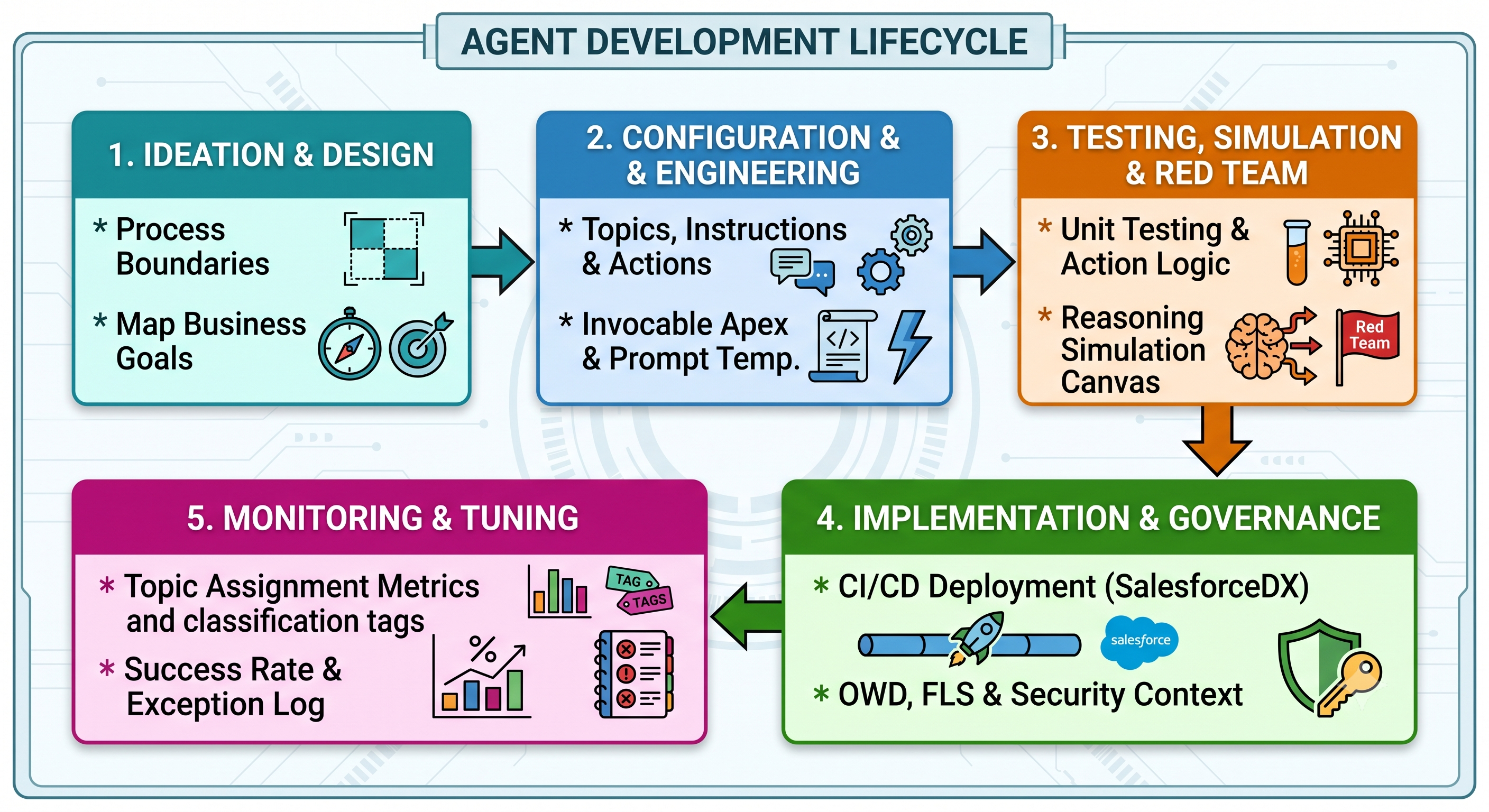
The ADLC process consists of five parts that describe how the agent goes through the development stages to reach the production environment.
Stage 1: Ideation and Design
During the first stage, different members of the team like architects and business representatives determine relevant business processes that can be automated.
Clearly define business goals (for instance: “Achieve a 40% cut in case resolution time”)
Map the process boundaries and define required data.
Define capabilities by Topics and prepare custom instructions.
Step 2: Configuration and Action Engineering
The admins and developers create the necessary components identified during the design planning stage Admins set up topics, create the instructions, and provide the Prompt Templates. The developers create an Invocable Apex class, expose the MuleSoft APIs, and set up the External Services. Declarative flows are created for the deterministic sub-processes.
Step 3: Testing, Simulation, and Red-Teaming
As agent behavior is dynamic, the regular unit testing (which evaluates fixed inputs and outputs) cannot be relied upon only. The agent testing involves a complex combination of the proven methods of code coverage together with the multi-scenario simulation.
Unit Testing Actions: Developers use the classical class of Apex testing to ensure that the developers’ actions return the requisite response and handle errors properly.
Reasoning Simulation: The team uses Agent Builder testing tools to run synthetic communications with the clients to determine whether the Atlas Engine determines the topics successfully, as well as creates proper actions.
Red-Teaming: The team intentionally seeks ways to hack the instructions using prompt injection, off-topic requests, and antagonistic inputs to make sure that the Trust Level component and the topics’ instructions work correctly.
Step 4: Implementation and Governance.
Agent components including Topics, Instructions, and Agent Definition along with their code are delivered to production phase using traditional Salesforce DevOps techniques including Salesforce DX, Scratch Orgs, and CI/CD.
Controls on access are used to define who can use the agents and how they can be used.
Human-in-the-Loop escalation is tested to ensure that there is a seamless transition to the service agents or salespeople once the limits of automation have been reached.
Step 5: Continuous Monitoring and Tuning.
Rolling out the solution does not mark the end of the software development cycle. It is necessary to monitor agent performance with the help of Agentforce Observability Tools.
The Admins will be responsible for monitoring the assignments of topics and determining how many requests are considered to be off-topic.
Information about the number of successful actions will be collected; this will help spot failing APIs or Apex exceptions.
User feedback obtained as thumbs-up/thumps-down ratings and evaluations of transcripts will help improve instructions and scripts step-by-step over time.
Real-life Applications Across Salesforce Clouds
To see how beneficial Agentforce is, it is important to understand how agentic design works within the three most utilized Salesforce Clouds.
Service Cloud: Automatic Service Resolution
Standard Method: A client makes use of a static decision-tree chatbot. If the required choice is unavailable in the system, a case gets created and a waiting period begins.
Agentforce Method: An automated Service Agent receives the message, “The order arrived broken, and I need the replacement delivered to my temporary address before Friday.”
Reasoning Steps:
The agent chooses an appropriate "Order Issues" category.
The agent makes an action to access information about the order from the customer’s verified account.
The agent checks the return policies using a grounded Knowledge Base query.
The agent makes an Apex action to confirm the temporary address.
The agent runs a Flow in order to create a replacement order and generate a return shipping label.
Finally, the agent sends the customer a single confirmation message with the information on the replacement shipment and its tracking number.
Sales Cloud: Smart Creation and Promotion of Prospects
Normal Method: Whenever there is a web lead, the Sales Development Reps (SDRs) conduct research on the business, send out standard email templates, and organize introductory meetings.
Agentforce Method: An SDR agent keeps an eye on incoming leads.
Chain of Thinking:
The agent obtains info on new leads with high purchase intent.
He/she then gathers information about the company by getting in touch with Data Cloud and other external sources.
Such data will be examined as per the business’ field of operation and size of the company.
Lastly, the agent creates an individual message that answers some technical issues mentioned in the form.
As soon as the person agrees to arrange a meeting, the agent checks if the account executive is available using an API and sets the meeting.
Marketing Cloud: Personalized Dynamic Marketing
Regular Method: Marketers create fixed customer segments and schedule emails based on fixed database characteristics.
Agentforce Method: A Campaign Agent monitors customer interactions in several channels.
The process of understanding:
The Agent notices that a certain segment shows decline in engagement.
She looks at previous marketing campaigns and comes up with some new messages using Prompt Builder.
She interacts with Data Cloud to create micro-segments in real time based on what consumers are currently doing online.
Then she sends them personalized marketing messages and increases her investments in the most productive messaging variations.
The digital workforce is revolutionizing business practices.
Agentforce is a groundbreaking technology. With the help of this software solution, businesses can leverage the power of virtual working tools.
While this shift towards new technology will not eliminate the role of administrators and developers, it will reinforce their power over processes. Knowledgeable and skilled employees will become true innovators in the digital age.
Having knowledge of the Atlas Rationality Engine, the power of the Data Cloud, and the principles of the Agent Development Life Cycle will allow Salesforce specialists to enhance their businesses with the help of autonomous agent technology, and the best way to begin this process is to take a detailed sales force online course.