
Salesforce Developer Course: Mastering C-Suite Communication for Technical Leads
Last updated on Aug 12, 2026
Transitioning from Senior Developer or Architect to Technical Lead means moving to a completely different world of work. Apart from being educated in platform architecture via a salesforce developer course online, the work you do on a daily basis shifts from writing good code and improving systems to aligning the business at a greater level.
Your success is evaluated through parameters like system uptime, code quality, test coverage, and the ability to solve problems effectively.
In contrast, the main responsibility of a Technical Lead is broader than that of a Senior Developer. Now you have to align your software development decisions with the goals of the business.
The main challenge for both junior and experienced Tech Leads is the communication gap between the technical and management team. Thus, when talking to the C-suite ( CEO, CFO, COO, CMO), all the technical terms, engineering limitations, and architectural schemes don’t work anymore.
To be able to lead with success, one must acquire the capability of turning intricate technical constraints into clear and actionable business plans.
Comprehending Executive Thinking
Before entrepreneurs and leaders can express their thoughts effectively, they need to explore the way executives view their organization. It is crucial to note that executives operate at a macro level. Their job implies driving revenues, cutting costs, managing company risks, ensuring compliance, and implementing strategies that promote long-term growth.
Whereas an engineering team might focus on improving legacy code with the purpose of minimizing technical debts, an executive will see a working system that makes money for the company so there is no sense in changing it. If an engineer is worried about ABC latency and software memory leaks, a CFO will be concerned about the overall churn rate, operational expenses, and return on investments.
Four Main Executive Priorities
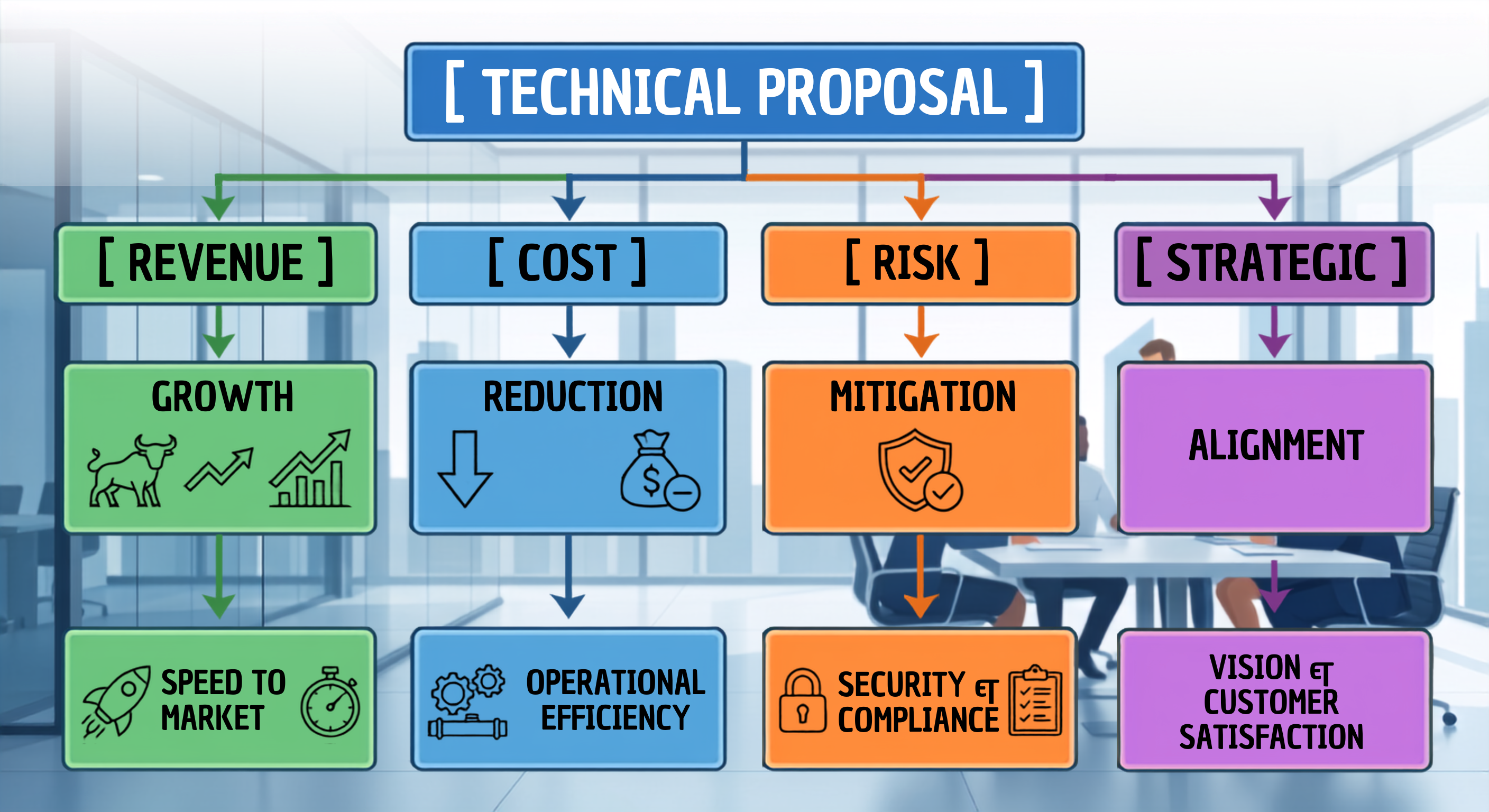
Every discussion at the C-suite can be broken down into four main pillars:
Revenue Growth: How will a particular effort result in increased sales, creating new market opportunities, or reduce time to revenue-generating products?
Cost Reduction & Efficiency: How will a certain move decrease the costs of conducting the business or minimize the equipment expenses?
Risk Mitigation: How will this safeguard the organization against the risk of being hacked, the risk of going against the law, and the risk of being broken?
Strategic Alignment: How will this assist in achieving the long term vision of the company and meeting the requirements of the clients?
When dealing with executives, it is necessary to view each technical limitation, each architectural proposal, and each engineering problem through the lenses of these four issues. If there is no connection of your technical requirement with revenue, cost, risk, or strategic alignment, it will be treated as less important or unnecessary.
Customizing Communication for Different C-Suite functions
Often, technological leaders make the mistake of using a uniform pitch approach towards the group of executives. The criteria by which each C-suite member assesses initiatives differ from one to another.
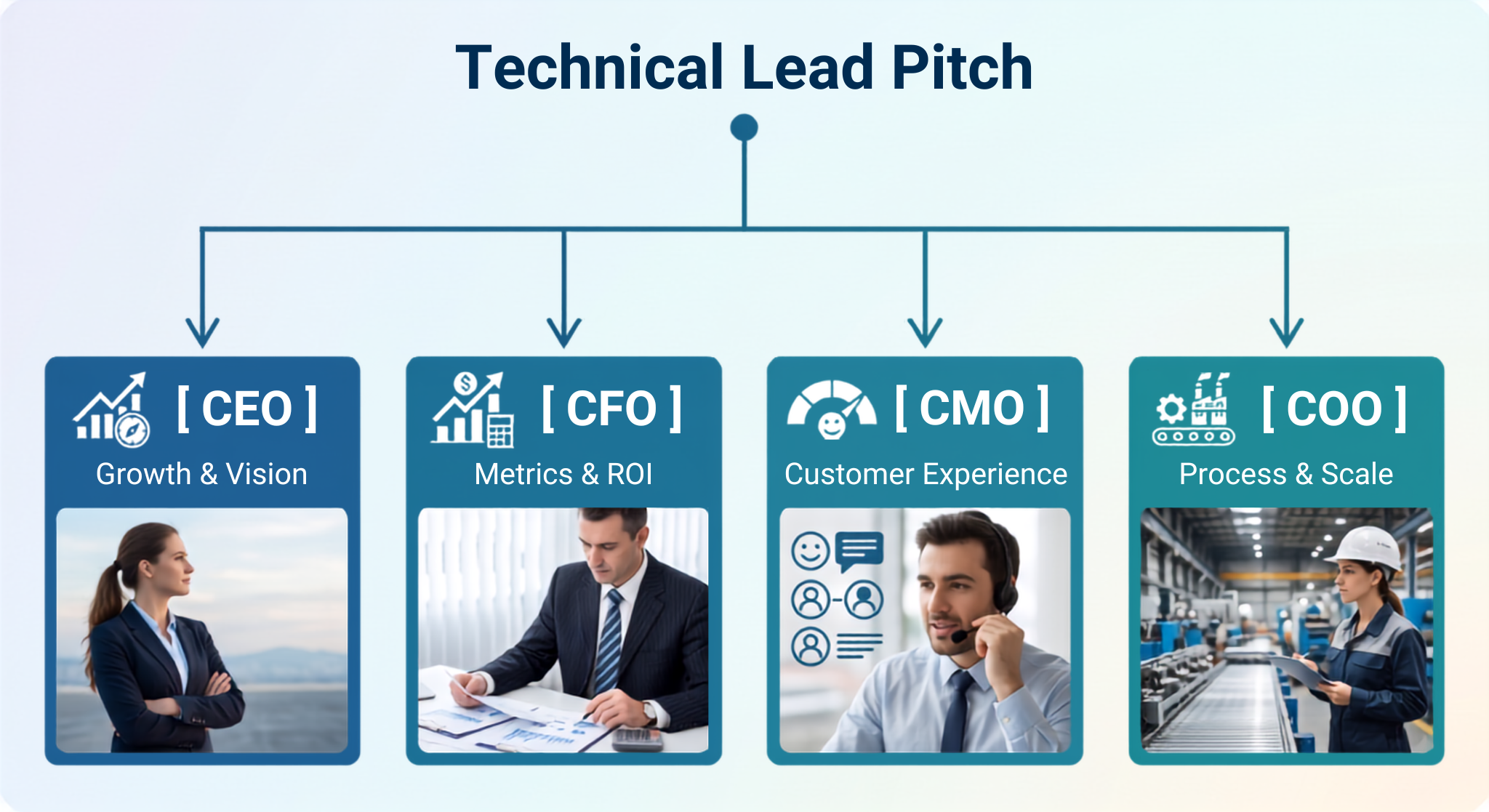
The Chief Executive Officer: Vision and Competitive Superiority
The CEO is focused on how they can differentiate their company from the competition, as well as grow their market share and enhance their enterprise value. The key when talking to the CEO is not to focus on the daily operations. Instead, it is best to refer to their technical capabilities as catalysts for entering new markets. For instance, instead of stating that the company is migrating to the cloud, say that with the use of modern technology it is now able to enter new markets or create new products several months earlier than competitors.
The Chief Financial Officer: Financial management and timeframes
One thing in common between all of the discussed parties is that the CFO considers every technological project as an investment competing for funds with other business projects. Therefore, it is better to present your project to the CFO using only pure financial terms: timing of wins, risk-adjusted investments and reductions of operational costs.
Instead of asking for funds to update the old systems, show how the money put in the engineering work at the beginning will help cut maintenance costs, penalties for not observing the rules, and will increase profit margins over the next three years.
Chief Marketing and Revenue Officers (CMO/CRO): Conversion and Speed
Sales and marketing managers concentrate on creating leads, acquiring clients, converting prospects, and keeping customers happy. Talks with revenue people should only mention the problems the clients experience and the speed of services.
If engineering needs to change the structure of front-end components or the API, the project should be described in terms of how the changes will increase conversion rates during the payment process, decrease the number of customers leaving before signing up, or speed up the release of new features for important clients.
Chief Operating Officer (COO): Reliability and Scale
The COO keeps the work of the company going without failures, improves the processes, and motivates staff. In conversations with operational management, speak about risk reduction and throughput rate.
Tell about the benefits the business will get from improving advanced automatic processes.
The Technique Behind Effective Translation
Translating technical terms into business terminology does not mean that it’s a matter of simplifying technology; it is a matter of raising the level of context. It means turning the attention from detailed technical lexicon to targeting the final result.
Changing the View on Technical Debt
Technical experts often have problems reaching agreement of top management about technical debt refactoring. It’s not easy to explain that the code is monolithic, non-modular or contains already outdated frameworks since the top managers may just hear that the engineers want to build the thing that already works.
Instead of referring to the code structure, it is possible to explain the technical debt in terms of implementation speed and financial risk.
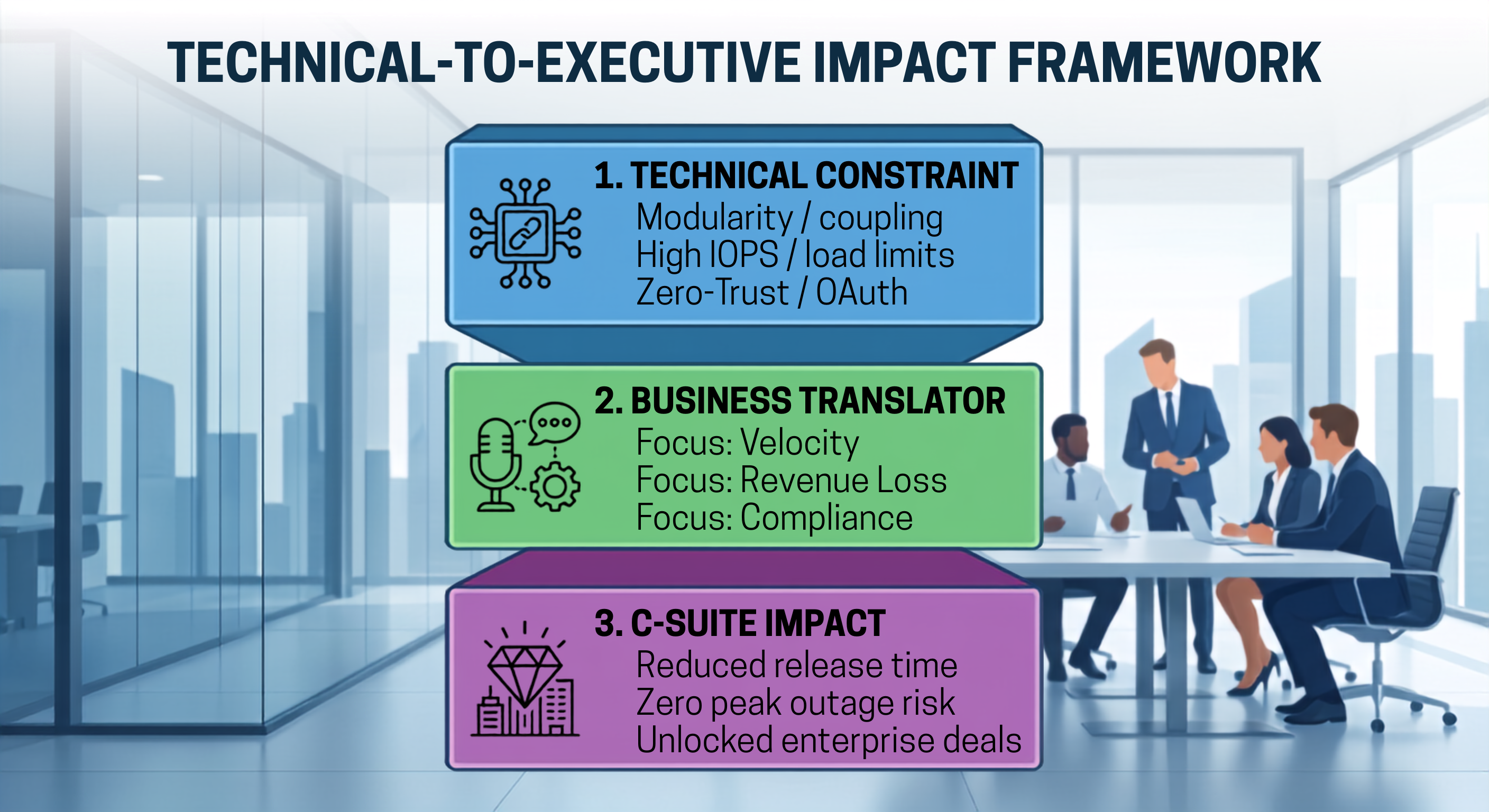
Technical formulation: "The core system is tightly-knotted and as a result prevents writing unit tests and forces continuous integration builds to take hours."
Business formulation: "The architecture is too complicated and doesn’t let us deliver new features fast; during the one month we modernize some components, it will be (possible to shorten the release time from four weeks to five days."
Revisiting Infrastructure and Scalability
Modernizing databases, transitioning to serverless technology, or designing systems for automatic scaling are all essential engineering processes; nevertheless, they involve significant costs and are resource-hungry.
Technical Definition: "We have to change our database cluster to a multi-regional one since we are using maximum IOPS in our read replicas."
Business Definition: "During the holiday sales season, we have our system maxed out operating at about ninety-five percent capacity." Consequently, any spike of traffic can lead to a crash of our checkout pipeline and result in massive revenue losses of thousands of dollars an hour. Thus, when we modernize our infrastructure, we are making sure that there is no downtime during our most profitable time of the year."
Reworking Security and Compliance
Typically, security advancements are perceived as expenses until a data breach takes place. To obtain funding for implementing preventive security solutions, it would be good to consider security from the viewpoint of corporate branding and compliance risks.
Technical Description: Zero Trust architecture, tight OAuth mechanism, and end-to-end encryption must be adopted for internal microservices.
Statement by Business: Our organization will be protected from any data breach threats that are likely to cost us millions of dollars in penalties and compensation through use of advanced identity and access services. Moreover, meeting these security requirements would help us make deals with corporate clients who demand compliance.
Preparing the Executive Pitch
The structure of your pitch plays an important role in its success when it comes to presenting any technical problems or initiatives to the C-level executives. The developers usually follow a logical order: the description of the problem, thorough analysis, the options available, and the solution recommended.
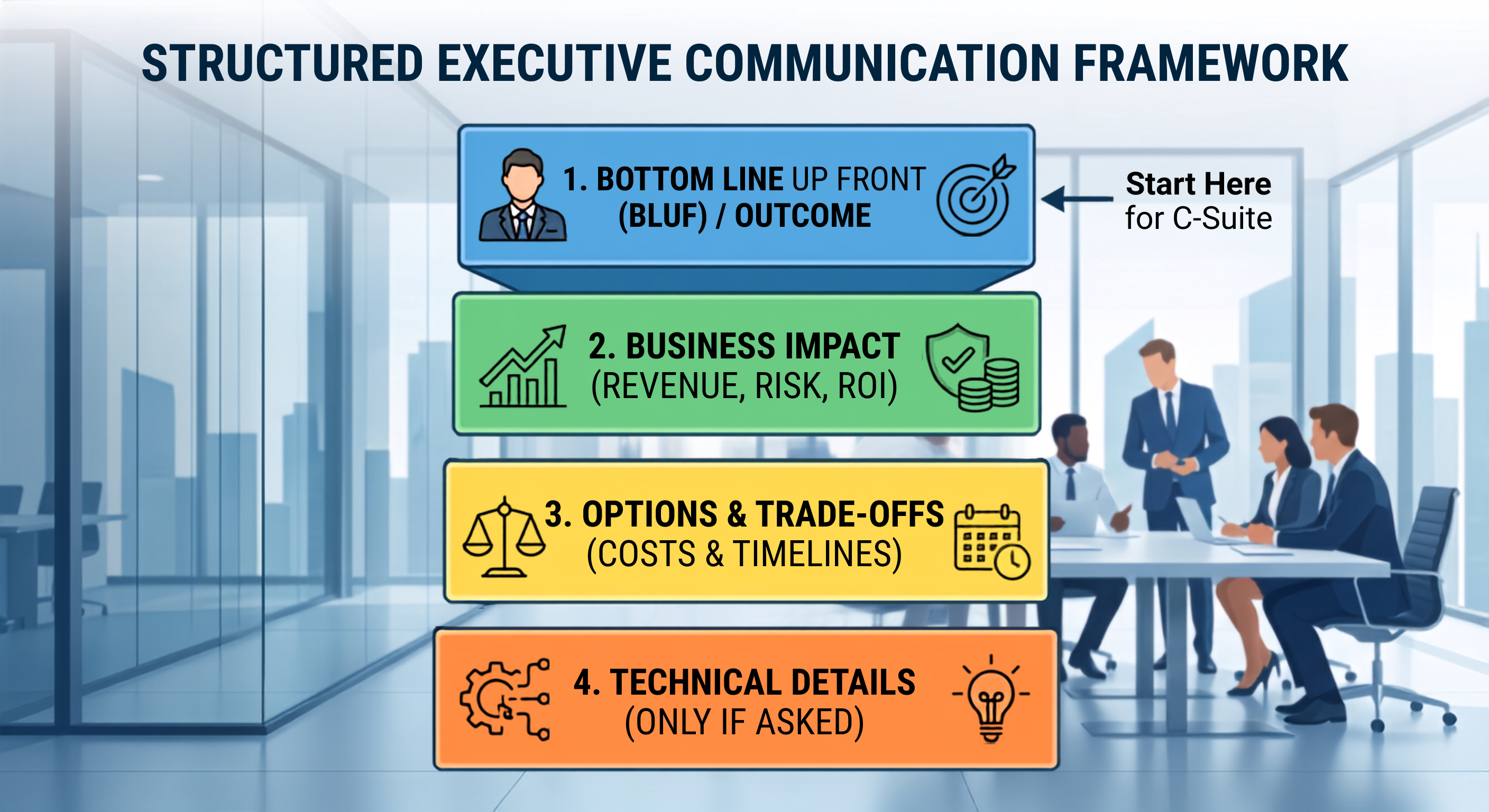
However, the executives are too busy to get this chronological flow of information. They favor the inverted pyramid: conclusions and consequences first, followed by the rationale, with details left for questions.
The Bottom-Line-Up-Front Approach
Make use of the Bottom-Line-Up-Front method when addressing the leadership:
The Executive Summary: Mention in two sentences or so the key recommendation, the cost estimate, and the expected outcome of the project.
The Business Impact: Provide a clear link between the project and some expected revenue, savings, time saved, or any other important business metric.
The Options & Trade-offs: Provide two or three options available (including none) along with the cost, risks, and timelines for each of the options.
The Recommended Action: Clearly express your engineers’ strategic recommendation and provide a step-by-step plan for implementation.
Innumerable Fortitude
One of the hardest tasks for Tech Leads is to map technical risks to numbers. While financial information, such as the cost of servers, can be clearly measured, items like developer friction or potential system failures appear to be abstract.
To encourage the C-level leaders to make decisions, it is necessary to quantify the financial and operational impacts even if there is uncertainty involved:
Establish the cost of lost developers’ time by multiplying the hourly salary of engineers by the number of hours of delay resulting from slow build pipelines or failures of environments.
Establish the price of the downtime of the system by multiplying the average profit per hour by the length of outage.
Point out the opportunity costs—what features or projects generating revenue cannot be produced due to the fact that the team is busy maintaining the unstable system?
When C-level executives see the quantified technical challenges in terms of labor hours, lost revenue, or delayed market entry, the choice to make an investment becomes obvious.
Creating Governance Structures to Align the Executives
Technical Managers should introduce governance structures to avoid communication mishaps. We should not wait until budget discussions or emergencies to speak with management.
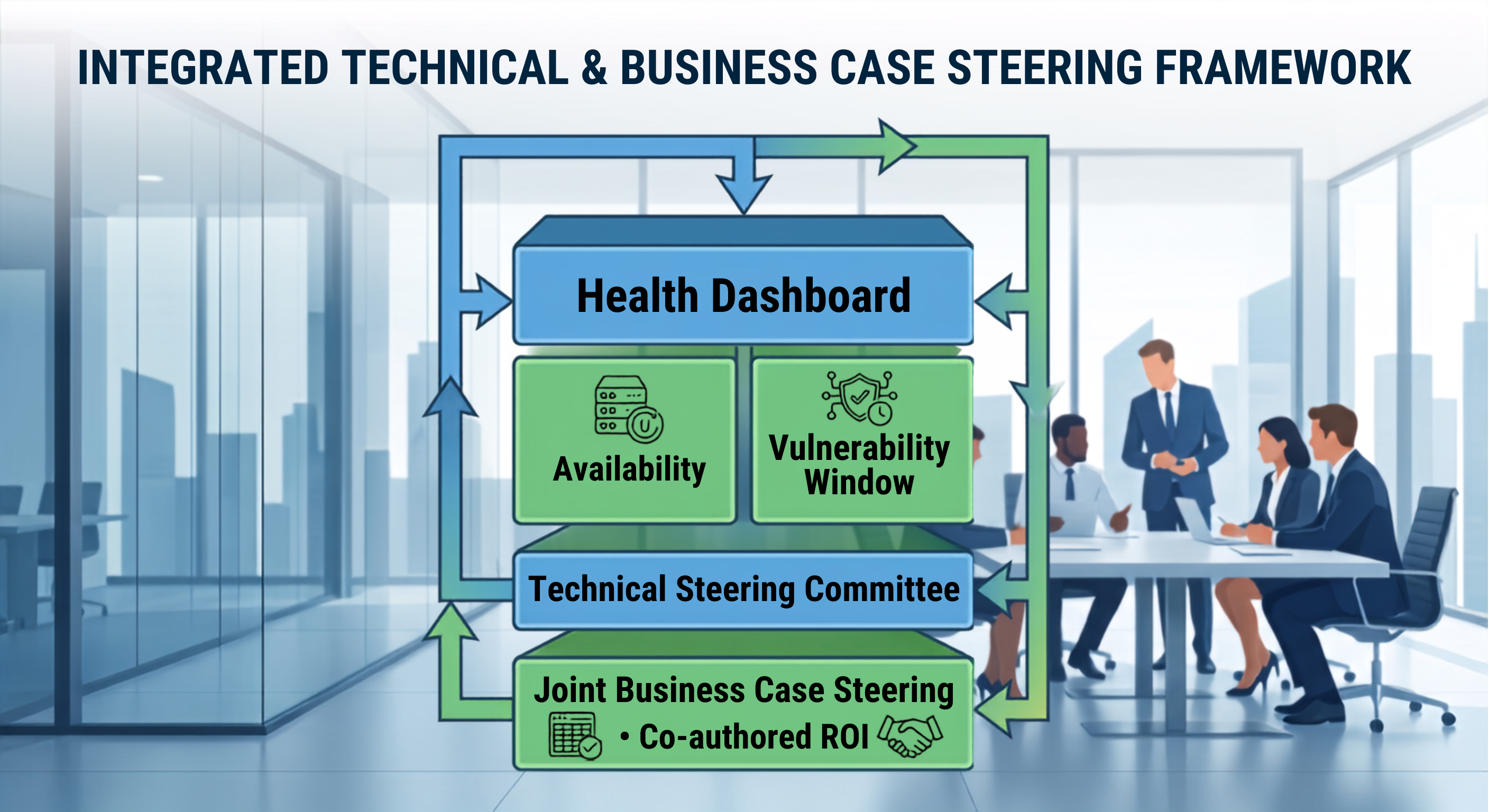
The Technical Steering Committee
Create a monthly or quarterly meeting of the Technical Steering Committee composed of engineering and product managers as well as executives. In such meetings, we will be able to assess technical debt, performance of platforms and alignment of project objectives to the business objectives.
Predictable Health Metrics
Create a simple technology dashboard for everyone who does not have an IT background. Instead of discussing the amount of code or commits, it is a good idea to talk about the uptime of the system, delivery rate, and time needed for security vulnerability fixing.
Shared Business Case Responsibility
Do not present large design proposals alone. Work with product, sales, or operational managers to prepare the business case together. When managers see that both management and engineering professionals approve of a project, the credibility of the proposal increases immensely.
Necessary Soft Skills for Technical Managers
Translating technical obstacles entails more than having good slides. You need the delicate set of interpersonal and strategic soft skills.
Active Listening and Strategic Empathy
Effective communication is about two people being involved in the conversation. Before trying to convince C-level leaders you need to understand their specific pain points.
The CEO is focusing on market disruption, investor relations, and company growth.
CFO cares about margins, cash flow, and predictable costs.
The CMO is concerned about customer experience, brand consistency, and user acquisition.
The COO is interested in operational efficiency, ability to grow the team, and process optimization.
Once you practice strategic empathy, you will be able to change your message to suit the specific executive you are talking to. In case you need the money for infrastructure from the CFO, make sure you put stress on cost optimization in the long run. In case you need to discuss improvements with the CMO, talk about page load speed and conversion rate improvement.
Managing Expectations and Declining Requests
Technical Leads often deal with impossible deadlines and impractical requirements from their business stakeholders. Telling an executive that something is ‘impossible’ technically or that “we are out of time” leads to conflicts and trust issues.
Instead, use trade-offs and alternative options when formulating your message:
Instead of saying, “We cannot implement this functionality until next month,” try phrasing it this way: “We will manage to deliver that feature to you by next month if we manage to re-allocate two engineers from the billing project. If not, we can produce a simpler version of this functionality in time without impacting on the billing project. What would you prefer?”
This way the interaction between you and your business partner becomes a collaborative process of decision-making where business decision-makers are responsible for strategic trade-offs made.
Acquiring Political Capital and Credibility
The ability to sway others without having a position of power is the essence of a successful Tech Lead. To win the confidence of their non-technical counterparts in upper management, technical leaders need to demonstrate their business knowledge, their platform know-how, and their ability to deliver on their promises. The combination of actual experience in delivering projects and structured salesforce developer training online is crucial for engineers in their efforts to acquire skills in effective communication and technical performance.
Make Good on Promises: Complete minor commitments in the realm of technology before making more radical requests for investment in architecture.
Accept Mistakes: When there is a failure in the implementation of technology or a huge discrepancy in predictions from reality, take responsibility for it, explain what went wrong in business terms, and show how it will be prevented in future.
Don’t Over-Promise: Offer realistic estimates in engineering with account for some unforeseen circumstances.
Dealing with Critical Executive Situations
To see how those principles can be put in action, let’s analyze some examples of critical situations that every Tech Lead is bound to face.
Scenario 1: Asking for Funds to Upgrade Technology
The Challenge: The core product is on a 10 year old monolithic framework that is no longer supported. The development team would like six months to refactor the platform into modern microservices.
Ineffective way: Telling the CEO the framework is end of life, it doesn't have modern community support, and makes writing automated tests hard
Effective Method: Frame the modernisation as an enabler of enterprise sales and product stability.
"Continued use of the existing legacy platform will add another three months to the onboarding time for new engineers and will lead to sporadic performance degradation at peak usage times." Describe how a phased approach to modernisation will lower cloud infrastructure costs by 20% in the next two years, and allow the engineering team to deliver new revenue-generating capabilities twice as fast, directly supporting the company’s annual growth objectives.
Scenario 2: The Description of a Major System Breakdown
The challenge : A bad migration of the database caused a 4-hour outage during business hours, preventing customer access and requiring emergency executive meetings.
Ineffective : Giving non-technical leaders a very technical post-mortem full of stack traces, deadlocks, and how database locking works.
Right Way: Root Cause Identification, business recovery and preventive measure.
Be clear on the effects on operations and downtime. Root cause explanation with examples, e.g., traffic jam at a time when systems are under maintenance. Go straight to the remediations that were implemented . Show how automated failovers and better validation scripts during deployment will now prevent this specific mode of failure from occurring again and that platform reliability has been restored.
Scenario 3: Refuting the Unreasonable Deadlines for Product Integration
The Problem: The company’s executives set a deadline for the integration process, which is not feasible technologically without violating security and architectural requirements.
The Wrong Approach: Worrying about the impossible deadline and complaining about executives’ unreasonable deadlines which they do not consider engineers’ point of view.
The Right Thing to Do: Offer a roadmap with risks and trade-offs.
Highlight the urgency of closing the customer’s contract as soon as possible. A phased delivery approach provides basic functionality required by business needs while minimizing the risk. It means that we will deliver an MVP within the set time, which will allow us to close the contract; however, if there is anything left unresolved, we will take care of it in a future release.
Executive Power: Path to Power
The path from an engineer who is merely technical to one who is strategic requires cultivation, self-reflection and practice.
Step 1: Be Deeply Involved In The Business
Start going to your organization’s town halls, studying financial statements, and understanding concepts such as Customer Acquisition Cost (CAC), Lifetime Value (LTV), Monthly Recurrent Revenue (MRR) and Churn Rate. Understand how your company makes money and how they spend money.
Step 2. Select a Mentor Who Is Not a Technical Expert
Find a Product Director, Business Analyst, or Finance Manager from your company. Allow him or her to review your presentation slides or business proposals before presenting to executive leadership. Make use of his or her feedback to reduce technical language and distill your main idea.
Step 3: Master Analogies
The concepts of asynchronous processing, caching layers, technical debt and cloud load balancing are simple to map onto physical analogies such as supply chains, transportation, or building construction projects. Create a collection of analogies that you can rely on during informal executive discussions.
Step 4: Concentrate on Impact, Not Output
Don’t measure the success of your engineering projects in story points completed or lines of code deployed compared to the business metrics impacted. Did that database tuning help reduce your customer page abandonment rate? Did that CI/CD pipeline lead to less customer support calls on releases? It will feel very comfortable for you to translate the technical impact to business impact.
Regardless of whether you are an onsite technical architect or online salesforce developer leading a remotely interactive development team over the globe, measuring a team's success through business results and outputs instead of just the number of codes written will help in achieving clarity and ease of determining the impact of technology.
Conclusion
The position of a Technical Lead is right at the intersection between human communication and hard core software engineering. You get in the door with technical competence, but your rise to the top is determined by soft skills, particularly the ability to translate the technical realities into strategic business impact.
When you’re well-versed in executive communication, you've moved past being an expense resource to the company and are now a strategic partner in business development. By connecting your engineering vision with C-suite priorities, you’re empowering your engineering team, securing needed funding for critical infrastructure, and ensuring that technology remains a key growth engine for the organization.