
Salesforce Developer Guide: Record-Triggered Flows Versus Apex Triggers
Last updated on Sep 15, 2026
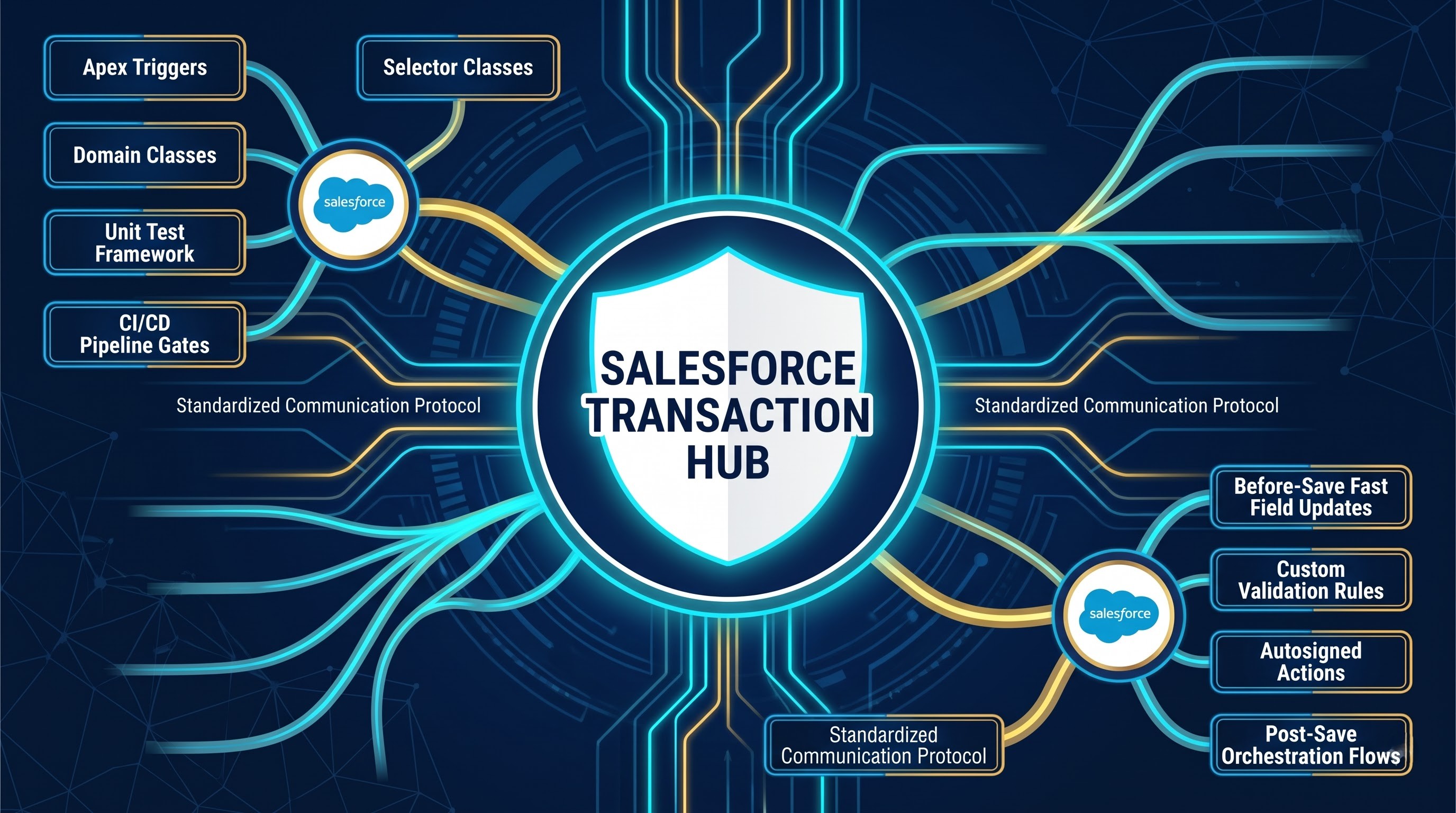
The Developmental Crossroads of Salesforce Automation
Over the last seventeen years, the Salesforce community had a definite classification of work done. This meant that the declarative tools, which include the likes of Process Builder and Workflow Rules, had simple engagements that could be handled well. Whenever there arose a requirement that involved extensive jobs processing, advanced sorting of collections, complicated connections with external systems, or logic, a programmer would have to step in and code upwards. A developer would begin writing the Apex trigger and put it on a handler layer to ensure functionality through well-written unit tests.
The new Salesforce platform has ironically turned this simple approach upside down. The end of old workflow engines which were the bases for the low-performance solution and the adoption of new high-performance Record-Triggered Flows helped to eliminate the gap of execution speed in different programming combinations. It has managed to create an execution environment for Record-Triggered Flows that is as fast as that for the Apex programming language.
The evolution of this has led to an interesting discussion within the sphere. Many organizations ask whether Apex triggers have become outdated, while others entertain the idea that the use of Record-Triggered Flows might bring some really dangerous technical debt due to the complications of using it within large enterprises.
What this means is that clicks and code are not competing ideologies but they both play their role in terms of architecture. When it comes to choosing what option is better - it is necessary to look beyond the marketers` language and extreme thinking and examine how transactions work and how the system functions as a whole.
Architectural Foundations: How Automation Works
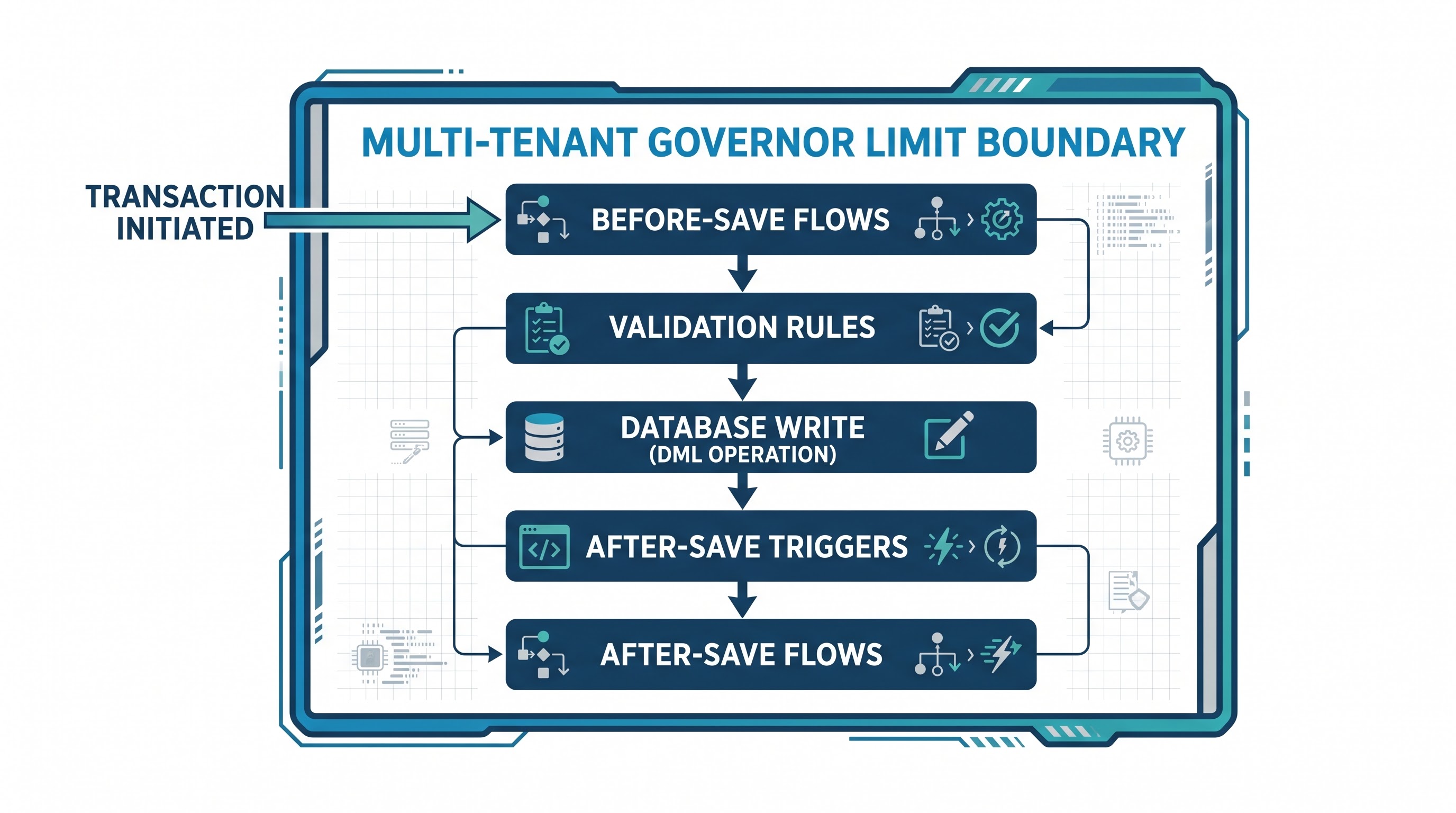
To understand when to use declarative flows instead of using the triggers you will need to look closer into how the Salesforce multitenant platform treats changes made to a particular record in the database.
In the moment when an end user selects save, API integration triggers an update or an automated batch gets triggered, Salesforce retrieves the original record and updates it from the new updates. From this moment execution experiences a rigorous trial. First system verification is done, then before-save Record-Triggered Flows come into play. Such Flows are executed before any record writing to the database. Since the record is not finalized or stored at this point, the modifications that are made to the triggering record during this phase do not trigger additional DML actions or recursive calls to triggers.
Right after before-save Flows custom validation rules work as well as before-save Apex triggers. After the save logic finishes Salesforce writes the record down to the database but the transaction is not finalized yet.
The post-save Apex triggers are executed first, followed by assignment rules, auto-response rules, and other updates that resemble the workflow. After that, the post-save Record-Triggered Flows come on board. After that, if a post-save flow or a post-save trigger makes any modifications to already existing records or to the records in relation to it, then secondary DML operations are triggered, pushing all downstream records through validation processes, flow execution processes, and trigger execution processes.
Understanding how this processor operates reveals an important architectural fact: Record-Triggered Flows and Apex triggers are processed in a single transaction envelope. They both come under strict limits as to CPU time consumed and the amount of data processed, so the difference between them stems not from geography, but from the number of processes that fall under the architect's management. Understanding these execution mechanisms is the key learning point of any salesforce developer course online offered by OnlineITGuru to equip developers with the knowledge to make sound architectural decisions from the start of the project.
A Deeper Look Into Record-Triggered Flows
Record-Triggered Flows can be viewed as new-age workflow rules. They are declarative micro applications that come with a potential equivalent to what was previously reserved for enterprise solutions.
Ability To Change Quickly And Influence The Market
The best thing about declarative programming is how responsive the business can be. Organizations are changing their business processes so fast in the modern world. Threshold limits are being revised and routing principles are subject to new exceptions and notifications need to be adjusted along with some restructuring. Everything created within the Record-Triggered Flows will enable the organization to make those changes very quickly if needed.
Whereas declarative configurations use Salesforce’s pre-compiled execution engine and do not have to depend on specially created unit tests to gain deployment coverage, they make it possible to eliminate the need to worry about test data, injecting mocks for external integrations, and fixing assertion errors that occur during the rush to deploy.
The efficiency of Before-Save Flows
One of the biggest advancements in modern declarative releases is the before-save Record-Triggered Flow (known as Fast Field Updates). The older architecture had Process Builder for updating field values within the same record; however, the execution order was at fault here since it caused a new cycle of execution to begin.
The main advantage of the before-save Record-Triggered Flow is that it performs its operations on the record prior to committing to the database. Compared to before-save Apex triggers, they run faster since they do not require an Apex environment initializing time. When it comes to basic operational tasks like normalizing phone numbers, filling in concatenated names, establishing default priority, and transferring relevant account data to the Opportunity record, the before-save flow is considered one of the fastest solutions that can be used on the platform.
Clearing Away the Confusion Surrounding Business Logic for Non-Developers
Coding is completely incomprehensible as far as business executives are concerned. An Apex trigger that is hidden in a repository of handler classes, selector layers, and domain abstractions is impossible to access for a business analyst, a sales ops manager, or an IT director who doesn’t have a technical background.
When the visual flow canvas has an organized layout and is documented correctly, it can illustrate the process flow visually with the help of process flow diagrams. Decision elements and loops and assignment blocks match the functional architecture diagrams you will see in discovery workshops. Thanks to the transparency of flow diagrams, business strategists that establish policy can easily communicate with technical specialists that put policies into life, this leading to fewer misunderstandings regarding requirements and faster functional audits.
Where Declarative Design Has Its Limitations
Even with everything they can do, Record-Triggered Flows are not a universal solution. Using them as an all-encompassing alternative to the work of software development professionals comes with serious risks, both technical and operational.
Governor Limits and Bulk Processing Issues
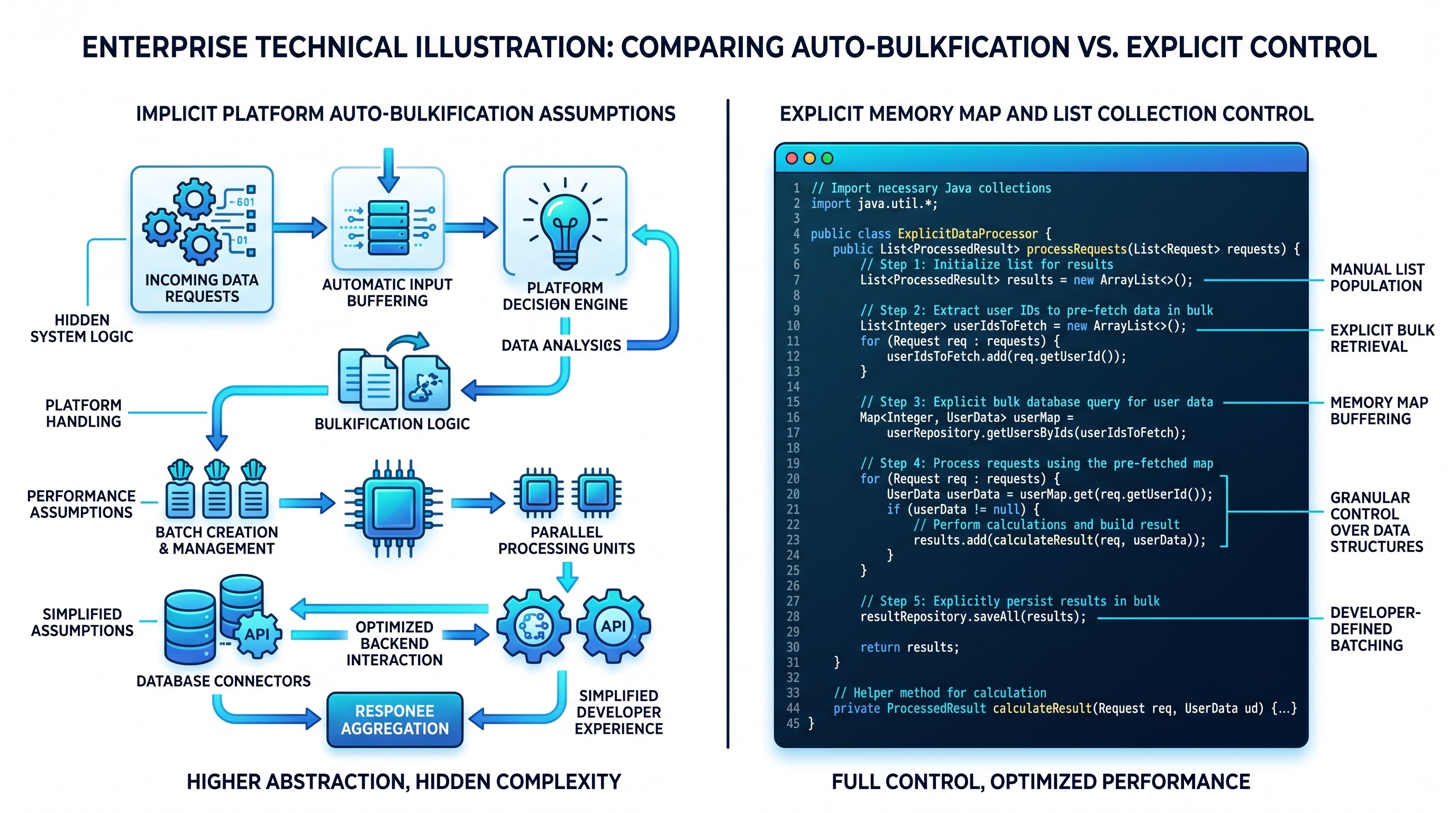
Salesforce functions like a multi-tenant application, which means it pools its hardware resources and shares them with its users. The governor limits are hard constraints which keep any one tenant from overusing the CPU or memory or database connections.
In Apex, developers have complete and precise control over any interaction with the database. When an Apex trigger receives a batch of two hundred records through the integration or through importing massive amounts of data, they create in-memory map collections themselves, get all record IDs, then run the database lookup once for all of them.
The process of bulkification in Record-Triggered Flows is primarily carried out by the platform compiler involved in the process. Though Salesforce introduced various changes in the way the platform automatically bulkifies updates and queries performed inside the loops while using flows, the platform cannot resolve poor architectural decisions. In circumstances where a declarative builder seeks to formulate queries through loops or undertakes complex multi-object traversals among different paths in the decision-making process, it becomes necessary for the compiler to make assumptions. In the case of larger workloads, such as large volumes, night-time processing, or heavy usage of APIs, these transactions can fail to reach either CPU or query limits, leading to the halting of transactions with no data. Avoiding these sudden stoppages of the system will require the observant instincts of a qualified online salesforce developer, whose expertise has been shaped by the experience of handling real business situations resulting from OnlineITGuru work.
Concerning Execution Order Issue in Several Flows
One of the biggest bad practices in business Salesforce administration is the existence of the unregulated, separate automations on a particular object. If the company creates five, ten, or twenty independent Record-Triggered Flows on Case or Opportunity object, anticipating how the system will behave becomes almost impossible.
The Flow Trigger Order was introduced by Salesforce so that administrators can assign a priority number from one to two thousand for ensuring the order of execution. However, although this is a rather simplistic method of organizing automation, it does not ensure that there is state management consistency as it would have been with the help of the Apex trigger framework. When flows are executed one after another, intermediate record saves, conditional routing, and further platform events can interact randomly. So, when there is a situation when Flow N4 has a problem because of the unintended field change set by Flow Number 2, it takes hours to investigate it.
Brittle Change Management and Merge Conflicts
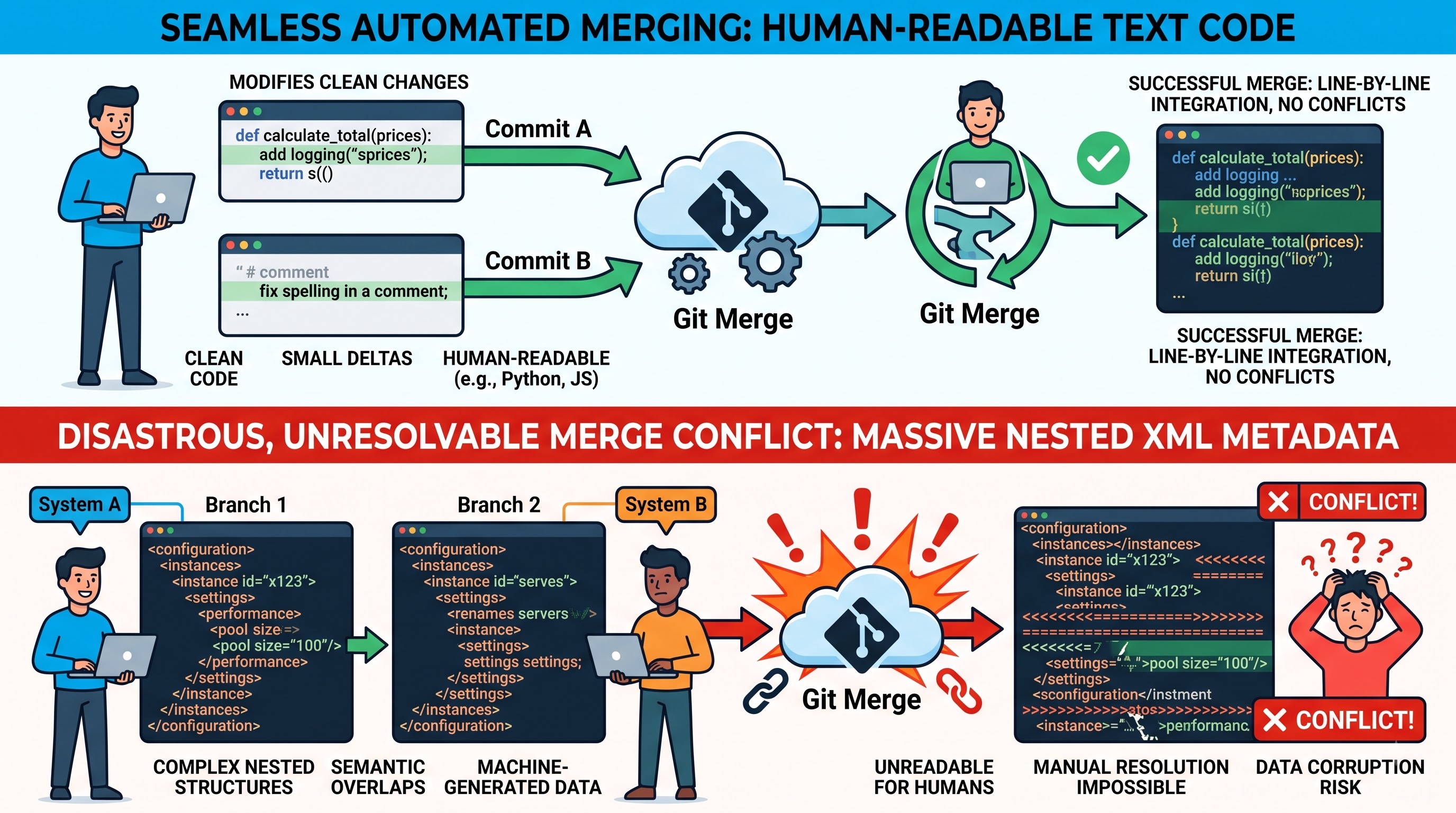
Modern-day software engineering depends on version control systems such as Git, trunk-based deployment models, and continuous deployment pipelines. The code itself exists in human-readable text file form and can be reviewed line by line via pull requests. When two developers work on different business requirements within the same Apex class, version control engines help identify differences in individual code lines, which helps automate branching and peer review processes as well as provides for easy merging.
Record-triggered flows are stored in the core platform structure in form of huge and heavily nested XML files. These metadata files imply positions on the visual canvas, layout parameters, and operation nodes. When two developers simultaneously change some elements of the same complex flow in different sandboxes, their XML files are impacted greatly.
Resolving a merge conflict in a three-thousand-line flow XML document is considered extremely challenging and prone to a disaster. A single misplaced node or broken tag leads to invalid flow architecture and requires the developer team to lose all work that was done by one of the developers.
Unquestionable Apex Trigger Authority
Apex programming language is an object oriented, strongly typed programming language based on Java. It supplies programmers with direct access to the lower level of programming, making it the best one when it comes to precision, performance, and maintainability.
Sophisticated Architectural Control and Patterns
For an organization, using Apex triggers means rather than a collection of procedural scripts, they develop efficient process building mechanisms. Now it depends on the developers to rely on the frameworks which separate tasks in the coding process.
The trigger itself consists of no logic, but only serves the purpose of a traffic officer checking the process without knowing which transactions are taking place – insert, update, delete, undelete, or which processes of execution are taking place.
Using transaction control flags, you’re allowed to override designated business processes in computer systems when your company implements its technology.
You’re able to implement advanced guards against recursion using variables that are not going to allow records to be updated while excessive processing does occur.
You have the ability to create intricate structures of in-memory data; for example, nested maps, collections of multiple keys, matrices with many dimensions. They will enable you to carry out your calculations nearly instantaneously while not getting affected by the governors.
Performance, scalability, and memory utilization
When a company advances to the level when it works with millions of records at a time, its overhead cost decreases. In the cases when other ERP systems are bringing in a continuous flow of numerous updates through high-performance bulk APIs the operational costs become really critical.
Apex has robust optimization features that are not present in declarative flows. A developer can query only the required fields, save heap memory with the help of collections, and apply effective database techniques that implement complex algorithms in RAM.
The efficiency of program execution of clean compiled hand-optimized code varies from declarative method execution.
Test-Driven Resilience and Refactoring Confidence
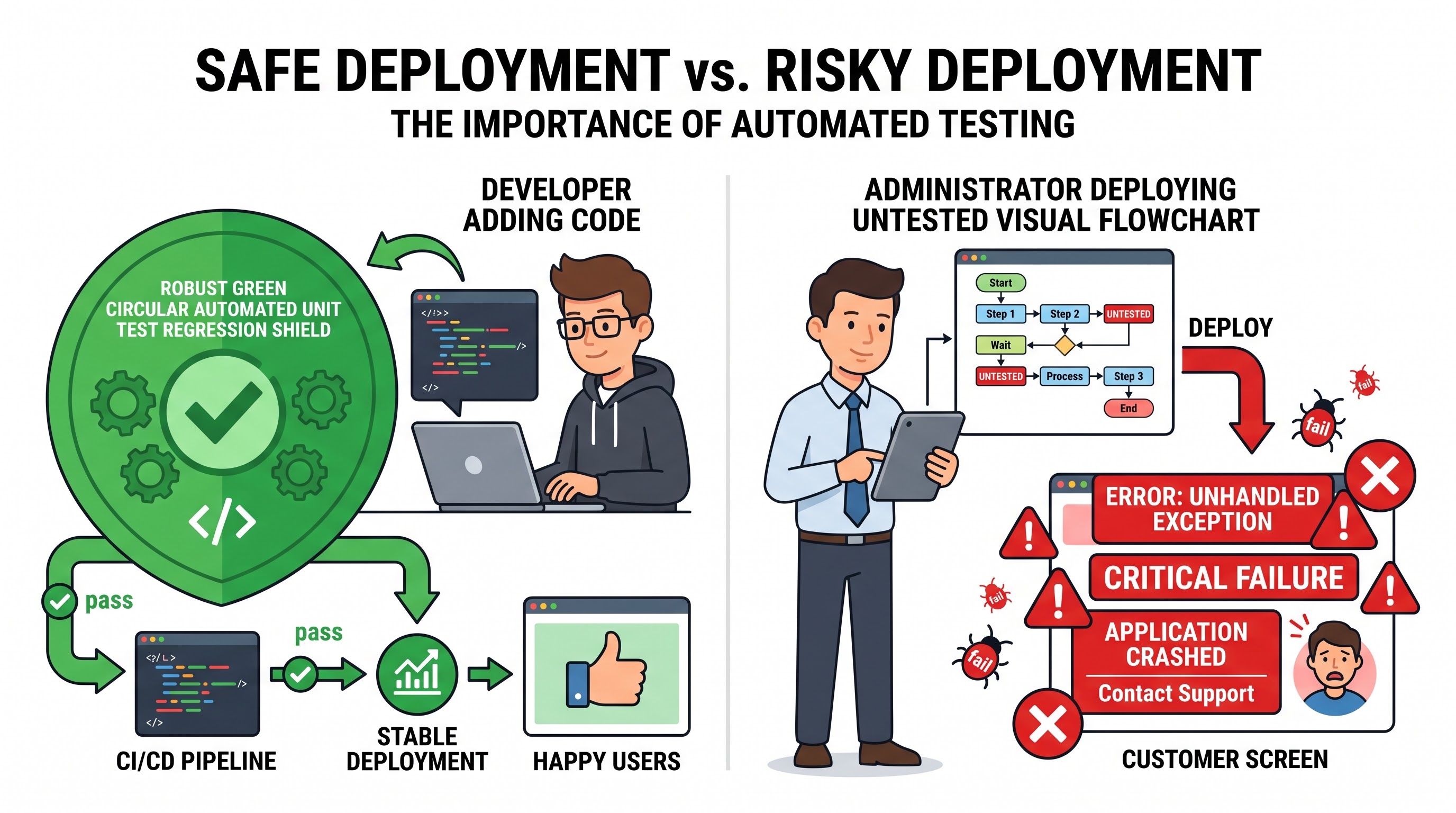
The most important aspect of enterprise IT is uninterrupted operation. A specific requirement for Apex programming is the presence of automated unit tests that have a coverage of at least seventy-five percent of the code, which should be conducted prior to the deployment of any logic into production.
Some consider unit testing just an obligatory procedure, while experienced developers treat it as the best preventive measure. A well-developed set of tests not only confirms that the code works at the moment but also ensures that operations in the future will not stop the execution of an already prepared program.
When a developer has added new logic after six months to an Apex trigger, the test suite runs immediately and executes countless prior business scenarios. If for example the newly added logic does not comply with a previously working validation rule it will fail immediately in a development sandbox environment. Flows, by design, do not have a mandatory compile-time regression testing framework, which means that an administrator can update an active flow, make a logical error, deploy it and never be aware of the fault until it shows up as an unhandled exception during a customer support call.
The Architectural Decision Framework: Understanding Fundamental Aspects
In order to choose an appropriate type of automation, whether it should be an Apex Trigger or Record-Triggered Flow, technology leaders should consider a number of important factors.
The Complexity and Cardinality of Data Connections
As the first factor, one has to consider the complexity of the data operations connected with the business process.
For example, when the requirement is primarily about extracting information from records that trigger an event, getting information on parent records, as well as putting values onto the same triggering record, it should be noted that a before-save Record-Triggered Flow is the only correct solution. In this case, using an Apex trigger seems to be absolutely unnecessary.
On the other hand, if companies have to work with complicated requirements that imply using non-linear structures, one cannot use this approach reliably. An example of this could be assessing an Opportunity and getting the related Opportunity Line Items so that later the company would have to check product information in a different Pricebook system, and receive historical Asset data in relation to a parent account.
In theory, creating such logic in a massive flow with multiple loops and collection filtering components could be done; however, the overall maintenance becomes nearly impossible. The level of understanding needed for navigating a visual canvas can be too high, and there is a risk of mass failures. Complex joins of collections, high cardinality, and deep traversals belong to the programming world of Apex.
System Throughput and Data Volume Profiles
The architect should focus not only on the way the automated process operates but also on the frequency and the amount of the operation.
A business logic flow that works well during manual testing performed by an admin who saves one record can break down completely when the system goes through load tests. If an object goes from operation to operation receiving data through any data-loading operations, automatic and continuous synchronization with outside systems, or bulk recalculations each night the architecture should be designed to handle constant flows of hundreds of records easily.
When it comes to transactions involving Record-Triggered Flows, the basic processing overhead incurred is much higher compared to using multiple Apex triggers. In normal cases it doesn’t matter but becomes a big issue when it comes to massive transactions of data. If the volume of transactions made by the object monthly is high and exceeds hundreds of thousands or even millions or if there are several simultaneous API updates occurring, automation should be done using Apex triggers to guarantee stability of the organization.
The Operating Team Model and Organizational Capability
System architecture must correspond to the reality of operations of the team supporting it. If you have very advanced systems but do not have good technical professionals or money to pay for their services, you are just wasting time.
When a company functions under the authority of only solo leaders, declarative processes give this group the chance to work independently. Using Apex triggers on such a team implies the necessity of hiring external developers for any small modification in picklist mapping or field assignment.
On the other hand, in the case of well-established enterprises, where a product engineering group works, where there is a strict version control process, an automated testing procedure, and a set of laws all companies need to comply with, utilizing programmatic solutions is better. In this case, the nature of Apex files that can be easily audited and tracked is relevant to the company’s broader IT governance.
Hybrid Reality: Combining Two Styles
The controversy between clicks and code often leads to a wrong choice, as if an architect had to pick only one of the two approaches. The finest Salesforce designs merge declarative and programmatic methods into one seamless system.
Invokable Method: A Unifying Concept
The Invocable Method annotation is one of the most powerful connectors in the Salesforce environment. This enables software developers to create complex, effective, and tested Apex code that works within a special clause and makes it practicable for reuse in the Flow Builder interface. With the salesforce developer training online offered by OnlineITGuru, aspiring salesforce developers learn to join successfully hybrid architecture used to construct the scalable business solutions based on the interaction of declarative flexibility and coding.
This hybrid form takes advantage of both paradigms:
The developer tackles the difficulties: The developer does the programming for performing functions that cannot be implemented easily by flows, such as producing complex dynamic payloads, invoking outside cryptographic libraries, and executing optimized real database queries. The developer also creates unit tests to ensure reliability and optimize memory usage.
The administrator governs the orchestration: The administrator uses this callable process in Record-Triggered flow, overseeing when it runs, controlling its inputs, and guiding its output without writing code.
This division strikes a good balance between programmability in particular places and flexibility for business operations.
Strategic Delineation by Execution Phase
A smart organization can neatly separate automation tasks according to function.
Before-Save Record-Triggered Flows perform only functions of field assignment within the same record, normalization, and defaulting. They serve both as before-save triggers and legacy workflow field updates with unmatched efficiency and zero DML overhead.
Apex Trigger Frameworks control the post-save stage of transaction where complicated validations, child record creation, external notifications with the use of platform events, integration synchronization, and multistage calculations take place.
After-Save Flows are used extremely rarely for low-volume processes requiring immediate turnaround of the tasks such as delivering customized internal notifications, creating simple tasks within the platform, or activating operational alerts.
This separation of responsibilities creates clear operating guidelines. If unauthorized field value appears in the opportunity, the team checks the before-save flow. If enterprise integration fails or complex rollup calculations get stuck, the engineering team investigates the Apex segment.
Checklist for Making Architectural Decisions
Before you begin working on your next automation requirement in the IDE and switching on the programming environment, put your ideas to practical use by applying the operational framework below.
1. Define the target data nature?
In case the automation refers to the object only associated with the occurrence of the process, rather than running the process via the Record-Triggered Flow, use the before-save Record-Triggered Flow. If the automation procedure is supposed to process a number of disconnected records or go through a large number of child objects, then an Apex trigger should be applied.
2. Define the expected density of transactions?
If the system is characterized by low or relatively low volume of transactions that come from users via graphical interfaces, it means that Record-Triggered Flow should be used because of its beneficial combination of speed and maintainability. If the object is subject to a great volume of data transfers caused by massive data integrations and automation of bulk processes or constant streams of a large number of requests, then the best option here would be to proceed with the process in Apex, where governor limits are strictly followed.
3. What is the frequency of changes in business processes?
Whenever business processes might be dynamic, experimental, or owned by the functional managers who need quick turnaround times, declarative solutions will deliver the necessary agility. Whenever the process is rather stable and represents the core and permanent business processes like financial transactions revision, strict rules enforcement, and foundational architectural security then Apex provides the required stability and immutability to the process.
4. Are there any constraints in implementing and testing?
If your team uses the mature development processes that include using automated branching with git, peer code review, continuous integration, and zero tolerance toward changes in production then Apex is very easily implemented. However, if your business processes are more dynamic and involve quick testing processes using simple sandbox approaches, then creating flow is recommendable to cut down on the engineering effort.