
Salesforce for Small Businesses: Boost Sales & Customer Care
Last updated on Nov 23, 2026
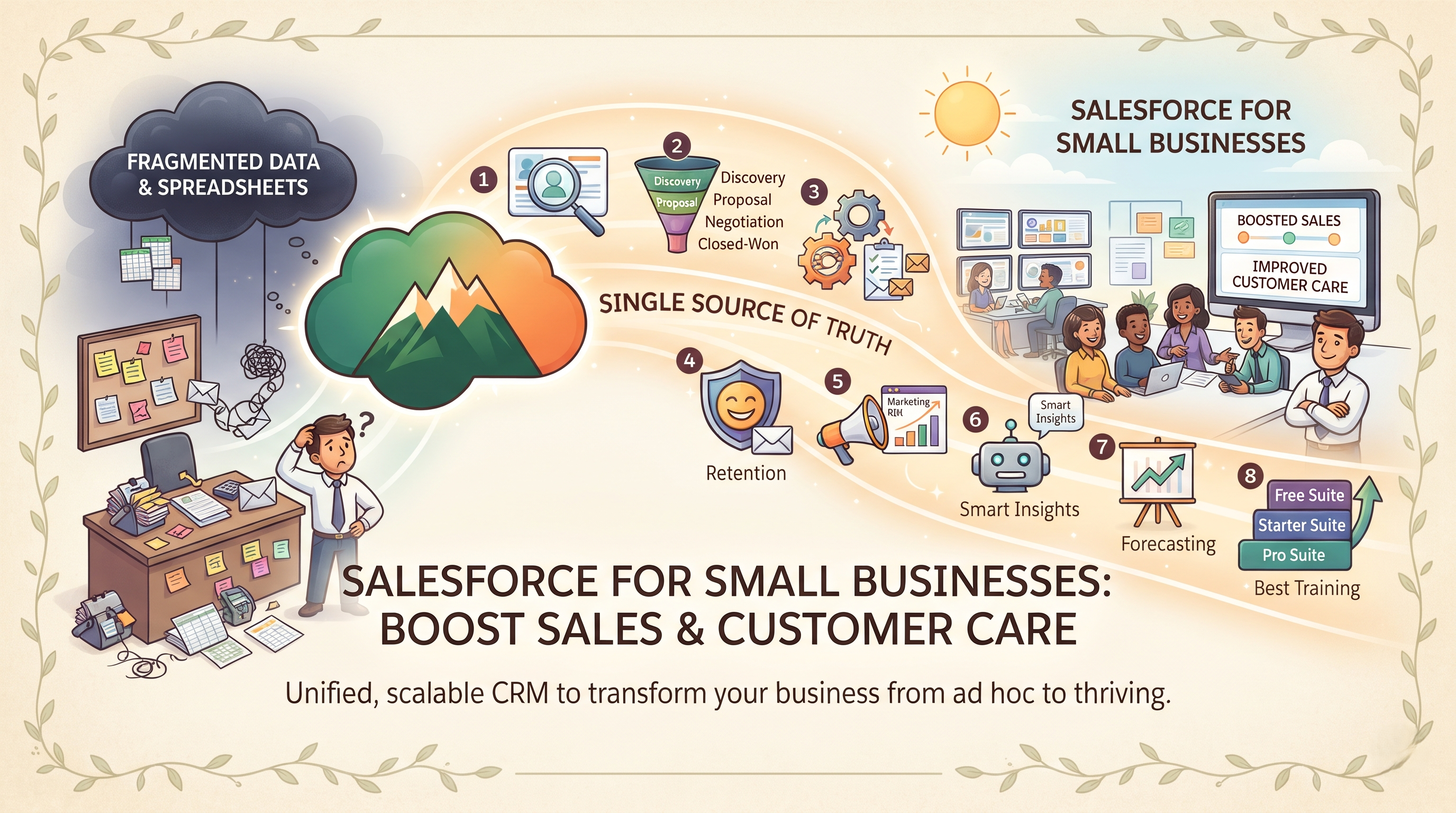
For decades, one fallacy has ruled the small business world. Until now, enterprise-grade Customer Relationship Management (CRM) software was the sole sanctuary of Fortune 500 companies with huge IT departments and bottomless budgets. Small business owners had to rely on a hodgepodge of spreadsheets, sticky notes, email threads hidden in inboxes and simple address books to manage their growing operations. You can get away with that ad hoc approach for the first few months of a young startup, but eventually you’ll run into a wall. Leads fall through the cracks, follow-ups are missed, customer histories disappear when a sales rep leaves, and leadership has no visibility into the real state of the sales pipeline.
Today’s small businesses are held to the same expectations as global enterprises. Today’s buyers expect personalised communication, quick response times and smooth handoffs between marketing, sales and customer support. Salesforce has responded to this change by developing its platform to suit the needs of agile, growing teams with specific solutions for small businesses including its Free, Starter Suite and Pro Suite. Salesforce offers a single, approachable foundation that expands with the business, instead of forcing small companies to use inflexible, entry-level tools that they’ll eventually outgrow.
Data Collection Single Customer View
Data fragmentation is the biggest barrier to good customer management in a small business. When marketing data is in an email blast tool, sales conversations are in individual inboxes, and support tickets are tracked on a shared spreadsheet, no one has the full picture of the customer. That fragmentation results in disjointed and awkward customer experiences—like a salesperson trying to sell an upgrade to a customer who’s currently fuming about an open billing problem.
Salesforce eliminates those silos by providing a single source of truth. From a prospect downloading a guide on your website to their latest customer service inquiry, all interactions are automatically fed into one customer profile. A team member can open a contact record and see a timeline of emails, phone calls, meeting notes, purchase histories, and open support cases, all in chronological order.
With that one view, small teams can offer a very personalised service without having to hire more people. A sales rep preparing for a discovery call can immediately see which marketing campaigns the prospect engaged with, and adapt their pitch to the exact pain points the buyer has already signalled. Anyone on the team can pick up a customer calling with a question, seamlessly, with full context, making a ten person company feel as attentive and organised as a dedicated concierge service.
Sales Pipeline & Lead Management Transformation
For a small business, cash flow and predictable revenue are existential priorities. However, many small sales teams are reactive, spending way too much time chasing cold leads and ignoring high-intent prospects. Salesforce brings order, discipline and predictability to the entire sales life-cycle.
The shift starts at the top of the funnel with automated lead capture and routing. Salesforce eliminates the manual labour of copying and pasting enquiries from a contact form on a website into a spreadsheet. Conversely, the web-to-lead functionality instantly creates a new lead record, checks for duplicates to keep the database clean and assigns the prospect to the right salesperson based on territory, product interest or availability. Speed-to-lead is one of the strongest predictors of conversion - getting connected in minutes vs days dramatically improves win rates.
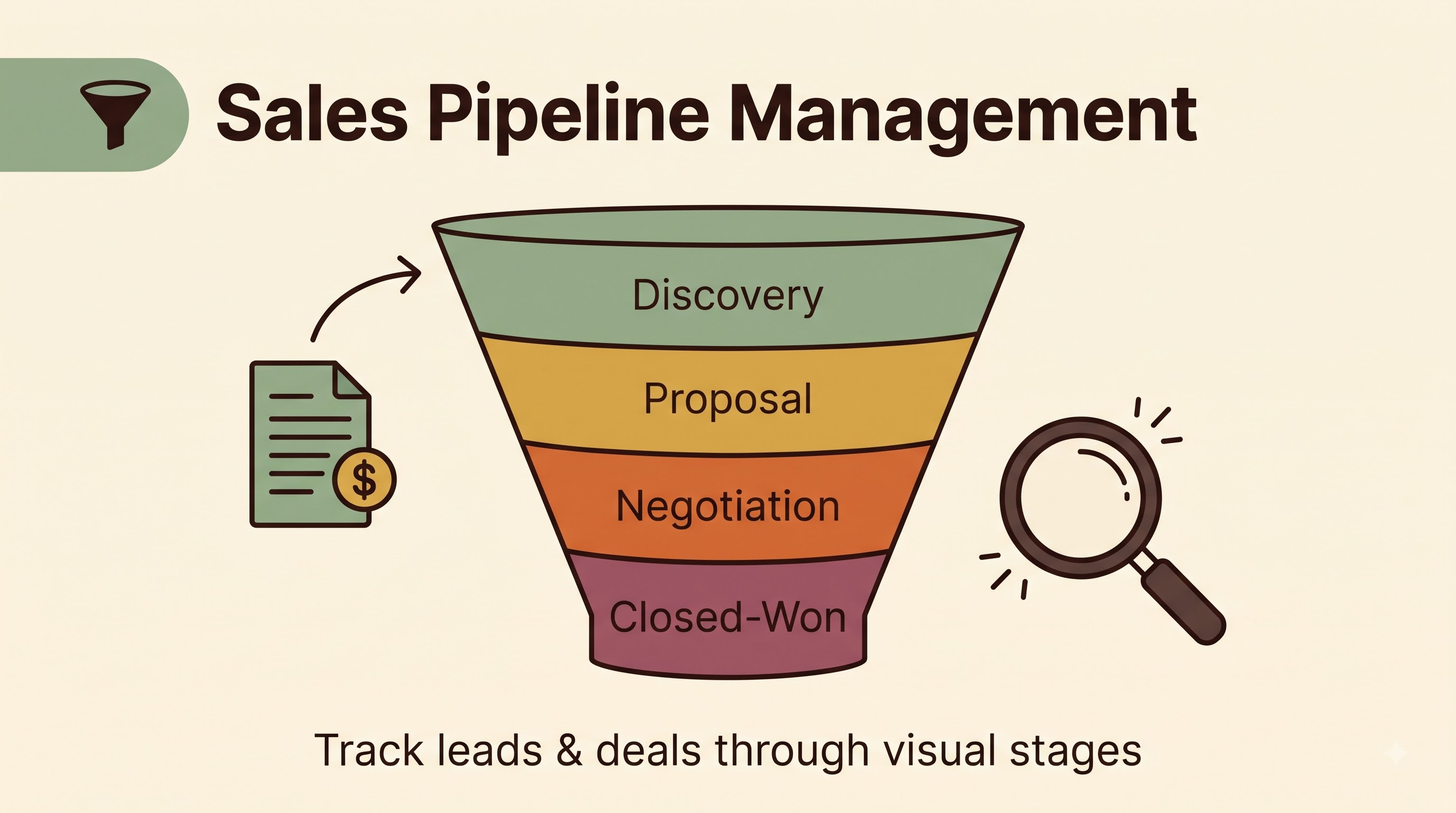
Salesforce’s visual opportunity management tools allow sales reps and founders to track each deal from initial qualification to final close with a pipeline lead. Deals are organised in easy to view stages like Discovery, Proposal Sent, Negotiation and Closed-Won that you can customise. The business owner can instantly see the total value of the pipeline, where deals are stuck and where coaching will have the most financial impact.
Sales quoting and product price books built in to make closing a breeze too. Sales reps can now create accurate, professional quotes from an opportunity record in seconds, instead of wrestling with manual document formatting and potential pricing mistakes. The transition from prospect to active customer is instantaneous once the deal closes and all of the pre-sale promises and specifications are preserved for the delivery or onboarding team.
Automate Repetitive Tasks for More Productivity
In a small business, everyone wears a lot of hats. “Founders are typically focused on closing deals, payroll, and operations. Administrative overhead is the silent killer of small business growth. Research shows that sales reps spend the majority of their week doing non-selling tasks like data entry, scheduling and internal status updates.
And Salesforce immediately returns that time with intuitive, point-and-click workflow automation. Small businesses can write automated rules to handle routine operational friction without requiring technical savvy or dedicated developers. For example, when a deal moves to the negotiation stage, Salesforce can automatically create a follow-up task for the account executive, notify the operations manager to get onboarding materials ready, and send a confirmation email to the client.
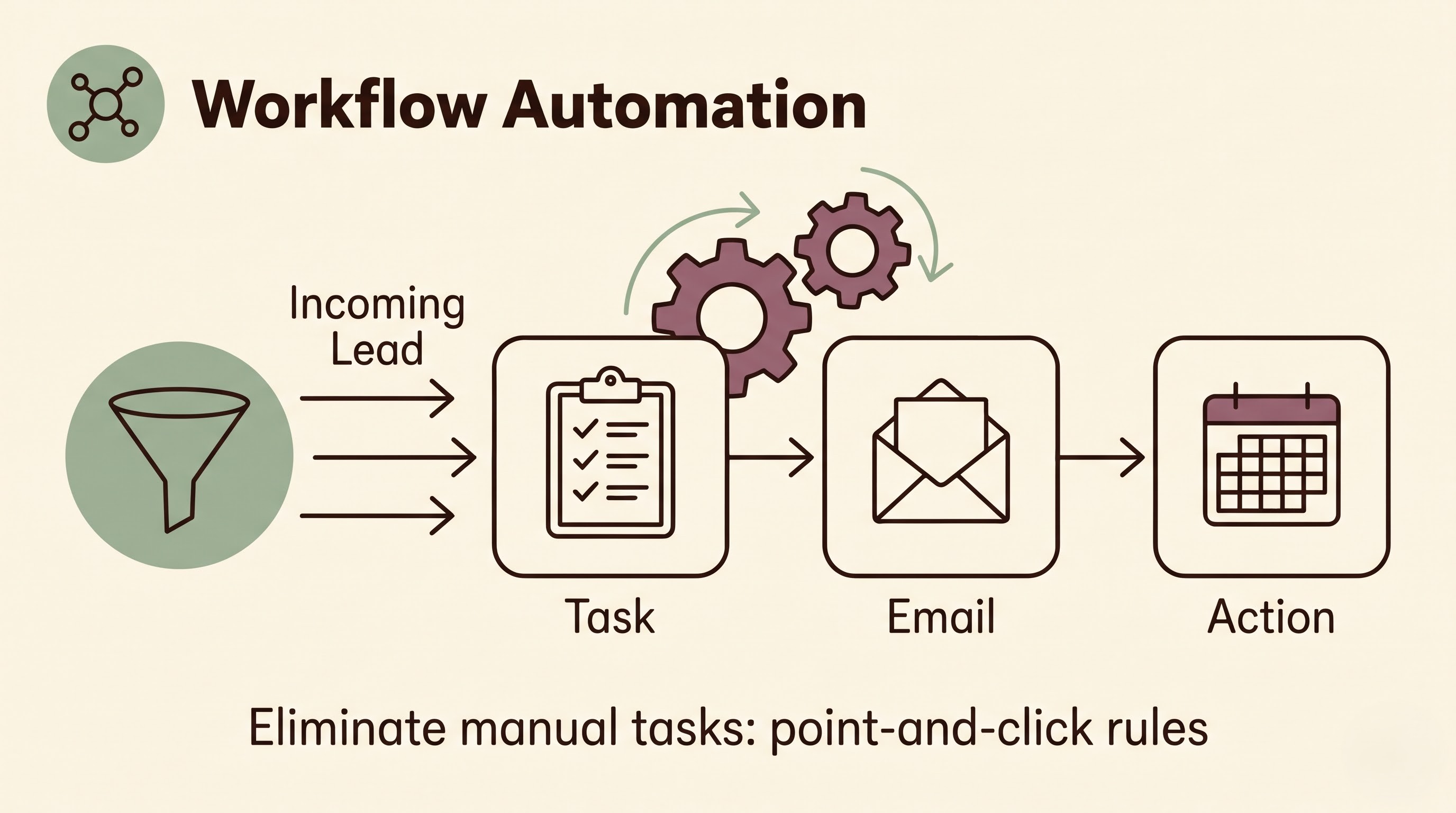
The integration with email and calendar platforms, including Gmail and Microsoft Outlook, further reduces the need for manual work. Emails sent to a rep’s normal inbox automatically sync to the contact record in Salesforce and calendar appointments sync seamlessly across devices. Field sales reps can use voice-to-text to update deal notes right after a client meeting in their car. Add mobile app access and this keeps data fresh and avoids late nite admin catch up sessions.
Transforming Customer Service into a Retention Engine
It costs much more to acquire a new customer than to retain one. This is why post-sale customer service is such an important growth lever for small businesses. The problem with support through a common public mailbox is that it quickly becomes messy, with the risk of two agents inadvertently giving conflicting responses to the same customer or a pressing complaint going unread over a weekend.
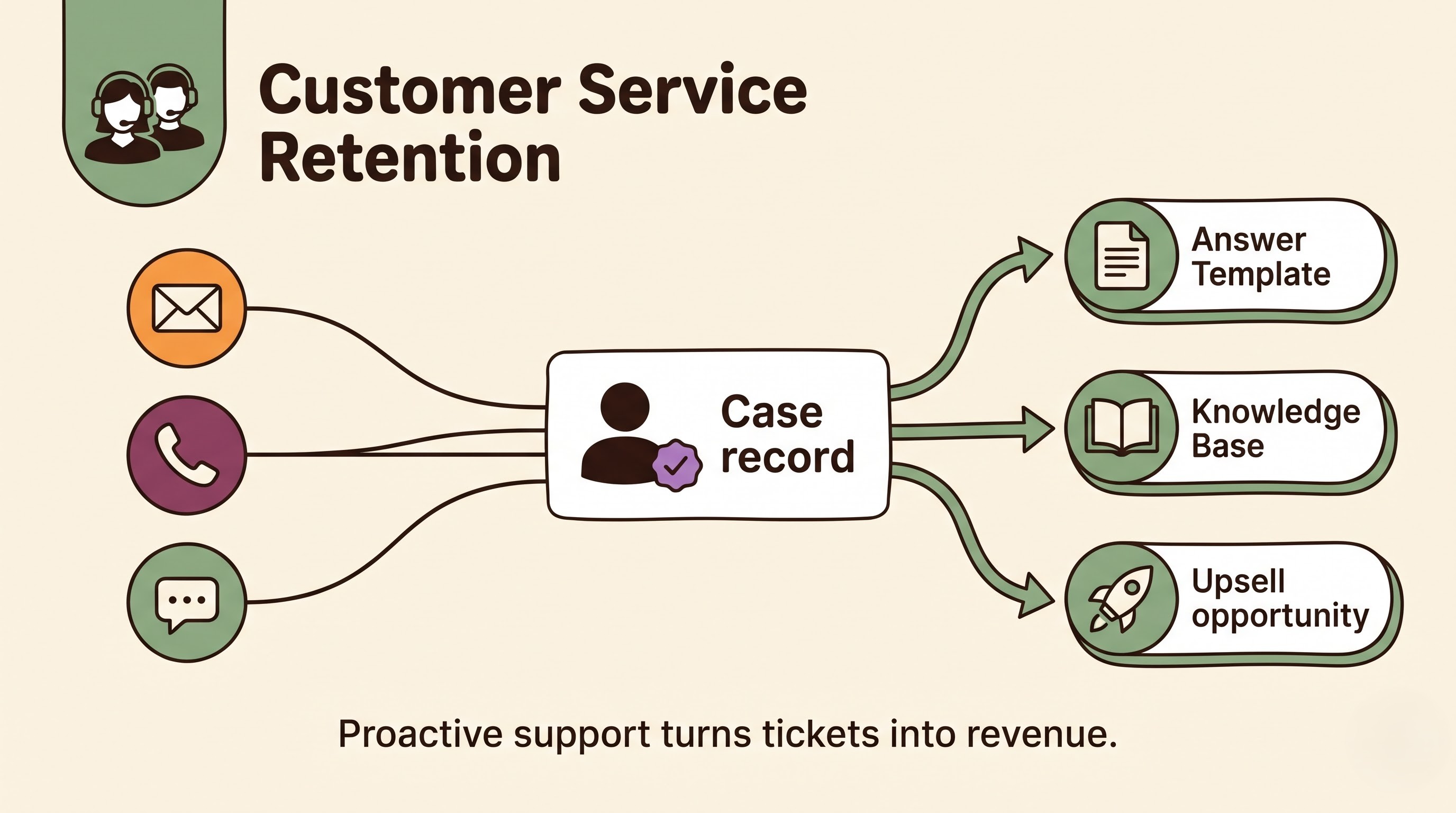
Salesforce combines customer service tools with sales data to build a proactive retention engine. Customer enquiries via email, web forms, phone calls and real-time chat are automatically created into a trackable case. Every case is prioritised, routed to the right team member, and tracked from open to resolution.
Response templates and an embedded knowledge base allow small support teams to answer common questions consistently and quickly, freeing up bandwidth to focus on complex, high-touch issues. Importantly, service and sales are on the same platform so support interactions generate future revenue. If a customer keeps asking how to do an advanced task, the system can ping their account manager of a natural upsell or cross-sell opportunity — turning a support ticket into expanded revenue while actually helping the customer thrive.
Marketing Alignment to Sales Revenue
For small business marketing budgets, every dollar spent on digital ads, events or email campaigns needs to deliver a return on investment. When marketing and sales are on different tools, there’s virtually no way to know which campaigns are actually generating paying customers vs. unqualified clicks.
Salesforce fills the gap by integrating marketing automation with the CRM. Small teams can create targeted email drip campaigns, segment audiences by purchasing behaviour or industry, and track engagement metrics like open rates and link clicks. If a prospect is engaging with marketing content repeatedly, such as by visiting a pricing page or clicking through three newsletters in a row, Salesforce can alert the sales team automatically when a lead is heating up and ready for a personal conversation.
Business owners have clear attribution because the campaign data is directly tied to sales opportunities. So instead of having to guess whether a trade show or social media campaign was successful, leadership can run a report that tells them exactly how much revenue each marketing initiative brought in. Now they can focus on winning channels and cut wasted spend.”
Using Current Artificial Intelligence
Artificial intelligence is no longer an experimental luxury for the tech giants. It fits right into the daily workflows of small business CRM users. Salesforce’s small business suites use assistive AI as a force multiplier for lean teams.
Generative AI tools can compose personalised outreach emails, summarise long customer interaction histories in seconds, and suggest next best actions based on deal momentum for sales and service staff. Instead of sitting through 20 minutes of months of past emails before a renewal call, a rep can read an AI-generated executive summary in 10 seconds and walk into the meeting fully prepared.
Predictive insights help small businesses spend their limited time wisely on the analytics side. It can look at past win-loss trends to bring forward the deals most likely to close this month and highlight at-risk accounts that are showing signs of disengagement so sales teams can intervene before a customer churns.
Forecasting and Data Driven Decision Making
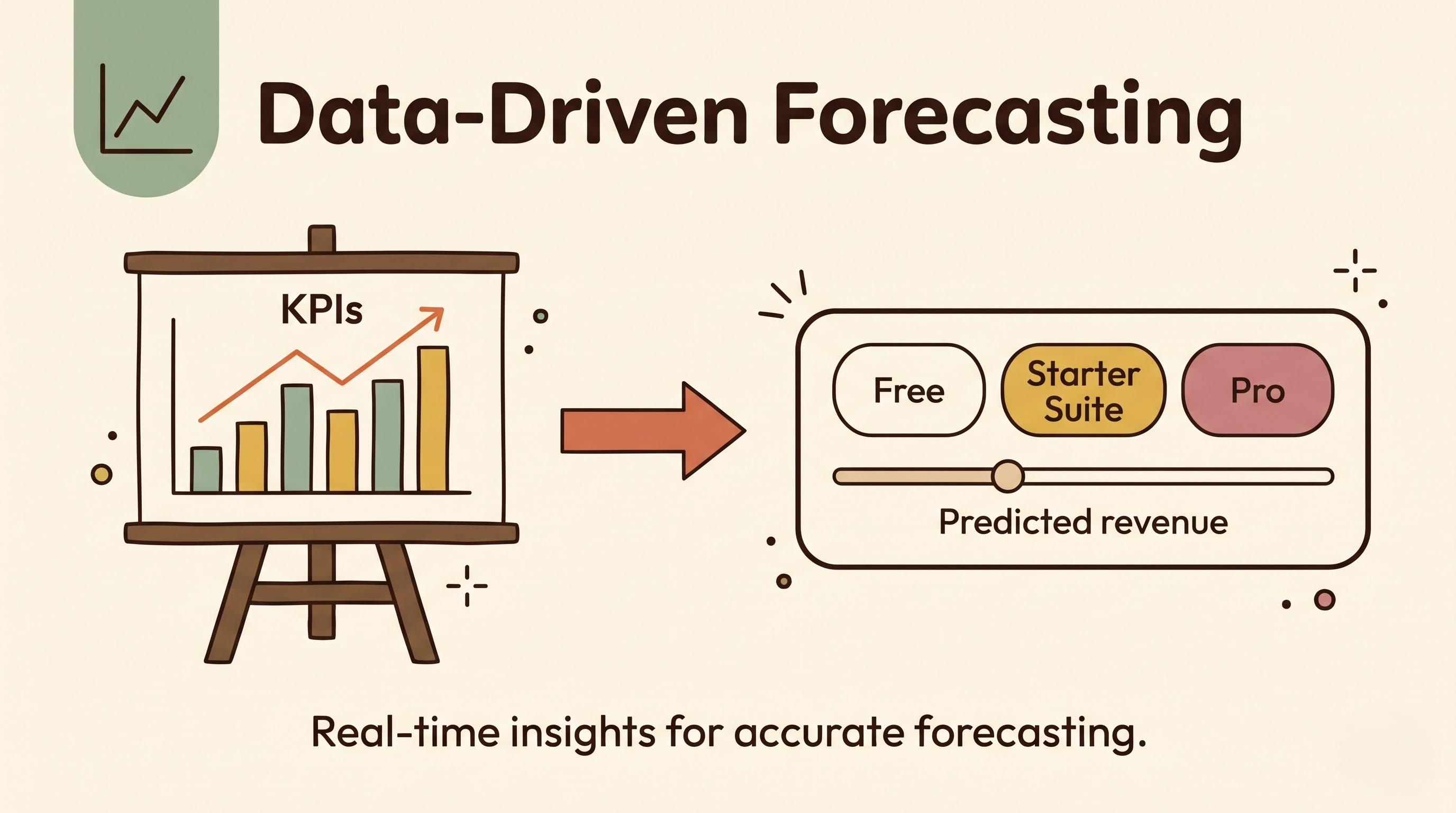
Gut feel is a big part of being an entrepreneur, but building a sustainable company means you need objective data. Reporting out of spreadsheets takes hours of manual compilation and by the time the report is complete it’s often out of date.
Salesforce replaces static spreadsheets with real-time reporting and analytics. Out-of-the-box dashboards offer small business leaders immediate visibility into important performance indicators like monthly revenue trends, sales rep win rates, average deal cycle length, lead conversion rates, and customer support resolution times.
The reality of accurate sales forecasting is now achievable for smaller teams. Founders can predict revenue months ahead by weighting opportunities by pipeline stage and expected close date. This financial clarity helps to make key strategic decisions such as knowing precisely when the business can afford to hire a new employee, invest in inventory or expand into a new geographic market.
Future scalability, without migration headaches
The hidden cost of a basic, budget CRM Maybe the biggest hidden cost of a basic, budget CRM is the “growth ceiling.” Many small businesses will start with a lightweight tool, only to find out two years later that it can’t handle complex quoting, multi-step automations, or integrations with third-party accounting systems. Leaving a CRM that you’ve outgrown is expensive, disruptive and puts your data and team burnout at risk.
Salesforce’s multi-tiered architecture solves this problem for good. The Free Suite is free for a single founder or a two-person startup to begin, organise contacts, track deals and manage basic cases. The team also adds its first dedicated sales and marketing people. The upgrade to the Starter Suite unlocks guided sales flows, dynamic email marketing and secure payment links — all without moving a single record. As your operations mature, you can upgrade to the Pro Suite, which offers advanced automation, custom objects, sales forecasting, and access to the AppExchange ecosystem—a marketplace of thousands of pre-built integrations for accounting, e-signature, scheduling, and e-commerce.
Apart from the above features, the software company also provides services such as security, cloud update, and a learning platform that is interactive known as Trailhead. However, although self-service tools are good for training purposes, there are some individuals who might need formal guidance, whereby the individuals can enroll for a salesforce course online.
Best Practices for Success
If a small business implements with focus and discipline, Salesforce adoption doesn’t have to be a six-month IT project. The most successful rollouts are built on a few key principles:
Start Lean and Concentrate on Core Workflows: Don’t over-customize the platform on Day 1. Start by plotting your current real sales stages, and cleaning up your current contact data, before you bring it in. This way complexity is introduced in a gradual fashion resulting in a high user adoption.
Champion CRM Adoption: A CRM is only as good as the data you feed it. Founders and sales managers who actively run their weekly pipeline reviews right inside Salesforce instead of asking for separate status spreadsheets, force the entire team to adopt the system as their default daily workspace.
Include Essential Daily Tools Early: Link your business email, calendar and accounting software right away. This is about reducing the tab switching friction for employees so that Salesforce becomes critical faster.
Invest in Training: Schedule 30 minutes a week for your staff to do Trailhead training or supplement it by taking salesforce online training. It is important to have a “champion” within your organization who takes up salesforce classes online so that he can learn the point-and-click configuration and become independent.
When it’s all said and done, Salesforce lets a small business punch way above its weight class. Salesforce brings together customer data, automates administrative busywork, aligns marketing with sales and provides real-time visibility into revenue. This turns customer and sales management from a daily source of operational stress into a repeatable, scalable engine for long-term growth.
Conclusion
Small businesses in today's intensely competitive marketplace can no longer afford to manage their most valuable asset – their customer relationships – using fragmented spreadsheets, isolated email threads and reactive guesswork. Modern commerce is moving faster. The gap between what customers expect and the makeshift tools we have to offer is getting wider every day. Salesforce closes the gap, giving lean teams the precision, speed and intelligence that used to be reserved for global enterprises.
Salesforce is breaking down the data silos that lead to missed opportunities and fragmented client experiences by creating a single source of truth across marketing, sales and customer service. Every phone call, email, marketing interaction and support request is combined into a single, unified timeline of the customer, enabling even a small team to deliver hyper-personalized, attentive service at each stage of the buyer journey. The use of automated lead routing, visualizing pipelines, and point and click workflow automation makes sure that no time is wasted in manual data entry, hence leaving more room for building meaningful human connections and closing the sale.
Salesforce ensures that leaders of small businesses gain perspectives on how to strategize their decision-making process by going beyond mere efficiency, thus making them play smart moves. Gone are those days of relying on gut feelings owing to real-time dashboards, accurate forecasting, and AI functionality. Leaders can see pipeline bottlenecks before they impact cash flow, identify which marketing campaigns are providing true ROI and actively manage at-risk accounts before they churn. Another key feature is the platform’s modular scalability, with tiered offerings from the Free Suite to the Starter and Pro Suites, allowing businesses to start small and grow their capabilities seamlessly, without ever having to suffer the cost and disruption of a painful software migration.
Investing in Salesforce, ultimately, is not an IT upgrade; it’s a fundamental investment in long-term success. When one adds up discipline, dedication of the leaders, and learning through Trailhead or salesforce online training from sites like OnlineITGuru, the Salesforce gets converted into the nervous system of an efficiently running small company.