
Salesforce Headless 360: Why Enterprise Applications Are Becoming AI
Last updated on Sep 19, 2026
Enterprise software has always followed a straightforward pattern. People open an application look for the information they need move through steps in a workflow and finish a task. Salesforce helped shape this model by offering one place where businesses could handle sales, service, marketing, commerce and customer data all in one spot. It worked well for years.
Now the way people work is shifting. Employees are using AI assistants coding agents, chat tools and automated systems to get their jobs done.. That brings up a new question: Do workers still need to open the application at all?
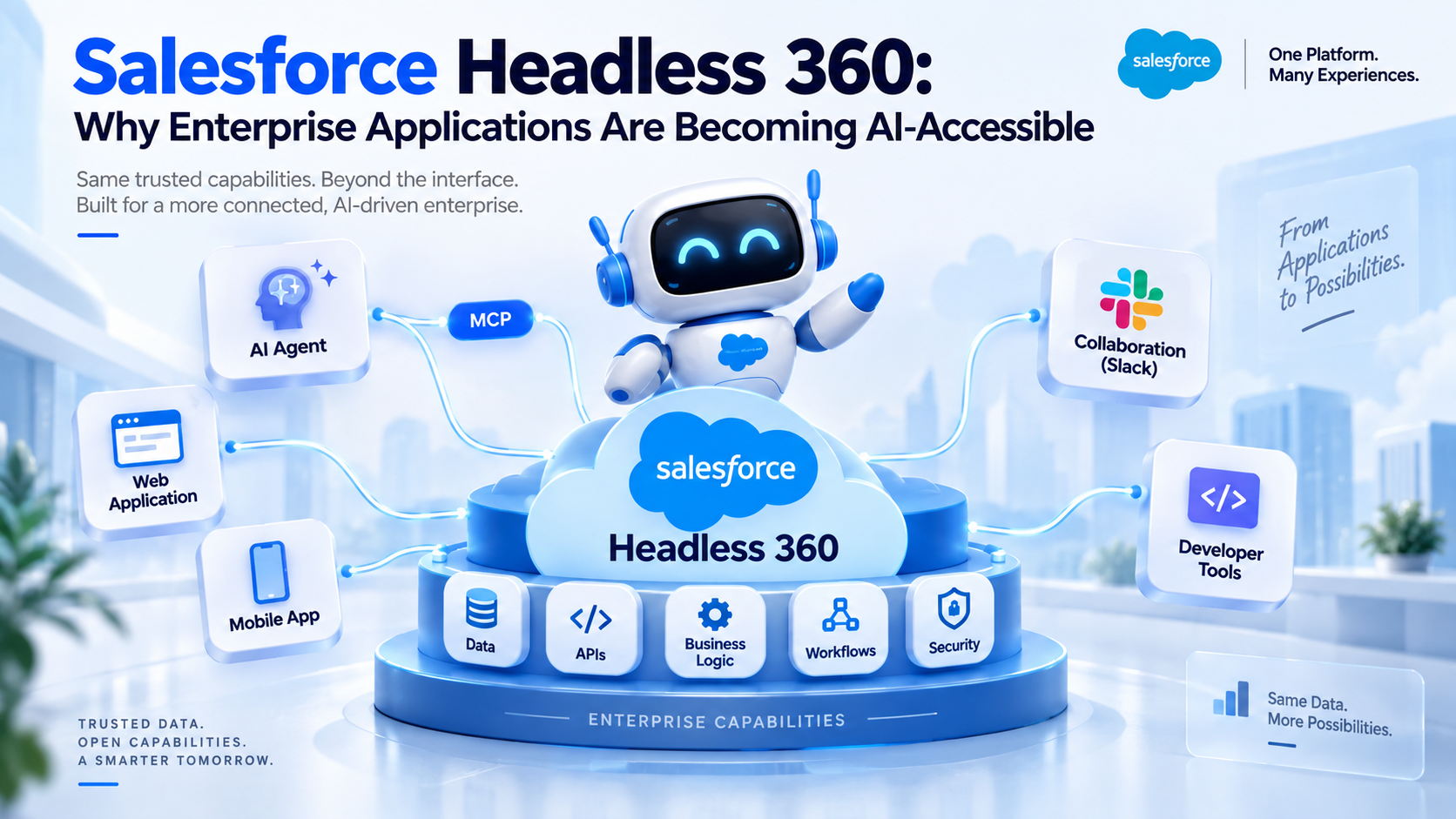
That’s where Salesforce Headless 360 comes into play. Of making users go through the usual Salesforce interface Salesforce is allowing access to its data, business rules, workflows, permissions and other functions from outside the app. This happens through APIs, Model Context Protocol (MCP) developer tools and other ways to connect. The goal isn’t just to build another user interface. The goal is to let Salesforce capabilities reach wherever people and AI agents already work.
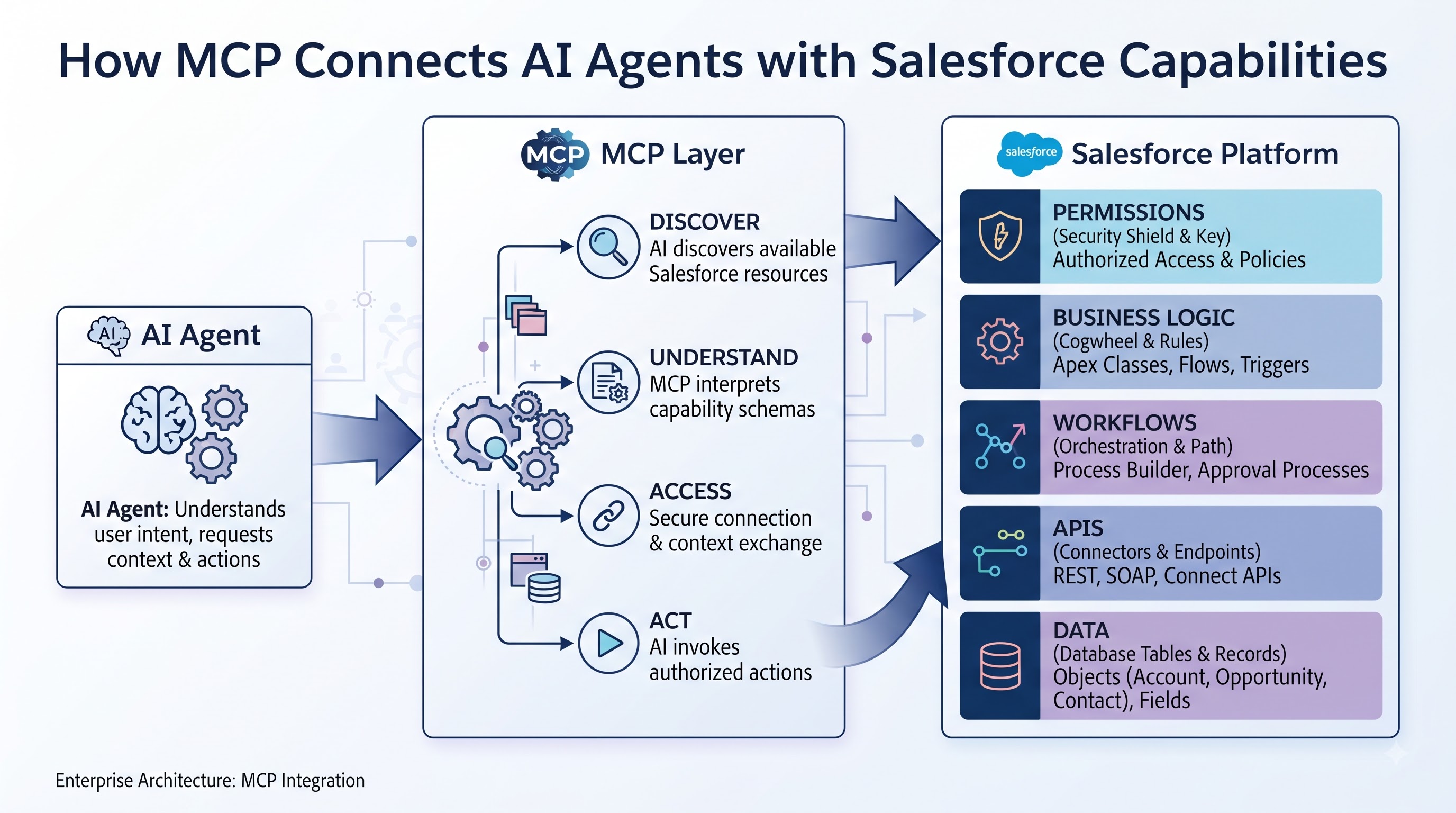
This change matters because AI agents don't just need data. They may understand what a customer wants. Knowing that doesn’t finish the job. An agent might need to check a customer record follow a business rule update an opportunity start a workflow or ask for an approval. If every single action requires a person to leave the AI tool and go back into Salesforce to finish it then automation loses most of its power. Headless 360 solves this problem. It makes core business functions available directly, to authorized agents and applications. That way AI can do more without needing someone to take over.
What Salesforce Headless 360 Actually Means
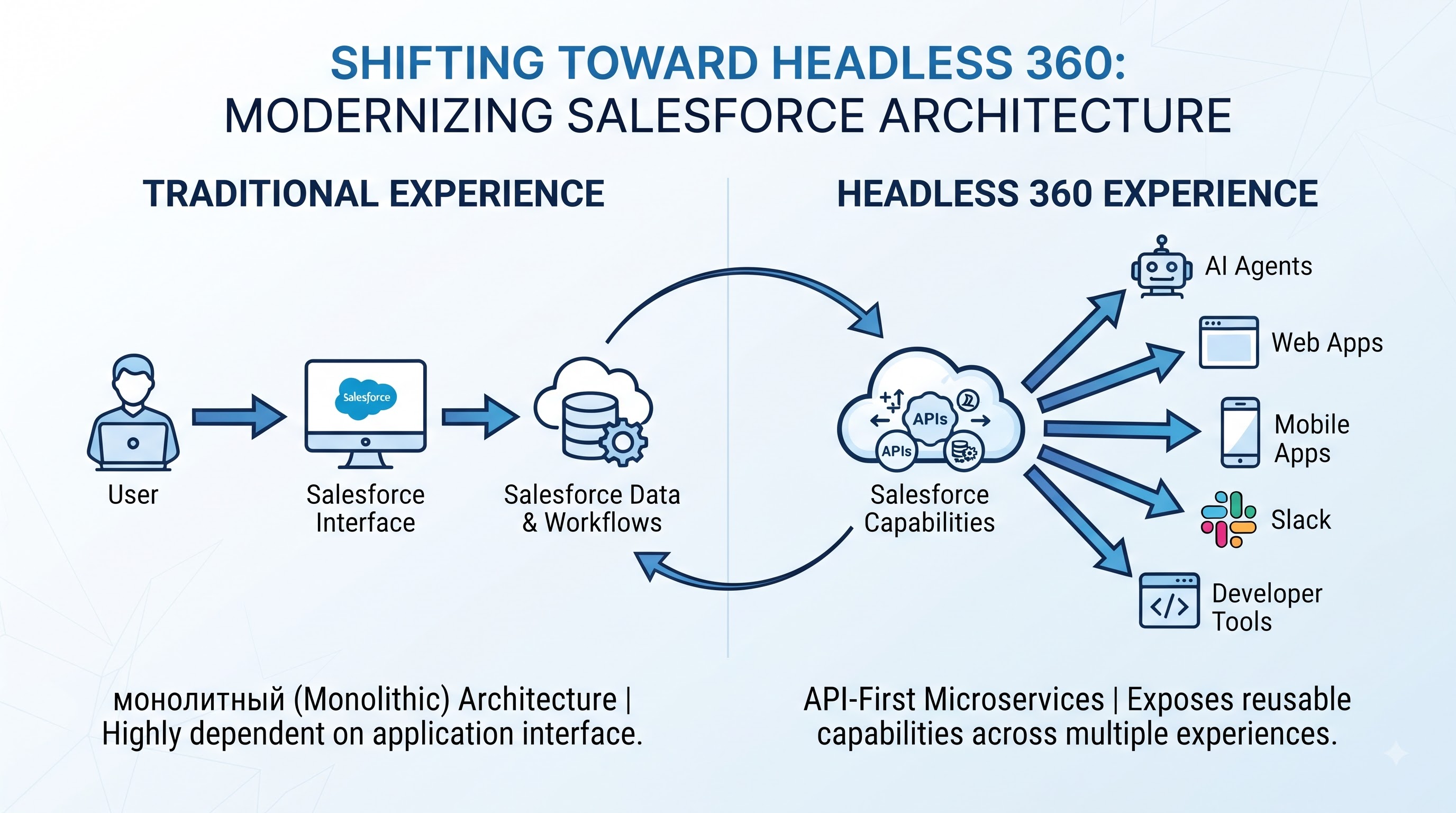
The term "headless" might seem more complicated than it really is. In software design it usually means separating the backend functions from the user interface. Of using only a screen to reach the system, the core data and business tasks can be accessed by other programs, interfaces or services. Salesforce has offered APIs and integrations for years but Headless 360 pushes this further by spreading it across the entire platform and making those functions easier for AI agents to find and use.
Think about a Salesforce workflow. A sales representative opens Salesforce, looks for an account, checks an opportunity, updates a field creates a task and then moves on to the customer. That work is fine. It needs a person navigating the interface. With an approach, the same core capability can be reached from another program or an AI agent. The key point is that the business rules do not need to be rewritten simply because the user interacts with a surface.
This does not mean Salesforce is discarding its interface. Lightning Experience and other Salesforce interfaces still matter for people who want to work inside the platform. Headless 360 is best seen as an architectural layer. Salesforce can remain the place where customer data, workflows, permissions and business rules live while other applications and agents use those functions in ways that fit their processes. Salesforce calls this an "and not an or" approach, not a replacement for the interface.
The bigger change is that the interface is no longer the core of everything. The business capability becomes the important part. A customer service function, for instance, can be used inside Salesforce, in a custom application, in Slack, or through another experience when the correct access and governance are in place. This flexibility is one of the reasons headless design is becoming more important as enterprise AI grows. It also means that salesforce training is increasingly moving beyond learning the platform interface and should include an understanding of integrations, automation, APIs, and how Salesforce capabilities can work across different environments.
Why AI agents need a way to connect with other systems
As the use of AI agents grows we see more limits. An API lets an app read data from another system. An AI agent must know what it can do what it can see and how to carry out a given process. Simply listing endpoints does not give the business logic that an AI agent needs to work properly.
For example picture an AI agent that helps a sales rep handle a request. The AI agent might have to locate an account look at opportunities know where the sale is in the cycle see if approvals are needed update a record and add a follow‑up task. Each of these steps uses objects, permissions, logic and validation rules in Salesforce. If developers must code every action that an AI agent needs, building and deploying many AI agents becomes too hard.
Salesforce’s Headless 360 MCP Server is designed to make connecting and launching AI agents easier. According to Salesforce an MCP‑aware AI agent can use a lot of functions over a connection. The set of operations will only expand. The docs list operations, such as queries, updates, user management, Apex tasks and event‑driven processes.
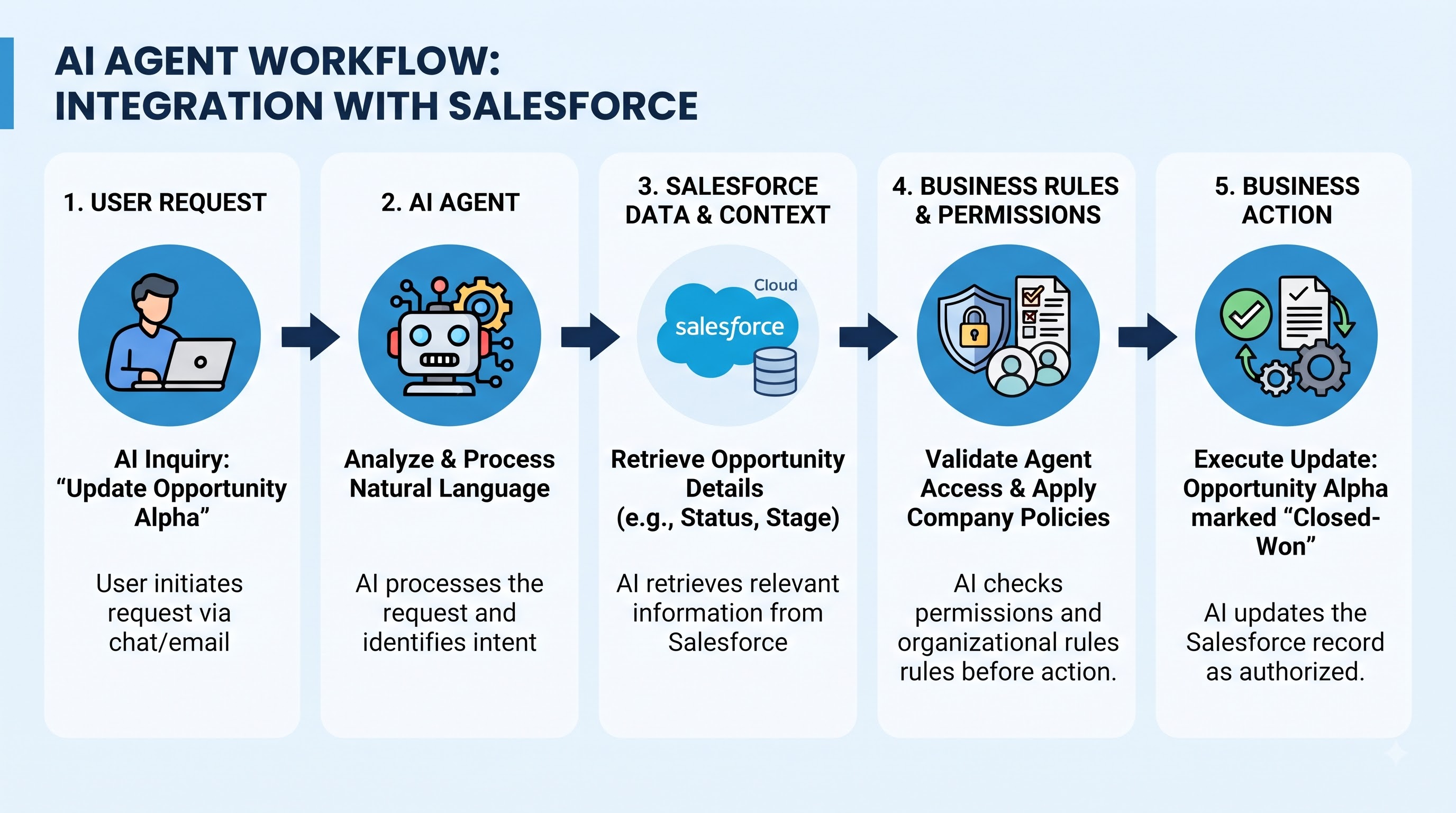
Salesforce calls this Model Context Protocol (MCP) to show that it wants a shared language for connecting AI apps to tools and services so each app does not need its separate integration. Salesforce says its Headless 360 MCP Server lets authorized AI agents find, understand and use these operations while keeping the permissions, workflows and rules as the rest of Salesforce. Simply giving an AI model data is not enough – it must work inside the rules of a business setting to be useful. In that way an AI agent can become a part of a business process, not just a tool, for answering questions that people have to ask.
From Data Access to Business Action
For years the conversation around enterprise AI centered on data. Companies wanted to link their data to AI models so employees could search documents summarize customer details or ask questions in language. That is still helpful. It only covers part of what is possible. The next step is letting AI use that data to do business tasks.
Take customer service for example. A customer might ask for an update on an order. An AI assistant could find the customer’s information. Give a reply. That’s useful.. The system becomes much stronger if it can check the order status spot any issues open a support ticket alert the correct team and update records based on company policies. Now the AI is not just fetching facts. It is taking part in business actions.
This is where Salesforce’s Data 360 and Headless 360 come into play. Salesforce says its Data 360 MCP Server can share customer context and support tasks like building models, transforming data, creating calculated insights, mapping fields, working with identity graphs forming audience segments and launching campaigns. The company recently announced expanded Data 360 API coverage as part of its 2026 360 plan.
The key idea here is that AI needs context to make decisions. A customer record by itself may not show what steps an agent should take. The full picture includes data relationships, definitions, workflows and permission rules—all of which help an agent know the move. That means Headless 360 is not about removing the browser. It's about making the core business environment available to any interface while keeping the structure that makes the data meaningful.
This change also shifts how companies think about automation. Of building a standalone AI assistant for each department, a business could connect agents to shared business tools. A sales agent, a service agent, a marketing tool or an employee support assistant could all use the underlying platform—each operating within their own permissions. This opens the door, to connected automation without having every team build its own tech foundation from scratch.
Why Security and Governance Are Important
The ability to access enterprise software from anywhere raises some obvious concerns about security. If Salesforce applications and their capabilities will become available through AI agents, applications, or other entry points, what those agents can do and what information they can access needs to be understood. The ability to provide a more pluggable and extensible system will require more careful attention to governance, which is why this particular aspect of the Headless 360 discussion takes center stage.
According to Salesforce, their headless architecture is designed in such a way that agents and experiences “inherit existing identity, permissions, compliance controls and governance rather than requiring new capabilities to be built for each interface.” This approach is critically important because an AI agent is different from an application that takes advantage of some headless features. An agent may decide which tools to use at any given moment and may have to perform multiple actions before reaching its conclusion. There are too many variables and too many steps involved in an agent’s actions for them to be appropriately governed at the UI level. This means that the controls and restrictions recognized by users of a headless application need to be embedded into the architecture at the level of the underlying business logic.
The same logic explains why Salesforce’s guidance is to focus on developing governance and permissioning practices that extend beyond the UI and into the rules and behaviors of objects and their relationships. When the UI is no longer the dominant feature of a system, the tools and rules that support it become more important than ever. In the context of a headless application or an AI agent, those rules and objects need to be evaluated and adjusted to ensure that they are appropriately restricting and directing the behavior of the users or agents.
For organizations that intend to embrace this architectural shift and the transformation that it requires, governance is something that should be considered before scaling up the initiative. Teams need to think through who has access to what information and what procedures are in place to analyze the data. Additionally, organizations will need to determine what rules and regulations apply to specific types of information and what measures can be used to monitor and manage activity. The more advanced the AI agent is, the more complex the tools, processes, and rules need to be in order to ensure appropriate levels of security and control.
Finally, this is where Salesforce professionals can make a difference. While the future state for Salesforce applications will involve far fewer screens and objects, there are additional considerations that go beyond the UI. This is why many of the recommendations produced by Salesforce suggest that administrators and developers gain a working knowledge of permissions, relationships, data quality and consistency, automation, and integration tools, and APIs. Someone who starts learning Salesforce today probably has a clearer picture of what the system looks like in the future.
Bringing Salesforce Into the Tools People Already Use
One of the ideas behind Headless 360 is that employees should not always have to change applications to complete simple tasks. People already spend much of their working day inside communication tools, email, collaboration platforms, development environments and specialized business applications. If Salesforce capabilities can appear inside those environments, the user experience can become more connected.
Slack is one example. Salesforce announced a Slackbot MCP Client that can connect Slackbot with Salesforce and other supported MCP servers. The company says this allows employees to perform activities such as updating Salesforce opportunities, retrieving contracts, launching workflows, and coordinating work across enterprise systems from conversations in Slack, subject to permissions and governance.
The value of this approach is not convenience. Context switching has a cost in business processes. Every time an employee has to leave one system open another search for a record, copy information, perform an action, and return to the conversation, there is an opportunity for delay or error. Bringing the capability into the existing workflow can reduce some of that friction.
The same principle can apply to developers. Salesforce says its platform can work with coding tools such as Cursor and Claude Code through MCP, APIs, Skills and CLI commands. Developers can therefore interact with Salesforce capabilities from tools that're already part of their development workflow rather than treating Salesforce as an isolated environment. For people building custom applications Salesforce is also expanding its Headless Experience Layer and Salesforce framework capabilities. The company says developers can use the platform with frameworks such as React and create experiences for web, mobile, embedded and conversational environments. The purpose is to separate the underlying business capability from the screen through which that capability is delivered.
That creates a shift in application design. Of asking, "How do we make users come into Salesforce?" teams can ask, "Where are users already working, and how can Salesforce capabilities reach them there?" It is a change in thinking, but it can have a major effect on how enterprise applications are designed,salesforce course .
What Headless 360 Means For Developers And Salesforcians (And Why Your Skills Will Not Be Useless!)
The rise of Headless 360 does not devalue existing Salesforce experience – on the contrary, it is expanded and given new meaning. While the ability to use the underlying infrastructure of Salesforce is still required and involves objects, data, automation, security design, business processes, integration points, and logic, the ways in which they can be utilized are changing.
A developer working with the new Headless 360 will have to become familiar with APIs, MCP, authentication and permissions, metadata, event-driven development,
AI-assisted tools, and much more, apart from Salesforce development technologies. According to Salesforce’s documentation on headless development, their product allows developers to access the critical functions of the software through open APIs, tools for change management, and command-line interface (CLI) commands for programmatic access by humans, programs, or AI-powered agents.
For administrators, the new toolset shifts the focus back on the data and governance. As long as there is no high-quality production data, there cannot be useful models in any environment. When an AI agent utilizes production data to train an algorithm, it does so at the speed of real-time transactions. If there are mistakes or faulty logic in the data, these issues will be incorporated in the new processes ten times faster than when humans perform the same task.
In other words, the quality of the data, the logic behind it, and the permissions matrix has a more significant impact on how useful an AI agent will be than the sophistication level of the AI model itself. That is why building a productive, trustworthy, and compliant Salesforce environment requires a lot more than just “plugging in” an AI agent. It is critical to invest time and effort into ensuring that the existing rules, processes, automation, and data meet all the requirements for quality, control, and governance.
As a result, proficiency in Salesforce technologies will continue to be a valuable professional skill, but it should be expanded to include an understanding of how data is being used and manipulated in the modern enterprise. The best way to learn salesforce for a career shift is not to focus exclusively on the tools and infrastructure but to build a comprehensive view of the system. One does not need to become familiar with all aspects of Salesforce and AI to understand the first lesson – the infrastructure. It is always useful to have a basic understanding of how the technology works before diving into the details of automation, programming, or configuration. By the same token, the deeper layers of configuration and data processing should be understood as a single integrated whole rather than a set of disconnected topics.
The Bigger Shift: Salesforce Without a Traditional Front Door
The most exciting aspect of Headless 360 is not a particular MCP server, API, or dev tools. The real architectural shift is that enterprise apps have traditionally been organized around the interface. But Salesforce is showing how the underlying business capabilities can be decoupled from any particular interface or accessed through any particular surface.
This includes not only a human-Salesforce interaction but also an employee using Slack, a dev using an AI coding assistant, a customer using some sort of custom application, or an AI agent performing some background task. All these diverse modes of interaction can be enabled by a common set of underlying business logic, data, permissions, and governance. Salesforce is describing this approach as making the apps “reusable as enterprise capabilities.”
We also shouldn’t underestimate the philosophical shift happening here. The idea is that AI agents are yet another interface for engaging with business systems. But instead of requiring an employee to navigate five different applications, they can explain the desired outcome to an authorized agent and let it do the tedious work. Of course, there’s plenty of nuance and complexity, and I would not describe this as a silver bullet for all the issues with enterprise applications. You still need your data to be reasonably clean, have properly established procedures, sufficient security and governance, monitoring, human oversight, and control points. You also have to accept that AI models are prone to errors, and giving them authorization to perform actions increases the risk of material mistakes compared to a scenario where humans directly review and approve every action.
With this architecture, Headless 360 is not necessarily a tool for getting rid of humans from the process. Instead, it enables diverse modes of work and provides opportunities for people to contribute in meaningful ways if their expertise is needed at a particular point. The overall approach seems to be more about “meeting people where they are” rather than insisting that humans must learn to use yet another enterprise application.
The 2026 edition makes it clear that the future of Salesforce is not a CRM app that one uses to perform a set of pre-defined tasks through a browser interface. Their investments pay off with the emergence of the Headless 360 architectural pattern that encompasses not only MCP but also Data 360, Skills that can be reused in various contexts, Slack integration, dev tools, and headless experiences across different Salesforce clouds. They realize that the applications and agents of the future will consume the business capabilities they expose through these different interfaces.
Conclusion
Overall, Salesforce Headless 360 is an important architectural shift that makes enterprise apps accessible through various modes of interaction. Instead of being the application “inside of which” employees perform their work, Salesforce is now enabling these capabilities to be delivered through different interfaces, applications, and even AI agents.
But the significance of this shift becomes even more profound when we consider AI agents. Such a tool cannot be productive in an enterprise environment unless it has access to the right data and business logic. And that’s where the Headless 360 architecture comes in – it enables an AI agent to have the same capabilities as an employee would have if they used the Salesforce interface. This is significant for several reasons. First, it might reduce the amount of boilerplate code needed to expose application capabilities to an AI agent. Second, it enables business logic to be reused across different applications, modes of interaction, and even humans. And third, it enables developers and administrators to use their deep knowledge of business logic and data in their professional capacity rather than trying to teach AI models through examples during the training phase.
In other words, I think that Salesforce Headless 360 is important because it rethinks the role of enterprise applications in the context of AI augmentation. By making application capabilities available through different modes of interaction, it enables a more fluid work environment in which the employee or an AI agent can get the job done without having to find, open, configure, and learn a new application each time they want to perform a simple task. And this ability to “get the right business logic in the hands of the people and AI agents who need it” is the primary value proposition of this architectural shift. The rise of AI agents in the enterprise will transform how work gets done, but the fundamental truth will remain the same – the application is just a means of getting the needed business logic to the person who needs it.