
Salesforce Platform Explained: Understanding Its Ecosystem
Last updated on Oct 30, 2026
Introduction to the Salesforce Revolution
Enterprise software experienced a big revolution during the last twenty years. Instead of using heavy applications that occupied lots of space in the server rooms, required a big IT department for the maintenance of the IT infrastructure and could not be upgraded fast enough, the cloud computing technologies were introduced. And among the biggest innovations in the sphere of the digital revolution, Salesforce appeared. Although at first Salesforce was considered to be revolutionary SaaS CRM application, nowadays it is far beyond application and is a complex integrated global ecosystem, which revolutionizes business processes, customer interaction and application customization.
For a better understanding of Salesforce it is important to consider not only its applications but also the platform and the ecosystem behind them. Salesforce is unique compared to other products by the complexity and diversity of its ecosystem including all sorts of elements ranging from cloud pillars to the application platform and marketplace, artificial intelligence, community of developers and other. In the present paper the emphasis will be made on the Salesforce platform and ecosystem behind it, on the principles of the Salesforce architecture and its major cloud pillars.
The article attempts to examine the Salesforce architecture, assess the characteristics of the architecture, examine some important cloud components in the Salesforce architecture, and provide an overview of the ecosystem that makes sure that the business succeeds. Those professionals who want to join this highly desired ecosystem should begin by enrolling for a salesforce course online.
The Architecture Foundation: Multi-Tenancy and Metadata
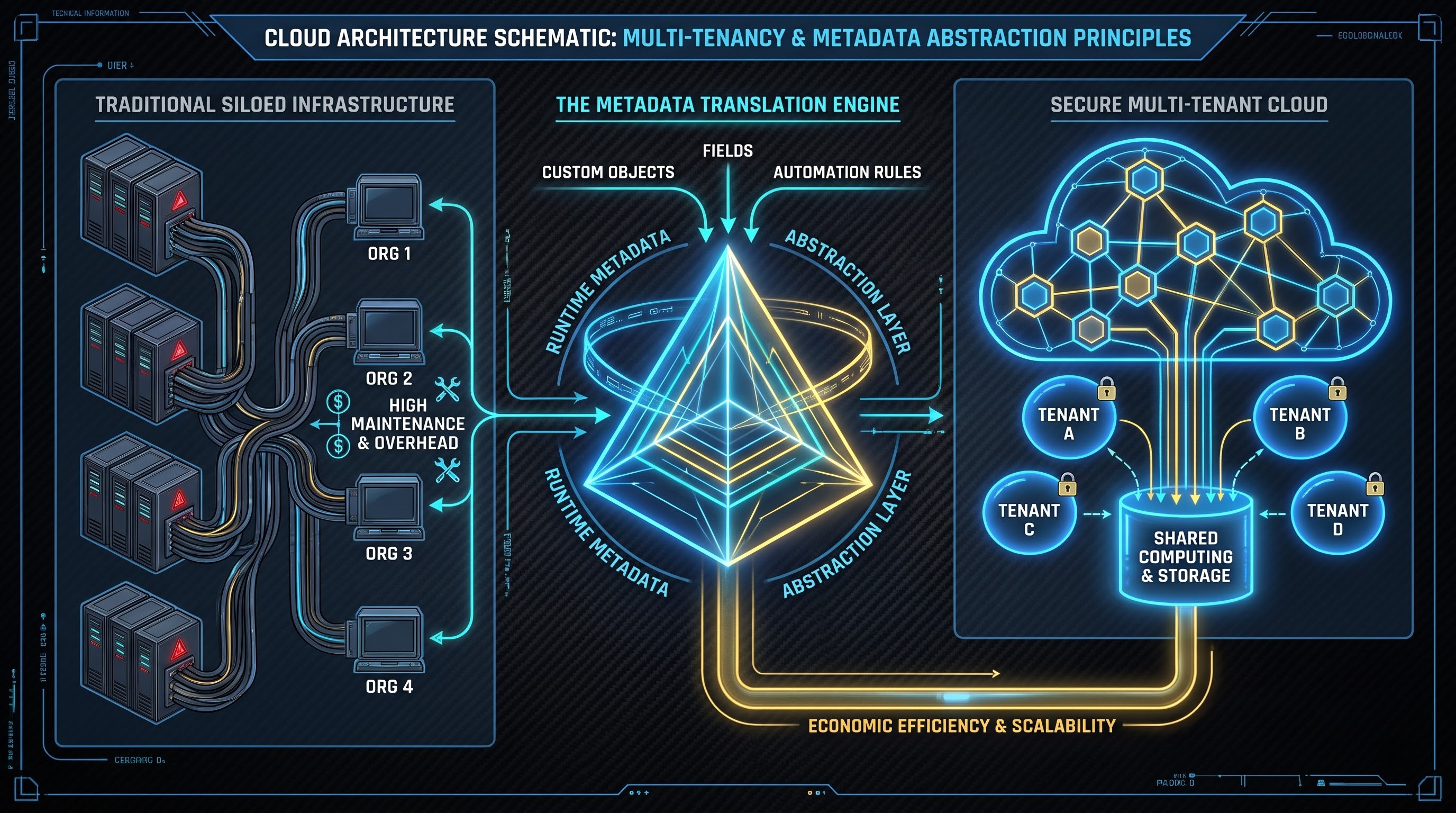
The main advantage of Salesforce platform lies in providing highly scalable architecture enabling various organizations from local small companies to global enterprises to utilize the same platform without any difficulties. Salesforce architecture is based on the principles of multi-tenancy and metadata-driven development.
The principle of multi-tenancy is one of the most important concepts in cloud computing economics. According to the multi-tenancy concept, several clients called tenants use one common infrastructure. Unlike the situation in traditional computing when every organization has its own hardware, in Salesforce there is only centralized infrastructure but there is the logical separation of every tenant. Thus, despite the fact that several organizations use the same computing power, storage and core services, all information is secured and protected.
Multi-tenancy provides a wide range of benefits for users: there is no need for manual updates since the platform updates several times a year automatically for all customers without violating the business logic of customized applications.
The second approach that suits multi-tenancy is a metadata driven development. As far as concerns traditional software environment, any alterations in data structure or logic should be done within the existing source code and require recompilation. Salesforce uses metadata, i.e. «data about data», in order to achieve abstraction on database level. Thus, each time developer or administrator creates custom field, object or workflow automation, he or she does not write code, but metadata, which is executed dynamically by Salesforce engine. Consequently, customizations and core platform code are independent. This means that at the moment of seasonal update of the product by Salesforce, all customizations are the same and work well. Such an approach gives companies the opportunity to be flexible and innovative and deal with new situations without paying technical debt.
The Core Product Clouds: Specialized Products for Different Departments
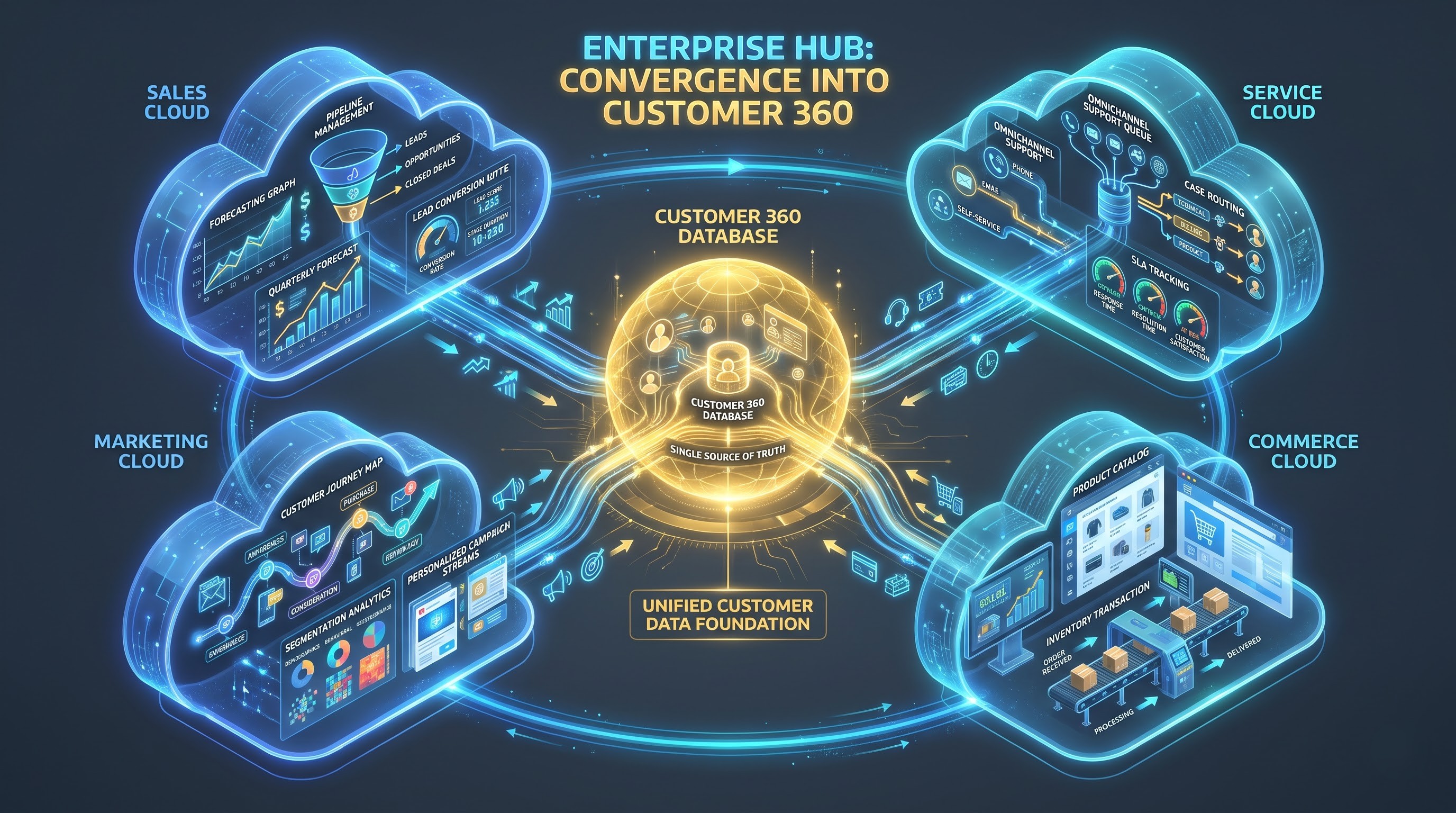
When it comes to platform, it provides the engine, while the customer side of the ecosystem consists of specialized product clouds for different departments, but integrated into one database called Customer 360.
Sales Cloud
Sales Cloud was earlier known as the backbone of the Salesforce software package. The main purpose of Sales Cloud is to assist in lead management, opportunity management, sales forecasting, and efficient sales for the salesperson, sales manager, and administrative assistants. Centralizing all customer information and history of interactions in one single place helps in removing data silos among team members. The visualization will help the manager identify issues with sales pipeline management, lead scoring, and automating administrative activities like logging emails and scheduling callbacks.
Service Cloud
Just customer acquisition is not sufficient; customers should be satisfied and retained. Service Cloud can help your business improve your customer services by providing one place where you can deal with customer service requests from various channels such as telephone, emails, live chat, social media networks, instant messaging applications, and so forth. Service Cloud has an intelligent case routing system that automatically routes tickets of customers to the correct agents based on various factors such as skillset of the agent or availability of the agent. Other features of Service Cloud are SLA management, knowledge base, and workflows.
Marketing Cloud
The Marketing Cloud offers an opportunity for designing and implementing digital marketing campaigns through emails, mobiles, social media channels, and webpages. Contrary to the conventional process of broadcasting message, the Marketing Cloud focuses on journey management of the customers. Understanding the real-time behavior of the customers and providing custom communication according to the customers’ preferences, past purchases and interactions are the core aspects of the Marketing Cloud. Using the advanced segmentation and analytics dashboard helps to enhance the ROI by identifying the right customers and the right messages.
Commerce Cloud
The Commerce Cloud caters to both business to consumer and business to business retailing models and gives the required platform for online digital store. Combining both the online and offline shopping experiences, the Commerce Cloud gives the required platform to manage the whole process of product catalog, inventory management, pricing and payment options. Using the personalization engines in the Commerce Cloud, the visitor gets a personalized shopping experience.
Salesforce Platform: From CRM to Beyond
Earlier, Salesforce was considered by the organization as an information storage platform, where all the information about the sales pipelines of the companies was stored. However, with the advent of the Salesforce Platform (formerly Force.com or App Cloud), there was a paradigm shift in the sense that Salesforce became an advanced PaaS platform which made it possible for the organizations to create customized applications beyond the purview of CRM based on the features of the platform.
Salesforce Platform allows technically proficient developers and non-technical business professionals to work together due to the availability of different application development platforms. In addition, there are many low-code and no-code platforms available for administrators and analysts, such as Lightning App Builder and Flow Builder, through which they can build their user interface, automate the business processes and build full-fledged applications through the drag-and-drop process. All of this can be done without writing even a single line of code.
The processes allow the secure and quick transfer of data from Salesforce to various ERP systems and database applications, data warehouses, as well as to other web applications. Developers undergo salesforce online training to get practical experience regarding custom application development and flow builder and apex code writing.
On the other hand, when a higher level of customization is needed, professional developers have access to the developer-centered platforms. Apex is an object-oriented language that is executed on the multi-tenant servers and allows developing complex business logic and triggers and controllers. The front-end can be developed using Lightning Web Components in accordance with the modern web standards.
Also, the integration capabilities play an important role in creating a versatile platform. Knowing that Salesforce does not work in isolation, the platform offers a full-fledged Application Programming Interfaces that include REST, SOAP, Bulk and Streaming APIs. The listed protocols allow transferring information securely and in real-time from Salesforce to the external enterprise resource planning systems, legacy databases, data warehouses and third-party web applications.
Artificial Intelligence and Modern Data Intelligence
In connection with the coming of the era of artificial intelligence and efficient data management within organizations, Salesforce has introduced intelligence into its architecture. It is worth noting that Salesforce treats the artificial intelligence not as a standalone feature but rather incorporates its cloud services around machine learning models.
The technologies used for prediction base on the analysis of the historical data of the customer and predict the future. Thus, for example, the salespeople receive predictive lead scoring that helps them choose the most promising leads to convert them. Concerning customer services, chatbots would be responsible for answering any customer inquiries 24/7, giving instant responses on simple queries, forwarding the difficult problems to humans and offering solutions to them. In addition, due to predictive analytics, it would be possible to establish the right time to send an email and the channel to reach certain customers.
The issue of data management is important in creating a smart system. In order to implement AI technologies properly, it is crucial for the organization to integrate various data sources from different organizational units into one view.
The AppExchange and Partner Ecosystem
No discussion of the Salesforce platform would be complete without the consideration of the socio-economic context in which it operates. One of the key elements of the ecosystem is the AppExchange – cloud market developed by Salesforce.
The AppExchange looks just like any other regular app store, but it is designed specifically for business software solutions. Thanks to the AppExchange, one will be able to discover many different solutions that have already been tested by the consultants who work with the native Salesforce platform. In case when some additional functionality is required, such as more complicated document generation and signature services, some particular tax calculation rules for a certain type of industry, or some unusual accounting integration, one does not have to create it. All one has to do is to visit the AppExchange, read the reviews, and simply install it into his or her Salesforce, without any trouble. This will make the process of adding value much easier and will help form a software vendor community for the Salesforce platform.
In addition to the large number of software vendors, Salesforce relies on consulting and system integration companies and on a variety of individual experts. The digital transformation of the entire enterprise is a complex process.
The force needs to be driven by Trailhead, which is a learning platform offered by Salesforce for free and is also gamified. Using learning paths, coding challenges, and certifications offered by the learning platform, any person from college students to people changing their career paths can be trained to become administrators, developers, architects, and consultants. The globally recognized certifications received through this learning platform have helped create an active job market all over the world.
Enterprise Governance, Security, and Trust
If the organization is using cloud services to store its valuable asset in the form of customer data, then security cannot be of secondary importance. The fundamental idea behind Salesforce is that trust is key, and it has adopted a multi-layered approach to securing data.
Strong identity and authentication techniques are vital for platform governance and include multi-factor authentication and single sign-on options. After the users get authenticated, then role-based access control framework determines what kind of information they will have access to and what actions they could do with this information. System administrators are able to create default corporate roles, policies and permission profiles in order to ensure that the employees would have access only to the information concerning their duties. Field-level security allows managing access to the data on field level, thus providing the company with an opportunity to regulate access to certain fields of the record.
Moreover, Salesforce meets all the international regulations, such as GDPR, HIPAA and regional financial regulations and thus provides organizations working in regulated industries such as healthcare, financial services or government sector with the possibility to utilize cloud computing services without the risk of violating any of the regulations. Audit logging, event monitoring and encryption tools will allow having full control and tracking of user actions.
Going Global: Industry Specialization and Salesforce of the Future
As technology continues to advance, enterprise software becomes something that can no longer be developed in a generic way. Whether it is a financial institution, health care institution, manufacturer, or even a government body, all such organizations have their own rules and regulations. This is precisely why Salesforce has made significant progress beyond its generic CRM and ventured into vertical markets. With the help of creating an architecture according to specific requirements, Salesforce has been able to position itself from a business utility to an industry operating system.
For instance, in regard to healthcare and life sciences, the organization needs to comply with the complex regulation of patient privacy, fragmented healthcare industry, and the need for integration and empathy. In such a scenario, the enabled vertical solution that Salesforce has developed helps in having a single platform for EHR (electronic health records), patient engagement application software, and healthcare provider management. This way, the care coordinator will be able to monitor the patient's progress across various locations, remind the patients about their appointments automatically, and stay compliant with all the regulations while keeping up with the speed of the digital world. The same case can be seen in the financial services industry as well. In such a scenario, wealth managers and retail banks use the custom overlays on the cloud in order to understand their client's entire portfolio, track their life events when they need financial assistance, and be compliant without having to worry about any security issues.
Integration and Enterprise Connectivity Evolved
There can be no such enterprise application that would exist in isolation. Litmus test for the modern platform should be in capability of working with data in the environment of complex IT architecture. The modern company works with the hybrid model, which implies the presence of the traditional mainframe IT architecture, the cloud data warehouse, the software solutions for every business unit and even custom applications. Increasing amount of data produced by the company and increasing speed of the processes makes the classic method of integration with point-to-point connection vulnerable and costly.
In this context, Salesforce offers a solution in the form of integration and data orchestration layer. Rather than creating point-to-point connection with the help of API development, companies use the integration platform, which allows connecting hundreds of enterprise applications using ready-made connectors. In this way, data engineers create data flow maps and make transformations and synchronization of data between Salesforce and other applications in real-time or in batches.
In addition, the concept of event-driven architecture has gained increasing relevance in the sphere of integration. This approach makes possible publishing and subscribing to events in real-time mode instead of constantly polling the database for changes. For example, when the customer changes the shipping address at the external ecommerce website, the system publishes events that would lead to instant updating of the Sales Cloud, Service Cloud and the billing system. Decoupling via this mechanism ensures that all of the company's departments operate with the same up-to-date context of information.
Organizational Change Management and Digital Agility
The development of a reliable technological infrastructure, such as Salesforce, is the primary step towards obtaining value from the company's investment. However, the value creation is mostly based on human factor and organizational aspects. In most cases, the problems associated with digital transformation are not connected with technology but with the reluctance of users and non-functionality of processes. With the emergence of the powerful platform that encompasses all processes of the organization, employees require a shift in mindset and processes.
Good governance processes must be established in the implementation of Salesforce as this is the way of communication between IT and the business. The COE model requires the activities of cross-functional managers concerning the prioritization of requests for the features, assessment of proposals on custom development, and technical cleanliness of the platform. The identification of the developers of automation, requirements to the modelling of data, and situations when custom development is not required and it would be better to use native features will help to prevent technical debt.
Not less significant is the encouragement of continuous learning and digital culture within the organization as the platform of Salesforce is updated quite often. Thus, digital transformation becomes an ongoing process for any enterprise. Employees should be motivated to participate in training programs, receive certification, and actively engage in communities.
All the features of the Salesforce system are very useful. Nevertheless, the major benefit of this system lies not in technical aspects, but in the fact that people can work smarter using the system.
Conclusion
The Salesforce solution is not just one of the most revolutionary ones regarding cloud-based CRM but also represents the major operating system of modern business. With the help of the multi-tenant architecture and approach to the development which is based on metadata, Salesforce offers a possibility to integrate all sales, services, marketing and commerce processes in one common database.
With the help of the well-elaborated platform layer, organizations can develop custom applications, automate processes using the technique of low-code development and connect with legacy systems using the APIs. The technology layer is supported by the amazing trinity that consists of artificial intelligence, AppExchange community and global community of professional people who are ready to learn during their whole life. It is vital to know the Salesforce platform ecosystem to be successful in the digital world.
Since the digital revolution has an effect on all domains, there is a need for knowledge regarding the Salesforce ecosystem. Be it skill improvement for the employees of your organization or enrolling yourself in the salesforce classes online, your knowledge of the ecosystem can open all the doors for you.