
Salesforce Webhooks and Event-Driven Architecture
Last updated on Oct 1, 2026
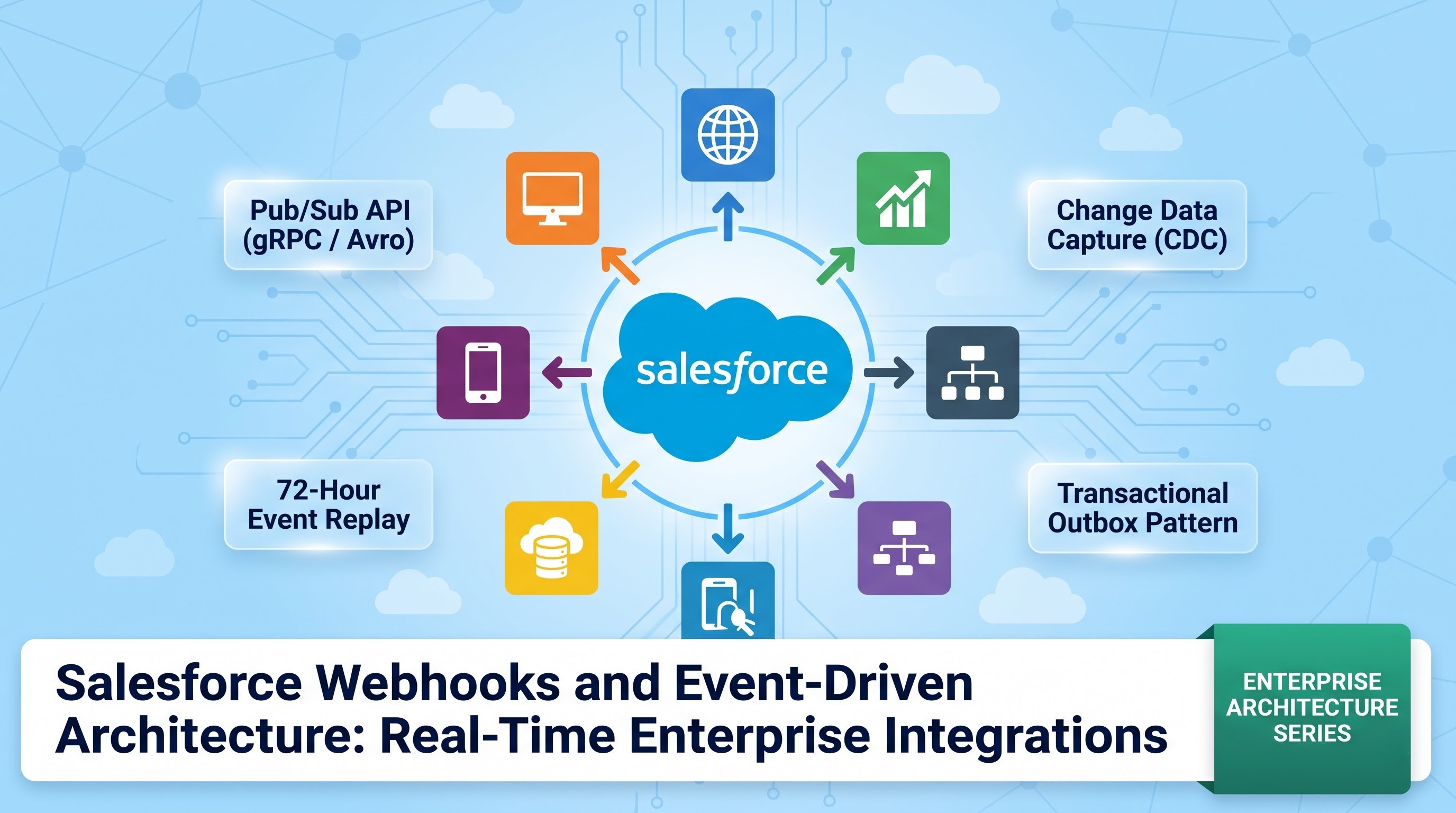
New business ecosystems cannot depend on older paradigms of synchronization again. In a fast-paced environment, basic customer platforms must convey state transition information at the same time among various distributed services. Enterprise resource planning systems, fraud detection systems, data lakes, microservice meshes are all in need of instant knowledge of transaction milestones.
In previous decades, the way to implement this was through applications of batch jobs or person-to-person webhooks. However, as distributed systems develop, person-to-person connections form fragile webs of dependencies. System failures happen at the source of the problem, and API governor limits are quickly faced.
To overcome all these problems, modern Salesforce architecture has begun using event-driven architecture (EDA). By combining the ideas behind webhooks with decoupled marketplace solutions, organizations have found a way to implement a real-time and reliable integration solution. This is what this document is about.
The Change of Paradigm: From Request-Based to Event-Based Systems
Conventional enterprise integration depends primarily on the synchronous request-response model. The client sends a request via HTTP, and the server processes the message while waiting for confirmation from the client.
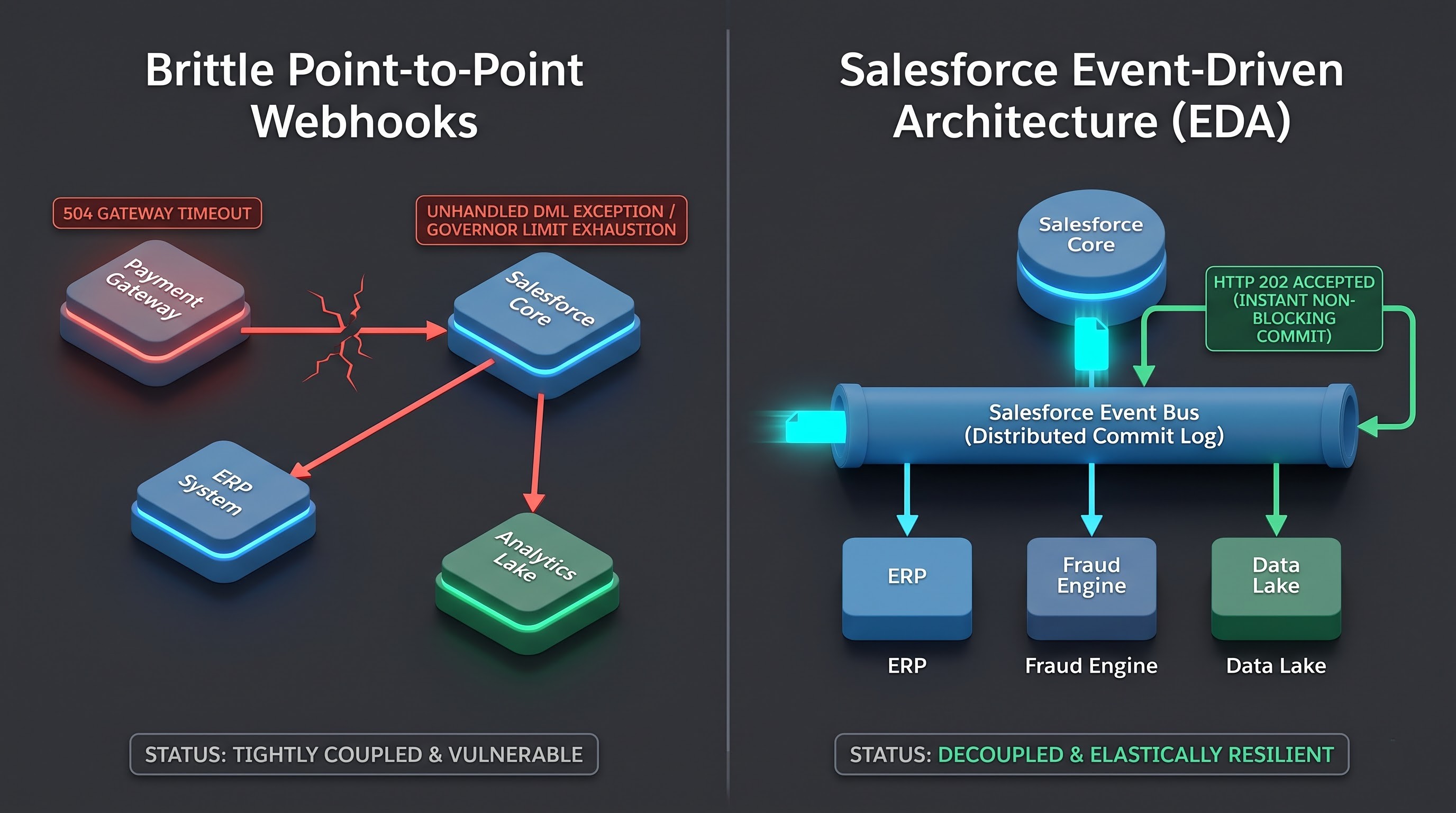
Although simple, this paradigm poses severe architectural constraints in the enterprise environment.
Temporal Dependency: The producer and the consumer must be available and connected at the same time. If there is a failure in the payment gateway downstream, the transaction initiated in Salesforce can fail as well.
Dependency on Payload: The calling party must know frequently the structure of the message sent downstream as well as routing rules and business aspects of the receiving party.
Point-to-Point Vulnerability: If the number of applications grows, the company with 20 independent systems has to create hundreds of individual connections, making it impossible to maintain them if changes in the message structure are required.
Unwise use of resources: Polling creates a situation where external applications check for changes in records in Salesforce using REST APIs or SOAP protocols, wasting resources for unused communications.
The relationship in Event-Driven Architecture is reversed. In this case, instead of waiting for queries or enduring open connections during prolonged operations, the architecture records changes in the state using immutable and discrete messages called events. The encryption of the event occurs without any knowledge of the identity, number, or processing mechanisms of the ultimate receivers of the message.
The subscribers sign to some specific stream and accept information at the speed convenient for them, and thus the principle provides a number of important advantages.
Decoupling: The receivers are completely independent from the sending party. Therefore subscribers can be introduced into the existing economic system without even rebooting Salesforce.
Asynchronous operation: As a result complicated combinations of several systems may work simultaneously without bothering the users from the financial transactions.
Elastic resilience: In the situation when a consumer at the edge goes to the offline mode the event broker saves the incoming data and can resend it ready to receive the necessary volume of transactions when the consumer is back online.
Anatomy of Webhooks and Events: Definitions and Nuances
The words webhook and event are often regarded as synonymous in the context of integration engineering. Although they are related concepts, they describe two different technical architectures that are applied on different abstraction levels.
What is a Webhook?
In essence, a webhook is a callback tool that works via the HTTP protocol. It is often viewed as a reversed API or REST call. In the standard case of using the API, client applications retrieve the data from the provider. In the case of a webhook, however, the provider transmits data to the specified URL of the client automatically as soon as a specific event occurs.
Webhooks on the transport level can be characterized as point-to-point and synchronous. The sending system starts an HTTP POST with a JSON or XML payload to the receiving server. The receiving system should be able to read the payload, acknowledge the receiving, and provide a reply about all the validations during the processing of the HTTP request.
What is considered as an Event?
Events can be defined as formal and unchangeable notifications on a visible state change that has occurred within the parameters of a certain domain. A very important aspect of this definition is that an event is a statement of an impact that has happened previously, being an objective statement instead of a call or instruction for realization of something by another domain.
Events include standardized metadata like a code, timestamp, event type code, and schema definition, and a payload in the domain expressing changes of certain values or a full picture of the entity.
The Comparison of the Mechanical Profiles
The observations of the work differences between classic webhooks and distributed event streaming methods show major contrasts across important groups of comparison.
Topology: Webhooks represent a direct connection from one sender or source to only one designated receiver or destination endpoint. The events are processed based on a pub-sub mechanism in which one message triggers the receiving of the same messages by any number of.
Transport Mechanism: Webhooks work using standard HTTP/HTTPS POST requests. Modern event fabrics use much more advanced and optimized techniques and protocols like gRPC, HTTP/2 multiplexing, or Apache Kafka consumer loops.
State and Durability: Standard webhooks have no functionality that contributes to message retention or re-indexing; in case the receiver fails to reply to the transmission, the delivery is based on any algorithms determined by the vendor. The events do remain in durable and distributed logs for as long as it is necessary within specified by user limits.
Backpressure Management: In the webhook network, the traffic is controlled by the sender and may thus lead to spikes on downstream endpoints. The event system uses the pull model where the subscriber has the absolute power to regulate its consumption.
Traditional Webhook Patterns in Salesforce: Functions and Challenges
Salesforce has provided the ability to send outbound notifications via HTTP for many years. Understanding how these outdated mechanisms operate clarifies the reasons why contemporary enterprise infrastructures are evolving toward sophisticated event streams.
Sending Messages Out
Sending Messages Out is a process in the workflow and flow process that consists of passing messages in the SOAP format via HTTP to external web services.
Sending Messages Out includes an integrated retry mechanism. In case the receiving end does not send back a properly delivered SOAP response, the system takes the message and retry sending it according to the rules of the burst current with a certain period at least for twenty-four hours.
Nevertheless, Sending Messages Out has serious architectural limitations:
It is strictly related to SOAP/XML as well as is contrary to modern standards of using JSON.
Messages are strictly tied to either standard or custom Salesforce object field schemas resulting in close binding between communication models.
A spike in inbound retries may cause extra issues for downstream services restoring from outages.
Programmatic Callouts using Apex
A developer can write HTTP requests using Apex programming language on APIs and webhooks after making changes to the database. A solid knowledge of asynchronous Apex callouts requires salesforce dev training from OnlineITGuru in order to avoid problems caused by unforeseen DML exceptions.
Although this is true that programming callouts in Apex gives a programmer the freedom to create various header formats, authorization methods, and serializations of JSON, using it in business processes has a number of limitations.
Restriction of the Callouts After DML: There is a strict rule in Salesforce about keeping the transaction integrity that restricts any callout to be done in the same transaction. Otherwise, an unhandled exception will take place. The limitation helps to avoid inconsistent distributed status of data which happens in case of disruptions in a network.
Washout of Limits on Execution: If a programmer needs to use Apex callouts, he or she needs to use some different execution approaches to make it work. So, he or she will have to spend asynchronous governor limits, which can only reduce the visibility of the transaction.
Vulnerability of Retry: Failure of an asynchronous job caused by network problems leads to making it necessary to create special and unique systems for logging errors as well as separate queues for retrying.
Flow-Driven HTTP Callouts And External Services
The new declarative technology in Salesforce enables administrators to configure REST API calls without the need to write code in the Flow Builder tool. Using the OpenAPI specification, external endpoints are converted to invocable actions.
Although this makes it easier to build integrations, it still has caveats associated with point-to-point communications, i.e., synchronous dependency on external endpoint response delays, limitations on execution time, and administration of link credentials and schemas.
The Salesforce Event Fabric: Fundamental Event Streaming Mechanisms
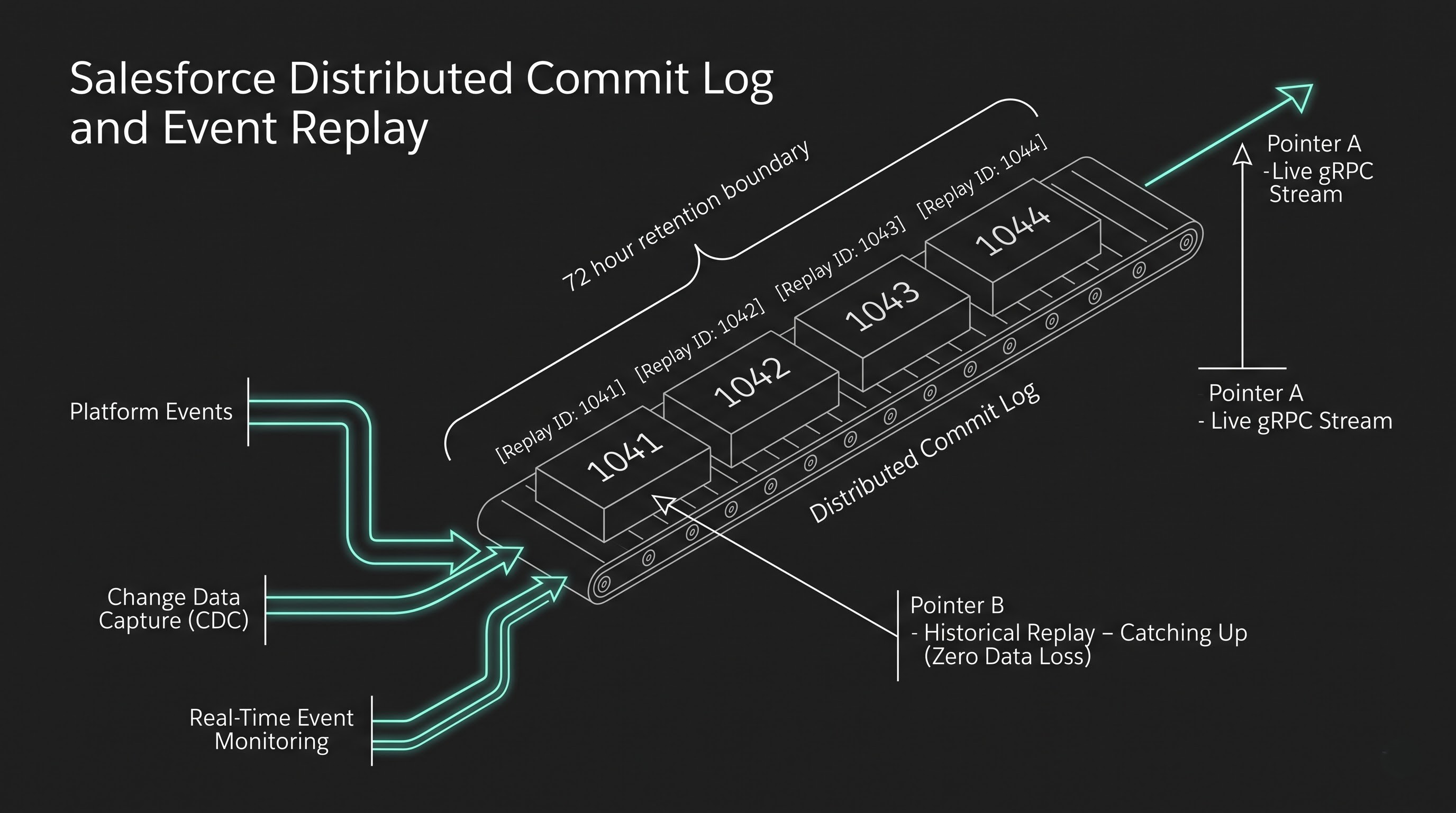
To overcome the limitations of point-to-point web services, Salesforce has created an enterprise-class event bus that is based on the concept of a distributed log using the architecture similar to Apache Kafka.
The Salesforce Event Bus decouples the publish and subscribe mechanisms by utilizing the commit log which is ordered and permanent in nature. As messages are placed on the bus, they are retained for some time (usually for 72 hours) so that clients can disconnect and then reconnect to the point of message processing.
Salesforce organizes events on this bus into different groups depending on business intention, flexibility of schema, and methods of emitting.
Platform Events
Platform Events are unique custom events developed by developers and created in the Salesforce metadata layer. These events are just like custom database objects wherein they have defined schemas made up of different data types like texts, numbers, boolean values, and structured JSON strings.
Platform Events are developed to share the business reasoning for their occurrences instead of sharing the actual database operations. For instance, rather than sharing a message saying that an Opportunity record changed the stage fields, an application can share a message saying that an Order was made or that a Fraud was detected.
There are two modes of publishing utilized by Platform Events:
Publish After Commit: The event message enters the event bus only after the original Salesforce operation finishes and is committed to the database. If the operation is rolled back because of a validation rule or a failure exception, the event is canceled. This makes sure that no external systems are informed about any business events that were not committed.
Publish Immediately: The event message is published to the event bus as soon as it is called, regardless of whether the surrounding processes were committed or rolled back. This approach is necessary for business error logging, distributed logging, and security alerts which should continue even if the business transaction fails.
Change Data Capture
Change Data Capture (CDC) is a native stream-processing technology that automatically publishes notifications every time records of an object are created, read, updated, deleted, or undeleted.
CDC does not require any custom trigger or flow code to publish messages. When an object is activated for CDC in the system configuration, the data storage database logs are watched, and the corresponding standard notifications are published to the bus.
Some of the key characteristics of Change Data Capture are:
Header Metadata: Each CDC payload carries a comprehensive metadata header that contains the transaction identifiers, commit timestamps, user ID, source of events, and the operational flags (such as create or update).
Delta Serialization: In the course of the record update, CDC payloads do not serialize the entire entity record, but send only those fields that have been changed in the current transaction. This results in the reduced size of the payload for high-frequency write actions.
Transaction Grouping: Many updates within a single database commit transaction are referred to a single transaction ID in their event headers. Thus, an external system can re-create the ACID transaction boundaries with the required accuracy.
Real-Time Event Monitoring
Real-Time Event Monitoring gathers all operational, security, and administrative events that occur within the Salesforce platform. These events enable monitoring user logins, reporting activity, API command execution, credentials access, and videos viewing.
Whereas they do not perform the core business logic, these events enable Security Operations Centres and other external systems to collect the real time audit logs and reveal suspicious access methods thus ensuring compliance governing.
Current Standards for Event Processing and Receiving
Transitioning to an event-driven system requires effective and high-speed communication protocols such as the Pub/Sub API and Event Relay. Taking up a full-fledged salesforce development course at OnlineITGuru teaches the necessary and practical skills to help both architects and engineers work with gRPC consumers, manage Replay IDs, and work with high-volume distributed streams.
Salesforce’s Pub/Sub API
In the past, external systems were able to connect with Salesforce’s message bus using the older Streaming API which was based on the CometD library utilizing the Bayeux protocol. The CometD library had certain drawbacks such as excessive memory consumption, difficulty establishing connections, lack of support for different programming languages, as well as unavailability of true two-way streaming.
The state-of-the-art is Salesforce’s Pub/Sub API which uses gRPC and HTTP/2 to create a very efficient, reliable, and swift interface that allows for various languages to be used.
Binary Serialization Using Apache Avro: The payloads get serialized through the use of Apache Avro format rather than lengthy JSON or XML text strings. This contributes to simpler data packet sizes, lesser CPU overhead in serialization as well as stricter schema contract enforcement.
Pull-Based Flow Control: Unlike older push systems that can overburden terminal users, the Pub/Sub API utilizes pull subscription systems instead. The consumers send requests to fetch exactly how many messages they can receive in accordance with their computing capacity thereby enabling back-pressure management in real time.
Single Interface: The only gRPC endpoint takes care of publishing and subscribing for Platform Events and Change Data Capture and Real-Time Monitoring thereby eliminating the need for multiple API integrations.
Event Replay Mechanism and Determinism
The key feature that sets the Salesforce Event Bus apart from regular webhooks is the ability to replay events. Once an event is sent to the bus, it is assigned an opaque incrementing pointer called Replay ID.
In case an external consumer is subscribing to events through the Pub/Sub API, they can provide an exact Replay ID in order to choose the start point of event consumption:
Earliest Retained: The consumer demands all events preserved in the retention log at the time of request.
Latest / Tip of the Bus: The consumer has the right to obtain only new events that have been posted after the connection is established.
Specific Replay Marker: The consumer provides an exact Replay ID that refers to a message that was earlier delivered and stored in the local store. Salesforce Event Bus starts streaming based on that identification mark.
The replay feature solves the problem of losing data during unplanned downtimes. In case an external service was out of order for eighteen hours, it can go back online, authenticate itself, provide its Replay ID, and deal with the backlog without any human effort.
The Event Relay
Event Relay serves as a native managed channel connecting the Salesforce Event Bus to cloud external event brokers.
Salesforce manages the connection lifecycle, transport authentication and Replay ID tracking behind the scenes. This enables serverless compute architectures (e.g. AWS Lambda functions or Azure Functions) to be directly triggered by Salesforce state changes, bridging the gap between internal CRM operations and external enterprise event fabrics.
Architectural Patterns: Linking Webhooks and Event Streams
Building enterprise ecosystems is about bridging the functional gap between incoming webhooks from external systems, internal processing and outbound distribution to downstream consumers.
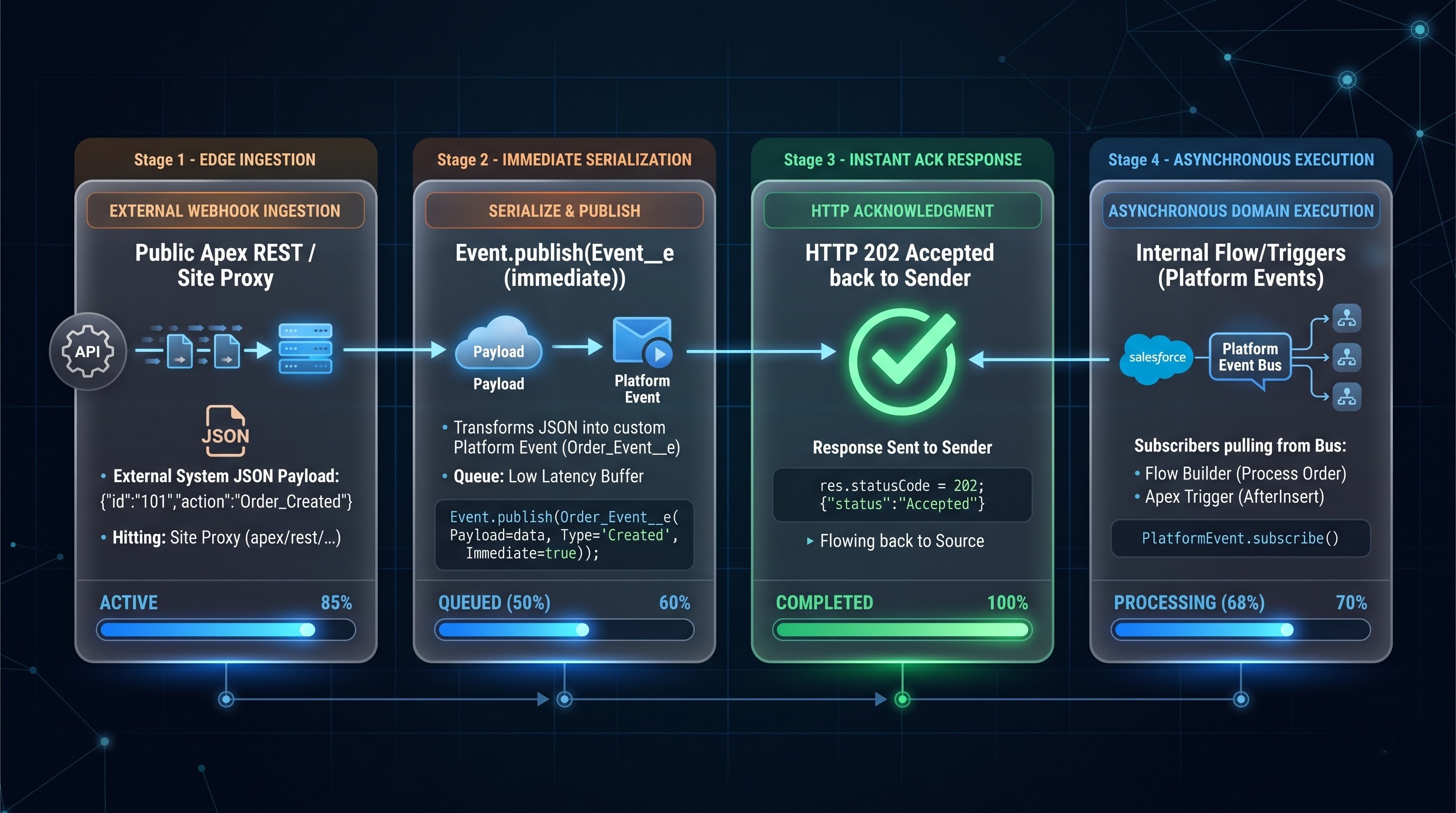
Pattern 1: Inbound Webhook Ingestion Decoupled
External platforms typically support only outbound webhooks for notification purposes. Operational risk is severe if these notifications are consumed directly into synchronous Salesforce database operations: volume spikes can hit database row locks, exceed CPU time limits or trip concurrent API thresholds.
Architects are using an asynchronous decoupling pattern for inbound payloads to address this:
Lightweight Ingestion: An inbound webhook hits an unauthenticated or token-authenticated public endpoint (e.g., an Apex REST endpoint hosted on a Salesforce Site or an edge proxy).
Immediate Event Conversion Instead of complex database mutations, validation logic or external lookups, the ingestion endpoint simply validates the payload structure, maps the JSON payload directly into a custom Platform Event, and publishes with immediate publishing semantics.
Instant Acknowledgement Within a few milliseconds, the ingestion endpoint responds to the external sender with an HTTP 202 Accepted status, freeing the network connection.
Asynchronous Processing Internal Salesforce event subscribers (like automated Flows or asynchronous event triggers) subscribe to the Platform Event stream, deserialise the payload, and execute business logic within their own isolated governor limits.
This pattern insulates Salesforce from transaction timeouts, provides instant responsiveness to the external caller and buffers incoming spikes in traffic over the platform event queue.
Pattern 2: Event Driven Outbound Webhook Distribution
External enterprise systems that require webhook-style HTTP notifications, when attempting to send those calls directly from synchronous Salesforce execution threads, results in tight coupling and failure cascades.
The event-driven solution separates outbound distribution with a dedicated event router:
Transactional Event Publishing - Business logic running inside of Salesforce completes its operations and publishes a Platform Event configured to publish after commit.
Intermediate Consumption An enterprise integration layer (e.g., MuleSoft, an AWS Lambda listener, or a lightweight microservice) subscribes to the event stream using the Pub/Sub API or Event Relay.
Dispatch and Fan-Out The external integration engine keeps the target registry of downstream webhook URLs, authentication tokens and payload transformations. It takes the single event from Salesforce and performs parallel HTTP POSTs to all registered recipient systems.
Dead-Letter Handling: The intermediate engine handles the retry algorithms, backoff schedules, and dead-letter queues for each endpoint, removing the management of webhook delivery from the core Salesforce instance.
Pattern 3: The Transactional Outbox Pattern
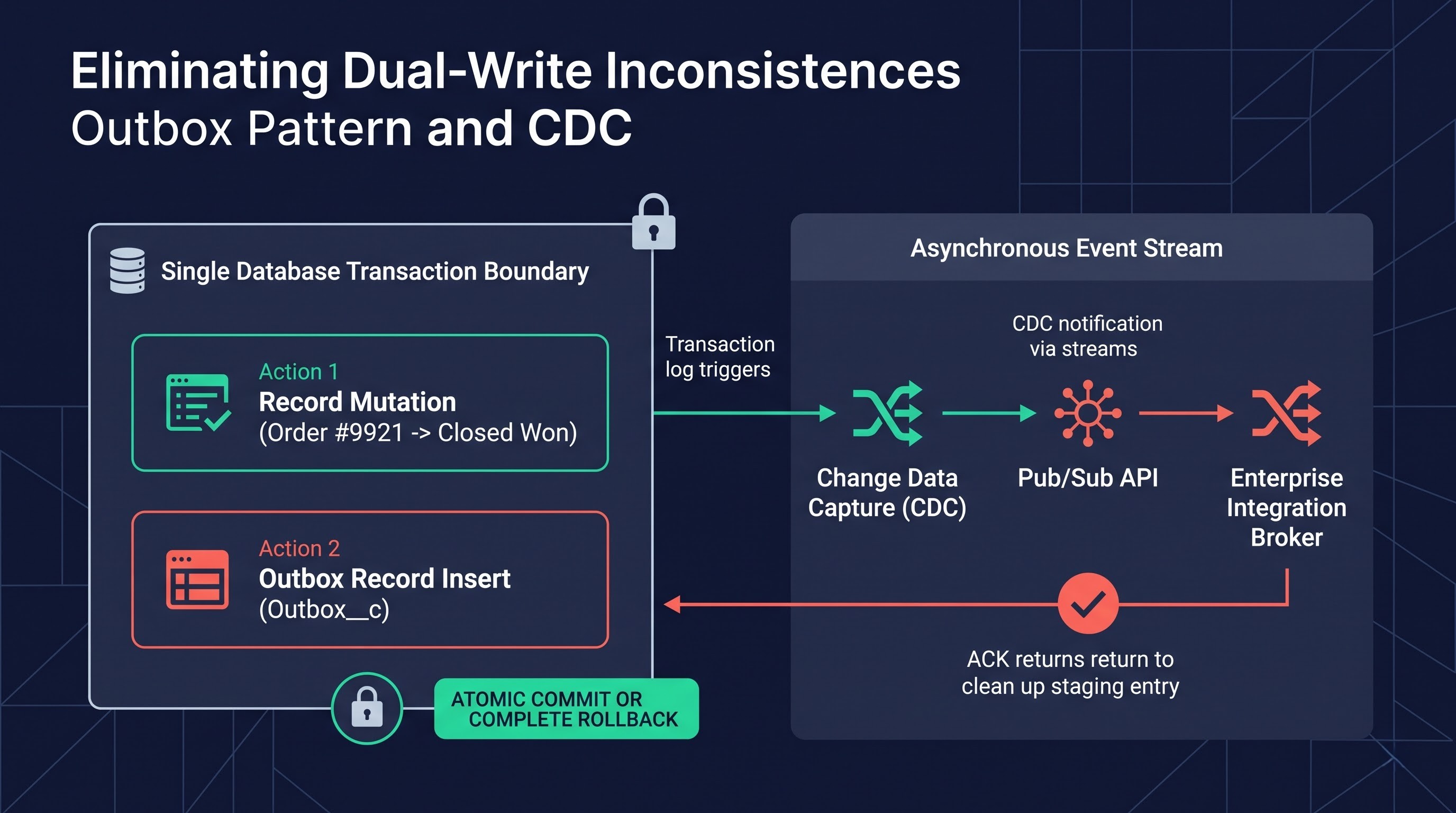
Dual-Write Failures are a problem that distributed systems must solve. This is when an application updates a local database, and tries to publish an external notification, but a system failure in the middle leaves one system updated, and the other unaware of the change.
Salesforce’s Transactional Outbox pattern uses the platform database and event bus to provide data consistency:
A business transaction changes standard records (like Accounts or Orders) and writes an Outbox record to a custom staging object in the same database transaction.
Both operations are in the same database unit of work, so either they both commit or they both roll back.
There is a Change Data Capture stream on the Outbox object. After the commit, a CDC event is triggered to external integration brokers.
Then the external systems will read the outbox event, run the necessary integration pipelines and send an acknowledgement to inform that the particular outbox entry has been successfully processed.
This pattern ensures that downstream consumers will only be notified if the underlying Salesforce database transaction commits successfully.
Become an Expert in Event-Driven Integrations through Practical Knowledge
To successfully employ event-driven architectures, Change Data Capture, and dependable webhook ingestion technologies means that you need to have a solid understanding of the platform. If you are moving from declarative programming to programming or creating distributed microservices, an online course for the best salesforce developer online training from OnlineITGuru offers you program in real-time projects.