
Securing Salesforce Code Quality Through Static Analysis
Last updated on Oct 15, 2026

Introduction: Why Enterprise Platform Integrity Matters
From a simple customer relationship management tool, Salesforce has grown into a mission-critical platform that supports complex enterprise applications around the world. Today companies are building sophisticated financial engines, healthcare portals, supply chain orchestrators and customer service hubs on the Lightning Platform. This centralisation of business critical operations makes Salesforce environments a prime target for malicious actors, but also makes them highly susceptible to technical debt.
Salesforce's multi-tenant architecture has a different set of security and governor limits issues than traditional isolated server deployments. Execution memory, database connections, and CPU time are shared with other tenants for apex code, Lightning Web Components, and automated flows. Code quality and security are essentially tied together. Poorly written queries can leak sensitive customer data across trust boundaries, drain transaction thresholds, grind important business to a halt across the enterprise.
Salesforce needs to be treated with the same rigour of software engineering disciplines for enterprise-grade resilience that any stand-alone enterprise stack would. Modern delivery teams need to move past ad-hoc code reviews and manual inspections and institutionalise defensive, secure coding practices across the software development lifecycle – including automated static analysis.
Anatomy of the security architecture in Salesforce
To write secure code on Salesforce, developers must be aware of the multi-layer security architecture of the Salesforce platform. Security is enforced by declarative permissions, object & field level security, sharing rules & programmatic execution modes.
The base layer includes Object-Level Security (CRED: Create, Read, Edit, Delete) and Field-Level Security (FLS). These declarative settings state what tables and what specific columns a specific user profile or permission set is allowed to access. Crucially, these restrictions are not inherited by default from the programmatic execution runtime. When Apex runs by default, it runs in a privileged context (often called system mode) and ignores any object and field restrictions for the user executing the code unless you explicitly specify otherwise.
The second important layer is sharing at the record level. This determines whether a user can see a particular record instance based on ownership, role hierarchies, public groups, criteria based sharing rules or manual sharing. Apex classes do not enforce record sharing rules programmatically unless developers explicitly decorate their classes with explicit keywords.
The disconnect between declarative access policies and programmatic execution is the biggest source of vulnerabilities in enterprise Salesforce instances. Custom apex services that expose endpoints/controllers/database changes without enforcing these boundaries bypass the entire security matrix defined by the platform admins.
Secure Coding Practices Core Values of APEX
When coding defensively in Apex, it is vital to embrace a specific defense-in-depth strategy. It is essential for developers to understand execution contexts, protection from injection, and the sanitization of inputs. To master these defensive strategies, one must develop an understanding that extends beyond the basics of syntax. This is why many engineering teams take virtual classes about salesforce developer course online to help them overcome the challenge of understanding business logic and how it meets high standards of security.
Execution Context Enforcement: With and Without Sharing
Sharing is not inherited - each apex class must explicitly specify its own sharing behaviour . The platform checks the record level access rights of the current user when running database queries with the with sharing keyword. If an enterprise developer forgets to add this keyword, or just depends on the default system behaviour, queries will run under the system’s context and sensitive records will be visible to users who should never see them.
There are valid business scenarios where the code needs to bypass sharing like creating an audit record, invoking automated routing or doing administrative reconciliations. These are instances where developers should use without sharing, deliberately and surgically. The best practice is to segregate privileged operations in dedicated service classes that internally strictly validate and then perform operations outside the normal scope of the user. The inherited sharing declaration is also a useful model for reusable service layers and utility libraries, as it guarantees that the security boundary is determined by the context of the calling class and prevents inadvertent privilege escalation when code is called from an ambiguous entry point.
Avoidance of Database Injection Vulnerabilities
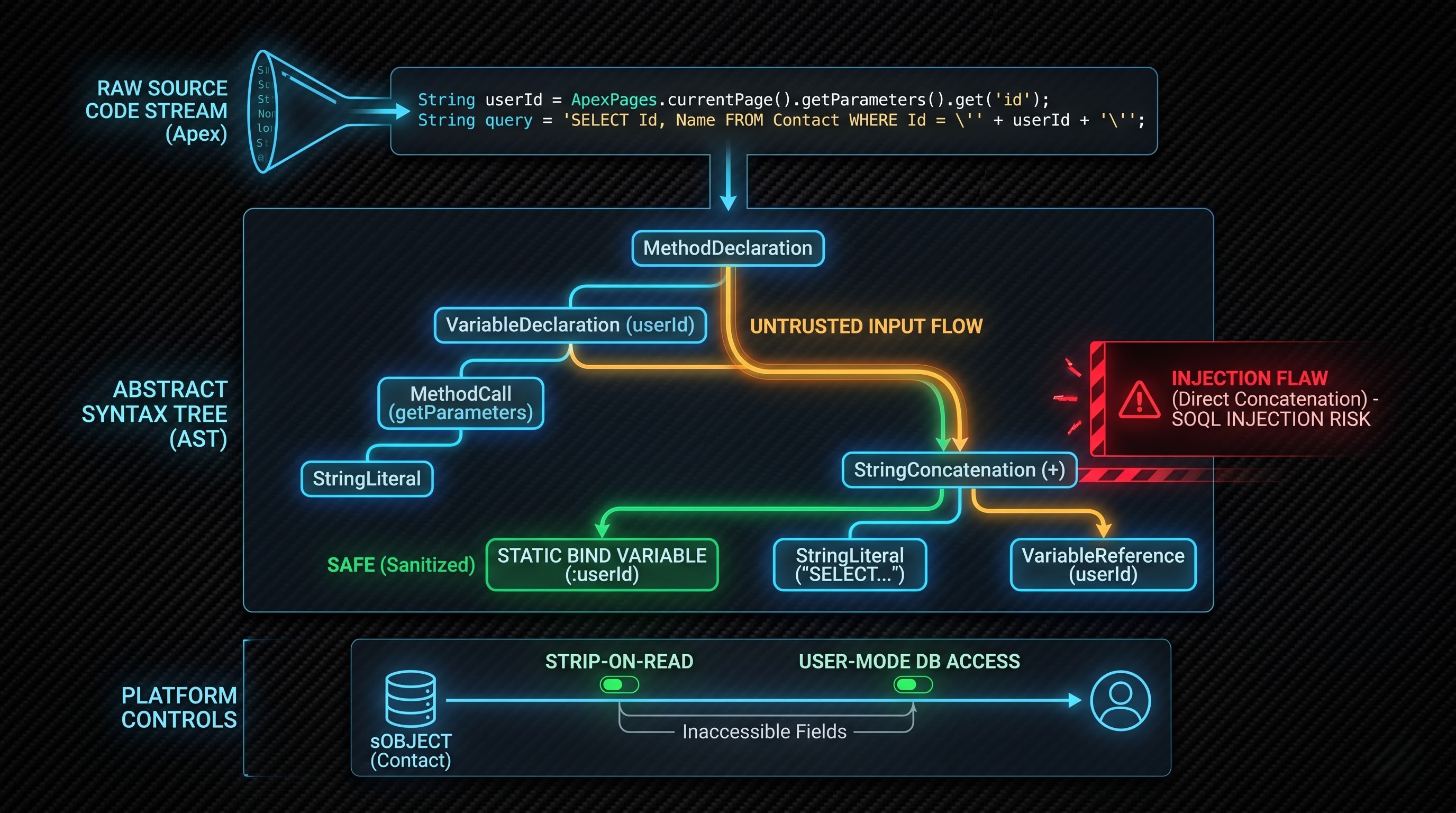
The most common injection flaws in Salesforce are SOQL (Salesforce Object Query Language) and SOSL (Salesforce Object Search Language) injection. They occur when untrusted user input is directly concatenated with dynamic query strings. This enables an adversary to modify query logic, bypass filters, and exfiltrate unauthorised data.
The first line of defence against injection is to use static SOQL with variable binding. The variable bind syntax treats the user input literally, and makes sure that it is treated as data, not as executable query syntax. When developers need to build queries dynamically (e.g. very dynamic search screens with dynamic sorting and filtering for business requirements), they should never concatenate raw string input. Instead, they should sanitise user values using platform’s built-in escaping methods and strict whitelisting of known fields and tokenise input strings.
Programmatic enforcement of access control at the object and field level
Apex uses ‘with sharing’ by default for database operations. Developers need to explicitly enforce FLS and Object Permissions before executing database queries, inserts, updates or deletes.
Historically it has been a very clunky manual check against schema to describe results before each and every data operation to see if fields were accessible or creatable. Schema checks are still fine, but the modern platform capabilities have a built-in security evaluation. Strip-on-read or strip-on-write automatically removes inaccessible fields from collections of sObjects based on user permissions, ensuring that no unauthorized data is ever returned to the UI or committed to the database. User mode database operations are responsible for ensuring that queries and database manipulations are done in accordance with the FLS and object permissions of the running user, and produce runtime security exceptions on attempted unauthorised data operations.
Aura Client Side Security and Lightning Web Components
Apex defends client-side JavaScript execution as well as modern Salesforce applications. The Lightning Web Component (LWC) architecture executes in modern web browsers and can be subject to vulnerabilities such as cross-site scripting (XSS), insecure execution of third-party scripts, and data leakage.
Cross Site Scripting (XSS) - Protection
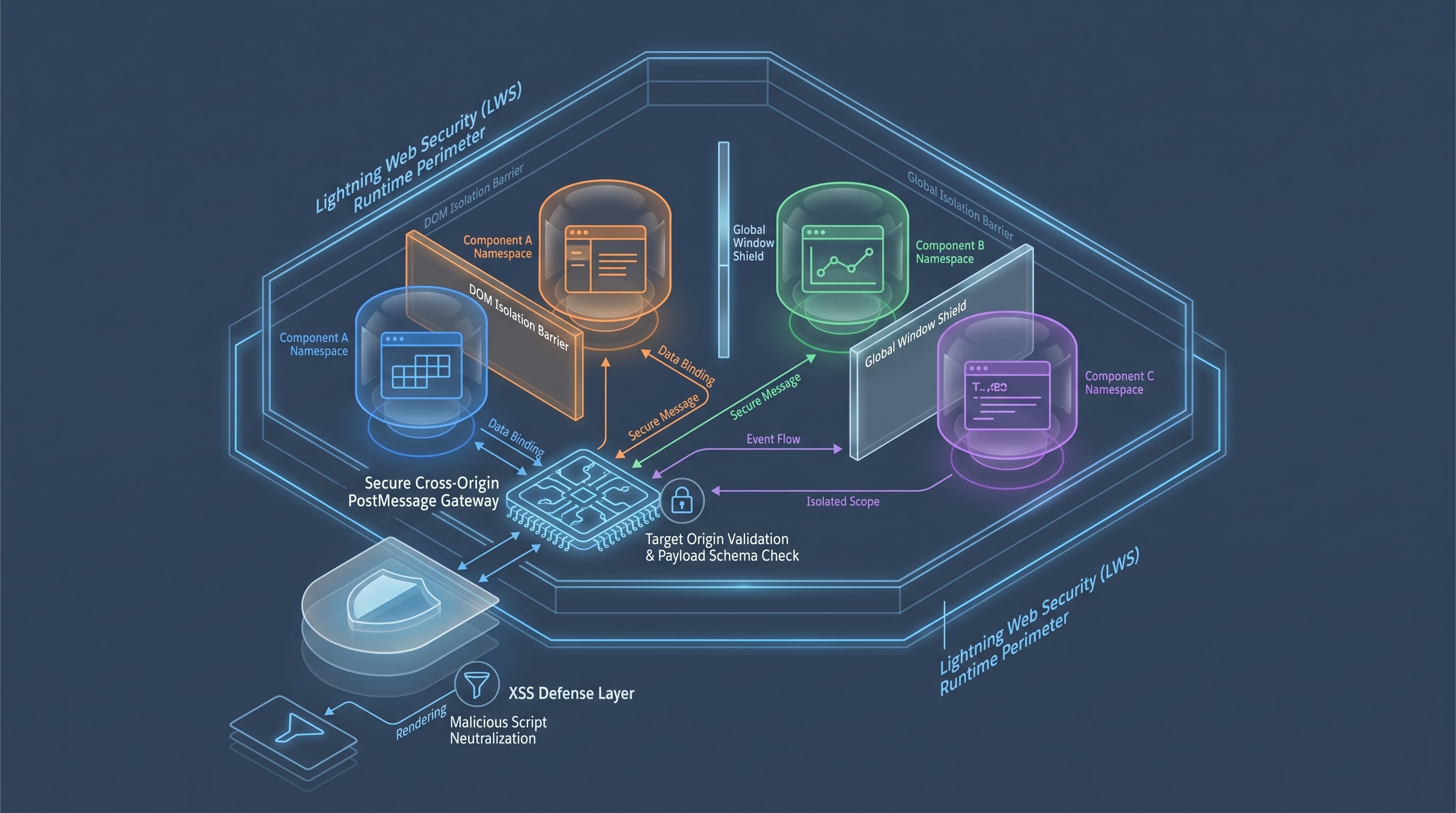
Cross-Site Scripting (XSS) happens when an application takes input and echoes it to the web page without validation or escaping. This allows us to run malicious JavaScript in the victim’s browser session.
Salesforce mitigates many XSS risks natively with Lightning Locker and its modern replacement, Lightning Web Security (LWS). Lightning Web Security leverages JavaScript virtualisation in the browser to sandbox components into different namespaces. This prevents unauthorized access to the global window object, shared memory spaces and Document Object Model (DOM) of other components.
But framework-level protections can’t protect against every developer-introduced flaw. For example, untrusted user input that is bound directly into unescaped DOM properties or HTML content that is dynamically generated using raw DOM manipulation can allow arbitrary scripts to bypass protections built into browsers, by default. Developers should use framework data binding, use native sanitisation libraries, avoid dangerous browser APIs and validate all input formats strictly on both client and server.
Embed secure namespace and communications
In modern enterprise Salesforce portals, it is common to embed external applications using iframe, web tabs or custom endpoints. In implementation, developers often use window postMessage API to do cross origin communication. If the origin is not strictly validated, malicious third-party frames running alongside the application can steal sensitive session data or send forged commands to internal controllers. Secure coding is checking the target and event origin on every message transaction, checking the payload schema and not accepting arbitrary origin.
Platform Limits (Performance and Handling Quality)
Performance and code quality are security concerns in the Salesforce world. However, many denial of service vulnerabilities are not due to malicious volumetric attacks but due to internal architectural issues that drain tenant resources.
Architectural Boundary Conditions: Constraints on the Governor
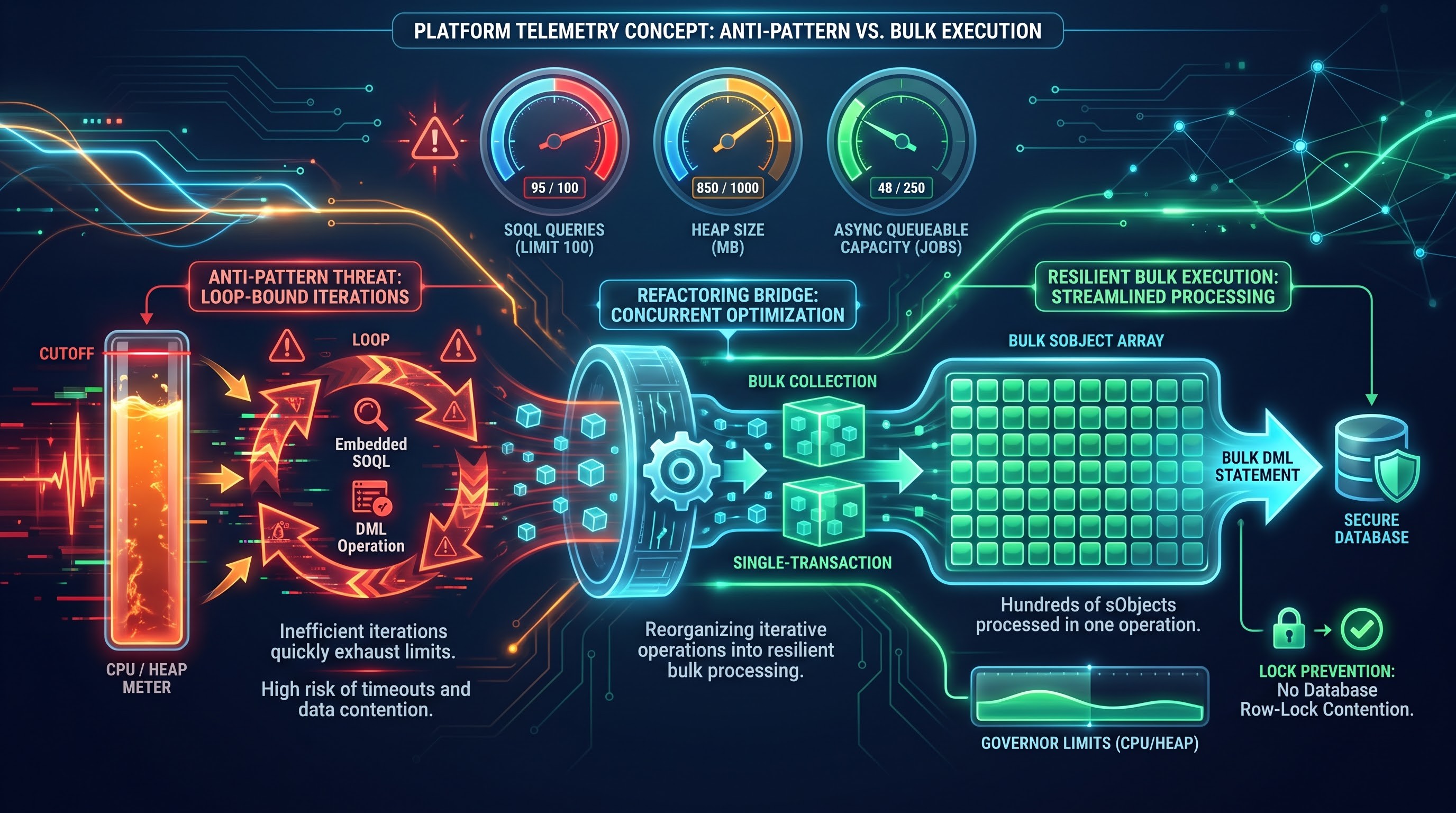
Salesforce runs their infrastructure on shared compute resources, hence the platform has hard governor limits on transactions. These are max total execution time, total queries executed, total records retrieved, heap size allocations and asynchronous process invocation counts.
If a transaction exceeds the allowed CPU time for the platform due to an unoptimised query or unindexed relationship, the thread is aborted immediately, any uncommitted data rolled back and an uncatchable exception thrown. This results in denial of service at the platform level such as customer facing portals or critical checkout flows.
Anti-Pattern Prevention: Loop and Duplicate DML Risks
The most infamous failure in Salesforce development code quality is putting database operations or queries inside iterative loops. But as more data is added, operations that are bounded by loops quickly hit transaction limits.
Resilient Salesforce Engineering needs bulkification on all programmatic interfaces. Design methods, triggers and integrations to process one to hundreds or thousands of records at a time. Collections and memory efficient data mapping structures and single bulk DML operations keep the transaction limits, reduce the database locking contention and ensure long term stability.
Handling data skew and concurrency
Architectural antipatterns such as account data skew (attaching tens of thousands of child records to a single parent) or ownership skew (assigning huge volumes of records to a single user) cause severe locking problems for large scale implementations with millions of records. A common reason for transaction failures caused by row-lock timeouts is concurrent inserts/updates on skewed records by automated Apex processes. If you’re writing high quality code for large data volumes then you need a good understanding of database locks, avoid locking records unnecessarily during integrations, and orchestrate massive updates asynchronously using batch apex or queueable frameworks.
Static analysis automation - the first line of defence
Quality depends on strict architectural rules but human developers are unable to manually discover every vulnerability or anti-pattern in large code bases. Static analysis is the automatic engine of software governance. It analyses source code without executing it.
Role of Rulesets and Abstract Syntax Trees
Static analysers read the source code files and transform them into Abstract Syntax Trees (AST). ASTs are the trees that describe the application structure and grammar. The analyser then uses custom rulesets to analyse the tree and identify code smells, structural anti-patterns and critical security vulnerabilities.
Static analysis tools can identify many different types of issues on the Salesforce platform, including:
Injection Vectors : SOQL & SOSL
Apex classes without sharing declaration
SOQL/DML in Loops
Hardcoded sensitive values (e.g. urls, crypto secrets, sandbox ids
Visualforce and Aura XSS Vulnerability: Unescaped Merge Fields
Javascript Anti Patterns and Memory Leak in Lightning Web Component
Complex nested conditionals harm maintainability and cognitive readability
Detecting defects on developers’ machines rather than in production environments reduces remediation costs by orders of magnitude and ensures compliance standards are maintained on an ongoing basis.
Common Static Analysis Frameworks in the Salesforce Ecosystem
Today there are a number of open source and enterprise grade static analysers available for Salesforce development.
The Salesforce Code Analyser is an official command-line tool that is a single executable wrapping the power of multiple underlying scanning engines. It combines PMD (a popular open-source static analyser with extensive rule coverage for Apex and Visualforce), ESLint (for auditing Lightning Web Component JavaScript) and other specialised security engines that perform data-flow analysis to track untrusted inputs across complex execution paths.
Enterprise security suites include deep semantic and taint analysis, as well as command-line tools. Taint analysis follows tainted data from user input points, through internal method calls, to sensitive database operations. Where the data is coming through a database query and has not been subjected to recognised sanitisation methods in the process the analyser flags a high priority vulnerability.
Integrating Security and Code Quality in CI/CD Pipelines
Static analysis cannot be a discretionary tool that developers are able to invoke manually whenever they want to. It needs to be baked right into automated continuous integration and continuous delivery (CI/CD) pipelines to enforce high standards across enterprise teams.
Setting Quality and Security Gates
Developers create pull requests into shared branches of a repository, triggering the CI/CD pipeline to automatically begin executing quality checks. The pipelines perform static analysis on the changed files and compare the results against strict quality gates defined by the organization.
Good quality gates impose severity thresholds by:
Severity Blocker / Critical Direct SOQL injections Hardcoded credentials No sharing controls If this is violated, the pipeline build will automatically fail, code will not be allowed to merge and the development team will be alerted.
High Severity: This includes DMLs or queries inside loops, catch blocks without handling or untested branches. Exceptions that cannot be merged require Technical leads approval.
Minor / Informational severity warnings are generated for violations such as non-standard naming conventions, minor formatting inconsistencies or slightly high cyclomatic complexity to encourage incremental refactoring without blocking urgent business releases.
Technical Debt Management and Alert Fatigue Prevention
One major failure mode for the adoption of static analysis in legacy Salesforce environments is alert fatigue. Bringing a static analyser into a five year old org usually means tens of thousands of warnings on day one. There are so many alerts that developers often abandon the tooling or turn off rules completely.
The baseline approach is the basis for sustainable integration:
Freeze the Baseline Treat existing violations as accepted legacy technical debt Have the pipeline analyser analyse only changed code (differential analysis)
Zero New Debt Policy: Enforce a strict policy that no pull request should introduce any new critical or major violations to the repository.
Intentional Debt Reduction: Allocate engineering time to systematically refactor legacy modules and refactor high-risk areas such as public guest user controllers and third-party integration services.
Runtime verification and automated testing
Static analysis can detect known syntactic patterns and data flows, but not dynamic business logic, runtime access constraints or stateful concurrency. The second pillar of code assurance is automated unit and integration tests.
Unit Testing vs Code Coverage
Salesforce requires 75% test code coverage for Apex classes to be promoted to production. Historically this mandate has led to an unhealthy anti-pattern. Writing superficial tests that only exercise lines of code, but don’t check results. This is done just to inflate coverage metrics.
This means that high quality testing is meaningful verification of behaviour. It is expected of developers to write good test methods with explicit assertions. The tests will show that the software works with valid inputs, handles invalid inputs gracefully, and enforces security boundaries.
Test of User Mode and Sharing Behaviours
When you build securely for the Apex platform, you must test your code against different user profiles and permission sets. With system testing techniques, developers are able to explicitly execute business logic in the context of defined target personas, e.g. constrained community users or local sales reps.
Throw platform exceptions for privileges attempted by unauthorized users. This will ensure that security statements will continue to work as the declarative configuration orbit changes over time.
Test Data Independence and Deterministic Behaviour
The organization’s existing data cannot be used for modern apex tests. By default, the apex test execution is isolated from the production records and thus the test methods must create their own in-memory deterministic datasets. Self-contained, isolated test classes ensure that tests behave the same in sandboxes, scratch orgs, and production pipelines without corrupting data or failing due to differences in the environment.
Cultural Fit: Building a Safe Development Culture
The engineering culture that uses technology, frameworks and pipeline rules is only as good as the technology, frameworks and pipeline rules it uses. Salesforce quality can be maintained with shared responsibility for security between Salesforce administrators, developers, release managers, and platform architects.
Code Reviews, Collaborative
Automating static analysis reduces the review cycle so human reviewers can focus on architectural nuance, intent and complex logic, not trivial syntax errors. Code reviews are a team learning opportunity where senior engineers mentor the teams on defensive design patterns, domain driven design and security implications of architectural decisions.
Closing the gap between Admins and Developers
In Salesforce, security boundaries are often fuzzy between declarative configuration and programmatic code. It’s possible for an administrator changing a permission set or public group sharing setting to accidentally open up an endpoint a developer wrote months ago. By contrast, an unfiltered query from a developer can bypass a set of sharing rules that an administrator has worked hard to put in place.
To eliminate this friction, the operational silos need to be broken down. Understand developers’ declarative configuration capabilities and how custom code interacts with platform sharing settings for admins. Join in on Design Review. Unified governance minimises configuration drift and allows for consistent security postures across declarative and programmatic assets.
Continuous training and threat awareness
Security threats, compliance rules, and platform capabilities continue to change. Salesforce is continuously launching newer security frameworks, new guest user policies, new JavaScript execution engines, and new user-mode database APIs. In this regard, it is important for engineers to incorporate trained professionals who will stay up to date on software releases, complete their salesforce developer training online with secure coding training and know how to utilize newer technologies to defend against unauthorized access errors.
Conclusion: Solid Engineering on Salesforce
In today’s enterprise world, the health and reputation of a business is directly tied to the security and reliability of a Salesforce environment. Salesforce can no longer be a configuration hub because it is the system of record for sensitive financial, personal, and customer data.
To become an enterprise-grade posture, you have to move from reactive firefighting to a proactive engineering discipline. By adopting defensive coding practices such as explicitly declaring sharing modes, preventing query injections, and enforcing field-level security, development teams are presented with structural vulnerabilities at their root. Organisations that integrate automated static analysis into their continuous integration pipelines establish objective quality gates that prevent technical debt from reaching production.
Utilizing secure coding practices and automated static analysis together with harsh automated testing procedures and team-oriented culture is an essential process that changes Salesforce operations from weak operational points to strong and scalable enterprise systems. To become an expert in the field of security and architecture, any novice or enterprise engineer who has studied it must complete all necessary steps for the salesforce developer online course.