
ServiceNow: The Invisible Nervous System of the Modern Workplace
Last updated on Oct 3, 2026
The Monday Morning Nobody Plans For
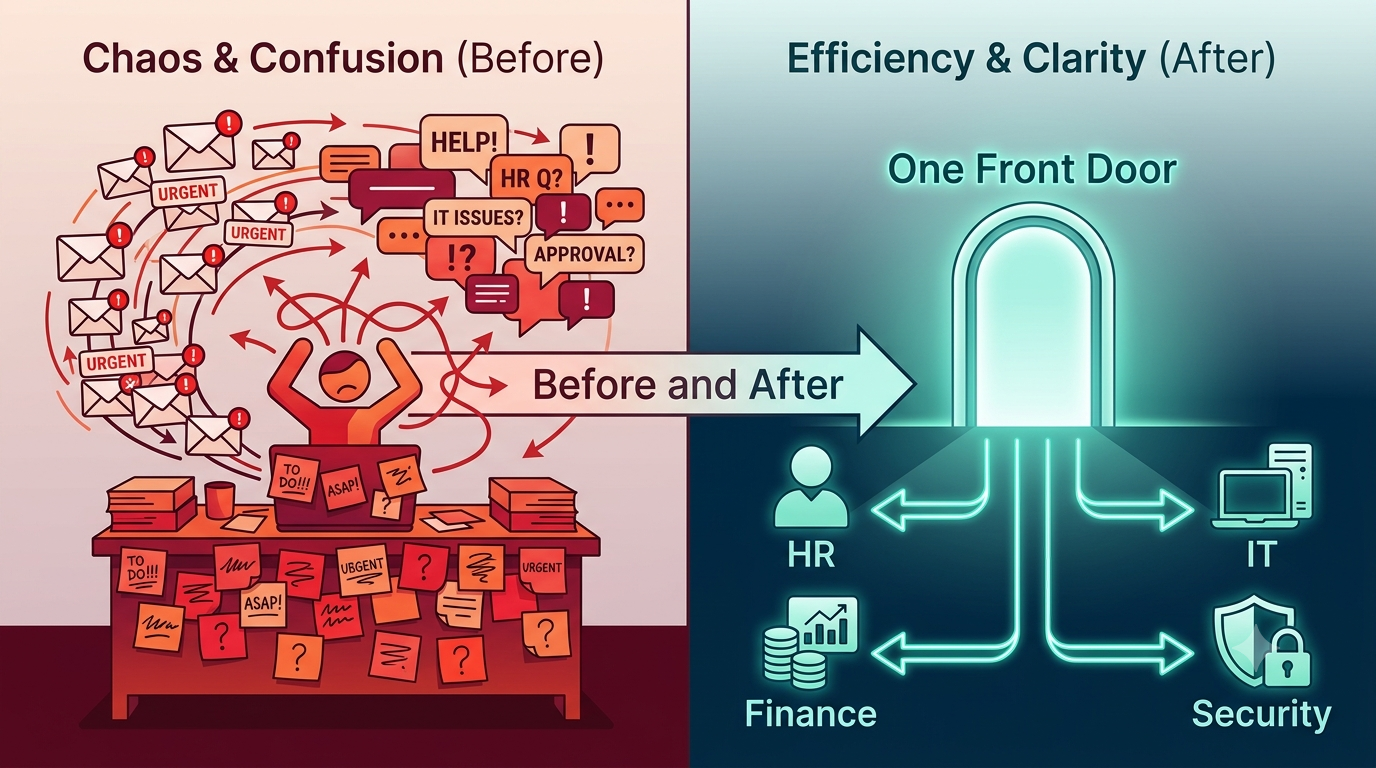
Imagine a Monday morning in a large company. Riya in marketing turns on her laptop. The VPN won't connect. A step away a new employee called Arjun is still waiting for the email account and software access that were promised to him on Friday. In the finance department someone needs a purchase approved by noon and in the data center a server is starting to get too hot. Four different problems, four people and four completely different teams. Now ask yourself a question: who is aware of all of this, who is solving it and who is ensuring nothing gets missed? In a company without a system the real answer is a confusing mix of emails, WhatsApp messages, chats, in the hallway and sticky notes. Someone forgets someone and thinks someone else took care of it and a two-hour problem slowly turns into a two-day problem. Multiply that by hundreds of workers and thousands of requests every month. You can see why big companies were struggling with what seemed like small issues. This is the confusion that a platform called ServiceNow was created to fix.
So, What Exactly Is ServiceNow?
Without beating around the bush ServiceNow could be described as a cloud‑based platform designed to help companies manage their work. This is the simplest definition of ServiceNow that ignores all the buzzwords. The platform was actually created in 2004 by Fred Luddy, who was frustrated by the way skilled people wasted their time chasing approvals and updates through email. The idea was simple yet brilliant: what if every request, problem or approval could be put into a single place where it would have an owner, a status, and a history? The first application of the concept was IT service management, which essentially is about controlling and streamlining helpdesk processes like managing employees’ requests for tech support or acquiring new hardware or software. It did not take long for ServiceNow to expand to other areas. Today, the platform is no longer just a tool but an integral element in the digital workflows of thousands of enterprises worldwide. The platform now covers a variety of use cases: IT operations, human resources, finance, customer service, security operations, and facilities management. ServiceNow is a cloud-based platform, meaning companies do not have to maintain their own software infrastructure, which helps explain why the tool has been adopted by so many large businesses. When people say ServiceNow is the system of action for the enterprise, what they mean is that while other systems store data, ServiceNow is where work is actualized until completed.
The Big Idea: One Front Door, One Memory
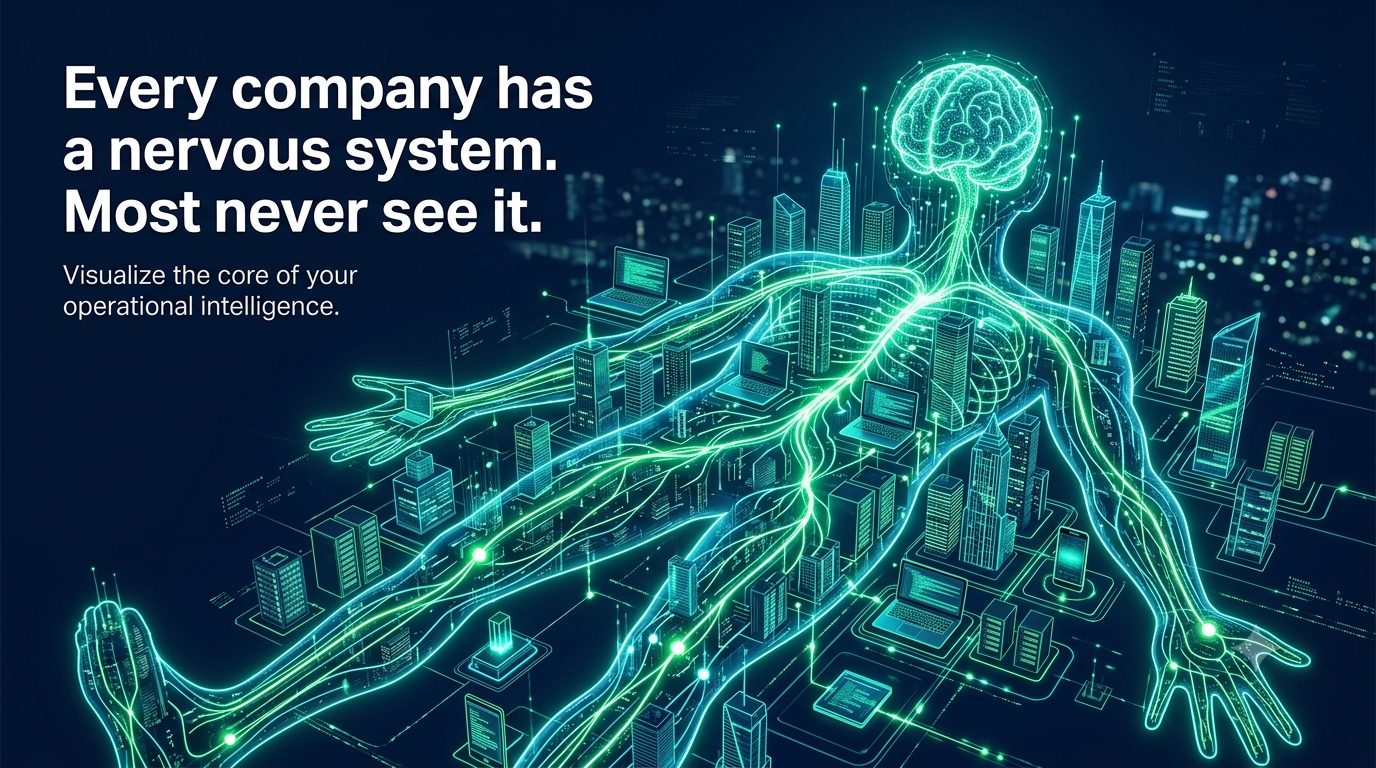
This big idea is unique to the platform. Is the foundation of the platform. It is important to understand this idea before you look at the technology. Think for a moment about the body. The body does not ask the brain to control each heartbeat, blink, or breath. Instead, a nervous system carries signals from every part of the body up to the brain and back again so the body does not have to think about it. When you touch something, the signal travels through the body. The body decides to pull the hand away before you even feel pain. A company needs a system, and ServiceNow aims to be that nervous system. Every department, every device and every employee is a nerve ending. A broken laptop, a leave request, a customer complaint, and a security alert are all signals. ServiceNow receives each signal, knows what type it is, sends it to the person or automates the response, and ServiceNow remembers what happened for next time. Two ideas are at the heart of this design. The first idea is One Front Door. One Front Door means employees do not need to know which team handles what because they raise everything in one place. The second idea is One Memory. One Memory means every record, every fix, and every decision is stored together so the organization learns from repeating the mistakes.
How It Works and What You Actually Need To Know
Allow me to have a peek under the bonnet but gently. Now this thing called ServiceNow is constructed of records. Records are bits of information that are stored in a table. If you have ever used a spreadsheet, you will understand what I am saying. Here we have a table which is like a sheet containing rows and columns. Each row is a record and each column contains information about the record. So when Riya comes along and reports the problem with her VPN, an incident record is created in the incident table. The record contains her name, the time of the incident, and its priority. And when Arjun turns up and wants some software, a request record is created in a table. It is these records that people are working with. They appear on the forms that people fill in.
On top of all this, there is the set of workflows. These are the rules that determine what happens next. So, for example, a rule might say that any request that has a value over a certain amount needs to be approved by a manager first. Then once it is approved, the request is automatically passed onto the procurement team. So no one has to bother forwarding the request. And beneath all this, there is the Configuration Management Database (CMDB). This is a living map of everything in the company. It contains everything from servers and laptops to applications. It shows the relationships between them so that it is possible to say if this particular server goes down then these ten service groups will be affected.
Automation: The Part That Feels Like Magic
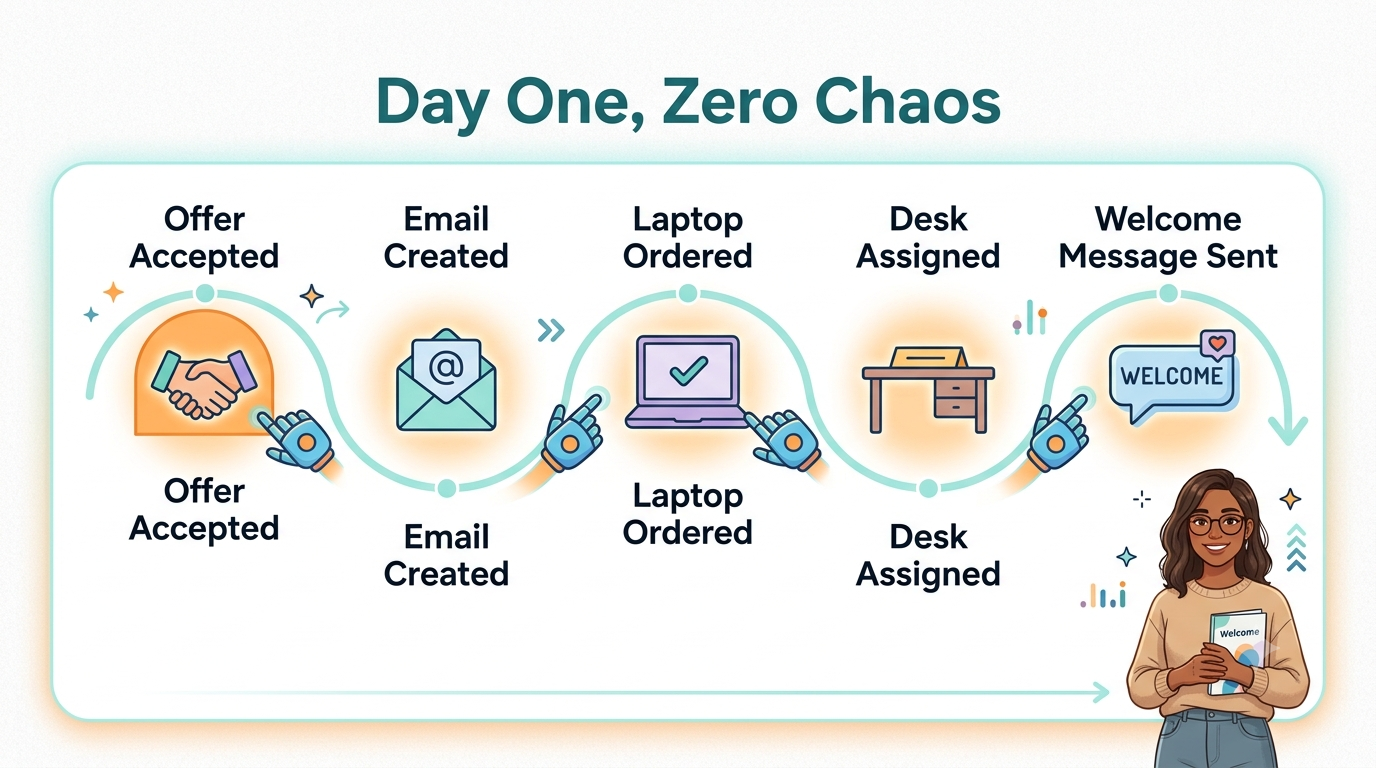
The magic of the platform is manifested when the software does its job automatically. For example, when a new employee joins the company, in traditional approaches, many instructions should be completed. First, the human resources department contacts the information technology (IT) department to create an email account. Then, the IT department notifies the facilities management about a new employee, so they can prepare a new desk. The facilities management department informs the employee’s manager about the situation. As a result, usually, one of these issues is forgotten, and an employee has to remind his manager about the missing task. However, with ServiceNow, the process is much easier: when the human resources department marks a person as hired, the software automatically initiates a set of predefined actions. For example, an email account is created, a request for a new laptop is sent to the IT department, a desk is prepared in the facilities management, and training courses are scheduled for the new employee. On the first day of work, the employee arrives at the office and sees everything ready and waiting for him/her. Another great feature of ServiceNow is that it is easy to configure the software, even without being a programmer. The software provides a visual builder, Flow Designer, where process steps can be set up as a simple flow, instead of programming them as IT developers usually do. Besides, in recent years, the software has been equipped with artificial intelligence that can understand the request and determine who should handle it, thus eliminating the need for extra steps. Moreover, the artificial intelligence function helps answer the most common questions by utilizing virtual assistants and chat-bots. Overall, the main purpose of the software is not to replace humans with robots but to eliminate simple and clear steps so that humans can focus on complex, double-checking, and error-proofing issues. Thus, employees are happy with the quick response, and executives are satisfied with the number of automated processes and eliminated paperwork.
Where You Meet ServiceNow Without Knowing It
The funny thing about this platform is that most people use it for years without hearing its name. If you have ever raised a ticket for a laptop at work, requested leave through an internal portal, asked HR about a policy and got a tracking number or received an automated message saying your request is being processed there is a good chance a platform like this was working in the background. Inside organizations it commonly shows up as IT service management for fixing and requesting technology as HR service delivery for employee queries and onboarding as customer service management for handling complaints and cases from customers and as security operations for tracking threats and responding to incidents. It is also used for IT operations management, where teams monitor the health of their systems and catch problems before users feel them and for governance, risk and compliance where companies keep proof that they are following rules and regulations. Banks, hospitals, telecom firms, universities, government bodies and technology companies all lean on it because their problems share the shape: lots of people, lots of requests, strict rules and a constant need to prove what happened and when. Wherever that shape appears a structured platform for work tends to follow.
Why Businesses Care So Much
It helps to look at this from a business owners chair because that is where the real value is easiest to see. Without a platform leaders are often flying blind. They cannot easily tell how long problems take to resolve which team is overloaded, which issues keep returning or where money is being wasted. With a platform every request leaves a trail and trails turn into dashboards. A manager can see at a glance that password resets make up a share of support tickets, decide to automate them and watch that number shrink the following month. A security head can see how quickly threats are being handled. An HR leader can see how long onboarding really takes. When work becomes visible it becomes improvable. That single shift is why companies are willing to invest heavily in this kind of platform. There is also a benefit that rarely makes it into brochures, which is employee experience. Nobody enjoys chasing three departments to get a thing done. When the process is smooth people feel respected. That feeling reaches customers too because happy and unblocked employees serve customers better.
The Person Who Keeps the Nervous System Healthy
A system does not maintain itself and neither does a platform this large. Behind every ServiceNow experience is a person or a team quietly keeping things running. This is the administrator. Think of an administrator as the doctor, gardener and traffic controller of the platform rolled into one. They. Manage user accounts, set up groups and roles so the right people see the right things, adjust forms and lists so screens are clean and useful, build and fix workflows, manage notifications, keep data tidy, handle imports from other systems and make sure upgrades do not break what already works. When someone says the form feels cluttered or that approvals are going to the person the administrator is the one who investigates and fixes it. The role sits at a crossroads where technical understanding meets business understanding because the administrator must grasp both how the platform works and how the company actually wants to work. For people early in their careers this makes the role an attractive doorway into the ecosystem since it opens paths towards development, consulting, architecture and implementation. Many professionals begin their journey by joining a structured ServiceNow admin course, where they learn the platform's fundamentals through guided, hands-on practice rather than guessing their way through a huge system alone.
What an Administrator Learns, in Plain Language
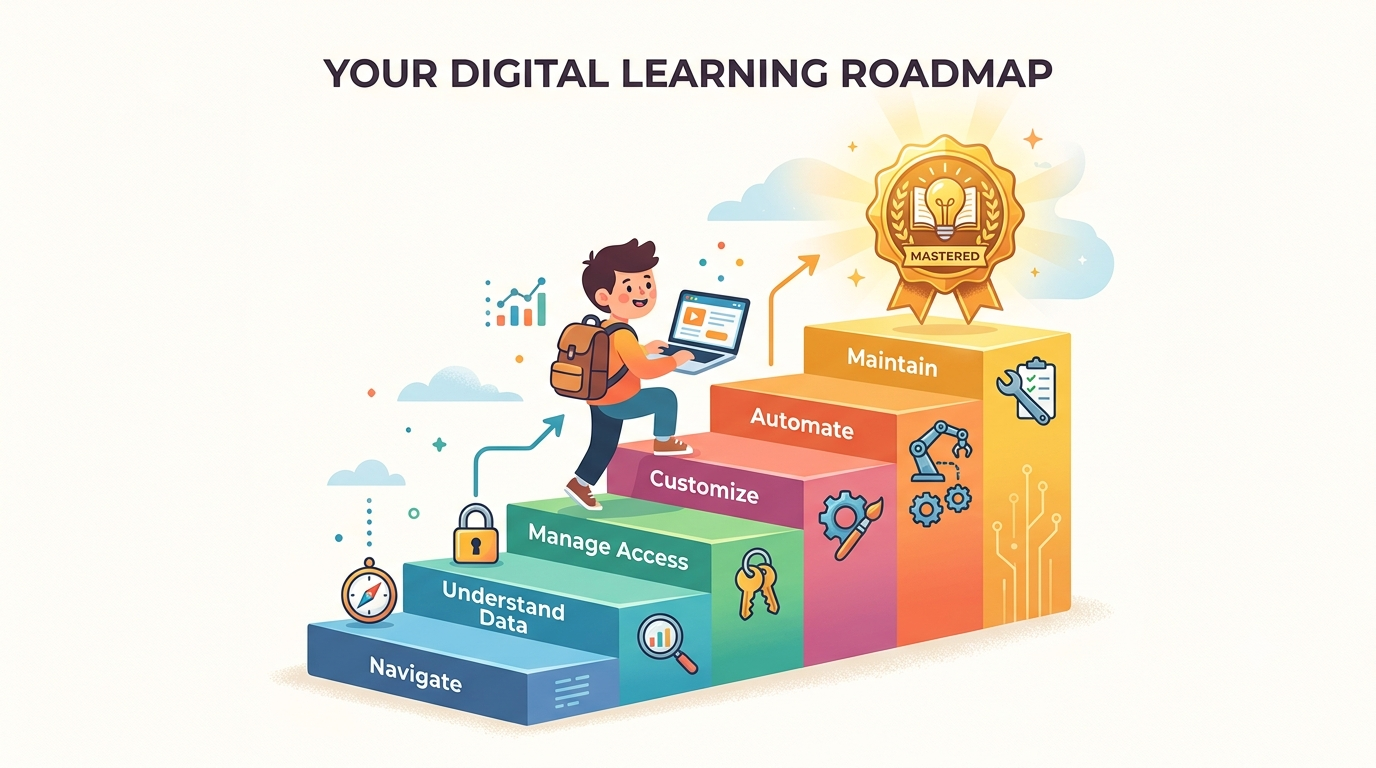
So what does the learning journey actually look like? Think of it in layers. The first layer is navigation and understanding where a beginner learns how the interface is laid out, how to find records, how lists and filters work and how the platform thinks about data. The second layer is the data itself: tables, fields, relationships between records and how information flows from one place to another. The third layer is people and permissions which covers users, groups, roles and access control. It is more important than it sounds because a platform holding sensitive company information must be strict about who can see and change what. The fourth layer is making the platform feel right which includes customizing forms creating views setting up service catalogs where employees can order things and designing notifications. The fifth layer is automation, such as flows, approvals, service level agreements and the rules that keep work moving on time. The last layer is data management, including imports, updates and keeping the information clean. None of these layers needs you to be a programmer on day one which is a relief to many beginners. What matters is thinking, patience and curiosity. A learner who enjoys asking how something works and why it works that way will usually feel at home here quickly.
Why Credentials Carry Weight in This World
Due to the platform's centrality in major corporations' operational schemes, employers are bound to look for proof of an applicant's comprehensive understanding of it. That is where the credentials come into play, as passing the official SN administration certification is the ultimate confirmation of one's journey beyond the superficial knowledge of the tool and into their ability to command it to do their every capricious bidding. It demonstrates that this person knows the intricacies and idiosyncrasies of the software's data structures and security mechanisms and is familiar with the procedures that allow them to manage its everyday operations. For the job applicants themselves, the preparation for the exams serves as a proving ground, exposing the gaps in their theoretical knowledge and giving them the chance to fill those before it is too late. The credential itself, while not a replacement for the extensive practical experience, serves as a feather in one's cap, a distinguishing factor in the competitive environment of the job market. It serves as the tangible proof of one's theoretical knowledge and the practical know-how that comes with it - the former being a prerequisite for the latter. That is why it is often paired with one or two practice projects and a sandbox instance where the exam taker can demonstrate their practical abilities. The recruiters are likely to favor those who can not only demonstrate their theoretical knowledge but also showcase their practical skills, utilizing the tools and practices that the actual job requires.
Choosing How You Learn
While there is no right or wrong way to learn the ropes, the more organized the curriculum, the faster one is to achieve their goals. Some prefer the self-guided discovery, with the plethora of freely available developer instances at their disposal, while others are in far greater need of the structure and mentorship that comes with the more traditional educational experiences. The best servicenow administrator course will provide the students with a balanced combination of lectures, practical labs on the actual instance, real-world case studies that utilize the software in the ways that the actual companies do and the preparation for the certification exams. The syllabus can vary, but the more practical the experience is, the better, as it allows the student to not only observe but also interact with the program. The more the courses focus on the actual application of the software in the real world, the more relevant are the experiences that the students gain. The most sought-after qualities are the ability to configure the instance, manage and monitor the services, troubleshoot the issues that range from the simplest regional approvals to the data cleansing and import-export scenarios. The applicants should be able to ask questions and receive answers in real-time, thus acquiring the confidence and the skillset that will allow them to thrive in the working environment. Either way, the quality of the results is most often the result of the time spent, making the steady progress over time a far better teacher than the frantic cramming before the exam.
Common Myths Worth Clearing Up
There are several common misconceptions that surround the topic, and addressing them is crucial in demystifying the field and presenting an accurate picture of the opportunities ahead.
The first myth is that only candidates with a coding background can succeed in this area of work. Indeed, programming skills are often involved, but at entry-level positions, they are all but a bonus, as the configuration-driven nature of the majority of the tasks takes precedence. As the professional grows and moves towards the more development-oriented roles, the demand for their coding skills increases - but at the entry-level, it is far from being mandatory.
The second myth is that only IT professionals can work with the software. At this point, the tool has permeated the corporate environment so profoundly that the company's operational needs can be found in the most minute of its departments, making the field open to professionals from various backgrounds, such as business analysis, among others.
The third myth is that the automation solutions eliminate the need for the human oversight. At best, this is a shortsighted view that fails to consider the changes in the corporate landscape. The more processes are automated, the more companies rely on the personnel that can understand those systems and realize when they fail, which is further compounded by the tendency of corporate environments to outsource such needs, further increasing the demand for skilled professionals.
The fourth myth is that the tool is too large to be learned by one person. While the tool indeed has an extensive scope, it is not insurmountable, as the fundamental knowledge can be gained by every determined and persistent learner, and the specific areas of work can be explored as the professional moves forward.
The Bigger Picture
If there is one thing that the reader should take away from this article, it should be the appreciation of the role the tool plays in the greater context. The company operates as the living organism, relying on the consistent information flow between the various nodes, and its proper functioning relies on the careful examination and manipulation of those signals. The SN offers the software infrastructure that allows the companies to construct the systems that serve to streamline the operations and transform the chaotic confluence of people, equipment, procedures, and policies into the organized whole. For the users, it means that the day-to-day procedures are far less reliant on the various communications and far more automated and efficient, while the management can ensure that there are constant opportunities to enhance the quality of the services they deliver. For the professional, it means the chance to grow in the field that is in high demand and be the vital link in the chain of ensuring the smooth continuation of the operations. The next time one sends the ticket and watches the process unfold before their very eyes, they should keep in mind that there are entire infrastructures that enable these few convenient steps and that their journey into this field could be the most rewarding one they can imagine.