
Stopping Fraud in Milliseconds: How Business Analytics Powers Real-Time Anomaly Detection
Last updated on Sep 21, 2026

By means of digital trading, fast payments, and accessible banking, financial processes now transpired in the blink of an eye. As positive as it is for customers, it creates a lot of difficulties and a highly hostile environment for risk engines. Today’s frauds do not only rely on plain and simple card cloning methods and static phishing schemes. Sophisticated modes of attack have emerged, which include the use of highly organized botnets, automatic credential stuffing, synthetic identity generation, application programming interface exploitation, and authorized push payment scams via real-time social engineering.
When an event of digital payment or identity verification takes place, an enterprise risk engine has around 50 to 300ms to assess the risk level, ascertain legitimacy and render the decision of whether to authorize the transaction, challenge it, or refuse it entirely before the consumer feels any delay or before the payment process times out. Traditional static rule engines cannot work under such circumstances. They have major issues with their maintenance, an overabundance of rules, weak logic, and they are unable to discover new ways of making attacks.
Unlike other fraud detection models, which depend on a well-established list of known types of threat, anomaly detection models are built on the principles of baseline modeling of human and institutional conduct. A detection engine identifies fraud in payments and identity just within milliseconds by determining the extent of divergence of a new event from a set of known patterns.
The following is a conceptual and architectural overview of how modern fraud-detection technologies work.
Overview of the Concept of Millisecond Budget – the Moment Credentials Are Stolen
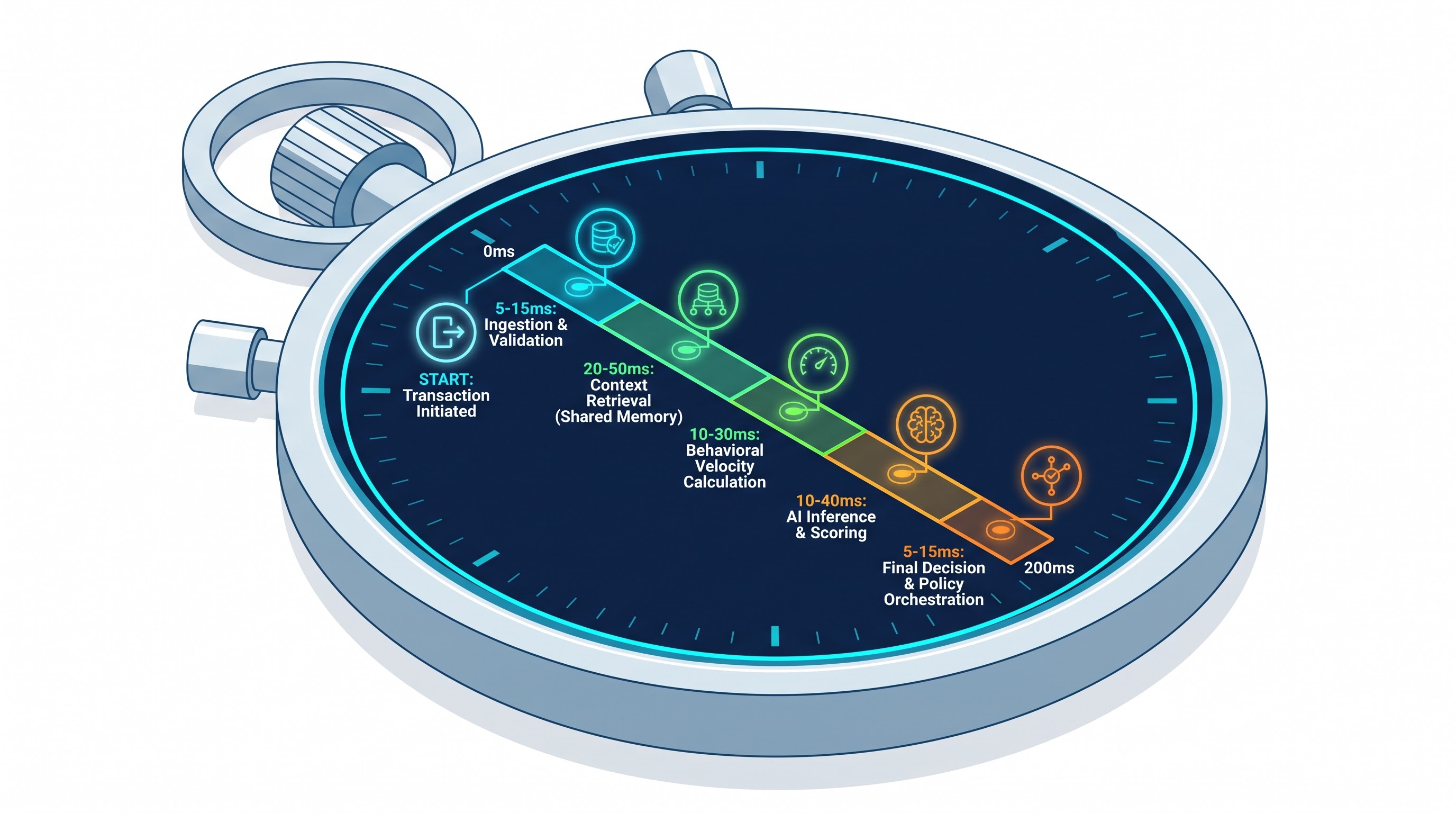
In order to understand the premise and functioning of anomaly detection, it is necessary to learn how strict time constraints are defined in the financial industry. Usually, the entire process of checkout does not have more than 200 milliseconds for fraud detection efforts. If the anomaly detection process requires 300 milliseconds to deliver results, the credit system will fail, and the purchaser will leave the online store without the purchase.
This extensive analysis of this operational time frame looks at the time used by risk systems as follows:
Ingestion and Protocol Deserialization (5 to 15 ms): The raw transaction payload is delivered through payment switches, webhooks, or messaging brokers. The system requires validating the payload, unpacking its nested JSON or binary formats, as well as verifying the integrity of the payload.
Real-Time Feature Retrieval from Online Stores (20 to 50 ms): The raw event does not provide enough information by itself. The inference engine demands historical context: How many transactions have been made by the user in the past five minutes? Has this device fingerprint been associated with other taxpayer identification numbers? What is the standard deviation of the cardholder’s spending on Tuesday afternoons? The low-latency in-memory storage and shared structure combining aggregated windows and profile attributes are capable of performing retrieval in a few microseconds.
Feature Pipelines of Dynamic Calculation (10 to 30 milliseconds): Some features of behavior can’t be pre-aggregated since they rely entirely on current events. The system determines the speed of geospatial movement (i.e. the distance between the current point of sale and the last transaction divided by the time elapsed since then), risk analysis based on IP subnet and behavioral entropy.
Inference and Scoring of the Model (10 to 40 milliseconds): The combined feature vector is passed through a system of several anomaly detection and supervised classifier algorithms. To reach the acceptable latency time, the models have to be compiled into the most efficient run-times, such as C++ libraries or tensor execution engines.
Policies Orchestration and Decision Making (5 to 15 milliseconds): The anomaly score is transformed into an action taken by the business. At this point, it is verified whether any legislation applies, as well as checking if the step-up challenge (i.e. through biometrics or two-factor identification) can be conducted or not.
Examining the budgeting of this time makes clear the hard choices involved in the engineering of solutions in regard to model complexity, structure depth, and computational efficiency. Developing, managing, and auditing this kind of high-speed fraud engine takes experts who know about risk management metrics and the design of analytics pipelines, something taught in today’s online business analyst classes.
Statistical Standards and Unsupervised Anomaly Detection in Large Scale

Traditional fraud schemes utilize supervised learning, where algorithms are trained on historical cases of fraud that had already been detected. While this could be efficient for threats that are well-known, supervised learning techniques remain reactive by nature. Thus, it is impossible for these algorithms to detect patterns of fraud that did not occur before, and they require labeled data which is usually delayed for a month or so due to charge-back processes.
Unsupervised anomaly detection does not require specific labels. It allows algorithms to learn the characteristics of normal behavior. While monitoring transactions online, these algorithms distinguish anomalous clients without the need for prior labels.
The primary methodologies in this context are:
Isolation Forests for Outlier Detection in High-Dimensional Data: Isolation Forests have two characteristics of outlier instances. It is less in number and has attribute values far different from other clusters. Isolation Forest creates a collection of random trees and isolates the outliers from the root of tree structure with much fewer splits than a normal instance.
Density Based Outlier Detection (Local Outlier Factor): Not all real transactions will be clustered together. People with a high net worth and business accounts and frequent travelers exhibit high variance. The Local Outlier Factor will adjust the score based on local density rather than the density of the given dataset.
The covariances and distances established by Mahalanobis: conventional Euclidean distance fails for measuring multidimensional transactional metrics like basket value, frequency of transaction and length of session, due to the correlated nature of financial variables. Mahalanobis distance matrices are useful in measuring the covariance of different attributes, as they are involved in highlighting events that may appear to be normal from one dimension, but are not possible in the context of a multi-dimensional combination.
The One-Class SVMs: One-Class Support Vector Machines (OC-SVMs) form a better boundary by mapping transactional vectors into high-dimensional spaces through non-linear kernels.
Deep Learning Models: Autoencoders, Sequence Networks, and Latent Representations
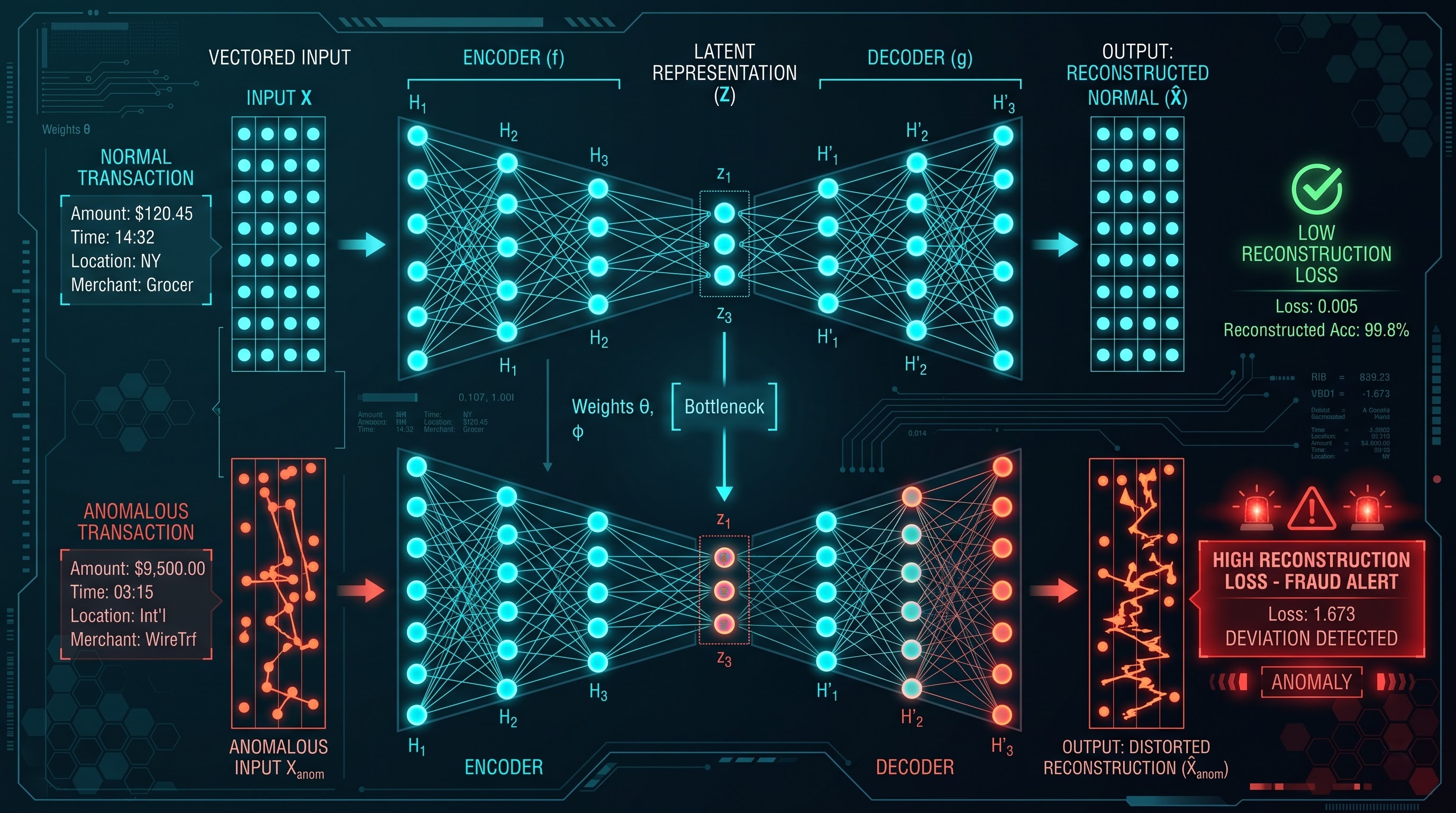
As fraudulent operations become increasingly sophisticated, standard forms of machine learning reach representation limits. Bad actors purposely commit frauds that do not exceed limits in a single variable: they use small payment amounts, imitate consumers’ purchasing patterns, and change their IP addresses. Deep learning gets past this problem by transforming high-dimensional data streams into lower dimensional latent variables.
Some of the important deep learning techniques which can be found in powerful fraud detection systems are:
Deep Autoencoders for Loss Calculation: An autoencoder reduces the attributes of normal transactions to a latent representation through a bottleneck layer. After that it reconstructs the original input using the compressed data to compute the error. Because the model is trained on real transactions, it knows the patterns in actions taken by normal users. When something unusual happens, the autoencoder fails to reconstruct the original input correctly. Thus, reconstruction loss is used as a continuous anomaly detection metric: the bigger the loss, the more unusual a transaction is.
Variational Autoencoder and Probabilistic Outlier Scoring: In contrast with normal autoencoders which determine deterministic reconstruction loss, variational autoencoders use mapping of inputs into the latent space as a continuous probability distribution. This enables the fraud engine to define the probability of the incoming session being from the legitimate user’s distribution.
Recurrent Architectures and Temporal Transformers in Behavior Sequence Modeling: Financial fraud is rarely a unique isolated event; it is a history of events. For instance, takeover of account normally exhibits a sequence of events - namely password reset requests, modification of communication preferences, dormancy, balance checking, and finally a transfer with large number of transactions. Long Short-Term Memory networks and causal transformer architectures analyze events being sequenced.
Discount scams and identity fraud are becoming major industries operated by organized crime groups. Modern crime groups do not attack accounts randomly; instead, they operate hundreds of "dummy" identities, third-party bank accounts, and merchant payment processing points in a consistent way.
If a particular fake account or bank transaction is considered in isolation, it will appear totally legitimate. It has authentic identity details, realistic device characteristics, and it passes basic velocity checks. However, the problem is not with the attributes of the transaction on the tabular level, but rather to be found in its topology.
Graph Neural Networks - Discovering Coordinated Fraud Rings and Colluding Entities

Payment fraud and identity theft have transformed into organized activities performed by syndicates. Unlike traditional methods of randomly contracting victims’ accounts, the modern syndicates are using hundreds of synthetic identities, compromised "mule" bank accounts, and merchant endpoints that work in synergy.
If we evaluate the synthetic account or a mule transaction independently, it will appear completely innocent. It includes a legitimate identity, real device fingerprints, and passes velocity checks. However, the problem is not in the transaction's attributes but rather in its connections.
Graph Neural Networks and graph analytics are able to identify the network-level anomalies:
Building Heterogeneous Graphs: The entities involved as nodes are identified as users, physical devices, credit card numbers, shipping addresses, bank routing numbers, and IP addresses. The types of transactions, logins, or characteristics shared between accounts are consequently depicted as edges.
Graph Convolution and Neighbors Aggregation: During the process of graph convolution performed by Graph Convolutional Networks, the information flows from the neighboring nodes. Thus, if a seemingly normal payment is made using a bank account with an encrypted device fingerprint that belongs to the blacklisted entity from three weeks ago, graph convolution may allow accumulation of this information on the target node.
Applying Sub-Graph Anomaly Detection: The criminal groups often form dense intricate structures characterized by circular payments, rapid transfer of funds between newly opened accounts and by providing identical identity information from the same router. Anomalous graph models provide the possibility to calculate certain structural metrics of subgraphs like local clustering coefficients or spectral graph wavelets to detect the communities radically different from regular consumer networks.
The Millisecond Graph Query Problem: It is impossible to carry out an unrestricted graph query with more than one billion edges within the period of fifty milliseconds. However, the development of real-time graph engines allows for the implementation of inductive graph representation learning whereby the prepared and kept in memory node embeddings are modified asynchronously.
Behavioral Biometrics: Ongoing Identification Verification
Static forms of identity verification, such as passwords, identification numbers, physical addresses, and date of birth, have lost all credibility due to historical data breaches committed by companies. The reliance on static identification credentials is inadequate.
In facing synthetic identities, automated bots, and credential stuffing account takeover attempts, modern anomaly detection has shifted to behavioral biometrics; that is, quantifying the way a human interacts physically and neurologically with a particular device.
This section is devoted to the examination of how passive biometrics are registered and analyzed.
Keystroke dynamics serve as an illustration: when individuals type in payment card data or their passwords, there is a specific rhythm they exhibit, reflecting flight time (the time it takes a user to release a key and press the subsequent one) and dwell time (the time a key is depressed). In this case, the behavioral anomaly model shows that a person uses a different neuromotor pattern than the true account holder. The remarkable thing is that bots and plagiarizing automation shows the same flight time and hence, can be easily identified.
Pointer and Cursor Movement Mechanics: Human interaction with the mouse is an inconsistency in nature. During use, mouse movement can change and undergo correction, and also unpredictable acceleration and deceleration stages. In their case, a headless browser is able to implement pointer movement algorithmically without performing actual spatial shifts. An anomaly detection engine is responsible for detecting vector trajectories for mouse pointer movement, which makes it possible to distinguish between humans and bots.
Touchscreen Physics and Gyroscopic Signatures: On the mobile devices, a behavioral engine provides information about the surface of the touchscreen, the force applied to it, the inclination angle of the smartphone and other data. Therefore, in this case as well, a cybercriminal acts with the phone in a completely different manner compared to an honest user, allowing us to identify fraudulent transactions with high reliability and automatically reject them, even if a fraudster enters the password correctly.
Synthetic Identity Fraud: Identification of Fictional People with No DNA Base
Synthetic identity fraud is one of the fastest growing and most intricate financial crimes. In contrast to conventional identity theft in which an existing account or card of a real victim has been compromised, synthetic fraud relies on creating a distinct identity. Criminals combine legitimate, unused identifiers from the government (such as Social Security numbers of children, dead people or non-active citizens) with fake names, borrowed addresses and temporary phone numbers.
The synthetic identity is systematically nurtured for months or even years. The fraudster acquires a basic credit, is turned down, gets an inquiry record, obtains a credit-building card and meets payments on time before going for the bust-out, when he uses all his borrowed funds from various financial institutions and simply disappears from the scene.
Anomaly detection models are utilized to identify synthetic identities at the moment of opening an account and the issuing of credit based on sophisticated techniques:
The abnormalities of the fragmented identity graph: While synthetic identities may pass the initial tests of a credit bureau, their structure shows abnormalities in the entire digital world. A real human identity has a trace of utility payments, voter registration, vehicle titles, ownership history, and work experience spanning hundreds of years. Anomaly detection systems analyze the depth of the digital footprints, evaluating the probability that an identity could have appeared in this world.
Disjointedness of the entity: Synthetic ring fraudsters often duplicate fragments of identities, for instance, they use one physical apartment address for 10 different personalities or connect five different identities to the same two burner phones. Clustering algorithms would help to understand the underlying connections between seemingly unrelated events.
Account inactivity and acceleration anomalies: Normal consumer credit use changes together with salary, seasonality and life events; meanwhile, synthetic identities have an algorithmic pattern of behavior: a long period of the credit being nurtured, followed by instant several applications for credit. Anomaly models detect the inconsistency of those two types of financial habits.
The Real-Time Feature Store and Data Streaming Architecture
Machine learning models totally rely on the quality and speed of the features received as input. A complicated anomaly-detection model will not be able to detect an account takeover in real time if the feature that indicates the “number of password changes within the last ten minutes” is updated only in a nightly batch job.
The infrastructure needed to compute, update, and deliver thousands of operational features at sub-millisecond latency is very complex.
Unified Event and Streaming Processing: All of the activity—page loads, keystrokes, password updates, balance requests, card approvals—has to be collected in real time using high-throughput distributed event systems like Apache Kafka and Apache Pulsar.
Stream Processing Engine: Stateful stream processors (e.g., Flink, Spark Streaming) help maintain sliding time windows of stream data and perform calculations in real time, always issuing the fresh results.
Dual-Layer Feature Stores (Online vs. Offline): The integrated feature stores are the backbone of many contemporary architectures for fraud detection in enterprises, acting as a bridge between training and subsequent inference. Historical log information is contained in the offline store (built using analytical object storage or data warehouses) and is measured in petabytes for training anomaly models. The online store (using the technology of modern high-speed in-memory databases such as Redis, Dragonfly, or Aerospike) helps keep the actual features in real-time in microseconds without any deviations between theory and practice.
Zero-Copy Serialization: Following the complex nature of the input feature vectors in the runtime creates extra overhead for the serialization and deserialization processes. The modern technologies offer zero-copy serialization frameworks (such as the Apache Arrow framework) permitting the inference models to use the specified data from the storage directly bypassing the hard conversion steps.
Cold Start Challenges, Adaptive Concept Drift, and Feedback Loops
Anomaly detection systems are faced with an inherent operational dilemma: The definition of "normal" is never constant. Legitimate human behavior experiences rapid changes that are influenced by budgets, cultural trends, holidays, and the introduction of new applications on the platform.
In addition, when the company launches a new payment option, begins to operate abroad, or opens accounts to young clients without a history of making transactions, the anomaly engine starts suffering from cold start issues that accompany all new initiatives.
To manage constant adaptation, certain architectural components are needed:
Concept Drift and Covariate Shift: Black Friday comes, and the purchase volume skyrockets, the shopping pace speeds up, the size of the basket grows thrice, and consumers buy things from atypical categories. Rigid anomaly detection systems will treat this massive behavioral change as a worldwide cyberattack, causing the avalanche of false positives to hit. That is why anomaly engines must change the threshold parameters dynamically and use online statistical profiling and moving average volatility instrumentalities.
Handling Automated Cold Start: For new accounts lacking transaction history, models need to look beyond personalized patterns. The configuration should allow for the quantifying of customers through cohort-based hierarchical models, where each new user is compared with parameters of their peer group until they acquire enough unique history to provide meaningful inputs.
Implementing a Fraud Feedback Loop: Fraud marks do not come promptly. Chargebacks, for instance, can take 30-90 days to be processed by the card associations. Nonetheless, operational indicators—like complaints, results from manual reviews, and results of biometric tests—are practically available in no time. The systems using adaptive anomaly technology, however, do not disregard ongoing updates and incorporate user feedback in such a way that weight adjustments do not lead to catastrophic forgetting of prior knowledge.
Explainability, Interpretability, and Algorithmic Auditing for Sub-Second Decisions
Worldwide financial regulations require that all automated systems generate clear, non-discriminatory, and understandable reasons behind declines of any transactions, freezes of accounts, or failures to verify identities. According to the regulations such as the EU's General Data Protection Regulation and the Fair Credit Reporting Act in the USA, it is impermissible for a company to decline a transaction because the automated unsupervised deep learning model generated a high latent distance for it.
The equilibrium of profound mathematics and human readability could be referred to as the hardest problem of contemporary fraud engineering. As modern data analytics groups integrate classical methods of explaining anomalies along with generative artificial intelligence to issue adverse action notices, analyze threat logs, and draft compliance summaries, professionals who undergo business analyst with gen ai course acquire precisely that expertise.
Global vs Local Interpretability: The global interpretability is related to the way the model works in general, whereas the local interpretability is about the explanation of the individual decision. The fraud detection needs local interpretability – why was this particular payment rejected at 3:14 AM?
Real-Time SHAP (Shapley Additive Explanations) and TreeSHAP: Shapley values, derived from game theory, precisely measure the marginal impact of each individual variable on the overall anomaly score. With advances in TreeSHAP algorithms, precise local explanations of decision tree ensembles have been enabled in low-millisecond windows, providing the best reasons for adverse action immediately.
Surrogate Interpretable Models: Where exact mathematical explanation of the model's decision process is too computationally complex to be done in fifteen milliseconds in pipelines using deep autoencoder or neural network models, engines simultaneously operate lighter weight interpretable surrogate models (such as shallow decision trees) to approximate the decision boundary and create immediate audit records.
Preventing Algorithmic Bias: When an unsupervised model learns that specific zip codes, geographic boundaries, or legacy bank routing numbers are statistically outliers, they may cause discriminatory practices without awareness. Pipelines are used for continual testing against statistical parity and equalized odds measures to ensure that risk engines test for transactional legitimacy instead of discriminating against underrepresented/marginalized populations.
Gaining Skills in Real-Time Business Analytics
With instant payment solutions and digital identity gaining traction around the globe, there is a greater need than ever before for people who have the ability to merge data engineering skills, statistical modeling, and financial risk management. For individuals looking to gain expertise in such concepts and frameworks used in the industry, getting enrolled in an online business analyst course india through OnlineITGuru is the ideal option.