
The Architecture, Mechanics, and Evolution of MongoDB
Last updated on Aug 26, 2026

The Beginning of Non-Relational Persistence
For almost 30 years, relational database management systems had been the leading foundation of enterprise software architecture. These included systems like Oracle, IBM DB2, PostgreSQL, and MySQL based on Edgar F. Codd’s relational model from which they drew mathematical precision, strict schema regulation, and declarative querying thanks to Structured Query Language. The main concept behind these systems was that data could and should be represented in multi-dimensional relations, consisting of rows and columns, each governed by primary and foreign keys, representing normalized relations with no redundancy, as well as ensuring the most important conditions of Atomicity, Consistency, Isolation, and Durability (ACID).
With the development of the Internet right into the cloud-computing era and massive multi-tenant web applications with a worldwide user base, shortcomings of relational databases started becoming evident. The rapid increase in transaction volumes and data inflow rates resulted in multiple scalability limitation issues. Relational database systems were designed predominantly for vertical scaling where it is necessary to use more powerful processors, faster memory, and larger disk storage instead of horizontal scaling on a distributed pool of standard servers.
At the same time, there were some changes in the structure of the software development lifecycle. Object-oriented programming languages such as Java, Python, C# and JavaScript took the lead, resulting in the emergence of the object-relational impedance mismatch: developers created complex object graphs made of rich domain entities but needed to spend a lot of time and resources mapping these objects into plain rows in tables of multiple levels of Object-Relational Mapping layers and turning them back while getting them out.
In 2007, the trio Kevin Ryan, Eliot Horowitz and Dwight Merriman, who created DoubleClick, experienced these limitations while developing the internet advertising solution capable of processing a few hundred thousands of operations per second. Understanding that modern software requires a data layer with priorities like developer productivity and natural horizontal data distribution, they decided to create a company in 10gen (now MongoDB Inc.) and introduced MongoDB in 2009.
The idea behind MongoDB was to create a document database that would fit somewhere between key-value stores, which had high levels of horizontal scalability but poor query capabilities, and traditional relational databases that had good query functionality but needed to scale in a more constrained way. MongoDB’s way of doing that was to treat self-contained documents that conform to the data structure as the basis of data storage.
Document-based storage
At the heart of MongoDB's philosophy is the document design. Instead of storing records in strictly defined tables with rows and columns, MongoDB organizes data in semi-structured documents that are stored in the so-called collections.
From JSON to Binary JSON
JSON and its variant, Binary JSON JSON (JavaScript Object Notation) is the most important language used by application developers interacting with MongoDB. However, the database management system does not utilize the raw format of JSON. This is because JSON is not efficient enough for database operations: it requires parsing of strings on every read, and limits data types to strings, numbers, booleans, arrays, objects, and null.
MongoDB has overcome the inefficiencies of JSON by introducing Binary JSON (BSON), which is a binary representation of JSON that has three distinct engineering goals in mind:
Efficient Representation: BSON is efficient in terms of physical space required according to its power of expression.
High Speed of Traversing: BSON allows for efficient scanning of documents in memory thanks to the fact that all data elements contain prefixes with length and field identifiers.
Diversity of Types: BSON types differ from standard types of JSON, incorporating 64-bit signed integers, 32-bit signed integers, IEEE floating point numbers, high-precision decimal numbers, raw binary data, timestamps, dates, regular expressions, and more.
The Anatomy of a Document and the Object Identifier
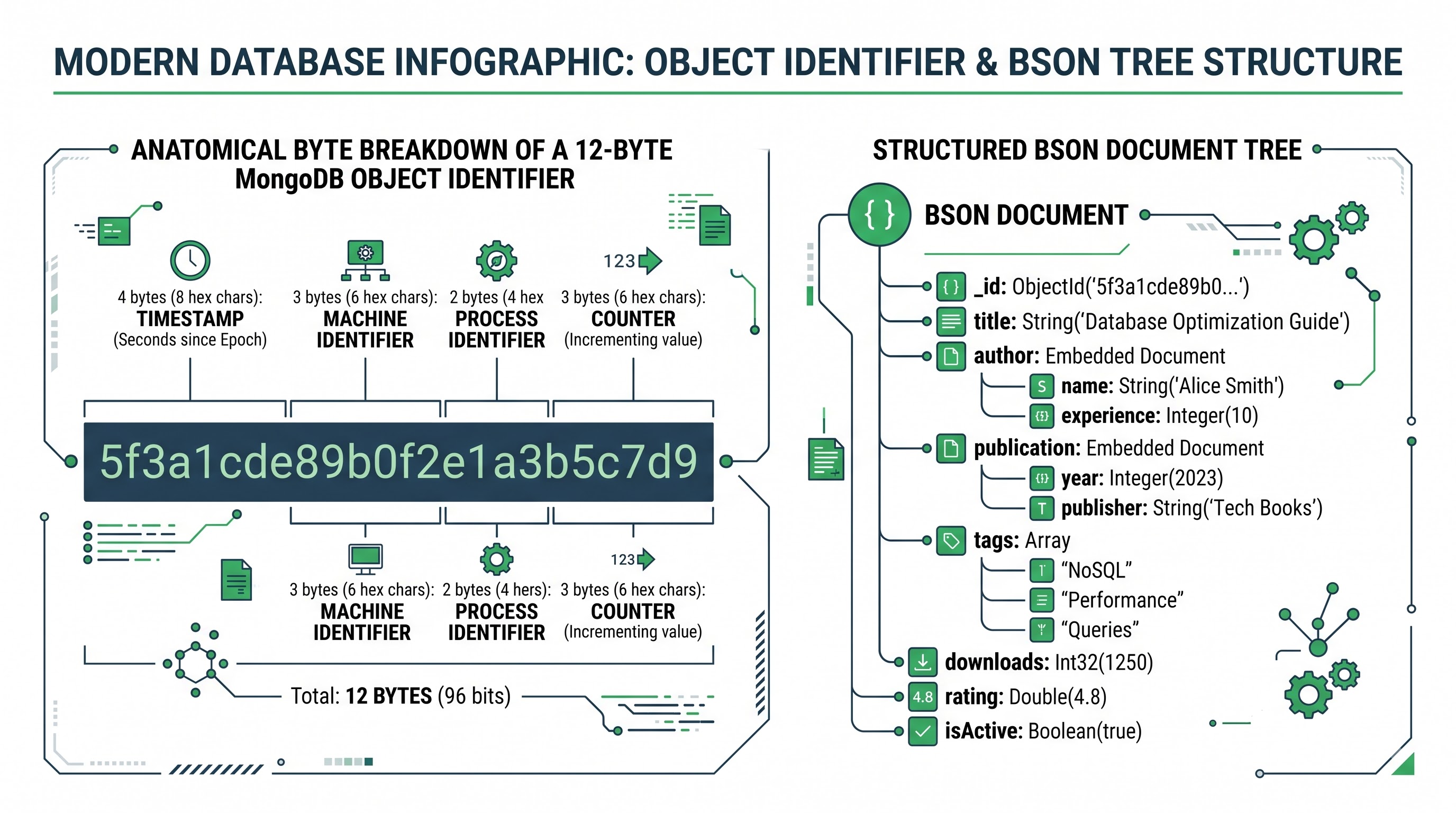
Every document in a MongoDB collection needs to have a distinct identifier which is present in the mandatory field called the identifier field. If the required field is absent, the MongoDB client or driver takes care of it and creates a twelve-byte BSON ObjectID automatically.
An ObjectID has a deterministic structure and permits a time-based distribution of information in a distributed system without the need for centralized control.
The first four bytes will consist of the Unix epoch timestamp, implying the ObjectIDs can be separated using the creation time.
The next five-byte section will represent a randomly produced value specific to the process and the host machine, ensuring that collisions do not happen in distributed application nodes.
The last three bytes are given sequentially starting from a random value to ensure that there are unique identifiers in the same second and machine.
Due to the capability of documents to house nested sub-documents and put together arrays of all kinds, a complete business entity—e.g., an e-commerce order with info about its customers, lines of goods, shipping addresses, tax calculation, and history of its statuses—can be stored as one piece of data.
Designing Schemas and Modeling Data
One prevalent myth tied to document databases claims that they are "schemaless." However, in reality, MongoDB is said to be "schema-flexible" or even "schema-dynamic." It does not require the mandatory implementation of Data Definition Language but nevertheless, guarantees the presence of some schema at the application layer. At the same time, newest modifications of MongoDB work with JSON Schema's validation engine that allows vouching for strict adherence to structural constraints, checking types and values.
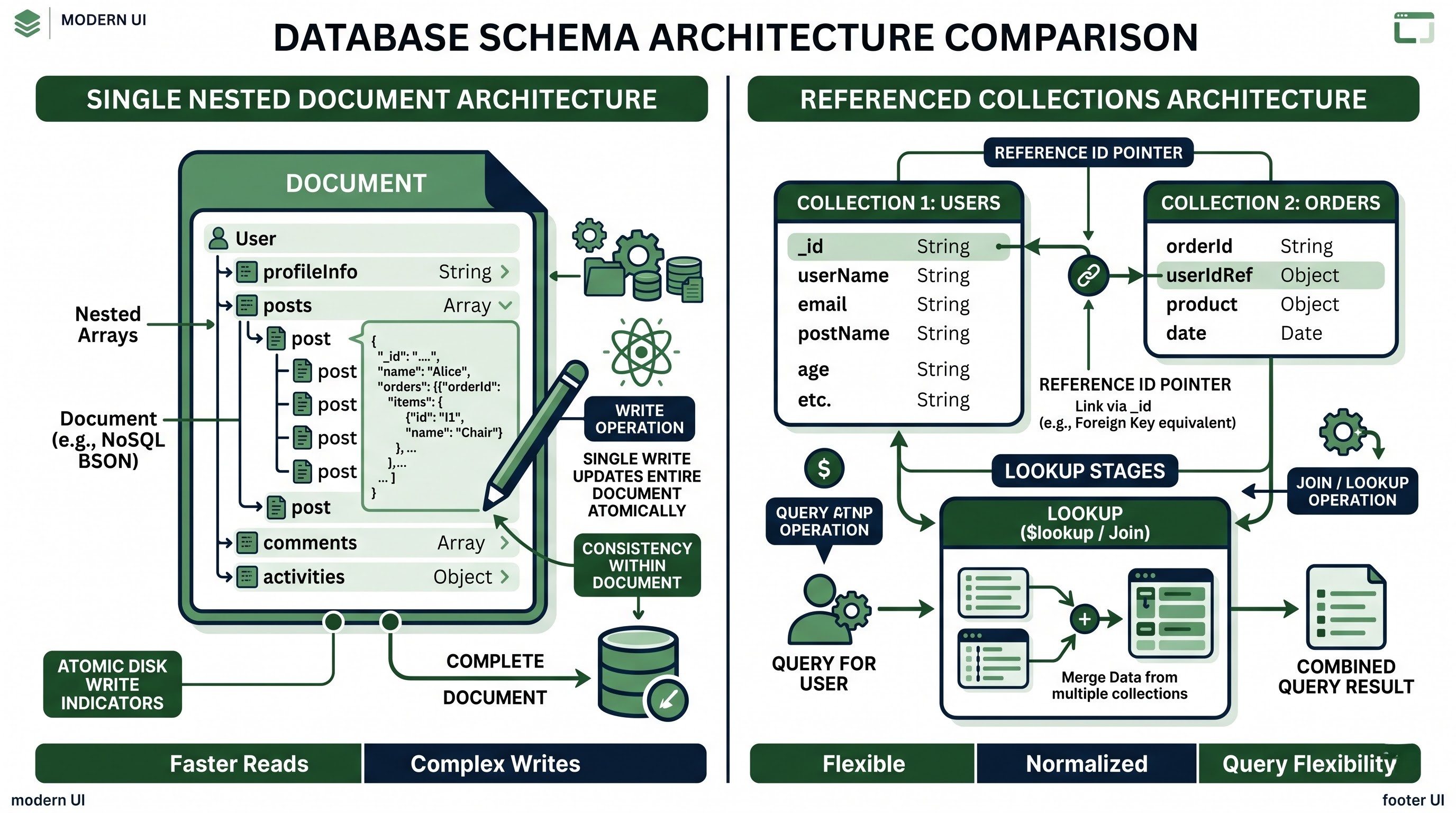
Data modeling in MongoDB is completely different from the classic usage of the third normal form of the relations.
The Embedding Paradigm (Denormalization)
With embedding, related entities (children) are nested in the form of sub-documents/arrays in a document (parent).
Advantages: Embedding creates excellent read performance because all the required data is retrieved from the single location on the disk/memory, which enables the database to answer queries with the help of only one disk seek. Moreover, writing to a single document is atomic hence the updating of both parent and nested arrays occurs either successfully or fails simultaneously and there is no need for distributed transactions.
Best usage: Embedding is used in one-to-one relationships (like a user with profile settings) or in one bounded many-to-one relationships (like an order and its items in it or a blog post and several comments).
Risks and Limitations: BSON has imposed a rigid ceiling of sixteen megabytes per document. This ceiling has been designed to protect its architecture from memory fragmentation issues and to guarantee regular network transfer latency. Creating endless one-to-many relationships with the use of embedding—like a sensor that is continuously sending telemetry data to one array—is bound to breach this ceiling and hinder the performance since the document will keep changing its size in the memory.
The Reference Model (Reference Linking)
The concept of Reference is like standard relational design in that it stores pairs of entities in different documents from different collections and refers to them through identifier references:
Benefits: Reference saves uncontrolled document growth, avoids data redundancy when entities are shared and permits the separate management of lives of different domain models.
Cases of Application: Reference is imperative for the many-to-many relationship like "students enrolling in courses," large or unrestricted one-to-many relationships like "influencer with millions of followers," and the frequently changing common metadata (in cases when denormalization would cause extensive update cascades).
How Retrieval Works: MongoDB gets the referenced data at the time it is queried using the lookup stage of the aggregation framework where it performs a left-outer join between collections or using client-side batching.
Advanced Architectural Design Techniques
Apart from simple referencing and embedding, sophisticated MongoDB modeling utilizes established design techniques:
Bucket Pattern: This design pattern is mostly employed in time-series and Internet of Things systems. It transforms several individual data values made in a defined period of time (for instance an hour or a day) into a single document with a fixed-size array of metrics.
Subset Pattern: If documents contain too large amounts of data that is not often used (for example, long product reviews or old archives), the most frequently watched subset of data (for example, ten last reviews) is embedded into the main document while the whole dataset is sent to another collection.
Computed Pattern: If one needs to make a lot of writing while retrieving calculated values simultaneously, computed values such as accumulated earnings, number of followers, or average ratings are written directly into a document, so there is no need for time-consuming calculations.
Schema Versioning Pattern: When an application changes, its data structures also change. By implementing a version integer in every document, the application can manage different schemes simultaneously and move older database entries at the moment of writing.
Proper understanding of these schema patterns and document modeling techniques is very important for contemporary database engineers. In case you are interested in practical assignments and organized learning, you can opt to mongodb learn online with OnlineITGuru for practical job experience.
The Query Framework and the Aggregation Pipeline
MongoDB uses flexible, actionable query language which it implements intrinsically through JSON-like document syntax instead of using SQL statements joined by strings.
CRUD Mechanics and Field-Level Projections
Simple interface for reading and writing gives developers high targeting precision:
Query Selectors: MongoDB employs the principal comparison operations (equality, inequality, ranges), logical operations (and, or, nor, not), element operations (existence, type checking), and evaluation operations (regular expressions, text search).
Dot-notation Navigation: The engine helps carry out deep search in nested structures and arrays through the use of dot notation. For example, an application can search in the structure of a field of the nested object, or find an element in the structure of an array of objects.
In-place Array Updates: The update modifiers enable performing atomical array-related actions such as adding new elements, deleting similar items, making use of positional matching, and cutting sizes of the array directly in the storage engine.
Projections: Read operations make it possible to use some basic projections and require operation from the engine to send a precise number of packets through the network in order to not overload the client application.
Architecture of the Aggregation Pipeline
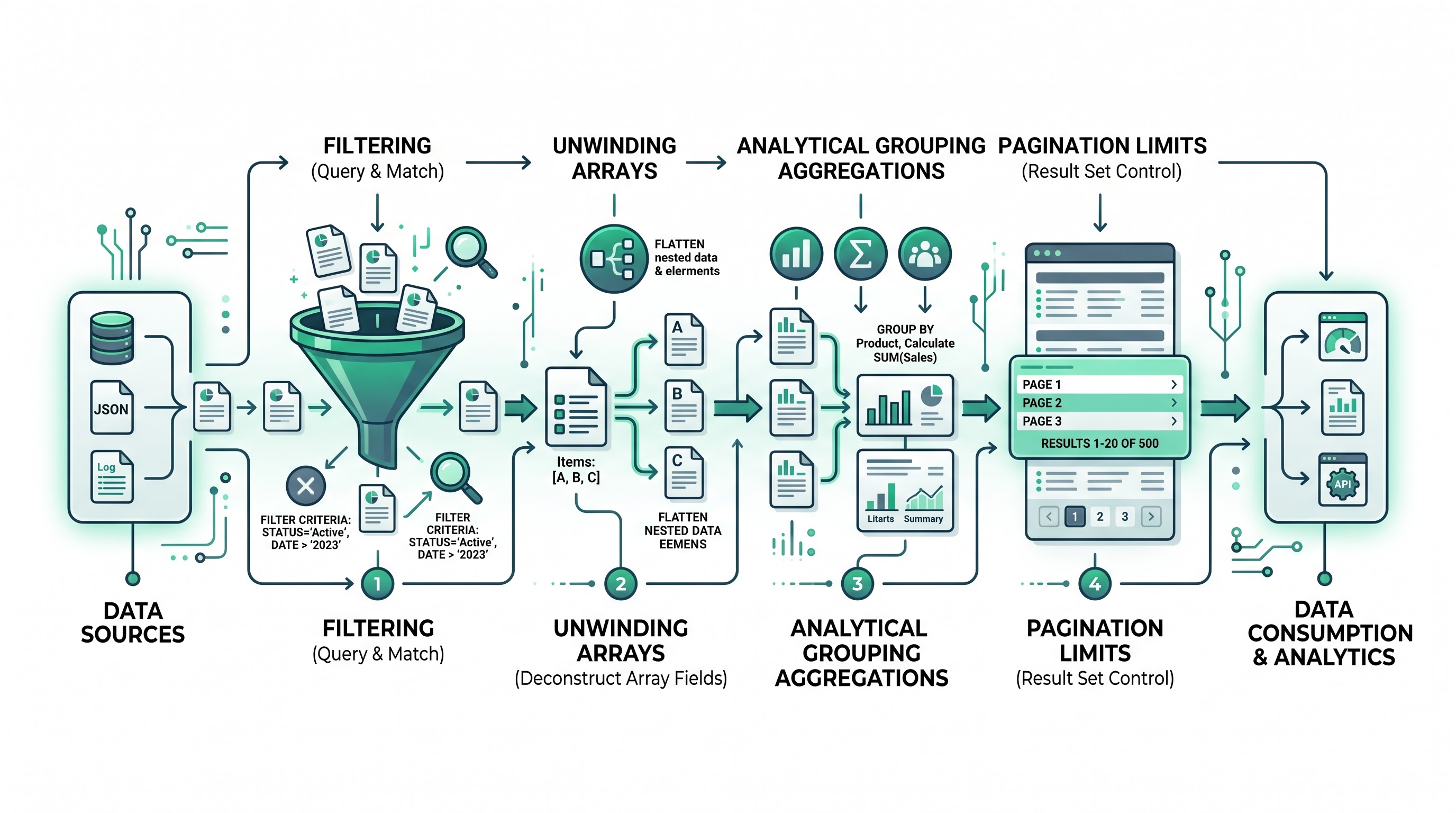
MongoDB takes advantage of the Aggregation Pipeline for performing analytical work, complex data transformations, and report generation. In a way similar to the Unix pipeline concept, the Aggregation Pipeline works by processing the stream of documents through a sequence of stages, with the output produced in one stage as an input for the next one.
The pipeline processes documents via several key stages:
Filtering and Shaping Stages: The process starts with filtering the incoming documents according to required criteria and projecting necessary sets of fields to discard redundant information at the earliest possible step; thus memory consumption is lower in the following stages.
Separation and Grouping Stages. Array fields can be untangled, and all array elements become separate documents. Then at the grouping stage, documents that have the same grouping key are collected and the cumulative functions can be performed (sum, average, standard deviation, minimum, maximum, or distinct values aggregation).
Stages for Sorting and Pagination: One or more keys are employed to order intermediate results and pagination via skip and limit stages is achieved.
Joins of Multiple Collections: The lookup stage adds capabilities for relational joins, meaning that related documents can be gathered from different collections and converted into array fields of a document being examined.
Windowing and Graph Lookup: Advanced stages enable execution of all kinds of analytical window operations (such as moving averages, running totals, and ranking within some document partitions) and recursive graph lookups in order to maneuver through hierarchical and interconnected models.
In destination execution does not always work as it was designed by MongoDB's query planner which optimizes performance by reordering stages usages, processing filter predicates and delivering intermediate results.
Constructing optimized aggregation pipelines necessitates an in-depth knowledge of practical work. By participating in interactive mongodb online classes at OnlineITGuru developers can learn all about real-world data conversion and complex queries under professional guidance.
Inside the Storage Engine: The WiredTiger Framework
WiredTiger is the storage engine introduced in version 3.0 of MongoDB, and WiredTiger has remained the main storage engine of the platform. WiredTiger has its work cut out for it, including controlling how data is physically stored on the disk, memory allocation functions, write-ahead logging, indexing, and managing concurrency during transaction processing.
Lock-Free Execution More Efficiently
Previous versions of MongoDB relied on MMAPv1 as an internal storage engine, which was limited by database-level and collection-level locking. WiredTiger transformed the operational efficiency of MongoDB by introducing document-level concurrency:
When several write operations hit the same collection simultaneously, they occur without getting collection-wide locks.
In case there are two write transactions trying to modify the same document, there is a write conflict that is resolved by the WiredTiger by aborting the operation resulting in the write conflict.
Read operations are performed without any locks, with snapshots of data being retrieved allowing one not to block write operations and ensuring predictable performance of read operations regardless of the level of write saturation.
The use of a dual-cache system by WiredTiger
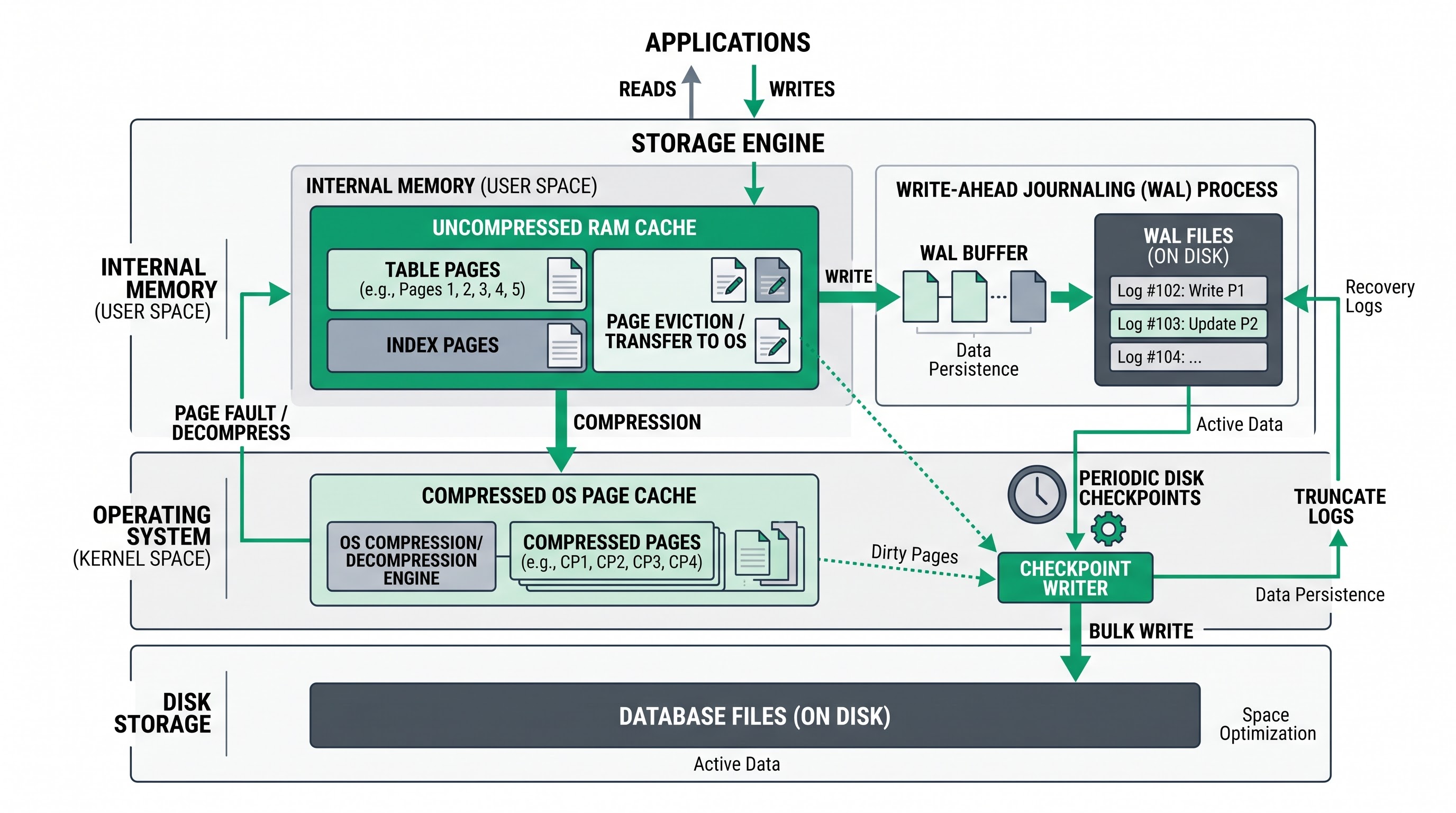
WiredTiger employs a complex dual-cache system that is structured to provide maximum performance and utilize the available system memory:
The WiredTiger Internal Cache. It is a standard practice to allocate about half of system memory (after deducting one gigabyte) to an internal cache in WiredTiger. It is stored in this cache that all documents and index pages can be processed as uncompressed data to allow fast CPU processing, direct updates, and internal transmission.
The Operating System File System Cache. The rest of the memory is managed by the built-in page cache of the operating system. When WiredTiger is writing pages from its internal cache to a disk, data is compressed prior to writing it to the file system cache. The architecture guarantees that frequently used data is stored in RAM memory, thereby minimizing the number of costly input/output operations carried out on block storage devices.
Compression algorithms
WiredTiger comes with built-in functionality of data and index compression, leading to reduction of total cost of ownership and savings in terms of physical storage:
Collection Compression: Collections are traditionally compressed by means of the snappy algorithm by default with a balanced ratio of CPU usage and the level of compression. In case of historical and archive collections, the users can choose the zlib algorithm or standards which are able to give the maximum level of compression.
Index Compression: By default, the account of the index is carried out with prefix compression in which extra prefixes from the keys of the index in terms of B-Tree are omitted allowing the effective storage of an immense index in the internal cache.
Checkpointing Process and Journaling Mechanism
WiredTiger uses a pair of complementary techniques for durability and crash consistency: check-pointing and a write ahead log:
Checkpoints: WiredTiger periodically creates a global snapshot of the database state and writes the contents of all modified pages to disk as a new consistent checkpoint. This process produces a reliable and recoverable state that can be used for point-in-time recovery.
Journaling: Between checkpoints, changes to the database are logged in an append-only file on disk. If a server fails, the database will be restored by applying all the journal log records recorded after the latest checkpoint.
Database professionals pursuing enterprise-level implementations must know the details of replication, failover processes, and storage engines. The benefit of undertaking a mongodb dba online training from OnlineITGuru is that it teaches students about cluster installation, disaster recovery, and real-time node administration.
High Availability and Fault Tolerance Using Replica Sets
In order to achieve continuous availability of data, disaster recovery, and operational failure tolerance, MongoDB should implement the notion of replica sets in any production environment. The replica set may be described as a group of MongoDB servers replicating each other's data for maintaining duplicate copies of the data.
Primary-Secondary Replication
The replica set should include an odd number of nodes, normally equal to or greater than three:
The Primary Node is the only node in a replica set receiving write requests. The primary node logs all operations that change the state of the database in physical collections as well as the operation log (oplog).
Secondary Nodes are responsible for obtaining data from the primary node and applying all changes to their data.
Arbiter Nodes assist in decision-making above the primary and secondary nodes in the set. An arbiter node does not keep any data but participates only in elections in order to break ties in the event when the other nodes vote in the same way.
Consensus, Elections, and Failover
MongoDB uses a consensus protocol inspired by the Raft consensus algorithm to make sure automatic handling of primary node failures takes place:
All nodes continuously exchange heartbeat signals in both directions. Every 2 seconds, they send messages to all and receive messages back.
If the primary node fails to respond within a specific election timeout (usually 10 seconds), then secondary nodes detect that leadership has been lost.
A secondary node with the latest oplog entry becomes a candidate for being the new primary and starts sending requests for voting to the other nodes.
Once the candidate reaches a strict majority of votes from all voting members, it becomes a primary and starts accepting writes. The whole process takes less than 3 seconds.
Tunable Consistency: Read and Write Concerns
With the help of adjustable Read and Write Concerns, MongoDB permits programmers to customize reliability and durability requirements on a per-operation basis.
Write Concerns, which specify how much acknowledgment should be expected from the database during the execution of the write operation, are given as follows:
Local (or Unacknowledged): After being processed in the memory of the primary, the write operation completes right away, providing the quickest speed accompanied by a possible issue of durability.
Majority: The write operation finishes after being duly recorded in the journals of the majority of the data-bearing replicas in a data-bearing collection, which means that the data will be protected in case of an election.
The read concerns define the level of consistency and isolation characteristics of the information retrieved:
Local: It provides the latest data from the node without confirming whether the write has completed the majority of votes. With this, although the performance is high, there is a chance of reading the data that can be reversed:
Majority: It provides the data that has been accepted by the majority of the nodes and hence does not allow "dirty reads".
Linearizable: This allows enforcing real-time serializability by ensuring that during the read operation, the primary contacts some quorum of nodes confirming that it reflects the latest writes globally.
Snapshot: This is used in multi-document transactions to provide a point-in-time snapshot isolation for all operations carried out.
Advancing Your MongoDB Expertise
No matter if you are creating document models, configuring WiredTiger storage, or handling multi-node replicas, moving from theory to practical use is only possible through structured training.
If you want to gain certification as a database professional, consider signing up for a specialized mongodb dba course or an extensive online program provided by OnlineITGuru. For developers who want to improve their application architecture, learning mongodb via interactive online lessons is the right option since they will receive help from an instructor and practical training on creating scalable NoSQL systems.