
The Architecture of Modern Belonging: Reimagining Human Capital Management in the Digital Era
Last updated on Sep 3, 2026
There is a quiet revolution happening inside the modern enterprise, and it isn't starting in the boardroom or on the factory floor. It is happening in the invisible spaces where people and purpose attempt to meet. For decades, corporate human resources operated as a purely administrative fortress—a maze of siloed databases, rigid spreadsheets, and transactional software designed more for record-keeping than for human potential. We treated workers as static line items on a balance sheet, managing them through fragmented tools that felt disconnected from the lived reality of everyday work.
Then, the world changed. The shift toward remote, hybrid, and boundaryless work revealed the deep flaws in these legacy architectures. Organizations quickly realized that managing talent required more than just tracking attendance and processing payroll; it demanded an operational nervous system capable of adapting in real time.
Enter the modern era of cloud-based Human Capital Management (HCM). Among the platforms reshaping this landscape, Workday HCM stands out not merely as a software suite, but as a unified core designed to bring clarity, empathy, and fluid decision-making back to the employee experience.
The Silo Trap: Why Traditional HR Frameworks Broke Down
To understand the rise of Workday, one must first look at the wreckage of traditional enterprise IT. In the mid-2000s, global corporations managed their workforces using a patchwork of disparate software packages. You had one system for benefits, a separate local database for local payroll, a third-party application for talent acquisition, and an entirely separate spreadsheet system for tracking annual performance reviews.
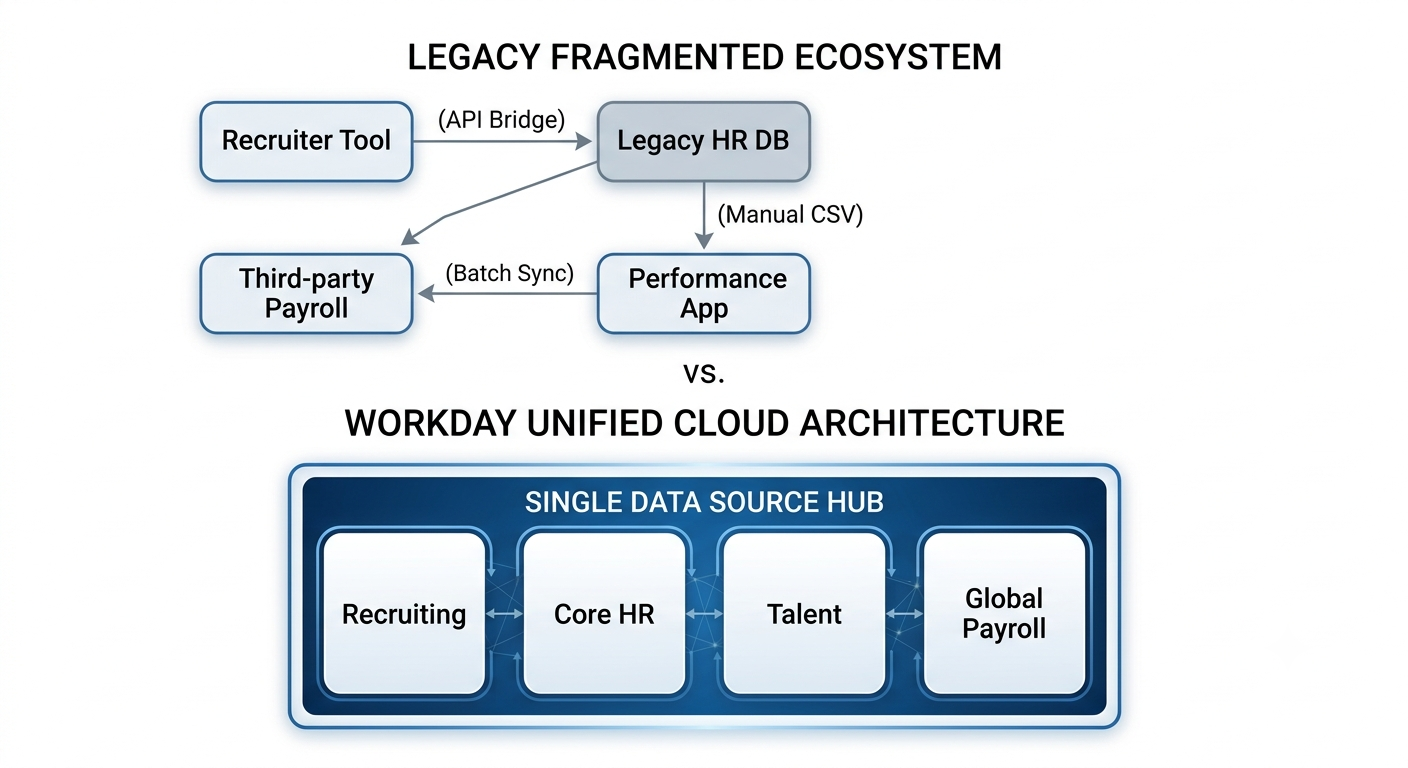
This fragmented setup created massive operational friction:
Data Discrepancies: A title change made in the primary database often took weeks to update across payroll or benefits systems, creating compliance risks and payroll errors.
Blind Decision-Making: Executive leadership lacked real-time visibility into global headcount, labor costs, or skill distributions, leaving them to make major strategic moves based on outdated monthly reports.
Frictional Employee Experiences: Workers were forced to navigate a confusing maze of different portals, login credentials, and interfaces just to perform simple administrative tasks like requesting leave or checking a pay stub.
When an organization operates on disconnected data, its workforce feels disconnected too. The physical separation of systems reinforces cultural silos, turning talent management into a series of bureaucratic hurdles rather than a strategic advantage.
The Power of One: The Core Architectural Philosophy
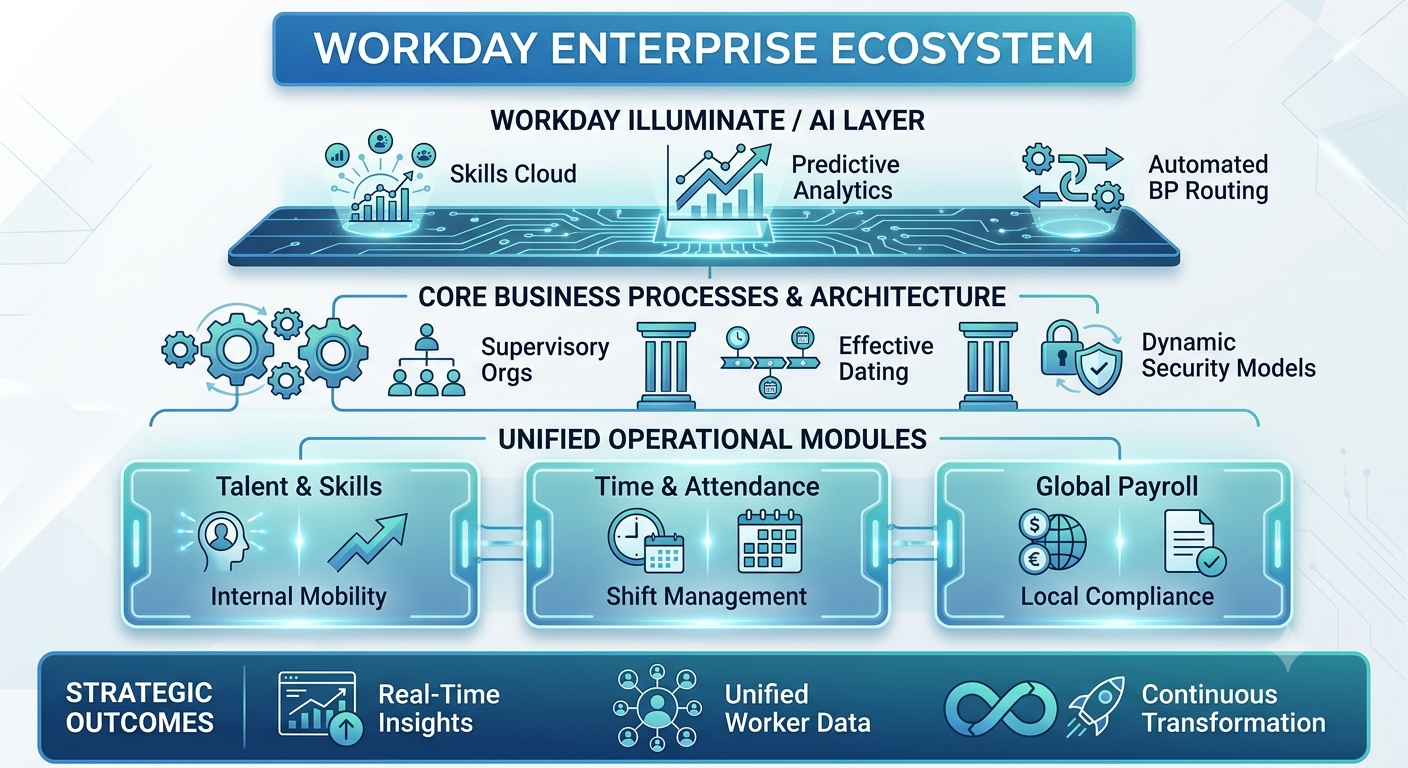
Workday took a fundamentally different approach from its inception. Rather than acquiring separate software products and trying to stitch them together with complex APIs, Workday built a cloud-native platform around a single unified database This "Power of One" philosophy means that every piece of data—from a worker's initial job application to their promotions, compensation adjustments, and skill tags—lives inside a single, shared object store.
The Engine of Flexibility: Supervisory Organizations
At the core of Workday HCM's data model is the Supervisory Organization. Traditional HR systems rely on rigid, fixed hierarchies mapped to specific accounting cost centers. When a company restructures, updating those systems requires months of manual data migration and IT rework.
Workday decouples managerial relationships from structural accounting. Supervisory Organizations define who reports to whom, driving business processes, security permissions, and approval flows seamlessly. If a team shifts to a new division, the underlying reporting lines reconfigure instantly, preserving historical context through effective dating without breaking financial mapping.
Effective Dating: Capturing Time in Motion
Most legacy databases only know two states: what is true today and what was overwritten yesterday. Workday operates on an Effective-Dated Engine. Every transaction carries an activation timeline:
Past (Historical): Audit trails maintain exact historical records of salaries, titles, and team structures for any given point in time.
Present (Current): Active data drives day-to-day operations, workflows, and automated routing.
Future (Planned): Organizations can model future reorganizations, scheduled pay adjustments, or hiring waves months in advance without affecting present-day operational workflows.
The Human Engine: Key Modules that Drive Enterprise Growth
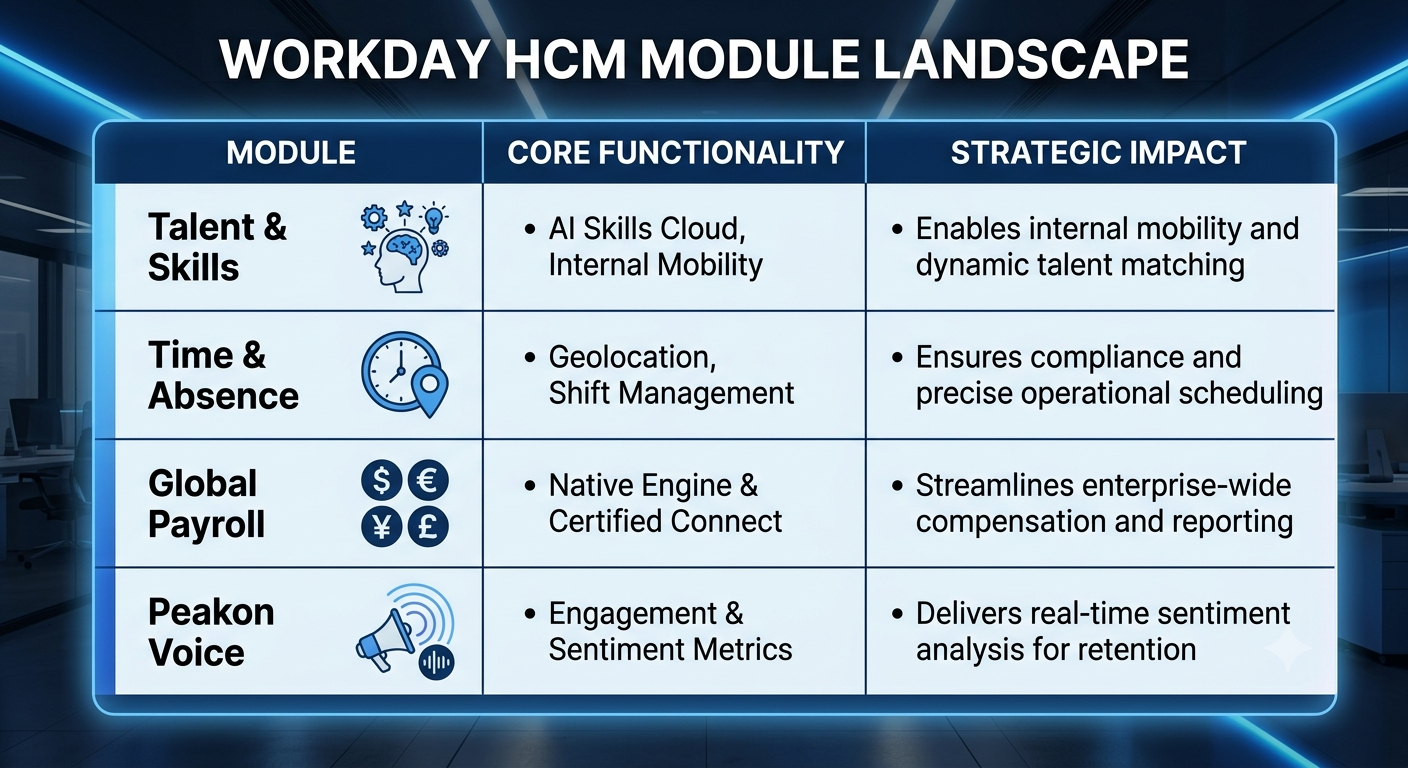
While the architecture provides the foundation, the modules deliver the daily operational value. Workday HCM integrates every touchpoint of the employee lifecycle into a unified experience.
Strategic Talent Alignment and Skills Cloud
The traditional resume is becoming obsolete. Forward-thinking enterprises no longer evaluate workers solely by job titles or degrees; they assess them by adaptable capabilities. Workday Skills Cloud leverages artificial intelligence to analyze, tag, and connect skills across the global workforce. The platform continuously translates dynamic project outputs, background history, and training completions into a unified skills ontology.
When a company launches a critical initiative, leaders don't need to run external searches. Instead, the platform surfaces internal candidates whose emerging skills match the project's exact needs. This internal mobility dramatically lowers recruitment costs, reduces turnover, and offers employees clear, personalized development paths. For professionals looking to navigate this evolving platform ecosystem, pursuing dedicated workday hcm training helps build a foundational understanding of how these talent analytics, organizational units, and business process configurations function together seamlessly in real-world deployments.
Dynamic Workforce Planning and Analytics
Human resource decisions shouldn't rely on intuition or reactive post-mortems. Workday integrates real-time business analytics directly into operational dashboards.
HR leaders can immediately analyze key organizational trends:
Flight Risk Models: Machine learning models flag teams experiencing high attrition risks based on compensation benchmarks, tenure trends, and manager changes.
Diversity and Inclusion Metrics: Live dashboard tracking gives organizations clear visibility into pay equity and promotion distribution across demographic cohorts.
Headcount Planning vs. Actuals: Managers can compare budgeted openings directly against active hiring pipelines in real time.
Operational Excellence: Configuring the Business Process Framework
The core engine driving everyday work inside the platform is the Business Process Framework (BPF). In legacy systems, modifying an operational approval path such as changing the approval requirements for a promotion or job change meant writing custom code or hiring external consultants.
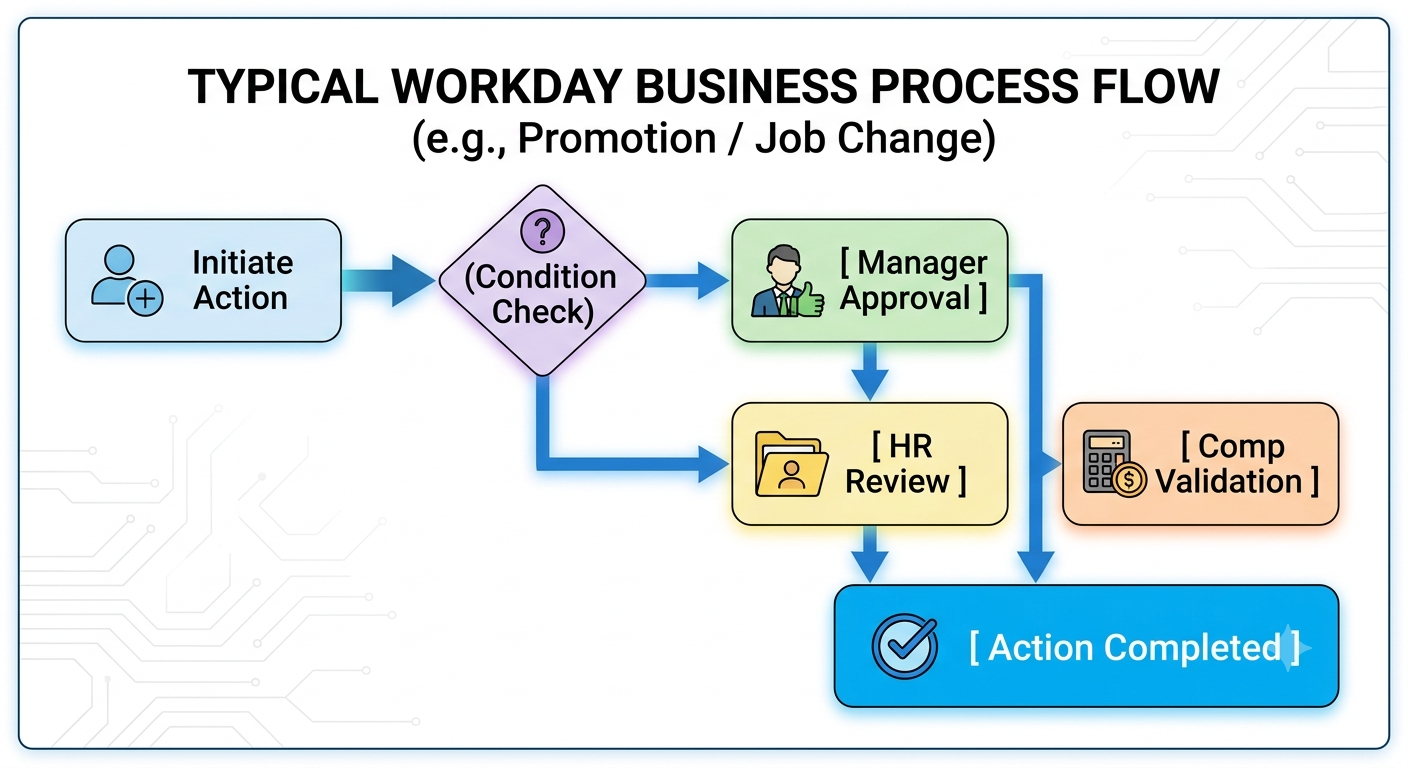
Workday replaces custom scripts with a visual, configurable workflow editor. Admins can configure custom business process definitions for every core action:
Initiation: A worker or manager submits an action (e.g., job profile change).
Condition Rules: Dynamic logic determines routing based on parameters like job profile, region, compensation tier, or cost center.
Approval Steps: Automatic routing passes the action to designated security roles for approval.
Action Steps & Notifications: Background services update worker profiles, calculate retro-pay adjustments, and notify key stakeholders instantly.
This configurable framework gives organizations the agility to adapt compliance rules, regional policy variations, or corporate reporting lines within hours instead of months. To gain hands-on proficiency with configuring these dynamic workflows and security rules, taking a structured workday hcm course provides the technical depth needed to build robust, compliant enterprise workflows.
The Artificial Intelligence Transformation: Workday Illuminate
As enterprise landscapes grow more complex, managing routine HR tasks manually becomes an operational bottleneck. The integration of Workday Illuminate transforms the HCM suite from an administrative record system into an intelligent, proactive operational assistant.
Generative Assistance: Automatically drafts comprehensive job descriptions, summarizes complex HR policies, and assists managers in composing personalized performance feedback to streamline communication.
Contextual Automation: Continuously scans transactions to identify anomaly patterns across payroll runs, expense submissions, and time-logging data, preventing costly operational errors before disbursement.
Agentic Workflows: Operates proactively behind the scenes to route routine approvals, suggest personalized career mobility paths for employees, and dynamically align internal skill sets with emerging business needs.
Rather than shoehorning external AI tools onto legacy code, Workday embeds machine learning models directly into its unified data foundation.
Proactive Decision Support
Illuminate analyzes operational patterns across millions of enterprise transactions to streamline everyday workflows:
Automated Job Requisition Generation: The platform automatically drafts detailed job descriptions based on target team skill gaps and organizational benchmarks.
Anomaly Detection in Payroll: Before payroll runs, predictive models scan compensation adjustments, flags irregular overtime patterns, and highlights potential processing errors before payments are disbursed.
Contextual Learning Recommendations: Employees receive personalized, real-time suggestions for training modules based on their current role, emerging project assignments, and long-term career aspirations.
Implementation and Adoption: Realizing True Platform ROI
Deploying an enterprise-grade cloud system is as much a cultural shift as it is a technological upgrade. Companies that extract maximum value from Workday view implementation as an ongoing operational transformation rather than a one-time software setup.
Successful implementations share several core characteristics:
Focus on User Experience: Leveraging mobile-first self-service portals empowers employees to update personal details, request leave, and track career goals independently.
Role-Based Security Design: Defining precise role-based and domain security policies ensures sensitive workforce data remains fully protected while streamlining management access.
Continuous Upskill Strategies: Sustained adoption relies on continuous learning initiatives that help administrators and managers stay ahead of bi-annual feature updates.
Completing targeted workday hr training equips modern human resource teams with the skills to audit security policies, optimize system capabilities, and drive high user adoption across global operations.
The Future of Work: Building an Adaptable Enterprise
The modern enterprise can no longer afford to operate on static, slow-moving systems built for an era of predictable, linear growth. In today’s hyper-dynamic market, organizational resilience depends entirely on an enterprise's ability to pivot its talent strategy as quickly as market demands evolve. Workday HCM has redefined how businesses manage, nurture, and empower their workforce by unifying core HR, payroll, talent management, and predictive analytics into a single, agile platform.
By replacing fragmented, legacy infrastructure with a real-time operational engine, companies gain the structural flexibility required to navigate disruption—whether driven by rapid technological advances, economic shifts, or changing workforce expectations.
Strategic Talent Alignment and Skills Cloud
The traditional resume is becoming obsolete. Forward-thinking enterprises no longer evaluate workers solely by job titles or degrees; they assess them by adaptable capabilities. Workday Skills Cloud leverages artificial intelligence to analyze, tag, and connect skills across the global workforce. The platform continuously translates dynamic project outputs, background history, and training completions into a unified skills ontology.
When a company launches a critical initiative, leaders don't need to run external searches. Instead, the platform surfaces internal candidates whose emerging skills match the project's exact needs. This internal mobility dramatically lowers recruitment costs, reduces turnover, and offers employees clear, personalized development paths. By shifting from reactive administration to proactive, skills-based workforce orchestration, organizations can build cultures grounded in agility, transparency, and deep human connection. Ultimately, technology should not obscure the human element of work; it should clear the path for people to do their best, most meaningful work.