
The Business Analyst Playbook: Strategy, Agile & Data Analytics
Last updated on Sep 7, 2026
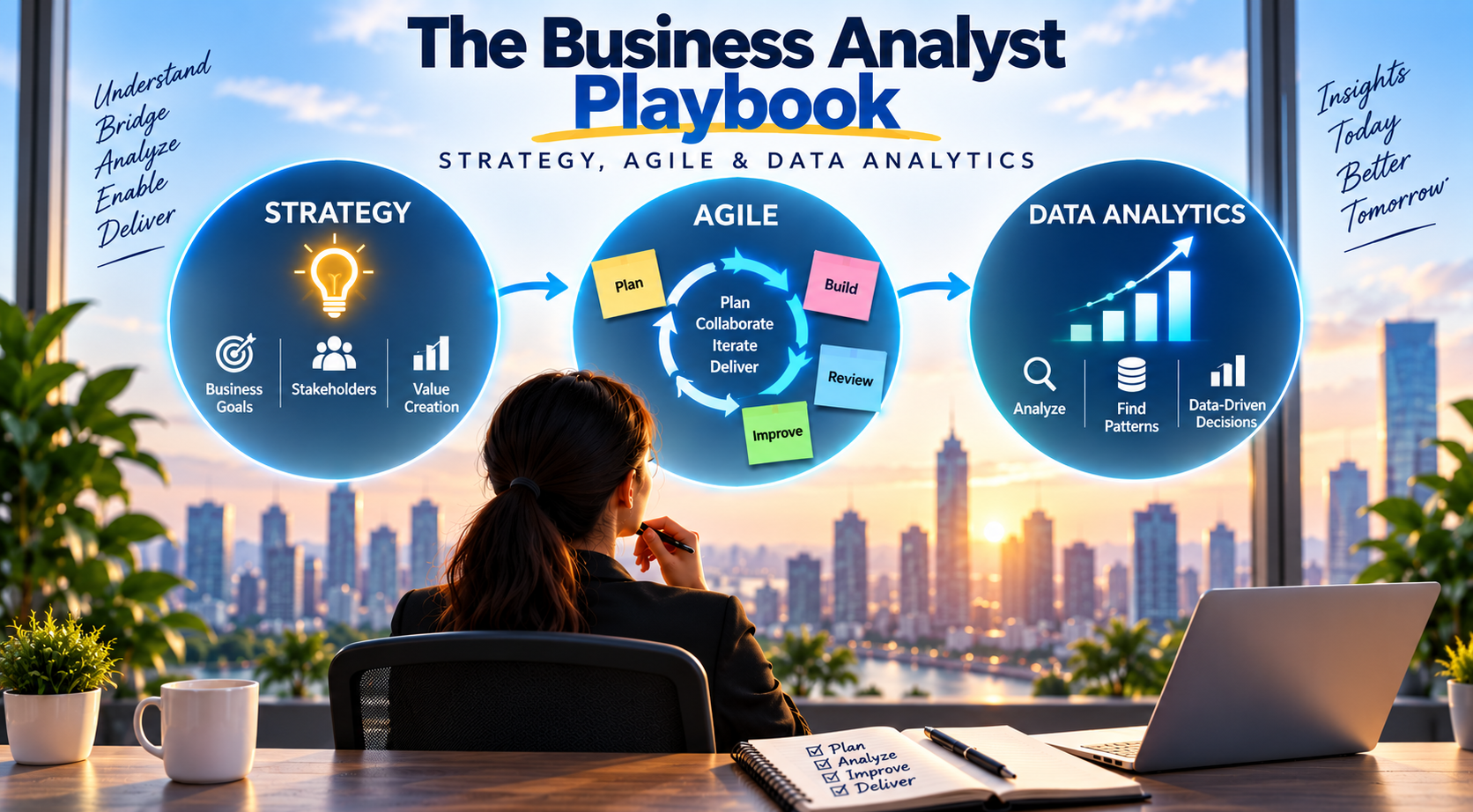
The modern corporate landscape moves at a relentless, uncompromising pace. In an era where market conditions shift overnight and emerging technologies disrupt entire sectors, instinct-based executive decision-making has become a high-risk, multi-million-dollar liability. Every single day, enterprise organizations lose astronomical sums to misaligned software initiatives, inefficient operational bottlenecks, uncoordinated team efforts, and product launches that fail to hit target market demand.
Sitting directly at the strategic intersection of business vision, customer experience, and technological execution is the modern Business Analyst (BA).
No longer just a scribe who takes meeting notes or transcribes user requests into documentation, today’s business analyst is a strategic problem solver, a process architect, a data storyteller, and a change agent. They decode organizational complexity, uncover hidden inefficiencies, and transform vague, chaotic business challenges into clear, actionable, and value-driven execution roadmaps.
The Modern BA Mindset — Blending Strategy with Technical Execution
To understand why the business analyst role has become one of the most critical functions within modern organizations, one must examine how enterprise operations have evolved. Organizations no longer require passive team members who simply follow instructions or manage static task checklists. Modern enterprises require critical thinkers who constantly question the status quo:
Why is this operational workflow designed this way?
Where are resources, time, and budget being silently wasted?
How can modern software architecture create measurable, compounding leverage for our bottom line?
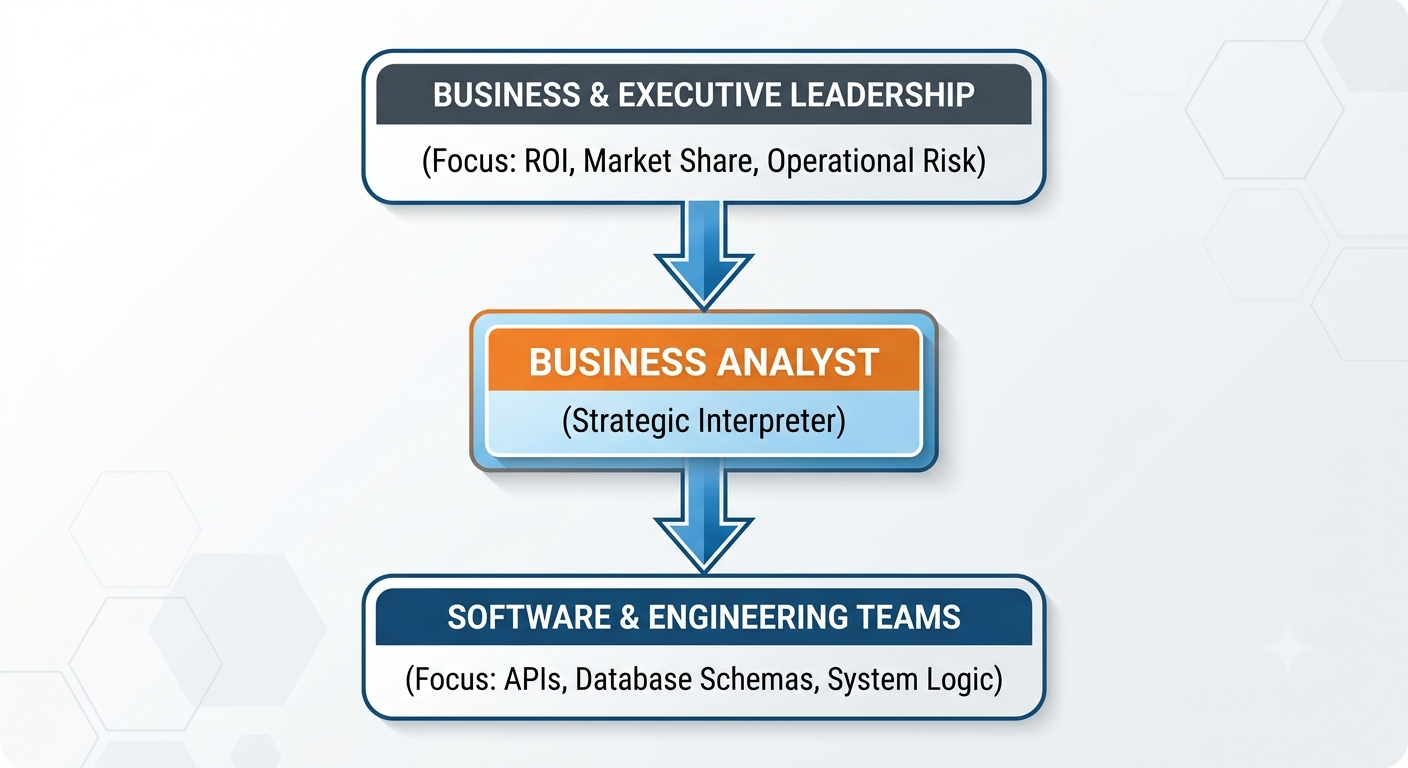
A skilled business analyst serves as a strategic interpreter. On one side of the table sit non-technical executive stakeholders, finance teams, and operations directors who speak in terms of return on investment (ROI), customer acquisition costs (CAC), risk mitigation, and
market share. On the other side sit software engineers, database administrators, and QA testers who speak in terms of APIs, microservices, database schemas, and technical debt. Without a business analyst bridging this fundamental communication divide, projects suffer from severe translation gaps—leading to software that functions perfectly from a technical standpoint but fails completely to address the core business problem.
The Dual DNA of High-Performing BAs
Navigating these two distinct worlds requires a unique blend of hard technical capabilities and high emotional intelligence (EQ). On any given day, an analyst's workflow might encompass:
Facilitating Strategic Workshops: Leading high-stakes requirement-gathering sessions with cross-functional leadership to align disparate departmental goals.
Conducting Root-Cause Analysis: Dissecting complex operational datasets using frameworks like the 5 Whys or Fishbone (Ishikawa) Diagrams to discover underlying structural issues rather than treating surface-level symptoms.
Drafting Functional Architecture: Translating high-level executive ideas into crisp, unambiguous user stories, acceptance criteria, and system functional specifications.
To build this multi-faceted skillset systematically and position oneself for high-impact roles, enrolling in a dedicated business analyst course offers a structured path through essential industry domains. A focused curriculum takes students through requirements engineering, lifecycle management, agile frameworks, systems modeling, and data analytics tools like SQL and Excel. Learning these core concepts through structured coursework equips professionals with the exact technical language and practical frameworks required to solve complex workplace challenges with confidence.
Business Process Modeling — Turning Operational Chaos into Visual Clarity
One of the most immediate, high-value contributions a business analyst makes to an organization is the ability to visualize, model, and optimize business processes. In structured organizations, undocumented or poorly mapped processes lead directly to miscommunication, redundant handoffs, elevated error rates, and costly operational friction.
BAs utilize standardized modeling frameworks to convert abstract business practices into clear visual blueprints. The two primary modeling languages used across the industry are:
Business Process Model and Notation (BPMN 2.0): Standardized visual language utilizing standardized shapes (events, activities, gateways, and pools/lanes) to represent end-to-end business workflows.
Unified Modeling Language (UML): Software-centric diagramming standard used to model system behaviors, entity relationships, use cases, and state transitions.
The "As-Is" vs. "To-Be" Transformation Strategy
The process optimization lifecycle driven by a business analyst follows a systematic two-stage methodology:
"As-Is" Process Mapping This initial phase focuses strictly on documenting the organization's current operational reality without filters, idealizations, or baseline assumptions. During this stage, the business analyst shadows end users in real time, tracks manual data entry points, and identifies structural handoff delays between departments. They catalog recurring error rates, pin down operational bottlenecks, and uncover informal workaround habits that employees have developed to bypass broken system tools. By capturing an accurate, objective baseline of daily operations, the analyst establishes the empirical foundation necessary to diagnose true root causes rather than surface-level symptoms.
"To-Be" Process Design The secondary phase centers on designing an optimized, streamlined future state that directly eliminates the inefficiencies identified during the initial mapping. The analyst systematically cuts out non-value-added steps, introduces automated decision gateways, and embeds system APIs to eliminate redundant manual data entry. They also establish clear, measurable Service Level Agreement (SLA) targets to govern performance across teams. Ultimately, this stage transforms raw operational pain points into an actionable architectural blueprint, providing executive leadership with a clear roadmap for digital transformation and operational efficiency.
When an analyst constructs a swimlane diagram, hidden operational friction surfaces instantly. Leadership can visually track how a single customer request travels through five departments, sits idle in manual approval queues for days, and requires redundant data re-entry across three disconnected legacy software tools. By proposing an optimized "To-Be" model supported by modern software integration, the BA creates a tangible business case for digital transformation.
Mastering these modeling conventions requires practical application and expert feedback. Enrolling in interactive business analyst classes gives learners hands-on exposure to creating process diagrams, swimlane workflows, and state-transition models under guided supervision. Working through real-world case studies alongside peers simulates actual project dynamics, helping candidates practice leading process mapping workshops, handling pushback from stakeholders, and refining workflows for maximum business impact.
Data-Driven Analysis — From Raw Enterprise Metrics to Executive Action
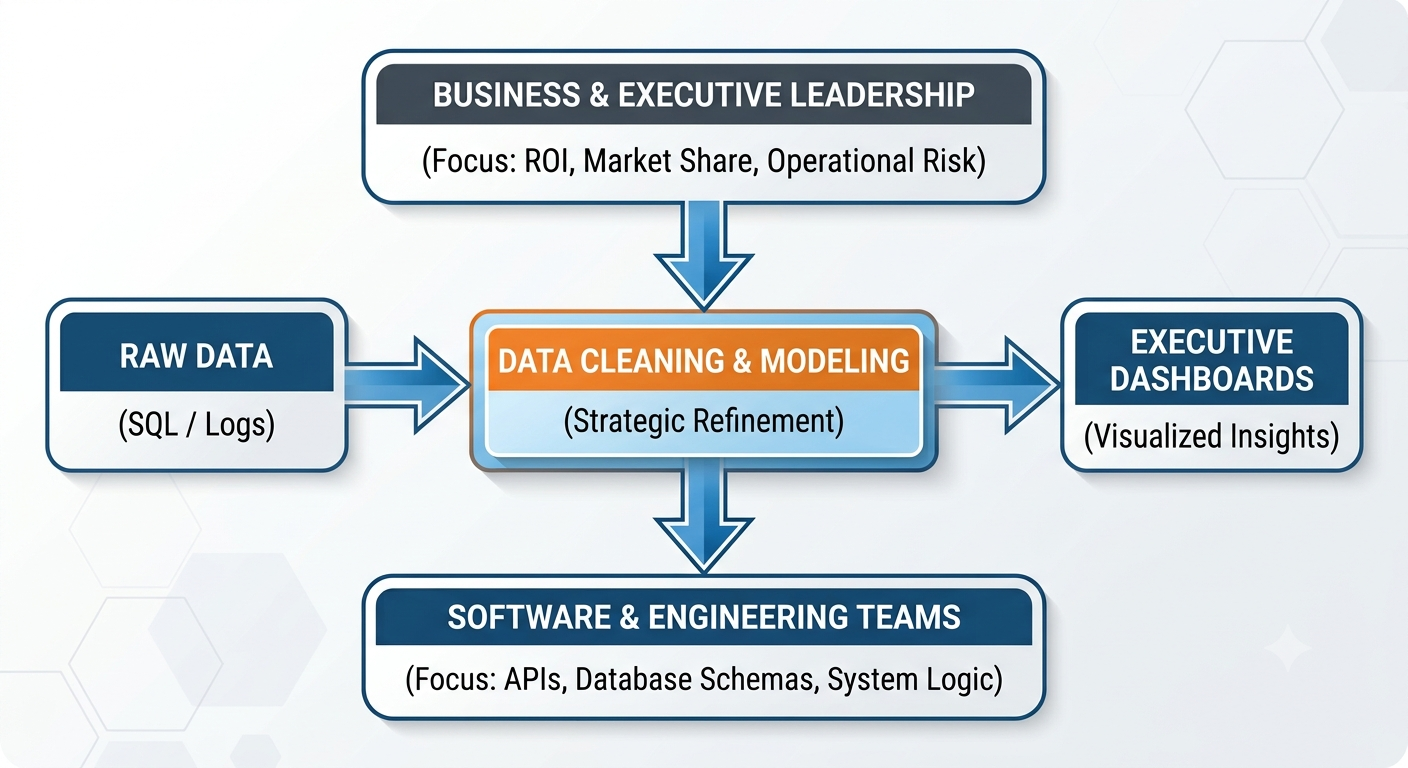
In modern business environments, intuition alone is insufficient to justify major strategic shifts or software investments. Organizations generate terabytes of operational data every second; however, raw data in isolation is merely noise. The business analyst acts as a data translator—extracting raw operational logs, manipulating data structures, identifying significant trends, and presenting findings in clear executive formats.
The Analytical Toolkit of the Modern BA
Structured Query Language (SQL): BAs must write fluent SQL queries to extract data directly from enterprise relational databases. Skills include joining complex tables (INNER, LEFT OUTER), performing aggregations (GROUP BY, HAVING), filtering transactional records, and utilizing window functions (ROW_NUMBER(), RANK()) to analyze temporal data patterns.
Advanced Spreadsheet Modeling: Excel remains a mainstay for rapid financial modeling, scenario analysis (What-If analysis, Goal Seek), and dynamic data summarization via Pivot Tables and lookup formulas (XLOOKUP, INDEX/MATCH).
Data Visualization & Business Intelligence (BI): Converting complex numerical analyses into interactive dashboards using platforms like Power BI or Tableau. A well-designed dashboard allows leadership to track Key Performance Indicators (KPIs) in real time—such as customer churn rates, average order resolution time, inventory turnover, or feature adoption metrics.
By grounding recommendations in empirical data, the business analyst removes subjectivity from executive planning. Rather than saying "our onboarding process feels slow," an analyst demonstrates: "Data shows 42% of platform users drop off at Step 3 of onboarding, resulting in an estimated $120,000 in lost monthly recurring revenue." This empirical clarity transforms vague suggestions into high-priority executive initiatives.
Agile Integration & Requirements Engineering — Driving Continuous Value Delivery
The historical approach to software execution—the traditional Waterfall framework—relied on spending months drafting massive, static requirements documents (Business Requirements Documents or BRDs) before writing a single line of software code. By the time the software was finally delivered months or years later, market dynamics had shifted, user needs had changed, and the product was often obsolete upon arrival.
Today, business analysts operate primarily within fast-paced, iterative Agile delivery environments (such as Scrum or Kanban frameworks).
The Agile Requirements Lifecycle
In an Agile setting, the analyst’s role shifts from writing rigid specifications to orchestrating a continuous stream of actionable requirements:
Deconstructing Business Goals into Epics & User Stories: Breaking down massive corporate objectives into modular, testable user stories following the classic syntax:$$\text{As a } [\text{User Role}], \text{ I want to } [\text{Perform Action}], \text{ So that } [\text{Achieve Business Benefit}].$$
Applying the INVEST Criteria: Ensuring that every user story is Independent, Negotiable, Valuable, Estimable, Small, and Testable.
Drafting Unambiguous Acceptance Criteria: Defining exact boundary parameters using behavior-driven development (BDD) formats such as Given-When-Then (Gherkin syntax):
Given a user is on the checkout screen with items in their cart,
When they enter a valid promotional discount code and click apply,
Then the cart total should recalculate immediately and reflect the exact percentage discount.
For professionals seeking to validate their knowledge across these modern frameworks, completing a targeted ba analyst course serves as an effective stepping stone toward earning globally recognized industry credentials like the Entry Certificate in Business Analysis (ECBA) or Certified Competency in Business Analysis (CCBA). Validating your skills through formal training and professional certifications demonstrates a clear mastery of standard business analysis bodies of knowledge (BABOK), making your profile stand out to recruiters and hiring managers in competitive job markets.
Strategic Stakeholder Management & Conflict Resolution
Software systems are ultimately built for and operated by human beings. Consequently, technical proficiency alone is insufficient for long-term career success. A core pillar of the business analysis profession is strategic stakeholder management—the art of navigating workplace dynamics, aligning competing departmental agendas, and managing organizational change.
Frameworks for Managing Stakeholders
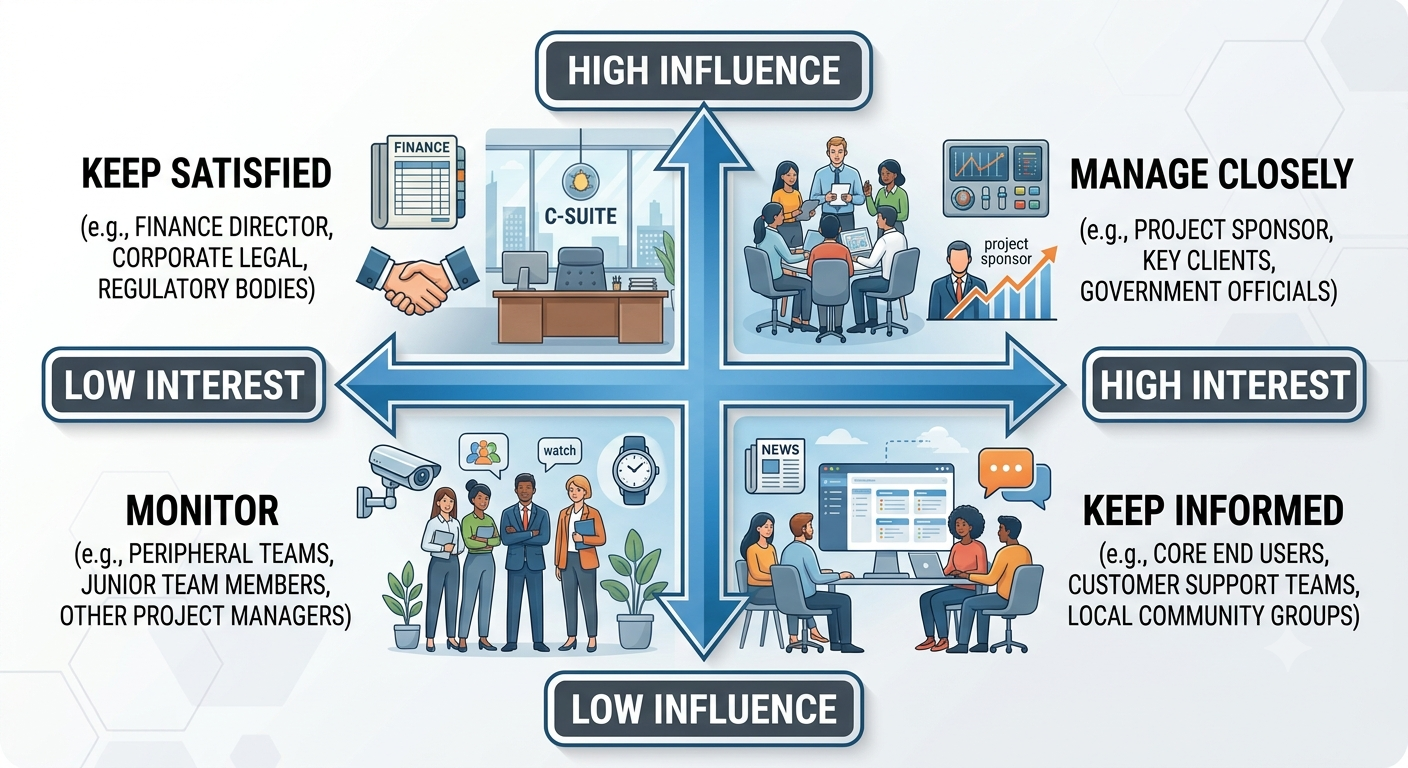
Analysts systematically identify and categorize stakeholders using analytical models such as the Power/Interest Grid:
High Power / High Interest (Manage Closely): Key executive sponsors and primary department leads. BAs engage them through frequent updates and direct alignment meetings.
High Power / Low Interest (Keep Satisfied): Governance boards, legal advisors, and corporate compliance officers. Requires keeping them satisfied on regulatory matters without overloading them with daily project noise.
Low Power / High Interest (Keep Informed): End-line operational users who will utilize the software daily. The BA leverages their tactical domain insight to ensure real-world usability.
Low Power / Low Interest (Monitor): Peripheral teams impacted minimally by project outcomes. Informed via general public release updates.
When priorities conflict—such as Marketing demanding new user-facing features while Engineering demands pausing feature development to address technical debt—the business analyst uses data-driven impact metrics to guide stakeholders toward objective, compromise-based solutions.
The Future of Business Analysis — AI, Automation, and Long-Term Career Pathways
As artificial intelligence (AI), machine learning models, and automated low-code platforms continue to reshape enterprise software development, the role of the business analyst is undergoing another major transformation.
While AI engines can rapidly generate code snippets, write basic documentation, or clean structured datasets, they cannot replace the uniquely human capabilities that define a high-performing business analyst. AI cannot conduct empathetic interviews with frustrated front-line staff, negotiate complex political trade-offs between C-suite executives, or assess whether a requested project aligns with a company's unique cultural values.
Junior / Entry-Level: Focuses on establishing core analytical fundamentals and supporting daily project delivery execution. Professionals at this level hold titles such as Junior BA, Systems Analyst, or Requirements Engineer, and their primary work centers on tactical execution. They manage baseline task documentation, draft basic Agile user stories, map simple operational workflows, and assist quality assurance teams with user acceptance testing (UAT) scripts to ensure delivered software meets initial requirements.
Mid-Level: Transitions from tactical execution to driving end-to-end requirement management and feature-level solution design. Operating as a Business Analyst, Agile Product Owner, or Process Consultant, these practitioners independently lead complex project modules. They optimize intricate cross-departmental processes, run advanced database queries using SQL to validate business hypotheses, and actively align conflicting stakeholder agendas to keep engineering teams focused on high-value business outcomes.
Senior / Leadership: Operates at the enterprise level, shaping long-term digital strategy, organizational growth, and portfolio-wide transformation. Serving as Lead BAs, Enterprise Architects, Strategic Consultants, or Directors of Product, these leaders align technological investments directly with C-suite business objectives. They manage entire project portfolios, direct enterprise-wide digital transformation roadmaps, advise executive leadership on risk and resource allocation, and mentor junior analytics talent across the organization.
By pairing technical capabilities (data querying, process modeling, platform architecture) with core human strengths (critical thinking, active listening, strategic negotiation), professional business analysts remain key drivers of organizational adaptation, resilience, and long-term enterprise growth.