
The Complete MuleSoft Certification Guide and Preparation Roadmap
Last updated on Oct 3, 2026
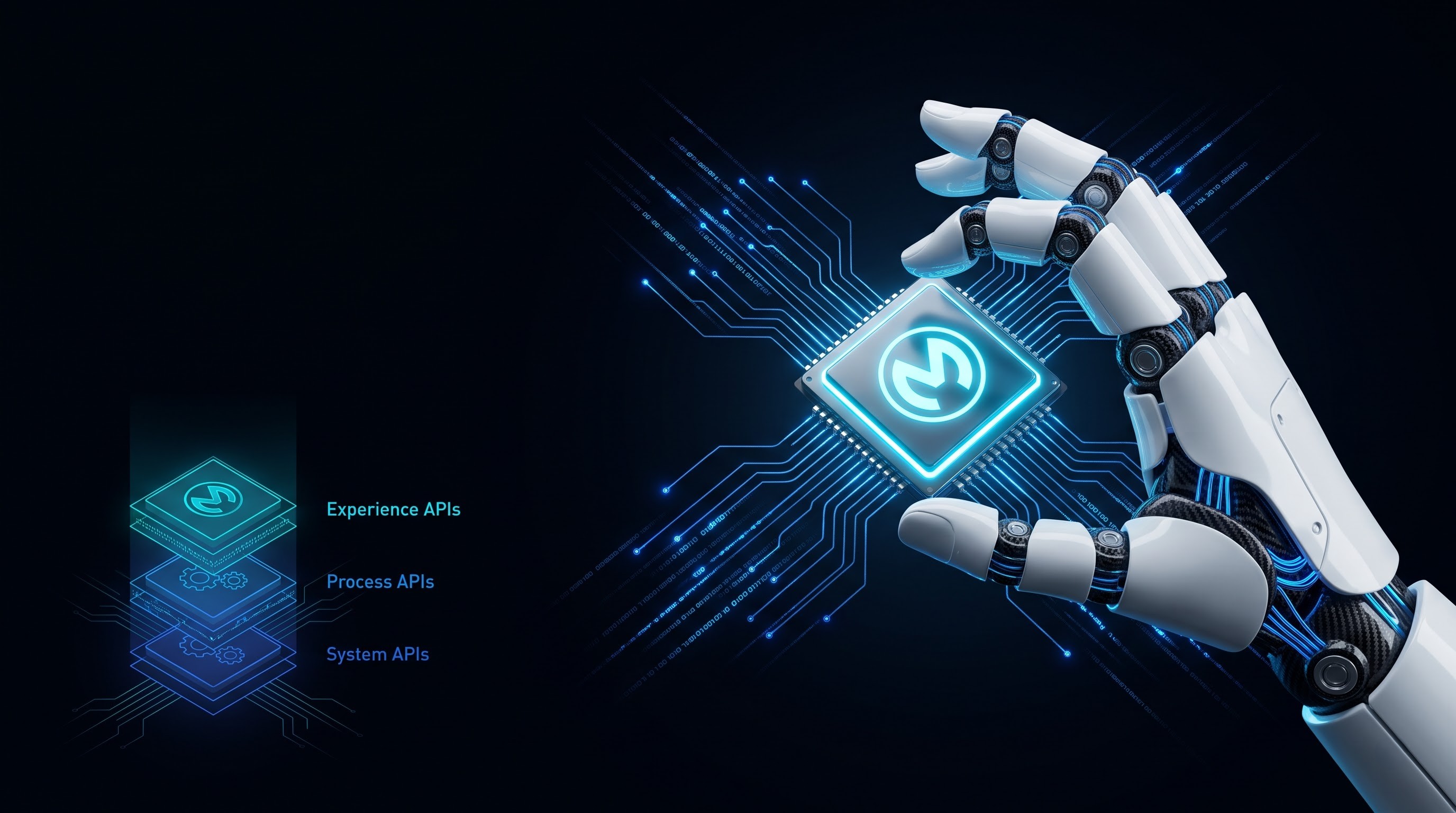
Enterprise integration now serves as the backbone of modern digital businesses rather than as just a back-office utility. With many organizations launching a vast number of Software as a Service applications, cloud platforms and on-premise databases, the pressure for unified connectivity is at its highest level ever. In this regard, the company MuleSoft is the market leader thanks to its ability to allow for the establishment of scalable application networks via API-led connectivity. The reason is that for engineers, developers, technical architects and enterprise technology executives the certification from MuleSoft proves their skills to design, create, secure and manage the technology environment.
However, it is imperative to understand that the process of obtaining MuleSoft certification requires familiarity with the process of obtaining the certificates depending on the individual’s current career level and engineering occupation. Each of the available certificates includes different theoretical constructs, business models and practical integration experiences.
The Strategic Importance of MuleSoft Certifications
In the realm of enterprise technology, demonstrated and certified skills are always considered to be worth more than experience that has not been well documented. The intricacies of integration engineering originate from its dependence on various protocols, security methods, types of data transmission, and a very rich cloud computing infrastructure. The reason for failures of systems or congestion of transactions can often be traced back to an integration problem.
In his role, MuleSoft license is of great strategic importance for technical specialists because it allows them to:
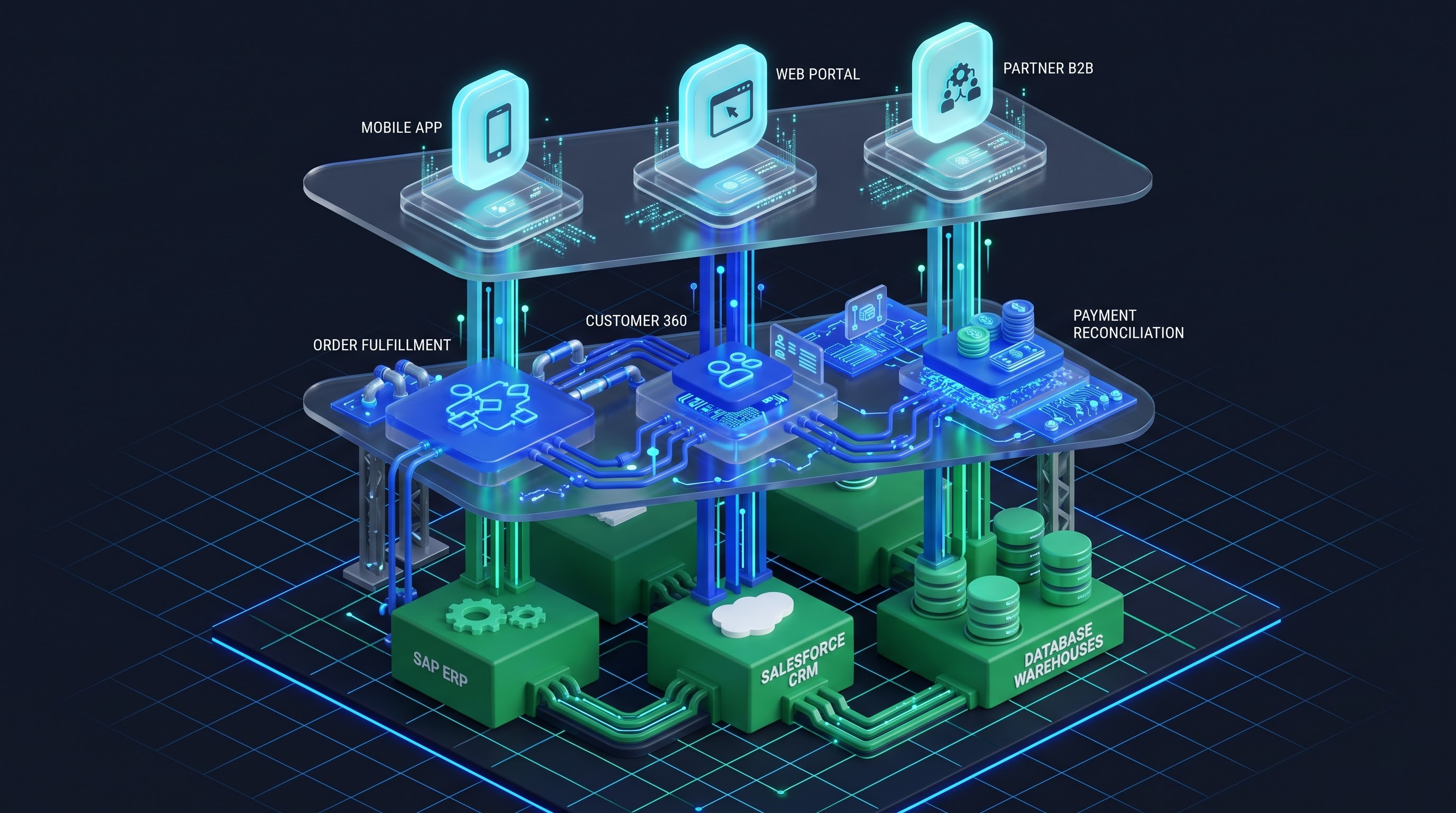
Understanding the API-Based Connectivity Concept: MuleSoft license holders are more advanced in their knowledge of the modern architecture notion of API-based connectivity rather than regular training in the area of point-to-point integration. Earning a MuleSoft license allows candidates to organize the assets of the company into systems, processes, and experience APIs.
In-Depth Understanding of the Whole Lifecycle of the Platform: These tests are designed to evaluate one’s knowledge of all stages of the process of API creation and implementation.
Recognition in the Industry and Market Compensation: Due to the fact that MuleSoft plays a role in the implementation of digital transformation programs across Fortune 500 companies, certified employees are able to attract the SENIOR positions, receive various consulting offers, and enjoy the power of design and integration of enterprise systems.
Adoption of Effective Practices: The curriculum of the certificate covers various points and specifies particular rules for software development, such as utilizing unified methods for error handling, implementing modules for integrations, developing relevant caching systems, and introducing safety measures in data exchange.
Although the need for certified professionals is growing rapidly, mastering the Anypoint Platform is something that requires structured and hands-on learning, not merely theoretical knowledge. By getting enrolled in an industry-oriented mulesoft online training provided by OnlineITGuru, budding developers and architects will be given the chance to have hands-on experience with real integration scenarios so that they learn the basic skills required to clear the certification exams on the very first try.
MuleSoft Certification System
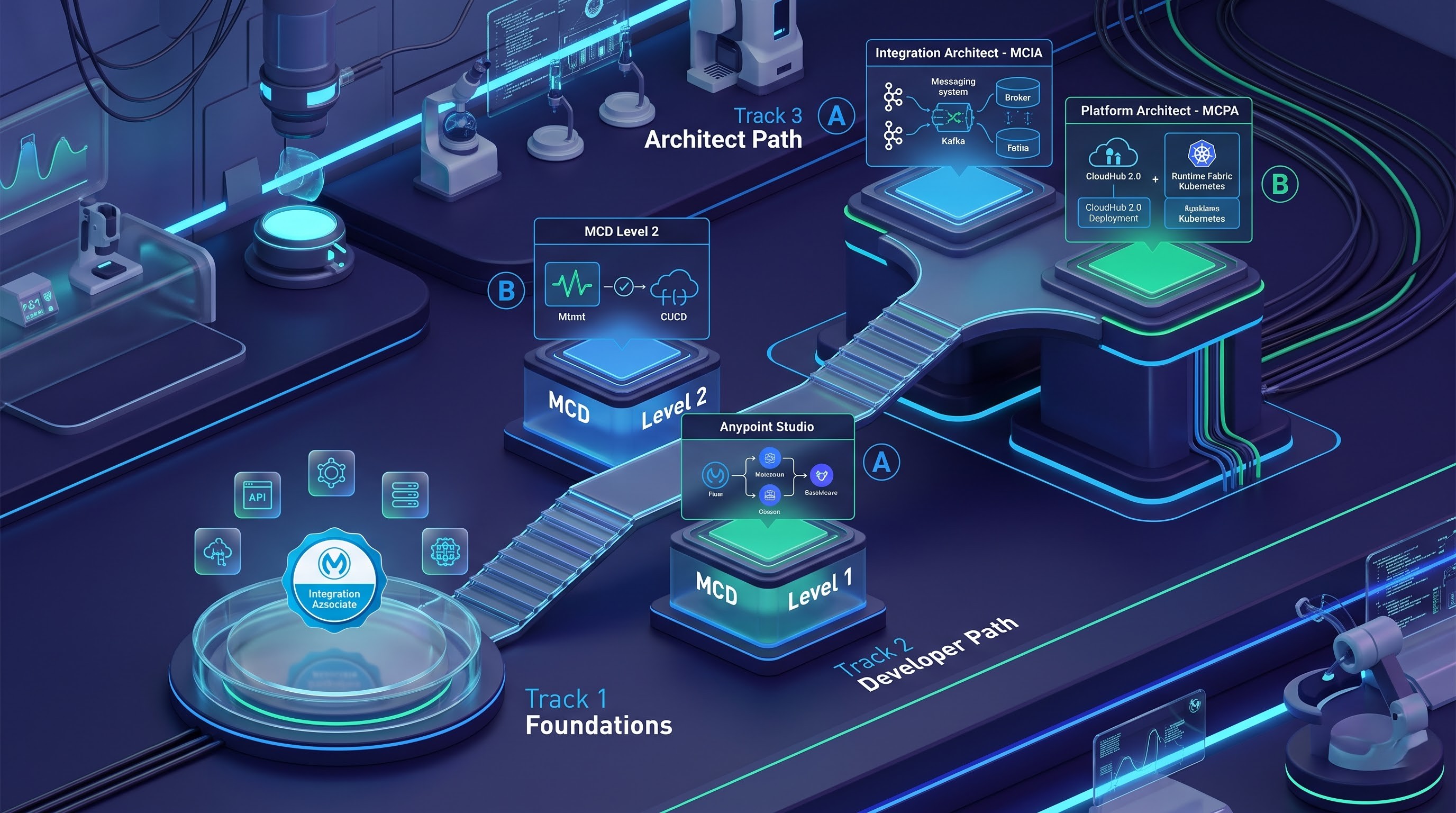
MuleSoft divides its certifications into three tracks: Associate, Developer and Architect. It is important to understand how these steps might influence one’s career plans.
MuleSoft Certified Integration Associate
MuleSoft Certified Integration Associate provides professionals with the first step in acquiring knowledge about integration architecture, API-based connections, and the most important components of Anypoint Platform.
Who should get this?
This certification is quite useful for project managers, business analysts, leads of integration teams, pre-sales specialists, entry-level engineers, and Salesforce admins working with the MuleSoft implementation teams but aren’t responsible for writing code for production transformation or configuring the low-level run time engines.
Knowledge Areas and Special Objectives
Principles of Integration: Differentiating between old types of the integration process in the point-to-point form and decoupled architectures; learning the basic integration methods such as pub-sub, request-response, batch synchronization process, and real-time streaming.
API-driven connectivity: Being deeply familiar with three types of APIs. System APIs open the basic systems of record such as ERPs and databases; Process APIs are responsible for the processing and manipulation of the information and Experience APIs are meant for formatting and optimization of the process of data consumption by different clients.
Anypoint Platform component features: Being able to understand the practical applications of the Design Center, API Manager, Runtime Manager, Exchange, Anypoint Visualizer, and Anypoint Monitoring.
C4E: Understanding the operational and human frame used for creation of the reusable API assets.
2. MuleSoft Certified Developer - Level 1 (MCD - Level 1)
MuleSoft Certified Developer - Level 1 is the most popular certification in the integration industry. It is a challenging practical exam which tests a person's skills in building, testing, deploying, and managing production-level APIs and integration which utilize both Mule 4 as well as Anypoint Platform.
Target Audience and their Responsibilities
The audience of this examination is made up of integration engineers, software developers, backend engineers, and technical consultants who are responsible for interpreting the functional specifications into a fully working Mule application.
Although the need for certified professionals is growing rapidly, mastering the Anypoint Platform is something that requires structured and hands-on learning, not merely theoretical knowledge. By getting enrolled in an industry-oriented mulesoft course provided by OnlineITGuru, budding developers and architects will be given the chance to have hands-on experience with real integration scenarios so that they learn the basic skills required to clear the certification exams on the very first try.
Key Areas of Knowledge and Objectives
API Design through RAML and OAS: Creating API specifications through using RAML and OAS. In addition, creating data types, query parameters, URI parameters, standard HTTP responses, as well as reusable components.
Implementation of Flows in Anypoint Studio: Creating reusable flows, sub-flows and private flows, and generating application skeletons through APIkit during the process. In addition, it uses the following tools: choice routers, scatter-gather routers, batch jobs and message mutators.
DataWeave transformation: Mastering the unlimited capacities of DataWeave, MuleSoft's in-built data transformation language, coding complex transformations from various hierarchical structures to JSON, XML, Java, CSV, etc., being able to write your own functions, working with null values, creating functions that filter the data or mapping through collections.
Routing, Scoping, and State: Managing a Mule Event lifecycle, being able to distinguish between event attributes, event payload and application flow variables; knowing about the scope and its preservation whenever there are network calls and things become asynchronous.
Error handling and resilience: Creating the error management process by making use of various types of the scope such as: On-Error Continue and On-Error Propagate scope, catching system-predefined errors as opposed to errors set up in the app, using exceptions and determining HTTP errors.
Connectors and External Protocols: Integrating with various relational databases via JDBC, JMS queue, message brokers, HTTP listeners, HTTP requests, or service based software.
Deployment of applications: Packing applications, deploying them into CloudHub or hybrid runtime, applying consumption policies and analyzing runtime logs.
MuleSoft Certified Developer – Level 2 (MCD – Level 2)
The Level 2 Developer certification goes beyond just basic application development. It focuses on enterprise-level engineering with applications of advanced data weave practices, and CI/CD pipeline automation.
Target audience and particular role
The program targets professional MuleSoft developers and senior integration experts, as well as the technical lead engineers who develop complex solutions and processes of integration between DevOps and implementation of Mule applications for environments that require high speed of processing.
Important areas of knowledge and main goals of the program
Advanced DataWeave 2.0 capabilities: creating the reusable modules of DataWeave, performing the process of binary transformation, applying recursion and custom-tail recursion, optimizing the memory usage with streaming and other types of payloads.
Modular Architecture and Maven Builds: creating custom parent POM files, configuring plugins, using shared domain projects for multi-tenant applications and making external property files.
The MUnit framework allows automated testing and includes writing full integration tests and unit tests, creating mocks for transport connectors and database calls, checking payload structures, debugging flow execution paths, and defining the code coverage that should be achieved in order for the automated build to take place.
Enterprise security and cryptography are achieved by using Mule Cryptography module capabilities; configuring the Java Cryptography Extension (JCE); encrypting various properties using the Secure Configuration Properties module; and implementing mutual TLS (mTLS) handshakes both on inbound and outbound endpoints.
Performance tuning and resilience in the application can be created using a variety of approaches including various reconnection strategies for connecting to third-party brokers, configuring Object Store v2 for persistent storage, caching the data, and implementing a distributed state, as well as utilizing streaming strategies to avoid out-of-memory issues while processing huge files.
DevOps and continuous delivery practices are implemented with the use of the MuleSoft Maven Plugin for automating deployments; controlling the secrets in CI/CD runners; and initiating zero-downtime upgrades in applications launched in CloudHub.
4. MuleSoft Accredited Integration Architect Level – Level 1
The credential of MuleSoft Certified Integration Architect represents a move away from code implementation skewing focus on solution architecture and architectural governance as well as system integration patterns.
Audience and Occupation Correlation
This certification is intended for architects of integration, solution architects, enterprise architects, and lead engineers who are responsible for defining the needs of the systems to develop application networks in an effective and affordable way.
Major Knowledge Areas and Targets
Architecture of Application Network: Structuring enterprise systems into decoupled API tiers; development of bounded contexts; API discoverability and reusing management and transition through learning processes and without damage initiated by end users.
NFRs: Designing systems with regard to certain metrics during operation of systems like availability, latency, peak load, data rights, disaster recovery, fault tolerance, etc.
Managing Transactions and Consistency: Handling transactions; local versus extended architecture (XA) distributed transactions; saga patterns and compensating transactions.
Messaging Styles and Event-Driven Frameworks: Breaking away old systems by using enterprise messaging brokers like Apache Kafka, Anypoint MQ, and RabbitMQ; using published and subscribed networks with dead-letter queue routing, idempotent customers, and guaranteed delivery.
API Safety Architecture: Making defense down the line; doing OAuth 2.0 design models (authorization code, customer credit, token interpretation); setting up JSON web token verification; securing inside transport as opposed to outside transport.
Data Governance and Payload Structure: Building canonical data models versus domain-specific schema definitions; facilitating transition from the old protocol to the new.
5. MuleSoft Certified Platform Architect – Level 1 (MCPA – Level 1)
The Integration Architect is focused on how applications communicate across the network, while the MuleSoft Certified Platform Architect is focused on the underlying infrastructure, deployment topologies, control plane governance, and organisational operating models.
This credential is designed for enterprise infrastructure architects, cloud architects, DevOps architects and platform owners responsible for operating, securing and maintaining the global Anypoint Platform infrastructure.
Key domains and goals of knowledge
Deployment Topologies and Hosting Models: Architectural trade-offs between CloudHub 1.0, CloudHub 2.0 (containerised on Kubernetes), Anypoint Runtime Fabric (hosted on self-managed AWS EKS, Azure AKS or bare metal) and traditional Customer-Hosted Standalone Mule Runtimes.
Network Infrastructure and Connectivity: Virtual Private Cloud (VPC) design, Dedicated Load Balancer (DLB) and Shared Load Balancer (SLB) configuration, IPsec VPN tunnels, Direct Connect and AWS Transit Gateway peerings.
Control Plane Architecture and Security: configure SSO using SAML 2.0 and OpenID Connect; configure external identity providers; configure fine-grained Role-Based Access Control (RBAC) and business groups; manage environment segregation.
Universal API Management (UAPM) – Managing and monitoring API’s running outside the MuleSoft runtime ecosystem, using Anypoint Flex Gateway to enforce policies in a lightweight reverse-proxy, importing non-Mule services to Anypoint Exchange.
Observability, Telemetry, and Monitoring: Designing centralised log management, telemetry ingestion, distributed tracing, functional monitoring alerts, and integration with third-party observability stacks such as Splunk, Datadog, and Prometheus.
6. Complementary and Specialised Credential
In addition to the traditional developer and architect paths, MuleSoft also provides specialised certifications in enterprise delivery methods and modern automation tools.
Certified MuleSoft Catalyst Specialist
The Catalyst credential validates proficiency in the MuleSoft Catalyst delivery methodology. Its focus is on enabling business outcomes, driving executive stakeholder alignment, building a thriving Center for Enablement (C4E) and providing structured playbooks to help organisations move from fragmented IT deliveries to an agile, reusable asset-based delivery culture.
Hyperautomation Specialist (MuleSoft Certified)
This credential is at the intersection of MuleSoft integration and Salesforce automation and tests the candidate’s ability to combine MuleSoft Composer, MuleSoft Robotic Process Automation (RPA), Anypoint Platform and Salesforce Flow. Designed for architects and solution developers building automated workflows to eliminate manual operational bottlenecks across legacy systems and modern cloud applications.
Preparation Roadmap in Detail: Step-by-Step
The key to success with the MuleSoft certification exams is to be both conceptual and rigorous in hands-on practice. These exams are based on scenario questions and not just definitions, and therefore candidates cannot pass them by simply memorising.
Phase 1: Basic Understanding and Theory
Review the Official Exam Guide: Get the latest exam datasheet directly from Salesforce Trailhead or MuleSoft training portal. Go through each objective one by one and find out what you don’t know.
Complete all relevant Trailhead Trails and Self-Paced Courses. Utilise the curated MuleSoft training modules on Salesforce Trailhead, such as Developer Fundamentals, Architecture Foundations, or Composer and RPA basics.
Architectural Paradigms Learn REST principles, HTTP methods, status code semantics, SOAP web services, JSON schema, XML namespaces, and enterprise integration patterns such as Scatter-Gather, Aggregator, and Splitter.
Phase 2: Laboratory work (practical hands-on)
Make a sandbox environment: Get a free 30-day trial account for the Anypoint Platform. Download and install the latest release of Anypoint Studio and a compatible Java Development Kit.
Build an App from Scratch:
Create a specification in Design Center using RAML and specify datatypes, traits and error responses.
Post the completed specification to Anypoint Exchange.
Import the specification in Anypoint Studio to generate the scaffolding flows using APIkit.
Add database access using a local relational database (PostgreSql or MySql).
Perform complex JSON to XML and XML to JSON transformations with DataWeave 2.0.
Add custom error handling routines that catch specific exceptions, set application error codes and map status codes for API responses.
Push the resulting artefact to CloudHub and enforce security policies using API Manager.
Simulate Real-World Failure Scenarios: Intentionally configure database connection failures, timeouts and malformed payloads. See how transaction rollbacks and HTTP status code assignments perform under stress by looking at the behaviour of On-Error Propagate versus On-Error Continue.
Phase 3: Targeted DataWeave Mastery (For Developers)
DataWeave is the most important study area for the developer certification candidates. This represents a large proportion of the exam and is the steepest learning curve.
Practice with the data onlineWeave Playground for testing data transformation logic without restarting studio runtimes.
Learn the core functions on arrays and objects: map, mapObject, filter, pluck, reduce, groupBy, flatten.
Learn to write custom utility functions, pattern match using the match operator, and code defensively against nulls.
Phase 4: Intensive Practice Tests & Diagnostic Review
Take Official Practice Tests Practice assessments available in the official course material or on the certification portal.
Root Cause Analysis of Incorrect Answers: When you get a question wrong on a practice exam, don’t just write down the right answer. Find out why the correct answer is better. Find out why the distractors are wrong. Build a minimal reproducing example in Anypoint Studio and observe the behaviour directly.
Fill the Knowledge Gaps: For any domains with practice scores below eighty percent, re-read the official MuleSoft product documentation.
Deep Dive: What Candidates Need To Know For Key Exams
Candidates should devote all their study time to specific high-yield subject matter to pass these exams on the first attempt.
Deep Dive: MuleSoft Certified Developer – Level 1 Core Topics
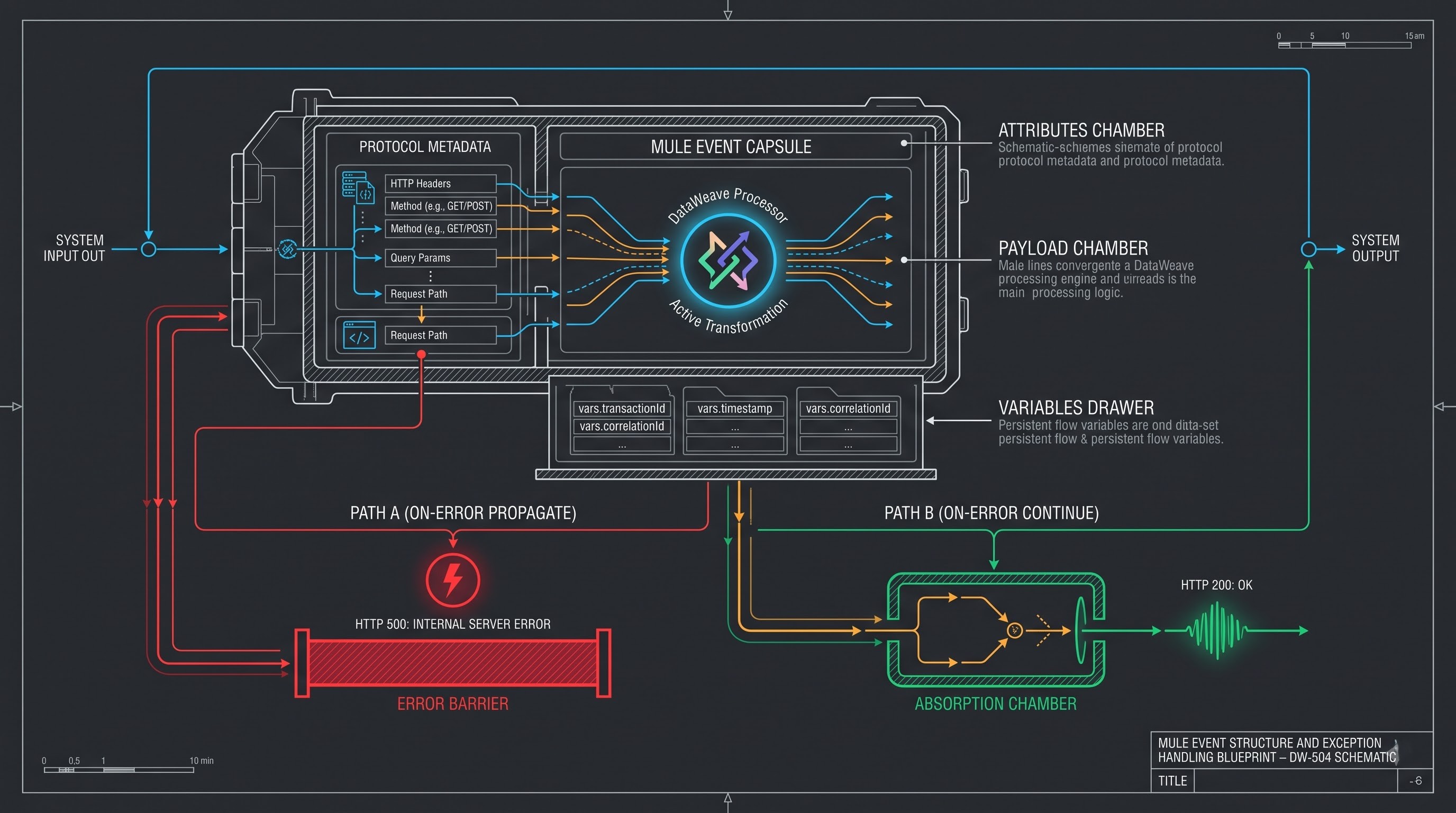
Anatomy of a Mule Event: Differentiate between attributes (metadata from incoming protocols such as HTTP headers, query parameters or file paths) and payload (the data you are dealing with). Attributes are reset or cleared when a new outbound call is made, but variables remain across flow steps in the same Mule application process.
APIkit Router Processing: Learn how the router routes incoming requests to specific flow implementations based on method and URI template. Learn to handle errors automatically generated by the APIkit router such as bad request (400), not found (404), method not allowed (405), not acceptable (406) and unsupported media type (415).
Error Propagation:
On-Error Propagate: Runs all processors inside the error scope, cancels any local transaction in process and bubbles the error to the parent caller as an error response (such as an HTTP 500 status).
On-Error Continue: Processes the processors within the error scope, catches the error, indicates success to the parent caller, and returns a 200 HTTP status code, unless an outbound variable or status code attribute is explicitly changed.
Flow Types Main flows (with event source) Sub-flows (synchronous, lightweight execution that inherits the execution context and variables without any execution overhead) Private flows (flows without event source with its own unique processing strategy and error handling scope)
Batch Job Processing: Learn how a Batch Job breaks a large payload into individual records, processes them through sequential Batch Steps with their own accept-expression filters, manages a persistent queue, and aggregates results in an On Complete phase.
Deep Dive: MuleSoft Certified Developer – Level 2 Core Concepts
MUnit Testing Constructs: Understand how to use the spy processor to check payloads before and after processor execution. See how to prove a processor ran some number of times by means of verify-call assertions. Use mock processors to return canned payloads without involving external infrastructure.
DataWeave Optimisation: Don’t read large files completely into in-memory objects. Use streaming capabilities (@StreamCapable) and consider the implications of deferred execution when writing to outbound targets.
Application Modularity and Maven Use parent pom configurations to get plugin configurations and dependency versions. Learn about how the Mule packaging plugin packages application jars and how to add custom Java classes and shared library definitions.
Secure Properties: Use the Secure Properties Tool to encrypt sensitive configuration keys with algorithms such as AES-CBC or Blowfish. Use the secure prefix syntax to reference secure properties in XML.
Deep Dive : Core Focus Areas of MuleSoft Certified Integration Architect
State and Idempotency: Develop mechanisms to avoid duplicate message processing in asynchronous messaging architectures. Know when to use idempotent message validators, distributed Object Stores and unique constraints at the database level.
Robust Messaging Patterns: Balance point-to-point vs. publish-subscribe topologies. Know how to set up dead-letter queues, exponential backoff retries, and circuit-breaker patterns to handle downstream system outages without losing transactions.
Security Topologies: Select between edge API security gateways or microservice-level authentication. Learn token exchange processes , validate JSON Web Signature ( JWS ) , set up mutual TLS , and firewalls on the perimeter .
High Volume Batch Processing vs Near Real Time Streaming: When to use Batch processing (async, bulk, error tolerant, record-level data syncs) vs. streaming with reactive processing pipes.
Deep Dive: MuleSoft Certified Platform Architect Core Focus Areas
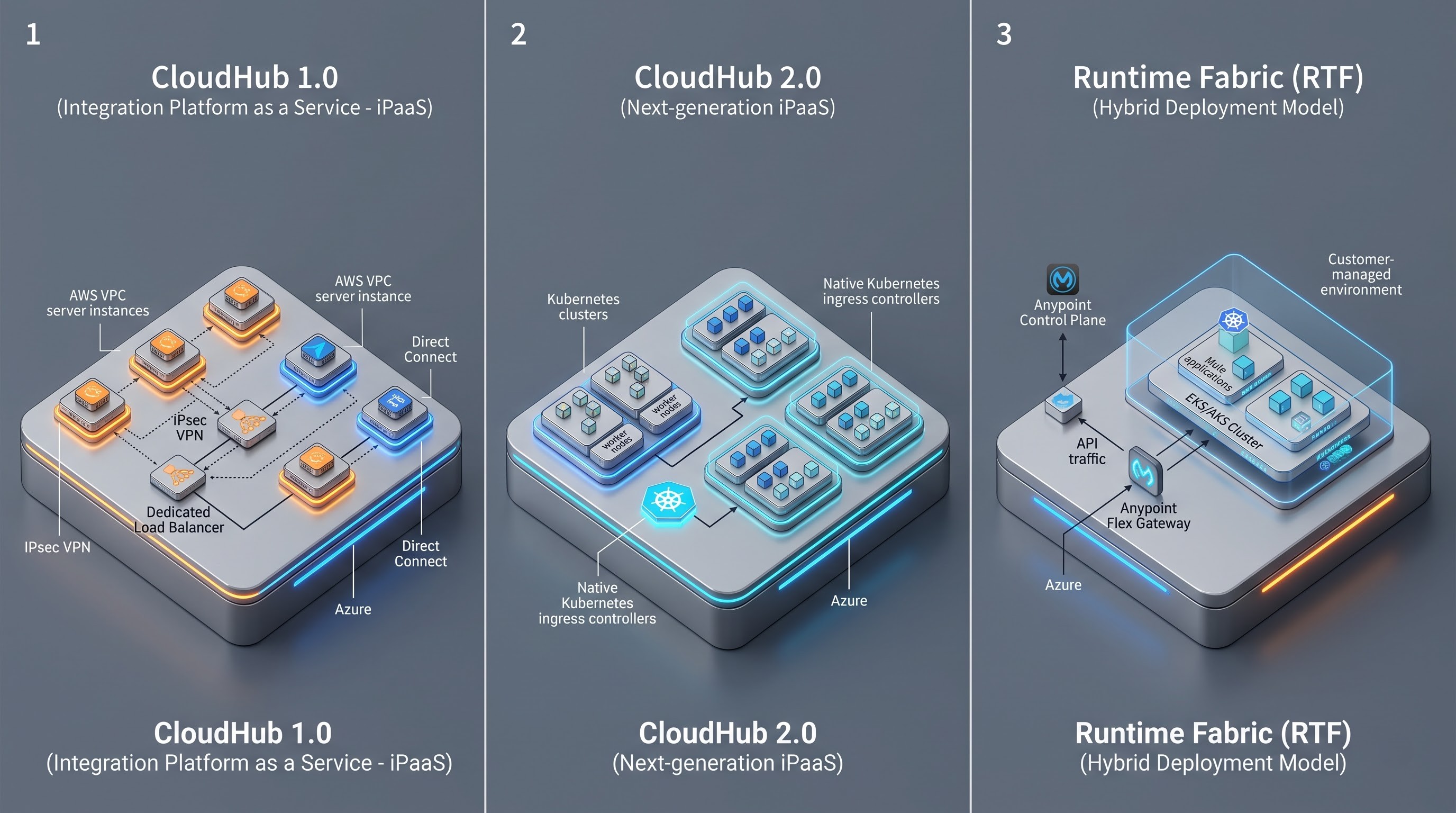
CloudHub 1.0, CloudHub 2.0 and Runtime Fabric:
CloudHub 1.0: VM-based instances (Workers); requires AWS VPC peering, VPN or Direct Connect; MuleSoft managed.
CloudHub 2.0 Containerised architecture on shared or private Kubernetes clusters Deploys applications as lightweight replicas Built-in Ingress controllers and private spaces
Anypoint Runtime Fabric: Customer managed Kubernetes infrastructure installed on private cloud or on-premises infrastructure, candidates should understand customer responsibilities for persistent storage, ingress controller routing and Kubernetes worker node scaling.
Network Sizing and Worker Allocation: Determine memory and CPU allocations (vCores) per expected transactions per second, payload size, memory intensive transformations, and concurrency profiles.
Universal API Management Deployment: Learn where to position Anypoint Flex Gateway (Connected mode vs. Disconnected mode) in front of upstream clients and behind downstream legacy services to achieve maximum governance with minimum latency overhead.
Show Improvement in Your Certification Path
To acquire certifications such as MCD - Level 1 or MCIA one needs to follow continuous practicing, solving scenarios and performing troubleshooting under the guidance of an experienced mentor. If you want to climb the success ladder of enterprise connectivity, you need to enroll yourself in a professional mulesoft online training at OnlineITGuru where you will be able to practice in labs, work on projects and follow a syllabus that suits more to prepare for the exams.