
The Definitive Guide to Boomi Enterprise Platform (2026)
Last updated on Jun 30, 2026
In today’s enterprise world, data forms the cornerstone of success, but it is locked inside disconnected SaaS silos, traditional on-premises ERP infrastructure, and raw data lakes. For more than ten years, iPaaS has been used as digital plumbing that simply moves data from Point A to Point B using static ETL (Extract, Transform, Load) processes and APIs.
Yet times have changed. With the advent of Generative AI, Retrieval-Augmented Generation (RAG), and autonomous agentic AI, there is a need for a completely new paradigm. AI-driven agents need not only secure and governed access to the data but also the ability to access the most important applications such as SAP, Salesforce, and Workday.
The Boomi Enterprise Platform has transformed itself from being just another conventional low-code iPaaS solution to becoming an AI-first, agentic data platform. In this thorough study, we look at the architecture of Boomi, including its cutting-edge Model Context Protocol (MCP) architecture, key operational components, and the governance requirements needed to build out autonomous enterprise automation in a secure way. Moving from traditional IT to a modern data platform will demand practical skills in technology. Should your team want to learn how to work within the workflows outlined in this manual, trying out a formal dell boomi online training program will tremendously help speed up the process.
1. Architecture & The Atomic Runtime
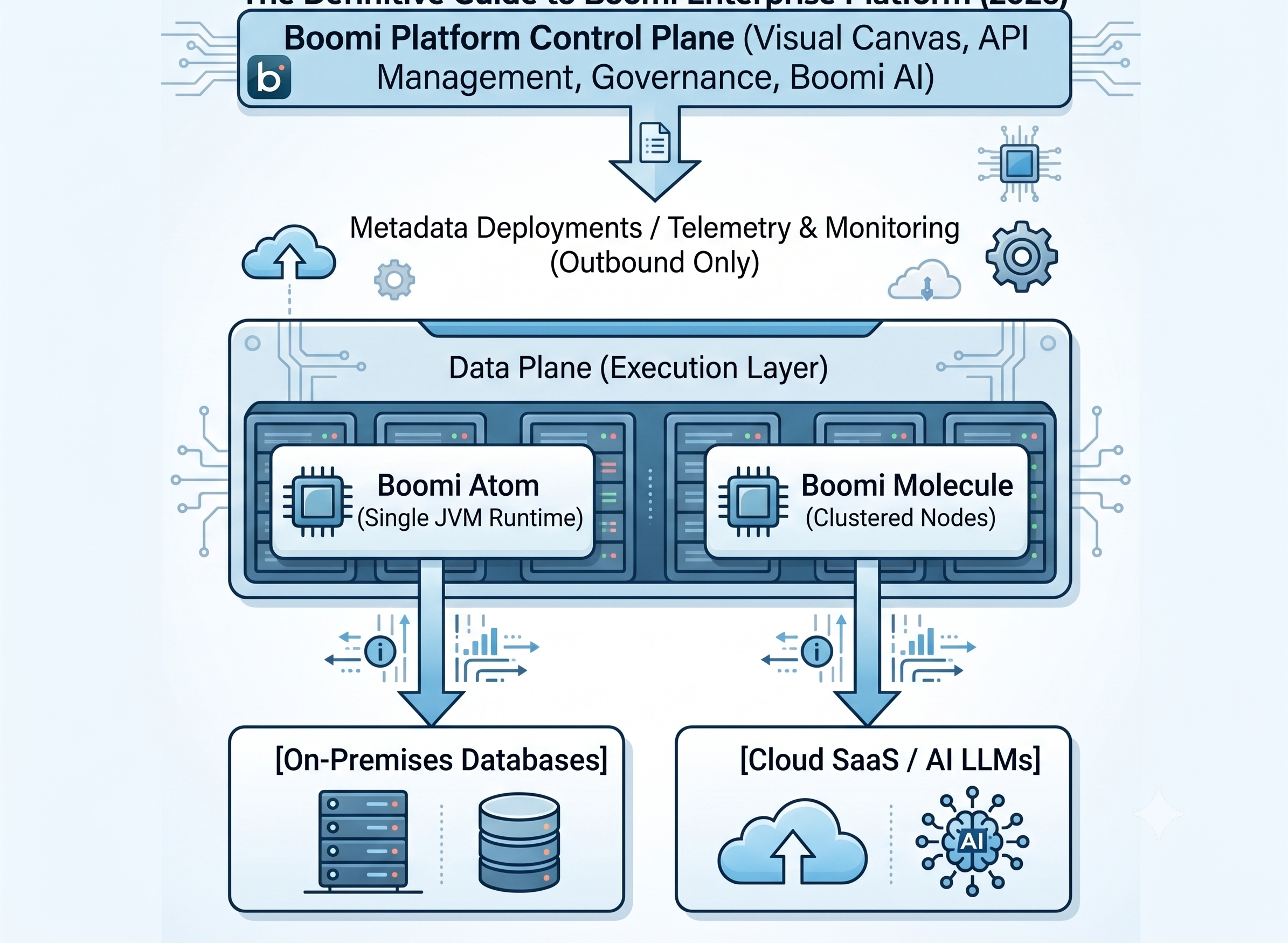
Boomi’s scalable enterprise architecture separates the Control Plane (the web-based management system) from the Data Plane (which is where execution happens). This separation of Control Plane and Data Plane ensures that business data never touches Boomi’s corporate infrastructure except when it is specifically hosted there.
The Boomi Atom
The basic building block of the system is the Boomi Atom. Atom is a small-sized, standalone application runtime based on the JVM. Atom contains all the configuration information, connectivity information, data mapping logic, and rules required to run an integration process.
Security Isolation: Atom makes outbound only secure HTTPS connections (Port 443) to the system for status updates and monitoring metrics. No incoming firewall port needs to be open in Atom, thus eliminating a major security vulnerability for enterprises.
Independent Operation: After an integration process is compiled and deployed from the cloud control plane to the Atom, the runtime works completely independent of the connection to the central system. If the connection is lost for any reason, then Atom keeps processing the data workflows, caching log information, and performing retries.
The Boomi Molecule
Where mission-critical companies demand high availability, load balancing, and parallel processing, the runtime evolves into a Boomi Molecule.
Clustered Infrastructure: The Molecule is a configuration of many Atom instances deployed on physical or virtual machines that operate simultaneously.
Dynamic Load Balancing: As soon as large volumes of payload or high-frequency API calls come to the platform, the Molecule dynamically allocates execution threads on the least utilized Atom instances, eliminating single point of failure bottlenecks.
Forked Execution: In case of huge data sets, the Molecule takes advantage of the advanced JVM forking. This allows creation of temporary worker JVMs that can execute separate data sets simultaneously.
Private Atom Clouds
Institutions running businesses that function within specific geographic and compliance constraints (HIPPA, GDPR, PCI-DSS), where the IT organization is responsible for all aspects of their technology governance, can deploy several Molecules to form a Private Atom Cloud. This gives central IT teams the ability to manage an integration solution for local business units.
2. Low-Code Integration & Data Transformation (Integration Hub)
It is due to the graphical, no-code user interface offered in the Integration Hub by Boomi that application integrations can be done at such speeds. As opposed to manual coding, Boomi employs graphical shape logic to perform application integrations within days that may require months otherwise. For developers who want to quickly become experts in these graphical logic designs, a well-formulated dell boomi online training would definitely come in handy.
Visual Process Design & Reusability of Components
Boomi uses a drag-and-drop interface where integration flows linearly with functional shapes:
Connectors: Abstract the technology details of the API (REST, SOAP, JDBC, EDI) into standardized configuration screens that manage the credentials, tokens, and connection pooling.
Execution Shapes: Manage the execution flow through decisions (if-else), route shapes (multiple condition routing), split/join shapes, and try-catch blocks.
Componentization: All components of Boomi from database query to scripts are considered as a component. Any changes made to any particular database profile propagate the change throughout all integrations using the same database profile, reducing maintenance time drastically.
Advantages of Advanced Mapping, Data Profiles, and Scripting Extensibility
Different data formats exist in enterprise software. Boomi resolves the differences through the use of Data Profiles (XML, JSON, Flat File, Database, EDI) and Boomi Map Shape.
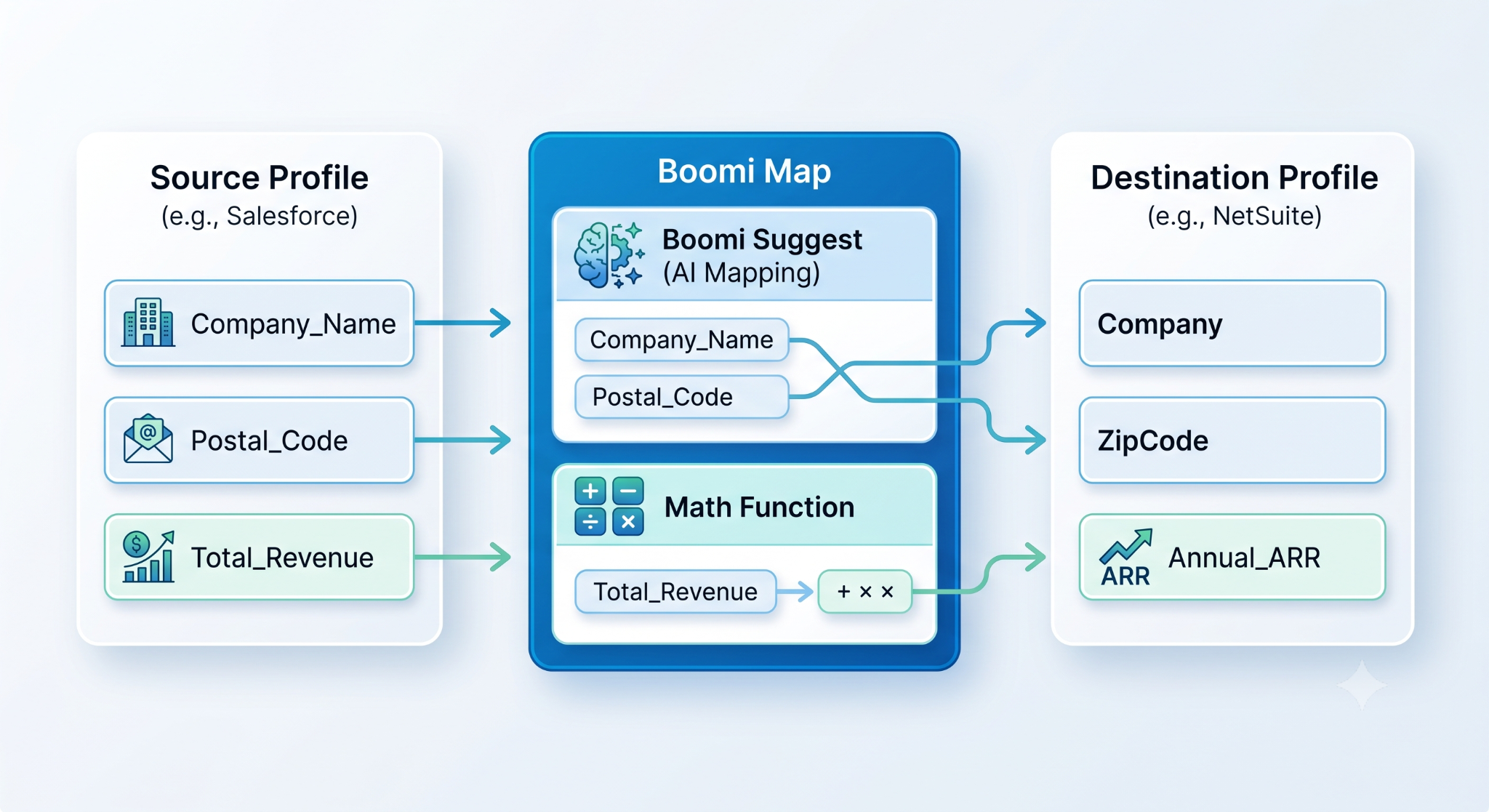
Boomi Suggest: Using the anonymized metadata of crowdsourced billions of mapped data points, Boomi’s AI system predicts and implements the mapping connections between the source and destination field with astonishingly high accuracy.
Map Functions: Advanced data transformation functions like string manipulation, math calculations, date format normalizations, and currency conversion can be configured within the map itself.
Scripting Escape Hatches: Wherever the limits of the native visual logic are hit, users can introduce their own Groovy or JavaScript scripts within maps or data flows.
3. Lifecycle API Management
For development of modern-day digital products, it becomes essential to make the internal backend system accessible in the form of a secure and discoverable API. The API Management functionality of Boomi allows decoupling of backend logic implementation from the external digital contract.
REST, SOAP and OData Services Generation
It is possible to make the internal Boomi integration workflow accessible in the form of a full-fledged web service very quickly. The same visual process can be deployed as a REST service, SOAP service or OData service.
Architecture and Security of API Gateway
The Boomi API Gateway is the entrance for all API traffic, securing the application runtime underneath.
Traffic Control and Rate Limiting: Prevents DDoS attacks or developer loops by implementing strict rate control policies (e.g., restricting an API key to make only 500 calls per minute).
Authentication and Policy Enforcement: Manages IAM by performing token validation or by performing delegated authentication through external IdPs using OAuth 2.0, SAML, OpenID Connect, and Keycloak.
IP Whitelisting and CORS Management: Restricts API access only to approved networks and controls CORS policy natively.
Federated Governance and Developer Portal
As more APIs emerge in an organization, discoverability remains an issue. However, Boomi tackles this challenge using a self-service Developer Portal. Developers inside or outside the organization are allowed to login safely and view a collection of APIs. They have access to the auto-generated OpenAPI/Swagger documentation and they also provision themselves the APIs keys and test endpoints using an interactive sandbox environment.
4. Master Data Hub (MDH)
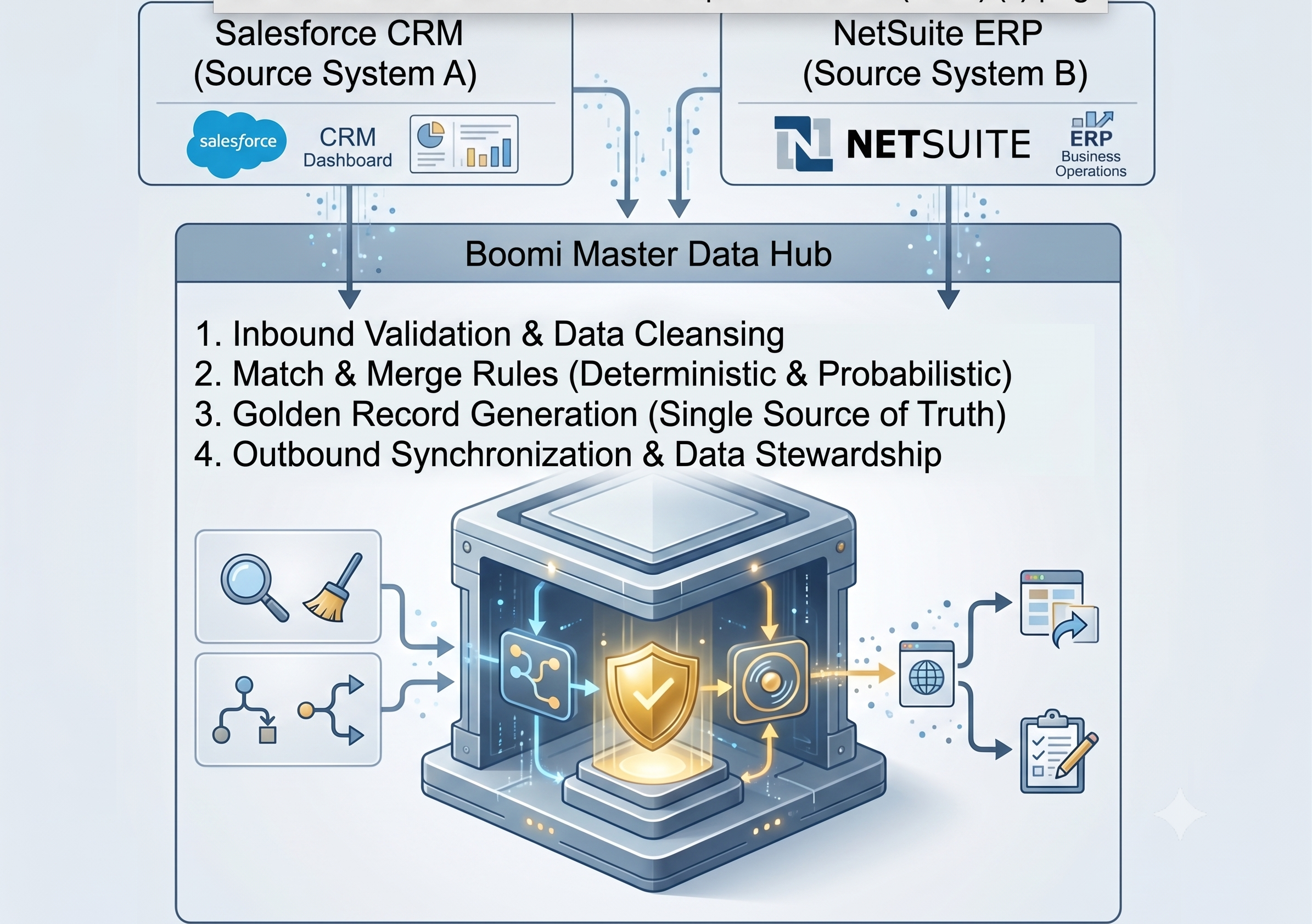
Architectural Source of TruthIntegration technology will not be as effective depending on the quality of data that runs on it. Silo-based applications always end up creating duplicates of information such as multiple addresses for a given client on Salesforce, Marketo, and NetSuite.
Data Cleansing & Validation Engine
As data enters MDH, they go through a sequence of validation checkpoints. The fields are automatically validated for structure, parameter and context (e.g. verification of a physical address through external validation APIs like postal service) before reaching the matching layer.
Match & Merge Rules
MDH supports creation of hierarchical match rules by data stewards to identify duplicate records:
Deterministic Matching: Alphanumeric comparisons of the unique identifier fields (e.g. Tax ID, Email Address).
Probabilistic Matching: Application of fuzzy logic algorithms (e.g. Jaro Winkler, Soundex) to measure the similarity of two records (e.g. Identifying “Abhishek” and “Abhisheck” at the same company address as the same person).
Survivorship Rules: It defines which system should win in case of data conflict. E.g. The phone number of Salesforce can be made to override that of NetSuite, but the billing address from NetSuite overrides the Salesforce one.
Golden Record Creation & Data Stewardship
Once the data is cleaned up and consolidated, MDH forms a single Golden Record. The Golden Record is given a GUID.
Bi-Directional Sync: Any subsequent change in the Golden Record will be published to the rest of the connected spoke applications. This ensures no data drift within the organization.
Stewardship Console: Any record that fails validation logic or falls under the low confidence matching threshold is automatically sent to the stewardship console. Exceptions are resolved manually by human users through an intuitive UI without using SQL commands or messing around with the payload.
5. B2B / EDI Partner Network Management
Modern day logistics depend on a series of EDI standards used to facilitate automated purchase, logistics and invoicing processes. Boomi offers built-in B2B integration that enables translation of cumbersome, legacy syntax into corporate data.
EDI Standards Support
Boomi includes native support for parsing and validating of all EDI structures available world wide:
X12 – the North America EDI standard for supply chain and logistics
EDIFACT – the international EDI standard
HL7 – the universal healthcare EDI standard
RosettaNet & AS2/AS4 – high security, internet natively-enabled transport standard
Trading Partners vs Individual Trading Partners
For the long haul, integrating suppliers, vendors, and distributors on an individual basis, while providing the flexibility, cost, and IT resources can be difficult and unsustainable. The Trading Partnermodule for Boomi helps enterprises unify and manage these trading partners under a single enterprise hub. Corporate profiles, created only once(AS2 certificates, ISA IDs and acknowledgments) can be pushed to an internally defined standard, and can be replicated to onboard other trading partners.
6. The 2026 Evolution
The Agentic Data Foundation Another area where Boomi provides enterprise innovation is in providing enterprise Agentic AI at Enterprise Layer.
What does this mean?
It means we go from data transport into the enterprise core data-foundation on top of which you build your AI agent. By 2026, we’re talking about more than just text-summarization; agents that are capable of several levels of transactions across many different software systems. Boomi’s platform ensures this doesn’t result in any cataclysm because you won’t experience agent hallucinations.
Integration of Model Context Protocol (MCP)
One of the most important drawbacks of the Large Language Models (LLMs) was that they couldn’t interact natively with anything but web applications. This drawback was mitigated by Boomi in terms of integration of the Model Context Protocol (MCP), which is an open source protocol.
iPaaS as MCP Server: The library of Boomi of more than 1,000 + pre-built enterprise application connectors is converted into the standard tools that can be used natively by the LLMs, like Anthropic Claude, Google Gemini, and OpenAI ChatGPT Enterprise.
Dynamic Discovery of Tools: In case an AI agent requires pulling data from SAP databases installed on-premise, then the AI agent requests this task from Boomi’s MCP Registry. Boomi provides the exact API endpoint with authentication and sanitizes the information.
Context for the Grounded Agent: Knowledge Hub and Meta Hub
AI agents cannot perform well without having sufficient context about the enterprises and also by misinterpreting specific terminologies. In this regard, Boomi has developed two governance engines named:
Boomi Knowledge Hub: The company offers a complete managed pipeline that ingests both structured and unstructured data from the enterprise such as PDF manuals, contracts, emails, etc. It will clean and standardize the data in order to develop a governance context layer for RAG operations.
Boomi Meta Hub: A platform system of record that solidifies the business logic definitions for the enterprise. The goal is to ensure that humans as well as AI agents have the same understanding of business metrics such as Annual Recurring Revenue.
Boomi AgentStudio & Agent Control Tower
To safely transition AI from secure development sandbox environments to live production systems, Boomi now offers full lifecycle management solutions for agents.
Boomi AgentStudio: A no-code interface allowing organizations to develop, test, validate and simulate AI agent behaviors using natural language prompts. This solution is equipped with an Agent SIM preview feature, which allows developers to simulate agent logic pipelines using historical production data to test the accuracy of the output generated.
Agent Control Tower: A centralized operation dashboard, which gives end-to-end visibility into AI agent workflows. The solution creates Agent Session Logs, which track the exact reasoning, prompts, tokens, and back-end integrations done by an agent while performing a task.
Boomi Distributed Agent Runtime
In order to ensure operational efficiency and adherence to strict data sovereignty requirements (such as GDPR and cloud residency), Boomi supports the Boomi Distributed Agent Runtime.
Enterprises can deploy computationally intensive AI agents as well as local small language models (SLMs) completely on-premises or localized private cloud, with highly sensitive customer data stored entirely within the organization’s firewall while substantially reducing network latency and API inference costs associated with cloud usage.
7. Advanced Integration Patterns & Architectural Best Practices
The successful deployment of Boomi at an enterprise scale will require not only simple point-to-point integration flows but rather advanced integration patterns (EIP).
Event-Driven Architecture (EDA) & Message Queueing
To achieve real-time reactivity of operations, synchronous API calls result in tight coupling and system dependency. Boomi uses asynchronous event-driven architecture:
Boomi Event Streams: A native fully-managed event queuing & pub/sub message broker. Publishes events to cloud scale topics without waiting for any destination system response.
Enterprise Streaming Integration: Boomi works perfectly well with industrial-grade event brokers such as Apache Kafka, RabbitMQ & Solace. This enables a single event (example: Order placed) to kick off multiple downstream processes on inventory, billing, logistics & CRM platforms all in parallel.
High Volume Batch Data Processing
While transporting large volumes of data (example: nightly stock taken from warehouses), the usual iterative loops exhaust JVM memory. Architects use the Boomi Flow Control element:
Parallel Processing: This is an operation that splits a high volume document stream into individual threads that execute in parallel on multi-core servers.
Data Chunking: Automatically breaks large multi-gigabyte flat files into micro batches (example: 5,000 records per batch) so that it executes safely within JVM heap memory constraints without exhausting memory.
Resilient Exception Handling and Auto-Retry Methods
Micro-failures are bound to happen on networks. Boomi production architectures employ the following defensive design approaches:
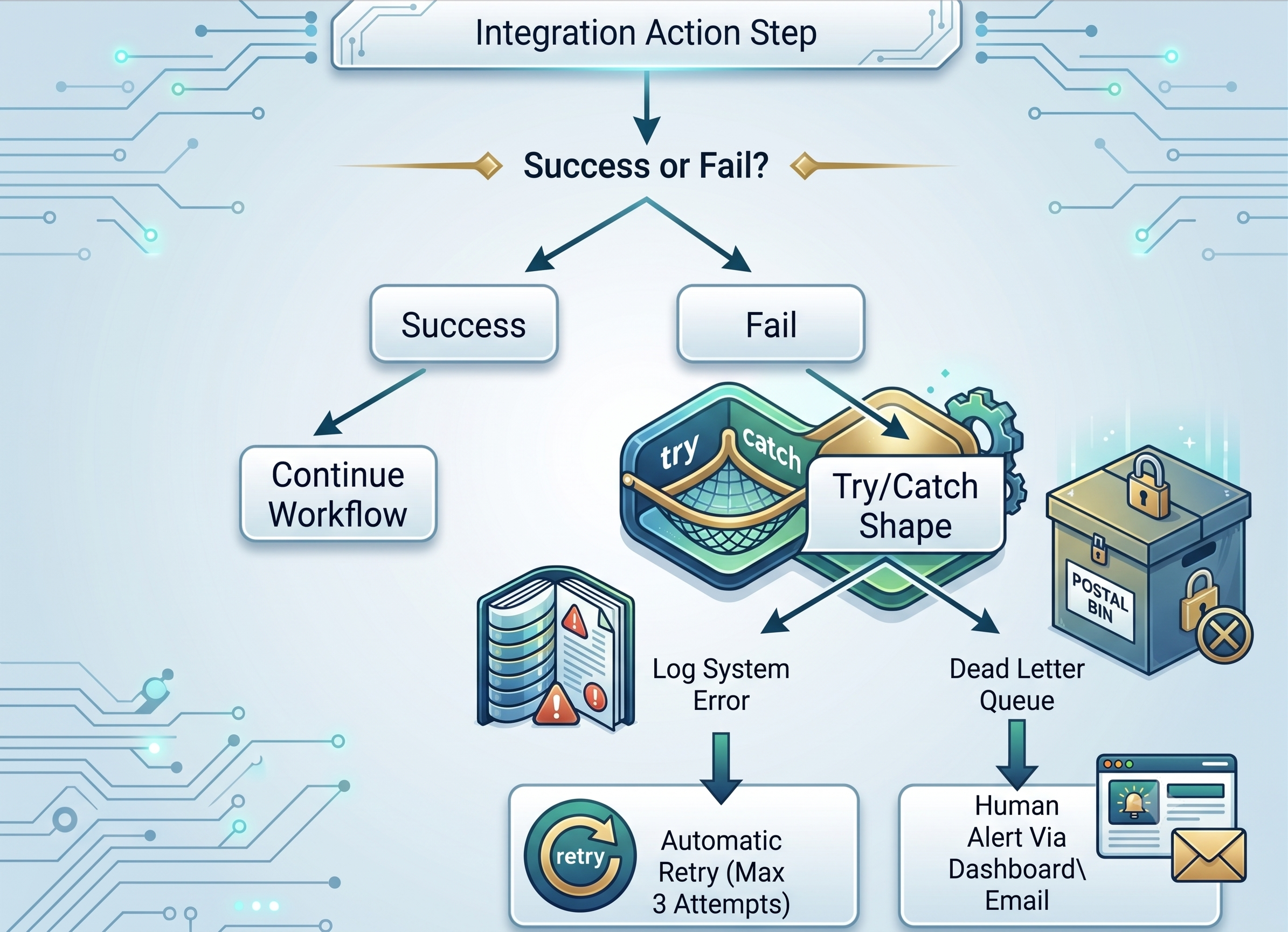
Exception Catching: Enclose dangerous network edges. The process catches the exception if the system does not receive any response from the application, thus preventing process termination.
Dead Letter Queue (DLQ): Failed messages will be automatically quarantined, enriched with error details, and then sent to the DLQ for developers to correct system errors.
8. Enterprise Governance, Security and DevOps (CI/CD)
Running an integration platform within multi-national organizations demands tight governance controls, transparency, and standardization of deployment processes.
The Boomi lifecycle management processes are organized into three different environment tiers, each suited to a certain development stage and managed through strict user access control:
Development (Dev): The first tier represents the designated sandbox used for process development, prototyping, and creation of integration components in their pristine form. Only users on a developer level have access to it.
Test / QA: The intermediate tier, which is created specifically for the purposes of validation, represents the test application sandbox. It can be accessed both by developers and QA engineers who perform integration testing, check data mappings and find errors.
Production (Prod): This is the highest environment tier, which is responsible for handling real-time transactions of data in critical runtime environment. Due to its involvement in critical enterprise processes, this environment is strictly locked and accessible only to admins.
Role-Based Access Control (RBAC) and Single Sign-On (SSO)
Least Privilege is a rule that enterprise compliance enforces. User Governance capabilities in Boomi include:
Custom Security Roles: Precisely segregate user activities. For instance, a “Support Engineer” is authorized to see process execution numbers and logs but is restricted from seeing the sensitive payload data fields and process configuration.
Enterprise Identity Management: Full native integration with enterprise Identity providers such as Okta, Ping Identity, and Azure Active Directory and mandatory enforcement of Multi-Factor Authentication (MFA).
Automated CI/CD Pipeline
Boomi comes with the platform deployment facility built-in; however, in an enterprise DevOps scenario, Boomi is integrated with external code pipelines.
Platform APIs: Boomi has its full control plane available through standard AtomSphere REST APIs.
Automation: Third-party automation tools like Jenkins, GitLab CI/CD, or Azure DevOps could programmatically create deployment packages for Boomi XML components, conduct automated unit testing against test runtime environments, perform environment property injection (using secrets managers such as HashiCorp Vault or AWS Secrets Manager), and deploy code to production using only automation.
Conclusion: The Strategic Imperatives for the Next Era
Boomi's Enterprise Platform is not just an operational tool that connects data gaps but is the strategic approach to digital business today. With low-code quick development capabilities, complete API exposure, master data cleaning via Master Data Hub, and Agentic AI capabilities, Boomi enables the active data framework necessary for safe business operations scaling into the automated era.
With organization-wide processes moving away from human-driven interactions toward AI-driven actions, the companies who will dominate their markets will be those who have data pipelines that work well, integration architectures that are governed, and complete observability. Applying the structural patterns and architectures defined in this guide ensures that your integration architecture is safe and secure for any future technology shift that might come along.
In order to fill the void that exists between theory and practice, it is important to make sure that your team has the proper skills. This is made possible by either taking advantage of a thorough Dell Boomi Course for your team or providing dell boomi online course for your IT staff.