
The Developer's Guide to Agentic AI: Building Multi-Step Autonomous Workflows
Last updated on Aug 17, 2026
The technology landscape moves fast, but the enterprise ecosystem around Customer Relationship Management (CRM) moves at a breakneck speed. If you have been paying attention to enterprise software trends recently, you have likely noticed a massive, fundamental pivot happening across corporate IT departments. We have officially moved past the era where artificial intelligence was just a cute, glorified text generator sitting in a side panel on your browser.
For a couple of years, enterprise software was dominated by "AI Copilots." These were sidekick tools designed to draft a quick reply to a customer email, summarize a long thread of support tickets, or suggest a snippet of code. They were helpful, but they were essentially digital assistants that required a human sitting in the driver’s seat at every single turn. The human had to prompt the tool, verify the output, click the buttons, trigger the backend workflows, and execute the final process. The copilot was a smart suggestion machine, but it could not actually do the work.
Today, enterprise engineering is undergoing a massive transformation toward autonomous AI agents. We are stepping into an era where AI doesn't just assist human workers; it acts as an independent entity capable of reasoning through multi-step problems, making context-aware decisions, querying real-time enterprise data, executing complex backend code, and completing end-to-end business workflows without requiring step-by-step human intervention.
For engineering teams, technical architects, and professionals looking to upskill through structured salesforce developer classes, this shift redefines what it means to build applications on enterprise platforms like Salesforce. Understanding how this architecture functions, why the market is adopting it so rapidly, and what skills are required to build these systems is no longer optional—it is the core baseline for modern enterprise software engineering.
The Evolution: Why Simple Copilots Hit an Operational Ceiling
To understand where the market is going, it helps to look at why early AI implementations hit a wall. When generative AI first exploded into enterprise workflows, companies rushed to bolt "copilot" interfaces onto everything. A sales rep could ask a copilot to summarize an account history. A customer service agent could ask it to draft a refund email.
While these tools saved a few minutes of typing, they failed to solve the deeper issue of operational friction. Consider a typical customer service scenario: a customer reaches out because their shipment arrived damaged. They want a replacement item and a partial refund.
Under a copilot model:
The AI reads the customer’s incoming message and drafts a polite response.
The human agent reads the draft, edits it, and hits send.
The human agent opens a separate system to check inventory levels.
The human agent manually creates a new shipping order in the ERP.
The human agent opens the finance module to process a refund back to the customer's credit card.
The human agent updates the CRM ticket status to "Resolved."
Notice what happened here: the AI saved about 30 seconds of writing text, but the human spent 10 minutes jumping between five different systems, verifying data, and manually executing database writes and API calls. The AI was a passive writer; the human was still the entire operational engine.
This manual bottleneck is why companies quickly realized that text-generating copilots don't deliver true scale. True operational efficiency happens when software can reason about a task, figure out what actions are required, execute those actions across isolated software platforms, verify the outcome, and close the loop independently.
This realization is driving the shift toward autonomous agent architecture.
Anatomy of an Autonomous AI Agent
What separates an autonomous AI agent from a basic LLM wrapper or a traditional automated script? It comes down to three structural capabilities: Reasoning, Context, and Action Execution.
1. The Reasoning Engine (System-2 Thinking)
Traditional automation relies strictly on deterministic logic: If X happens, do Y. If an edge case occurs that was not explicitly coded into the system, the automation fails. Basic LLMs, on the other hand, use probabilistic text generation: Given word A, what is the most statistically likely word B?
Autonomous agents combine these worlds using advanced reasoning engines (such as the Salesforce Atlas Reasoning Engine). These engines don't just generate text; they utilize multi-step planning loops often referred to as ReAct (Reason + Act) workflows. When an agent receives a goal, it breaks that goal down into logical sub-tasks, determines which tools or software functions it needs to call, executes those tools, observes the output, and adjusts its next step dynamically based on the results.
If an API call returns an error or missing parameter, a traditional script crashes. An autonomous agent's reasoning engine reads the error, realizes it needs a missing customer ID, retrieves that ID from a secondary database query, and retries the action.
2. Grounded Context and Real-Time Enterprise Data
An AI model cannot make accurate business decisions if it is isolated from the company's live data. Autonomous agents rely on real-time data engines—like Salesforce Data Cloud—to "ground" their decisions.
Instead of training a model on static historical data, the agent uses real-time vector search and retrieval-augmented generation (RAG) to pull in live context at the exact moment a decision is being made. When an agent evaluates whether to approve an instant refund, it doesn't guess. It queries the live data unified across web interactions, purchase histories, support tickets, and ERP databases to check the customer's lifetime value and current return history before deciding.
3. Action Execution (Connecting AI to Code)
An agent without the capability to write or edit data is just a conversational chatbot. Autonomous agents derive their power from Action Frameworks.
Developers expose specific programmatic tools to the AI agent—such as invocable Apex classes, declarative Flow automations, and external REST APIs. The reasoning engine treats these custom code snippets as "tools in a toolbox." When the agent determines it needs to update a database, process a payment, or trigger a shipping label, it securely executes the corresponding code action on behalf of the user.
How Autonomous Agents Operate in Practice
To see how this works in a production enterprise setup, let's revisit our damaged shipment scenario under an autonomous agent framework:
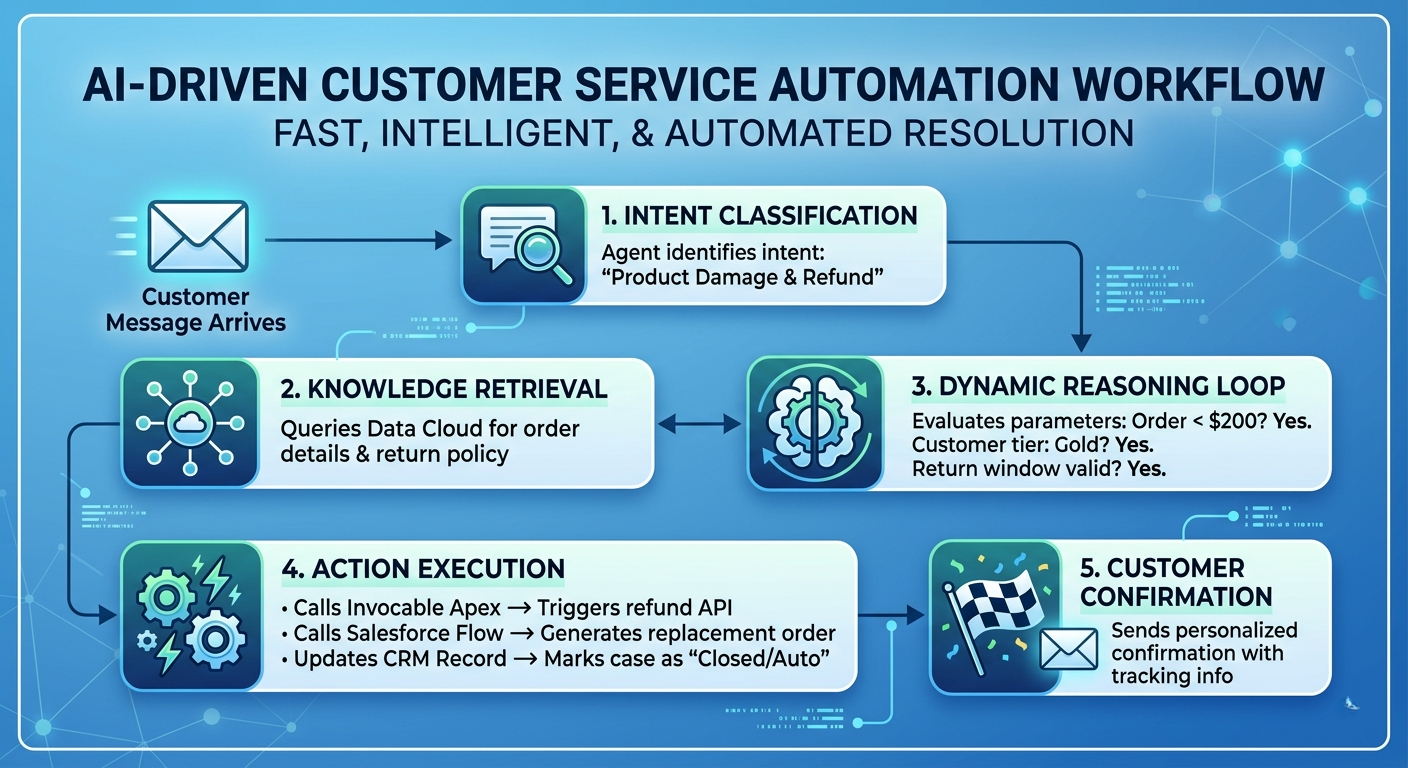
The entire sequence takes seconds. No human typed a response, opened an external portal, or manually created a shipping label. Human team members are only brought into the loop if an edge case explicitly violates a safety guardrail—for instance, if the requested refund amount exceeds an enterprise threshold.
The Architecture Shift: What This Means for Enterprise Engineering
The move toward autonomous agents changes the core architectural practices of software engineering on CRM and cloud platforms. For years, developers spent their time writing rigid procedural logic, designing custom user interface screens, and wiring up user-driven buttons. In an agentic world, the focus shifts toward modular action design, governance, and data architecture.
From Monolithic Code to Atomic, Reusable Actions: Developers no longer write giant 1,000-line scripts designed to run a fixed linear process from start to finish. Instead, they write small, highly focused, well-documented code modules (Invocable Apex or sub-flows) designed to perform one specific task cleanly.
Because an AI reasoning engine decides when and how to call these functions based on user intent, developers must write precise metadata descriptions for their code. The developer must explicitly tell the reasoning engine: "This Apex action takes an Order ID as an input, verifies if it is within a 30-day window, and returns a boolean output." If the developer’s code annotation is vague or incorrect, the AI engine won't know when to use the tool.
Clean Code & Bulkification Matter More Than Ever
When code is called dynamically by an AI agent instead of a structured user interface button, strict adherence to coding best practices becomes critical. Developers must ensure that custom actions handle CPU governor limits efficiently, run asynchronous jobs when processing large workloads, and enforce strict enterprise security permissions. An unhandled exception in an invocable action doesn't just crash a screen—it breaks the reasoning loop of an autonomous agent.
The Fusion of Low-Code and Programmatic Code
The modern enterprise tech stack is not an "either/or" choice between custom coding and low-code build environments. It is a unified ecosystem:
Salesforce Flow handles deterministic business rules, standard approvals, and simple record updates cleanly without adding technical debt.
Apex & Custom APIs handle heavy data processing, complex mathematical logic, multi-system integration endpoints, and high-performance algorithms.
Lightning Web Components (LWC) provide modern, web-standard user interfaces when human interactive input is needed.
Agentforce & Atlas Reasoning Engine act as the orchestration layer sitting on top, using both low-code flows and programmatic Apex as tools to execute workflows dynamically.
Upskilling for the Agentic Era: Mastering the Core Platform
Because the market is aggressively adopting autonomous agent platforms, the demand for tech professionals who actually understand how to architect, configure, build, and secure these environments is exploding. Companies are discovering that you cannot simply buy an AI tool and expect it to work out of the box; you need skilled developers and architects who understand data models, system boundaries, and underlying platform frameworks.
If you are looking to build a high-growth career in this space, gaining hands-on, practical expertise through structured training is essential. Enrolling in a comprehensive salesforce developer course gives you the foundational understanding of database schemas, security models, and cloud infrastructure required to support complex automations.
As you advance your technical capabilities, structured learning helps you transition from simple administrative concepts to writing production-ready code. Understanding object-oriented programming in Apex, managing asynchronous processing, interacting with databases using SOQL, and creating dynamic web applications using Lightning Web Components are the absolute building blocks required before you can build custom tools for AI agents.
When evaluating any training program, it is vital to choose a curriculum that covers both foundational programmatic concepts and the modern platform shifts happening today. A modern learning path should not just teach you how to write basic database triggers from ten years ago; it must teach you how to build clean integration layers, write invocable methods for AI engines, structure data architectures for real-time analytics, and implement CI/CD pipelines for deployment.
Core Skill Blueprint for Modern Enterprise Developers
To thrive in this new landscape, engineers need a balanced mix of declarative, programmatic, and AI-centric capabilities:
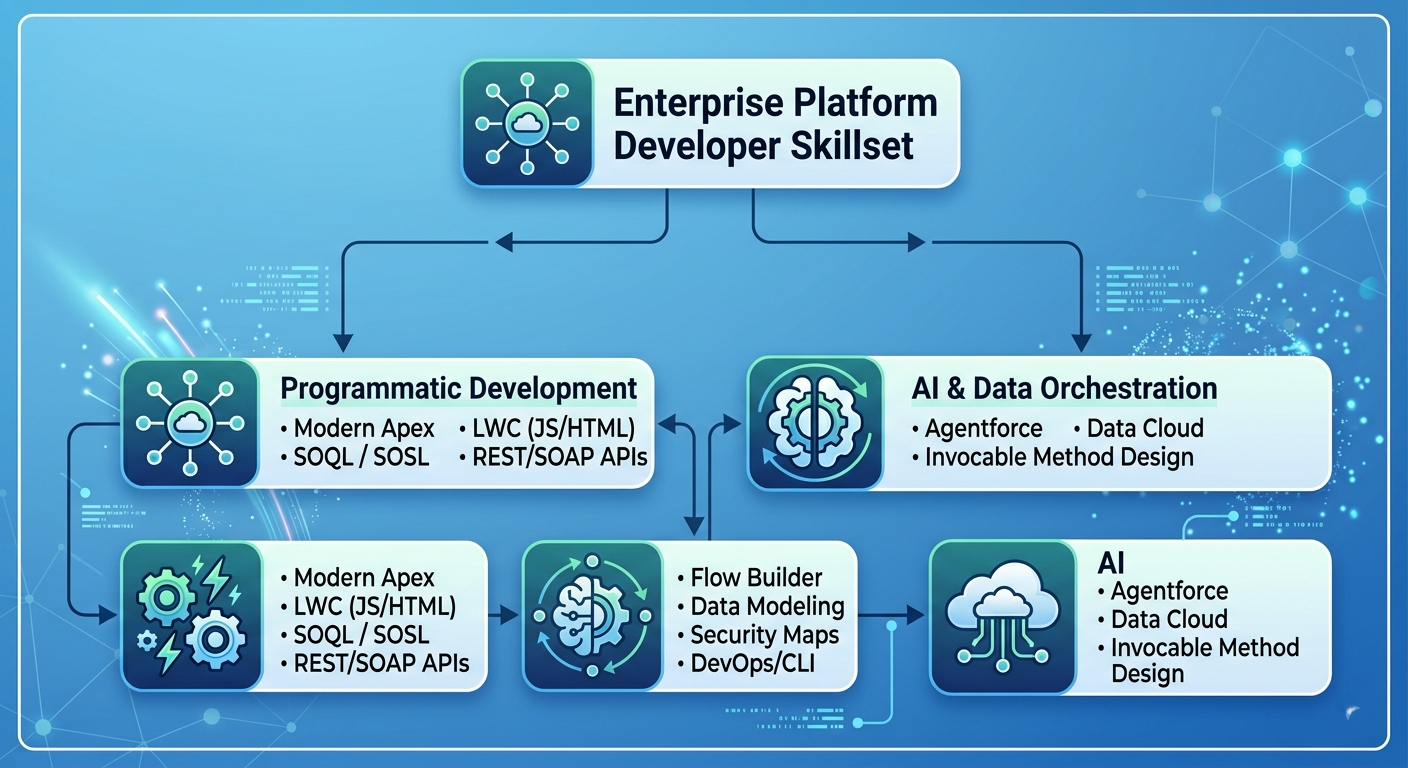
Backend Mastery (Apex & SOQL): Writing bulkified, secure backend logic that executes within tight execution limits.
Frontend Standards (LWC & JavaScript): Crafting responsive components using open web standards.
Automation Architecture (Salesforce Flow): Knowing when to use low-code flow orchestration versus heavy custom code to keep systems maintainable.
Integration Engineering: Connecting CRMs securely to external microservices, cloud warehouses, and third-party SaaS applications.
AI Agent Configuration: Structuring topics, instructions, guardrails, and invocable actions to allow AI models to perform work without breaking business rules.
Real-World Business Impact: Beyond the Hype
Why are enterprise executives investing heavily in this agentic shift? It comes down to measurable operational outcomes rather than novelty metrics.
1. Dramatic Increase in First-Contact Containment
In traditional customer support, "containment rate" refers to the percentage of customer inquiries resolved without needing to pass the issue to a human agent. Traditional self-service portals and rigid decision-tree chatbots often had abysmal containment rates because they broke down the moment a user asked a complex question or phrased something unexpectedly.
Autonomous AI agents, backed by reasoning engines and real-time enterprise data, are routinely handling multi-step resolutions end-to-end. By verifying identities, querying logistics platforms, and executing refunds or replacements directly, agents elevate containment rates while keeping customer satisfaction scores high.
2. Slashing Employee Context-Switching
The average enterprise worker spends a massive percentage of their workday toggling between different browser tabs, copying data from one system to another, and filling out standard administrative logs.
When autonomous agents are embedded into everyday communication channels—like Slack or CRM dashboards—they handle the background cross-system plumbing. An employee can simply instruct an agent in plain language: "Update the opportunity stage for Acme Corp, generate a draft renewal contract based on their current tier, and notify the account manager on Slack." The agent invokes the required backend processes, updates the system records, and delivers the result in seconds.
3. True 24/7 Operational Scale
Human teams cannot operate at peak performance across every timezone without massive payroll overhead and burn-out risks. Autonomous agents execute complex, highly regulated operations with identical precision at 3:00 AM on a Sunday as they do at 10:00 AM on a Tuesday. Because they operate strictly within pre-defined developer guardrails and security rules, businesses can scale their operational throughput infinitely without linear headcount growth.
Addressing the Elephant in the Room: Governance, Trust, and Security
With software executing actions autonomously, security engineering becomes more vital than ever. Giving an AI model the ability to write to enterprise databases or trigger financial transactions without human oversight sounds terrifying to a Chief Information Security Officer (CISO) if proper architecture isn't enforced.
Building successful agentic enterprise systems requires strict security layers:
Role-Based Execution Context: An AI agent should never operate with god-mode administrative privileges. When an agent acts on behalf of a user, it must strictly inherit the sharing rules, field-level security, and object permissions of that specific user. If a user doesn't have permission to view salary data or approve $50,000 discounts, the agent executing code on their behalf must be blocked from doing so as well.
Deterministic Guardrails: High-risk actions—such as deleting customer records, issuing large wire transfers, or sending external emails to massive lists—should always require an explicit "Human-in-the-Loop" approval step. The agent can assemble the context, prepare the payload, and present the decision to a human manager with a single-click "Approve/Reject" interface.
Auditability & Observability: Every reasoning step, data query, and action executed by an autonomous agent must be logged in audit trails. When an issue occurs, engineers must be able to open an execution log, review the precise chain-of-thought that the reasoning engine took, inspect the inputs and outputs of every invocable method called, and fine-tune the instructions or code to prevent future errors.
The Road Ahead: The Agentic Enterprise
We are witnessing a fundamental shift in how enterprise software is conceptualized, designed, and deployed. The era of static software screens where humans spend hours acting as manual middleware—copying numbers from emails into CRM fields and clicking through endless forms—is drawing to a close.
The future belongs to the Agentic Enterprise: an operational ecosystem where human professionals focus on strategy, creative problem-solving, relationship building, and high-level governance, while a network of autonomous AI agents handles the complex execution, data orchestration, and cross-system workflows under the hood. For developers, architects, and technology professionals, this evolution represents an incredible career opportunity. The engineers who win in this new era won't just be the ones who know how to write syntax; sfdc developer course, they will be the architects who understand how to structure clean data, build robust and secure programmatic actions, orchestrate low-code automations, and design AI agent frameworks that turn complex business challenges into effortless, automated outcomes.