
The Hidden Side of Workday HCM: How One Employee Change Can Affect Multiple HR Processes
Last updated on Sep 16, 2026
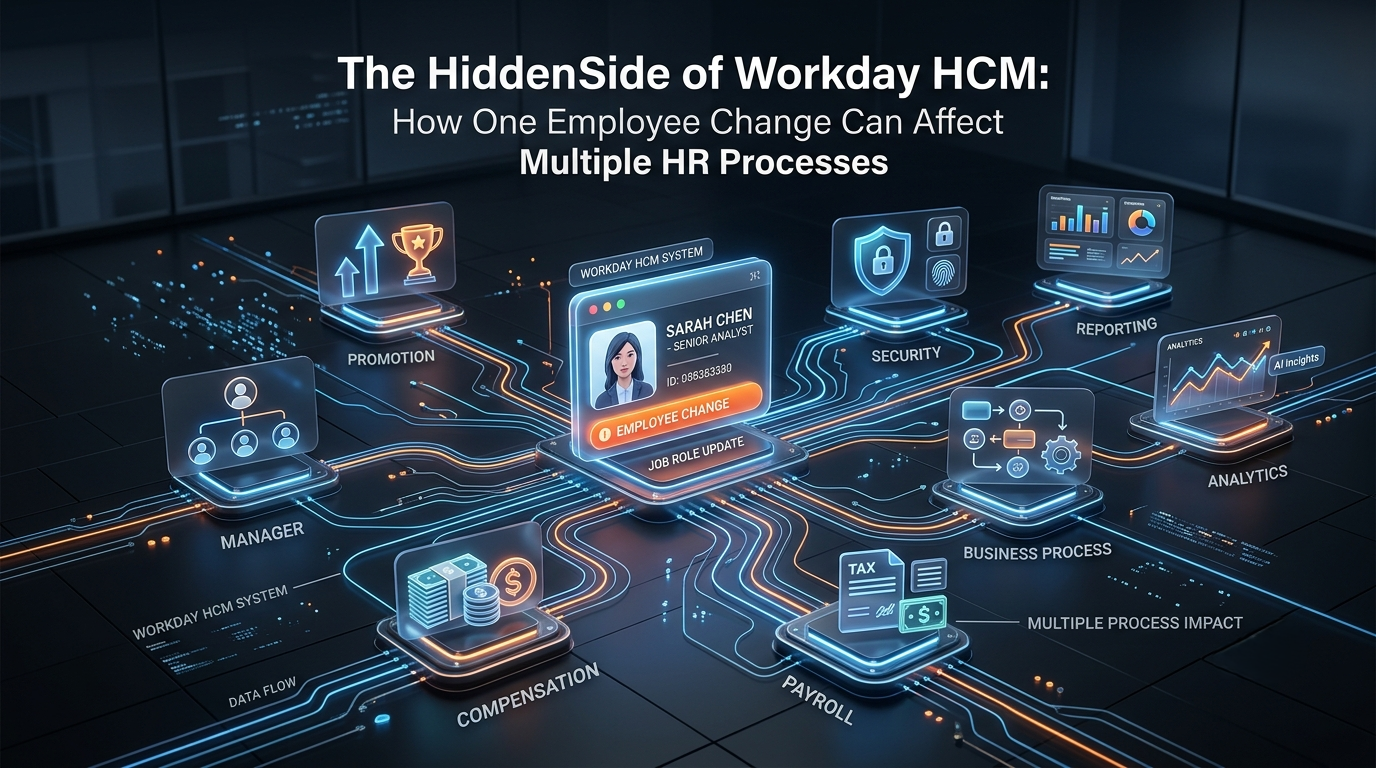
One Employee Change Can Start a Chain Reaction
Normally, changing a job title within modern organizations involves administrative tasks related to human resources. However, the process is far complicated since the change in job title activates several other connected processes in the organization. For example, an employee who has recently been promoted from software developer to senior software developer might not see his or her promotion as anything significant, but rather they receive a new job title and a new salary. Inside Workday HCM, however, the promotion can involve much more. The employee’s job information, compensation, manager relationship, supervisory organization, business process approvals, reporting structure, security access, and workforce data may all need to reflect the new position. This is one of the less visible aspects of Workday HCM: employee information is not stored as isolated pieces of data. Different parts of the system are connected through organizational structures and business processes. When one piece of information changes, the system may use that information in other processes as well. This interconnected approach is important because organizations rarely manage employees through one HR activity at a time. A promotion can affect compensation, a transfer can change the employee’s organization, a manager change can influence approval workflows, and a change in location can affect other employee-related processes. Understanding these relationships helps explain why enterprise HR systems require more than simply entering information into a form. They need carefully designed processes that determine what should happen when employee information changes. Workday HCM provides a framework for managing these changes, but the value comes from how organizations configure their processes, structures, security, and integrations around their business requirements.
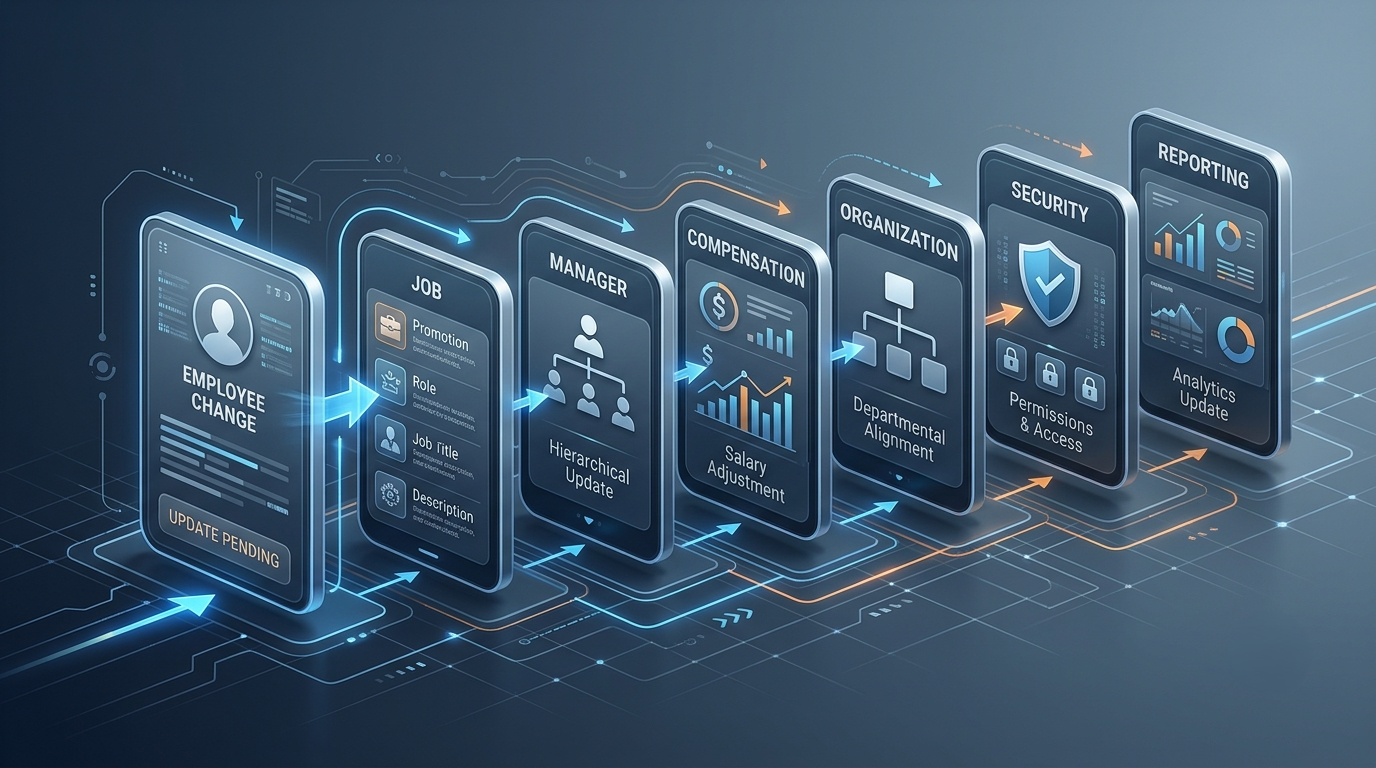
When you are learning workday hcm course , it is helpful to change how you think. Rather than considering individual HR transactions as separate events, it is more beneficial to view the employee’s record as part of a larger network of information. The continuous use of employee data means that a change will have implications that go beyond one specific transaction.
What Happens When an Employee Gets Promoted?
Promotion has always been a simple illustration of how a lot of interactions work within HR systems. Let’s take Priya who is a marketing executive and who is promoted to the position of a marketing manager. HR is starting to proceed to the promotion process. But this doesn’t mean that it is the end after the new title is documented. An employee may take a new role, get some changes in salary or new benefits packages and might even get into a different reporting organization. If Priya turns into a manager, some of her functions and relations with other employees will also change. An employee who reported to another manager will be reporting to Priya from now on and this affects approval and reporting processes. Thus, it is apparent that Workday HCM provides functionality beyond mere data encoding; HR transactions amount to a business event. An HR transaction represents an event in an employee’s life allowing the Workday system to execute changes accordingly. Many events are linked to compensation. If a promotion comes along with a raise, new compensation data must be recorded. Compensation may depend on the configuration of an organization’s processes.
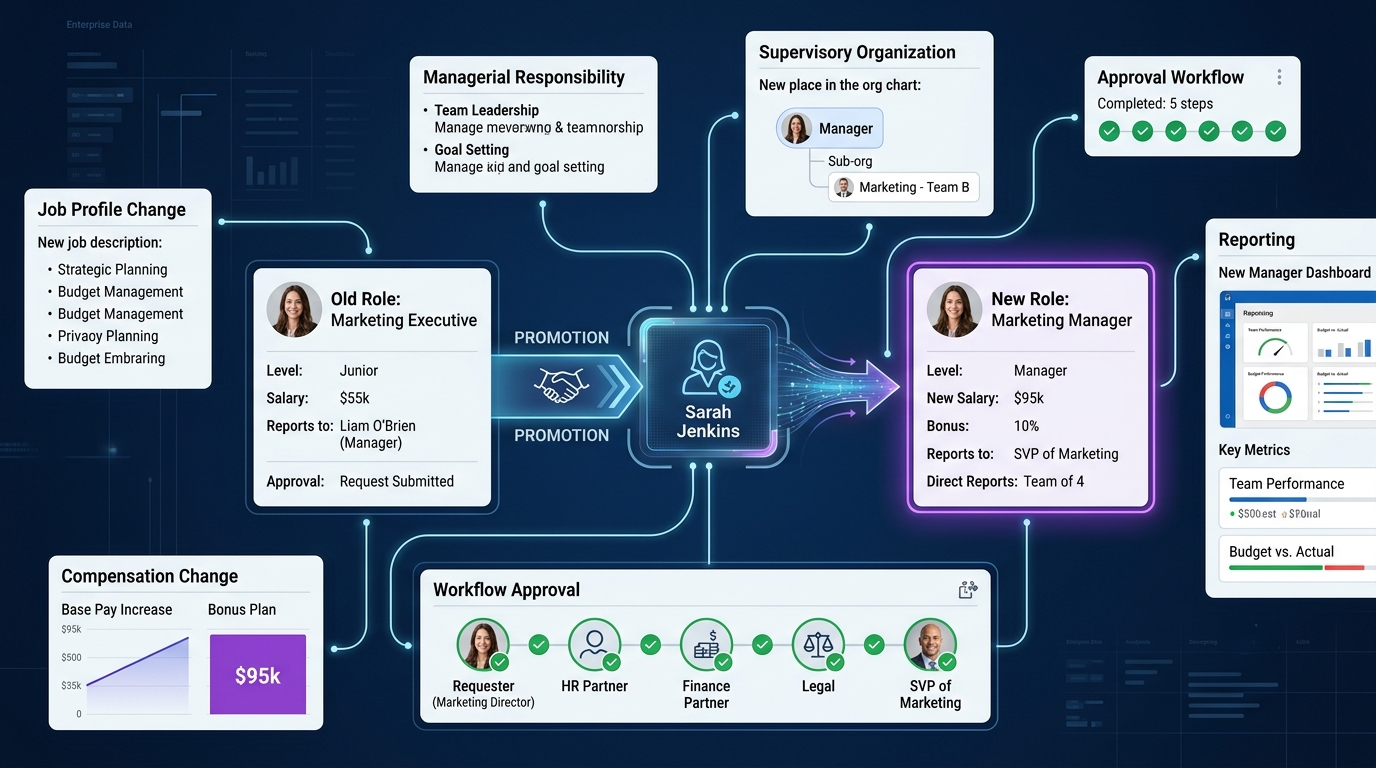
The new role can also influence reporting and analytics as now there is one more employee at the particular level or function. Furthermore, if the employee is responsible for managing a team, managerial relations will also affect approval processes, performance processes, and other HR tasks. As it turns out, what seems like a straightforward promotion turns into a series of interconnected transformations. It is important to note that not every promotion will set off the same chain of events. Companies use Workday in accordance with their own corporate policies, organizational structures, procedures of approval, and integrations. This is why the whole sequence may differ from one organization to another. However, the idea is simple: all data on the employee is interconnected, and whenever a significant event happens concerning that employee, it may touch on several areas. Thus, it is important for HR experts and Workday users to understand the correlation between the business needs and the configuration of the system instead of treating each question as a separate one.
The Manager Transition that Affects an Employee’s HR Experience
A shift in manager may seem to be not a big deal compared with promotion, but this change can greatly impact the work experience of the employee. If a company changes the structure of its department and transfers the employee from one manager to another, the employee’s data may not change, but the position of that person within the organization is different. In Workday HCM, the relationship with a manager is one of the important links in the organization, as managers are usually involved in different HR processes. Depending on how the company is set up, a manager can take part in various HR activities. a manager change can affect not just the approval of sick leaves but also of other personnel actions, including remuneration changes and any corporate performance initiatives. A change of manager therefore affects whose provisions are reviewing or signing off certain matters and how the employees fit into various management systems. In practice when a department manager is viewing employee data, he or she may come across classifications that group employees based on their managers’ hierarchy or other management systems. The fact of the employee’s transfer to another manager creates a basis for relevant reporting. Moreover, a manager change is likely to be associated with certain changes regarding the level of access to employee information dictated by the organization’s security configuration rule. In a similar vein, the exact actions taken by an organization will depend upon how the security model has been implemented. Due to this, manager changes should not be treated merely as administrative updates. The HR department must understand why the change has taken place, and whether there is any other information that has to be changed accordingly. If a manager change is brought about by a temporary reporting situation, it may need to be handled differently than in case of a permanent organizational change. Similarly, manager change may coincide with a job change, change of location or transfer, thereby creating a chain of events that are related to one another. From the perspective of Workday professionals, knowing about such connections is useful for developing the processes, since it gives them the knowledge of how HR really works. A configuration may be technically correct, however it won’t be of any use, if it does not fit the approval structure of the organization or the responsibilities of management. The purpose is to have the system reflecting the actual business relations existing in the company, while achieving the required level of security and data integrity.
Significance of the Business Processes in employee changes
Actually, there is a business process behind every employee change which defines how transactions flow in an organization. Therefore, instead of letting every change happen uncontrolled, organizations can create business processes which define all the steps taken in the transaction: who starts it, who reviews it, who approves it, and what should happen after that. For example, let’s tell about transferring an employee from Finance to Operations department. HR professional might initiate the transfer, but the organization might require approvals from the existing manager, future manager, HR partner or some other responsible person. When all the needed approvals are obtained, the employee’s organization information can be modified according to the configured business process. While every organization has its own way of doing things regarding the business process, it is important to realize that any business process is able to transform HR policy into a business process. The use of Workday by businesses with an overly complicated approval process can lead to delays for employees. In addition, failure to adhere to a specific list of approval steps can cause loss of control, as well as increased reliance of HR workers on manual workarounds. That is why configuring the software needs to start with knowing business needs. Before beginning to modify this or that process, one needs to understand what the company’s goals are, who is to approve what, what information is to be recorded, etc.
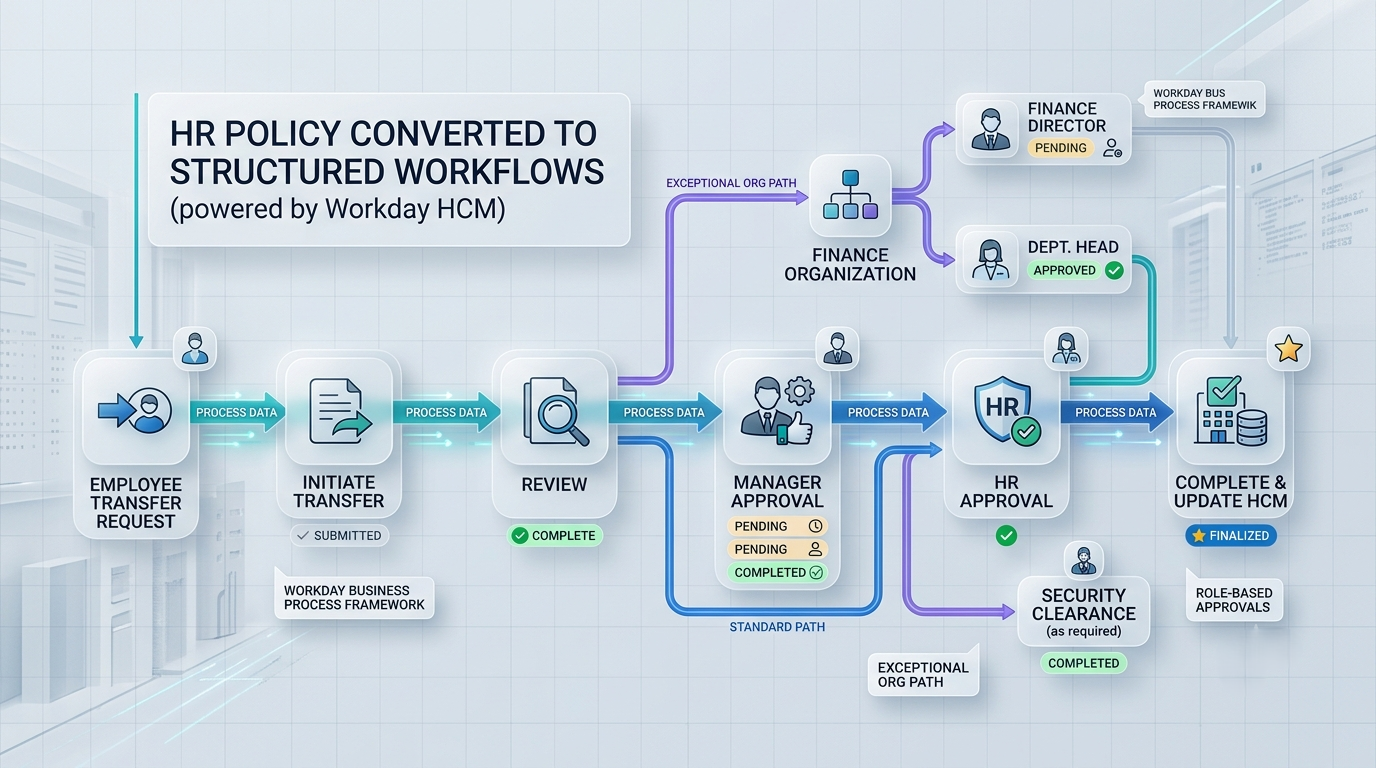
In addition, different companies can treat the same personnel event differently. A small business may have only one level of approval for a job change, while a big company might require multiple stages of approvals due to many factors. It is therefore not enough to copy the configuration used by a different organization; the mere fact that Workday HCM is used does not imply that things will turn out the same way. It is the organizations that define the purpose for which the technology should be utilized within HR functions. For students undergoing Workday HCM training, understanding business processes is crucial for linking the technology and its configuration with HR operations. Rather than simply memorizing screens and terms, the trainees could appreciate the value of the transactions and the implications of the steps they involve, thereby making it easier to deal with complex employee lifecycle changes.
Combining Employee Data with Payroll, Compensation, and Other Systems
When organizations link Workday with other corporate systems, such as payroll using middleware, the resulting complexity increases even more. Employee job or compensation details may have implications outside the HR module. For example, salary modifications affect payroll systems, while organizational changes are useful for financial statements. Companies might also integrate Workday with benefits systems, access management solutions, learning tools, recruiting systems, or other software products. Such integrations enable information to be exchanged between systems as specified in the requirements. The key aspect here is that the impact of an employee amendment does not stop inside Workday. For instance, if an employee gets a raise due to promotion, the information needs to be transferred to the payroll system in the future. If an employee moves to a different unit, information connected with that position will have to change accordingly.
Organizational change can also have significance for financial or reporting systems. The precise integration architecture is very different depending on the organization in question, so there exists no standard process of how to operate after an employee change occurs. Some organizations rely on Workday as the system of record for the information related to employees, while other systems can be used for certain types of data. In turn, the integration design process should determine which system is responsible for a certain type of information, when the information exchange should take place, and how to deal with mistakes. The significance of this grows considerably when thousands of employee records are altered on the platform. Manual processing is sufficient in the cases when the number of employees remains small, but it will lead to loss of efficiency in bigger companies. Various automated integration solutions can ensure employee data enters the database automatically. The problem of security controls arises in the case of failed integration wherein the mismatch among multiple systems may lead to the need for investigation. This is where Workforce practitioners need to understand the process of mechanisms sooner than any particular integration. They need to know how employees' data are created and processed as well as what systems depend on them. Even when a practitioner is working only on HCM configuration and not on integrations, having some knowledge of connected systems will help him to understand the impact of the configuration choice.
Why the Quality of Data and Configuration are More Essential than You Might Think
Connected HR system's reliability depends effectively on its data and rules. In case the employee data is not accurate, it is not complete, it is duplicated or it is not structured accordingly, then, it can cause problems in other processes too. Consider the situation when an employee was incorrectly assigned to some department. At first sight, this problem may seem unimportant, but later the incorrect data will be used for reporting, approval, compensation, security tasks and integrations. Because of this, the importance of data quality while working with Workday HCM becomes apparent. In such a way, any organization must have clear definitions of the data of each employee and clear processes for maintaining it. The technical efficiency of a business process alone is not sufficient if there are too many layers of approval or if the process is not compatible with the way employees function in the organization. Likewise, security needs to be planned properly, as employee data may contain sensitive information that can be accessed only by people with the necessary authorization. The system needs to strike a balance between being user-friendly and getting enough control. Another major hurdle is the changes in the organization. Companies often carry out restructuring or come up with new job titles, take over other businesses, or modify reporting relationships. The HR system should be able to deal with these changes without disturbance. One thing that companies should do to achieve this is to regularly revise their configurations and data structures. For those taking Workday HCM, this section is useful because it highlights the importance of understanding Workday as a whole and not merely learning new features.structures of organizations, privacy, reporting mechanism as well as integration system. Also, it is vital to know the difference between workability and sustainability when configuring any system. Testing is another essential component to be taken into account. A company can run various experiments and switch to another mode before anything important is launched on a production level. For instance, it could go for testing whether a transfer, a promotion, a manager’s resignation, or a salary change is approved, secured, properly reported on, and everything on the lower level works. Thus, it is possible to avoid problems after the g system starts functioning.
The Bigger Picture: From Individual Employee Transaction to Workforce Intelligence
The true value of interconnected employee data becomes evident once a business shifts its focus from individual transactions to overall workforce analysis. Every day, HR departments perform a series of activities that encompass hiring, promoting, transferring, changing managers, adjusting salaries, reorganizing structure, or terminating employees. Analyzing them exclusively means looking at ordinary employee operations but analyzing them together establishes a lot of data on how the workforce environment is evolving. For instance, processes like several promotions within one department can signal high levels of internal career movements, while many transfers can indicate the reorganization of employee structure or emerging needs of the staff. Headcount changes can provide HR with insights about the staff´s growth, while compensation data can clarify how salaries are distributed among different positions or areas of the organization.
The effectiveness of the given information is contingent on the quality of data, reporting design, organizational definitions, and the relevant business questions. Workday HCM introduces enhanced reporting and analytics capabilities to organizations and helps them utilize the data concerning their workforces from various angles. However, not all the data collected automatically becomes valuable business insights. HR and business executives should still decide what exactly they want to know and how they should interpret the information. That is where the whole employee data lifecycle comes into play. The process of employee changes begins as HR transactions that undergo the process of all business processes and approvals, change employee information, may connect to compensation or other systems and help in producing the reports on workforce. The understanding of this full employee change model leads to the understanding of what Workday HCM is. It is not just a system for processing HR-related operations in an electronic format. It is a full-fledged platform through which employee data is created, updated, transferred, and analyzed. This may be valuable for people interested in getting workday HR training since the knowledge allows them to connect their HR activities to the whole organizational process. When a person is promoted, it can have an impact on compensation and reporting. When a manager relocates, it can have an effect on approvals and the relations with the organization. When an employee is transferred, his/her location in the organizational hierarchy can be changed. A compensation change may affect payroll operations. Being able to understand these links will enable companies to create better processes. Also, this knowledge will be beneficial for Workday consultants. HCM system’s true power is the ability to manage related processes, not only record a change.