
The Migration That Was Supposed to Fix Everything
Last updated on Sep 9, 2026

A mid-sized fintech team once moved a user-profile service from PostgreSQL to MongoDB because product managers kept adding new fields — loyalty tier, referral source, KYC status, regional tax flags — and every addition meant a migration, a deployment window, and a Slack thread about downtime. MongoDB looked like the obvious fix. No more ALTER TABLE. No more waiting for a database migration to ship a feature.
Eight months later, the same team was debugging a production incident where roughly 12% of user documents had kyc Status stored as a string, another chunk had it as a boolean, and a handful — created during a rushed sprint — didn't have the field at all. A query that assumed one shape silently skipped documents with another. Nobody had lied about the data. Nobody had broken a rule. There simply hadn't been a rule to break.
This is the part of the MongoDB story that rarely gets told in beginner tutorials: the database did exactly what it promised. It stored whatever shape of document the application sent it, as fast as it could, without complaint. The complaint arrived later, from an application that assumed consistency the database was never asked to guarantee.
The Word "Schema-less" Was a Marketing Accident
For years, MongoDB was described — often by MongoDB's own early marketing — as "schema-less." It's a phrase that stuck, and it's also one of the more consequential misunderstandings in modern backend development. The common belief: MongoDB doesn't need a schema, so you don't need to design one. Why people believe it: The database engine genuinely doesn't enforce a fixed structure by default. You can insert a document with five fields, then insert a different document with fifteen completely different fields, into the same collection, and MongoDB will accept both without complaint.
What's actually happening: The schema doesn't disappear — it moves. Instead of living in the database's table definitions, it lives in your application code, your API contracts, and the assumptions your queries make about document shape. If your application expects address. city to always be a string, that expectation is a schema. It's just an implicit one, enforced by nothing and documented nowhere.
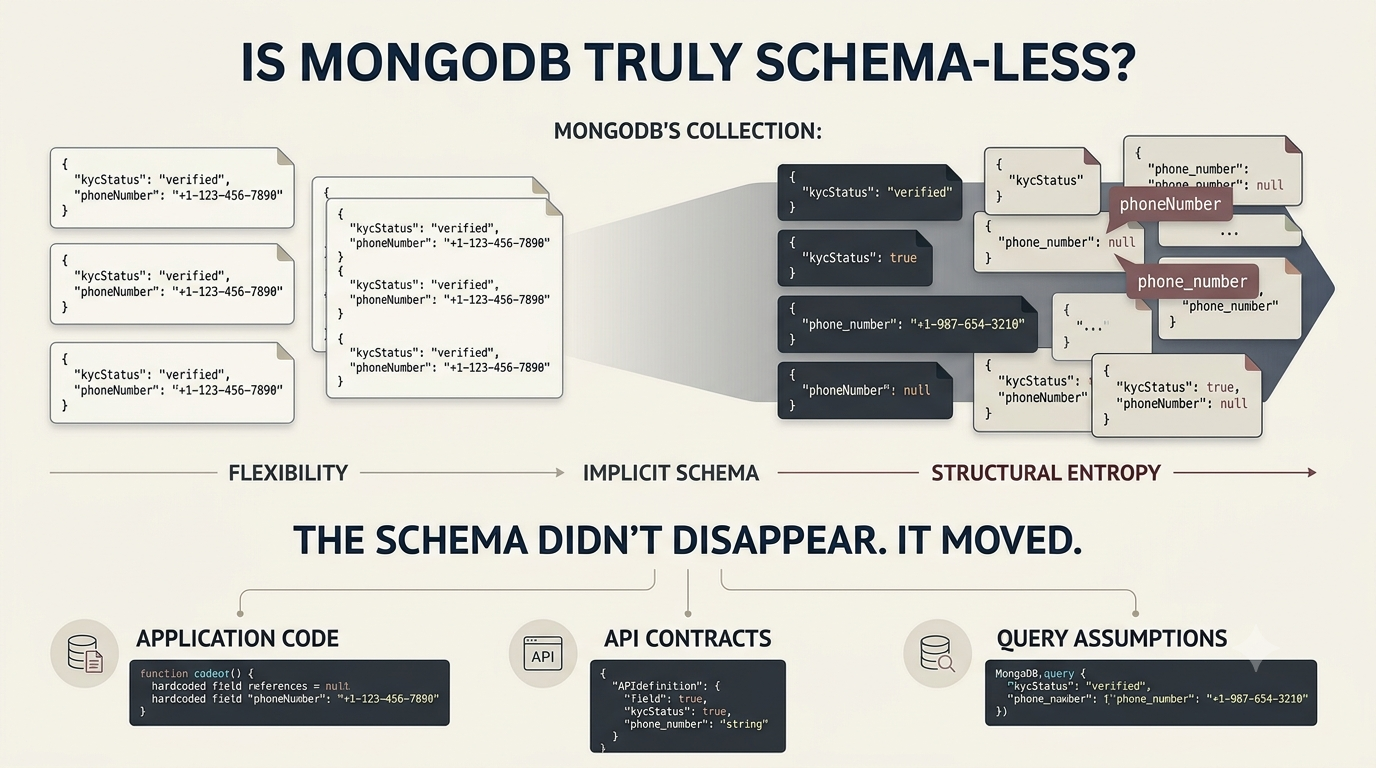
What readers should do differently: Treat "schema flexibility" as a design decision, not a default state. MongoDB gives you the option to evolve document structure gradually — that's genuinely valuable for iterative product development — but it doesn't remove your responsibility to know what shape your data should take at any given point in time. Document-level validation, versioned schemas, and clear field-naming conventions aren't relics of relational thinking; they're how you keep flexibility from becoming entropy.
Where the Real Bottleneck Begins
Here's a pattern that shows up constantly in teams six to twelve months into a MongoDB adoption: the database isn't slow, the queries aren't technically wrong, but nobody trusts the data anymore.
It usually starts small. A backend developer adds a new microservice that writes to an existing collection, but names a field slightly differently — phone_number instead of phone Number. A second developer, unaware of the first change, writes a query filtering on the original field name and silently misses every document the new service created. No error is thrown. No test fails, because the test data was seeded consistently. The bug surfaces weeks later as "some users aren't getting SMS notifications," and the root cause takes a full day to trace back to a naming inconsistency introduced by two people who never spoke to each other.
This is the real bottleneck in most MongoDB deployments — not throughput, not latency, not sharding complexity. It's coordination. A relational database forces coordination through its schema; if two teams disagree about a column's type, the database itself refuses to let both versions coexist. MongoDB removes that forcing function, which means the coordination has to happen socially, through code review, documentation, and shared conventions — and social processes fail far more quietly than database constraints do.
Why Relational Instincts Get You Into Trouble in the Opposite Direction
Interestingly, the opposite mistake is just as common, and it comes from experienced engineers rather than inexperienced ones. Developers who spent years working with relational databases often bring normalization instincts with them. They see a User document with an embedded array of orders and immediately want to split it into separate Users and Orders collections, connected by reference IDs — because that's what "correct" database design looked like in their previous job. Sometimes that's the right call. Often it isn't.
MongoDB's document model rewards a different kind of thinking: data that's read together should usually be stored together. If your application almost always needs a user's five most recent orders whenever it loads their profile, embedding a reasonable subset of that data avoids a second round trip to the database. Over-normalizing a MongoDB schema — turning every relationship into a reference, the way you would in a relational system — reintroduces the exact join-like complexity MongoDB's document model was designed to reduce, except now it happens through application-level $lookup aggregation stages instead of SQL joins, usually with worse performance characteristics.
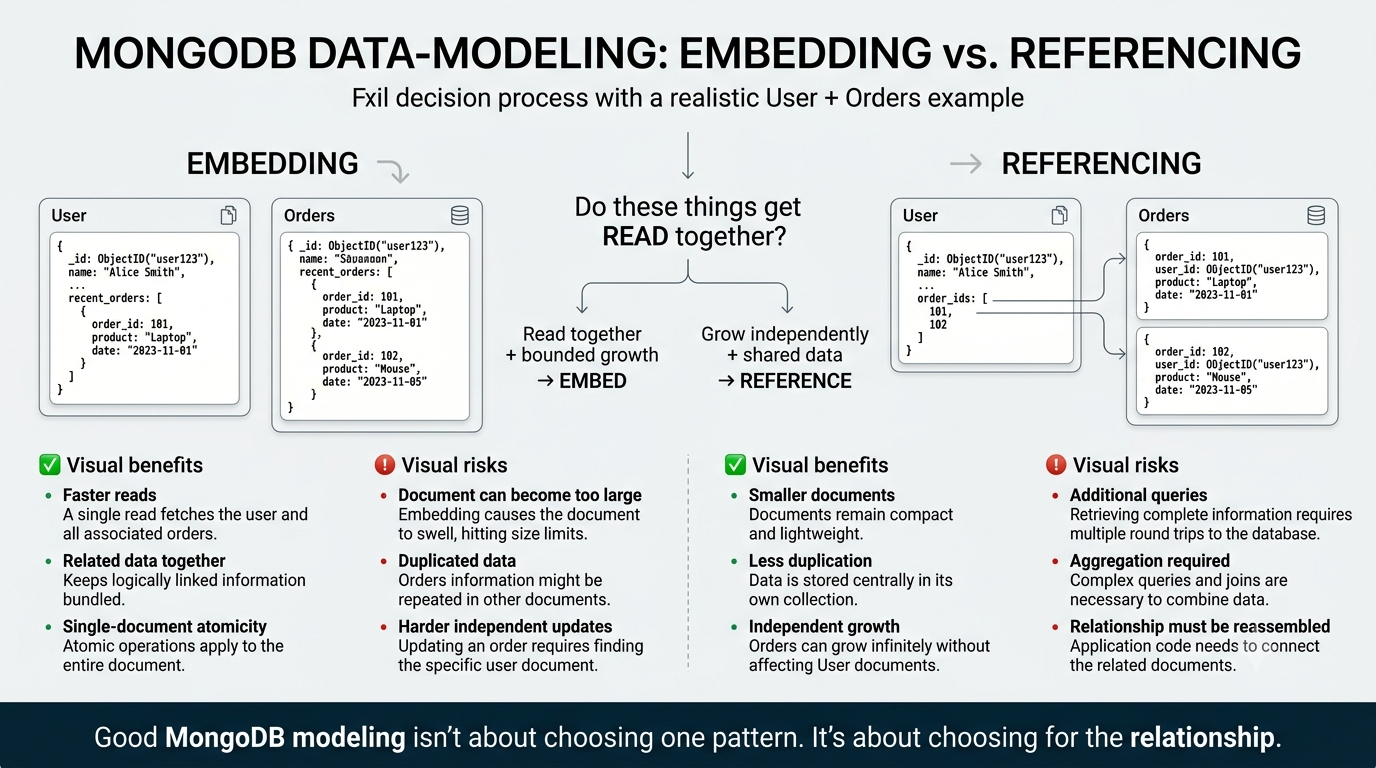
The trade-off is real and worth naming directly:
Embedding improves read performance and keeps related data atomic, but can lead to large, unwieldy documents and duplicated data that's harder to update consistently.
Referencing keeps documents smaller and avoids duplication, but requires additional queries or aggregation to reassemble related data, and loses MongoDB's single-document atomicity guarantees across the relationship.
Good MongoDB data modeling isn't about picking one pattern and applying it everywhere. It's about asking, for each relationship in your data: how often is this read together, how often does it change independently, and how large can it realistically grow?
The Scaling Story People Tell Themselves
There's a specific piece of MongoDB folklore worth challenging: the idea that sharding is something you turn on when you need to scale, and it solves the problem cleanly.
The common belief: When a MongoDB deployment starts struggling under load, sharding — MongoDB's built-in method for distributing data across multiple servers — will resolve it.
Why people believe it: Sharding is genuinely one of MongoDB's most powerful features, and MongoDB's own documentation and default configurations make it feel like a switch you flip rather than a design decision you make years in advance.
What's actually happening: Sharding distributes data based on a shard key you choose — a field or combination of fields used to decide which shard a document lives on. Choose a shard key with low cardinality, or one where most write traffic concentrates on a narrow range of values (a timestamp-based key is a classic offender), and you get a "hot shard": one server absorbing most of the load while the others sit idle, which is functionally the same problem you were trying to solve, just wrapped in more infrastructure.
What readers should do differently: Shard key selection has to happen with an understanding of actual query and write patterns, not as a reflexive scaling response. It's one of the few decisions in MongoDB that's expensive to reverse once a collection has grown large, because re-sharding existing data at scale is a nontrivial operational project, not a configuration change. Teams that get this right usually get it right because someone on the team has actually worked through shard key trade-offs before — through direct production experience or through structured, hands-on preparation. Many of the mistakes described in this article are exactly what a well-designed mongoDB training programme spends its time correcting: not syntax, but judgment — knowing when to embed, when to reference, when a shard key will age well, and when a document is quietly doing too much work.
Why Nobody Wants to Be the One Who Redesigns the Schema
There's a psychological pattern behind why inconsistent schemas persist long after everyone knows they're a problem: fixing them requires someone to volunteer for a project with high risk and low visible reward.
Redesigning a document structure that half a dozen services already depend on means touching working code, coordinating a migration across teams, and accepting that something will probably break in a way nobody predicted. Meanwhile, leaving it alone costs nothing today — the cost is diffuse, spread across every developer who has to remember which of three possible shapes a document might take. Humans are reliably worse at weighing distributed, ongoing costs against concentrated, immediate risk. That asymmetry is why so many MongoDB collections accumulate structural debt for years: not because nobody notices, but because noticing isn't the same as being the person willing to own the fix.
This is also why schema validation — a feature many teams enable only after their first serious data-integrity incident — is worth adopting earlier than most people do. MongoDB supports document validation rules that can enforce required fields, types, and value ranges at the collection level, without forcing you back into a fully rigid relational structure. It's a middle ground: keep the flexibility to evolve documents over time, but stop the database from silently accepting a kycStatus field that's sometimes a string and sometimes a boolean.
The Governance Question Nobody Asks Until It's Too Late
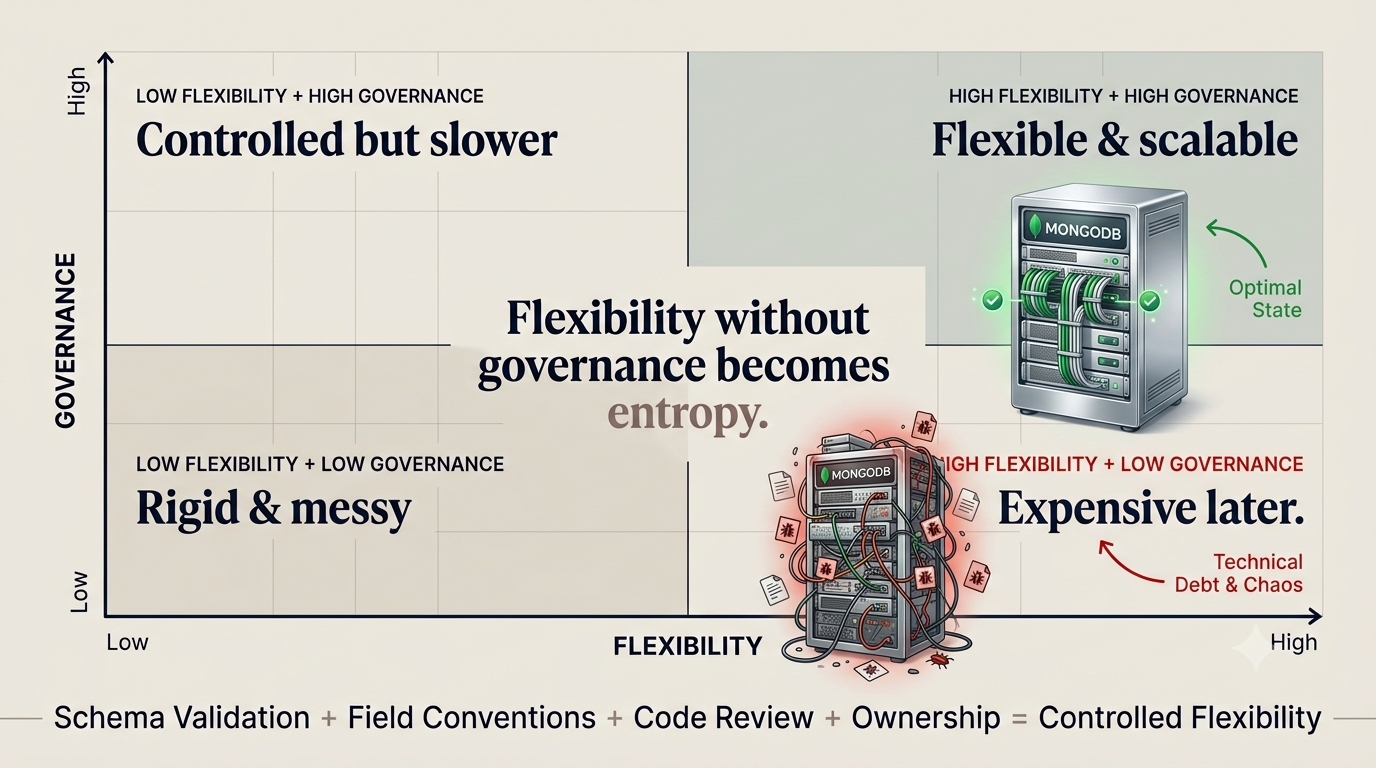
There's a trade-off underneath everything discussed so far that deserves to be named explicitly: flexibility and governance pull in opposite directions, and MongoDB doesn't resolve that tension for you — it just gives you more rope on both ends.
A team with strong governance — validation schemas, clear field ownership, documented conventions, disciplined code review — can use MongoDB's flexibility to iterate genuinely faster than a relational team, because they're not waiting on migration scripts for every product change. A team without that governance gets the same speed early on, and pays for it later in exactly the kind of debugging session described at the start of this article: hours spent tracing a bug back to a field that means three different things depending on which service wrote it.
Security follows a similar pattern. MongoDB's flexible authentication and role-based access control are well-suited to complex, multi-tenant applications, but flexibility in access control configuration means it's also easier to under-configure than in systems where restrictive defaults are harder to avoid. The database gives teams the tools to build tightly governed systems; it doesn't build the discipline into the defaults. A two-axis diagram plotting "flexibility" against "governance," showing where undisciplined MongoDB usage typically lands versus where well-governed usage lands
What to Actually Do Differently
Reading about these failure patterns is only useful if it changes specific decisions. Here's what that looks like in practice:
Write down your document shape before you write your first insert. Even an informal JSON example in a shared doc, updated when the shape changes, prevents the "three different versions of the same document" problem from starting in the first place.
Turn on schema validation for any collection more than one service writes to. Start permissive — required fields and basic types — rather than trying to lock everything down at once.
Choose shard keys based on actual write and query distribution, not convenience. Pull real traffic patterns before committing, and specifically check for concentration around a narrow range of values.
Default to embedding for data that's read together and doesn't grow unbounded; default to referencing for data that grows independently or is shared across many parent documents. Don't apply either pattern universally.
Treat field-naming conventions as part of your API contract, not an implementation detail. A naming mismatch between two services is one of the most common and hardest-to-trace sources of "missing data" bugs.
Budget time for schema cleanup the same way you budget time for dependency updates. Structural debt in a document database doesn't throw compiler errors to force the conversation — someone has to schedule it deliberately.
When something looks like a scaling problem, check for a modeling problem first. A poorly modeled document structure often produces symptoms — slow queries, large document sizes, awkward aggregation pipelines — that look like infrastructure limitations but are actually design decisions made months earlier.
The Real Question MongoDB Asks You to Answer
Every database makes a bet about where structure should live. Relational databases bet that structure belongs in the engine, enforced automatically, even at the cost of flexibility. mongodb course bets that structure belongs closer to the application, where it can change quickly — but that bet only pays off if someone on the team actually holds up their end of it.
The teams that get the most out of MongoDB aren't the ones who use it because it's schema-less. They're the ones who understand that "schema-less" was never really true — it just meant the responsibility for structure moved from the database to the people building on top of it, and they took that responsibility seriously instead of treating its absence as permission to skip it entirely.
That's the real lesson underneath every horror story about MongoDB in production: the database rarely fails on its own. It fails when the discipline that used to be automatic becomes optional, and nobody decides to keep doing it anyway.