
The Modern Salesforce Ecosystem: Architecture, Multi-Cloud Strategy, and the Shift to Agentic AI
Last updated on Jul 8, 2026
Enterprise software has seen major changes during the past three decades moving away from separate and isolated, on-premise systems towards integrated and cloud-native ecosystems. At the forefront of such change is Salesforce which started out as a trailblazing SaaS product offering Sales Force Automation solutions back in 1999.
In today's world, Salesforce operates as a platform of enterprise operations delivering customer experience (CX) solutions, operations, data analytics, and self-managed automation. In order to understand what makes this platform successful in today's world, one needs to take a look under the hood of Salesforce's operation and learn more about its architecture, multi-cloud matrix, data engine, and its pivot towards agentic artificial intelligence.
1. Core Architecture: The Multi-Tenant & Metadata Platform
Unique architecture underlies all the stability and scalability capabilities of Salesforce. Contrary to traditional applications which need individual infrastructure stacks for each customer corporation, Salesforce relies on a shared resource model based on three key elements: multi-tenancy, metadata-based architecture, and full API stack.
Governor Limits and Multi-Tenancy Architecture
For the multi-tenant architecture model where many firms called tenants use the same infrastructure, operating system, and databases, there should not be any monopoly by anyone firm on computing power, memory, and database bandwidth. Salesforce uses governor limits which are strict programmatic limits aimed at ensuring no firm uses too many resources.
Governor limits include the limit on the number of queries run during a single transaction, as well as the CPU time spent running user-written codes. As these governor limits are inherent in the cloud platform runtime itself, anyone who wants to salesforce admin course online architecture will have to learn how to write code that doesn’t hit these limits.
Metadata-Driven Architecture
Code, data, and configurations are separated through a metadata driven run-time engine. In Salesforce, all what defines unique configuration for the business in terms of page layouts, database object definition, user privileges, workflow are included in metadata (information about information).
Whenever a user accesses the system, Salesforce virtual engine loads this metadata dynamically and executes appropriate business logic and renders custom user interface. As such when the core database structure and code are upgraded in the global release, the application logic will not be disturbed.
API-First Infrastructure
All actions executed within the user interface, as well as all models developed in the backend are exposed via a reliable API layer. Such an approach ensures programmable access to the system from various sources:
REST/SOAP APIs: They are used to perform point-to-point data manipulations and synchronizations.
Bulk APIs: They are built to process large amounts of data asynchronously and manage sets of data.
Streaming APIs: This API is meant for use in an event-driven architecture where data change is sent to other systems in real time.
2. The Salesforce Cloud Matrix
The Salesforce Company has upgraded its infrastructure by dividing up the enterprise processes into specialized modules of functionality called Clouds. Although the systems act together as one, each is specifically designed for a particular challenge faced by the business organization.
Sales Cloud: Creating Predictable Revenue
This is the fundamental aspect of the entire Salesforce suite. It acts as the monitoring tool for the entire B2B or B2C sales cycle and aids in converting leads into actual business accounts, contact information, and opportunities for closing deals. With lead routing and forecasting automation, managers get insights on the efficiency of their revenue process. One of the best functionalities in Sales Cloud is Sales Engagement that helps in creating cadences for emails, calls, and task management.
Service Cloud: Managing Support Operations
Unlike the Sales Cloud, Service Cloud focuses more on retaining customers than acquiring them. All the incoming customer queries from email, phone, live web chats, and instant messages are consolidated into one single interface named the Lightning Console.
With the help of automatic rule assignment, cases are assigned to relevant agents and their entitlement is verified. Also, this cloud offers great Field Services Management capabilities that help in managing trucks, their parts, and technician scheduling.
Marketing Cloud: Achieving Personalized Marketing on a Larger Scale
The Marketing Cloud enables complicated outbound marketing across websites, emails, mobile apps, and push notifications. Using Journey Builder, for instance, marketers can create event-triggered customer journeys. In case an e-commerce shopper leaves an online shopping cart, the system sends out a personalized email offer 6 hours later, with a mobile SMS reminder after two days if the transaction hasn’t been completed yet.
Commerce Cloud: Combining Transaction Processes into One Platform
The Commerce Cloud facilitates B2C and B2B digital storefronts. This platform allows using headless APIs and front-end interfaces for catalog management, tiered pricing, checkout processes, and order routing to regional warehouses. With the help of the connected transaction history to the customer database, businesses will be sure that sales and support representatives know everything about what their clients have bought.
3. The Modern Data Engine: Data Cloud & Core Integration
In the course of implementing different point solutions, enterprises tend to find their customer engagement data scattered across separate databases, ERPs, and legacy systems. Salesforce addresses this problem by means of its modern data engine, which consists of Data Cloud (previously called Genie) and the core programmatic engine.
Data Cloud: Real-Time Harmonization
Data Cloud functions as a scalable data lakehouse engine that collects tremendous amounts of data from any corporate source, including AWS, Google Cloud, corporate data warehouses, and third-party webhooks.
As disputed to CRM platforms that are specially make for transactional data, Data Cloud deals with large numbers of behavioral data in real-time.
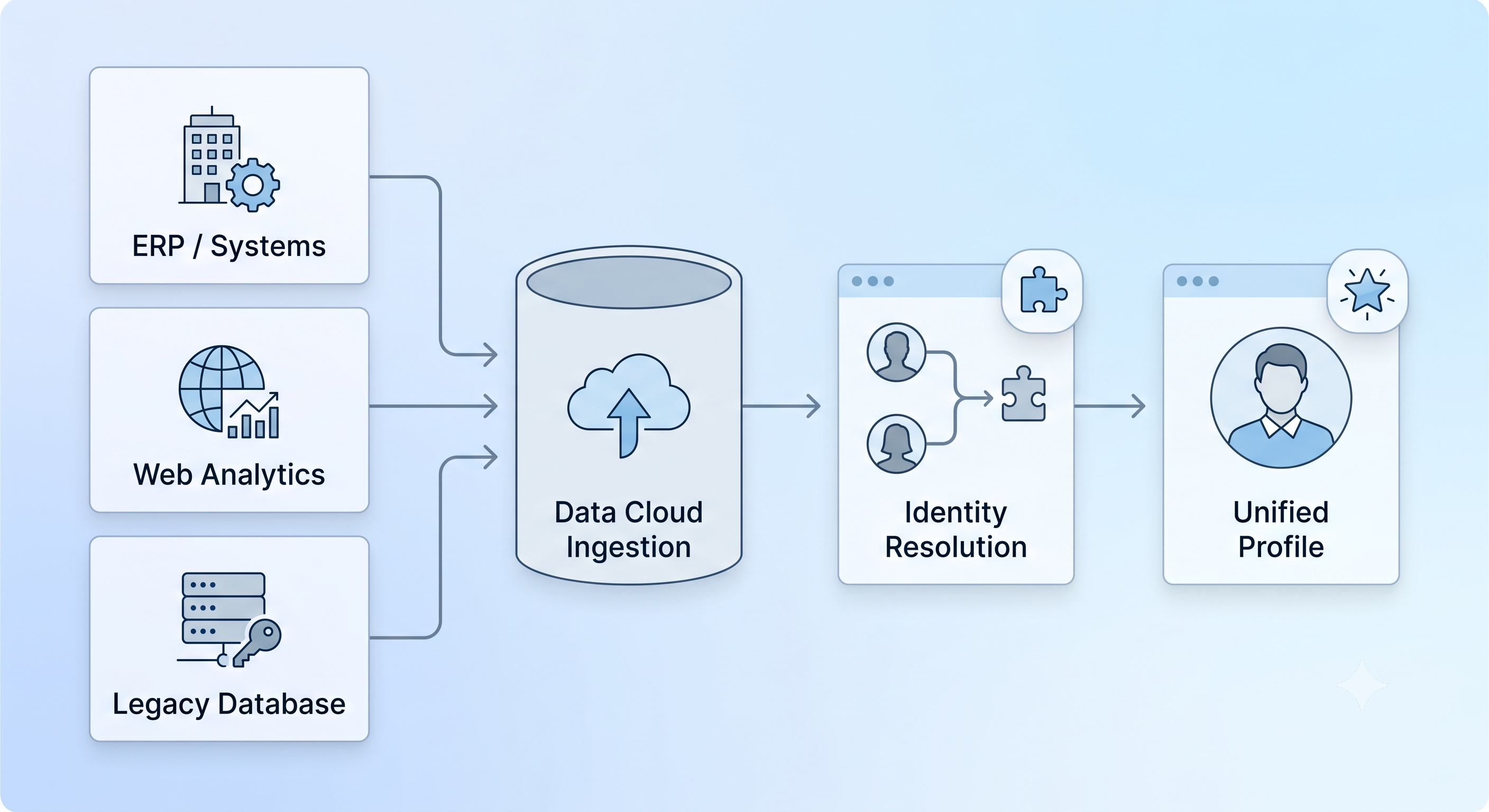
Ingestion: High-speed connectors funnel the data into the data lakes in such a way that there is no impact on the core CRM system performance.
Harmonization: Mapping of data occurs using the standard Cloud Information Model (CIM) for different fields like cust_id, client_no, and user_identifier.
Identity Resolution: Matching attributes (matching hashes or phone numbers, for instance) help in merging data sources and forming a unified customer view.
Activation: The customer’s unified view becomes available immediately to core systems where the service cloud or sales cloud can leverage it.
Extensibility: Declarative v/s Programmatic Development
The platform provides an easy way to do things with customizable development environments, where customisation does not become an architectural problem. To gain these statuses, professionals frequently choose to learn salesforce admin course online from the ground up by OnlineITGuru.
Declarative Development: Non-operators use visual tools to work for business logic. Software like salesforce flow help users to make their workflows, validations, and record manipulations through visual means, without writing a single line of code.
Programmatic Development: When it comes to business logic that is beyond the scope of declarative development, the developers leverage programmatic tools:
Apex: An object-oriented and statically-typed language like Java that executes natively within the Salesforce platform.
Lightning Web Components (LWC): An architecture UIs which is fast and modern who is relies on web standards.
4. Agentic AI: From Einstein to Agentforce
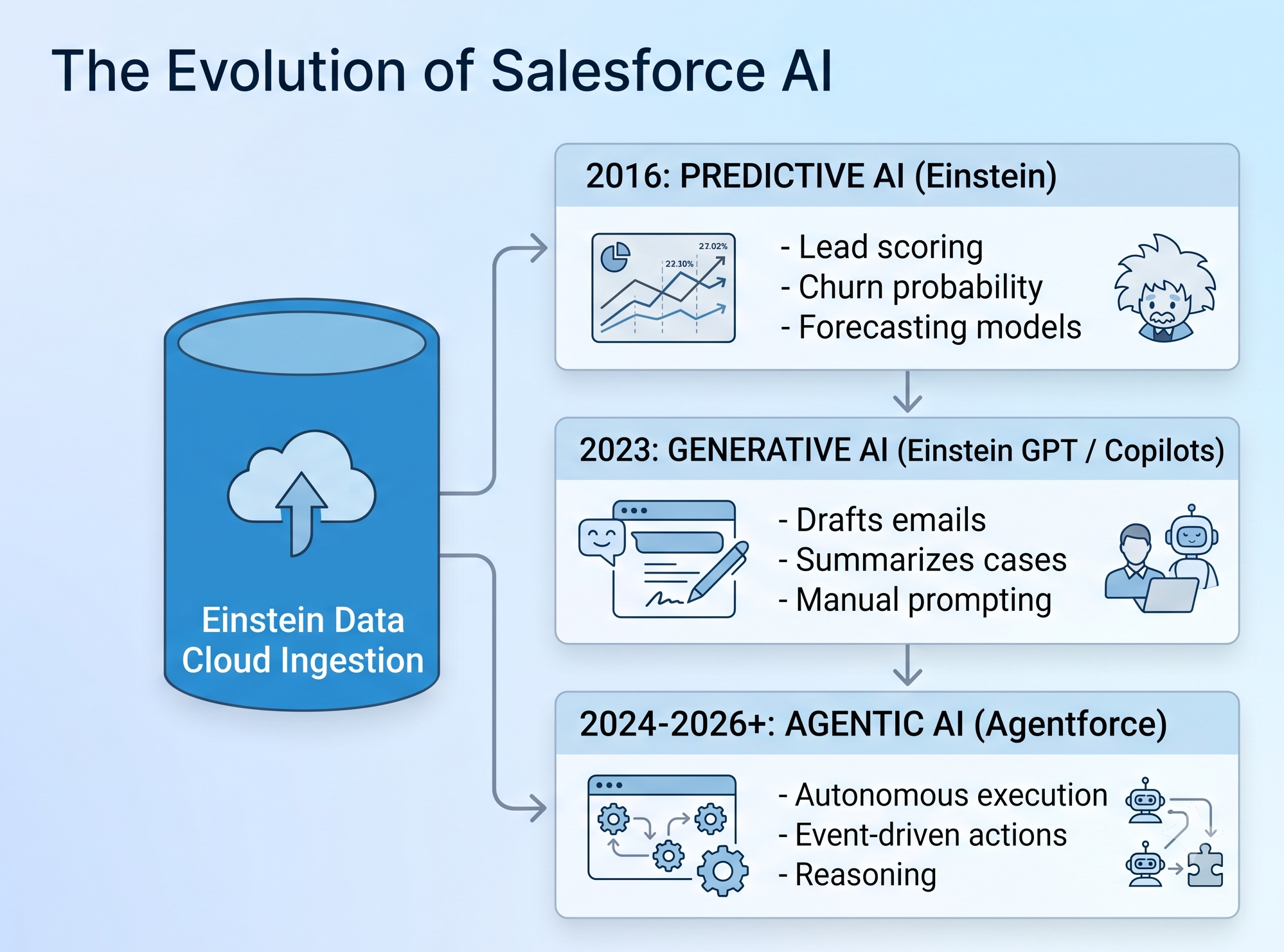
Artificial Intelligence in the Salesforce platform is not limited anymore to simple statistical analysis and generation of prediction text. The whole scene has moved from being predictive and providing help through copilot bars to agentic AI systems based on Agentforce.
Agentforce and Autonomous Agents Overview
In contrast to the traditional approach to developing chatbots using fixed decision trees, and copilots that always need human intervention, Agentforce offers a solution with totally autonomous digital workforces. These artificial intelligence agents observe system activities, evaluate intentions of the client, and perform complex actions automatically.
Developers do not write a regular script for the agent but only provide it with:
Role and Purpose: for example, “Manage returns of the corporate product and provide a refund according to the worldwide policy.”
Trusted Context (Data Cloud): this is the access to purchase history, past support tickets, and communication records.
Guardrails and Governance: guardrails set rules on what the agent can and can't do automatically.
Tools for Actions: Flow workflows, Apex classes, or any external APIs that the agent can use when it deems necessary.
Agentforce Reasoning Engine in Motion
When a customer reaches out to an organization about returning the purchased product, the Agentforce engine performs an analysis of the incoming message via natural language processing techniques. Rather than composing a standard text reply, the reasoning engine identifies the proper instruments required to solve the problem.
It may automatically launch a Flow that will assess the inventory at warehouses, perform regional cost calculations for shipping, compose a paid shipping label via API of a third-party shipper, and register all activities in the internal CRM return management system. In cases where the received message does not conform to the established corporate policies, the agent hands off the interaction to a live operator along with the comprehensive description of the performed actions.
5. Implementation Plan, Governance, and Technical Hygiene
Deployment of enterprise-level cloud architecture requires adherence to strict engineering practices. Since Salesforce is so pervasive in sales, support, and financial systems, any ad hoc changes may have significant effects on operations.
Application Lifecycle Management (ALM)
Enterprise organizations leverage advanced DevOps philosophies for managing change through ALM. The usual lifecycle process involves traversing:
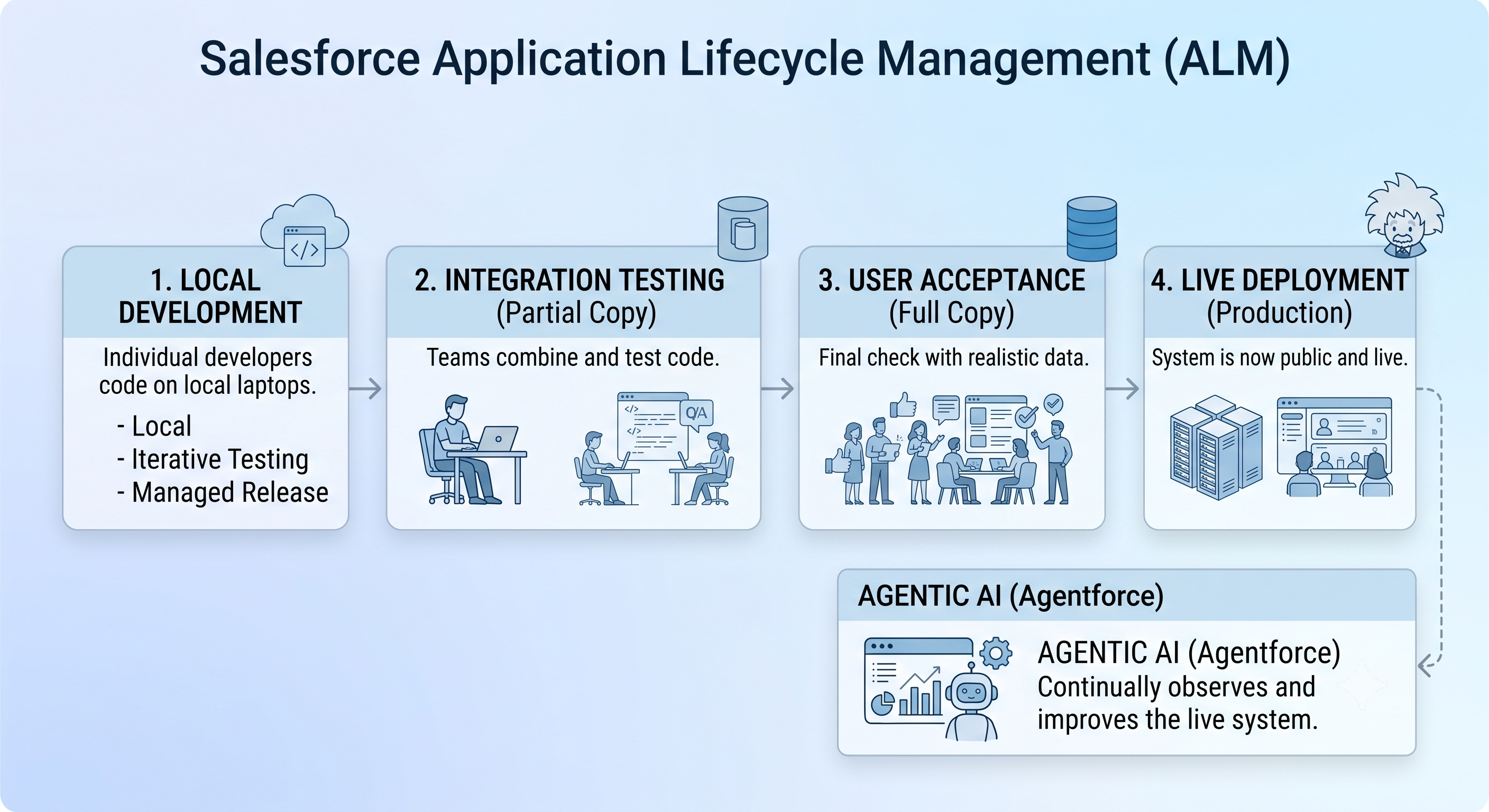
Scratch Orgs & Developer Sandboxes: Software developers code and implement declarative components in an environment which does not have any live customer data.
Source Control (Git): Metadata is captured for all changes made to the system and placed in a centralized source control repository.
Continuous Integration / Continuous Deployment (CI/CD): The automation process of deploying helps validate custom code to system architecture through the execution of unit tests when code is deployed to verify that code deployment does not have an impact on functionality of the platform.
User Acceptance Testing (UAT): Changes are deployed to a Full Copy Sandbox where the exact copy of the production environment is replicated to help validate changes.
Techniques for Managing Technical Debt and Customization Risks
Due to the ability of the platform to allow for adding of custom fields, validation rules, and automation processes easily, the platform can get a lot of technical debt if it is not managed properly. Automations that are redundant and are aimed at the same data objects may cause system issues such as database locking and slower loading of pages.
In order to keep the system healthy, platform designers should adopt good governance techniques. Advantage of inherent abilities of the software before actually coding is an essential development in any complete salesforce admin training online course. Architectural considerations would do well to rely upon the inherent abilities of the platform rather than depend too much on programming code.
Only a single automation can be applied to everything.: Updates to backend records must be controlled using one design approach like Salesforce Flow or Apex Trigger Design Framework to control the order of execution of the process.
It is important that occasional metadata cleanup to performed for the project of eliminating carbon copy custom objects, validation processes, and unnecessary user profiles.
This analysis system will implicate using the potential of the platform instead of complete complex programming.
6. Security, Trust, and Compliance in the Era of AI and Big Data
With businesses increasingly looking to store all their operational data in one place and implementing autonomous agents, security and compliance become an absolute necessity. As Salesforce is a system that stores sensitive customer data (including PII, payment data, and health history) within its architecture, Salesforce employs a multi-tiered security approach, designed to build trust and facilitate business innovations.
Shield Platform: Advanced Encryption and Auditing
Businesses operating in very regulated industries, such as healthcare, banking, or public sector industries cannot rely on standard cloud security controls. To cater to the needs of such industries, Salesforce provides special tools called Salesforce Shield. Salesforce Shield consists of three main elements:
Platform Encryption: Contrary to the conventional encryption at rest, this product allows enterprises to perform encryption of sensitive fields (such as SSN numbers, credit cards information, or health information) while keeping all the platform features functional.
Event Monitoring: This tool enables the security team to get visibility into user activity in terms of what exactly they are doing inside the application, i.e., who downloaded the report, from which IP addresses which specific records have been accessed, and when export tasks were launched by the users. This helps with proactive detection of threats and real-time security audit.
Field Audit Trail: The solution enables businesses to track how the data life cycle is developing and changing for up to 10 years, thus giving a tamper-proof ledger of data changes that becomes essential when dealing with very stringent requirements, such as HIPAA, GDPR, or Sarbanes-Oxley (SOX).
The Einstein Trust Layer: Governing Generative and Agentic AI
The transition towards generative AI and autonomous agents requires the organization to solve new security challenges because there is a need to guarantee that the company's internal confidential data will not be used to feed public large language models (LLMs) and train external neural networks.
Here Salesforce provides the solution in the form of the Einstein Trust Layer.
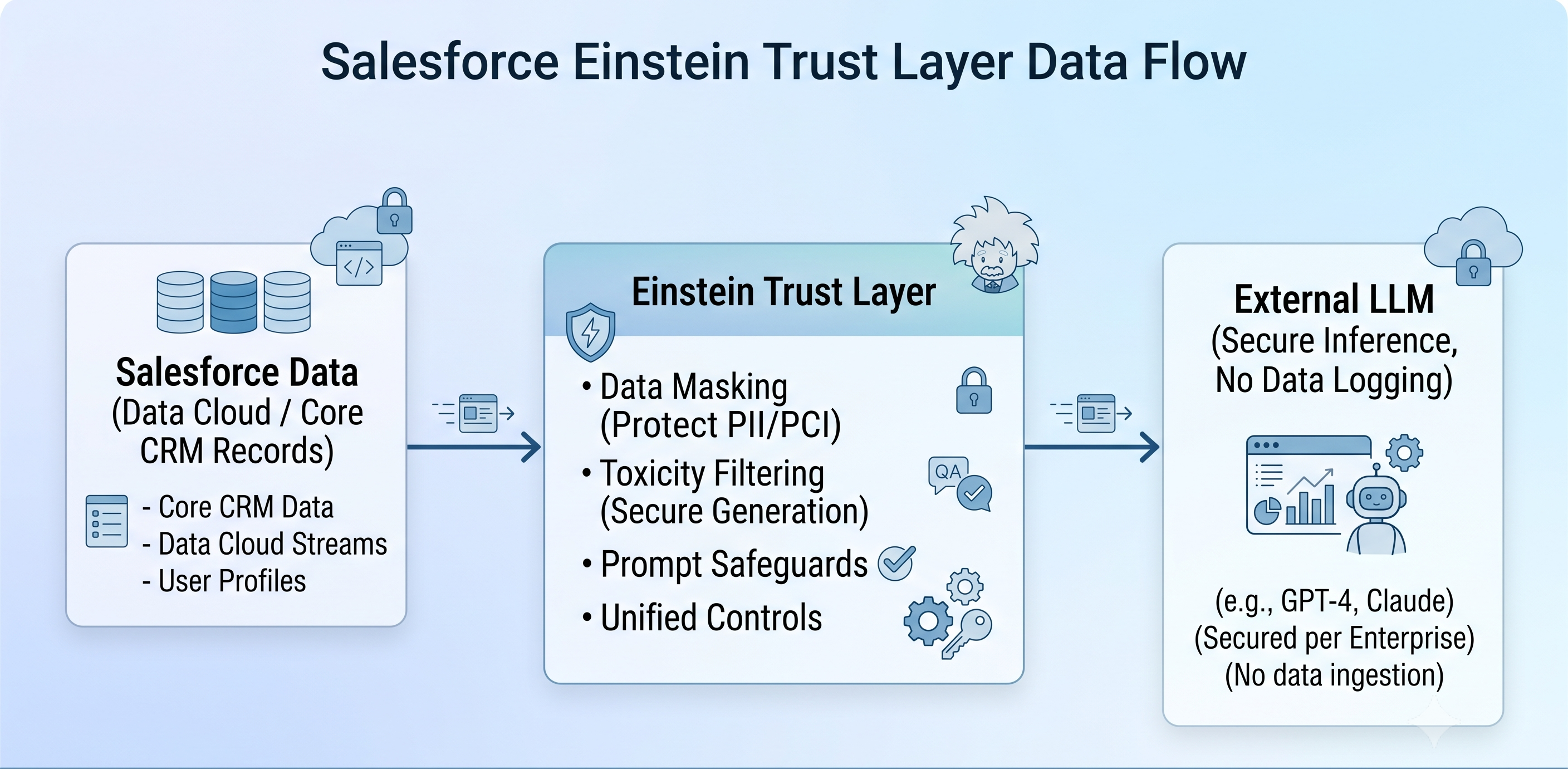
When a request for content creation by an LLM is made by an autonomous agent or process, the Einstein Trust Layer will intercept the data payload and implement various safeguards on it:
Data Masking: It detects PII, replaces names, addresses, and phone numbers with anonymous tokens prior to transmitting the request outside the corporate environment.
Secure Inference: The data will be analyzed within a secure environment where third-party LLM vendors are prohibited from keeping user data to train models outside their contractual agreements.
Toxicity Detection and Auditing: After the response is returned, the trust layer analyzes the output for potential toxicity, bias, or hallucinations, logging the interaction for security review.
Through implementing all of these guardrails within the platform itself, enterprises can now deploy autonomous agents that can interact with customers in a complex manner without compromising their security, data privacy, and customer trust.
Conclusion: The Modern Enterprise Operating System
Salesforce has come a long way from being just another simple digital Rolodex. By grounding its technology stack on a powerful multi-tenant core, branching out into multi-cloud, and leveraging real-time data orchestration with the help of Data Cloud, Salesforce has proven itself to be an indispensable operating layer for modern enterprise companies.
Adopting agentic AI means a total rethinking of how companies scale their workflow processes and manage relationships with customers. Rather than serving just as a passive system of records which demands continuous data entry, Salesforce is turning into an intelligent agent that will be able to orchestrate data, automate processes, and manage customer experience autonomously. For modern enterprises, using Salesforce becomes not only about selling; it becomes about building an efficient, data-driven, and fully automated operation backbone for future growth.
In order to guide your team through this challenging terrain and equip them with these architectural skills, considering salesforce admin training online programs from OnlineITGuru can provide you with the required training programs and guidance to prepare for building an enterprise backbone.