
The Role of Data Modeling in Data-Driven Decision Making
Last updated on Jun 10, 2026

W.r.t the time, organizations were getting large amounts of data such as customer interactions, sales transactions, social media platforms, enterprise applications and IoT devices. Today the Data is more accessible than ever before, but extracting insights from raw information to drive business decisions is still a challenge. This is where data modelling comes in. Data modelling is defined systematic way of describing, managing, and analysing data. It helps organisations to make informed decisions, based on accurate and reliable information.
Across industries, data driven decision making has become a strategic imperative for businesses. “Companies can use data to identify trends, increase operational efficiency, understand customer behavior, mitigate risks, and gain a competitive advantage. But the quality of the decisions depends a lot on the quality and structure of the data under it.” Without a robust data model, a company could be vulnerable to inconsistent information, duplicate records and inaccurate reporting.
Data modeling is the visual development of data structures and their relationships for a system. This is the basis for databases and data warehouses . This Data modelling ensures data is stored efficiently and can be retrieved when necessary. Conceptual, logical and physical data models give organizations a bridge between business requirements and technical implementation.
A Good data models allow for easy data integration from different systems . This provide stakeholders with consistent and accurate information. Moreover, It also provides scalability, allowing organizations to scale their data infrastructure as their business needs evolve. The more companies rely on analytics, artificial intelligence and machine learning technologies, the more they need good data modeling.”
By investing in data modeling, companies can improve the accuracy of their reporting, strengthen their data governance, and streamline their decision-making processes. By linking disparate data sets, organizations are able to see how they operate in full, providing confidence to their leaders when making strategic decisions.
The demand for data professionals with skills is rising and many are joining Data Base Modeling Course to learn database designing, data architecture and analytics skills. These training programs equip professionals with the practical skills to be valuable contributors to successful data-driven initiatives and to help organizations thrive.
Data Modeling and Decision Making Based on Data
Data-driven decision making is now an integral part of modern business strategy. Today’s organizations are collecting massive amounts of information about customers, employees, partners and operations systems. But data collection is not enough. Systematic approach is needed by the businesses to manage, control and analyze the information efficiently. Here is where data modeling can help a lot.
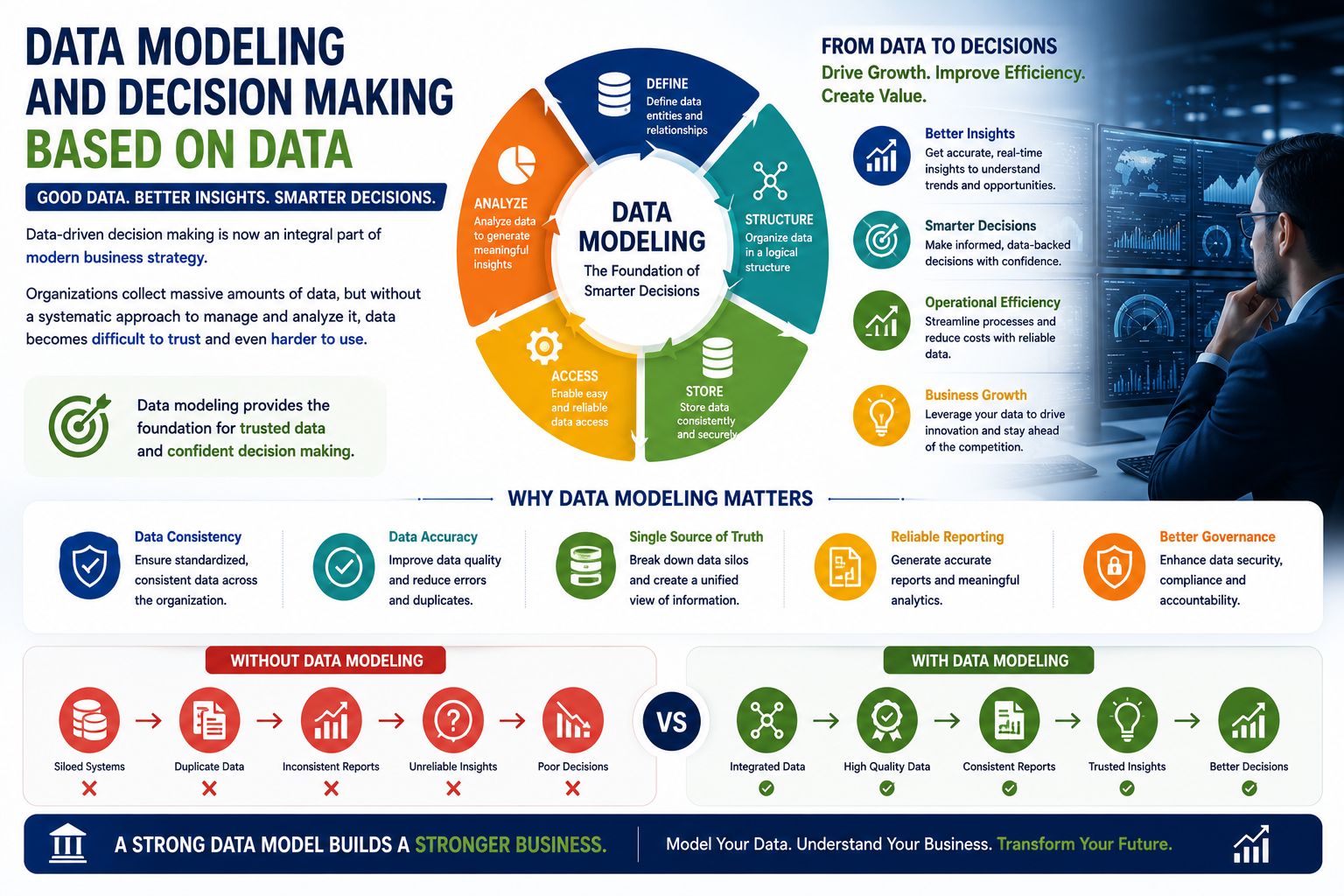
Data modeling is the process of defining how data is stored, connected and accessed across an organization. It helps to ensure that data is consistent, accurate and available for reporting and analytics. Without good data modeling organizations often end up with siloed systems, duplicate data, inconsistent reports and unreliable insights. A solid data management architecture enables organizations to harness the power of data to make strategic decisions that drive growth, efficiency and innovation.
Improved data consistency across the organization
One of the biggest benefits of data modeling is that it can help make data more consistent. In many organizations data is spread across many systems, databases and applications. Different departments may use different names for the same information, have different formats and different definitions. Such non-standardization can lead to confusion and reporting errors.
Data modeling is the description of the business entities, their attributes and relationships. All organisations are using the same data because the data structures are standardised. Customer records, employee data, product information etc can be maintained consistent across different departments and systems.
Consistent data increases confidence in business reports and analytics. The information they are getting is reliable to the decision makers since it is coming from a standardized and well-structured data environment. This allows organizations to make more accurate strategic decisions and reduce risks from bad quality data.
Improving Data Integration Across Systems
Modern businesses use several software applications to run their operations. Customer relationship management systems, enterprise resource planning platforms, financial applications, supply chain tools, human resource management systems all generate valuable data. But these systems often operate in isolation, creating data silos.
Data modeling is the way organizations combine information from disparate sources into a common framework. Data models describe the relationships between different data sets . They make it easy to move data from one system to another . This integration gives you a high-level view of your business operations and saves you the effort of consolidating data manually.
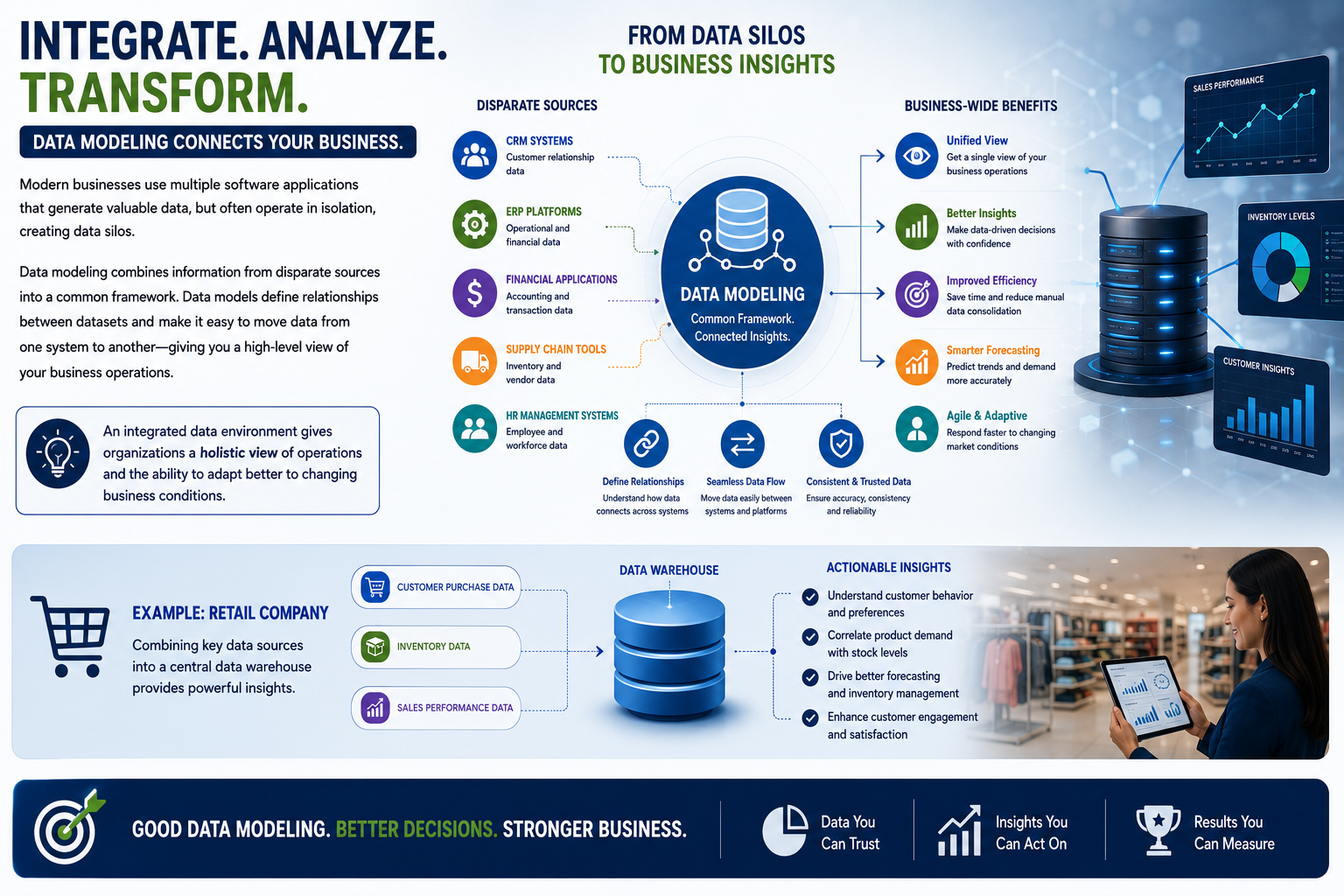
For example a retail company could combine customer purchase data inventory data and sales performance data into a central data warehouse. Good data modeling helps decision makers understand how customer behavior correlates with product demand and stock levels. “These insights are helping to drive better forecasting, inventory management and customer engagement strategies.”
An integrated data environment gives organizations a holistic view of their operations and the ability to adapt better to changing business conditions.
Making Business Analytics and Reporting Better
Business intelligence and analytics rely on well structured data. Organizations use dashboards, reports and analytical tools to track performance and trends and to assess business results. The quality of these insights is directly proportional to the quality of the underlying data structure.
Data models are designed to make it easy to store and retrieve data. They allow analytical systems to extract information and generate accurate reports. So, how do we build a data structure for data reduction and performance improvement for queries? This is where data modelling comes into play.
Advanced analytics efforts are also supported by well-designed data models. Well-structured data can do better trend analysis, predictive modeling and performance monitoring in organizations. Real-time insights for executives and managers for informed decisions.
A financial institution can model the data of their customers’ transactions, find out the spending pattern and detect the fraudulent activities. Structured data provides healthcare organizations a way to improve patient outcomes and the use of resources.
Analytics are used to gain competitive advantage, and so data modeling is becoming more and more critical to successful reporting and decision making strategies.
Facilitating Scalability & Future Growth
With growth comes more data, and more complex data, for organizations. New products and services, customers, and operational processes add more information that must be well managed. Without a scalable data structure, companies can suffer from performance and operational inefficiencies.
By creating databases and data warehouses that can handle growing data volumes, data modeling lays the groundwork for scalability. Good models allow an organization to scale its system without losing performance or data quality.
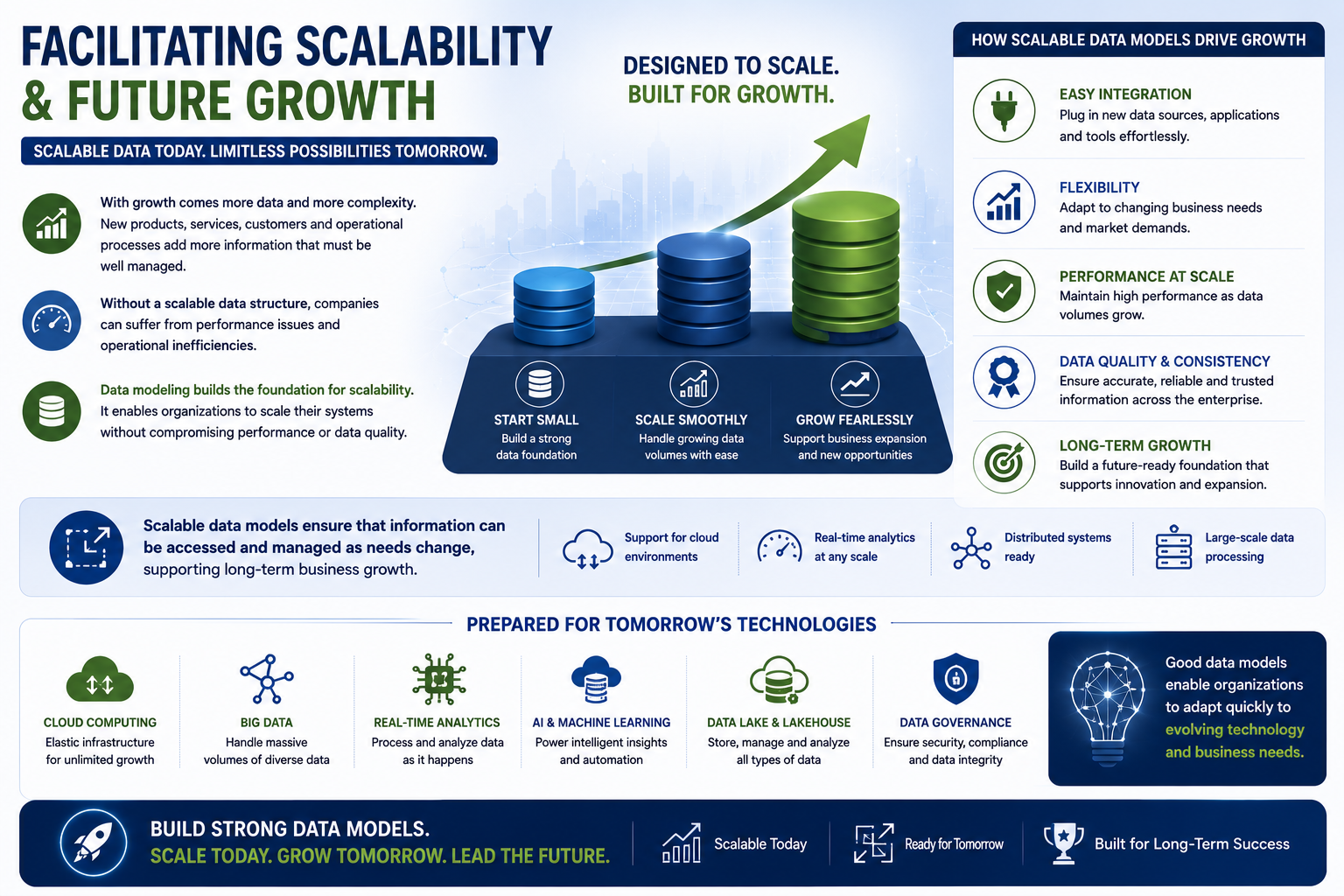
Scalable data models ensure that information can be accessed and managed as needs change, allowing for long-term business growth. This allows organizations to plug in new data sources, applications and analytical capabilities without disrupting existing processes.
Cloud computing and big data technologies are evolving fast and there is an increasing need for scalable data architectures. In the modern business environment, data models have to be flexible enough to support distributed systems, real-time analytics and large scale data processing environments. Good data models enable organisations to react to these changing technology demands.
Data Modeling Training Skill Building
Data driven decision making is more and more important. There is a lot of demand for people who know how to do data modeling. Companies are looking for people who can build robust data structures, support analytics initiatives and maintain data integrity across enterprise systems
This is what many professionals are looking for by opting for Data Modelling Course programs. The training programs include entity relationship diagrams, normalization techniques, dimensional modeling, database design principles and data warehouse architecture.
Learners gain hands-on experience in designing and implementing data models to achieve business objectives through exercises and real-world projects.
Better regulatory compliance and data governance
Businesses must ensure that data is accurate, secure and compliant with industry rules.
Data modeling is an important part of governance initiatives because it provides sufficient documentation of data structures, relationships, and business rules. The visibility also helps organizations to maintain their data to be of high quality and to be accountable for information management.
Well-defined data models help with regulatory compliance by enabling classification and proper handling of sensitive information. Healthcare, finance, insurance and government have all strong rules for data privacy and security. “The ability to model data well allows organizations to operate efficiently and meet requirements.
Organizations can use data models to establish data quality controls, validation rules, and access management policies. These controls help reduce the risk of error, unauthorized access and non-compliance.
Informing strategic decisions
Data modeling provides an organized and integrated view of organizational data for decision makers to better understand business operations. All types of data driven decisions whether it is customer behaviour analysis, supply chain optimisation, financial performance improvement or innovation initiatives all have data modelling as an integral part.
Organizations that embrace robust data modeling techniques are more agile to market changes, improve operational performance, and drive long-term business success. As data becomes more important, data modeling will be a critical part of helping organizations turn data into intelligence.
Conceptual Data Model
Data modeling is a process and conceptual data modeling is the first step of this process. It concentrates on the identification of high-level business entities and the definition of relationships among them. The emphasis here is more on business requirements, and less on the technical implementation details.
Conceptual models are a simple view of an organization’s data landscape. They help the stakeholders to understand how different business entities like customers, products, employees and transactions interact with each other. Conceptual models are easy to grasp and allow for good communication between business leaders, analysts, and technical teams.
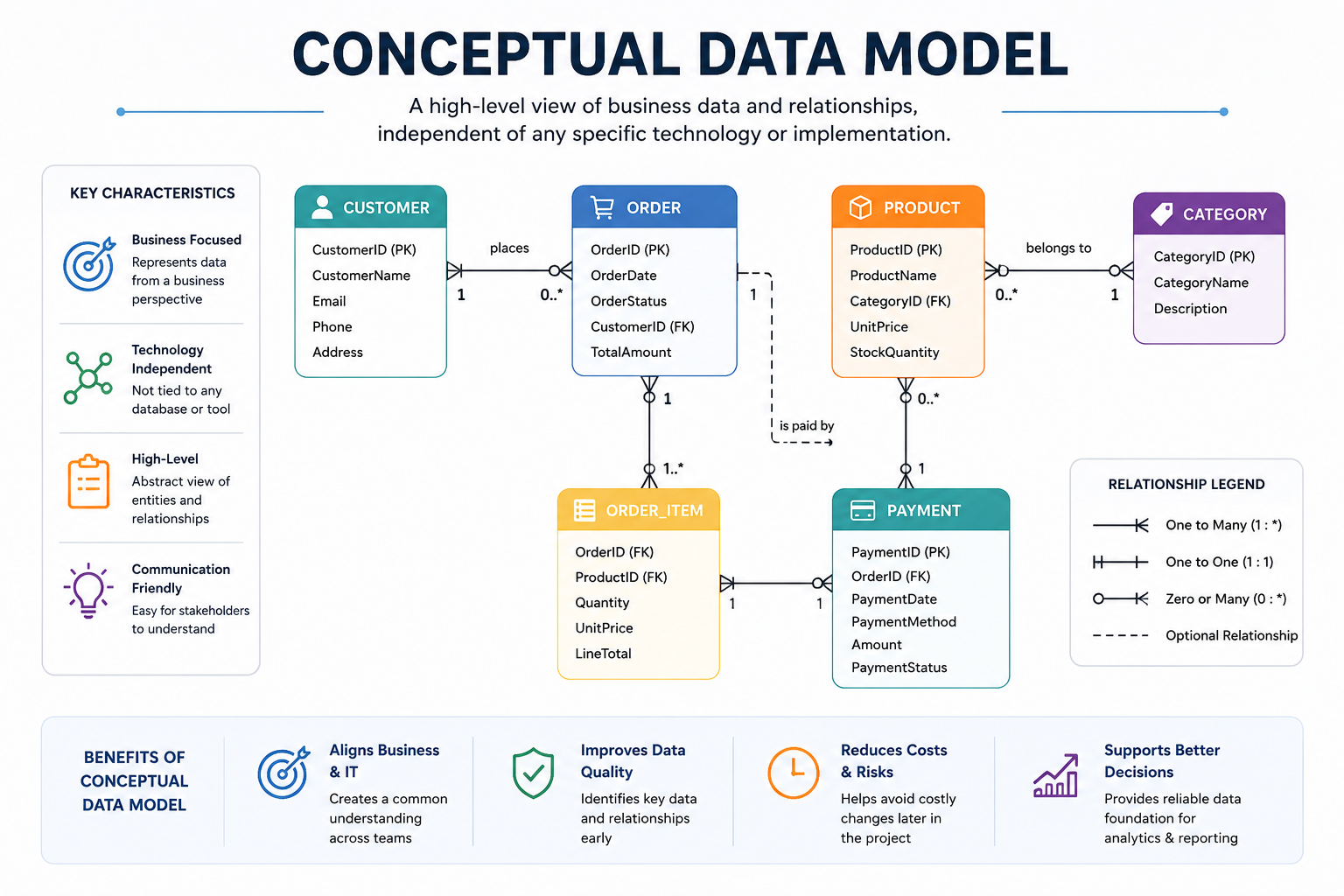
Conceptual Data Models are often used by organizations to help in the planning phase of projects to make sure that data projects are aligned with business objectives. This clear description of the requirements for business information provides a good basis for the following phases of modeling.
Logical Data Modeling
The logical data model is an extension of the conceptual model. It’s more detailed, more accurate. In this phase, the specific characteristics, relationships, business rules and data constraints are defined that will specify how information should be managed.
Logical models connect the business requirements to the technical implementation. They define the structure of the data in a way that is independent of any specific database technology. It enables organizations to be flexible with technology platforms and concentrate on accurate representation of business processes.
For example a logical model could specify customer information like customer id, name, address, email and purchase history; and the relation between customers and orders. These details are provided by logical models and enable data to be organized in a way that satisfies reporting, analytics and operational needs.
Good logical data modeling helps organizations to eliminate ambiguity, improve data consistency, and create a structure for effective data management.
Physical Models of Data
The last step in the data modeling process is physical data modeling. It takes logical models and converts them into database-specific implementations that can be deployed in an organization’s technology environment.
The second step is to define the tables, columns, indexes, storage structures, primary keys, foreign keys, and performance optimization methods. Physical data models take into account the technical specifications of database management systems and ensure that data can be stored and retrieved efficiently.
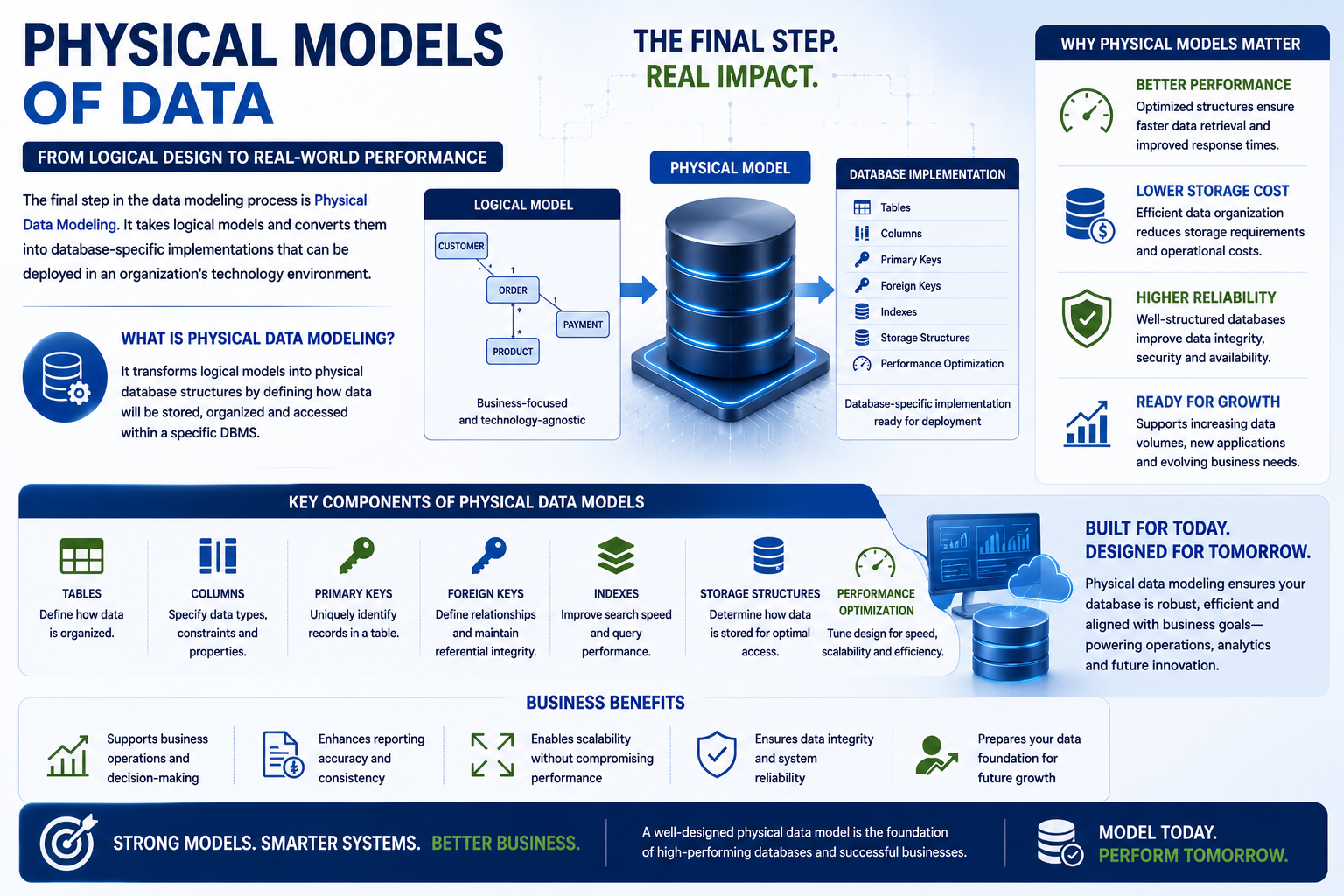
A good physical model improves the performance of the database, reduces cost of storage and improves reliability of the system. Physical data modeling helps organizations ensure that their databases can support business operations, reporting needs and future growth.
The value of normalization
A further important data modeling issue is normalization. Normalization is a process of organizing data in such a way that it reduces redundancy and improves data consistency. Normalization reduces redundancy of data, which increases the integrity of data and reduces the chances of data inconsistency.
For example , normalization avoids repeating customer information in multiple tables . Instead , it creates a separate customer table that can be referenced when required . That helps in maintenance and also ensures that the updates are consistently reflected across the database.
In some analytical environments, denormalization is used to enhance reporting and query performance. Whether you normalize or denormalize depends on the business and technical requirements.
Analytics Dimensional Modeling
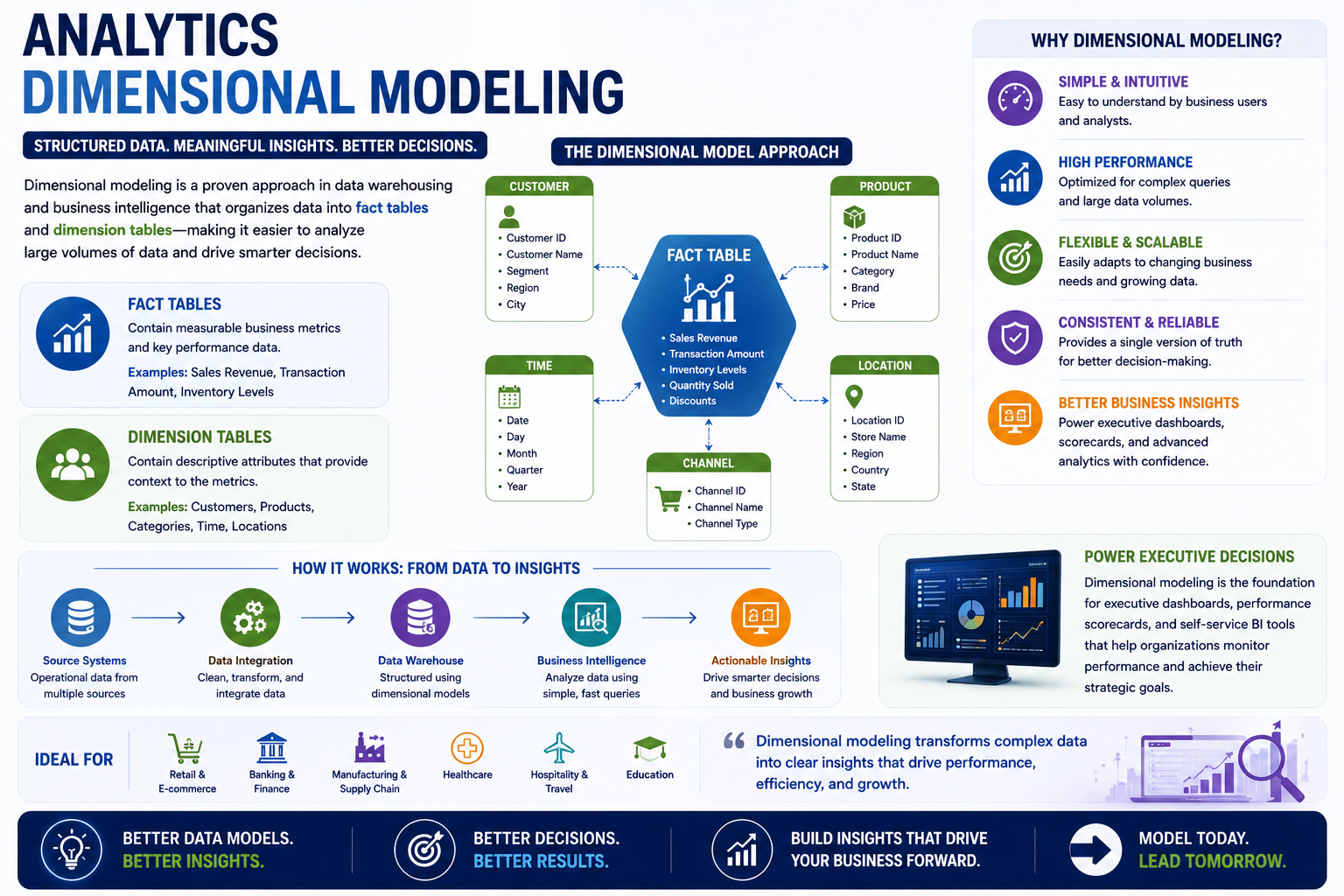
Dimensional modeling is a common approach in data warehousing and business intelligence projects. This method organizes data into fact tables and dimension tables. It is easier to analyze large amounts of data.
Fact tables hold quantifiable business metrics such as sales revenue, transaction amounts, or inventory levels, while dimension tables hold descriptive information such as customer details, product categories or time periods.
For many organizations, dimensional modeling is a popular means to support executive dashboards, performance scorecards, and business intelligence solutions.
Fostering Collaboration and Career Development
Data modeling also improves the collaboration between business and technical teams. Entity relationship diagrams (ERDs) and other visual tools help stakeholders understand the data structures and relationships to ensure that everyone is aligned on the business needs.
Data modelling professionals are in high demand as organisations continue to invest in analytics, cloud technologies and digital transformation initiatives The Data Modelling Courses will provide you with practical experience of database design, modelling techniques and use of industry standard tools.
Data Modeling: Future and Job Opportunities
As more organizations adopt digital transformation and data-driven business practices the future of data modeling is increasingly important. Technologies like artificial intelligence (AI), machine learning (ML), cloud computing, big data analytics and Internet of Things (IoT) are generating volumes of information like never before. Businesses are gathering and analyzing more data than ever before, and as a result, structured, scalable, and efficient data architectures are becoming critically important.
Data Modeling is the first step to manage the ever growing data ecosystem. It helps businesses structure information, correlate data sets, and create models to fuel reporting, analytics, and operational workflows. The skills of data modeling professionals are becoming a key enabler for organizations to transform raw data into valuable business insight as enterprise data environments become more complex.
The Effect of Cloud Computing on Data Modeling
The storage, management and analysis of data has been transformed by cloud computing. There is a trend in many companies to move from traditional on-premise systems to cloud-based platforms to increase scalability, flexibility and cost efficiency.
Today’s organizations have data scattered across hybrid or multi-cloud environments where multiple platforms and applications are used. Environments such as these require sophisticated techniques for modeling data for access and integration. Data modelers build architectures that satisfy data consistency, governance, and analytics needs across systems.
Cloud-native databases, data lakes and data warehouses require flexible data models to manage large volumes of structured and unstructured data. Good data modeling helps organizations get the most out of their cloud investments while still meeting their performance, security and compliance standards.
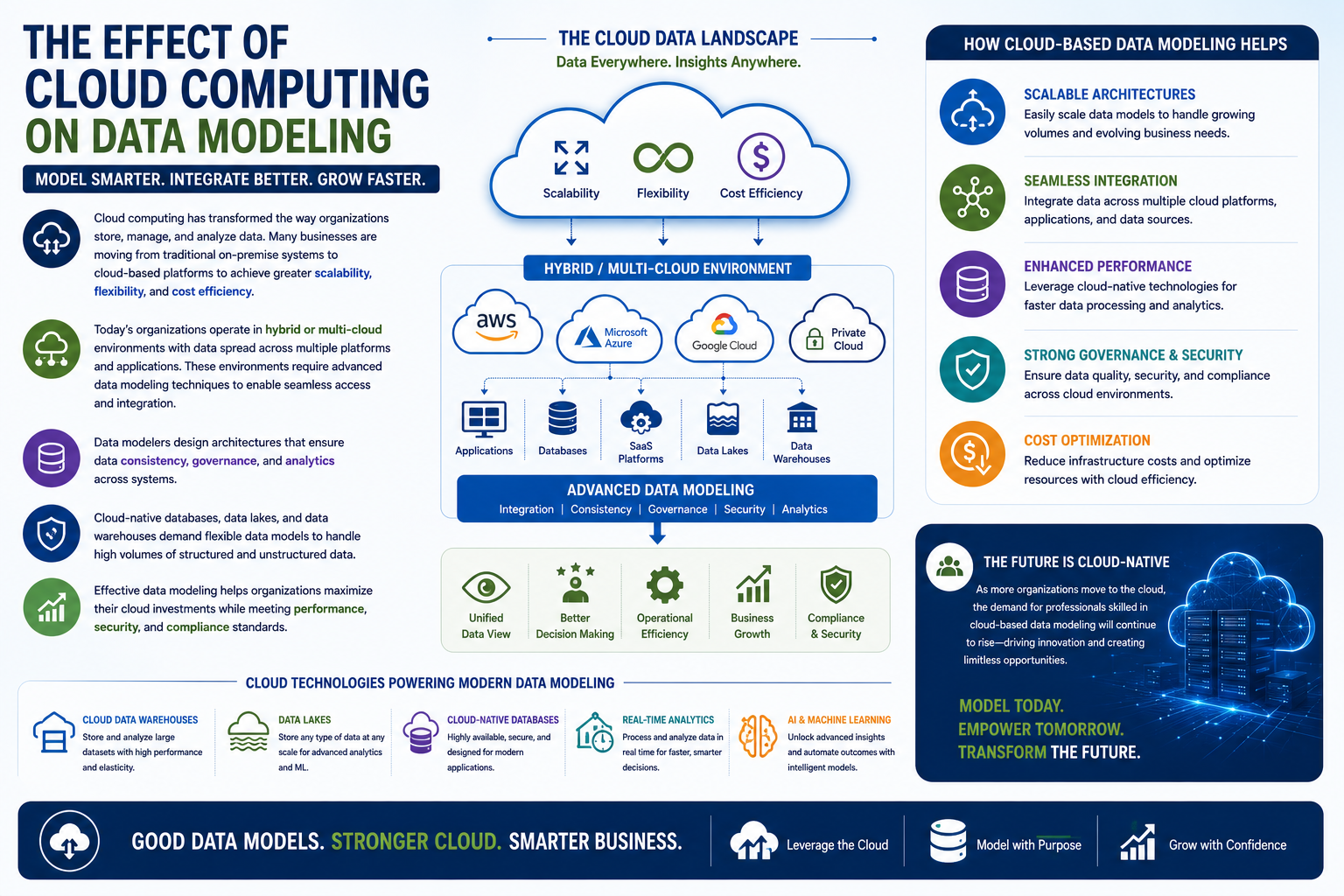
The trend of companies moving to the cloud continues and with that the demand for professionals skilled in cloud based data modelling will continue to grow.
Data Governance & Compliance is more critical than ever
Data privacy regulation and compliance around the world is getting tighter and tighter. Organisations should be transparent about how they collect, store, process and share data. “Failure to meet regulatory standards can lead to financial penalties, damage to reputation and operational disruptions.
Data modeling is an essential part to support your data governance efforts. Good data models make clear the data structures, ownership and relationships. This enables the enforcement of governance policies and compliance.
Data models assist organizations in enhancing the quality of their data, implementing security controls and identifying who is responsible for managing information. Data modeling will remain a vital tool in meeting evolving regulatory requirements and protecting sensitive data.
More chances to model data
Data driven business models are booming and created a huge demand for data modeling professionals. Across all industries, organisations need people who can design, manage and optimise enterprise data architectures.
Jobs available in this field are:
Data Architect
Database Administrator (DBA)
• Data Engineer
• Business Intelligence Analyst –
•Data Analytics
• Data Warehouse Development
• Information Architecture
* Analytics Consultant
These professionals help organizations improve data quality, support business intelligence efforts and build scalable data architectures. Some of the industries actively looking for qualified data modeling professionals include healthcare, banking, insurance, retail, telecommunications, manufacturing and technology.
Organizations are investing heavily in analytics and digital transformation projects and the demand for these skills will remain strong for many years to come.
Data Modelling Online Course for Skill Development
Those who are interested in making a career in this field can get valuable knowledge from a Data Modelling Training. “Online learning programs provide the flexibility for professionals and students to develop technical skills without a need to disrupt work or personal commitments.
Such courses usually deal with key issues including:
Fundamentals of Database Design
Entity Relationship Modelling (ERM)
Data Modeling (Logical and Physical)
Data Warehouse Design
Denormalization & Normalization
Dimensional Modeling
SQL & Database Management
Data Governance Principles
Best Practices in the Industry
Many online programs also feature hands-on projects and real-world case studies, allowing students to apply theoretical concepts to practical situations. This experience gives you confidence and prepares you for professional roles in data management and analytics.
Data modeling is the foundation for good data driven decision making. Data models also enable organizations to organize and structure information efficiently which can lead to better data quality, more efficient reporting, improved analytics and alignment with strategic business goals. As organizations speed up their digital transformation initiatives, resilient data architectures will become even more critical.
Data modeling is an important component of helping organizations derive maximum value from their data – from supporting advanced analytics and leading business intelligence initiatives to integrating enterprise systems. Learning data modeling can prepare you for a rewarding career and help your organization flourish in the fast-changing world of data.
Conclusion:
If you are a person who wants to learn industry-related skills to enhance your career, OnlineITGuru gives end-to-end training programs to teach you real-time knowledge and practical experience on data modeling concepts, tools, and best practices. With expert-led training and hands-on projects, learners can build the skills to succeed in today’s data-driven business world.