
The Salesforce Developer Guide to Meaningful Apex Testing Beyond Coverage
Last updated on Sep 25, 2026
The seventy-five percent code coverage imposed by Salesforce is not just a protective measure, but one of the most misunderstood aspects of the platform. Originally designed to keep flimsy code from ruining the shared service community, the regulation has resulted in the culture of superficial compliance. Developers write tests that, instead of pursuing real goals, simply seek to turn lines of code green to clear the deployment process. Assertions are absent, edge cases are skipped, and exceptions are caught in empty blocks just to make sure that the program continues to work. As a result, the code works without problems in production even if it collapses under real-life conditions.
Writing meaningful tests for Apex entails deliberately moving away from mere coverage-driven testing and towards the validation of behavior. A suite of tests must do more than simply running code, but it has to create a measurable behavior contract that will confirm that the system functions as intended under the normal conditions, degrades in case of failure, and is able to withstand large portions of data. By concentrating on three important principles of testing such as imitation of external HTTP integrations through realistic mocking, intentional provocation and assertion of custom exceptions, and corruption-free scaling of data using static resource loading, engineering teams can build resilient testing systems that allow for stable CI/CD building and delivery of solutions into production.
Breaking Free from the 75% Ceiling
The problem with the regular standard platform metric is that code coverage looks at execution, not correctness. A test method can execute every single line of code in an Apex class without it making sure that any calculation is indeed correct, that any record in the database is updated and so on. When teams focus purely on achieving certain percentage levels, they often write tests that are overly dependent on implementation details instead of expected outcomes. If a programmer refactors the code of an internal helper method or changes a private variable, part of the test would fail, but the overall business functionality will not be affected at all.
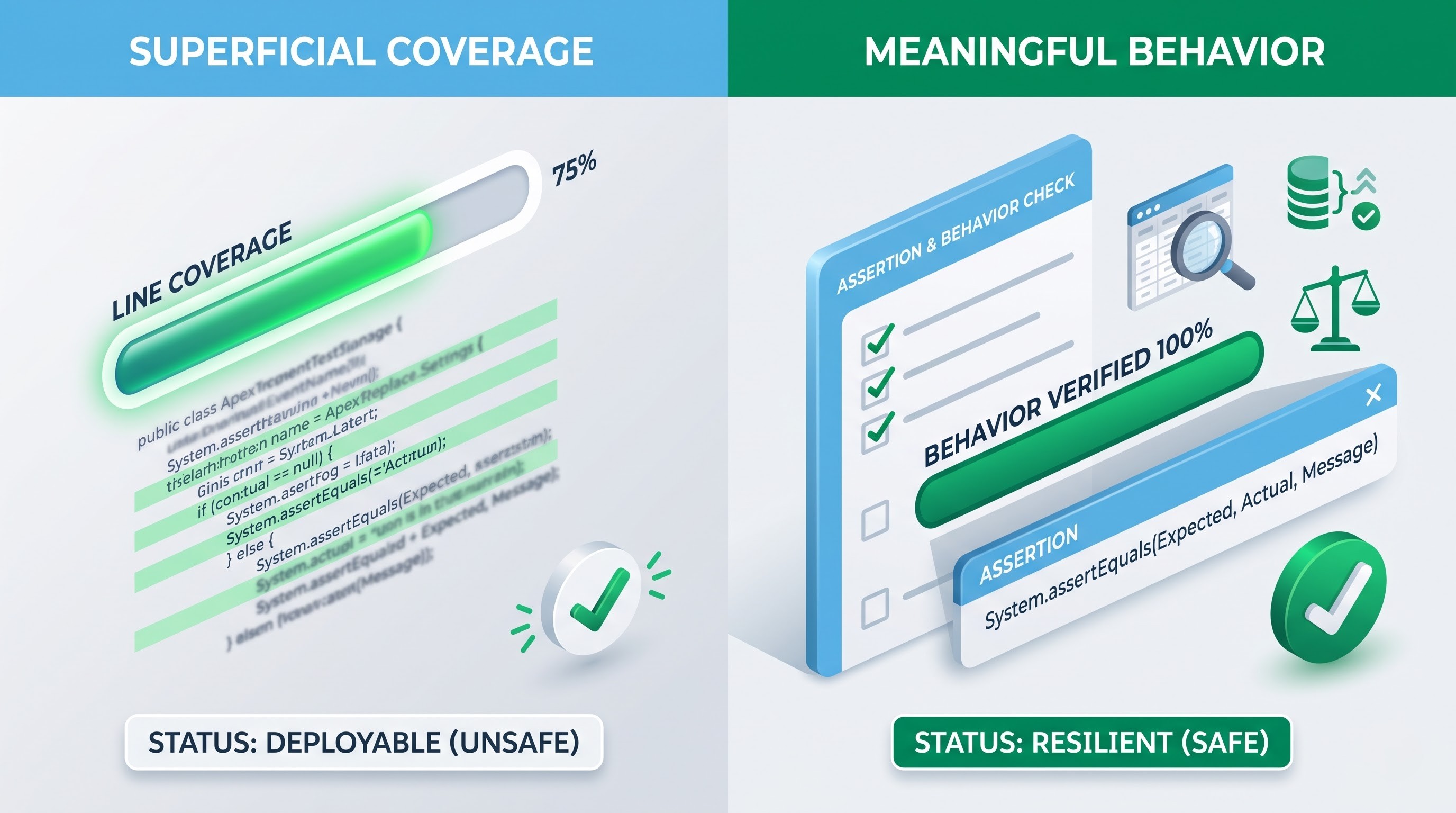
Effective testing is needed, meaning that every testing method must verify a hypothesis of the system. A well-designed test consists of three basic questions: What was the system state prior to performing an action? What exact action was performed? What proof is available that the state of the system after the action is the same as it should be according to documentation? Answering these questions demands strict assertions. The standard assertions library that the platform has must always be treated seriously. Each system test must check not only successful scenarios such as the creation of a record or a successful change of the status but also negative scenarios verifying the inability of unauthorized users to perform certain actions, the fact that invalid parameters are noticed, and no orphan documents are found in the system.
It should also be mentioned that resilience testing treats governor limits like architectural issues rather than overhead during runtime. Salesforce implements multi-tenant architecture in which code that works well in a sandbox can collapse under actual loads. In order to learn how to properly use this architecture, salesforce developers should take professional salesforce developer training online to take full advantage of the governor limits as design elements instead of surprises during runtime.
Architectural isolation and execution context
Before starting to work on complex mock-ups and external data loading, it’s critical to understand the boundaries of execution offered by the testing framework. The platform also has particular boundary delimiters meant to separate the lifecycle of a test into three major steps such as baseline data creation, performance step, and specification verification.
Once the test execution starts, it creates necessary data required during the execution in RAM and the isolated testing database. Due to the best practices in testing used nowadays, tests are not allowed to access live data from the production system, thus every record related to the testing scenario should be created specifically for it. Then upon creation of the baseline data, the test proceeds to the operational stage where it makes calls to the platform’s boundary methods. By invoking the execution boundary the platform does two important things: it makes the governor limits reset completely meaning such consumption of the database in the data preparation stage will not affect the logic being tested, and it forces all operations performed asynchronously (like jobs queued for execution, future calls and deferred operations) to run synchronously prior to closing it down.
When the boundaries are not properly defined, tests are unpredictable due to timing problems and limit exhaustion that hide real bugs. When business logic functions within its own dedicated boundary, assertions can be performed in a stable and deterministic state. The separation makes sure that in case of a failure, the real reason for it is obvious: the logic failed to provide expected outcome rather than being unsuccessful due to excessive query consumption by auxiliary trigger during setup.
Learning to Simulate External HTTP Callouts
In the present scenario, the implementation of modern technical enterprises lies right in the core of complex digital ecosystems involving payment systems and ERPs (Enterprise Resource Planning). The basic module of any advanced salesforce developer course online teaches how to create robust integration layers able to deal with numerous challenges such as limits of traffic usage, delays, and poor internet outcomes.
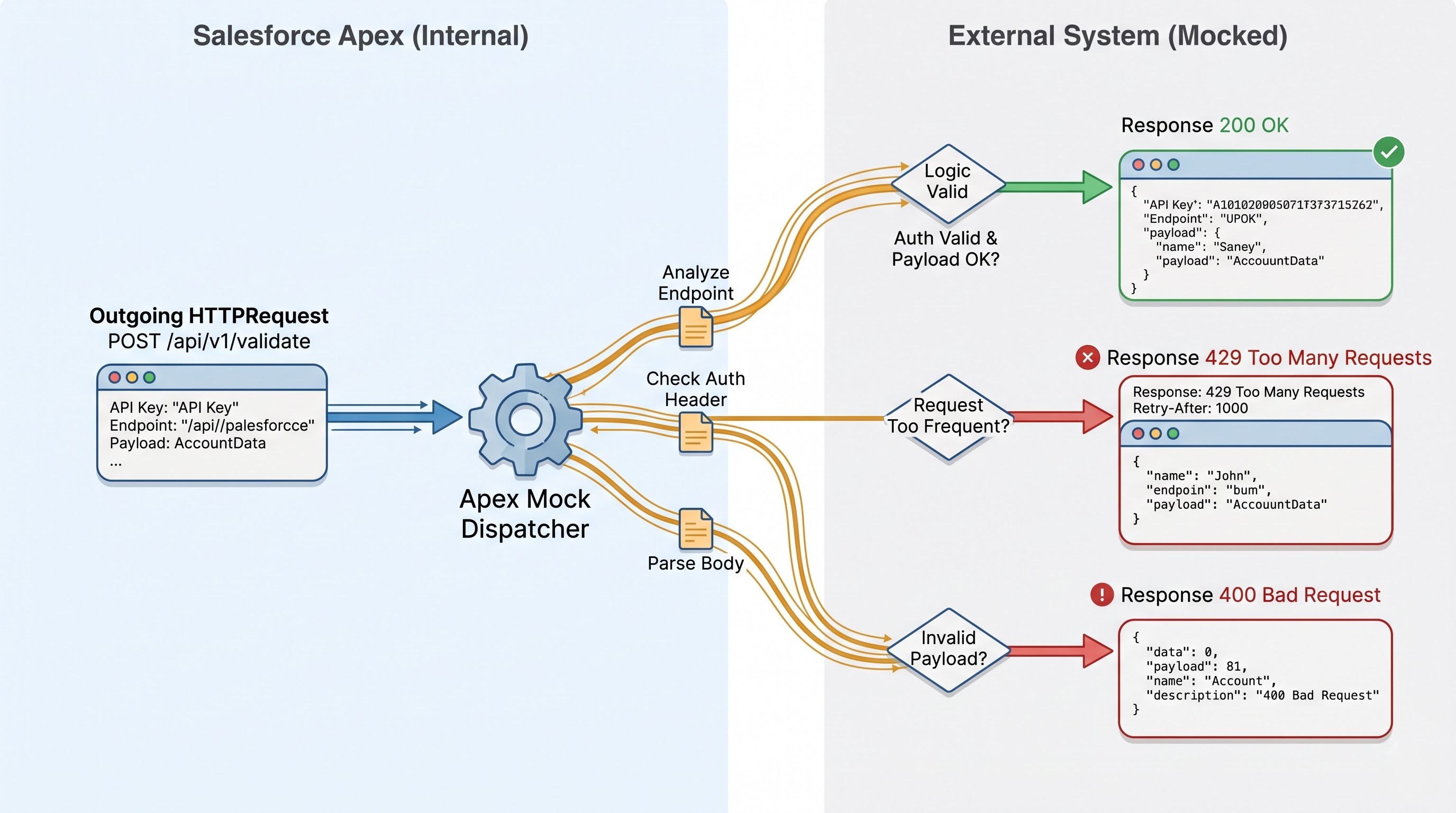
Nonetheless, developers often regard callout simulation as an unpleasant formality and create simple dummy classes that return a pure status code of "two hundred" and an empty response body. This technique satisfies the platform requirement to execute the callout line, but it renders the application completely defenseless against the chaotic reality of distributed networks. The resilient integration layer should not simply deal with smooth successes but also adapt to different dirty responses, transport is unresponsive, rate-limiting headers, and other internal server errors.
The Technique of Stateful and Dynamic Mocks
A good testing architecture does not use hard coded, single-return mock classes. Instead, it employs dynamic mocks, changing parameters on the fly during tests, or stateful multi-call dispatchers which analyze the incoming request and provide the answer.
In enterprise business processes, one single user action is likely to be followed by the series of outbound calls. For example, an account management process can call an identity verification service to confirm the position of the user, call an address verification service to normalize the geographic information, and call a financial system to make a billing entry. A basic mock that gives the same payload for each of the calls is bound to lead to errors in case of deserialization/validation of business principles in case of subsequent calls.
Dynamic dispatching mocks allow us to deal with the problem through the evaluation of outbound request parameters. The mock can check the endpoint URI, HTTP method, certain headers, e.g., authorization keys or content type, and the request payload. This information enables the mock to internally make the necessary calls and reply with different answers.
Initially, the mock will verify whether the outgoing request has been created correctly. A useful test not only checks what happens when a response is received, but also whether an outgoing request has the appropriate authentication headers, has been sent to the right service endpoint and has been serialized into the required payload as specified in the contract with an external party.
Then the dynamic mocks help developers create a response to edge cases that are too unpredictable to happen in real physical integration environments. For example, if a mock sends a client a status code of 429 describing that the request was rate limited, it allows a developer to carry out tests for retry attempts.
Thirdly, dynamic mocks are important since they create a perfect environment for testing the defensive parsing of APIs that change from time to time and may return unexpected nulls, when timestamps or error arrays are different than expected. If the developer uses faulty, truncated, or improperly structured payloads in response, he or she has the great opportunity to check if the Apex integration layer is able to catch the errors of parsing efficiently, to log the proper data into custom logging systems, and to provide human-friendly outlook in case of an error instead of leaving the user with an unexpected internal failure.
Custom Exception Testing and Defensive Ways of Execution
Real engineering mastery is shown by how safely an app goes down when conditions worsen. For a talented expert in online salesforce developer, creating deliberate negative tests and asserting custom exceptions is as important as developing the main business logic.
It is important for programmers to consider custom exception handling as part of design architecture. Custom exceptions denote any violations which occur in a given business environment. For example, an organization cannot proceed with an order due to a lack of stock, or a discount cannot be applied because the amount exceeds the upper limit set by the organization.
The composition of the negative test hypothesis takes a different approach as opposed to standard methodologies. In cases where customary testing is being done, the test asserts that the execution continues until the final lines of code of the method while confirming the absence of changes of the method state.
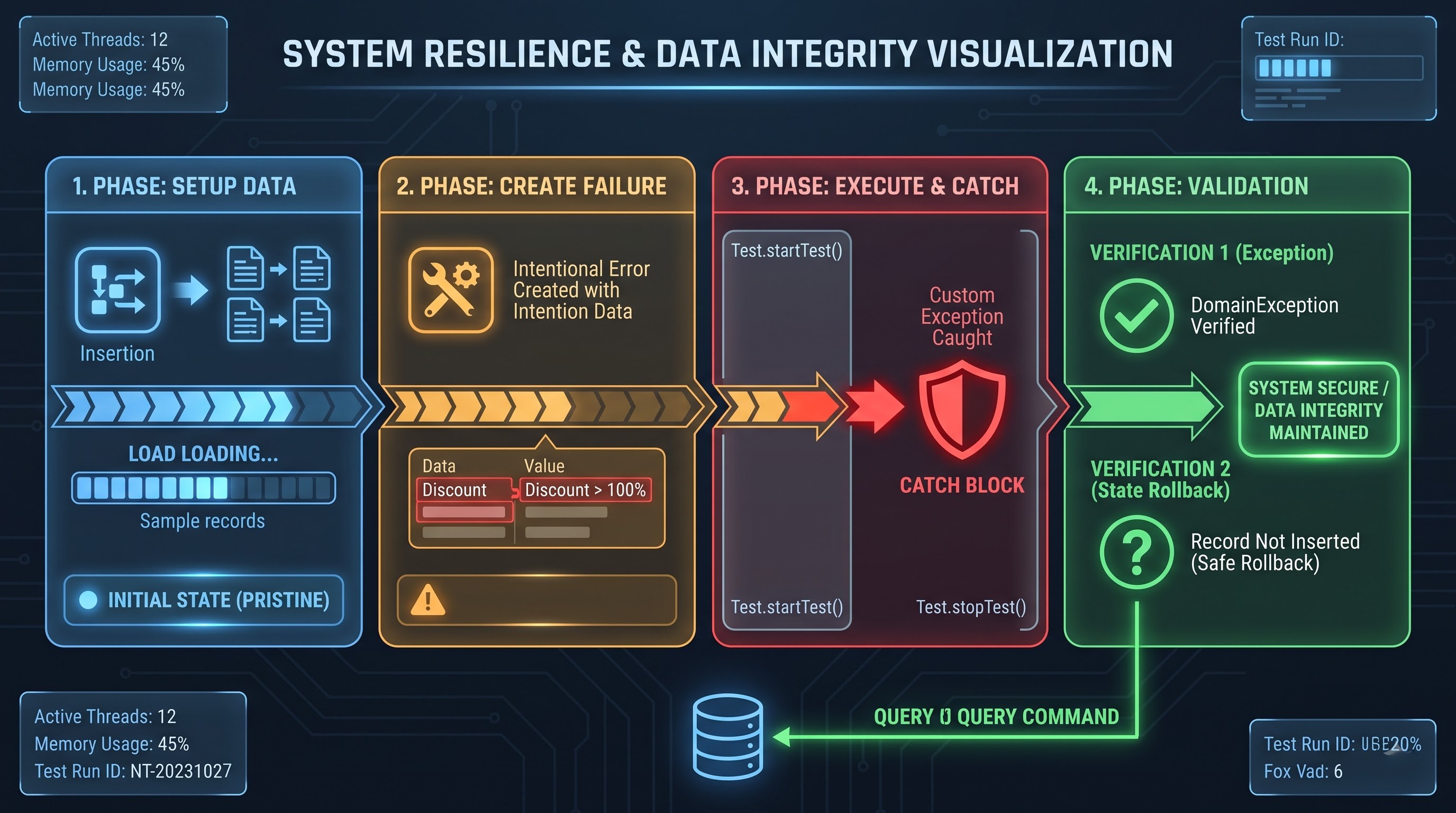
In order to perform this process effectively, the developer has to create cases where failure of the operation is anticipated. The logic must be executed in an intentional error-handling context. The test has to satisfy three conditions.
First of all, the operation must not be permitted to complete successfully. Should the execution proceed past the point where throwing an exception was required, the test must fail immediately with an explicit error message indicating that the required exception was not thrown.
Second, the catch block of the test method must catch the exception thrown and analyze its properties. It is not enough to confirm that the exception was thrown. The test must check that the caught instance was specifically the custom domain exception and not just a random exception of the platform runtime environment, e.g., null pointer dereference or a query exception. Having a null pointer exception providing a seemingly successful negative test case is a serious anti-pattern; it indicates that the code malfunctioned instead of functioning according to its logic.
Third, we should check if the function tests the operational contents of the exception. Custom exceptions have essential structured metadata. The function should check if the users are receiving the correct error messages and whether the internal error codes are in accordance with the enterprise error codes.
Validating Rollback Operations And State Purity
Not only is the exception being thrown checked, but also, probably not so often, the state purity must be checked as well. Normally, an unhandled exception would lead to the rollback of the whole transaction. However, if there is custom error handling with savepoints and rolling back commands, then there are errors in rollback boundaries that could let partial commits be done without being tracked.
A full-blown test should confirm exception-related impacts. If an automatic program meets with an error while executing a multi-step function, for instance, after creating an invoice record and before preparing an invoice line item, the test should assert that the whole operation was terminated. It follows that after an exception occurs, there should be a query made to the database to confirm that the parent invoice does not exist in it. Without the assertion, the developer will only be able to say that an error happened and not that the database was safe from orphaned and damaged records.
Scaling to Bulk Realities through Static Resource Loading
Salesforce is a bulk-processing machine. Unlike conventional apps where user requests are processed in full isolation on dedicated threads, Salesforce regularly gathers incoming work for up to two hundred records in a batch. Therefore, triggers, asynchronous jobs, and automated workflows should be designed to cope with such load without violating governor limits for query number, data access operations, and CPU processing time.
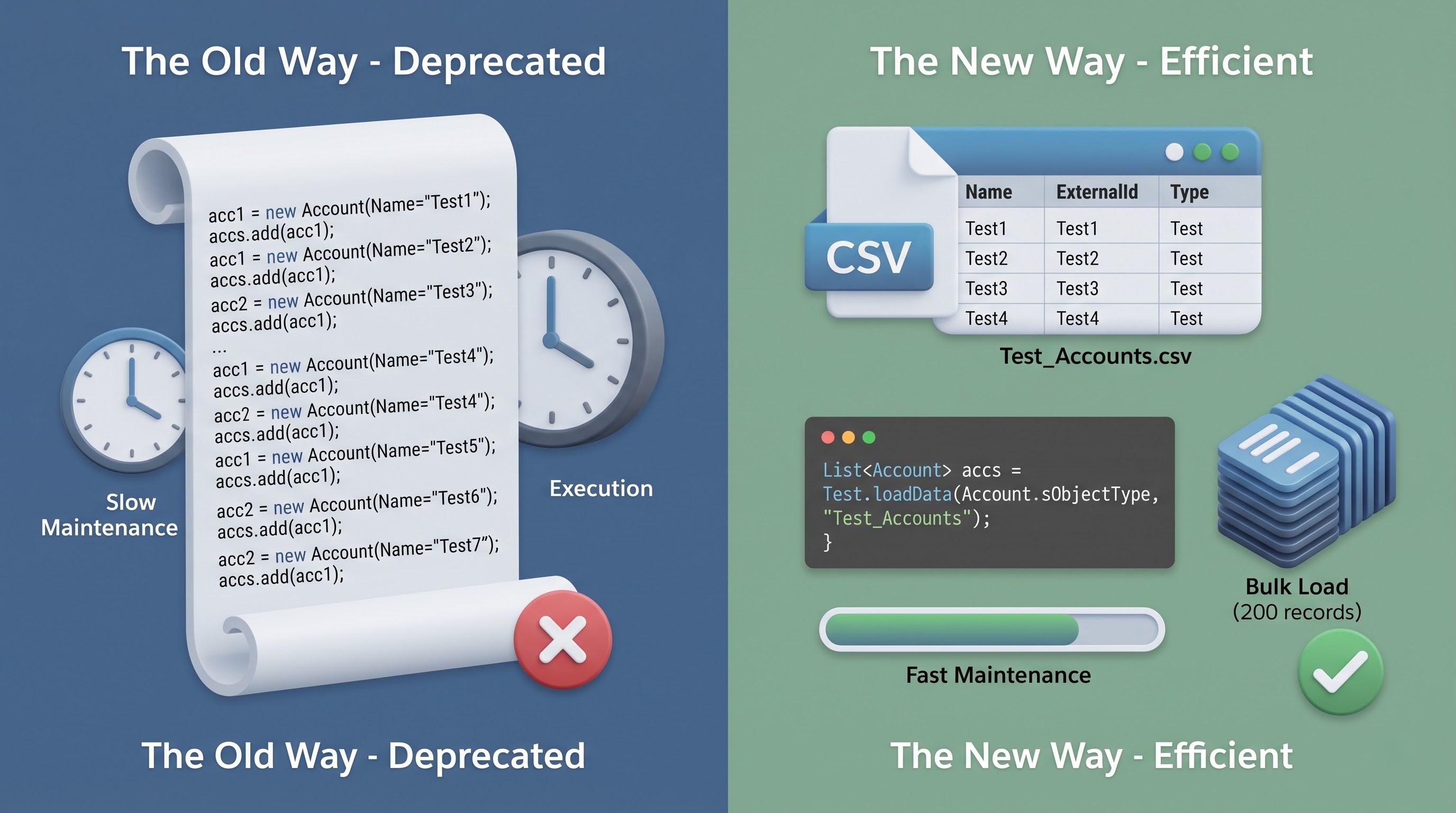
The process of testing these bulk behaviors solely by creating records through programmatic methods creates maintainability issues. If an application includes many associated standard and custom objects that have validation rules, lookup relationships, and many record types, writing procedural code might lead to the creation of gigantic and complicated test classes.
Using Predefined Static Datasets
To separate the design of test data from test execution logic, the platform provides a mechanism to load static data. This feature enables developers to create complex multiple-record datasets in CSV files or keep them as static resources within Salesforce, making it possible to load them into the database with a single command.
Using static resources for testing bulk data offers several advantages:
The use of this technology guarantees utter transparency in respect to the way test data was produced. Instead of going through dozens of lines of variable declarations, links and branching processes in the Apex test setup method, an engineer will just take a glance at a neatly organized data file showing a realistic picture of enterprise records.
It enables real testing of edge conditions at scale. The file used as a static resource may contain from 50 to 200 different entries where each of them contains a mixture of field values. This offers developers a chance to test heterogeneous batches, namely batches where 50% of entries follow the business rule and 50% go against it, which gives them an opportunity to check whether business logic is working correctly and simultaneously separate faulty records without zeroing the entire batch.
Through the improvement of the efficiency of test maintenance as well as schema migrations. When a regulatory administrator creates a new necessary field on an object or when an upgrade of an enterprise package happens, the ability of the programmatic data creation factories to work appropriately is hampered, which results in breaking the execution in many test files. However, with the implementation of centralized static data resources solutions that allow the developer to maintain one location of the data schema can result in a clear upgrade of the operational baseline thus making test execution compliant again.
Managing hierarchies with relational identifiers
One of the main difficulties occurring while transferring from the procedural data creation to the file-based data loading procedure is relational integrity issues. When using imperative Apex scripts, the ability to create a parent account along with its child contacts is quite simple in nature since the process of account data creation is followed by structuring a unique account identifier via the database generated output and assigning it to the contact parent relation field before the finalization of contacts records data entry.
Comma-separated value files residing in static resources cannot access run-time Salesforce record ID numbers until they are written. Encoding static files with twelve or fifteen-character identifiers is an anti-pattern that introduces fragile dependencies, especially between sandboxes for which synchronization of identifiers is not guaranteed.
The enterprise approach to this issue is the intelligent use of external identifiers. By creating a number of external identifiers on the parent objects in the schema, the programmers can write descriptive and predictable reference keys right inside the static files.
During the extraction of the relational data at the sequence of execution tests, the parent portion of the data is extracted first, creating records with the unique external identifiers. The child static file references these external identifiers in its relationships. The testing framework can then tie these connections-up with standard upsert functions or relational logic before insertion. This approach allows extracting a complex hierarchy of objects, such as accounts, opportunities, and relevant products, using only configuration files.
Business Assertions and Purposeful Diagnostics
The last element that makes a test suite functional is its assertion strategy. Although you need only execute your code to ensure coverage, maintaining consistency requires compelling and effective validation. Many older systems simply include assertions that perform binary checks, such as checking for null objects or verifying non-zero list sizes. While these assertions provide some insight into the reasons for failures during night builds, they offer very little help in figuring out what went wrong.
Assertions of worth must comply with three basic design principles:
Firstly, assertions should be specific in terms of behavior. Instead of making a generic assertion about a record being updated, it should evaluate which fields are of importance for the business operation. For example, while there should be an assertion that checks the existence of an amortization schedule record, if an automated service calculates amortizations, the assertion must also verify that the calculated balance corresponds to the model.
The second principle is that assertions should always use expressive diagnostic messaging. When using the assertion framework, every assertion method allows an explanatory message string to be passed. This parameter should not be neglected. When an assertion fails during automated deployment, the error message shown in the deployment log can be the only diagnostic clue available to the engineering team. An assertion that fails with a clear and meaningful message, such as "Expected the opportunity stage to move to Closed Won after the payment has been made but it remained in Negotiation," allows an engineer to pinpoint the problem without having to download the test class and reproduce the issue.
Thirdly, assertions must substantiate global impact of the system. Business logic, when exercised, often produces ripple effects within the enterprise architecture, such as triggering platform events and creating administrative task records, and recalculating the parent roll-up fields. A test can only be called holistic if it confirms that all the potential ramifications have been examined. For example, if an account is deactivated, the test should check not only whether the active flag is set to False in that account, but also if opportunities relating to the account are flagged appropriately, reminder tasks have been cancelled, and an audit record containing the reason of deactivation is saved in the database.