
The Strategic Navigator: Understanding the Modern Business Analyst
Last updated on Aug 29, 2026
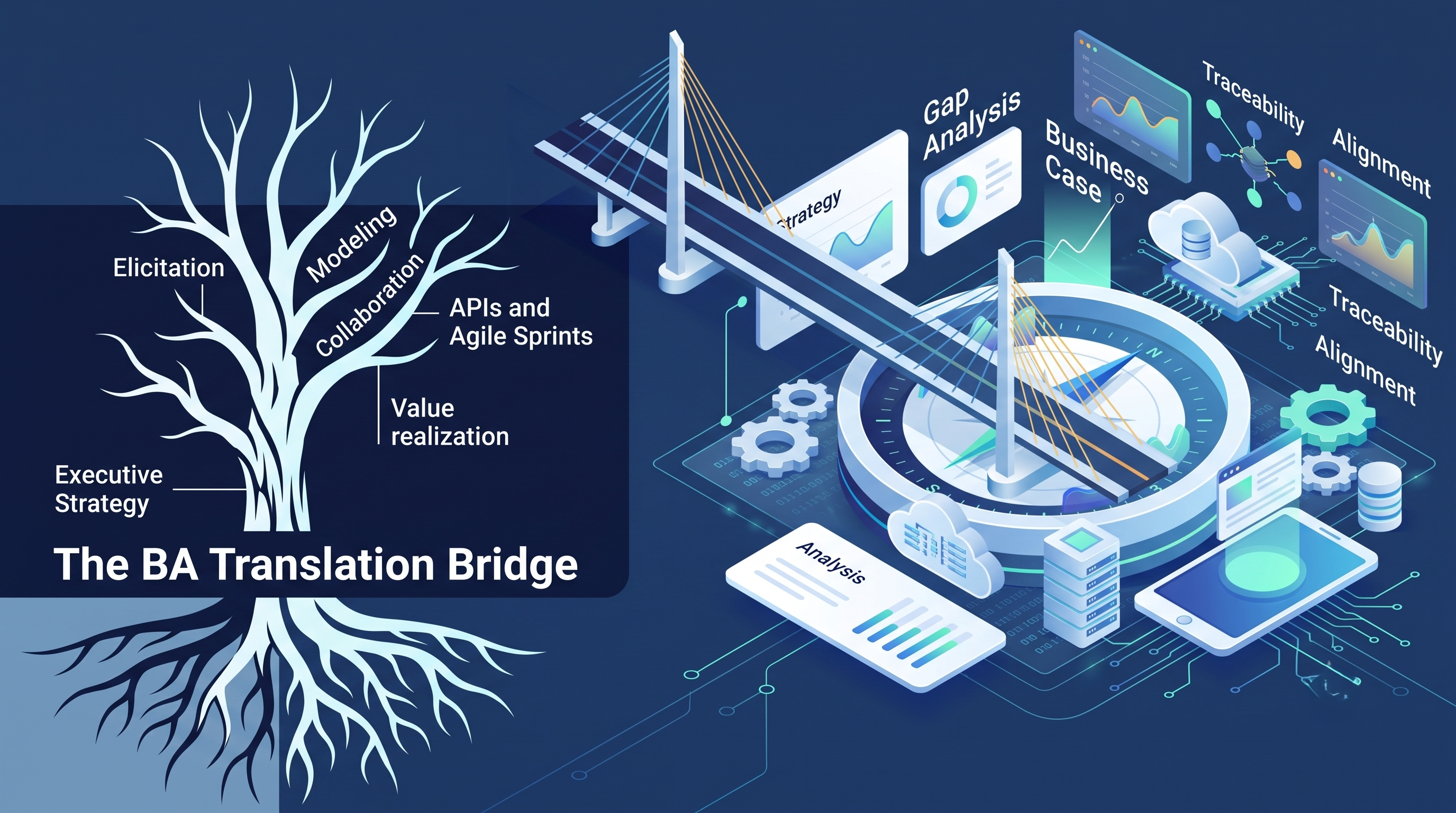
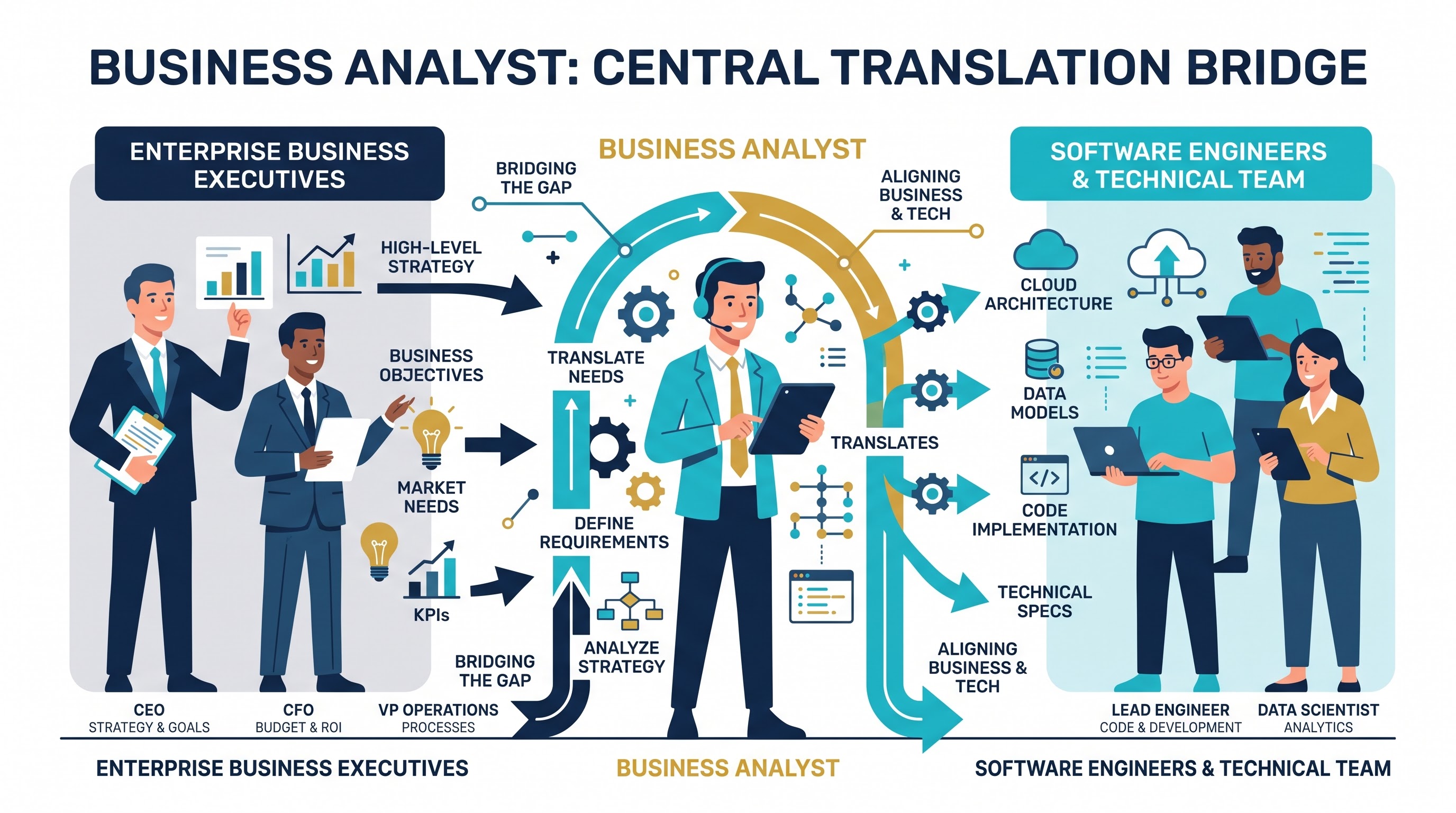
The distance between business objectives and its practicality can be enormous. Business leaders may spot an emerging market, streamline their supply chain, or update their customer onboarding process. At the same time, the IT team has the technology necessary to construct databases, create interfaces, or set up the cloud. However, without a common language and means of communicating plans clearly, companies are often unable to translate their vision into actionable steps and just waste resources on expensive projects that fail to help them achieve the expected outcomes.
The role of the business analyst is to span this gap. Rather than being just a transcriber of notes from meetings to specification documents, the modern business analyst acts as an investigation of problems within organizations, an adviser on strategic matters, a mediator, and a provider of value.
Evolution of Business Analysis
The field of business analysis has witnessed an extraordinary metamorphosis in recent decades in line with industrial computing, organizational science, and product delivery approach.
The Era of Systems & Documentation
Initially, with the advent of computer technology, business analysis was perceived as a part of systems analysis in corporations that were busy with converting manual paperwork in the form of payrolls, inventory records, billing, and similar tasks into routine mainframe computing operations. Analysts were responsible for describing step-by-step procedures and passing this information further to developers.
Under the influence of the Waterfall model of development process, the approach to business analysis became extremely documentation-driven. Business analysts created enormous documents known as Business Requirement Documents (BRDs) and Functional Requirement Specifications (FRSs) consisting of hundreds of pages. After completion of documentation the work of analysts was complete, and engineers were working alone for months and even years until a ready-made system was revealed to the public. In such a case the risk became huge, because by the time the software was launched the market situation had changed completely.
Agile Revolution and Constantly Adding Value
The wide-scale application of different Agile approaches, including Scrum, Kanban, and Extreme Programming, revolutionized the way companies develop their solutions. Under the conditions of Agile, business requirements are never fixed right from the start of a project lasting several years, but change dynamically during the process of iterations and collaboration with stakeholders and users.
In such circumstances, the business analyst's function became much more collaborative. It became not only about writing specifications at the very beginning of the project, but also participating in the discussions with product owners and grooming backlogs of user stories and acceptance criteria for each sprint.
Data-Driven and Intelligent Enterprise
Currently, it also requires some more skills because of the emergence of big data, cloud computing, and artificial intelligence technologies. Modern-day BAs should be able to understand not only the flow of operations in a business process, but also the flow of information, enterprise-wide integration, and predictive analytics. The job of the business analyst is not only to understand how a business process works, but also how data, automation, and intelligent algorithms can completely redefine this process.
Core Knowledge Areas and the Business Analysis Lifecycle
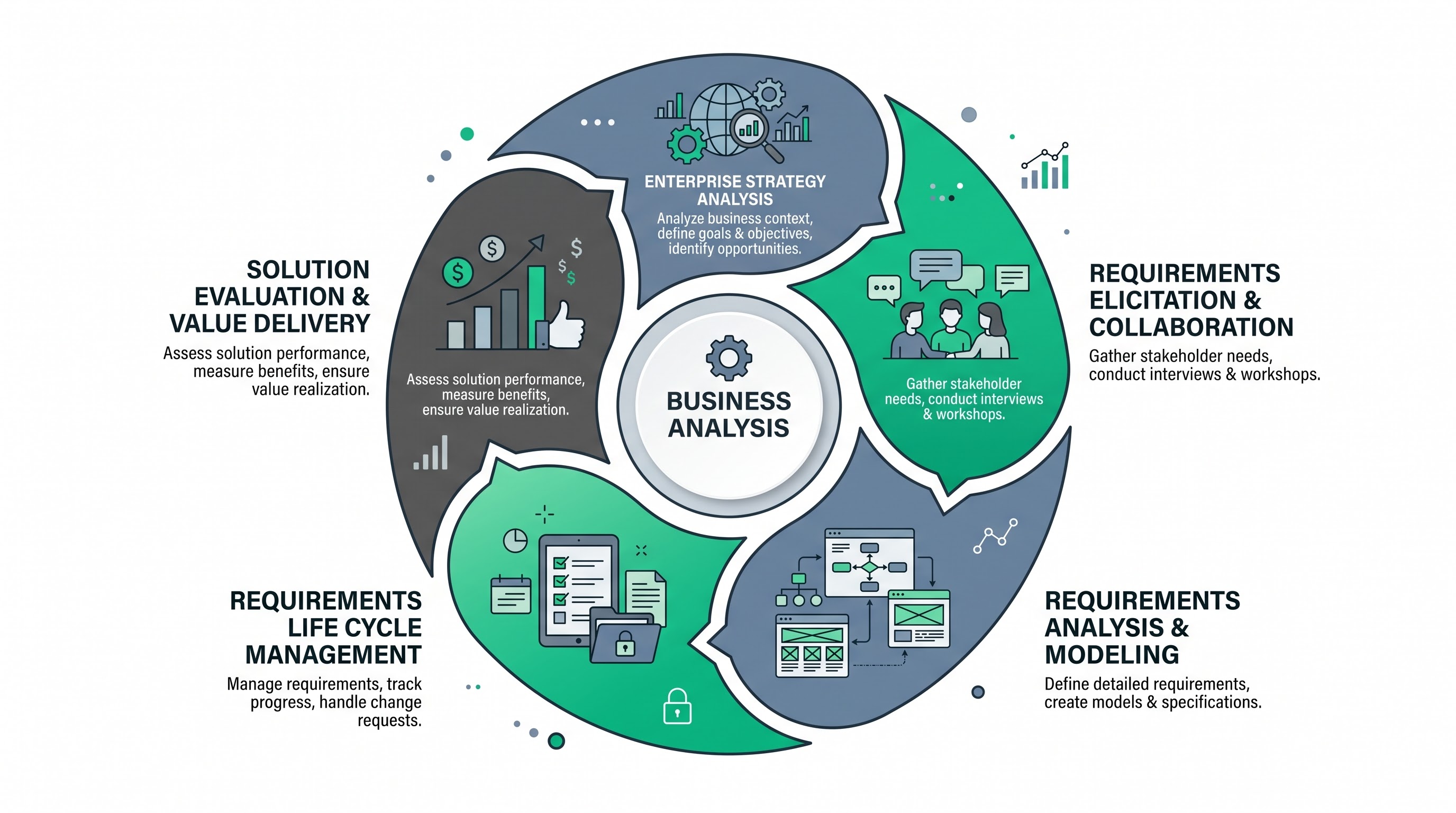
The International Institute of Business Analysis (IIBA), via the Business Analysis Body of Knowledge (BABOK Guide), divides the field into core knowledge areas. The core knowledge areas are how the life cycle works when a business analyst drives a measurable change.
Enterprise Diagnosis and Strategy Analysis
Before writing a line of code or considering an outside vendor, the enterprise needs to understand its current state, its desired future state and what strategy will achieve it. The strategy analysis involves:
Identifying Business Needs and Problems: This is the stage where the real reason behind the organization’s poor performance, cost leakages or customer dissatisfaction is identified rather than addressing symptoms.
Capability and Gap Analysis: Evaluation of the organization’s existing capabilities, processes, data, and technology against the needs to meet the strategic goal.
Scope Definition: This is a practical scope of what the initiative covers and does not cover, so that it is not overly complex.
Business Case Development Quantify ROI, operational savings, risk and resources to help executive decision making in prioritising initiatives.
Elicitation and Collaboration
Elicitation is the process of eliciting information, tacit assumptions, constraints, and goals from the people working within the company. Elicitation is not simply a process of listening but of actively engaging.
Collaborative Discovery: Organizing interdepartmental focus groups and structured interviews in order to find out how things get done throughout the various departments.
Observational Research: Shadowing frontline workers in order to discover the workarounds, the manual spreadsheet use, and other inefficiencies which are never documented.
Document and System Analysis: Looking through the documentation of the legacy systems, regulations, customer service tickets, and performance measures.
Requirement Analysis and Design Definition
After collection of the unorganized information, business analysts convert the collected data into formalized structured models that can be analyzed and used for designing and developing purposes:
Specification and Modeling of Requirement: Conversion of business needs into structured models like process flows, data dictionaries, use case descriptions, and state transition diagrams.
Verification of Requirements: Validation of the requirements that are well formed, clear, consistent and testable.
Validation of Requirements: Checking whether the requirements fulfill the business needs and create value for the business.
Design Options Definition: Working with the technical architect on the determination of how the problem could be solved through the process of software design or redesign of process only.
Life Cycle Requirements Management
Requirements do not remain the same; they vary depending on technical limitations, budget changes, and competitive changes in the market. This ensures alignment and consistency during the whole course of the project.
Traceability: Setting up forward and backward traceability matrix to make sure that each business goal can be traced back to particular functional requirements, which in turn, can be traced back to test cases and deployed functionalities.
Prioritization: Using structured frameworks to assist business leaders in making hard choices when limited time, budget or technology does not allow implementation of everything that has been requested.
Change Control and Management: Analyzing the impact on architecture, budget and timeline of the changes requested before incorporating them in the scope of work.
Evaluation of the Solution and Value Realization
The job of an analyst is not over when a new process or system is implemented. Evaluating the solution will be an evaluation of the effectiveness with which the solution is achieving the desired outcome from a business perspective.
Performance Indicators: How well do the performance indicators post-implementation match the performance indicators highlighted in the business case?
Barriers to Adoption: Barriers, training, and usability issues that prevent organizations from adopting the solution.
Recommending Improvements: Making suggestions for continuous improvement of configuration, policies and other aspects to achieve maximum value from the investment.
Essential Competencies and the Professional Skill Matrix
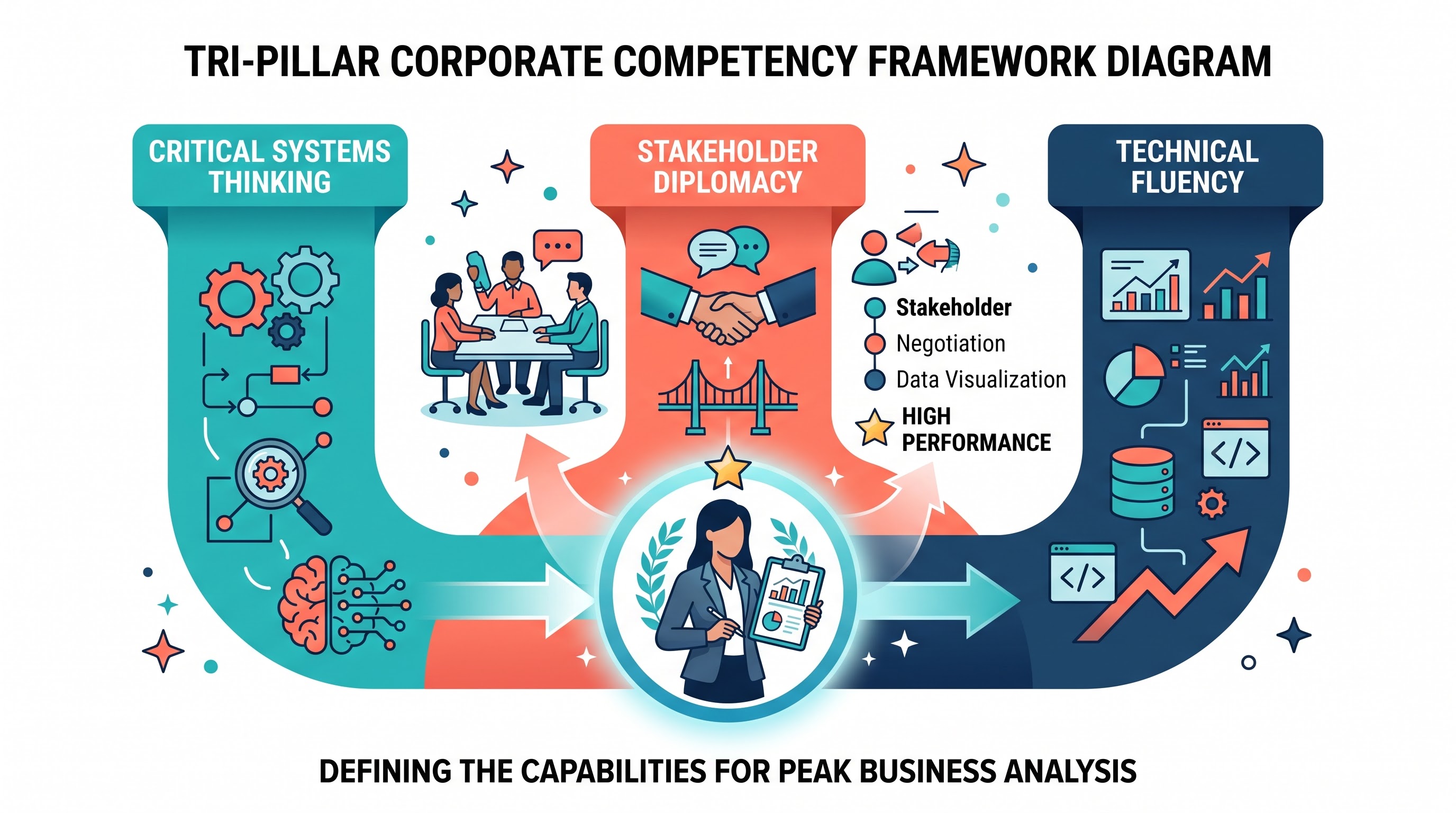
A successful analyst must acquire three main skills, namely critical thinking, business knowledge, and technical fluency, which are a part of the essential skills and competencies that can be learned through professional business analyst classes.
Critical Thinking and Analysis: Any effective business analyst will utilize his/her skills to decompose complex problems into small components, recognize different patterns and apply reasoned judgement while evaluating different possibilities.
Root Cause Analysis: It is essential for an analyst to go deeper than just finding out what stakeholders wish to achieve, to decide what organization actually needs. In order to apply this technique a business analyst should be skilled at posing right questions.
Systems thinking: Any organization exists mostly as a system composed of sub-systems which are connected and interdependent. Thus any changes on the system level will affect other areas of organization like accounting, logistics, and legal departments.
Decision analysis: Analysts should make decisions based on different scenarios with several variables related to cost, risks and technologies.
Communication, Diplomacy and Facilitation
The job of a business analyst entails spending much of the day communicating with people. He/she should be able to communicate equally effectively with the CEO, the customer service employee, the outside auditor, and the software engineer.
Listening: Listening not only to the message but also to the underlying issues, organization resistance and underlying assumptions.
Conflict Management and Consensus Building: Working out the compromise between departments that are motivated differently. The sales force usually needs the customizations to close the deal fast while the engineering department wants reliability and conformity. The BA should be able to broker the compromise.
Communicating Visually: Turning the complex logical process into visual representation.
Domain Knowledge and Business Understanding
The business analyst has to be aware of the commercial, regulatory as well as economic trends going on in the industry where he or she works.
Understanding Regulation of the Industry: Knowing how various regulations of the industry impact its design and functions.
Knowing Models and Unit Economics: Understanding how the organization generates revenue, makes expenditures, and manages cash flows.
Understanding Processes: Knowing and understanding business processes: order-to-cash, procure-to-pay, inventory management, and customer life cycles.
Technical Skills
A business analyst does not write code, but he/she has enough technological level of knowledge to clearly get into conversation with the engineers.
Basic Knowledge of Database Design: Relational databases, entity relationships, normal forms, data flow.
APIs and Integration: How to connect different systems via API creation, events streaming, and messaging.
Non-functional Requirements: Importance of performance metrics such as maximum delay times, concurrent processing level, security, accessibility, and disaster recovery.
Core Methods and Operating Frameworks
The techniques used by business analyzers in their work depend on the methodology followed by the company they are working in. This is a useful skill which is taught to students of modern business analyst classes online.
Agile and Scrum Methodologies
In Agile environments, business analysts are an active participant in continuous product delivery.
Backlog Grooming and Refinement: Working with the Product Owner to break down high-level business initiatives into detailed user stories, explaining rationale, and solving any discrepancies before the development work can commence.
Acceptance Criteria: Developing logic statements that could be used for testing, thus defining the exact set of conditions for when a user story will be considered completed and operational.
Sprint Planning and Review Process: Being an expert in the area in terms of the sprint planning process, thus answering any question that comes up there and validating the done increments at the sprint review stage.
Conventional and Forecasting Models (Waterfall)
In strictly regulated industries like aviation, government contracts, and clinical health care, the necessity for complete documentation from the beginning persists.
Complete Preliminary Preparation: Completion of structured requirements packages that go through several stages of review and approval before commencing a development process.
Tight Control Gates: Application of mandatory approvals, implying that a new stage can be initiated only following the given authority’s consent.
Business Process Management (BPM)
BPM is the approach based on treating business processes as assets that can be studied, designed, improved, and automated.
Current Processes vs. Future Processes: Description of existing business processes with all possible human interference and the creation of an improved future process without some steps.
Cycle Time and Bottleneck Elimination: Assessment of the process performance, the time spent waiting, and mistakes made for better business efficiency.
Standardization: Use of well-known modeling instruments such as Business Process Modeling Notation (BPMN) in order to ensure a single vision of the process by teams working on the global market.
Basic Techniques and Tools
Business analysts use various techniques both qualitative and quantitative to uncover, define and document business requirements.
Types of Requirements and Their Hierarchy
Requirements must be structured into different levels of abstraction in order not to confuse the strategic goal from its technical implementation.
Business Requirements: Organizational goals, for instance, decreasing the time required for processing invoices by 40% or expanding the platform to the European market.
Stakeholder Requirements: Certain requirements of a particular group of users or divisions, for example, the requirement for branch managers to be able to authorise expense claims by using a mobile phone.
Solution Requirements (Functional): In-depth specifications about the particulars of how the software is supposed to work including the software operations, calculations, data checking, pathways used.
Solution Requirements (Non-Functional): Characteristics or quality of the operation, such as system’s uptime, reaction time, systems user capacity, standards of information encryption.
Transition Requirements: Special qualities allowing to go from the current situation to the new one, such as data migration control codes, ensuring old records preservation and training of personnel.
Strategic and Diagnostic Frameworks
Strategists use standard theories to evaluate environmental elements, performance levels, and causes:
The 5 Whys method: The process of repeating “why” questions to move past the basic indications of failures.
Fishbone (Ishikawa) model: Organizing probable factors behind the problem into categories such as people, steps, technology, materials, measurements, and environment.
SWOT and PESTLE analyses: Assessing the strengths, weaknesses, opportunities, and threats of an organization as well as the political, economic, social, technological, legal, and environmental factors.
Gap analysis: Systematic comparisons of the current results and operational levels with the target states for the purpose of designing the necessary actions.
User Stories and the INVEST Framework
In contemporary software delivery, the idea of requirements is often embodied in user stories, representing the perspectives of end users.
Story Format: The actor, the actions, and the value proposition should be combined in the form of a story.
Acceptance Criteria via Given-When-Then: Using behavior-driven language to define preconditions, events, and response.
INVEST Quality Standard: Independence, negotiability, value, estimability, smallness, and testability of each user story.
Use Cases & Scenario Narrative
In case of complex systems with complicated rules of interactions, use cases serve as a step-by-step guide to interactions between outside actors and the system.
Primary Happy Paths: Simple documentation of the standard sequence of events that leads to the accomplishment of a goal.
Alternative and Exception Paths: Documentation of alternative sequences of events, edge conditions, error handling, network timeouts, and failures.
Preconditions and Postconditions: Stating the exact conditions of the system prior to enabling the use case and the situation after its conclusion.
The Responsibilities of Stakeholder Management and the Process of Elicitation
Managing stakeholder needs, arranging for political alliances, and finding a common ground for opposing objectives is one of the most difficult parts of business analysis.
Stakeholders Need to be Found and Mapped
Not all stakeholders exert the same amount of influence or interest. To be successful in his/her work, the business analyst has to build the map of the organization in the beginning.
High Power and High Interest Stakeholders: important executives and sponsors of the project, as well as system owners who are to be properly managed and informed.
High Power and Low Interest Stakeholders: important people (e.g., legal or compliance director) who have the right to stop the project but need to be satisfied without exposing to them too many details.
Low Power and High Interest Stakeholders: users of the system, because without them the implementation of the project will not succeed.
Low Power and Low Interest Stakeholders: groups that need to be monitored without any interaction.
Managing Scope Creep and Conflicting Priorities
Scope creep is a prevalent condition of multiple project breakdowns and is defined as uncontrolled extension of project scope without corresponding extension of time, resources, and budget.
Clear Scope Definition: The well-defined scope baseline must be determined and agreed upon at the very beginning of the project. All subsequent changes should be assessed against the scope baseline.
Value-Based Prioritization: The requests for new features must be prioritized according to their relevance to objectives set for the project.
Impact Assessment: Provide clear and concise information on the impact of the new requests on the project implementation.
The Current Range of Business Analysis Job Titles
Business analyst job title covers a wide variety of specialized roles varying from industry to industry, as well as by the depth of technology and organizational structure.
Functional Business Analyst
A Functional Business Analyst is expected to be immersed in various departments such as finance, human resources, supply chain, and risk management. They are expected to have a lot of experience in the industry, know all ins and outs of business processes, and contribute to enhancing business operations, as well as adjusting enterprise solutions like ERP and CRM systems.
Technical Business Analyst / Systems Analyst
Technical Business Analyst is a professional who works closely with teams involved in software development and infrastructure. Due to their strong technical background, they typically deal with API design, database design, queues, and cloud computing. Besides, they are responsible for transforming business ideas into technical drawings, which software developers are able to implement.
Business Data Analyst
Business data analysts lie in the intersection of business analysis and data science. They use statistics, analytical methods and business intelligence tools to draw useful insights from big data. The duties of this job may also include the identification of the trends in the business environment and development of dashboards into KPI.
Agile Business Analyst / Product Owner Proxy
In agile settings, the BA usually acts as the Product Owner. They handle daily demands of backlog management, provide guidelines to developers on their user stories, explain what acceptance criteria are, and lead user acceptance testing.
Enterprise Architect / Strategic Analyst
Strategic business analysts have the highest levels of maturity in business. They cooperate with top managers and assist them in the analysis of the company’s strategy and capabilities and develop big-scale projects for the organization.
The Influence of Artificial Intelligence on Business Investigation
The introduction of generative AI, large language models (LLMs), and intelligent automation has led to professionals upgrading their skills with the help of a business analyst with a gen ai course in learning automated requirement writing and predictive mining.
Automated Creation of Requirements Documents
AI systems are able to analyze huge amounts of non-structured feedback, interview notes, client tickets, and old documents. Analysts can use these functions to:
Synthesize Discovery Sessions: Make a summary of long interviews and show crucial operational problems, different dangers, and conflicting statements.
Create first versions of requirement documents: AI generates the basic stories of customers, standard criteria for acceptance, and edge cases based on vague goals of business.
Structure the Information: Understand historical workflow structures to suggest a new improved process.
Data Discovery and Predictive Mining of Processes
Modern tools for process mining analyze the logs of events that occur in business systems, showing actual ways in which business processes work in practice, not how it is written in official business manuals.
The Unique Human Traits
AI might be very advanced in recognizing patterns, creating documents and generating scenarios, but it can not take over all the interpersonal skills of the BA.
Politics in the Organization: Understanding the unannounced rivalry, skills of big sellers and protectionism that affect the decision-making.
Ethics and Strategic Thinking: Judging if automated algorithms fulfill the value of the company, social responsibility and meeting rules.
Empathy: Helping clients who are scared of losing their jobs and gaining their confidence.
Need for Experts Who Can Translate Complicated Business Challenges into Action and Implementation Has Never Been Higher. It is essential that businesses undergo the digital transformation process by having experts capable of turning complicated business challenges into actions and technical implementations. Taking a ba analyst course industry-centric will equip you with all the frameworks required and allow you to participate in real-world projects to take your career as a business analyst to the next level.