
The Ultimate Guide to Advancing Your Career with an Artificial Intelligence Masters Program
Last updated on Jun 30, 2026

A paradigm shift is occurring in the technology world of the globe. The technologies related to Artificial Intelligence (AI) and Machine Learning (ML) have evolved from cutting-edge technology to become an intrinsic component of today’s enterprise technology stack. It does not matter whether we are talking about code generator tools, copywriting solutions, self-driving vehicles, or personalized medicine platforms; everything is about AI-powered automation.
Being an IT specialist, software engineer, data scientist, or just an enthusiast, you are now presented with an outstanding chance. However, being an AI engineer is not just about knowing basic algorithms, but it implies a deep understanding of various complex areas of computations.
The agentic ai course represents the plan created by industry professionals for their students to become certified AI engineers. This article talks about the benefits of taking the master’s program, skills that you are going to gain, and the reasons why you need a specialized program.
1. The Hierarchical Architecture of Artificial Intelligence
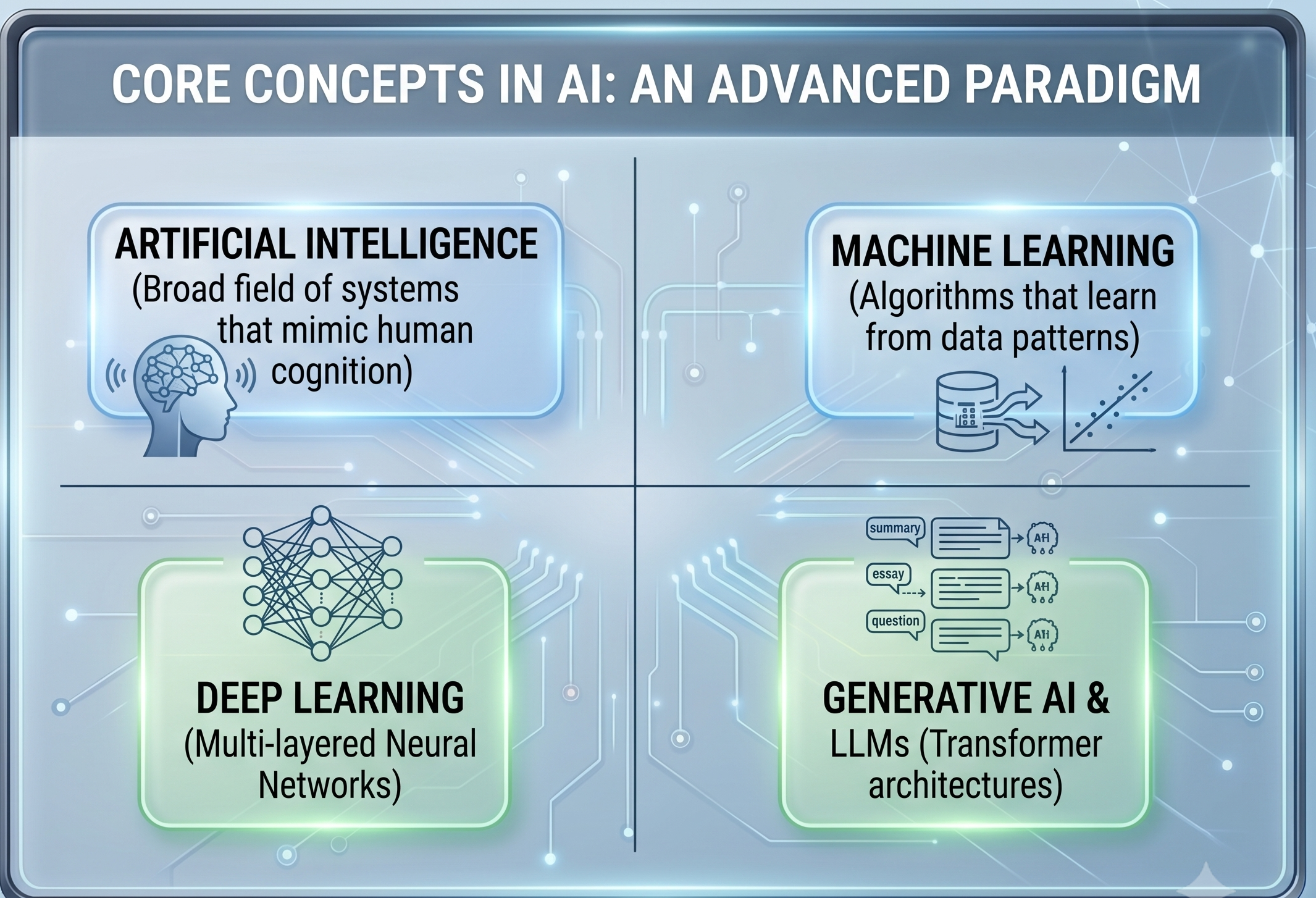
The domain of AI is frequently discussed in terms of its wholeness as a concept, but in reality, it is quite hierarchical and consists of various engineering disciplines that are nested one inside another. In order to develop scalable and intelligent systems, it is necessary to comprehend the nature of each layer.
1.1 Artificial Intelligence (AI)
At its highest level, Artificial Intelligence can be said to constitute the larger picture of creating machines, software programs, or agents that carry out tasks normally performed by humans through their intelligence. AI is comprised of:
Symbolic AI (Good Old Fashioned Artificial Intelligence – GOFAI): Knowledge-based systems using rule-based inference engines and hard-coded decision structures.
Deterministic Search Algorithms: Early forms of path finding algorithms used in robotics and games.
Modern Probabilistic AI: Models that move beyond hard-code rules and instead assess the probability of a particular outcome.
1.2 Machine Learning (ML)
Machine Learning refers to a specific branch of Artificial Intelligence that represents a paradigm change in the process of software development. Traditional programming implies that a programmer codes the rules and feeds the data to get the output result. In the case of Machine Learning, the programmer needs to feed the data and the expected answers and the algorithm creates the mathematical function (the rules) needed to obtain the required results.
The difference between ML and traditional programming is in the fact that the ML system does not contain the hardcoded rules; instead it uses the input structured data, calculates its statistical features, optimizes internal coefficients and learns how to generalize from that.
1.3 Deep Learning (DL)
Deep Learning is the technical advancement of Machine Learning technology based on human brain physiology. This uses neural networks that have several hidden layers (thus the name "deep") which automatically generate abstract and high-level features from unstructured input data.
Unlike Machine Learning, which needs manual "feature extraction" where humans need to first manually determine the critical data variables and then structure them before passing them into the algorithm, Deep Learning neural networks skip this cumbersome step. The input data, for instance, raw pixel grids or raw audio signals, goes through multiple mathematical layers, learning hierarchical identification of features such that lower levels recognize edges while higher ones recognize objects.
1.4 Generative AI & Large Language Models (LLMs)
Generative AI is at the forefront of deep learning innovation. While traditional deep learning methods focus on classifying and predicting numeric values, generative models aim at constructing synthetic data through coherent outputs in the form of text, images, audio vectors, and even codes.
The big revolution in the field is brought about by the Transformer Architecture through its self-attention techniques to assess contextual relationships in sequential data. LLMs view text strings as multi-dimensional token sequences to predict the most accurate tokens in huge context windows leading to reasoning capabilities, coding abilities, and functioning digital agents.
State-of-the-art Algorithmic Frameworks & Learning Models
Choosing the proper algorithmic model is the single most important decision for an AI architect to make. It is totally dependent on the characteristics of the input data, the business goal, and the computational power at hand.
Supervised Learning
Supervised learning is the most widely applied learning paradigm in business settings. Within supervised learning, the algorithm learns from a training set where the input features and labels (i.e., output values) are provided. Then the model learns by minimizing the error of its prediction by modifying its weights in a feedback loop. The structural classification of supervised learning into two major task categories is as follows:
Regression: Prediction of a numeric value. For instance, predicting the market value of the property based on its size, location, and previously sold price, or the next quarter demand forecast in the supply chain management.
Classification: Classifying the data into distinct classes. It may be binary classification (e.g., classifying whether the credit card transactions are frauds or genuine) and multi-class classification (e.g., routing the emails of customer support to various departments, such as billing department, technical support department, or returns department).
Unsupervised Learning
Unlike supervised learning, the input variables in the unsupervised learning algorithm consist of only input without output or target variables. The model does not know what to look for and its goal is to analyze the input data in order to discover any natural structure or mathematics behind it. Some major branches of unsupervised learning are as follows:
Clustering: Clustering involves clustering the data into various clusters using geometric distance measures. One of the classic examples is consumer segmentation where marketing tools automatically identify different clusters of consumers on the basis of purchase speed, navigation patterns, and average basket size.
Dimensionality Reduction: Reducing multidimensional data into lower dimensions while retaining most of the original variability. Methods like PCA enable engineers to visualize very complicated multidimensional data and lighten the computing burden prior to running heavy models.
Anomaly detection: Data points that differ from the usual statistical baseline significantly. This technique is widely implemented in monitoring machines' IoT, in order to predict their malfunctioning and prevent total breakdown.
Reinforcement Learning (RL)
Reinforcement Learning describes a model where there is an interaction of the independent "agent" and an ever-changing and unpredictable environment. The "agent" doesn't work according to a predetermined set of data/instructions; it works based on a trial-and-error loop through a Markov Decision Process. With each action taken by the agent in the environment, it notices the change of the state and receives feedback in the form of a mathematical reward/penalty. Over a million times repeating these processes, the goal of the agent is to find an optimal "policy," which means the process of mapping each state of the environment to the most adequate action to get the maximum reward.
Why Should You Join a Masters Course on Artificial Intelligence?
With industries competing to deploy intelligent systems within their processes, there is a high shortage of AI professionals against a rising need. There is a huge difference between traditional software engineering and AI systems engineering, thereby forming a large skill deficit.
Increasing Demand for AI Professionals
Companies are not interested in engineers with knowledge of basic application architecture; they need experts that will develop intricate neural networks and machine learning pipelines.
In terms of learning pathways in the field of artificial intelligence, an organized and structured agentic ai course holds definite architectural superiority over any self-directed tutorial or short course in the following terms:
Depth of Curriculum: Though short courses tend to focus on simple syntax and separate libraries within 10 to 40 hours of study time, a master's program involves a strict commitment of over 250 hours in building up thorough foundations in the areas of multi-variable mathematics, inferential statistics, deep learning, and natural language processing.
Exposure and Mentorship: A self-directed learning pathway restricts the learners' practical exposure to simple code-along exercises with help from mere texts and public online communities. A proper structured program offers a direct interaction of the learner with the relevant experts and learning managers who will take him or her through various real-world projects and case studies.
Professional Career: The short courses offer just a bare certificate at their end, which has very little significance for corporate employment. An organized program aims at grooming its participants for the enterprise market through professional certification and resume marketing activities.
2. Artificial Intelligence Engineering Core Curriculum Architecture
A production-level AI engineer is a combination of expertise in computer science, statistics, and math. Each of the domains mentioned is huge in scope, and this program dissects them into manageable units.
Core Pillar 1: Programming in Python with Basics
Python programming language is an unequivocal language of choice in the field of data science and artificial intelligence. This program does not assume the skills but rather helps build them from scratch.
Data Fundamentals and Types: Dealing with runtime problems via variables, tuples, lists, dictionaries.
OOPs - Object-oriented programming: Software design with concepts like Encapsulation, Inheritance and Abstraction.
Error and Exceptions Handling: Handling crashes through Try-Catch-Finally.
Production Operations: Using knowledge of logging levels, file systems, multithreading and garbage collection.
Core Pillar 2: Advanced Mathematics and Statistics
Each model uses some form of advanced mathematics behind the scenes. Without the knowledge base, it is impossible to debug any failing neural network.
Linear Algebra: Matrices and vector spaces, eigenvalues and eigenvectors used for multidimensional data mapping.
Calculus: Application of differential equations in loss optimization models and gradient descent techniques.
Inferential Statistics: Research into distributions, tests of hypotheses and importance of P-value.
Core Pillar 3: Scientific Data Analysis & Data Science (EDA)
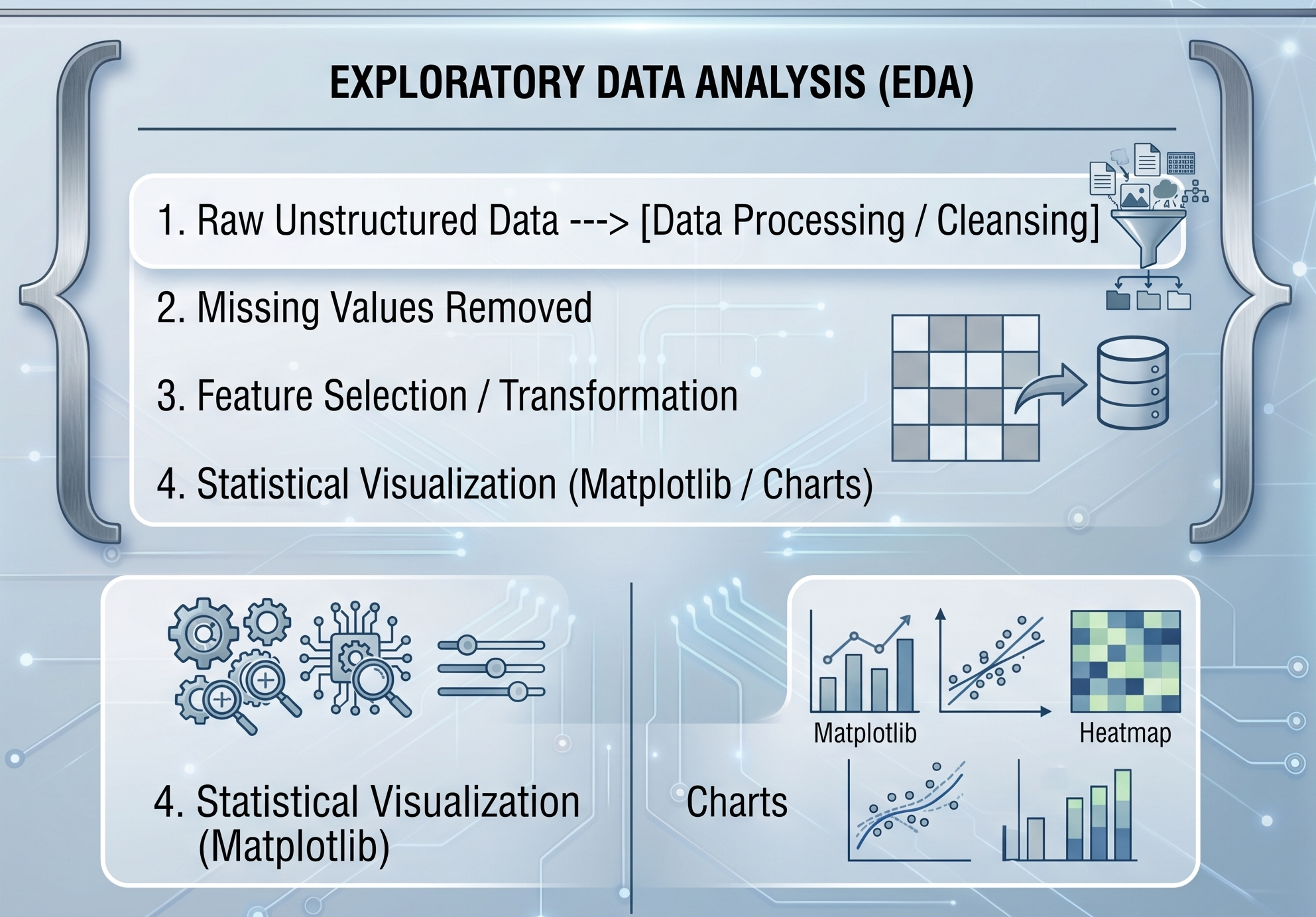
Prior to the development of the model, it is necessary to gather and analyze the data.
Pandas, Numpy: Methods such as Slicing, Indexing and Joining in the process of data analysis.
Data Cleaning: Detection of the lack of certain data and anomalies.
Data Visualization: Application of Matplotlib and Seaborn libraries for visualization.
Core Pillar 4: Machine Learning & Artificial Neural Networks (ANN)
At this stage, we study AI algorithms for prediction starting from simple prediction models and up to more complex processes.
Supervised Learning Algorithms: Regression algorithms.
Unsupervised Learning Algorithms: Finding assemblage like k-means, which deviate from the common pattern.
ANN: Study of the input layer, network architecture, and weights, etc.
3. Key Technical Disciplines for Applied Artificial Intelligence
To become proficient in AI, one has to go past standard programming skills into dedicated visual, semantic, and computational disciplines.
Natural Language Processing (NLP) and Transformers
Today's text-driven AI has gone way past basic keyword searches or simple frequencies. Modern text systems use transformers that analyze text contexts in both directions.
Tokenization and Embedding: Converting text into high-dimensional vectors with geometrical representations where semantically similar words are clustered together.
Attention mechanism: The ability of a model to concentrate on highly significant parts of an entire sentence regardless of their physical distance from each other.
Computer Vision (CV)
Computer vision teaches neural networks how to recognize visual information provided by cameras, medical scanning devices, and satellites.
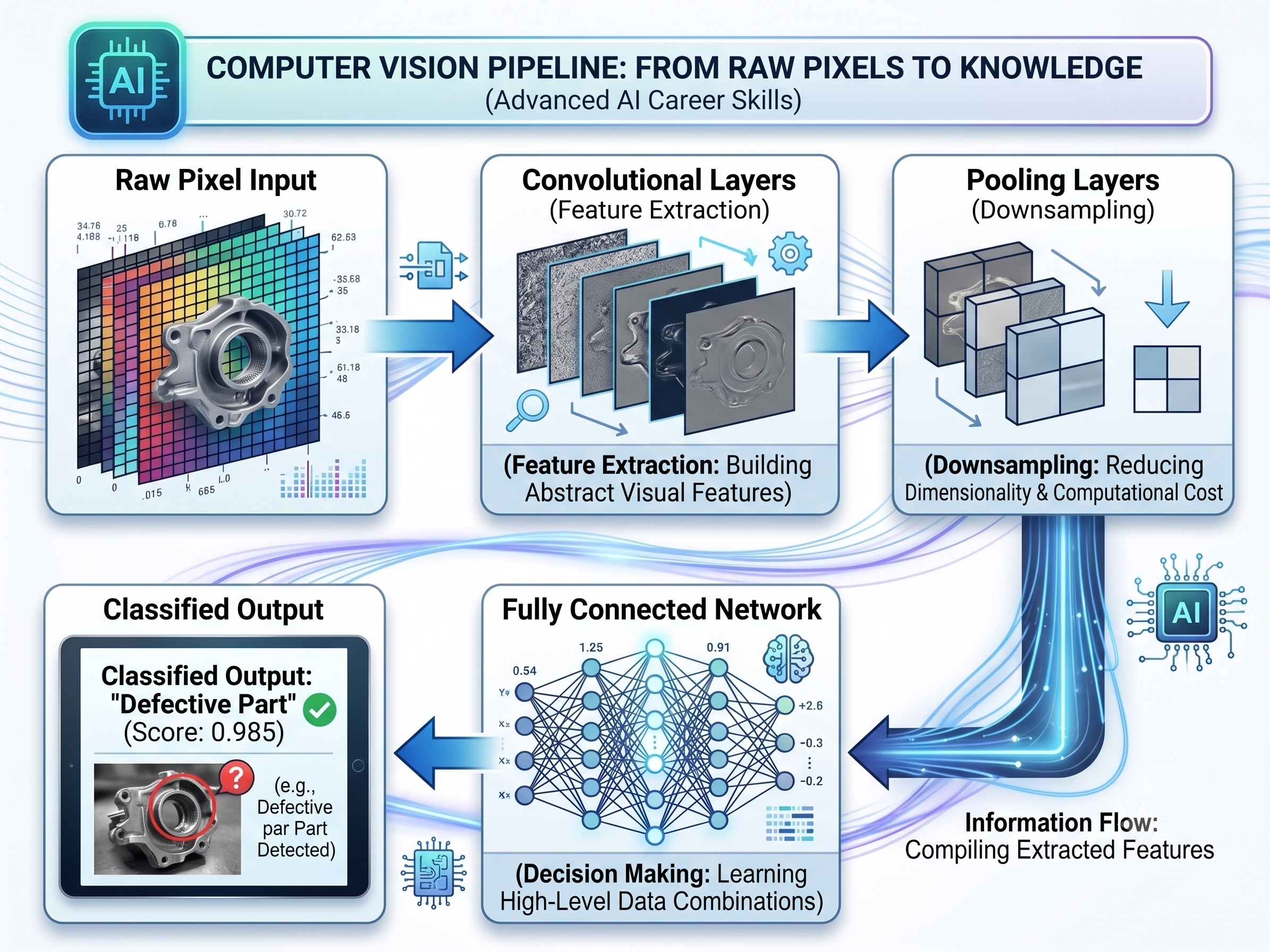
CNNs: Certain types of neural networks that have been designed to detect hierarchies within spaces (for instance, in the form of pixels) including patterns of movement or line.
Applications: Used for quality certainty in manufacturing, detection of tumors in healthcare, and object detection in driverless car technology.
4. Designing for Scalability: MLOps and the Data Pipeline
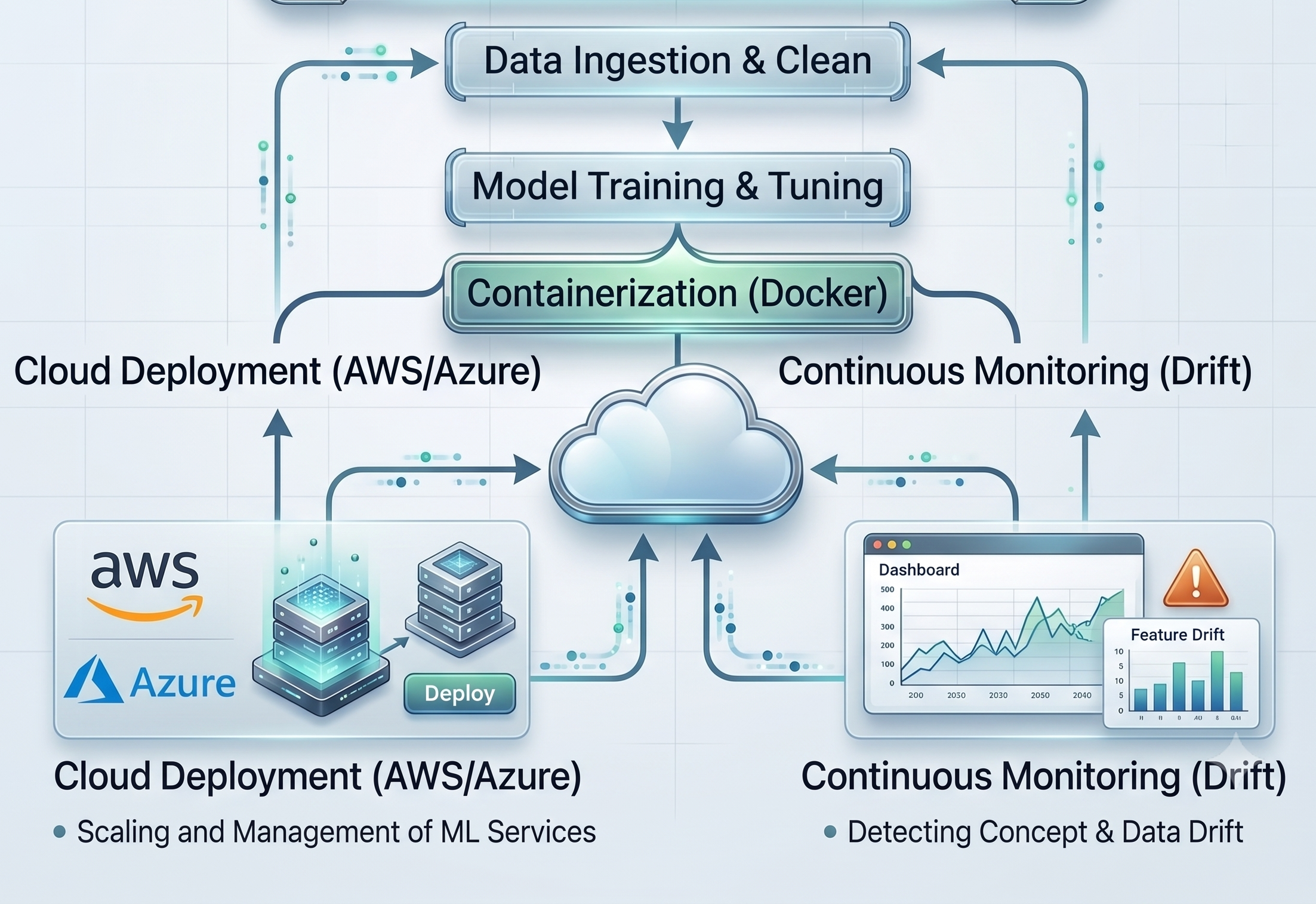
It does not matter how great an AI model you design on your personal computer if you cannot make it scalable for production. The link between data science and software architecture is MLOps (Machine Learning Operations).
Components of Critical Infrastructure:
Data Engineering Pipeline: Ingestion of large volumes of data using platforms such as Apache Spark and SQL or NoSQL databases to guarantee that data is clean, well-formatted, and consistent before reaching the model.
Containerization and Orchestration: Making use of Docker to containerize the AI engine along with all its dependencies and guarantee that the same works seamlessly on different servers; Kubernetes is then used for scaling such containers according to the traffic requirements.
Data and Model Drift: Real-time production data evolves. Data scientists monitor the performance of deployed models to detect situations when changes in real-life data start causing deterioration of the prediction accuracy.
5. Hands-on Portfolio Milestones & Career Pathing
Evidence of being able to engineer lies in validated portfolio projects similar to business problems encountered.
Production Portfolio Milestones Include:
Predictive Analysis Engine: Developing a validated supervised machine learning system to predict business results from unprocessed behavioral data.
Deep Learning for Computer Vision: Engineering an artificial neural network capable of dealing with multidimensional arrays in visual assets classification and recognition.
Enterprise Exploratory Pipelines: Creating data visualization systems to transform unstructured metrics into meaningful business analytic reports.
Explainable AI (XAI) Models
As mentioned above, the solution to this problem is achieved through transparency and interpretation techniques in AI, using special mathematical frameworks for model evaluation:
SHAP (SHapley Additive explanations): The algorithm is based on the principles of the game theory and shows in detail how much contribution was made to the final model decision by each separate feature. Thus, for instance, it is able to show explicitly that debt-to-income ratio contributed 60% to the decision on application rejection and 20% - employment period.
LIME (Local Interpretable Model-agnostic Explanations): The technique works with the black box model, changing only one feature and analyzing the difference in the model output. As a result, the system creates a simple local model that explains a particular prediction.
The application of such frameworks will help engineering teams audit the models for fairness, detect, and eliminate any demographic or socio-economic bias that is hidden deep down in the training dataset, and ensure full compliance with all the ever-changing laws related to the safety and privacy of data.
Career Pathways in the Global Market
Having knowledge of mathematics, as well as the MLOps engineering life cycle, can prepare technologists for highly impactful career pathways in the global technology industry.
AI Engineer: The task of an AI Engineer is the integration, implementation, and application of cognitive algorithms in current software systems. They specialize in working with large language models, fine-tuning pre-trained models, vector database management, and building conversational or agentic applications that work with end-users.
Machine Learning Engineer: Machine Learning Engineers work directly in the overlap area between data science and deployment. Their main job is to take the experiments created by scientists and scale, package, optimize and deploy these models into production. They are experts in creating automation pipelines, optimizing runtime performance and in MLOps infrastructure.
Data Scientist: Data Scientists pay special attention to extraction, explorations, statistical modeling and experimentation. They dive into messy and unorganized corporate data and discover critical business trends and conduct complex statistical analysis and create first predictive models which are used for defining corporate high-level strategies.
AI Solutions Architect: AI Solutions Architects provide the overall picture of the technological environment of an organization. They develop overall technical strategies, architectures of cloud infrastructure, data management practices, and computational infrastructure necessary for safe and profitable integration of AI models in the corporate ecosystem.
Conclusion: Your First Step Forward Into The Future
The shift from being a regular software engineer to becoming an Artificial Intelligence engineer involves much more than merely changing your way of programming or using machine learning tools. It involves a complete shift in your thought process from deterministic and logical approaches to probabilistic thinking based on data.
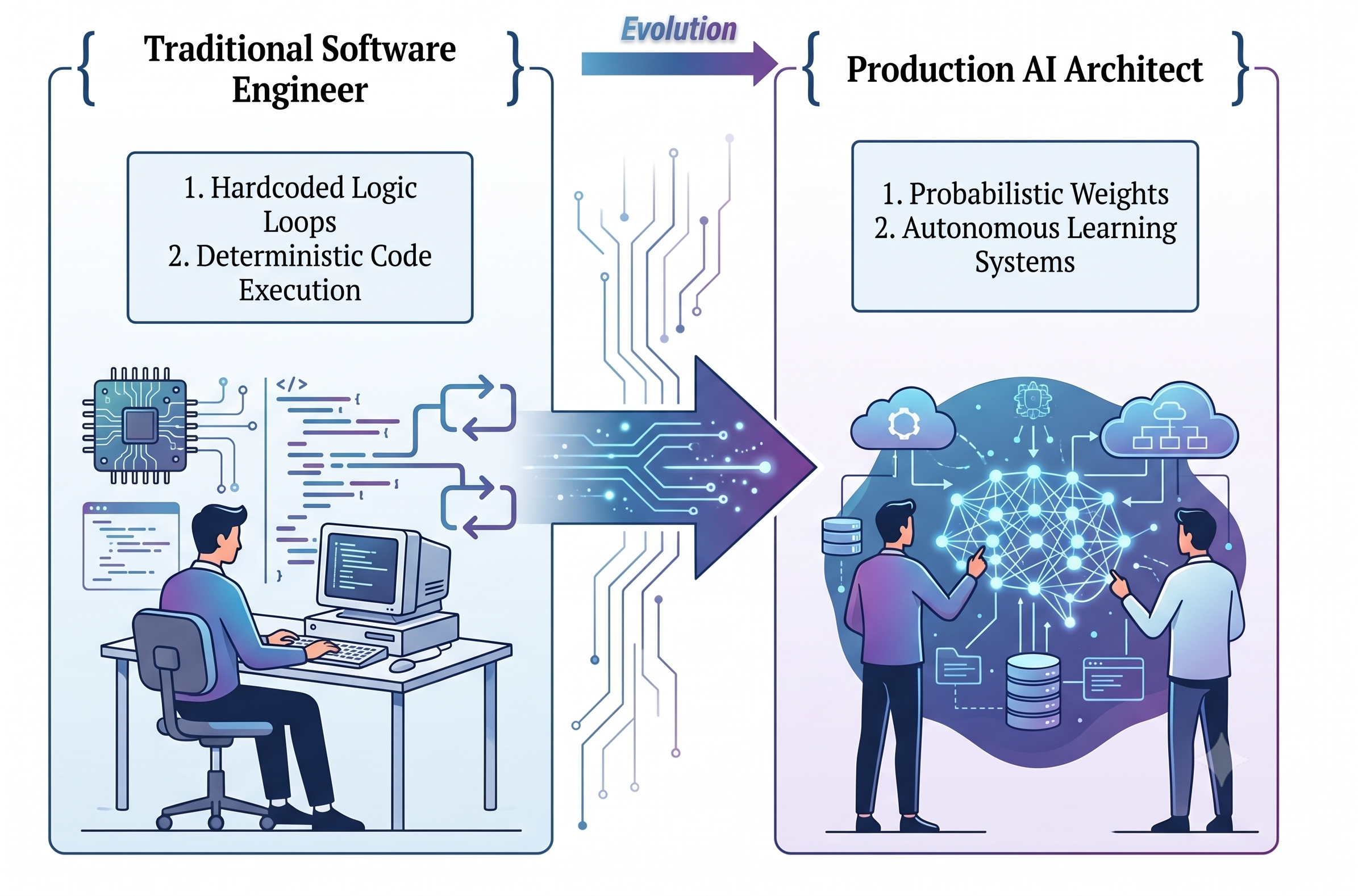
The journey to becoming a leader in this domain is a result of cross-functional integration of the following four pillars:
Basic Mathematics: Getting a thorough and functional understanding of multi-variable calculus, linear algebra, and inferential statistics so that you can successfully debug complex neural architectures and reduce modeling errors.
Data Engineering Made Efficient: Design data pipelines that process complex and chaotic data streams and create robust feature matrices for the machine.
Neural Networks Architecture: Design multi-layered neural networks, spatial convolutional network architecture, and bidirectional transformer architecture to detect latent semantic features.
Automatic ML Pipeline: Create operations using the Docker technology, schedule operations dynamically using Kubernetes technology, and monitor predictions in real time to combat silent degradation of models.
With the accomplishment of these technical skills in all of these areas, one moves onto the strategic level of development. This enables you to transition from merely being an end-user of AI software packages to becoming the designer and architect of the future of technological progress on a global scale.
Enterprise systems that you implement will not just perform automated actions, but also act as engines for predictive intelligence, perform spatial analytics in real time, and generate conversational reasoning systems in various sectors on a global scale. The barrier to entry may be rather high, but the road ahead is crystal clear. Plan out your learning trajectory, immerse yourself in the mathematical foundations, configure production systems reliably, and enroll in the ai agents course to take your first decisive step toward leadership in global organizing variation.