
The Ultimate Guide to MuleSoft Architecture and API-Led Connectivity
Last updated on Jul 8, 2026
In today’s modern world, it can often be stated that data is the new oil. However, such a comparison is not complete. In contrast to oil, data is usually not available from one central location that can be easily accessed. On the contrary, in today’s organization, data can be found in an increasingly fragmented environment, which includes on-premises databases, multi-clouds, SaaS applications, and edge devices.
Lack of innovation in this case cannot stem from the lack of either data or software capabilities. Integration challenges stand in the way of progress for businesses when they are trying to combine all their systems in one.
MuleSoft, a part of the Salesforce Company, offers a different perspective on this problem. While in most cases integration remains an engineering problem to solve via bespoke software, MuleSoft brings integration back to architecture. It is only possible through the use of the Anypoint Platform, which happens to be the central product of the company alongside API-led connectivity that stands as the key approach of mulesoft. Professionals tend to make use of a structured mulesoft online training offered by OnlineITGuru for bridging the gap between both of these aspects.
1. The Central Ideology: From Point-to-Point to Composability
In order to comprehend the reason behind the widespread acceptance of MuleSoft in many of the world's leading corporations, it is first necessary to identify the basic flaw in the conventional approach of custom integration which involves the point-to-point (P2P) approach.
The Weakness of Point-to-Point Approach to Integration
Whenever a firm needs to integrate its CRM such as Salesforce with another ERP, such as SAP, a programmer could write a script or Java program to get the data out of one and then transform and load it to another. It would be fine with two systems.
But as the company grows, a new engine for e-commerce, inventory control system, logistics system, support system, and marketing automation software are added to the mix. For communication between these different systems to be possible, the number of P2P communications becomes quadratic in proportion to the number of systems, which can be represented as:
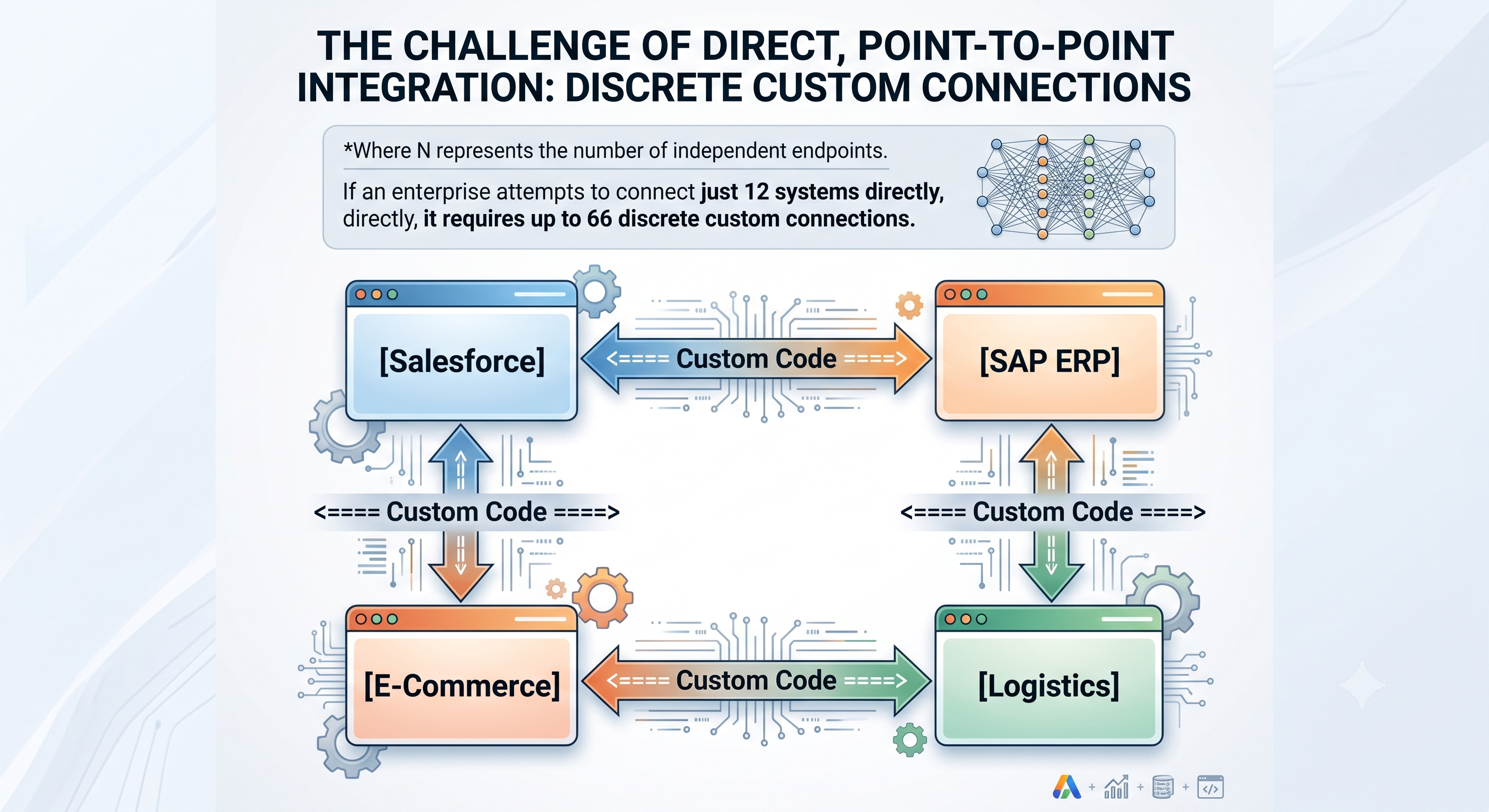
This architecture generates immense technical debt:
Brittleness: A small change in the schema of one system will break several custom scripts further along the chain.
Invisibility: Since the code is scattered among different servers and cron jobs, pinpointing problems and bottlenecks becomes extremely challenging.
No reuse: Each integration is handled as a custom build. In case the mobile app requires the exact customer data that the ecommerce website already connects to, programmers have to duplicate all connections from scratch.
The Microservices and API-led Alternative
By adding the abstraction layer in between, MuleSoft solves this problem. Rather than coding a direct pipe between System A and System B, each system exposes its data and logic through a shared communication channel to the central communication bus via reusable Application Programming Interfaces (APIs).
If integrations are built using standardized building blocks, the whole enterprise transforms into a composable one. In case the company decides to replace the legacy inventory database with a new cloud data warehouse, only the API component interacting with this database would be updated. Nothing else would be affected.
2. Technical Blueprint: The 3-Tier API-Led Connectivity Architecture
API-led connectivity is the cornerstone of the design methodology espoused by MuleSoft. This methodology involves structuring the APIs in such a way that they are divided into three unique tiers according to their role and usage.
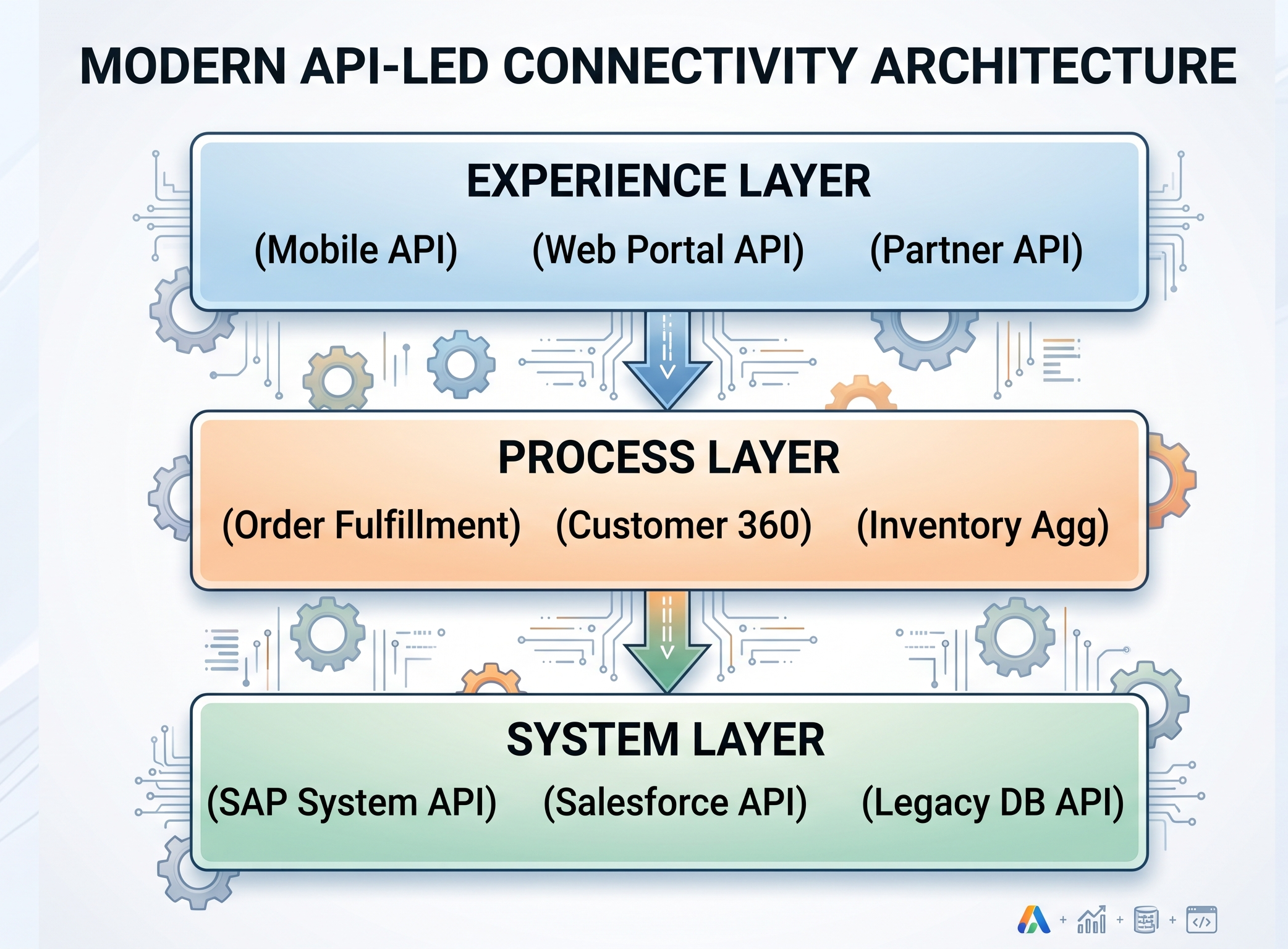
The System Layer
The System Layer is tasked with the responsibility of unleashing the core assets of the organization. It works directly with the core systems of record like Mainframes, SAP, Oracle ERP, NetSuite, and custom SQL databases.
Properties: The System layer APIs shield downstream developers from the intricacies, strange protocols, and complex data formats used by the legacy backend systems.
Lifecycle: The System APIs rarely change since they mimic core infrastructure and therefore are governed strictly by the organization’s corporate governance.
Example: GetCustomerFromSAP System API will translate the strange protocols of SAP’s RFCs or complex XML payloads into a standardized JSON object.
Process Layer
Process Layer is composed of all the business logic, orchestration and aggregation rules. APIs in this layer aggregate and process data received via one or more System APIs, ignoring how it was obtained.
Characteristics: Process Layer is like an engine room of business processes. It manages the state, data enrichment, merging of data and conditional routing of data.
Lifecycle: Process APIs evolve together with changing business requirements, when a company changes its order processing logic or comes up with the new customer on-boarding process, for example.
Example: The CheckCustomerStatus Process API sends the request to the SAP System API to get the billing history and simultaneously requests the Salesforce System API for open support tickets to find out whether the customer qualifies for a credit extension.
Experience Layer
Experience Layer transforms data and delivers it to particular digital channels and consumer devices. Various consumers need various data representations: a mobile application needs the highly optimized light-weight payload of data to preserve power and wireless capacity, while an internal web-based dashboard needs the full-scale dataset.
Features: Experience APIs filter out excess details, provide protocol conversion, and deliver content optimally for the given target interface.
Lifecycle: This tier evolves fast, in line with the rapid cycle of development of frontend user interfaces.
Example: A process such as ECommerceCheckoutExperience API offers a customized endpoint that is designed specifically to receive mobile one-click checkout requests and pass them on to the Process layer.
3. MuleSoft Anypoint Platform Ecosystem
MuleSoft provides its services through Anypoint Platform, which is an iPaaS platform (Integration Platform as a Service). However, given that getting familiar with such a complex ecosystem necessitates a good grasp of cloud integration, then one can achieve faster success when enrolled in a mulesoft online training.
Anypoint Design Center
The Design Center is a place where developers can play. It features web-based design tools such as API Designer, which enables software architects to describe API by means of the industry standard modeling languages (RAML – RESTful API Modeling Language or OAS – OpenAPI Specification). Mocking services are immediately available for the developers to check the behavior of the API prior to writing any integration code.
For building the integration flows themselves, MuleSoft provides Anypoint Studio, which is a Visual IDE based on Eclipse. In Anypoint Studio, users build the actual integration flows through a visual drag-and-drop canvas and still have access to the XML configuration files underneath.
Anypoint Exchange
This marketplace and reuse repository holds all digital assets of an organization. It includes hundreds of MuleSoft templates, examples, and connectors that connect to popular enterprise software (Workday, ServiceNow, AWS S3, Snowflake, and others).
Within an organization, the Exchange is used as the platform to expose custom System, Process, and Experience APIs. Through this self-service portal, developers avoid redundant work since they can check Exchange to make sure that there is no other flow that exposes the system that they need.
Mule Runtime Engine
The Mule Runtime Engine is the actual execution platform. It is a lightweight Java-based ESB solution that is built specifically for maximum performance with minimum resource usage.
This platform uses a non-blocking reactive architecture allowing it to handle millions of messages concurrently. This cloud-ready or local on commodity hardware solution routes and processes all incoming events through a set message flow and manages exceptions and transactions.
Management Center of Anypoint
The Management Center allows IT administrators and operation managers to have complete control over their application network through three main tools:
Runtime Manager: Tool for deploying, configuring and scaling Mule applications within cloud, on-premise or hybrid clusters.
API Manager: The tool responsible for governance. With API Manager, IT administrators can enforce security and throttling policies (like OAuth 2.0 authentication, rate limiting, Client ID enforcement and IP whitelisting) on live APIs without having to change the code of the application itself.
Anypoint Monitoring and Visualizer: Real-time monitoring of your application network. Visualizer automatically maps the dependencies of live APIs, thus allowing the users to visualize how the data is being transferred within the enterprise and spot the performance gaps or breakage points.
4. In Depth: DataWeave - The Data Transformation Engine
Every integration involves some form of data transformation. System A communicates in XML; System B understands JSON; a legacy system exports plain CSV records. In order to make the communication happen without having to write custom parsers, MuleSoft invented a special-purpose programming language called DataWeave.
It is native to the Mule Runtime Engine. It views data streams as functional collections to be processed by applying sophisticated mappings, filters, and aggregations to them with a nice syntax.
DataWeave Core Architecture and Features
Input/Output Format Agnostic: There is no difference between input and output formats for DataWeave. One could read an Excel file, merge it with an XML stream and output a JSON structure with the same core syntax. The runtime takes care of parsing and serializing of data.
Performance, Streaming: DataWeave is tuned heavily to stream data. Multi-gigabyte files could be parsed and transformed without loading the whole payload in memory thus avoiding OutOfMemory errors common for other custom parsers written on Java.
Strong Typing: DataWeave has strong typing. It allows one to easily debug data transformation scripts in Anypoint Studio before their deployment into the production environment.
DataWeave Syntax in Use
For example, in order to showcase the ease of using DataWeave, here is the input XML message which is a representation of the raw order from the legacy mainframe system:
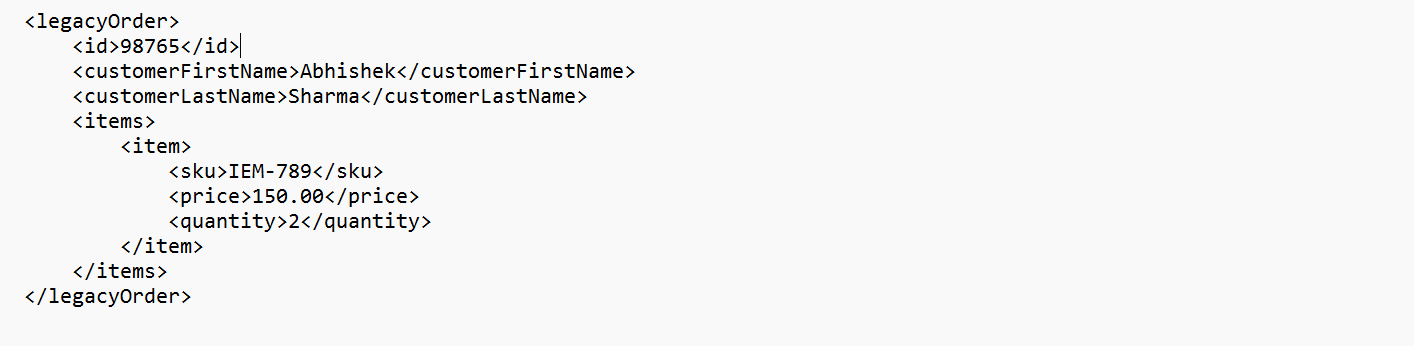
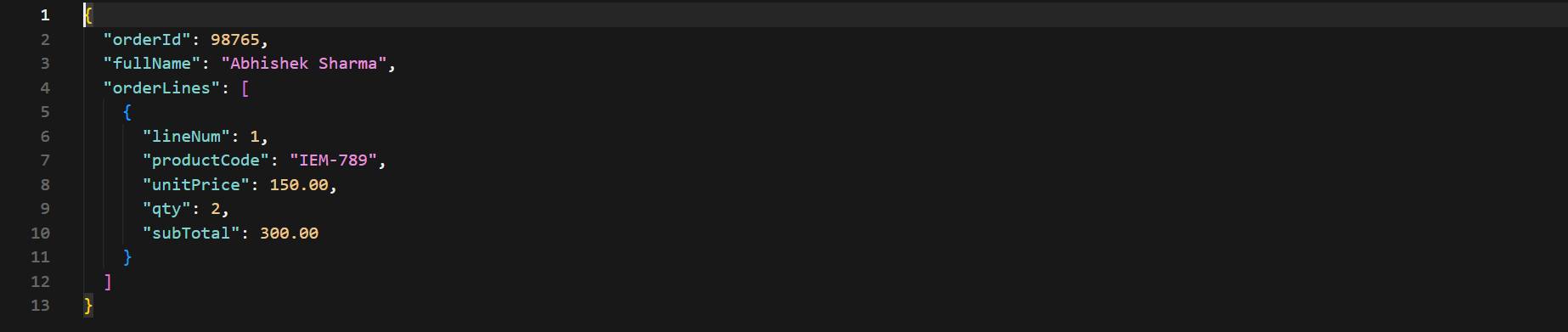
The requirement for the organization may be to convert this data into JSON format, with calculated columns included. The DataWeave script for the same would look something like this:
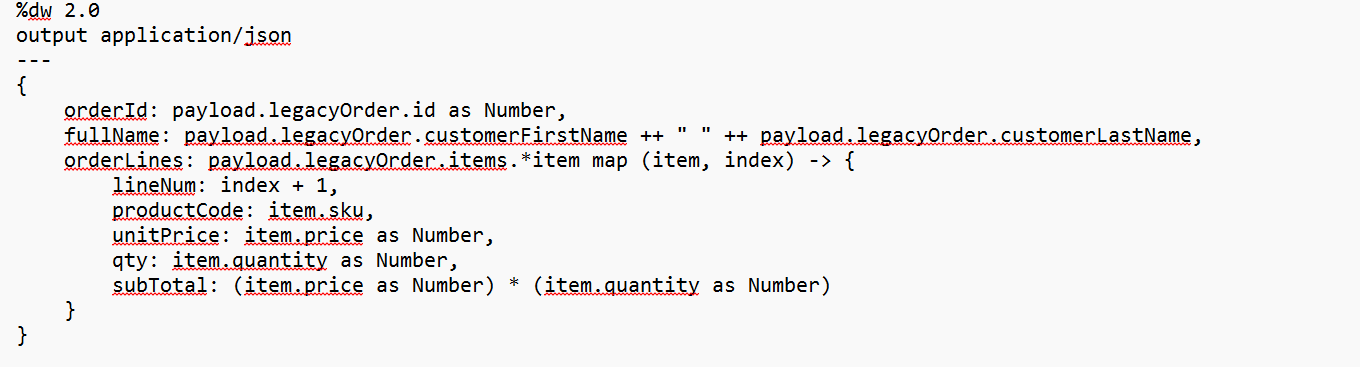
The result of the process would be the output JSON message:
5. Deployment Topologies – CloudHub, Hybrid and Runtime Fabric
Organizations work within multiple environments because of data residence laws, limitations of existing infrastructure, or even the cloud strategy of the organizations. MuleSoft supports multiple deployment topologies in order to cater to such needs.
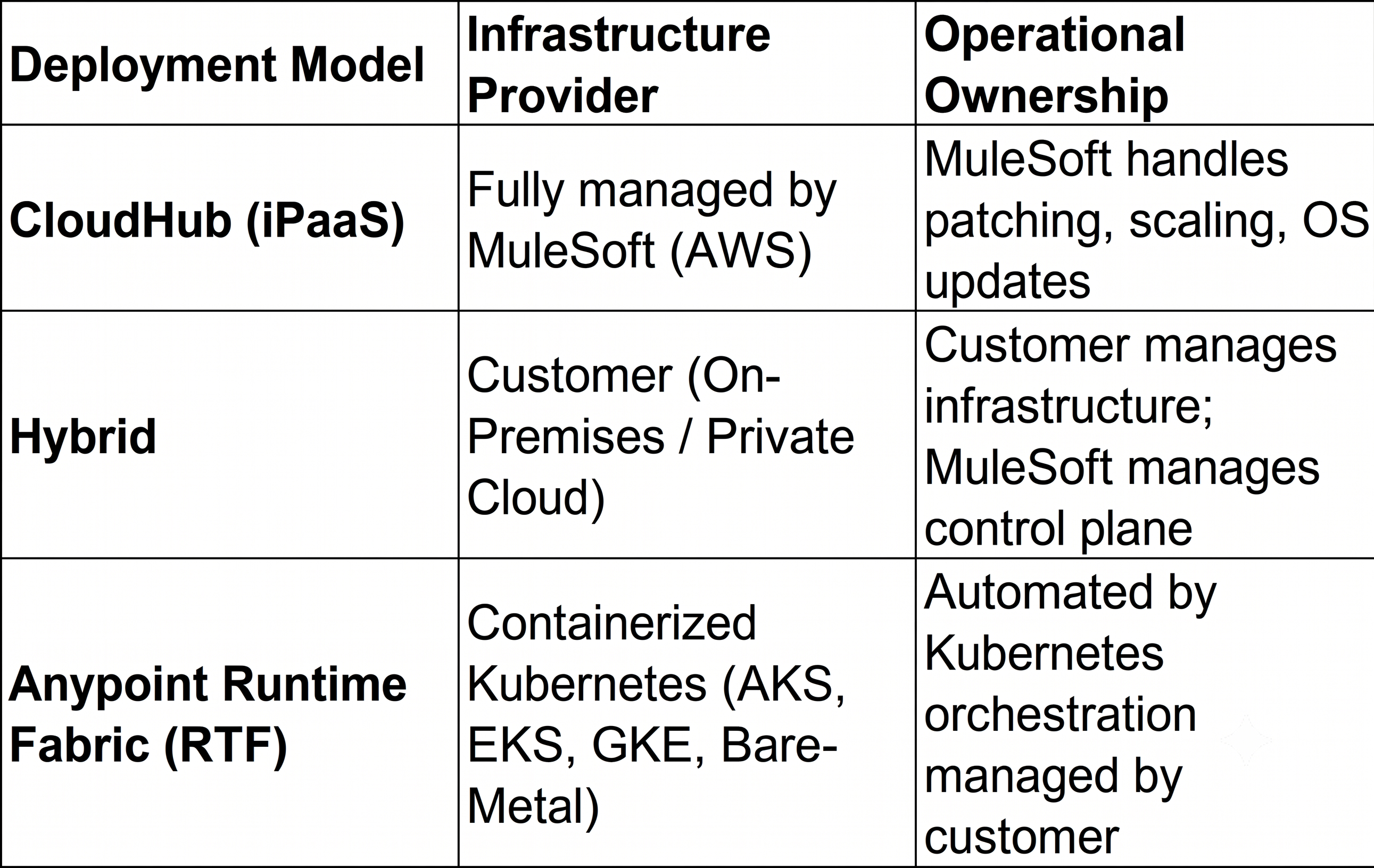
CloudHub: The Native Cloud Architecture
CloudHub is an enterprise-level cloud integration platform. On deployment of an application on the CloudHub platform, an instance of a dedicated, isolated virtual machine referred to as a Mule Worker is created by the platform.
There exist different computational power levels of workers (vCore based). CloudHub natively offers high availability, load balancing, and regional routing, which enables developers to scale their APIs horizontally or vertically with just one click in the Runtime Manager.
6. MuleSoft in the Modern Age: Agentic AI and Automation
With advances in technology, MuleSoft has not only been involved in application integration but also has extended to business process automation and AI management. After being acquired by Salesforce, MuleSoft plays a key role in AI ecosystems such as Salesforce Agentforce.
MuleSoft Composer and RPA
In recognition of the fact that every integration process does not necessarily need an enterprise developer, MuleSoft developed MuleSoft Composer. It is a lightweight and low-code interface available right inside Salesforce and other business suites. The business analyst, operations manager, or HR professional is able to configure automated workflows using the visual wizards instead of programming or creating RAMLs.
For legacy applications that have no API connections—desktop applications or green screen terminals for example—MuleSoft RPA (Robotic Process Automation) comes in handy. Intelligent software bots simulate user interface actions by clicking buttons, copy pasting texts, or data extraction from scanned images and feeds the extracted information right into the MuleSoft API Network.
Integration for the Agentic AI Ecosystem
The emergence of Agentic AI—autonomous AI agents with the ability to execute multi-step business strategy—has changed the integration requirements. The capabilities of an AI agent will be determined by its actions and the amount of data available to it. In the absence of integration, the AI assistant will be just a conversation text engine, isolated from the heart of the company.
MuleSoft is the integration platform responsible for connecting the AI brains with the nervous system of enterprises. If an AI agent wants to perform tasks such as checking warehouse inventory levels, issuing customer refunds, and updating billing addresses, then it uses the MuleSoft APIs for the job.
Moreover, solutions like MuleSoft Agent Fabric and Flex Gateway are extremely important from a management standpoint. They enable IT decision-makers to find out, secure, and track the activities of various AI agents in different cloud ecosystems and prevent "agent sprawl." Strict parameters of corporate data governance and security compliance are mandatory.
7. MuleSoft Architecture Best Practices
For obtaining maximum value from MuleSoft and building an application network that will speed up digital transformation, developers must adhere to the following key architectural best practices:
Strict Separation of Layers: Avoid any urge to mix the layers. Never make System API perform business logic processing, and never have an Experience API access ERP database directly. Maintaining separation between the layers will help to keep everything modular in the future.
Specification-first Design: Always generate design spec (RAML or OAS) in Design Center before implementing API in Anypoint Studio. This way frontend/backend teams can work simultaneously having mocked API ready.
Focus on Asset Reusability: Treat each integration as a product. Publish your APIs in Anypoint Exchange to be found by other departments, thus avoiding duplication of code.
Adopt Strong Error Handling Strategy: Take help of error handling capabilities offered by MuleSoft. Make sure APIs provide meaningful and standard HTTP status codes and error messages, helping in fast debugging and retry logic.
Ensure Edge Security: Make sure all exposed endpoints are secured using security policies at the API Manager level. Apply rate limiting to ensure protection against unanticipated traffic to back-end systems and also use encrypted property files to keep database passwords secure.
By following the above principles, the contemporary businesses will find it easy to dismantle traditional data silos, fix any technical debt, and make their whole IT environment composable. For the engineers who want to adopt these standards at their respective enterprises, complete mulesoft developer course online from OnlineITGuru will be very helpful.
Conclusion: The Composable Road Ahead
From being an optional choice to become more flexible for modern businesses, transitioning from point-to-point connections to an organized application network became a necessity to survive in a highly competitive landscape. With an influx of data arriving at businesses from all kinds of cloud systems, old infrastructure, and even edge nodes, a traditional approach using custom coding is doomed to be buried under its own complexity. MuleSoft's Anypoint Platform offers an innovative approach by revolutionizing integration in terms of a unified architecture.
Through decoupling systems by means of the three-tier API-led connectivity consisting of System, Process, and Experience layers, MuleSoft presents an approach to become a truly composable business. Legacy systems can be easily exposed, business logic is encapsulated, and data becomes optimally prepared for every frontend application. Thanks to such powerful data manipulation tools as DataWeave and flexible deployment options as CloudHub and Runtime Fabric, businesses gain amazing agility, operational insights, and solid security.
Looking forward, such architectural sophistication becomes all the more necessary in the age of Agentic AI and hyper-automation. Self-sovereign AI agents, such as those that exist in the Salesforce Agentforce platform, are no smarter than the extent to which they have access to data and capability for performing actions. MuleSoft plays the key role of ensuring that AI, beyond being a mere text-conversational agent, becomes an active powerhouse capable of checking inventories, updating ERPs, and managing customer workflows in real time.
At the end of the day, proficiency in MuleSoft is about much more than simply application integration; it is about building a reusable and scalable nervous system. For those organizations which will take a spec-first approach, separation of concerns, and a mindset that embraces asset reuse, the result will be an inevitable end to data silos, technical debt, and the ability to pivot within a moment's notice. Those interested in acquiring these much desired capabilities, whether they be individual developers or enterprise development teams, can do so through mulesoft developer course online at OnlineITGuru.