
The Workday Revolution: Architecture, Ecosystem, and the Future of Enterprise Cloud Software
Last updated on Jul 11, 2026
Enterprise Software traditionally had been an area of compromise. For many years, enterprises have used highly fragmented systems to run their operations with two of their most valuable assets being their people and money. These legacy systems which fell under Enterprise Resource Planning (ERP) were famous for being inflexible and required huge investments in terms of money and time. These ERP systems were known to have a continuous upgrade cost burden which ended up breaking all the customized code.
The founders of Workday, namely Aneel Bhusri and Dave Duffield, changed the ERP approach completely by establishing Workday in 2005. The emergence of Workday's unique cloud-based technology has made Workday a game changer in the way business is carried out. As large corporations are moving quickly away from their traditional systems to adopt this new technology, the ability to use it has become an essential career advancement tool. For those seeking to make a place in this huge trend, the choice of workday courses online has gained great popularity.
The Genesis: From PeopleSoft to the Cloud
The beginning of Workday is best explained by examining the corporate battles that led up to its creation. Previously, Dave Duffield had founded PeopleSoft back in 1987, which he made one of the most profitable HRMS software in the world. Aneel Bhusri was working alongside him, being an integral part of strategy and vice chairman.
In the early 2000s, Oracle started a hostile take-over against PeopleSoft. After a long, drawn-out battle of years, Oracle finally acquired PeopleSoft for $10.3 billion dollars in January 2005. The founders of PeopleSoft now found themselves out on the street, watching the company that they created get absorbed by Oracle’s large-scale portfolio.
The two of them did not decide to retire and instead met in a diner in Lake Tahoe, California to plot the next move. They understood that companies like Oracle and SAP were bound to carry the weight of their success. They had many millions of legacy code written for on-premises mainframe and client-server architecture that could not simply be moved to the cloud.
There was nothing old or existing for Duffield and Bhusri. They founded Workday with a clear vision to develop the best human capital and financial management application suite over the internet in a subscription model – Software-as-a-Service (SaaS), as we call it now.
Technology Blueprint: The Force of Unified Data Core
What sets apart Workday from its competitors is not the look of its interface or features that come with it, but the technology behind the application. Traditional ERP systems tend to be modular hybrids. Companies like SAP and Oracle have been growing for years by acquiring other software companies (SuccessFactors, Taleo, Hybris) and trying to unite them into a whole system.
A mess of databases is the result. A change in an employee profile within the HR application will probably need an overnight job to synchronize the data with the Payroll application, which then will initiate another one to synchronize with the accounting database. All the separate data in separate schemas will need complex iPaaS solutions to keep the harmony.
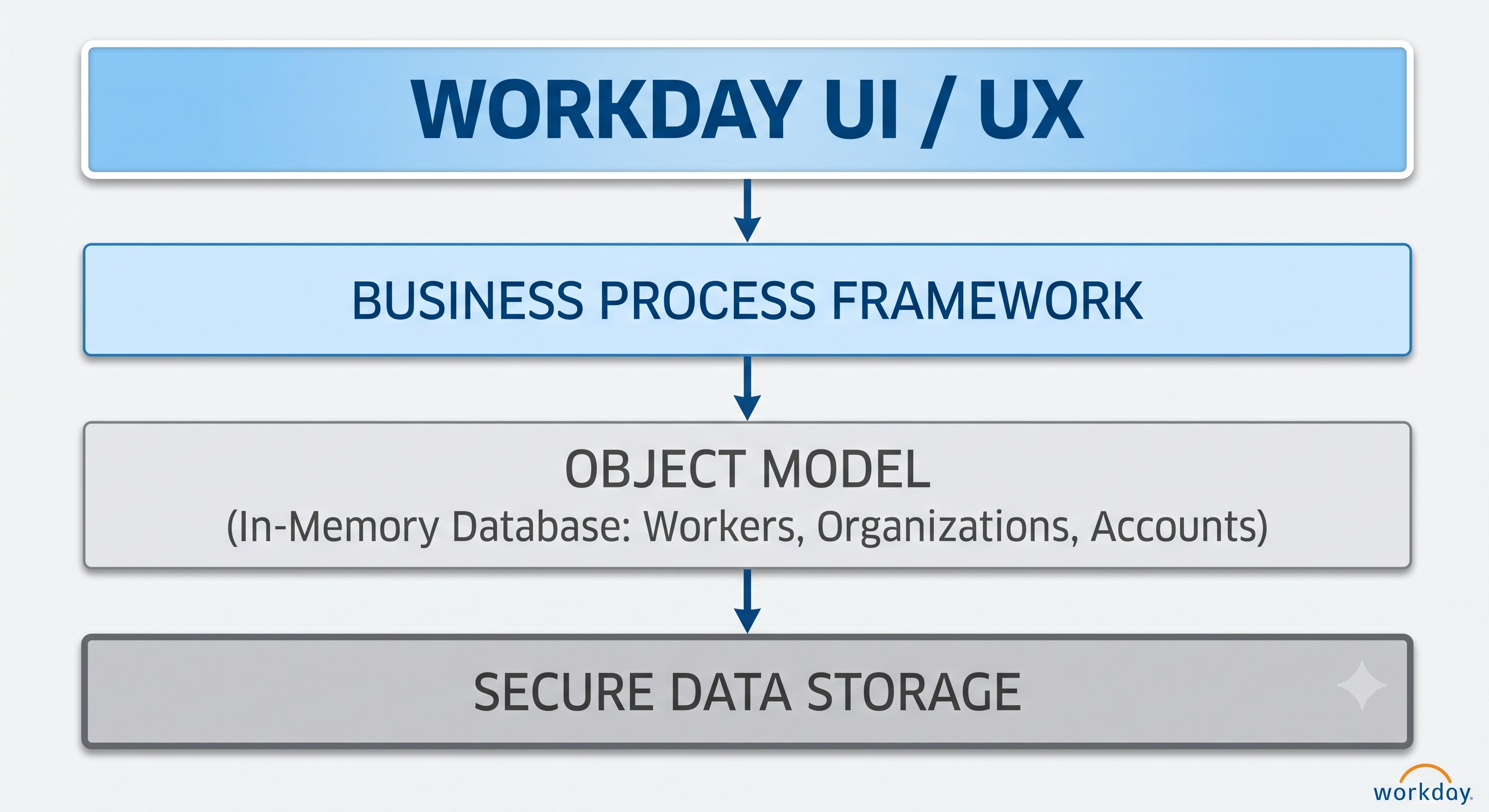
Workday solved all the problems by introducing a key concept – the Unified Data Core.
The In-Memory Object Model
As opposed to using conventional relational database table structure where data needs complex SQL joins in order to access information, Workday developed a database architecture that is fully operated in-memory.
At Workday, all business objects are just objects including employee, position, cost center, journal entry, or supervisory organization. Since all information is kept in RAM instead of retrieving it from slower hard drives, the analysis becomes instantaneous.
The Single Version of truth
Since Workday has one object model, it does not have two databases for HR and Finance departments. When the manager promotes an employee and increases his/her salary:
The Human Capital Management (HCM) module modifies the employee's title and grade.
The Payroll module automatically adjusts the paycheck deduction based on new salary.
The Financial Management module instantaneously adjusts the higher cost forecast in the department's budget ledger.
This process occurs simultaneously with zero interfaces batch.
Continuous Clean Software Advantage
A third radical change compared to the previous way is how Workday deploys its product. On-premise software meant that enterprises were bound to one certain version of the software. The process of upgrading to another version was so costly and risky that it could take enterprises 7 to 10 years between upgrades.
Workday uses a single codebase and multi-tenant architecture. All Workday customers around the world use one identical version of the software. Two times per year, Workday releases updates for all users at once. Customizations never fail due to separation of configurations in the metadata layer from the actual software logic. Such an approach makes sure that none of the customers ever gets stuck with outdated software versions.
The Core Product Suite
Starting from the beginning as an HR focused platform, Workday became a comprehensive enterprise cloud covering all the operations of a business.
Human Capital Management (HCM)
Workday HCM remains the key asset of the company's product range. It covers the whole life cycle of the employee from hiring to retirement.
HR Core: Creates supervision structures, organizational matrices, and worker profiles. The product helps global firms to monitor compliance within multiple regulatory environments without difficulty.
Talent Management & Compensation: Helps organizations to monitor employee skills, performance appraisal process, succession planning, and complicated incentive compensation.
Recruitment: Applicant tracking system (ATS) bundled in core HR, which ensures that after recruiting a candidate, his/her profile is immediately transformed into a worker profile without additional data entry.
Learning: Content distribution and management system that enables enterprises to develop their employees and monitor compliance training.
Workday Financial Management
For many years, the market was treating Workday as an HR vendor and skeptically questioning whether CFOs would be comfortable storing their GLs in the cloud. However, Workday Financial Management convinced all the skeptics.
General Ledger & Accounting: Provides multi-currency, multi-entity configuration and real-time consolidation capability. The CFO's job becomes much faster since transactions are processed in real time.
Revenue Management: Manages sophisticated contracts, revenue recognition rules (such as ASC 606), and invoicing processes.
Spend Management: Includes procurement, inventory, and spend management. An employee takes a photo of a receipt on his mobile phone and OCR of Workday pre-fills the expense report.
Planning and Adaptive Planning
In 2018, Workday made an acquisition worth $1.55 billion of Adaptive Insights and renamed it Workday Adaptive Planning. This solution acts as a financial planning and analysis solution (FP&A) for the whole company. It enables executives to create complicated multi-variable financial models, do scenario planning and forecast work force needs using live data coming straight from HCM and Financial modules.
Architecture of Customization: Extend and Prism
Traditionally, SaaS solutions were considered inflexible. If there was no certain button or process built into the solution, then it was impossible for the client to do so. Workday came up with an answer to this problem and introduced two important technologies:
Workday Extend
Workday Extend provides enterprise IT with the capability to create custom-made applications within the Workday environment. These bespoke applications will look, act, and feel exactly the same way as the native Workday page. Importantly, these applications can leverage the current security architecture and object models in the hosting system. In other words, the firm can develop a custom application called "Company Car Allocation" and check whether the employee has the right job level and the appropriate location.
Workday Prism Analytics
An enterprise generates a huge amount of data not in the ERP system but in the point-of-sale terminal, security badging terminal, or third-party CRM system, such as Salesforce. Workday Prism Analytics operates as a central data management platform within the Workday perimeter. The data engineer will have the opportunity to combine data from external pipelines, integrate them with HR and financial data in Workday, and generate analytics without leaking workforce data into any external data warehouse.
Security, Compliance, and the Global Enterprise
Enterprise management requires protecting highly confidential information: social security numbers, medical records, financial information, and financial performance indicators. Workday has been architected from the beginning using the concept of Unified Security Model.
Instead of configuring permissions in several different systems, the security administrator defines a single policy. In case an HR business partner has been given permission to view salaries of employees within a certain geographical area, this constraint will apply to Core HR, Payroll, Reporting, Analytics, and even on mobile platforms.
In addition to this, as more stringent rules like EU GDPR (General Data Protection Regulation) and several other localized data protection laws came into existence, it became possible for multinational companies to mask data, change retention policies, and generate audit trails to track the exact time when somebody accessed a particular data set.
The Competitive Environment: The War for the Cloud
The enterprise software industry is no joke. Workday is part of the highest level of competition, facing both established companies and small players.
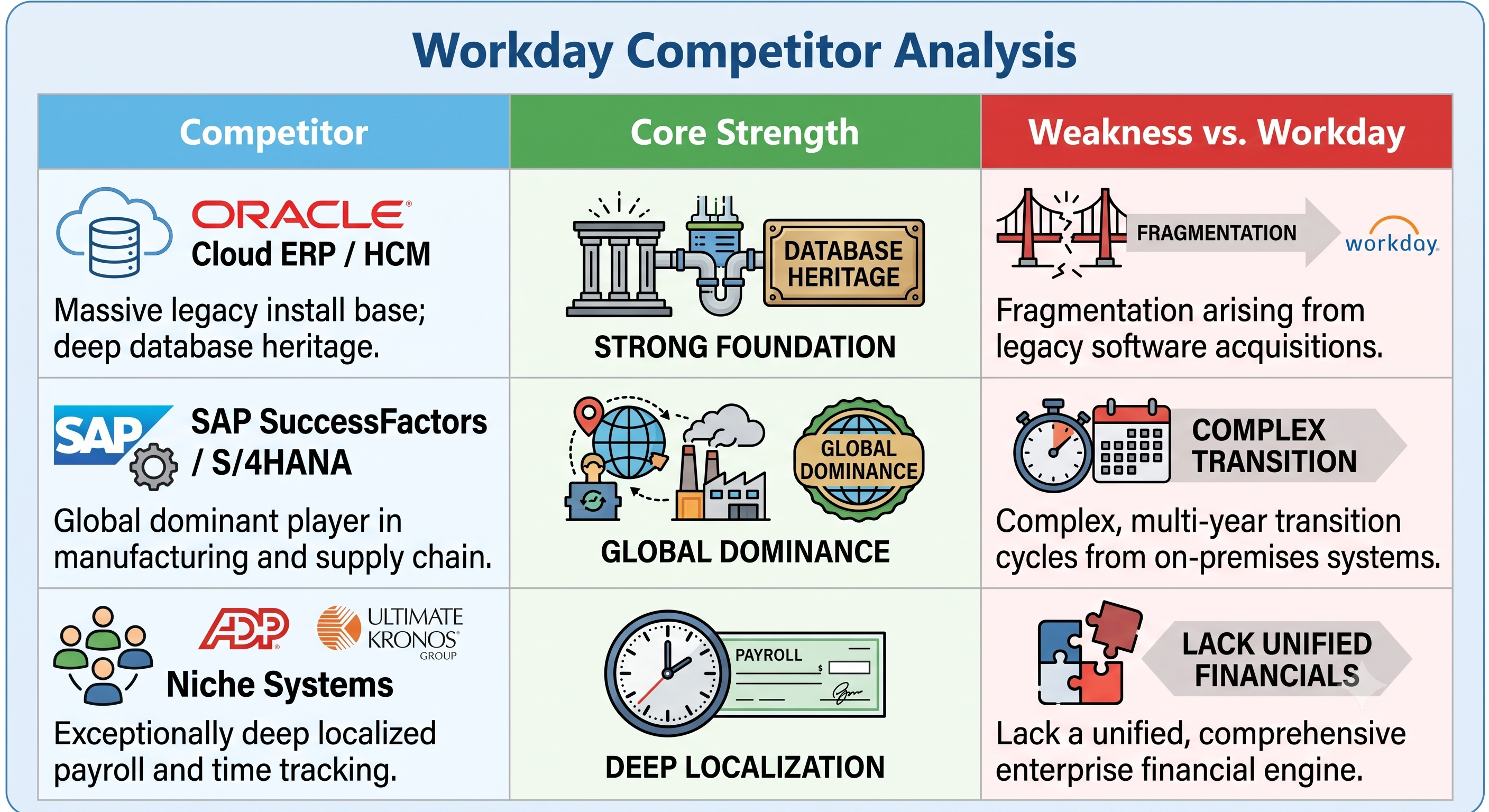
What sets Workday apart is the quality of its code base. While Oracle and SAP invest tons of money in creating middleware connectors that would connect their acquisitions, Workday uses its R&D budget to develop its core features and improve usability.
The Human and Cultural Factor
But not only through technology did Workday achieve its success in the market. It adopted an intentional cultural strategy as well. As Dave Duffield formulated it: "Employees first, customers second." The idea behind that was the following – happy employees take good care of their customers automatically.
Internally, this philosophy was reflected in focusing on Customer Satisfaction scores. In the world of enterprise software where traditionally companies were viewed in an adversarial manner, Workday regularly boasted of having customer satisfaction numbers above 95%. They maintained a rich ecosystem of users built around the annual Workday Rising conferences where system administrators, partners, and executives interact in an open manner.
Next Step in Enterprise Computing: Artificial Intelligence and Machine Learning
Data intelligence is the hallmark of modern enterprise computing. Having a single unified database is no longer enough as it is used for training of intelligent systems. And there is no enterprise that possesses such a unique wealth of corporate data like Workday.
Workday includes AI and ML technology in the core of its software architecture rather than selling it as an additional product.
Skills Cloud: Skills-Based Economy
One of the greatest use cases of ML technologies by Workday is the Skills Cloud. Resume information and job titles are notoriously ambiguous and inconsistent. Workday uses ML to analyze millions of job descriptions, performance reviews, and resumes to create a universal ontology of skills.
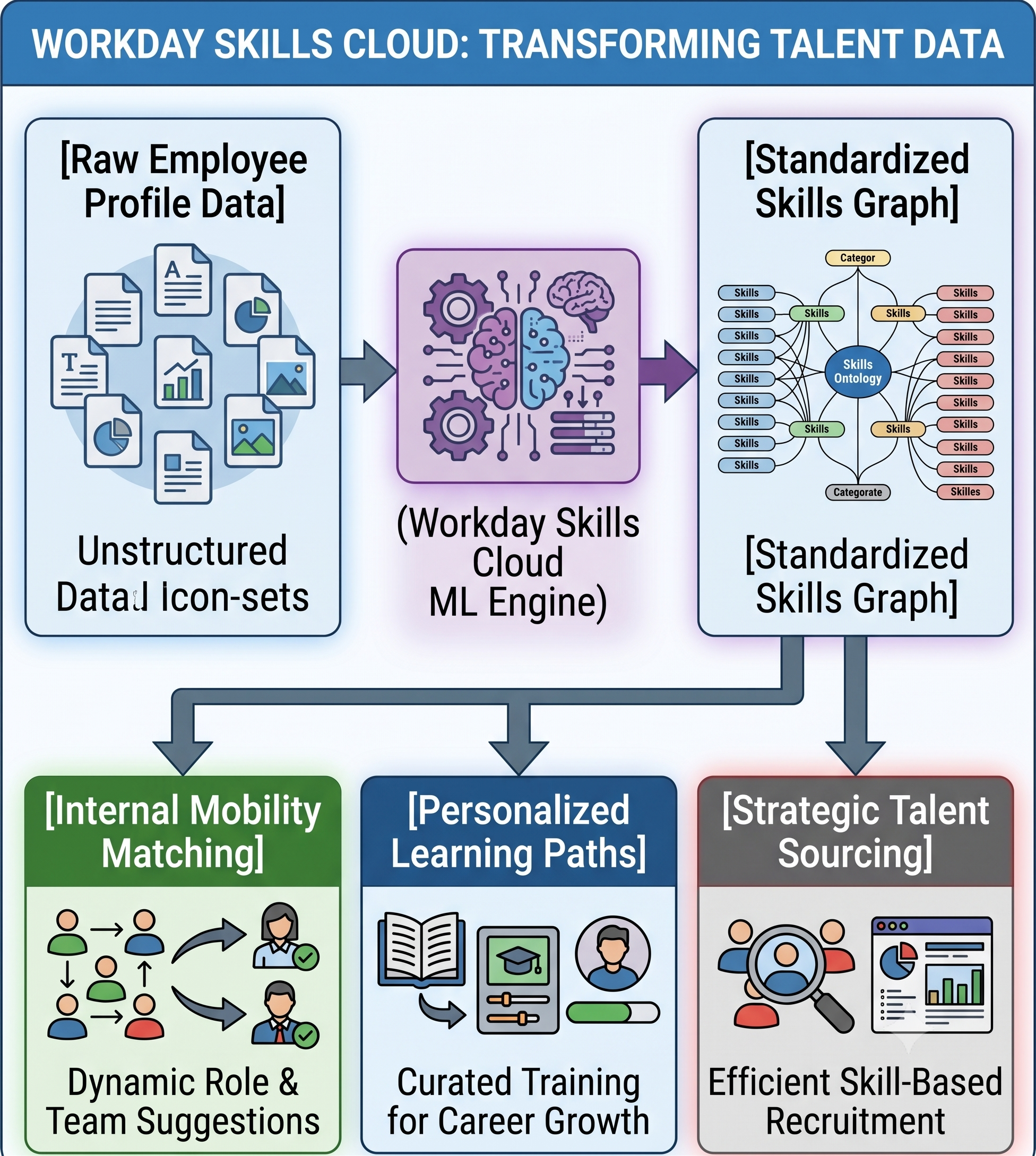
Based on an analysis of the skills of the workers, the system is able to make recommendations for:
Career changes that help employees develop themselves.
Customized training courses through Workday Learning to overcome skills shortages.
Improved candidate slates for recruiters taking into account their true abilities, not resume matching alone.
Generative AI and Process Automation
Through the use of generative AI, Workday automates the processes which require administrative input. With just a few clicks, the system can automatically prepare customized job descriptions, provide talent summaries for each individual worker, and summarize the terms of any financial contract. Financial departments can benefit from continuously scanning through thousands of ledger entries with machine learning algorithms in order to detect any anomalies.
Difficulties and Vulnerabilities
In spite of Workday’s rapid success and technological superiority, there remain certain structural challenges facing it as it moves forward into the future:
The Pivot to the Mid-Market: Workday was designed for the Fortune 500. They have implementation and subscription prices that require serious investments. In order to keep growing at such a high pace, Workday will need to keep winning businesses in the mid-market segment and here they are up against smaller and cheaper solutions offered by BambooHR, Rialto or Rippling.
The Manufacturing / SCM Weaknesses: While Workday is the clear winner in the service industry, finance and technology sector, they do not offer any serious Manufacturing Execution System (MES) or Supply Chain Management (SCM) system, which makes it impossible for big manufacturing companies to implement their solutions.
High Dependence on System Integrators: The workday solutions are complicated and the customers mostly deploy them through accredited partners like Accenture, Deloitte, PWC and KPMG. The costs charged by these professionals can raise the entire bill to two or three times higher than what it used to be initially. This huge financial hurdle is responsible for generating an explosive demand for internal technical expertise globally and this is why thousands of people who wish to make a career switch are enrolling in workday courses online at OnlineITGuru.
Ecosystem Expansion: The Marketplace and the Partner Networks
In its journey from application suite to a platform, Workday was responsible for giving rise to a large secondary economy - the Workday Ecosystem. Understanding that no single vendor can solve all the granular requirements for operation in different geographies, Workday introduced the Workday Marketplace – a tightly controlled community through which certified software vendors (ISVs) can develop pre-integrated software solutions using Workday APIs.
It could be a localized specialist in performing background checks in Singapore, a sophisticated automated tax calculator, or an industry-specific software application to plan nurses' schedules. These solutions can integrate with the core solution plug-and-play style. Thus, by making development of custom solutions easier and cheaper for customers, Workday keeps them on its platform and outsources peripheral software support to independent vendors.
On the other hand, it is a highly competitive job market that boasts numerous professionals who are certified in Workday. This market has a whole network of consulting firms and global systems integration companies, training literally thousands of configuration consultants each year. In order to make your career in this lucrative cloud economy, it would be wise to use interactive workday online training available from OnlineITGuru.
The Evolution of Leadership and the Next Act
One essential element of Workday's sustained stability has been its well-thought-out approach to succession planning. Founder Dave Duffield slowly withdrew himself from running the company, allowing Aneel Bhusri to take the wheel as the CEO. Recently, Workday managed an efficient transition of executives by hiring Carl Eschenbach, a seasoned veteran of enterprise technology, who first became the co-CEO together with Bhusri before becoming the sole chief executive.
Such a leadership transition symbolizes the end of the era when the priority was the disruption of the cloud and the production of products and the dawn of a new era where the priority will be global scale, growth in the vertical industries, and commercialization of artificial intelligence technologies. During this era of leadership, Workday is pushing its boundaries outside of its strongholds in North America and Western Europe into the Asia-Pacific region and Latin America.
Looking Forward: Workday in the Coming Decades
Ultimately, the future course for Workday is to transcend the realm of being merely a System of Record, or even System of Intelligence, and to become a System of Agency, which would perform autonomous actions rather than just presenting data and making predictions.
Think of a scenario, where AI agent detects an unexpected increase in demand for products in a certain region, analyzes headcount data automatically using Skills Cloud, creates a requisition for localized salespeople in Adaptive Planning, designs optimal compensation package taking into account the current live market data, and puts job offer together without the human executive even knowing about any of this.
In the end, staying true to the initial principle that people and money of any organization are intrinsically connected and should be seen through the same clean interface, Workday retains its unique position. Technologies may change, workplace environments may transform, but the core of every great business will always remain the same – the ability to navigate the present with crystal clear data and to plan the future with maximum agility.
Conclusion: The Blueprint for the Modern Enterprise
The tale of how Workday started from a blank sheet of paper at a California cafe and grew to be a cloud-based company serving more than 60 million people around the world shows just how effective purely architectural thinking can be. Understanding the need for data integration, cloud delivery, and a user-friendly interface was what helped Aneel Bhusri and Dave Duffield change the old industry.
Since firms are functioning in a highly volatile global economy environment, where talent is rapidly moving around, regulatory changes occur frequently, and technology is evolving quickly, there is definitely a need for a system like this one. Since artificial intelligence has been incorporated into the core data model, which was untapped until now, not only can Workday record the history of transactions within the company, but it can also dictate its future. In this context, both the firms who want to develop their IT staff and the developers, who would thrive in this future, need to undergo full workday online training offered by OnlineITGuru.