
Top Benefits of Learning UiPath: Why Automation Skills Matter in 2026
Last updated on Dec 9, 2025

The electronic world is changing under our feet faster than we have never seen before. By the year 2026, it is not whether automation will affect the workforce; it is how it will transform it to an extent. Those days of manual data Donkey work, of repetitive and tedious Donkey work, is quickly coming to an end and being supplanted by the lean and smart future of intelligent software robots. Robotic Process Automation (RPA) has become one of the most important technologies in this future fact, and UiPath is the first platform to become the leading one. To any professional seeking to future proof their career and open the door to a lot of growth, learning how to use this tool has ceased to be a choice, but rather a necessity. This paper explores the reasons why the automation-focused economy of 2026 predicts the UiPath expertise as the best career choice to make today.
How do UiPath automation skills help professionals stay relevant in the future of automation jobs?
Human-robot collaboration will be one of the defining characteristics of the very near future workplace. The panic about losing jobs to robots is being superseded by the fact that robots are doing jobs, and humanity is liberating to do the higher-value work. In this new paradigm, UiPath automation skills act as the critical differentiator between becoming obsolete and becoming indispensable. It is the professionals who will prosper who can recognize automate-able processes, create an effective workflow, and handle the digital workforce.
Simple digital literacy will fall short by 2026. Businesses will need people with an appreciation of how efficiency works. The UiPath skills enable you to cease being inactive as a technology user, but to be a proactive business solution architect. You will be the one who connects the old system of the business with the future that is digital. This capability is vital for staying relevant in the future of automation jobs, where the ability to leverage technology to solve complex business problems will be the primary metric of professional value. Rather than being afraid of being pushed out, UiPath practitioners will be the ones who help them undergo the process, which will keep them in the middle of organizational development and innovation.
Why is learning UiPath online considered one of the fastest ways to build robotic process automation skills in 2026?
The rate at which technology is changing nowadays makes most of the traditional education framework (which takes many years to be completed) to be too slow. When a standard curriculum is created and delivered, the technology has already been advanced. This is why the decision to learn UiPath online is increasingly viewed as the most efficient pathway to competency. RPA is a digital and cloud-based nature, and in this case, online learning conditions are practically the best way to learn these skills.
The new online tools can provide instant access to the newest versions of the UiPath software, ready-to-use sandbox environments to practice with, and real-life use-case scenarios. This immediacy is crucial for quickly building practical robotic process automation skills. Moreover, online learning enables professionals to upskill without disrupting the current career and integrating intensive learning into their working schedule, which is also flexible. As we approach the demands of automation skills 2026, the ability to rapidly acquire, test, and deploy new knowledge is paramount. Online applications accelerate the learning curve and learners are able to graduate to functional developer status within a few months, keeping up with the hectic pace of the industry demand.
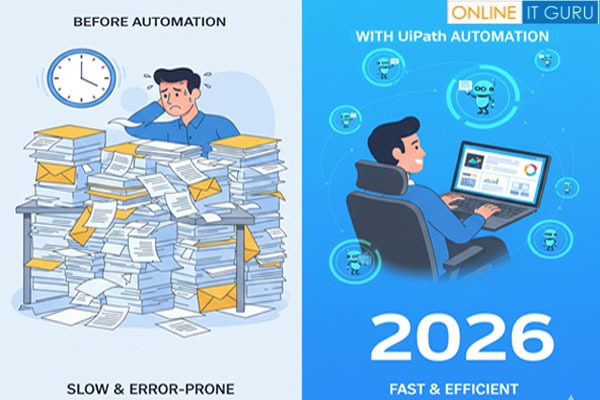
What are the key UiPath career benefits for professionals entering RPA career opportunities?
The RPA sphere and UiPath knowledge in it are the keys to the treasure trove of professional benefits. The most immediate of these UiPath career benefits is the significant earning potential. Because of the acute lack of qualified RPA professionals and their great demand compared to the vast global demand, the certified UiPath professionals receive extremely high salaries, which can be significantly higher than those of the traditionally IT-skilled professionals.
The field is extremely diverse in terms of position. It has nothing to do with hard-core coding. RPA career opportunities span a wide spectrum: Business Analysts are needed to identify process bottlenecks; Solution Architects are required to design complex automation infrastructures; Developers are essential for building the bots; and Infrastructure Engineers are needed to manage the orchestrator environments. This diversity makes sure that practitioners having various aptitudes, be it analytical, technical, or strategic have a profitable niche. Also, RPA is not often a sector-specific talent; it can be used in financial, healthcare, logistics, and manufacturing sectors, and it offers the highest level of employment and mobility to jobs across different industries.
How does a structured UiPath training course prepare learners for automation skills in 2026?
Although self-study through forums and random videos might offer a rudimentary introduction, it usually introduces dangerous knowledge gaps which can be realized in the practice of real-world enterprise settings. A structured UiPath training course is essential for preparing learners not just to use the tool, but to master it according to industry best practices. The demands of automation skills 2026 will require robust, scalable, and secure automation solutions—things that ad-hoc learning rarely covers.
A good curriculum is designed in a progressively scaffolding way. It goes past the straightforward record and playback methods into the more complicated fields of exception management, REFramework (Robotic Enterprise Framework), data manipulations, and cognitive AI-integration. It makes the learners know the reasons why something is done in a particular way. By enrolling in a comprehensive UI Path Training program, participants gain exposure to mentored projects that simulate actual business challenges. This mentoring experience is priceless, and the difference between theory and the applied problem-solving attitude of a working environment
Why are UiPath certification benefits becoming critical for advancing UiPath developer skills?
Noise is intensified in a booming market. What does an employer do to draw the line between an enthusiast who was taught on YouTube and a strict professional? This is where UiPath certification benefits become critical. Certification is a goal, a world-wise acknowledged mark of your competence. A UiPath certification is risk mitigation in the eyes of the hiring managers and hiring clients; it is evidence that you have a standardized base of knowledge and can perform to the standards set by UiPath.
Certification is also a gateway to the top of the career ladder to the people who are already in the field. Advancing UiPath developer skills to a Senior or Architect level frequently requires the deep-dive knowledge tested in advanced certification exams. It is an indication of a serious take on the craft and command over such intricate concepts as scalable architecture and security governance. As automation programs grow larger and larger organizations adopt it by 2026, they will demand certified professionals to manage their mission critical bot rollouts, and certification will become an indispensable resource to career advancement.

Want to get Certified on UI Path? Enroll for UI Path Certification Course
What do robotic process automation skills impact long-term growth in automation-driven careers?
RPA is being seen as a stepping stone by many, yet it forms the basis of a much bigger career in smart automation. Acquiring solid robotic process automation skills today lays the groundwork for long-term growth in automation-driven careers because RPA is increasingly converging with Artificial Intelligence (AI) and Machine Learning (ML).
RPA has structured tasks that are rule based. But the next stage up to which you progress as you become an expert with UiPath is so-called cognitive automation the ability to combine tools that read unstructured documents (Document Understanding), sentiment (NLP), or make probabilistic decisions (ML models). The platform of these sophisticated technologies is UiPath. It is thus only with RPA that you would not be pigeonholed into a legacy technology. Rather you are on a progressive path, developing the simple bots through to the creation of intelligent and sophisticated digital workforces. This constant development will make the career long after 2026.
What role do UiPath developer skills play in shaping the future of automation jobs?
UiPath developers are not only coders but also the creators of the new world of work. They are not confined to the implementation of instructions and principles but essentially redesigned the way business processes are carried out. UiPath developer skills are the tools used to dismantle inefficient, decades-old workflows and rebuild them for the digital age.
These developers play a pivotal role in shaping the future of automation jobs by determining what is possible. It is them that are determining how they can mingle a modern CRM with a legacy mainframe system with the help of a bot resulting in a technological disconnect of the kind that used to necessitate a human swivel-chair interface. Their flexibility to innovate using the platform has a direct effect of agility and efficiency of an organization. By choosing to learn UI Path, developers are empowering themselves to define the future workplace protocols, creating systems where humans and bots coexist productively. They are the pioneers of the real application of digital transformation.
How can UiPath automation skills open new global RPA career opportunities in the coming years?
Efficiency speaks globally. They may be a bank in London, a hospital in Hyderabad and a logistics company in Tokyo and all of them want to make their operations cheaper and more accurate. Because UiPath is the global market leader, possessing UiPath automation skills essentially gives you a practically universal work visa. The demand is not local, but it is a global one.
This global demand opens up unprecedented RPA career opportunities. We witness the great influx of remote work opportunities among the RPA developers so that the specialists could work in the best foreign companies in their home countries. Moreover, large consulting companies are always forming international teams of UiPath specialists to implement massive applications to multinational companies. It can be through freelancing sites, global consulting, or distance jobs where UiPath expertise eliminates geographical boundaries so in the next few years you can vie on the finest positions the world has to offer you.
Conclusion: The Future of Work.
We are rushing at a speed so fast to the year 2026 and the gap between the automated and the non-automated workforce will be unbridgeable. The UiPath advantages go way beyond a pay raise, this is a guarantee of employment, ability to move across career paths, and a place at the table where the future of business is being determined. The opportunity to become a leader in this space is available at the present moment. Not to see the revolution, but to be part of it. To acquire the organized, intensive knowledge required to make it as a success, consider collaborating with a reputed training organization. To follow a complete journey of becoming a beginner to an expert, consider the OnlineITGuru that will help you find your way towards mastering the art of automation.