
UiPath Robots: Architecture, Governance, and Enterprise Scale
Last updated on Oct 13, 2026
Robotic Process Automation has come a long way from being considered an innovative tool for achieving efficiency in operations to being termed the backbone of modern-day digital enterprises. The central piece of the automation ecosystem from UiPath is a software robot or a lightweight execution agent that is capable of interfacing with humans, APIs, databases, and unstructured data streams. Automation design occurs on the development canvas while governance happens using orchestration layers; and software robots do the actual work here. It becomes the digital hands, eyes, and brain for automation projects in the organization.
The comprehension of the categorization, working and application of UiPath robots at organizational level is important for enterprise architects and technical supervisors to be cautious when introducing digital employees in the absence of appropriate architectural foundations. The lack of the proper implementation may cause a number of challenges including unsatisfactory execution and management as well as incorrect utilization. Those who are willing to improve their practical skills in the area of architectural principles can take Best UiPath Training online from OnlineITGuru.
UiPath Robots – Architectural Foundation
The UiPath Robot is an execution engine working in conjunction with a host operating system or containerized runtime environment. The chief role of this Robot is executing automation workflows created and then published using a development environment, for instance, UiPath Studio. As opposed to being a replacement to any enterprise system, a software robot will work along humans interacting with the presentation layer of applications, web browsers, terminal screens, as well as the enterprise resource planning software in the background.
Architecture and Lifespan of a Robot
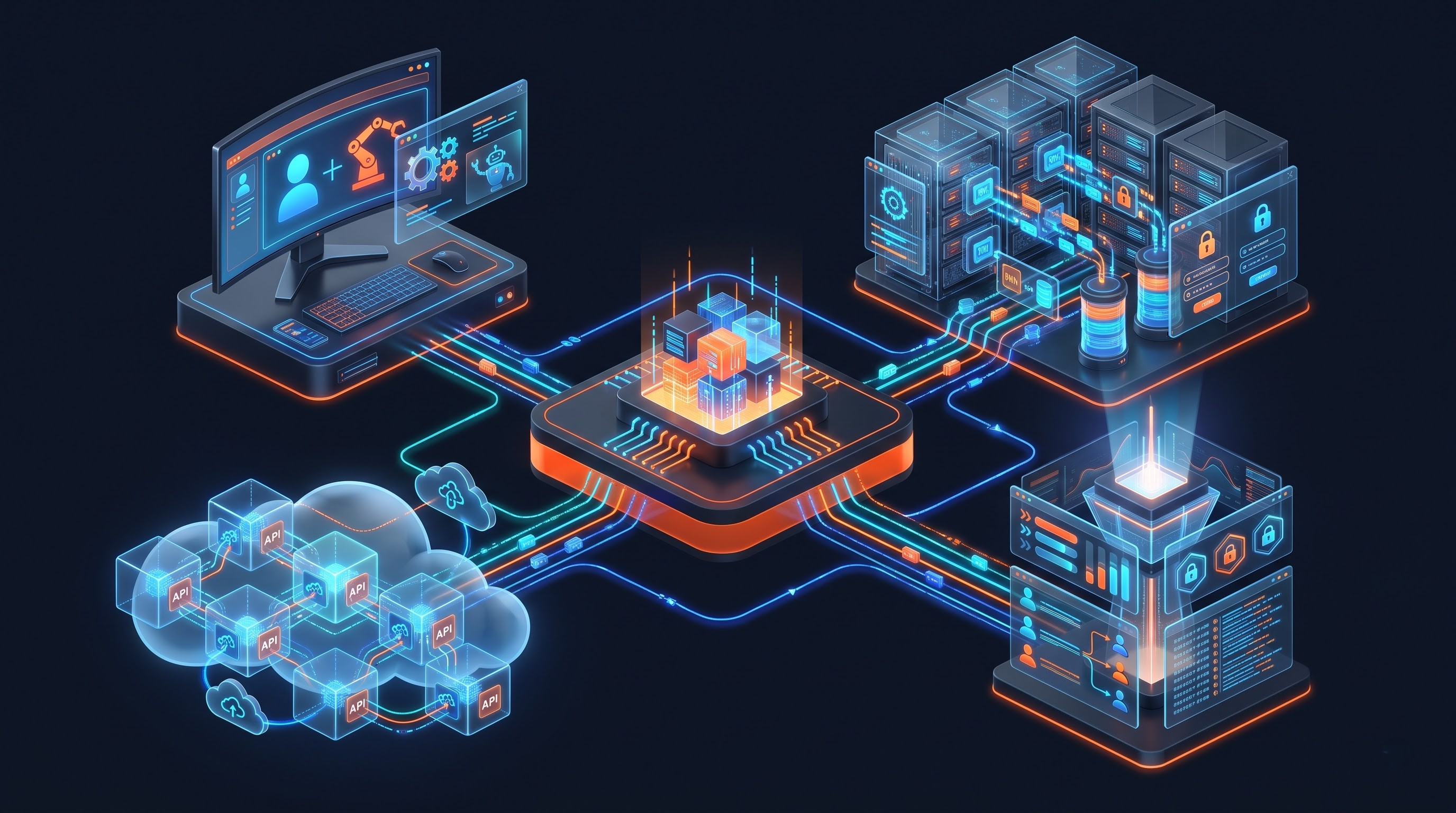
UiPath robots work on a decoupled architecture that involves client execution runtime, service controllers, as well as orchestration connection.
Robot Service controls local robot execution, scheduling, log routing, and provides persistent two-way communication with the management server, UiPath Orchestrator. This service guarantees that execution policies, environment settings, and access configurations that are set up at the enterprise level are applied to physical machine/virtual desktop infrastructure.
Robot Executor serves as a current execution instance. Whenever a workflow is started, the Robot Service creates a running instance. This includes working with planned activities, using GUI, utilizing algorithms and processing information. By separating the execution instance from the service controller, this architecture assures that the workflow failings, as well as bugs and other problems, won’t have a negative effect on the performance of the whole software system.
UiPath Assistant works as an interface for workers. This gives a human-oriented control panel that enables users to see assigned automated processes, perform on-request activities, establish execution settings and follow the progress of performance. In conversational and desktop deployment, the Assistant acts as a link between people and their working system.
Object Interaction Model
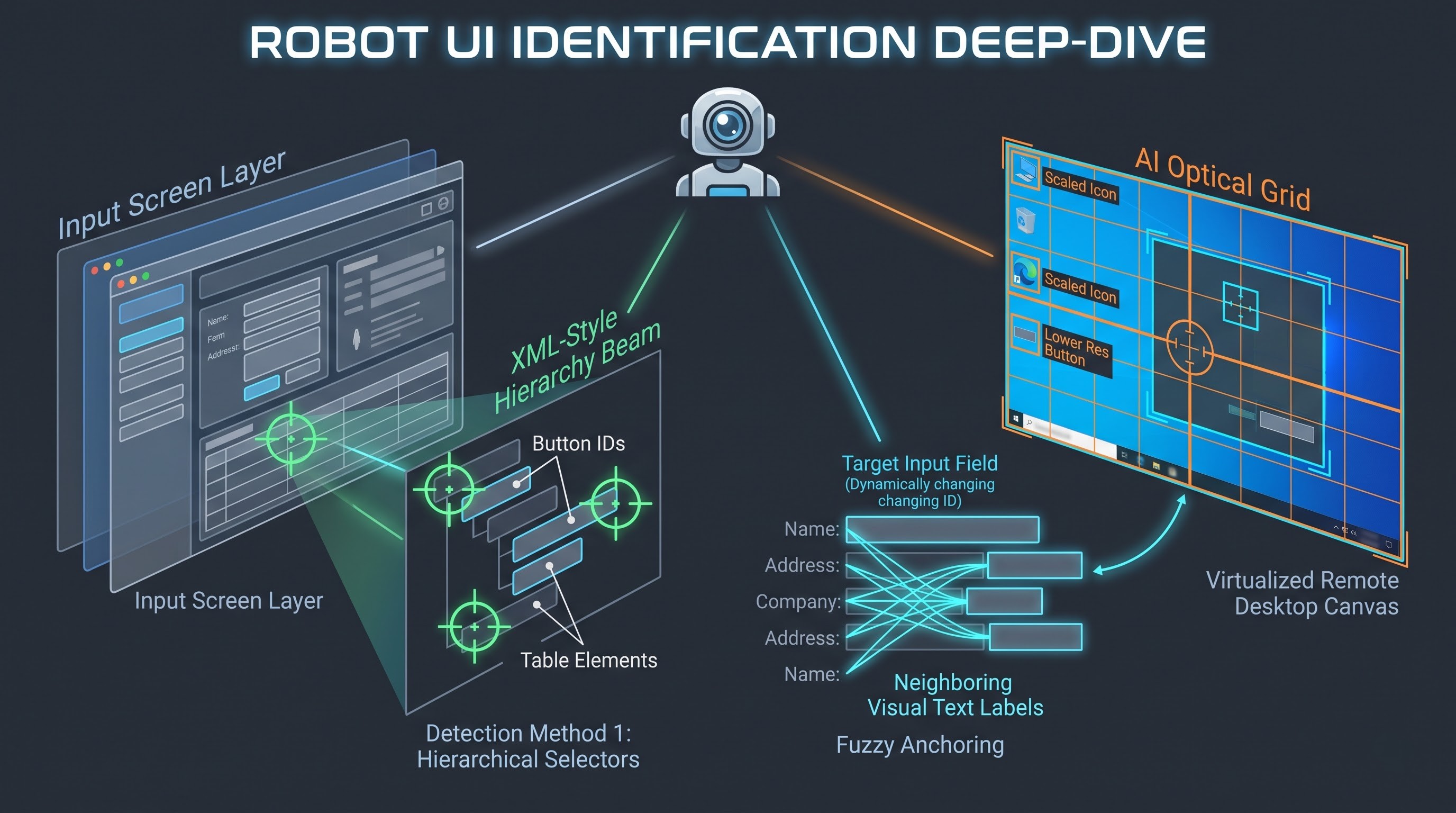
UiPath robots differ from traditional scripting models in that the graphical user interface is converted into a structured Object model. Instead of relying on static coordinate clicks, the robot analyses the Document Object model of browsers, inspects the Java Virtual Machine access bridges in older platforms, UI Automation Trees in the operating system.
When applications are delivered over the network, e.g., using Citrix, VMware, or remote desktop protocols, the UiPath robot uses computer vision and deep learning models because the direct access trees are not available when delivered through virtualization channels. The visual engine scans for UI elements dynamically, recognizes buttons, labels, text fields, and tables while not affected by any scaling, color, or resolution changes.
Types of UiPath Robots
The robot workforce in the UiPath is organized based on the human interaction need, the execution environment, and approach for resource utilization. The difference in the execution approach determines the architecture of the infrastructure, user governance, and security methods.
Robots with Human Interaction
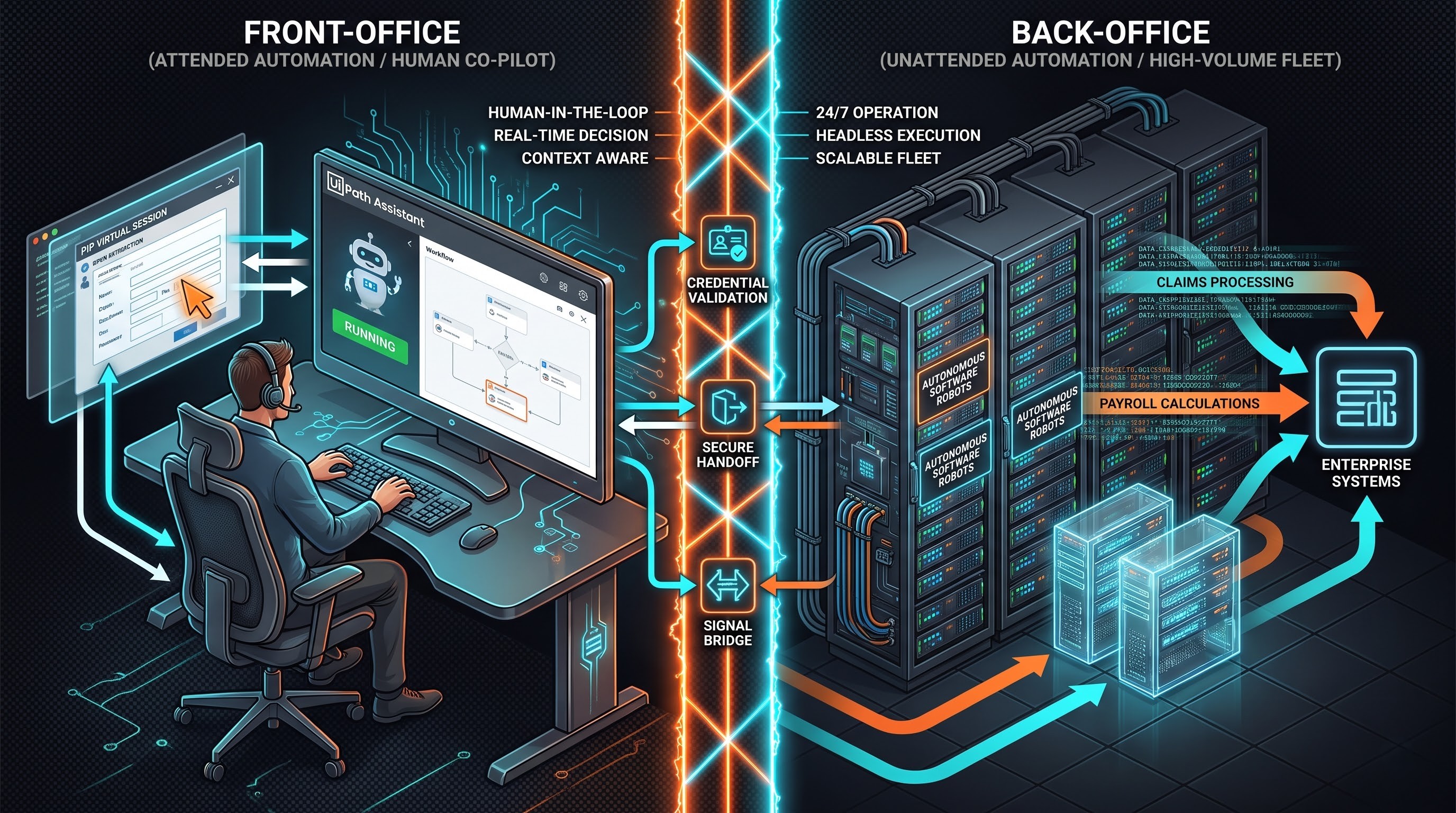
Attended robots serve as co-pilots for the knowledge workers sitting at their desk. As robots are installed in knowledge workers’ desktop or endpoint devices, they perform the functions on behalf of the logged-in user. The operation is initiated by an action made by people including but not limited to hotkeys, events from applications and systems as well as a manual action invoked in the UiPath Assistant.
It is important to note that attended automation is aimed to bring people into the process. There are many situations when the knowledge workers need to make informed decisions based on some contextual facts, judgement, and feelings about their clients’ situation. In general, attending robots will complete machine-related things in this process – getting files, reading emails, filling forms across multiple applications, checking information in several systems, and preparing the document required for transactions. After processes fulfilled by the attended robot are completed, the robot hands over the control from machines back to the knowledge worker for making the proper transaction finally.
Attended robots work within the user's sphere of control, either directly through the keyboard or mouse or in the background. Various technologies such as picture-in-picture are making it easier for attending robots to work through their own virtual sessions. This allows them to carry out various commands and operations in a virtual window without interrupting the person working on the main screen.
Unattended Robots
Unattended robots are standalone and independent software solutions created for high-volume transaction processing that follows strict rules. These robots do not need any human involvement to perform the tasks as they function in a special environment. In contrast to the attended ones, the unattended ones are generally operated in a separate and isolated environment such as cloud virtual machines, remote desktop hosts, and conventional servers.
Managed from a centralized location, unattended robots function based on external factors. The start of the job is followed by robots performing such operations as proving credentials, logging in into the system, isolating the session for the robot run, performing the assigned tasks, logging the actions done by the robot, and closing the session.
Unattended robots are an integral part of industrial automation systems as they perform critical activities like batch reconciliation, processing payrolls, processing claims, and synchronizing master data. They accomplish all these forms of work after operational hours.
Studio and Testing Robots
Certain robots have been developed to fulfill the needs of governance, continuous delivery, and quality assurance.
Studio robots are used as a run-time environment in the authoring tools and allow developers to compile, test, inspect, and debug workflow codes during the development stage. These environments allow the enforcement of governance policies by checking that the workflow files are in line with the architecture guidelines and verifying that all necessary UI selectors are intact before the logic gets packed into production artefacts.
Testing robots facilitate enterprise testing and ensure quality assurance. When combined with CI/CD pipelines, testing robots handle automated functional, performance, regression, and integration testing of enterprise software solutions. Whenever a company updates its ERP package or a client relationships management solution, testing robots run a multitude of automated tests to verify that important business processes are still functioning correctly. Acquiring an impeccable expertise in the field of setting up these environments represents the main aim of a dedicated uipath course online bridging the gap of traditional automation scripting and enterprise-level test automation.
Cloud Robots and Containerized Robots Cloud computing represents a new trend in enterprise infrastructure as opposed to using static desktop virtualization. Cloud Robots make it easier to model how robots run in the cloud. Cloud Robots is a ready-made solution of UiPath that is an elastic service running in the UiPath cloud. Instead of having to build and support Windows virtual machines, set up cloud storage and maintain load balancers, the cloud robots use their internal facilities.
Containerized Robots give customers the ability to use the cloud in a self-hosted manner. Container Robots, despite their name, are not confined to trendy technologies but work with standard operating methods and Linux-based initiatives while remaining API-oriented. This means that it comes with a very lightweight Runtime Engine packaged in form of a small disk image and it is available for deployment. They can be operated in the cluster environment with an option to scale by adding the needed number of containers at any given moment of time.
Primary Functional Abilities and Methods
The operational flexibility of UiPath machines is due to features that are divided into separate groups such as deterministic functioning, visual perception, semantic understanding, and event-centric management.
Current UI Automation and Selector Devices
The key point of corporate robotic automation systems is firm interaction with GUIs. Past automation systems employed screen scraping technology and were quite sensitive to even the slightest change in a product's appearance and particular position of buttons on the screen.
UiPath machinery employs the latest selector package that integrates a number of interface scanning approaches. The term selector refers to the XML-similar string hierarchy that characterizes the structure of the target interface.
To deal with the frequent changes in the interface's appearance, UiPath machines apply fuzzy matching, regular expressions, visual anchoring, and the APIs of the application in the industry. When the company makes updates to the web application which results in the updating of the element ID of the input field, the robot uses the acquired visual anchors while defining the target. This method allows improving the stability of the work process and decreasing the efforts required for maintenance.
History of Automation and Cross-Platform Processing
In the past, the automation robots were required to establish an interactive display so as to replicate the process of moving the mouse and typing. Modern technologies like UiPath have therefore achieved separation of the automation of the front end from that of the processes of ‘data processing’. The robots utilized on the processes that involved APIs, bus connectors and databases were found to be practical and efficient enough as far as being able to perform every operation without need of any display. This reduced their consumption of both resources and time as they weren’t dependent on visual displays.
Moreover, unique operating systems designed based on the latest containerization allowed executing tasks executed in background mode on both Linux and Mac machines. This saved on infrastructural costs as it eliminated the need to have a license for Windows OS just to operate on the basis of processing data.
Incorporating Document Understanding technologies, UiPath robots make it possible to absorb, classify, fetch, and ensure unstructured input. The pipeline for extraction starts with optical character recognition mechanisms designed for handwriting, noisy images, and typography mixes. The categorization of a document type is done by classification algorithms when documents have been digitized.
The process of semantic data retrieval refers to the use of specially-oriented machine learning models. Instead of using rigid coordinate areas, they find such items as list line items, tax IDs, and billing entities with the assistance of spatial layout analysis and natural language processing. If the amount of confidence for extraction is lower than the specified regulatory limits, the robot collects the transaction and tends to an enterprise, human-in-the-loop verification station, notifying a specialist about the fields with low confidence that should be analyzed prior to continuing the documents processing process.
Generative AI and Autonomous Agentic Reasoning
The latest stage of development of UiPath robots entails generative AI, contextual grounding, and agent reasoning models. If classical robotic automation managed the tasks of deterministic automation abiding the rules, real-life business situations delivered non-structured communication, ambiguous conversations, and process trees.
Current robots employ foundational models integrated with AI trust layers to carry out tasks. Hence robots can analyze extensive case histories, compose complex messages, process customer complaints, and change vague inquiries into a structured request.
Using agentic workflows, robots are moving from acting as mere execution engines to goal-oriented agents. With a given task of solving a difficult shipping situation, the robot is able to check all the enterprise APIs and review internal knowledge databases, and also carry out necessary intermediate steps and actions, processing feedback received and recouping from temporary failures.
Mining of processes and integration of desktop operations with robots
Robots don’t work alone, their efficiency relies on the right process intelligence. When paired with process mining and task mining solutions the robot operates based directly on the analytics pulled from the logs of enterprise activity and desktop work of employees.
The technique known as process mining utilizes data from transactions via systems like SAP, Oracle and Salesforce to reach full process trials for the identification of issues in the activities and practices of non-compliance. Task mining is a complementary method that deals with data mining from users' activity without specifying any tasks.
Robots can be directly deployed where that data show operational issues leading to money and time losses.
Enterprise Orchestration, Governance, Security Architecture
The use of robots in the organization means that some special requirements come to exist in terms of identity providers, governance policies, availability, and the amount of data available for reporting.
Centralized Control over Robotic Workforce
The main control system for all robots in a company is the UiPath Orchestrator. This system handles workload prioritization, assets’ management, controlling access to the robots, and allocation of customers and environmental factors.
The process of work distribution takes place with the help of queues within the UiPath Orchestrator. The assigned tasks are analyzed and represented as units of work that contain certain data.
In case of an increase in transaction activities, like month-end closing functions or unexpected business demands, dynamic allocation regulations immediately activate additional cloud or virtual bots, reposition unused robots into high-priority queues, and create an equilibrium in processing work among different host devices. The queue infrastructure guarantees operational resilience in that if a host machine has a malfunction affecting transactions in transit, then the queue manager catches the broken transaction and preserves its state to try the execution later on another robot.
Identity Administration and Access Control
Software bots carry out operations with essential record-keeping systems, which leads to the idea that the governance of identity of digital workers is as important as the management of people. Unlike commonly used and built-in passwords shared in scripts, UiPath robots are keyed into identity organizations through modern credential storage.
In case of an increase in transaction activities, like month-end closing functions or unexpected business demands, dynamic allocation regulations immediately activate additional cloud or virtual bots, reposition unused robots into high-priority queues, and create an equilibrium in processing work among different host devices. The queue infrastructure guarantees operational resilience in that if a host machine has a malfunction affecting transactions in transit, then the queue manager catches the broken transaction and preserves its state to try the execution later on another robot.
Identity Administration and Access Control
Software bots carry out operations with essential record-keeping systems, which leads to the idea that the governance of identity of digital workers is as important as the management of people. Unlike commonly used and built-in passwords shared in scripts, UiPath robots are keyed into identity organizations through modern credential storage.
Enterprise security information management platforms, cloud monitoring systems, and centralized data repositories receive these records. Every click on an interface, instance of a web request in the system's backend, updates made to payload data, and user logins are timestamped and assigned to the appropriate digital worker.
When the robot stumbles upon rogue logic branches or exceptions in the system, it can use secure screenshots and execution stack traces to save the execution context. This troubleshooting package lets support teams detect the source of the error, which can be unexpected shifts in the UI, timeouts in the network, or incorrectly formatted data without getting access to the sensitive personal data.
Overview of Use Cases for Enterprises
UiPath robots are capable of generating impressive value in the context of enterprises due to the fact that they perform end-to-end processes, delivering productivity and allowing people to focus on strategic activities.
Banking and Financial Services
Organizations in the banking sphere and financial institutions are running on legacy core banking systems, decentralized lending solutions, and compliance regulations, making them perfect for multi-tier robotic automation.
Anti-Money Laundering and Know-Your-Customer (KYC) Verification in Compliance Analysis
Compliance analysts engage in significant processes to collect identity documents, gather negative media records, review sanctioned entities register, and examine company registers.
Robots make the process of carrying out investigations easier to handle. When a retail or institution account is established, unattended robots collect client application details, compare third-party sanction databases, evaluate international business registry data, and sanitize historical data from old core systems. The robot synthesizes all information into a common investigative package.
If the risk score exceeds the established limit, the case will be transferred to the dashboard of an AML officer. An attended robot assists the officer in creating necessary regulatory filings, preparing the necessary SAR reports, and digitally saving evidence in the layers of core compliance storage.
Mortgage and Loan Processing
The loan processing procedure involves a huge number of scattered documents and numerous software applications. Once the supporting documents are submitted, UiPath robots collect data from paychecks, tax documents and bank statements to extract key financial figures.
The robot manages to match all of this information with its internal credit evaluation systems, as well as accessing other credit data through APIs and entering the information it gathered into the main loan system. The robot finds differences in the debt-to-income ratios, prepares the initial disclosure packets, and sends approval notifications, which reduces the time needed for mortgage approval from weeks to a few short hours.
On top of that, healthcare facilities need to consider great administration load and the requirement of fast access to medical services, facing strict privacy laws and obsolete methods of storing medical data in order to be able to function properly.
The major problem that may lead to delays in work of the hospital is obtaining an authorization from health insurance providers. The robots deal with authorization requests by collecting necessary information about patients and treatments from the medical record, medical codes and other sources.
The robots create accounts in the portals of different health providers, submit all the necessary medical documents and track the status of the request.
Management of Revenue Cycle and Reconciliation of Claims
Healthcare billing teams are responsible for the reconciliation of claims.
Where there is claim rejection, the robotic system checks the remittance advice for the denial codes and finds out whether the patient’s history contains any missing demographics, unbilled coding, or no referral. For the simple administrative rejection, the error will be corrected and entered by the robot again, and in the case of complex medical rejection, the robotic system generates a packet and provides it with all necessary medical documentation and sends it to medical coders to obtain final approval.
Supply Chain, Logistics, and Production
The modern supply chain necessitates a synchronization of data in a matter of seconds and with the efficient capability of using applications such as enterprise resource planning (ERP), warehouse management (WMS) systems, transport carrier portals, and other computer applications.
Order-to-Cash Process and Handling Exceptions
Supply chain companies receive orders in various forms, which can vary from simple electronic data interchange messages, sophisticated emails with PDF files attached, and downloads from portals.
UiPath robots receive incoming POs, analyze line-item data, verify volumes and rates, and record confirmed transactions within core ERP systems, such as SAP S/4HANA. In case of inventory shortages, the robot looks for alternative fulfillment locations, works out delivery changes, informs logistics coordinators, and sends confirmations to clients.
Freight Tracking and Logistics Coordination
On a daily basis, logistics coordinators usually need to sign in to ocean, air, or freight shipping services to check the status of shipments and customs clearances.
Machines are capable of functioning independently; they gather the information concerning the transportation operations from the tracking websites, communicate with transport broker API services, and check the emails providing updates on the transportation operations to enter the information about the points in the transport management system. In case something goes wrong, the robot evaluates the consequences for supply routes, informs warehouse personnel about their working hours, and also informs the end consumers about the timing of their delivery.
In the process of quick expansion of digital employees in finance, logistics, and health care sectors, the demand for RPA engineers and architects is growing in the world. OnlineITGuru offers a Uipath course online india for those who want to obtain knowledge and skills that are recognized on the market. The students of the course will learn about real-life project implementation, queue management in Orchestrator, and complex automation projects.