
What Happens When Your Data Starts Asking Better Questions?
Last updated on Sep 7, 2026
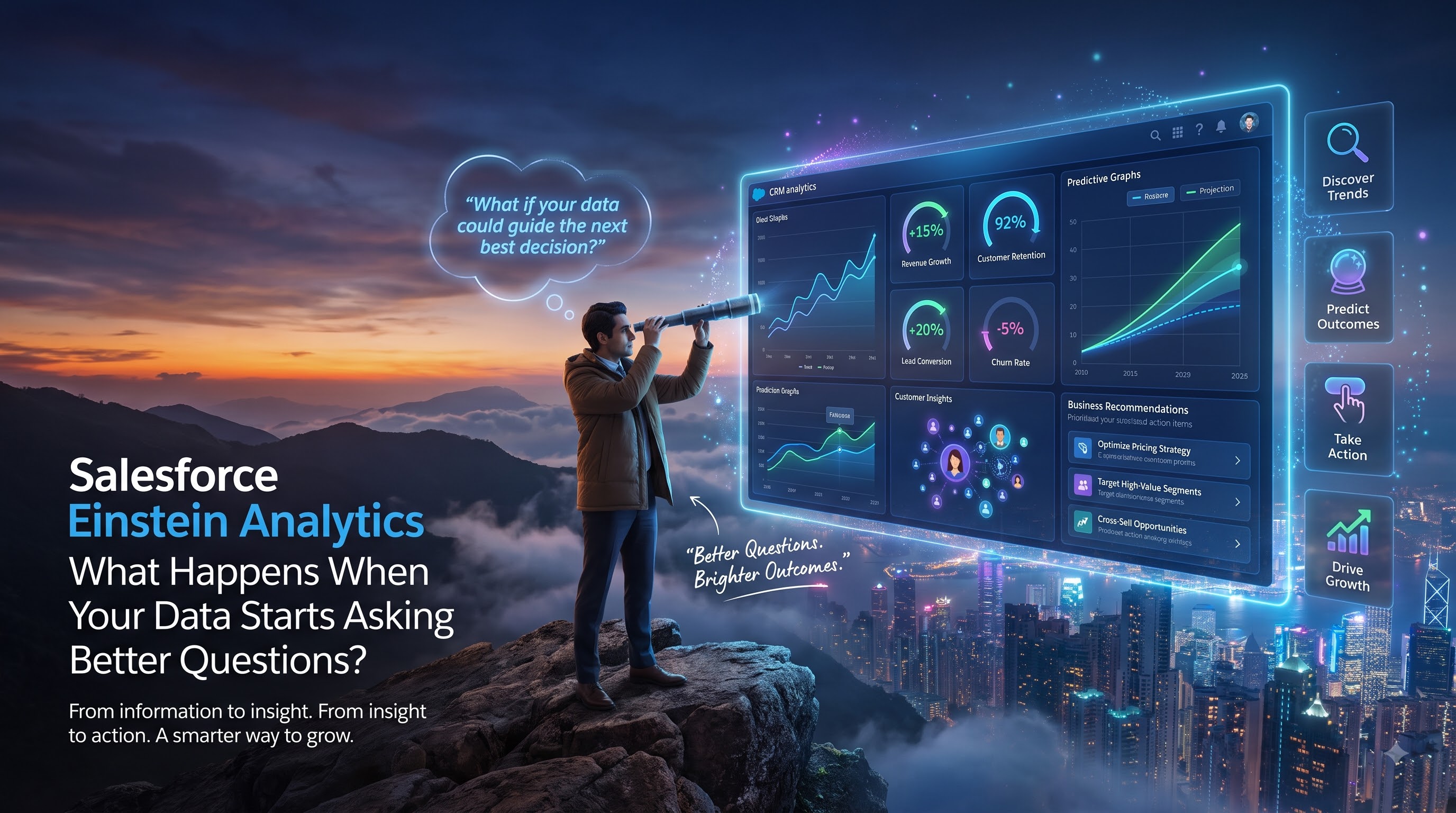
Most companies don't have a data problem anymore.
They have a decision problem.
A sales manager can open Salesforce and see hundreds of opportunities. A service leader can see customer cases, response times, and satisfaction scores. A marketing team can track campaigns, leads, and conversions. The information is already there, often in greater quantities than anyone can comfortably process. Yet when someone asks a much more important question—“What should we do next?”—the answer rarely appears neatly inside a single report.
Someone still has to investigate.
They have to compare numbers, identify patterns, question unusual results, understand what changed, and decide whether what they are seeing actually matters. This is where Salesforce Einstein Analytics becomes more interesting than simply another way of displaying business data. Today, Salesforce positions Einstein Analytics within CRM Analytics, bringing together interactive analytics and AI-powered capabilities that help users explore information, understand patterns, make predictions, and connect insights more closely with the work they are already doing.
The important shift isn't that Salesforce can put more charts in front of employees. It is that analytics can become part of the process through which people understand a problem, challenge their assumptions, and decide what to do about it. And that changes the question we should ask.
Instead of asking, “What can Einstein Analytics show us?”
A more interesting question is:
“What could our people notice if they didn't have to search so hard for the answer?”
The Report Was Never the Real Destination
Think about what normally happens during a sales review. A manager opens a dashboard and sees that the team is behind its quarterly target. The overall pipeline looks healthy, but expected revenue has fallen. One region is performing particularly poorly while another appears to be ahead of plan. At first glance, the dashboard has done its job because it has clearly presented the numbers. But almost immediately, those numbers create another set of questions that the dashboard itself may not answer.
Why is that region behind? Are fewer opportunities entering the pipeline, or are existing opportunities failing to progress? Are deals taking longer to close? Has the customer mix changed? Are larger opportunities becoming harder to convert? Is one stage of the sales process creating a bottleneck? The moment these questions appear, the user has moved beyond simple reporting and entered the territory of analysis.
That is the difference worth understanding. A report is extremely useful when you already know what information you need to see. Analytics becomes more valuable when you don't yet know what is causing the result. CRM Analytics allows users to explore Salesforce and other data through interactive analytical experiences, giving them more freedom to investigate different dimensions of a business rather than simply accepting the view that someone created for them.
This changes the role of the dashboard.
The dashboard isn't necessarily the final answer.
It is the beginning of the investigation. A good analytical environment should make the next useful question easier to ask.
The Most Interesting Part Is What You Ask Next
People rarely approach data with a perfectly formed analytical question. More often, something catches their attention first. A number looks unusually high. A trend suddenly changes direction. One sales team starts performing differently from another. A customer segment that normally behaves predictably begins moving in an unexpected direction.
That small moment of curiosity is where meaningful analysis often begins. Imagine a sales leader notices that opportunities worth more than $100,000 are taking significantly longer to close. The immediate human reaction might be to assume that sales representatives are struggling to move large deals forward. That explanation sounds reasonable because it fits what the leader can see. But analytics gives the organization an opportunity to challenge that first assumption instead of immediately turning it into a conclusion.
The team could investigate whether these opportunities involve more stakeholders, require additional procurement steps, come from particular industries, have longer approval cycles, or contain other characteristics that naturally make them slower to close. What looked like a sales-performance problem might actually be a process problem. Or perhaps it is a customer-segment problem. Or perhaps the organization has simply been applying the same expectations to very different types of opportunities.
This is one of the most valuable things analytics can do.
It can make an organization pause before accepting its first explanation.
Instead of asking, “Who is responsible for the poor result?”, the conversation can become, “What characteristics are creating this result?”
That is a much more productive question.
Einstein Changes the Question From “What Happened?” to “What Could Happen?”
Traditional reporting is mainly designed to explain what has already happened in the business. That makes it useful for tracking revenue, conversion rates, customer activity, service performance, and countless other historical measures. But businesses rarely want historical information simply because they enjoy looking backward. They want to use what happened before to make better decisions about what happens next.
This is where Einstein-powered capabilities make the conversation more interesting. CRM Analytics can help users explore historical information and identify patterns, while Einstein Discovery adds predictive and machine-learning capabilities that can help analyze relationships in business data and estimate future outcomes. Instead of stopping at a statement such as “these opportunities were lost,” the organization can begin asking whether current opportunities display characteristics associated with similar outcomes.
That difference matters because businesses make decisions in the present, not in the past. A sales leader doesn't have much ability to change the opportunities that were already lost last quarter. What they can potentially influence are the opportunities sitting in today's pipeline. A service manager cannot change yesterday's customer experience, but they can identify customers whose current behavior resembles patterns associated with future dissatisfaction.
Prediction, therefore, becomes useful when it creates an opportunity to act earlier.
But there is an important limitation that should never be forgotten: analytics does not magically know the future. Predictive systems estimate probabilities and relationships from available data. Their usefulness depends on the quality of that data, the relevance of the variables being analyzed, the quality of the underlying model, and the way people interpret the result. The healthiest way to use predictive analytics is therefore not to treat the prediction as an unquestionable instruction. It is to treat it as decision support.
Prediction Alone Isn't Enough
Imagine a salesperson receives an indication that an important opportunity has a low probability of closing. The prediction immediately attracts attention, but the next thought is almost unavoidable:
Why?
If the system simply displays a score without meaningful context, the salesperson may ignore it. They may know something about the customer that isn't represented in the available data. They may also have developed their own judgment over years of experience. A mysterious prediction can easily feel like a challenge to that judgment rather than useful assistance.
This is where explainability becomes important.
Einstein Discovery can surface factors and relationships associated with predicted outcomes, allowing users to investigate what may be influencing a result rather than simply receiving a number. That creates a more useful relationship between people and AI because the employee doesn't have to blindly accept what the system says. They can examine the evidence, compare it with their understanding of the situation, and decide whether the insight deserves attention.
This is particularly important in business environments because predictions are rarely made in a vacuum. A salesperson understands conversations that may not yet be recorded in Salesforce. A service representative may recognize an unusual customer situation from a recent interaction. A manager may know that an external event has changed the circumstances around a particular account. The purpose of analytics should therefore not be to tell people that their experience is wrong. It should give them another source of evidence.
Good business AI doesn't remove human judgment. It gives human judgment better information to work with.
A Dashboard Can Tell You the Problem. Analytics Can Help Find the Pattern.
Consider a fictional software company that has started noticing an uncomfortable problem: quarterly revenue forecasts are becoming increasingly unreliable. Leadership initially assumes that some sales representatives are simply being too optimistic about their opportunities, so the company creates a dashboard showing forecast accuracy by salesperson.
The dashboard identifies several representatives with significant forecasting gaps. At first, this seems to confirm the original assumption. The company could easily respond by asking those individuals to improve their forecasting discipline.
Instead, the team decides to investigate further. They compare opportunity size, industry, stage history, expected close dates, sales-cycle length, activity patterns, and historical outcomes. A different pattern begins to emerge. The largest forecasting errors are concentrated around complex opportunities that remain in late-stage pipeline for unusually long periods.
Now the problem looks very different. The issue may not be individual performance at all. The forecasting process itself may not properly account for opportunities that involve additional stakeholders, procurement requirements, or longer approval cycles. What initially looked like a people problem may actually be a process-design problem. That discovery could lead to changes in qualification criteria, forecast categories, opportunity stages, approval processes, or management attention. The organization has moved from blaming the visible symptom to investigating the conditions that produce it.
This is where analytics creates real value.
It doesn't simply identify a bad number.
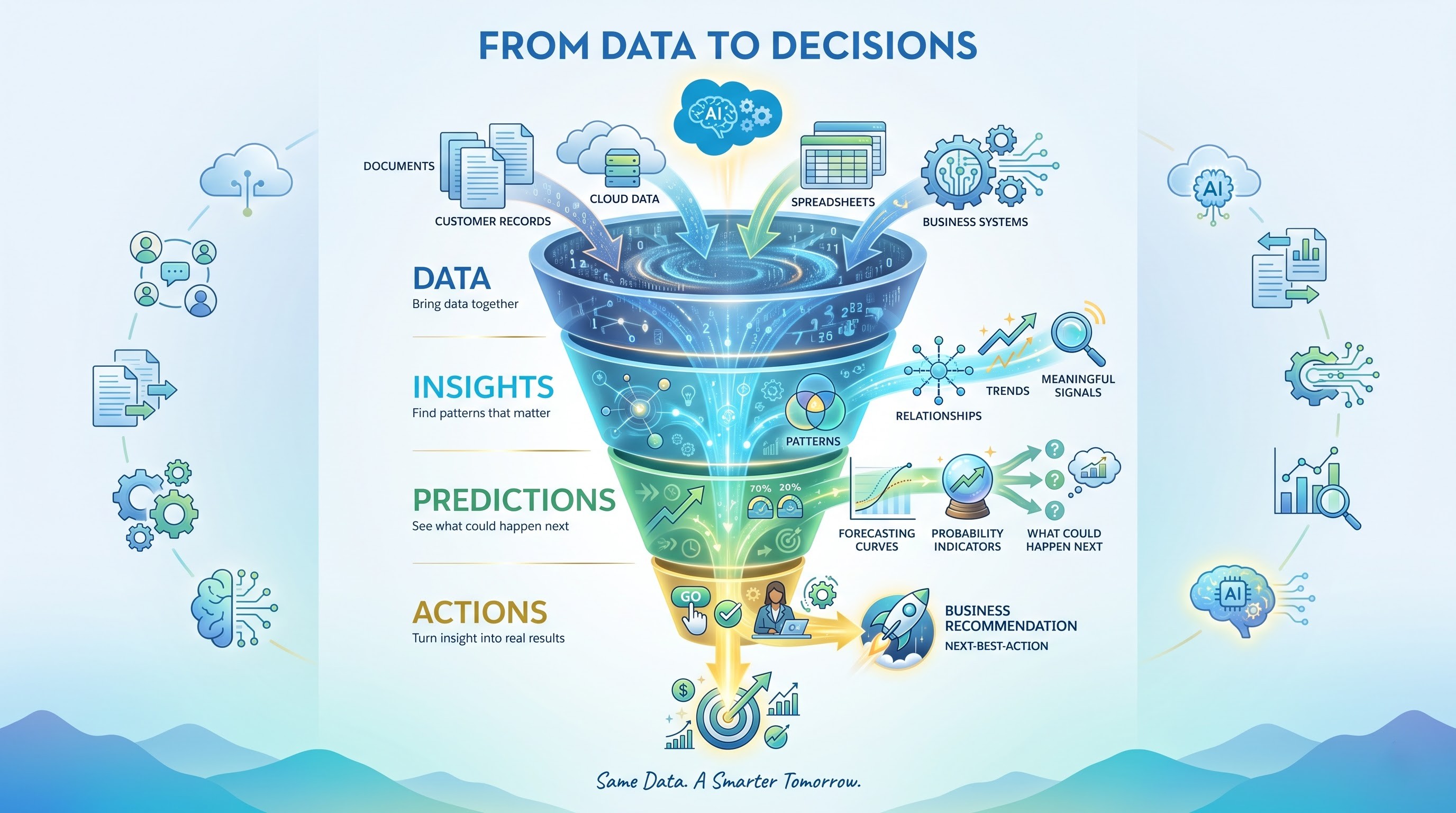
It helps the organization move through a much more useful sequence:
Symptom → investigation → pattern → explanation → possible action.
That is far more valuable than simply adding another colorful dashboard to Salesforce.
The Hidden Power of Bringing Analytics Into the Workflow
There is another reason analytical projects sometimes fail to create as much value as expected: the person who discovers the insight isn't always the person who can act on it. Imagine an analyst discovers an important pattern on Monday. They prepare a report on Tuesday. A manager sees it on Wednesday. The team discusses it on Thursday. By Friday, the opportunity that needed attention may have already moved into a different stage, a customer may have made another decision, or the business situation may have changed.
The problem isn't necessarily the quality of the analysis.
The problem is the distance between insight and action.
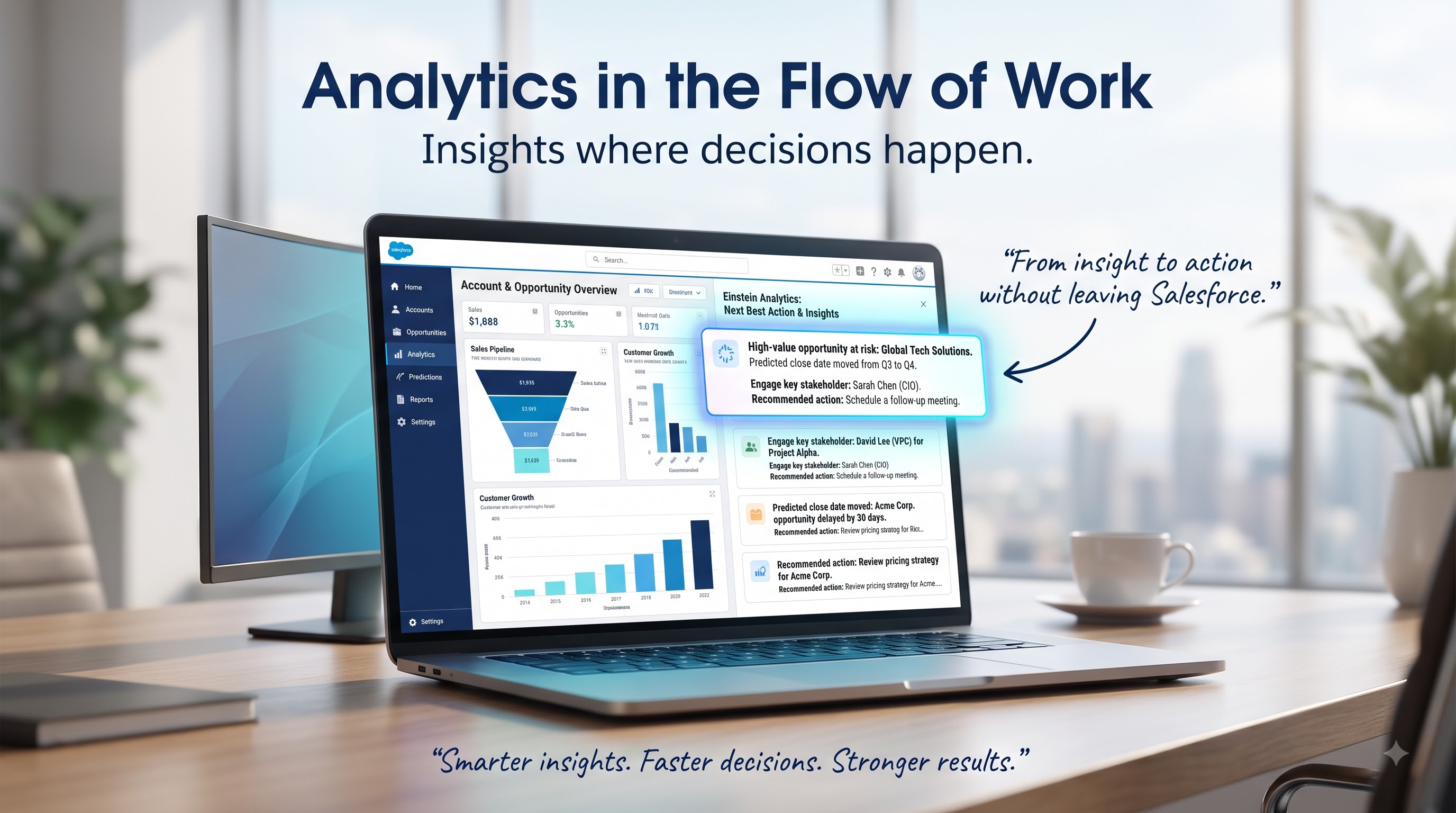
Salesforce's approach to CRM Analytics emphasizes bringing analytics closer to the operational environment. Insights and predictions can be surfaced within Salesforce experiences and connected with capabilities such as Flow, allowing analytical information to become part of the processes where work actually happens. This creates a subtle but important change. Instead of asking an employee to leave their normal workflow, open another analytics application, search for a dashboard, interpret the result, and then return to Salesforce to take action, relevant information can appear closer to the record, process, or decision that matters.
That makes analytics more operational. The insight is no longer something that exists only inside an analyst's report. It can become part of the decision itself. And the shorter the distance between insight and action, the greater the opportunity for analytics to influence behavior.
Data Quality Is Still the Uncomfortable Foundation
AI usually gets the exciting headlines. Data preparation usually doesn't.
Yet predictive analytics cannot escape the quality of the information underneath it. A company may have sophisticated analytical capabilities, but if customer records are incomplete, opportunity fields are inconsistently populated, important activities aren't recorded, or different teams use different definitions for the same metric, the resulting analysis can become difficult to trust.
Imagine that one team records a customer industry as “Financial Services,” another uses “Banking,” and a third uses “Finance.” A human might understand the relationship immediately, but an analytical system working with those values may interpret them differently depending on how the data has been structured and prepared.
Now multiply that problem across thousands or millions of records. The challenge becomes much larger.
This is why data preparation should not be treated as an annoying technical step that happens before the “real” AI work begins. It is part of the analytical process itself. CRM Analytics can work with Salesforce and other data sources, while data preparation and transformation capabilities help make that information suitable for analysis. Before building a sophisticated model, organizations need to ask surprisingly basic questions. Do we trust the data? Are important fields populated consistently? Are our business definitions clear? Are we measuring the outcome we actually care about? Have the rules for calculating our KPIs changed over time?
Those questions may sound less impressive than machine learning, but they determine whether the machine learning deserves to be trusted.
In analytics, better data often creates a bigger advantage than a more complicated model.
The Psychology of Too Much Data
There is a strange assumption in business analytics: if information is useful, then more information must automatically be better. Human attention doesn't work that way.When employees are presented with dozens of metrics, alerts, charts, filters, and KPIs, they don't necessarily become better decision-makers. Their attention can become fragmented. Important signals compete with less important information, and eventually employees may stop knowing which numbers actually deserve their attention.
This is why dashboard design is more than a visual exercise. A useful analytics experience should establish hierarchy. It should help a user recognize what changed, understand why it matters, identify where unusual behavior is occurring, and decide what deserves further investigation. The purpose isn't to make every possible piece of information visible. The purpose is to make the important information difficult to miss.
For example, a sales dashboard might begin with the most important business outcome, then show how pipeline movement is affecting it, followed by the segments or opportunities responsible for the change. We can keep additional details available for deeper investigation rather than competing for immediate attention.
A dashboard containing twenty charts isn't automatically more sophisticated than one containing five. Sometimes it is simply harder to use. The strongest analytical experience is often the one that lets a busy employee understand the situation quickly and then go deeper when something genuinely deserves investigation. The goal isn't to make people spend more time looking at dashboards. The goal is to help them think more clearly.
Einstein Analytics Training Should Start With Problems, Not Buttons
The way professionals learn analytics matters almost as much as the technology itself. Someone can learn how to create a dashboard, configure a dataset, build a visualization, and launch a model without necessarily developing strong analytical judgment. Technical familiarity tells you where the buttons are. Analytical thinking tells you which button actually matters.
Imagine a business leader saying, “Our customer retention is falling.” That sentence sounds like a clear problem, but it is still too broad to analyze effectively. A strong analytics professional begins breaking it apart. Which customers are leaving? When did the change begin? Is the decline consistent across customer segments? Are certain products affected? Does customer engagement change before churn? Which factors appear related to retention? Can historical data support a useful prediction? Most importantly, what could the business realistically change if the pattern were confirmed?
This is why effective einstein analytics training should not focus only on feature memorization. Learners should practice turning business problems into analytical questions, identifying the data required to investigate them, exploring relationships, interpreting results, and connecting those results to practical decisions. The platform becomes much easier to understand when every capability has a reason for existing.
A learner who knows how to build ten dashboards may still struggle when a business executive gives them an unfamiliar problem.
A learner who knows how to investigate an unfamiliar problem can usually figure out which analytical capabilities are needed.
That is the difference between tool knowledge and analytical capability.
Why the Best Analytics Professionals Think Like Investigators
There is a useful way to think about an analytics professional: they are closer to an investigator than a dashboard designer. A detective doesn't begin with a conclusion and then search for evidence that confirms it. They start with an outcome, gather information, compare possibilities, identify unusual patterns, test assumptions, and gradually develop an explanation. Good analytics follows a surprisingly similar path.
You start with something that needs to be understood. You establish what the outcome actually means. You investigate the available evidence and look for relationships. You question the obvious explanation rather than immediately accepting it. You test whether the pattern is meaningful and consider whether another variable could explain what you're seeing. This is the kind of thinking that makes salesforce einstein analytics training more valuable when it goes beyond simply teaching platform features and instead develops the ability to approach unfamiliar business problems analytically.
Only after that process should you start thinking about action.
This mindset becomes even more important as AI tools become easier to use. When generating a prediction becomes easier, the ability to ask the right question becomes more valuable. A technically impressive model answering the wrong question is still a poor analytical solution.
For example, predicting which customers are likely to churn may sound useful. But if the business has no practical way to intervene, the prediction may have limited operational value. A smaller model that identifies customers where a service intervention can actually change the outcome could be far more useful.
The sophistication of analytics should therefore be measured not only by the complexity of the model. It should also be measured by the quality of the decision it helps improve.
Where Salesforce Einstein Analytics Becomes Truly Valuable
The biggest opportunity isn't necessarily creating more sophisticated dashboards. It is connecting different stages of decision-making so that information can move naturally from observation to investigation and eventually to action. A sales team can use historical information to understand pipeline performance, investigate conversion patterns, and identify opportunities that may deserve additional attention. A service organization can examine customer behavior and identify patterns associated with satisfaction, escalation, or potential risk. Marketing teams can compare campaign outcomes and explore which characteristics are associated with stronger engagement. Leadership can move from high-level performance indicators into the underlying factors that are influencing those results.
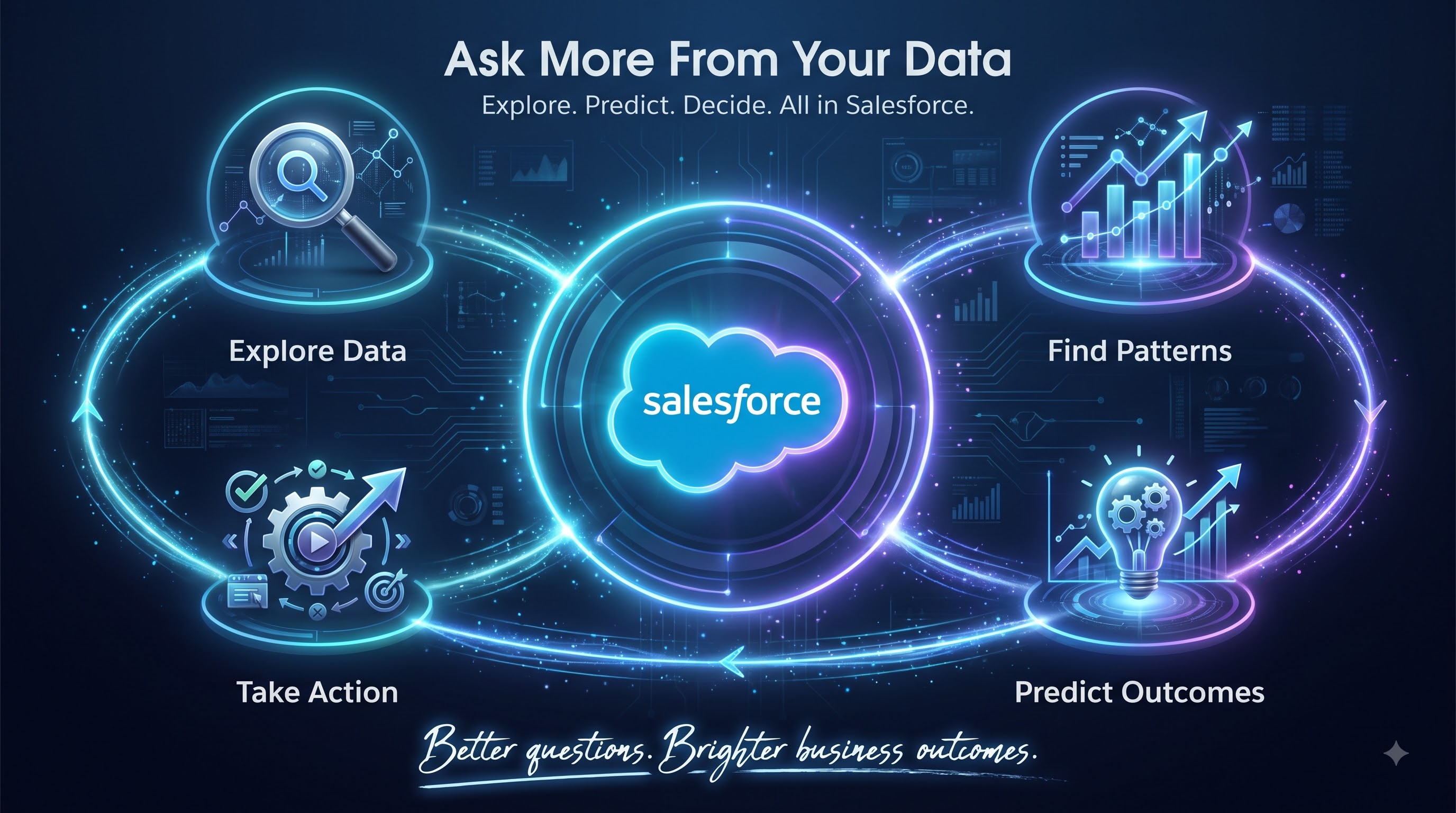
Across these use cases, the technology becomes valuable because it supports a sequence of increasingly useful questions.
What happened?
Why did it happen?
What might happen next?
What could we change?
That sequence is more important than any individual feature.
This is also why someone considering a salesforce einstein analytics course should look beyond a curriculum that simply lists dashboards, datasets, visualizations, and predictive capabilities. Those features matter, but their real value appears when learners understand how they fit into a business investigation. A strong learning experience should help connect technical capabilities with realistic scenarios where the final objective is not simply producing an analytical output but supporting a better decision.
Knowing how to operate the platform is useful.
Knowing what problem to solve with it is far more valuable.
From Business Intelligence to Decision Intelligence
There is a broader idea underneath Einstein Analytics that is worth understanding.
For a long time, business intelligence focused heavily on helping organizations understand their information. Companies built reports, dashboards, data warehouses, and analytical systems so leaders could see what had happened and compare performance over time. But modern organizations increasingly want something beyond visibility. They want to make better decisions faster. That does not mean handing every important decision to AI. Business decisions still require context, experience, ethics, judgment, and an understanding of circumstances that may not be represented in structured data. Instead, the opportunity is to place useful intelligence closer to the moment when a person has to decide what happens next.
A salesperson deciding whether an opportunity needs intervention is one example. A service manager deciding whether a customer situation deserves escalation is another. A marketing leader deciding where to allocate budget faces the same fundamental problem. So does an executive deciding which performance issue deserves immediate attention. In every case, the value of analytics comes from what happens after the insight appears. That is why CRM Analytics and Einstein Discovery are more interesting when viewed as components of a larger decision-making system rather than isolated Salesforce features. The future isn't simply about dashboards becoming smarter.
It is about decisions becoming better informed.
What Businesses Should Actually Expect From Einstein Analytics
It is tempting to expect AI-powered analytics to provide perfect answers. That expectation creates problems because no analytical platform can eliminate uncertainty, changing markets, incomplete information, unexpected customer behavior, or human judgment.
The more realistic expectation is much more useful. Einstein Analytics can reduce some of the friction involved in understanding complex business information. It can help users explore data, identify patterns, investigate relationships, make predictions from historical evidence, and bring relevant insights closer to operational workflows. Those capabilities can give employees a stronger starting point when they have to make decisions under time pressure.
But the strongest organizations will not necessarily be the ones with the largest number of AI models. They will be the ones that develop a disciplined relationship with their data and analytical systems. They will know which outcomes matter, understand the limitations of their information, question predictions instead of blindly accepting them, and connect insights with actions that people can realistically take. That requires a combination of technology and organizational behavior.
A prediction is useful only when someone understands what it means.
An insight is useful only when someone can act on it.
And an action is useful only when it improves an outcome that actually matters.
That is where analytics stops being a technology project and becomes a business capability.
The Future Isn't a Smarter Dashboard
The name “Einstein Analytics” can make the technology sound as though its ultimate purpose is to create a more intelligent dashboard.
That description is too small. The more important transformation happens when organizations change how they think about information. Instead of waiting for someone to create a report, employees can investigate questions themselves. Instead of stopping at what happened, they can explore why it happened. Instead of waiting until a problem becomes obvious, predictive signals can help identify situations that may deserve attention earlier.
Most importantly, analytics can move closer to the workflow. That means the person making the decision doesn't necessarily have to become an expert analyst just to access useful information. The analytical capability can increasingly become part of the environment in which work already happens. This creates a more natural relationship between data and decision-making. The employee doesn't think, “Now I need to go use analytics.” They simply encounter information that helps them understand the situation they are already dealing with. That is a much bigger change than adding another dashboard to Salesforce.
Conclusion: The Question Matters More Than the Dashboard
The most valuable thing Salesforce Einstein Analytics can provide isn't necessarily a chart.
It is a better question. A dashboard might tell a sales manager that revenue is falling. Analytics can help uncover where the change is happening and which segments are contributing to it. Deeper analysis can reveal relationships behind the outcome. Predictive capabilities can help estimate what might happen next, while actionable insights can help the organization consider what could potentially change the outcome.
That creates a progression that is much more meaningful than simply reporting numbers:
See the problem → investigate the pattern → understand the drivers → anticipate the outcome → decide what to do.
Technology supports every stage of that journey, but people still provide the context and judgment that turn information into decisions. And perhaps that is the most useful way to think about Salesforce Einstein Analytics. It isn't about replacing the person sitting in front of the dashboard. It is about giving that person a better chance of noticing something important, understanding why it matters, questioning their assumptions, and acting while there is still an opportunity to change the outcome. Because businesses don't ultimately compete on how many dashboards they have. They compete on how well they turn information into action. And that is where Einstein Analytics becomes much more than analytics. It becomes a way of helping people make better decisions.