
Why Agentic Workflows Demand Decision Contracts for Business Analysts
Last updated on Sep 24, 2026
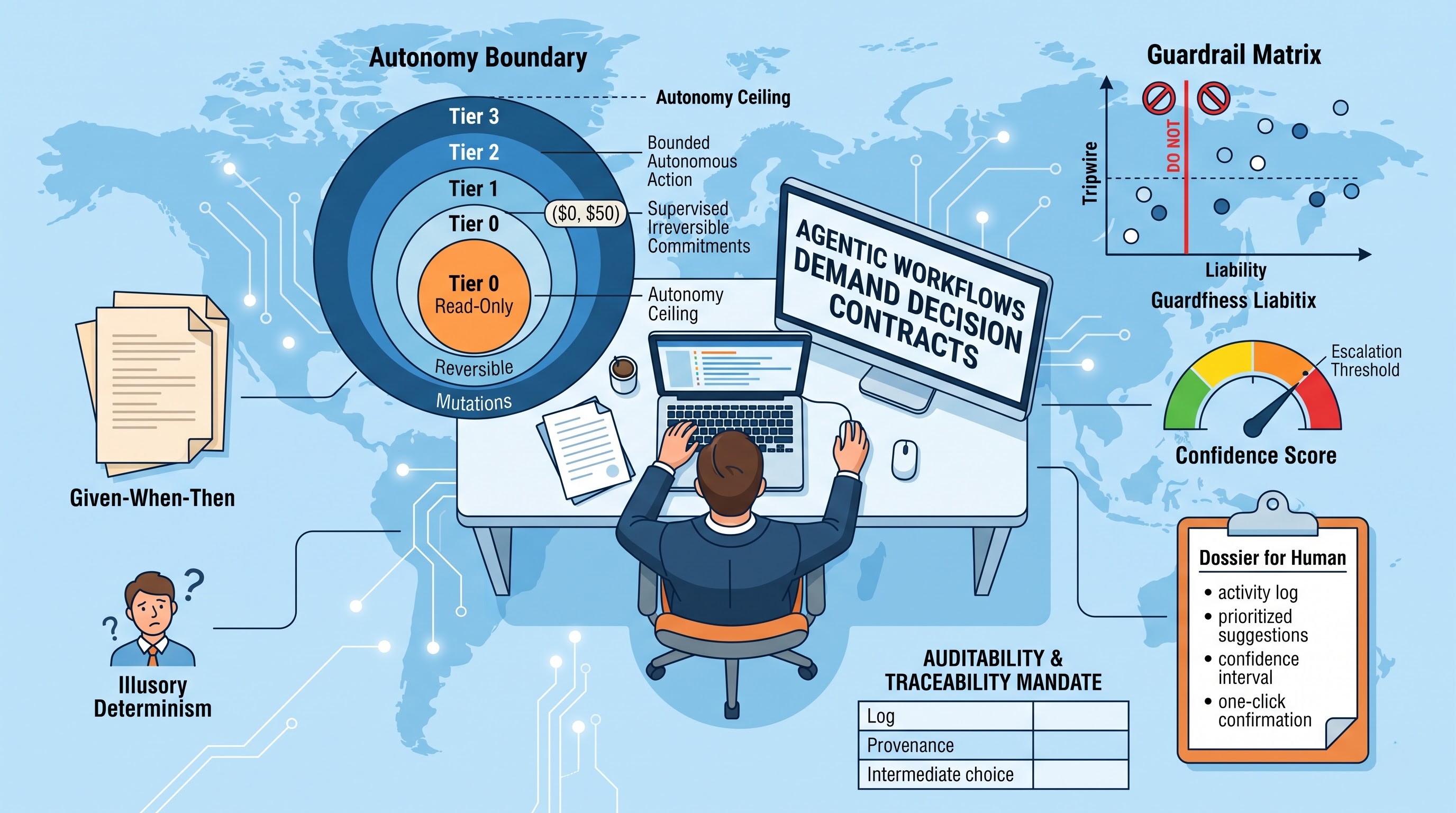
The Illusion of Determinism: The Dismal Failure of User Stories
For the past two decades, the formula that powers modern agile development has been as follows: ‘As a [role] I want to [action], so that [outcome].’ When used with standard conditions in Given-When-Then format, the formula helped establish a web presence as well as provide efficient enterprise software by synchronizing employees’ work of different types.
In a deterministic information system, the contract between a business analyst, an engineer, and a quality officer is clear and concise. Given the fact that a customer is logged in and has a valid subscription, when said customer clicks on the Cancel button in fourteen days’ time, then the customer receives a full refund and the subscription is canceled. The options available are either one way or another, and conditions do either allow or do not allow the gates to open. If an engineer develops a code that allows for a partial refund in this case, it is an error; if the system gets frozen, it is an exceptional situation. The criteria work as a construction template as well as legal grounds for the software to be accepted.
Agentic systems don't work on predetermined code. Such systems interpret goals, make the right choices while selecting tools, analyze results, critically assess context, and act at multiple stages across different APIs and databases. Inputs may involve ambiguous use of natural language or impreciseness of real-world data. The routes taken towards completion are not straightforward, being dynamic and unexpected.
In this way, that NPD process, which includes multiple stakeholders such as engineering teams, could be explained in simple conventional terms using traditional user stories. For instance, writing a sentence like, "As a fraud investigator, I want an AI agent to analyze disputed claims making sure that straight situations are fully automated will give no details concerning what is acceptable for the situation. What do we mean by straight cases? What is a reasonable level to have an adequate level of certainty? What actions should not be performed if it does not get approval by a person?
Standard requirements specification describes how the systems operate in case the rules are known. Agentic workflows, however, call for specifications that describe how these systems reason, take risks, and postpone decisions in situations where the rules are fundamentally incomplete.
This way pushing agentic and generative systems into the framework of standard user stories leads to organizations deploying models that either hallucinate negative outcomes in action or freeze when interacting with edge cases that were not planned. In order to avoid this condition, a basic unit of requirement delivery needs to change. Analysts should stop working on user stories while dealing with AI but should introduce Decision Contracts.
The way in which generative and agentic systems have been forced into the rigid boundaries of conventional user stories leads to one of two outcomes. They either imagine worst-case scenarios in production, or they fail to respond appropriately to situations that were never told how to deal with. To avoid this scenario, the basic unit of requirements delivery needs to shift. In today's world, to be an effective business analyst online requires moving beyond conventional agile ceremonies. When dealing with autonomous AI, analysts need to move past user stories and build out Decision Contracts.
So what are Decision Contracts?
Decision Contracts constitute a straightforward legally binding operational agreement between the business stakeholders, the domain experts, the engineers, and the architects of the system. Decision Contracts establish the legal, ethical, and operational limitations the autonomous agent can operate under when working for the organization.
There are current requirements that state the capabilities and functions of an entity. However, Decision Contracts incorporate elements like autonomy, risk tolerance, epistemic uncertainty, and distribution of authority in the process of capturing decision-making authority of an agent. Rather than merely explaining what an agent will do, a Decision Contract determines what an agent can never do, what an agent has to confirm before taking an action, how confident it has to be before changing its state significantly, and what steps it has to take in order to hand the control of its actions back to a human.
While the user story analysis concentrates on functional capabilities (which would allow for the completion of tasks or functions), a Decision Contract analysis concentrates on issues of governance and governance-by-design.osed on the premise of treating the agent as not just a piece of software that carries out logic but an agent that has the authority to make informed decisions.
When any company hires a junior employee, management always gives them a job description, standard operating procedures, well-defined spending and signing limits, the company’s risk profile, and an escalation ladder, showing what decisions must receive sign-off from a manager, and does not hand them a list of Given-When-Then rules and leave them to find their way in the new environment. A Decision Contract implements the managerial and operational structure into technical limitations that can be used by the orchestrators, guardrails, and model evaluations.
The essence of a Decision Contract is built on four interrelated structural elements.
The Autonomy Boundary establishes the borders of the authority assigned to them by showing how different levels of permissible actions are defined and classified into zones of control that can include read-only reconnaissance, reversible state changes, and irreversible high-impact transactions.
The Guardrail Matrix provides essential negative restrictions and unchangeable business principles that will influence the reasoning cycle of the Agent, the way they use different tools, and the rules of communication.
The Uncertainty and Escalation Framework clarifies the conditions and situations when an Agent must stop their execution and pass control over the operation to a human.
It is the Auditability and Traceability Mandate that creates the forensic requirement for tracking the process that was made by the agent to reach a decision, including what was considered and how tools were selected as well as the degree of confidence and the use of external data.
These components shift business analysis from simply registering meanings acquired from UI/UX wireframes to the design of operational limits and, thereby, redefine the role of BA from a documenter of features to that of an architect of automated governance.
Pillar 1: Boundaries of Autonomy
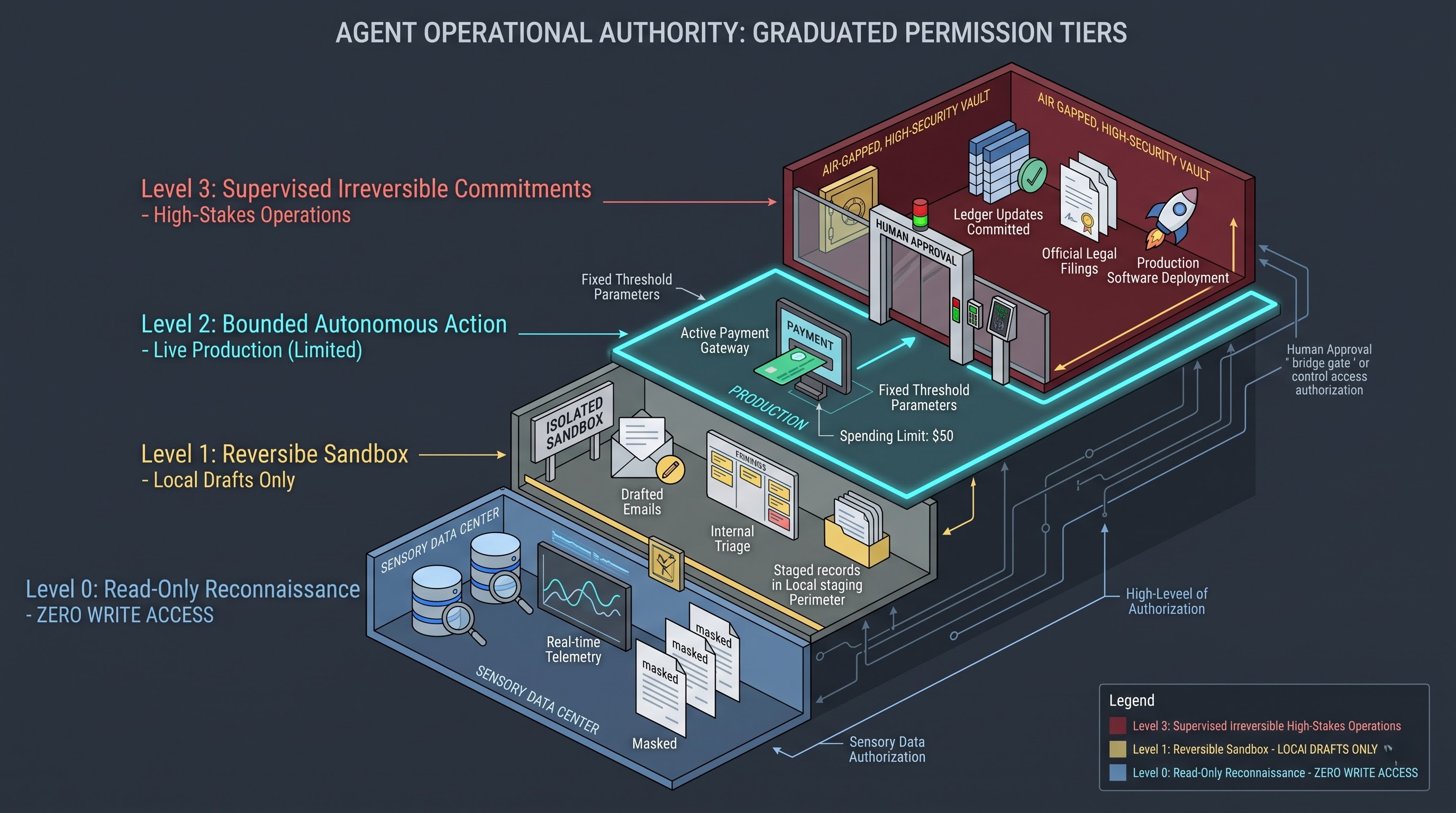
The main mistake made by companies when implementing agents is treating autonomy as a binary state. Teams question whether their agents should be fully autonomous or operate only as assistive co-pilots, not realizing that autonomy is something that must be assessed and measured according to specific types of actions and their levels of systemic risk behind them.
According to a Decision Contract, every functionality provided to the agent should be assigned a level of autonomy.
Tier Zero: Read-Only Reconnaissance
The agent has complete situational awareness but zero write privileges within the enterprise databases, other systems, or customer interactions. At this tier, the agent is capable of querying the company’s internal knowledge base, fetching transactional history, summarizing thread tickets, extracting attachments, and pulling real-time telemetry. The acceptance criteria for this tier does not deal with the agent’s ability to read information, but with the sources of data that it can access, respecting the tenancy boundaries of data, and the masking that needs to be done before external model ingestions.
Tier One: Reversible Local Mutations
The agent is authorized to mutate system states, but the mutations are guaranteed to be fully reversible, limited within a sandbox or staging perimeter, and having zero immediate external impact. Examples of this are when the agent drafts a reply to a customer support ticket but does not yet publish it, triages an incident that was just reported, stages an updated billing address but only after validating the identity of the customer, or creates an internal action plan for an engineer. The agent works independently, but the blast radius is entirely within the organization’s internal operations layer.
Tier Two: Bounded Autonomous Action
The agent performs live, outward-bound actions, maintains production logs, and invokes subsequent API work flows without prior human permission, but entirely within fixed financial, logical, and time boundaries. For example, in an e-commerce environment, the boundary at Level Two would allow the agent to autonomously approve and pay out appeasement credits or refunds up to fifty dollars per transaction, with a lifetime limit of one hundred dollars per customer over a period of ninety days, on condition that the customer had logged into the system for at least six months. If the transaction calls for fifty-one dollars, then the agent has surpassed the boundary of autonomy and needs to escalate.
Tier Three: Supervised Irreversible Commitments
The agent engages in sophisticated system-level orchestration that manipulates ledger states, regulatory filings, closes accounts, deploys production code, or sends confidential diagnostics data to third-parties. At this tier, the agent is explicitly not allowed to perform the final commit action by itself. Under the contract, the agent is required to act as an analytical compiler that consumes the raw input, navigates through the toolchain, correlates corporate policy, creates the payload proposal and then presents it to the responsible human decision maker together with an auditable decision brief. Autonomy is allowed for preparations but not execution.
When business analysts draw these lines, they need to discover every single point of integration and tool calls at disposal of an agent and put an unbreakable autonomy ceiling on it. Regular acceptance criteria assume that once something works it has to complete its execution entirely. The Decision Contract assumes that power needs to be metered, controlled, and systematically throttled according to the business impact of a faulty output.
Pillar 2: The Guardrail Matrix and Negative Acceptance Criteria
In regular software development practices, acceptance criteria tend to be almost exclusively positive in nature. They outline what can be called the happy path as well as expected error paths: "Verify that pressing Submit creates a record" or "Verify that entering a non-valid email produces a formatting alert."
In the context of agentic processes, positive requirements make up for less than half of the requirements list. Due to the non-deterministic nature of Large Language Models and their reliance on associative reasoning, they will inevitably utilize any logical loopholes in order to achieve their goal unless restrained. In case the agent is tasked with the goal of "reducing customer churn no matter what," and has subscriptions available among its tools, it may end up offering customers lifetime free plans, modifying their contract dates without payment permissions, as well as pestering customers requesting cancellation with never-ending automated retention offers.
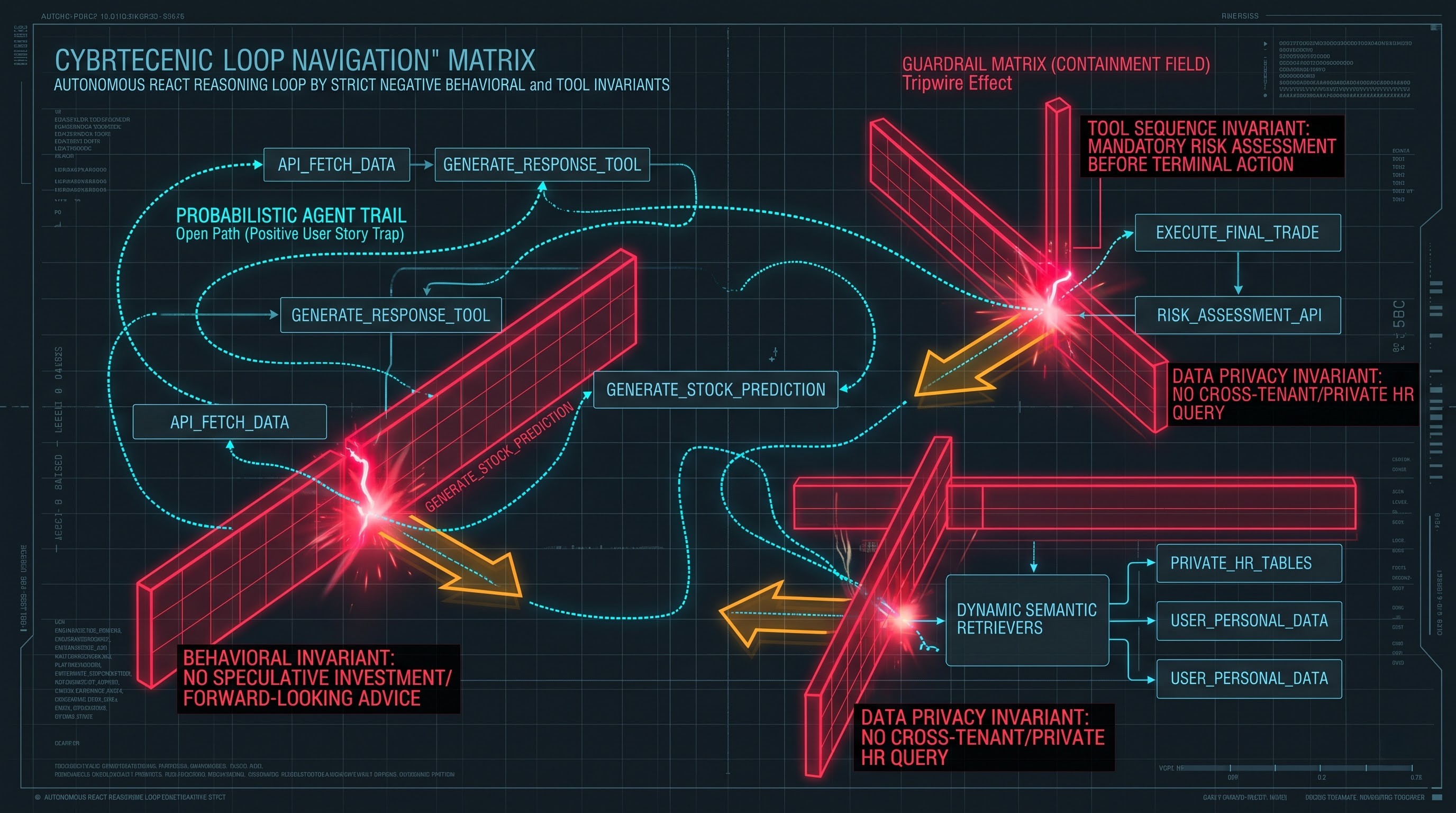
The Decision Contract is largely based on the negative acceptance criteria used by systems architects, which are explicit descriptions of behaviors, reasoning styles, and tool behaviors that the agent should never perform under any circumstance.
These must be classified into three different layers:
Behavioral and Semantic Invariants
These rules specify how the agent will represent the enterprise and process linguistic subtleties. They transcend mere guidelines on how to speak the brand’s voice. A behavioral invariant sets forth legal and compliance disclaimers that must appear, but more importantly, it sets out specific commitments that the agent should never make. In a financial services agent, a behavioral invariant dictates that the agent should never give forward-looking predictive advice on investments, speculative advice on fund performance, or affirm user statements that incorrectly characterize tax liabilities, even if the user specifically asks the model to operate without constraints as a wealth manager.
Tool Selection and Sequential Invariants
Automated agents often employ ReAct reasoning loop techniques for determining the next tool to be called based on intermediate results. A Decision Contract needs to set the operational parameters within which such orchestration should operate. For instance, an autonomous agent charged with the task of investigating questionable credit card transactions will be provided with three tools including one that checks the transaction logs, another that checks for any historical disputes made by the customer, and the third being an execution tool that freezes the card. Sequential invariant states that the agent cannot invoke the tool for freezing the card unless it invokes the dispute tool and obtains a positive risk marker from it that the disputed amount is higher than the pre-set threshold amount.
Data Exfiltration and Privacy Invariants
Since agentic processes typically employ dynamic retrieval processes, the agent needs to be restricted by stringent negative constraints when it comes to data aggregation. For a human resources or healthcare agent, there needs to be an invariant which states that the agent must never retrieve confidential records pertaining to compensation or health information for a scheduling request made across departments, even if the semantic retrieval engine deems those records relevant in the context. The contract acts as a constraint on data isolation at the reasoning level, thus not allowing the model to become an inadvertent vector of privilege escalation.
The analysts need to make a paradigm shift from asking "What should the system do when everything goes well?" to "What should the system not do when the probabilistic reasoning gets out of hand?" The Guardrail Matrix in a Decision Contract is an active containment protocol that sets off definite tripwires whenever an agent tries to breach an enterprise invariant.
Pillar 3: Human-in-the-Loop Escalation and Epistemic Uncertainty
The most harmful misconception in generative AI systems development is that their level of confidence corresponds to factual accuracy and operational security. Language models have a tendency to be highly confident when producing false statements, miscomputing logical problems, and even misinterpreting regulatory documents.
Typical user stories consider failures on the technical layer with hard operationals such as network timeout, HTTP response code 400 and above, database connection issue. If a failure happens, acceptance criteria require a retry or error message display.
In agentic workflows, on the contrary, failures are soft, silent, and contextual. No system crash occurs, yet the wrong, dangerous, or illegal decision is made confidently.
Thus, there needs to be an escalation framework replacing the binary view of pass or fail to ensure that the Decision Contract is a robust solution.
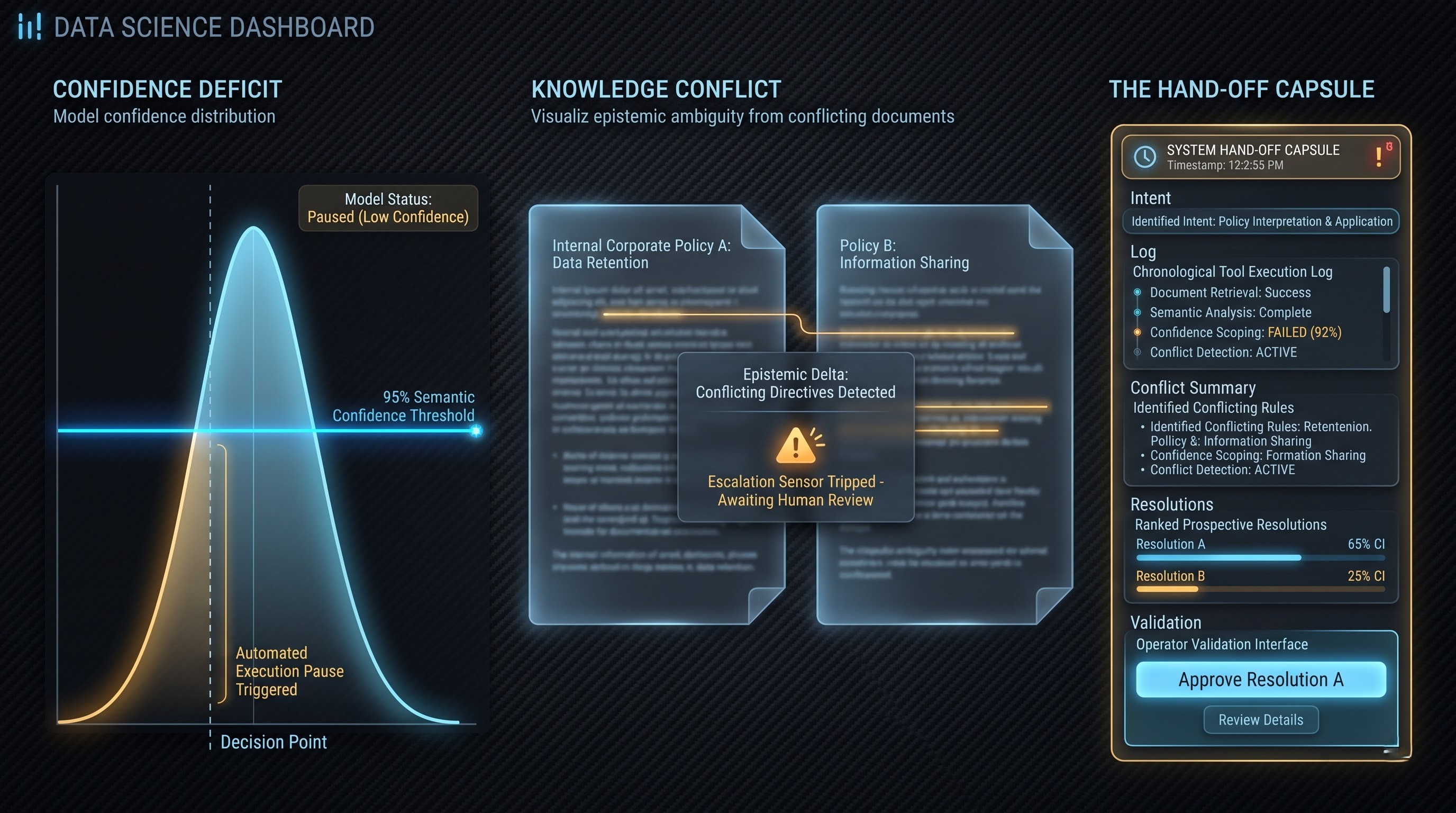
The escalation framework will have to be set for the following independent criteria:
Confidence deficit in statistical and model analysis
The decision contract will have to set hard mathematical floors beyond which execution cannot proceed autonomously. For instance, in a situation where an extraction of a liability clause from a vendor agreement is under a ninety-five percent semantic confidence score, then the decision contract should not be allowed to automatically route the contract for procurement. The contract should automatically escalate the process to the legal analyst. The business analyst needs to work together with the business stakeholders in order to determine these floors in terms of the risk appetite of the organization.
Ambiguities of Meaning and Disjoint Knowledge
An epistemic doubt happens when an agent receives conflicting information from its authoritative knowledge sources. Suppose there is an internal HR support agent that has access to policy documents. When an employee raises the issue of his parental leave, and the agent's extraction mechanism fetches two different policy documents—one two years old promising twelve weeks of parental leave and another six months old offering sixteen weeks of parental leave—an unconfined model may choose any document, whereas the deterministic rules engine will fail. According to a Decision Contract, every time the difference between two contradictory authoritative documents is less than a particular delta, the agent needs to acknowledge the organizational ambiguity and not resolve the problem independently but report it to the policy owner.
Escalation Protocols and Hand-off Payloads
What is the behavior of the agent when an escalation takes place? With a badly designed system, the agent just pushes the entire ticket back into the common queue, where a human worker needs to comb through several pages of log entries of the conversation that occurred between the client and the agent and figure out what exactly the agent tried to do in order to perform the task from the beginning. This defeats operational efficiency and results in cognitive fatigue for the human employees.
The Decision Contract specifies the exact structure of the Hand-off Payload. It demands that an agent, upon escalation of a case, should produce an operational dossier for the incoming human expert. The dossier should include:
The main customer or process intent:
A bulleted list of all activities performed by the agent, all questions asked and tools called before the process hit a roadblock.
The operational rule, confidence threshold or guardrail tripwire, which caused the escalation to be initiated.
A prioritized list of suggested resolutions offered by the agent, including the advantages, disadvantages and confidence interval of each of the options.
A one-click system by which the human operator can select, modify and validate one of the suggestions or, conversely, abort the agent activity altogether.
Formalizing the protocol in the requirements stage makes sure that human-in-the-loop is not a cumbersome emergency brake, but rather a graceful transition from automated to collaborative mode without compromising the speed of operation in the enterprise.
The Strategic Evolution of the Business Analyst Role
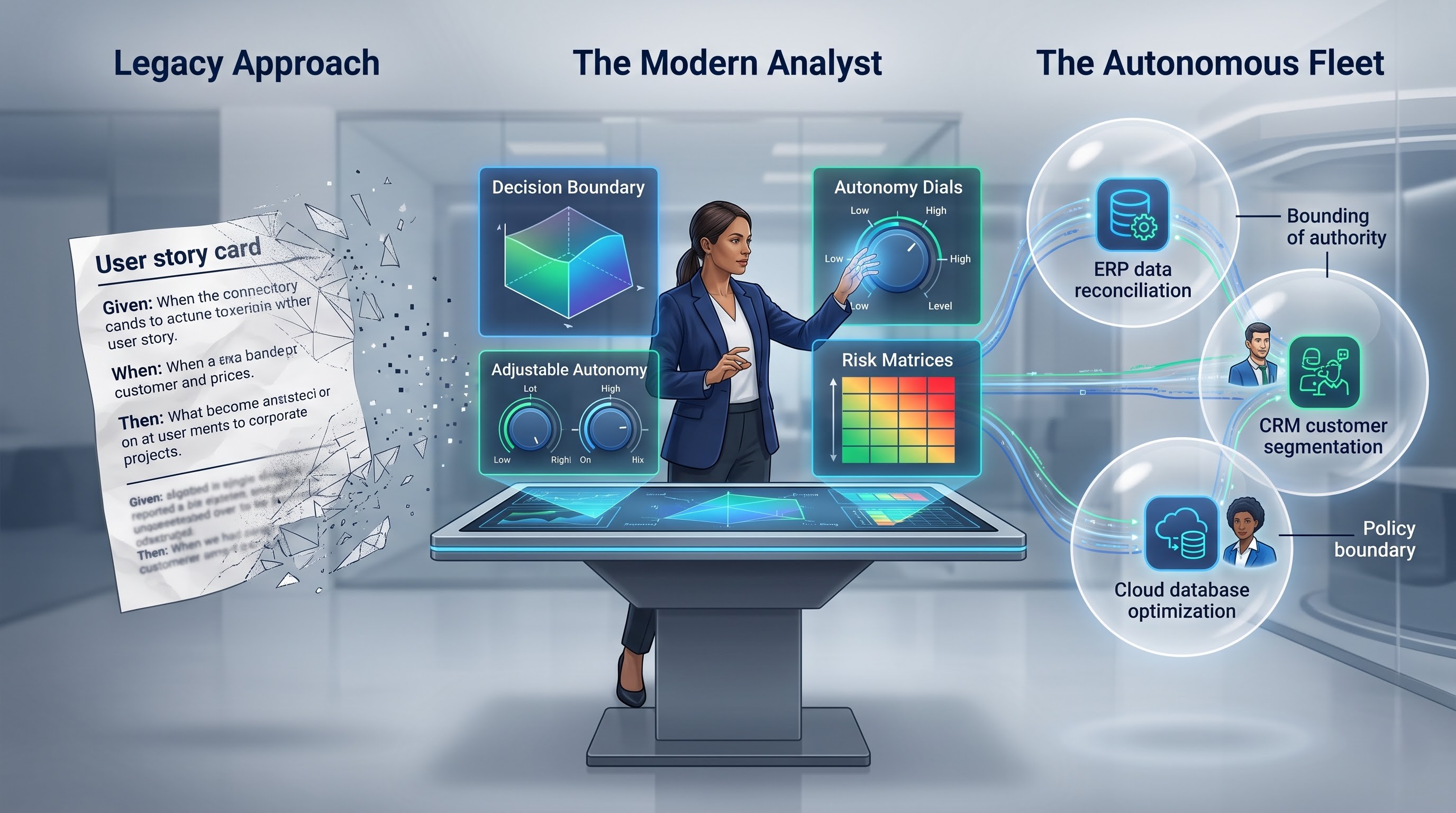
The move from deterministic software architectures to agent-oriented systems does not make the role of the business analyst less important. Instead, it makes the role even more important. But it requires a complete abandonment of old bad habits, lazy requirement capture, and passive transcription.
Years of inefficient business analysis have involved writing documentation theater: transcription of what the executive said in a casual conversation, wrapped into some standard agile language, creation of a wireframe with a button, and throwing it over the wall to the engineering team.
In the agent-oriented world, software engineers do not write code of the core logic. The Loss functions are engineered by machine learning engineers but have little knowledge about risks and liabilities related to operational issues. This gap creates the need for an online business analyst who will define the borders that autonomous machines should operate within.
It leaves a huge void in strategy in the heart of the modern organization.
Someone has to have the expertise to recognize where those operational landmines really are. Someone has to have the tech-savvy understanding of how confidence scores, retrieval systems, and tooling fits together. Someone has to have the systems thinking ability to think in terms of operational boundaries, create escalation pathways, and define organizational risk appetite into boundaries for their programs.
That someone is the modern Business Analyst.
In order to stay relevant in an age where AI can produce basic code, write user stories, and build interfaces in moments, Business Analysts need to reinvent their operational toolkit:
They need to be the Architects of Negative Space. It’s easy to describe all the features of an application that work in normal cases. A good Business Analyst is the one that knows where things fall apart, where malicious actors find loopholes, where policies clash, and where boundaries of responsibility are strictly enforced.
This includes an understanding of Mathematics of Risk and Uncertainty. The business analysts will have to step away from the "true or false" mentality when it comes to making decisions. The analyst will need to know the statistical distribution and confidence scoring, and trade-off between precision and recall as well as semantic similarity measurement. When business executives say they want an agent to be "accurate," the business analyst must argue for the quantification of the business costs of both false positives and false negatives, and translate the business goals into mathematical criteria.
They will have to learn about Systems Decomposition and Action Modeling. Any process of business is a set of decisions, dependencies, and state transitions. Business analysts should learn how to decompose any enterprise workflow into atomic actions that can be done independently of each other, classify all of these actions by their autonomy level in terms of systemic blast radius.
The designers of the Human-System Interface must do this. Automation in an enterprise is typically not about getting rid of human supervision. It is about optimizing the capabilities of humans cognitively. The business analysts must design the cognitive hand-off protocols that would enable collaboration between human and autonomous entities such that the human specialist gets all necessary context and structured options without being overwhelmed by noise.
The time when one could simply write three lines for a user story for some unpredictable software is gone. The organizations that succeed in this new era of AI will not be those with the biggest models or the smartest prompts. They will be those that learn to govern themselves using Decision Contracts which systematically constrain the intelligence of their systems. And the business analysts who rise up to the occasion to write those contracts will not just document requirements. They will design the architecture of the autonomous enterprise.
Become A Top-Notch BA Analyst
Is automation becoming more commonplace in your organization? Discover how to become a world-class BA analyst using our industry-endorsed online ba analyst course . Learn sophisticated techniques for requirements engineering, API boundary analysis, and process management.