
Why Companies Are Hiring More Business Analysts Than Ever
Last updated on May 17, 2026

Things are moving fast in the digital economy today and organizations constantly find themselves under pressure to become more efficient, cut costs, deliver better customer experience and beat the competition. With the introduction of new technologies such as Artificial Intelligence, Cloud Computing, Automation, Data Analytics in the business, there is a huge demand for skilled Business Analysts in the industries.
Businesses, from IT companies and healthcare organizations to banks, retail brands and manufacturers, need business analysts to bridge the gap between business goals and technology solutions. With this growing demand, Business Analysis has become one of the most promising career options in today’s corporate world.
The demand for business analysts is increasing
A Business Analyst works with an organization to help define its business needs, and to suggest a solution to business problems. In today’s competitive, technology driven business environment organizations depend on Business Analysts to bridge the gap between business operations and technical solutions. They understand business problems and analyze existing processes and provide effective solutions. Today, they are a critical aspect of business success.
Before launching any project, organizations should know what problems they are trying to solve and what outcomes they are seeking. Business Analysts interact with stakeholders, management teams, customers and technical departments to kow accurate requirements and translate them into organized plans. This analysis helps to ensure that projects are aligned to business objectives and reduces the risk of misunderstanding during implementation.
The companies of today are complicated with complex technology, multiple departments and large amounts of data. If companies don’t analyze inefficiency, delay project failure can occur. Business analysts provide data-driven solutions through which organizations improve operations, identify bottlenecks and streamline workflows. They also back digital transformation projects like cloud migration, ERP implementation and process automation.
Another key role of a Business Analyst is to improve processes. Many organizations suffer from outdated systems, duplicated processes, and poor communication between departments. The problems result in lower productivity and higher operating cost. Business Analysts review current business processes and identify opportunities for improving efficiency through automation, technology upgrades, or workflow improvements. Streamlining operations can help companies save time, reduce costs and enhance overall performance.
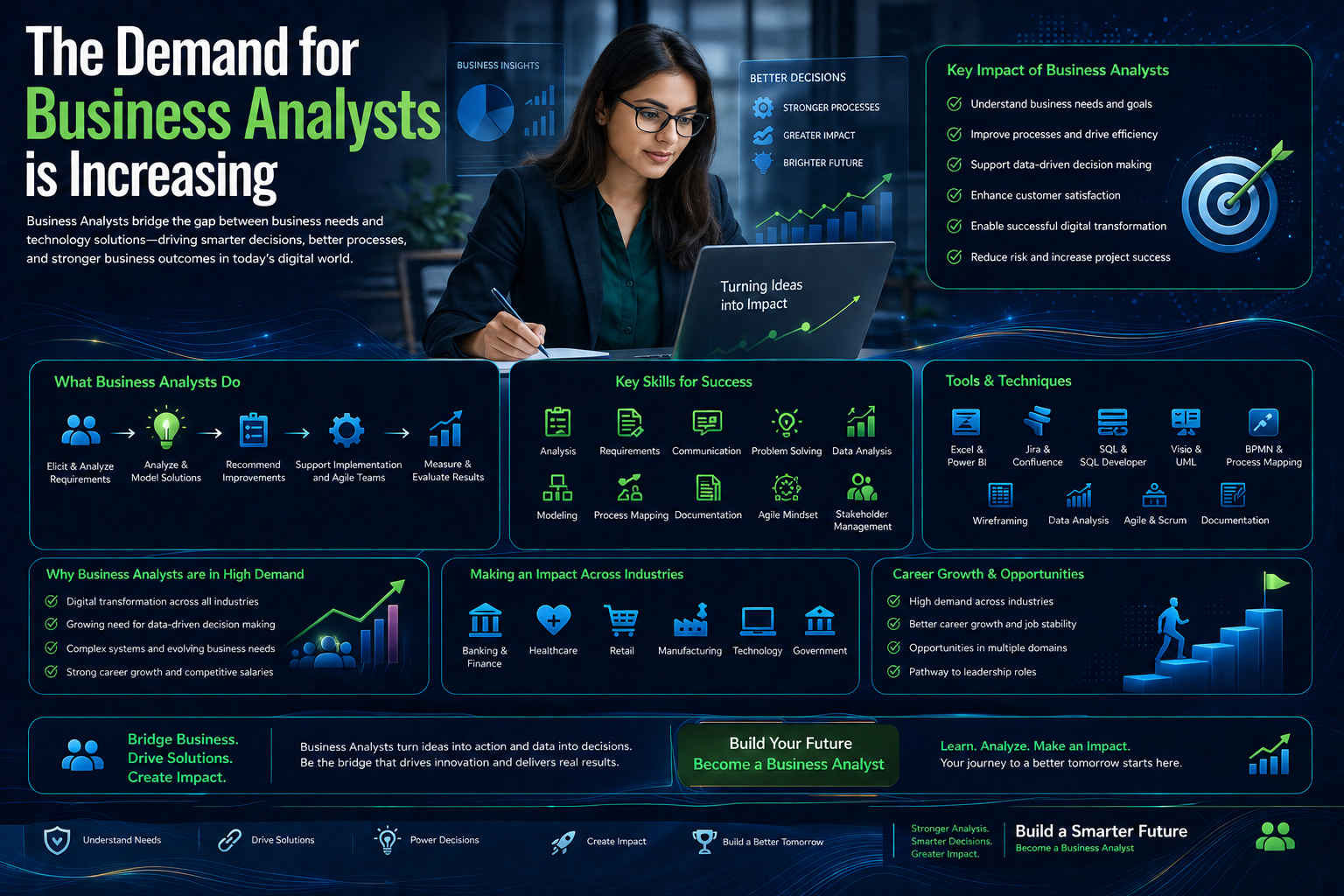
Business analysts also play an important role in improving customer satisfaction . They improve internal operations . Today’s consumer demands seamless, personalized, fast experiences across digital and physical experiences. If they don't meet these expectations, companies could lose customers to competitors. They analyze customer feedback, user behavior and market trends that allow organizations to better understand customer needs. From these insights they can recommend product, service and customer engagement strategies to enhance the overall customer experience.
Another big reason as to why Business Analysts are becoming increasingly valuable is due to digital transformation. Companies across all industries are using technologies such as cloud computing, artificial intelligence, automation, big data analytics and enterprise software platforms. However, meticulous planning and proper coordination between business and technical teams are essential for the successful implementation of new technology. Business analysts help ensure technology solutions are aligned with the organization’s goals, and provide measurable business value. They allow companies to change better , less risk in implementation and better transitions .
Business analysts are also key to project management and to Agile development environments. In agile projects, requirements are often changing fast due to feedback and changing business priorities. Business analysts help teams adapt and adjust by iteratively refining requirements, defining user stories and communicating clearly with stakeholders. They bridge the gap between business needs and technical delivery They allow development teams to deliver successful projects faster and more efficiently
If a business does not do enough analysis and planning it is likely to run into serious problems of going over budget, missing the implementation deadline, not implementing at all and running inefficiently. Business analysts can leverage strategic insight, thorough documentation and a structured approach to problem solving to reduce these risks. Their involvement leads to better decisions and increases the likelihood of project success.
The need for Business Analysts with the right skill-set is increasing today with the digital transformation initiatives and data-driven strategies. Organizations need professionals who can connect business strategies with technology implementation to improve efficiency, customer satisfaction and profitability. Business Analysts are important and that’s an obvious sign of the importance of Business Analysts in determining the future of modern businesses of various industries.
Want to become a Business Analyst Enroll click to get the BA Analyst Course
Digital Transformation Driven Demand
One of the biggest reasons companies are hiring more Business Analysts today is the rapid increase of digital transformation initiatives across industries. Companies aren't just running their business using traditional systems and manual processes. “Instead, organizations are investing heavily in modern technologies like cloud computing, AI, machine learning, automation, big data analytics and enterprise software solutions to improve efficiency, productivity, and customer experience. Demand for qualified Business Analysts is skyrocketing – these ever more complex transformations are a major driver.
The digital transformation goes beyond new software or upgrading legacy systems. Business Analysgt help companies to rethink their business strategies, re-engineer processes, improve communication and align technology investments with long-term business goals. Digital transformation projects that are poorly designed and executed may result in delays, budget overruns, low user adoption and operational disruptions. Business analysts help organizations address these challenges by ensuring that each technology initiative is aligned with business goals and delivers measurable value.
The main responsibility of a Business Analyst in digital transformation understands the current business processes. Many companies continue to run legacy systems that may be incompatible with new technologies. Such systems often result in inefficiencies, duplication of effort and communication breakdowns between departments. Business Analysts analyze the existing workflows and identify the operational bottlenecks and the pain points you can improve. Their analysis helps organisations to migrate smoothly from legacy systems to new digital platforms with the minimum disruption to business.

Business Analysts can also add value by communicating with Stakeholders: Digital transformation project generally involves multiple teams like management, IT teams, operations teams, developers, vendors and end users Different groups of stakeholders may have different needs and expectations. The Business Analyst acts as the bridge between technical and non-technical teams. They turn business requirements into technical specifications. This ensures all stakeholders involved in the project are aligned with the goals, timelines and deliverables.
Requirement gathering and documentation is another Key Area of Business Analyst. But before any digital solution is implemented, it is important for organisations to know what they want to achieve.
Detailed requirements are key to success when deploying an ERP system, CRM platform, automation software or cloud application. Business analysts collect information from stakeholders, record the business needs and describe the functional needs and establish frameworks for the development and implementation teams.
As automation and AI technologies trend upward, the demand for Business Analysts is at an all-time high. Businesses are using automation to take care of repetitive tasks, thus minimizing the need for manual labor and maximizing operational efficiency. Automation projects need to be carefully planned to identify the processes that are good candidates for automation and how this will affect employees and the business. They document business processes, identify the risks and help the businesses implement automation strategies to increase productivity while maintaining the stability of the operations.
Also, the move to the cloud is creating a demand for Business Analyst . To achieve scalability, flexibility and cost savings companies are moving their infrastructure from on-premise to cloud based platforms. Moving projects to the cloud usually involve data migration, system integration, security planning and process re-engineering. In these transitions, business analysts become the bridge to ensure business continuity and alignment of cloud solutions with business objectives.
The Business Analyst role is still an important part of the project life cycle in Agile and modern project environments.Engaging them promotes cooperation, reduces the likelihood of project failure and increases the possibility of project success.
With industries undergoing digital transformation, business analysts are a resource organizations can tap to cope with technological change. They are vital to the success of modern business, as they are capable of combining business insight, analytical thinking, communication skills and technical understanding. The more digital transformation becomes a business imperative, the more businesses are realising that it’s not just about the technology but about the people, the processes and the business strategies – and Business Analysts are right there in the thick of it.
Decision Making Using Data
In the current world, data is the lifeblood of businesses to make decisions that are informed and strategic. Organizations accumulate massive amounts of data from customers, sales and marketing campaigns, operations, financial systems, and digital platforms. The data gives the companies insight into the customer’s behaviour, market trends, operational performance and opportunities for business growth. But data is not only about collection. Organizations need skilled professionals who can analyze the data properly and convert them to actionable insights that are in line with the goals of the organization.
Business analysts are a huge help for businesses to interpret complex data. They look at business trends, find patterns, watch performance metrics and create solutions based on the insights from data. Business analysts help organizations to make better decisions that improve efficiency, profitability and customer satisfaction. They do this by looking at reports, customer feedback, operational flows and market information.

Business Analysts work alongside management teams, department heads and technical teams of modern organisations to understand business problems and opportunities for improvement. They provide ideas to improve the business growth and running with analytical and problem-solving skills. Their business acumen and data analysis skills can be an asset in industries such as banking, healthcare, retail, IT, manufacturing and e-commerce.
The explosion of analytics, business intelligence and digital reporting tools has created a huge demand for skilled Business Analysts. Organizations want professionals who can analyze data, communicate findings and help facilitate strategic planning efforts.
BA Online Course is one of the best options for students and working professionals to make a successful career in Business Analysis. This Business Analyst Classes helps students to learn core skills such as requirement gathering, data analysis, process modeling, stakeholder management, Agile methodologies & business communication The online training programs offer practical projects and real world scenarios, preparing the candidates to meet the current industry requirements and improve their career opportunities in the fast growing Business Analysis field.
Greater focus on the customer experience
In recent years, the rapid pace of digital transformation and the increasingly competitive landscape across industries have transformed customer expectations. Today’s customers expect speed, personalization, seamless digital interactions and quality customer service across multiple channels. Customers expect businesses to respond to them, know them and provide simple solutions through websites, mobile apps, chat systems and online services. If the companies are not able to meet these expectations then they will lose their customers to the other companies which provide better user experience and efficient services.
Business Analysts are vital in assisting organizations to deliver improved customer satisfaction and experiences. They analyze the customer data, customer reviews and find pain points that affect customer interactions. Business Analysts know what is the problem in business and what is required by customer. They can also make suggestions for process improvements and leverage technology to help businesses better serve their customers and operate more efficiently.
Business Analyst: The Business Analyst is a liaison between the customer and technical groups in the business. They work with the development teams, marketing teams, customer support teams and operational managers to ensure that the products and services meet customer expectations. By adding them to their systems, companies can create more user-friendly systems, enhance their communication channels and optimise business processes that directly affect the customer experience.
In recent times, customer satisfaction has been a critical factor to business success especially in industries like e-commerce, banking, health care, telecommunication and retail. Business Analysts help organizations to ease the online shopping, make banking transactions smooth, make patient service systems better and make customer support operations more effective. They see inefficiency. They find ways that are useful. “They go out and sell and build customer relationships.
With organizations moving towards customer centricity, demand of Business Analyst with right skills is increasing. Today’s digital marketplace has companies well aware that they need to deliver great customer experiences that build their brand reputation and customer loyalty to succeed.
Project Management – Modern & Agile
To speed up delivery, many organizations are adopting agile methodologies for flexible, collaborative projects. Traditional project management methods are often too rigid to meet fast changing market needs and changing business needs. An organization can use agile methodologies to deliver projects in manageable phases or increments, with continuous feedback and improvement throughout the development lifecycle. Agile is one of the most popular project management methodologies today in such industries as IT, banking, healthcare, e-commerce, telecommunications etc.
One of the most important factors in Agile environments is collaboration between stakeholders, developers, testers, product owners and management. Communication and quick decisions are needed for a project to be successful. In fast moving environments, Business Analysts are critical to bridging the gap between business goals and technical implementation.
Business Analysts are a key role in Agile and Scrum projects. They write user stories, elicit business requirements, prioritize work and facilitate communication in the team. Collaborate with stakeholders to understand project goals and translate business needs into detailed functional requirements that development teams can easily consume. They help clear up misunderstandings , make workflows more efficient and ensure projects are aligned with customer needs and company goals .

In Agile frameworks Business Analysts also perform sprint planning, backlog management, requirement refinement and test co-ordination. They have excellent analytical and communication skills, which allows teams to adapt fast to changing requirements and still deliver quality and on time. Business analysts help technical teams and the business work together better, which can lead to more successful projects.
Agile is gaining popularity in the world and companies are looking for people who are familiar with Agile and Scrum. Also, the growing interest is creating an increasing demand for online Business Analyst training courses. Business Analyst Course helps the learners to learn Agile methodologies, Scrum practices, gathering requirements, creating user stories, managing stakeholders, JIRA tools and project documentation. Our courses provide practical experience on real projects and ready professionals for Business Analyst roles in today’s Agile world.
Business agility, flexibility and customer centric development have never been more important and Agile Business Analysts are in demand across all industries.
Cost Reduction & Process Optimization
All industries are looking for ways to reduce operating costs, improve efficiency and increase overall productivity. In today’s competitive business environment, companies need to be cost effective while still providing quality products and services. But slow business processes, ageing systems, manual work and miscommunication between departments can lead to delays, errors, customer dissatisfaction and financial losses. If not taken care well these operational issues can have direct impact on the business performance and profitability.
This is where business analysts can assist organizations in identifying and correcting inefficiencies. They review existing workflows, business procedures and organisational procedures to identify areas for improvement. Business analysts will review current processes and the way information is communicated from one department to another to find bottlenecks, duplication of processes, communication gaps and unnecessary steps in operations that are having a negative effect on productivity.
Once the inefficiencies are identified, the business analysts then suggest better solutions to improve the efficiency of the workflow and to reduce the operational costs. Possible solutions are automation, system upgrades, better allocation of resources, better reporting processes, or implementation of modern enterprise applications. Their recommendations help organizations improve coordination across teams, avoid duplication of effort, reduce manual errors and drive operational efficiency.”
Business analysts work with stakeholders, management, IT and operations staff to ensure process improvements align with business objectives. They are the bridge between business needs and the technical solutions that enable businesses to implement change and achieve measurable results.
Operational efficiency is key to profitability and customer satisfaction in the banking, healthcare, retail, manufacturing, logistics and information technologies industries. A company that can increase efficiency and reduce waste has a clear competitive advantage in the market.
They are valuable to all industries and can help to improve operational performance, reduce risks and increase productivity. Demand for Skilled Business Analysts is growing exponentially across the globe as organizations look to optimize cost and digitize.
Industries Demand
Business analysts are needed not only in IT industry. Today, nearly every industry has Business Analysts who can help with business operations and technology initiatives.
Industries looking to hire Business Analysts include:
• Information Technology (IT) TPRF, for example, has a large network of IT suppliers and professionals.
Banking & Financial Services Healthcare
Sécurité
• eCommerce, retail
• Create
• Telecoms
• Education in Supply Chain & Logistics
• Government departments
Business analysis skills can be applied across industries so there are plenty of career opportunities and growth potential.

High Income & Career Progression
The Business Analyst profession is popular for their attractive salary packages as well as the opportunities of career growth. Business Analysts also earn good money. Senior Business Analysts are strategic assets within organisations and should be well rewarded.
Professionals may also advance to senior roles such as:
Senior Business Analyst
Product Owner
Management of Projects
Consultancy services
Data Analyst Software
Functional consulting
Product management
With further certification and industry experience, Business Analysts may progress to management positions where they play a crucial role in business strategy and digital innovation.
Work Remotely & Internationally
The remote work has opened up Business Analyst Jobs all around the world. Increasingly, companies are looking to remote business analysts to support projects and teams across the world. This kind of flexibility allows professionals to work with organizations in different countries and industries. Business Analyst are required in Global job market for their communication, domain knowledge and analytical skills . As more organizations adopt hybrid and remote working models, the demand for skilled Business Analysts will likely increase even further.
Why Study Business Analysis? – Good Career Move
Business Analysis is a new and exciting career option for students, fresh graduates and professionals. It’s a safe job with constant learning, a good salary and the opportunity to work on innovative projects.

The Business Analysis training gives professionals important skills such as:
Requirements Gathering
• modelling methodsStakeholder management
•Data analysis
• Paper work
* Scrum processes
• Communication and presentation skills
These are the skills that are hot in today’s technology driven business environment.
Conclusion:
Business and technology are merging, and companies want people who can bridge the gap between the two. Business analysts help companies become more efficient and achieve better outcomes, whether it’s digital transformation, data analytics, Agile project management or improving the customer experience.
As businesses adopt AI, automation and cloud technologies, the need for skilled Business Analysts exists across all industries. OnlineITGuru is the best Online Business Analyst Training Institute. Skills to learn Agile, SDLC, requirement gathering, JIRA, SQL basics, real time project skills for successful career with industry roles