
Why Companies Choose Salesforce: The Platform, the Ecosystem, and the People Who Keep It Running
Last updated on Oct 8, 2026
There is a moment in the life of almost every growing business when the spreadsheets stop working. It usually arrives quietly. A sales rep forgets to follow up with a lead because the note lived in someone's personal inbox. A support manager cannot tell whether a customer who just complained is also the customer who signed a six-figure renewal last month. A founder asks a simple question, "How many deals are we likely to close this quarter?", and gets three different answers from three different people. Nothing is exactly broken, but everything is slightly out of sync, and the cost of that mismatch compounds every week.
This is the moment when companies start shopping for a customer relationship management system, and more often than not, the shopping ends with Salesforce. That is not an accident, and it is not only because of a famous brand or a very good marketing machine. Salesforce has held its position at the top of the CRM market for more than two decades because it solves a specific kind of problem unusually well: it gives organizations a single, shared version of the truth about their customers, and then it lets them bend that system to match the way they actually work instead of forcing them to adapt to the software.
In this article, we will walk through the real reasons companies choose Salesforce. We will look at how deeply it can be customized, why its app marketplace changes what a CRM can be, and how it manages to serve a five-person startup and a global enterprise with the same core platform. And because no platform runs itself, we will also talk about the people who make Salesforce work day to day, and what it takes to become one of them.
The Problem Salesforce Was Built to Solve
To understand why Salesforce keeps winning, it helps to remember what it replaced. Before cloud software became normal, customer data lived in a patchwork of places: contact managers installed on individual laptops, shared drives full of half-updated spreadsheets, and expensive on-premise systems that took months to install and years to feel comfortable with. Upgrading meant a project. Accessing data from outside the office meant a VPN and a prayer. When Salesforce arrived with the idea that business software could simply be opened in a browser and paid for monthly, it sounded almost too simple to be serious.
But the simplicity hid a bigger shift. When the software lives in the cloud, everyone works on the same version at the same time. A salesperson updating a deal in Mumbai changes what a finance analyst sees in London a few seconds later. A support agent can see the full history of a customer without chasing three colleagues for context. The system stops being a record of what happened and becomes a shared workspace for what is happening right now.
That shared workspace is the real product. Features come and go, interfaces get redesigned, and AI assistants get bolted on, but the foundational promise has stayed the same: one place where sales, service, marketing, and operations can all look at the same customer and see the same story. Companies that have lived without that clarity tend to describe the change in emotional terms, not technical ones. People talk about relief, about meetings getting shorter, about arguments over whose numbers are right quietly disappearing.
It is also worth noting that Salesforce did not stop at being a sales tool. Over time it grew into a family of products covering customer service, marketing automation, commerce, analytics, and more. For a business, that means the decision to adopt Salesforce is rarely a decision about one department. It is a decision about whether to build a customer-centered operating system for the whole company, one that can grow in directions nobody has planned yet.
High Customizability: A Platform That Bends Without Breaking
If you ask experienced Salesforce professionals why the platform has stuck around in so many industries, the answer you hear most often is customization. Every business believes, with good reason, that it is a little different from every other business. A hospital tracks patients, referrals, and care teams. A bank tracks accounts, compliance checks, and relationship managers. A manufacturer tracks distributors, orders, and warranty claims. A software-as-a-service company tracks trials, subscriptions, and usage. A rigid CRM would treat all of these as variations on the same contact-and-deal template and leave everyone slightly unhappy.
Salesforce takes a different approach. The core platform gives you objects, which are essentially the tables that hold your data, and it lets you create your own alongside the standard ones. You can add custom fields to capture exactly the details your team cares about, build page layouts so that each role sees only what is relevant to them, and design validation rules that keep bad data from sneaking in at the door. Then, through workflow automation tools such as Flow, you can describe business processes in a visual builder: when a deal passes a certain value, route it for approval; when a case sits untouched for two days, escalate it; when a contract is signed, create the onboarding tasks automatically.
What makes this especially powerful is that a huge amount of it can be done without writing a single line of code. Administrators routinely build sophisticated systems using nothing more than clicks, menus, and a clear understanding of how the business works. That lowers the barrier to improvement dramatically. A team does not need to file a ticket with engineering and wait for a sprint to add a field or change a process. Someone who understands the problem can often fix it the same afternoon.
And when clicks are not enough, the platform opens a second door. Salesforce has its own programming language, Apex, which behaves a lot like Java and lets developers write custom business logic that runs on the platform. On the front end, Lightning Web Components give developers a modern, standards-based way to build custom user interfaces that feel native to Salesforce. This is the point at which a healthcare company can build a patient-intake experience that looks nothing like a typical CRM screen, or a financial firm can encode its own risk rules directly into the system.
The table below gives a simple picture of how these layers fit together, from the most accessible tools to the most powerful.
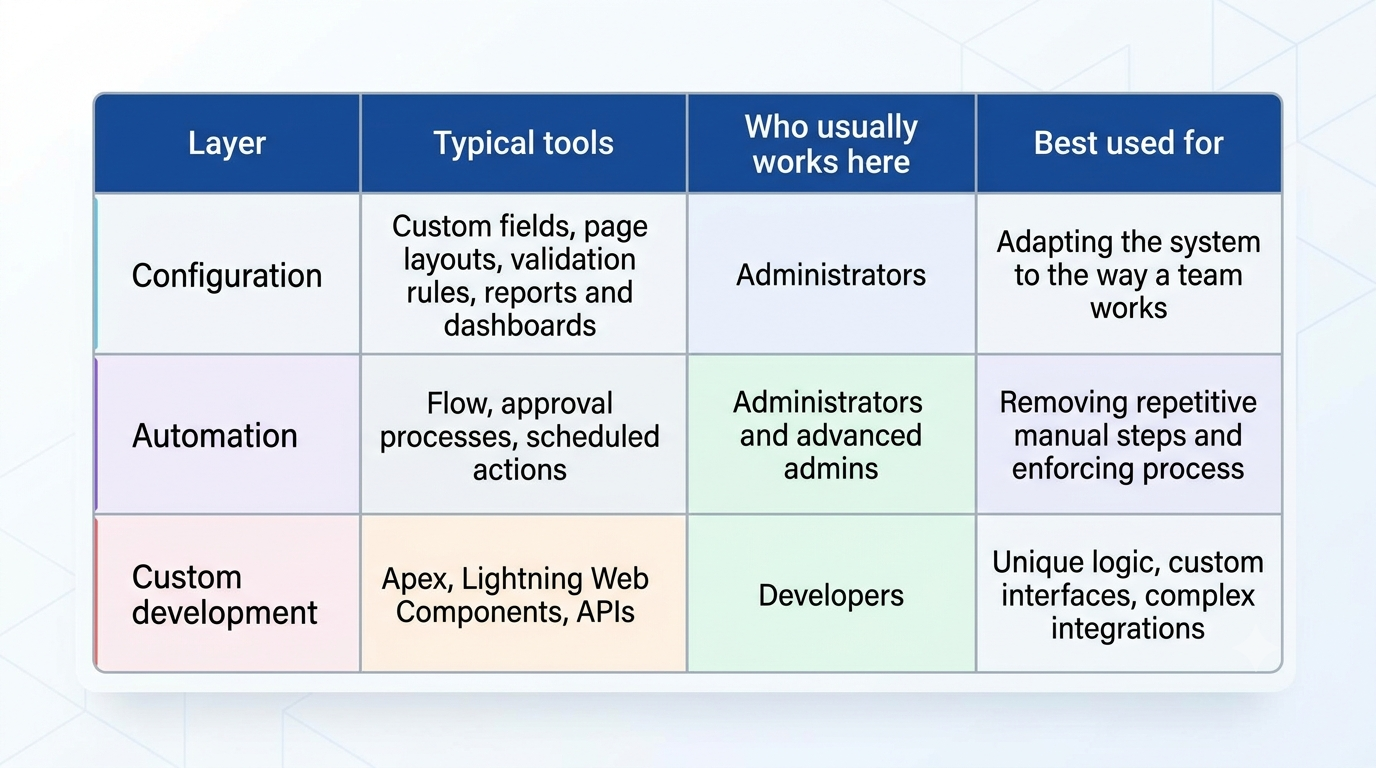
The important thing about this layered structure is that it lets a company start simple and add sophistication only when it needs it. A small business can run happily on configuration alone for years. A larger one can combine all three layers. Nobody has to throw everything away and start over because they outgrew an earlier choice, which is one of the most expensive mistakes a business can make with its software.
The AppExchange: An Ecosystem That Extends the Platform
Customization is only half of the story. The other half is that you rarely have to build everything yourself. Salesforce runs a marketplace called the AppExchange, which people often describe as the app store for enterprise software, and the comparison is surprisingly accurate. Instead of games and photo editors, it offers thousands of business applications and integrations that plug directly into Salesforce, built by independent software companies and consultancies around the world.
Think about what that means in practice. Your sales team wants to send contracts for e-signature without leaving the opportunity record. A connector for a tool like DocuSign handles it. Your marketing team wants to sync campaign audiences with an email platform such as Mailchimp. There is an integration for that too. Your company lives in Slack and wants deal updates and approval requests to show up in the channels where people already talk. Salesforce owns Slack, and the two products are connected in ways that make that kind of workflow feel natural rather than patched together.
The deeper benefit is risk reduction. Building software from scratch is slow, expensive, and uncertain. Buying an established app from the AppExchange means you are starting with something that other companies have already tested in real conditions, and you can often try it before committing. For a business that needs to move quickly, the difference between building a capability in six months and installing it in six days can decide whether an opportunity is captured or lost.
There is also a network effect that quietly strengthens the whole platform. The more companies use Salesforce, the more incentive developers have to build for it, and the more apps exist, the more attractive Salesforce becomes to the next company evaluating its options. It is a virtuous circle that competitors find very difficult to copy, because it takes years of community growth, not just good engineering, to build an ecosystem of that size.
For the people who work with the platform, the AppExchange also changes what the job looks like. A good administrator is not only someone who knows how to configure Salesforce itself. They are someone who knows when to build something, when to buy something, and when to simply connect two systems that already exist. That judgment, about which tool belongs where, is often more valuable than any single technical skill.
Scalability: From Five People to Fifty Thousand
Perhaps the most underrated reason companies choose Salesforce is that they do not expect to outgrow it. When you are evaluating software for a ten-person team, it is tempting to pick whatever is cheapest and simplest today. The trouble is that businesses that succeed do not stay ten people for long. Systems that were fine at ten become painful at a hundred, and by a thousand, many of them are quietly holding the company back.
Salesforce is built on a multi-tenant cloud architecture, which in plain terms means that all customers share the same underlying infrastructure while their data and customizations stay securely separated. The practical result is that a startup with five employees and a global enterprise with a hundred thousand are, at a technical level, running on the same foundation. There are no servers for the customer to buy, no capacity planning spreadsheets, and no weekend-long migration projects when the company doubles in size. Salesforce handles upgrades three times a year automatically, and customers receive new features without installing anything.
Scalability, though, is not only about raw capacity. It is also about structure. As a company grows, it needs more nuanced control over who can see what. The sales team in one region should not necessarily see another region's pipeline. A partner organization should see only the deals it is involved in. Salesforce offers a layered security model, with profiles, permission sets, role hierarchies, and sharing rules, that lets an organization start with broad, simple access and tighten it progressively as the business matures and its compliance obligations grow.
The following table shows how the same platform tends to be used at different stages of a company's life.
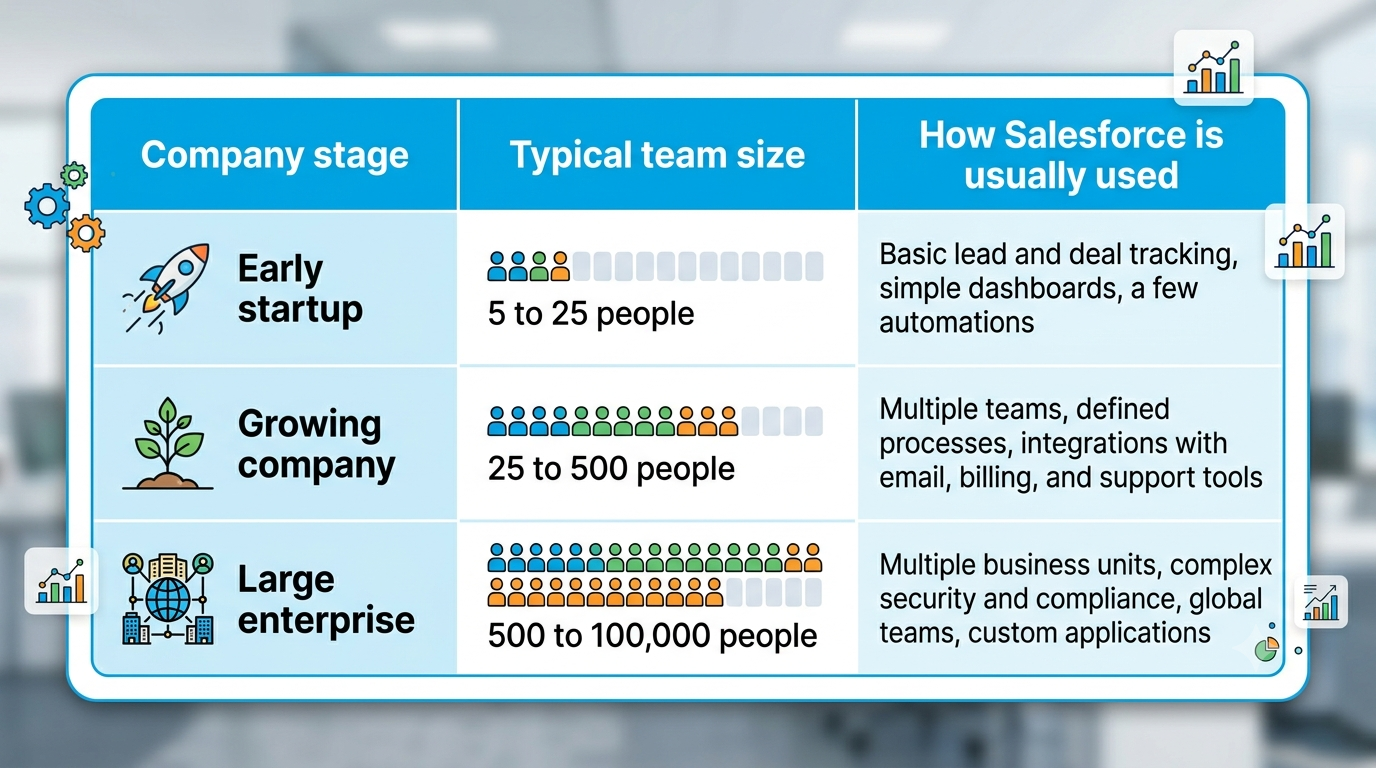
What matters most in this picture is continuity. The startup that began with a few fields and one dashboard is not forced to migrate to a different product when it becomes a mid-sized company. It adds users, layers in automation, installs a few apps, and keeps going. The data it collected in its first year is still there, still useful, and still connected to everything it adds later. For leadership teams, that continuity is a form of insurance.
The Hidden Ingredient: Someone Has to Run It
Here is the part that brochures tend to skip. Salesforce is powerful precisely because it is flexible, and flexibility has a price: the system does not configure itself. Behind every smooth Salesforce experience, there is usually a person who decided how the fields should be structured, how the permissions should work, which automations should run, and what the dashboards should show. That person is the Salesforce administrator, and in many organizations they are the quiet reason the platform delivers value instead of becoming expensive shelfware.
The job is more varied than the title suggests. On any given day, an admin might create a new report for a sales manager who needs to prepare for a board meeting, fix a broken automation that is sending duplicate emails, onboard a batch of new hires with the right access, clean up duplicate records that are confusing the sales team, and sit in a meeting translating a vague business request into something the system can actually do. It is part technician, part analyst, and part diplomat, and the best admins are often the people who understand both the software and the humans using it.
Because the role is so central, companies tend to value people who have invested seriously in learning it. A structured salesforce admin course can take someone from a basic familiarity with the interface to a real understanding of how the platform is organized: how objects and relationships work, how security is layered, how automation is built, and how data should be managed so that reports stay trustworthy. That structure matters because Salesforce can feel overwhelming when you try to learn it by wandering through menus. A guided path turns a sprawling product into a sequence of understandable ideas.
There is a practical side too. Organizations rarely hire an admin because they want someone to click buttons. They hire one because they want problems solved before they become crises, and because they want someone who can say, with confidence, "Yes, we can do that, and here is the simplest way to do it." That confidence comes from understanding the platform's logic deeply enough to find the cleanest solution, rather than the first one that works.
Why the Admin Path Is Such a Practical Career Move
For people deciding where to build a career in technology, the admin route has some unusual advantages. Unlike many technical paths, it does not require a computer science degree or years of programming experience. It rewards curiosity, logic, communication, and a willingness to understand how businesses operate. People arrive at it from sales operations, customer support, project coordination, teaching, and even completely unrelated fields, and many of them find that skills they already had, such as organizing information or explaining complicated things simply, transfer surprisingly well.
The demand side is just as encouraging. Because Salesforce is used across so many industries, the opportunities are not tied to one sector. Banks, hospitals, retailers, nonprofits, software companies, and government agencies all run Salesforce, and all of them need people who can keep it healthy. That diversity gives admins a kind of career flexibility that is hard to find elsewhere. You can move between industries without starting over, because the underlying platform skills travel with you.
The path also has a natural ladder. Many professionals begin as administrators, deepen their skills through certifications and experience, and then branch out. Some move toward advanced administration and become experts in complex automation and data architecture. Some become business analysts who bridge the gap between teams and technology. Some learn Apex and Lightning Web Components and become developers. Others become consultants, architects, or product owners who shape how entire organizations use the platform. Starting as an admin gives you a view of the whole system, and that breadth is a strong foundation for whatever comes next.
For anyone who likes the idea of this path but wants to see it laid out before committing, a good salesforce administrator course will usually cover the same ground that real jobs demand. You learn the data model and how to shape it, you learn to build automation that saves people time, you learn to create reports and dashboards that managers will actually use, and you learn how to protect data while giving people the access they need. By the end, the aim is not just to recognize features but to think like someone who can be trusted with a company's most important customer information.
It is worth being honest about the effort involved, though. The platform changes constantly, with new releases arriving several times a year, and the people who do well in this career are the ones who treat learning as a habit rather than a one-time event. The reward for that habit is that the skills stay valuable, because the platform keeps evolving and organizations keep needing people who can evolve with it.
What Good Learning Actually Looks Like
Not all learning paths are equal, and anyone who has tried to teach themselves a complex tool knows how easy it is to spend weeks consuming content without actually becoming capable. Watching someone else configure a system feels productive, but the understanding it creates is shallow until you try to build something yourself, make mistakes, and work out why the system behaved the way it did.
The strongest approach is one that mixes explanation with practice. Quality salesforce administrator training puts you inside a real environment early, usually a free developer org, and asks you to build things: a custom object for a made-up business, a set of fields and validation rules, a flow that automates a small process, a dashboard that answers a question a manager might ask. When something breaks, as it will, the debugging teaches more than a dozen clean demonstrations ever could. Over time, you start to develop instincts about how the platform behaves, and instincts are what separate people who can follow instructions from people who can solve unfamiliar problems.
The second ingredient is context. Salesforce does not exist in a vacuum, and the best learning connects features to the business reasons they exist. Why do sales teams care about opportunity stages? Why does a service team obsess over case queues and response times? Why do marketing teams argue about lead scoring? When you understand the human problem behind a feature, you configure it better, because you know what the feature is supposed to accomplish rather than simply how to switch it on.
The third ingredient is a clear target. Many learners work toward the Salesforce Certified Administrator exam, which covers topics such as configuration and setup, object management, security, data management, automation, and analytics. Even if you never care about the credential itself, the exam outline serves as a useful map of what a competent admin is expected to know. Using it as a checklist helps you notice gaps in your understanding before an interviewer does.
Finally, there is the matter of community. Salesforce has one of the most welcoming user communities in the software world, with local groups, online forums, and a free learning platform called Trailhead that lets people earn badges while working through guided modules. Learners who engage with that community tend to progress faster, because they get unstuck sooner, hear about opportunities earlier, and see how experienced professionals approach problems that textbooks never mention.
Bringing It All Together
When you step back, the reasons companies choose Salesforce form a coherent story. The platform can be shaped to fit almost any industry, from the simplest configuration to fully custom applications. Its marketplace means that most of the capabilities a business needs already exist and can be connected rather than built. And its architecture means that the company that starts small does not have to fear the day it becomes large. Each of those strengths reinforces the others, which is why so many organizations that begin with a narrow use case end up building much of their customer operation around the platform.
But the story is incomplete without the people. Tools do not transform businesses on their own. They transform businesses when someone takes the time to understand how the work really happens, designs the system to support it, and keeps adjusting as the company changes. That someone is very often an administrator, and the value of the role is why careful, hands-on learning is worth the time it takes. If you are a business leader, the lesson is that choosing Salesforce is only the beginning. The returns come from investing in the people who configure, maintain, and improve it. If you are someone considering a career in technology, the lesson is that there is a practical, accessible path into one of the most in-demand ecosystems in the industry, one that rewards curiosity and steady practice more than prior credentials. Either way, the platform's staying power comes from a simple idea that has not changed since the beginning: when everyone in a company can see the same customer, the same story, and the same truth, they do better work together. Everything else, the customization, the ecosystem, the scale, is in service of that idea.