
Why DataStage Still Matters: From Enterprise ETL to AI-Ready Data
Last updated on Aug 12, 2026
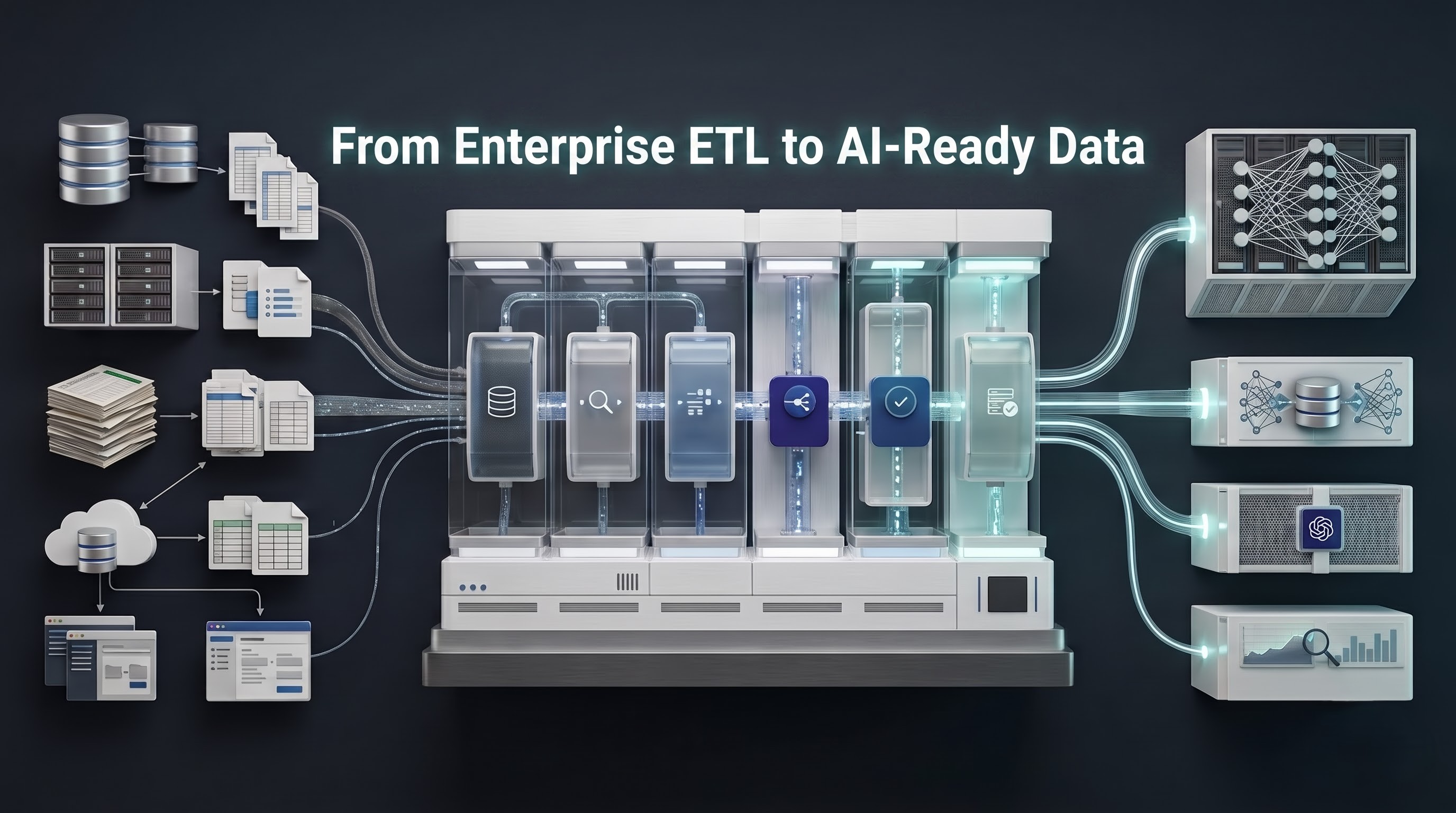
How IBM DataStage is evolving from traditional data integration into a broader foundation for cloud, analytics, and AI may be the technology getting the most attention today, but enterprise AI does not begin with the model. It begins much earlier, with the data that the model is expected to use.
Large organizations rarely keep all their information in one place. Customer records may sit in CRM systems, transactions in operational databases, financial information in ERP platforms, and newer workloads across cloud services. These systems often use different structures, formats and business definitions. That creates a problem that has existed long before generative AI: how do you bring disconnected enterprise data together and make it reliable enough to use? This is where IBM DataStage fits.
DataStage has traditionally been known as an enterprise ETL platform, helping organizations extract, transform and load information between different systems. But its role is becoming broader as organizations adopt cloud infrastructure, hybrid environments, real-time data and AI-driven applications. IBM currently positions DataStage around ETL and ELT, batch and streaming integration, replication, observability and trusted data for analytics and AI.
So the more useful question is no longer simply whether DataStage is an old or new technology. The better question is whether the data integration problem it solves is becoming more important as enterprise technology becomes more complex.
Why Enterprises Still Have a Data Integration Problem
A company can have access to enormous amounts of data and still struggle to turn that information into something useful. Imagine a large retailer trying to understand its customers. Customer profiles may come from a CRM platform, purchases from transactional databases, inventory from another application and financial information from an ERP system. The business sees all of this as one operation, but technically, the information exists across several disconnected environments.
The problem becomes even more noticeable when those systems use different formats or definitions. One application may identify a customer using an account number while another uses an email address. Dates, product names, transaction categories and other fields may also follow different standards. Someone has to bring these sources together before analysts, applications or AI systems can work with them effectively. That is the fundamental role of data integration.
Data integration connects information from different sources, applies the required transformations, and delivers it to systems where it can be analyzed or used. DataStage was built around this enterprise requirement, and the need has not disappeared simply because organizations are moving toward cloud and AI. In many cases, those technologies have created even more sources that need to work together.
For professionals who want to understand how these integration workflows are designed and how DataStage fits into enterprise data environments, a DataStage course can provide a structured starting point by connecting the platform with the underlying ETL and data-integration concepts.
A simple way to understand the problem
Different systems → Different data → Integration → Consistent information → Business use
The important point is that DataStage starts with a business problem, not with a particular software feature.
What DataStage Actually Does
At a practical level, DataStage helps organizations move and transform information between different systems. Suppose a company wants to create a central analytical environment for its sales operations. Data may come from several databases and applications. Before that information can be analyzed together, it may need to be cleaned, standardized, joined with other sources and transformed according to business rules.
A simplified DataStage workflow looks like:
Source Systems → Extract → Transform → Integrate → Target Platform → Analytics
The transformation stage is particularly important because raw information is rarely ready for immediate business use. Values may need to be standardized, duplicate records handled, fields combined, formats converted or business rules applied.
DataStage supports both ETL and ELT approaches. With ETL, transformation generally takes place before data reaches the target system. With ELT, information can be loaded first and transformed within the target environment, a pattern that has become increasingly relevant with modern cloud data platforms.
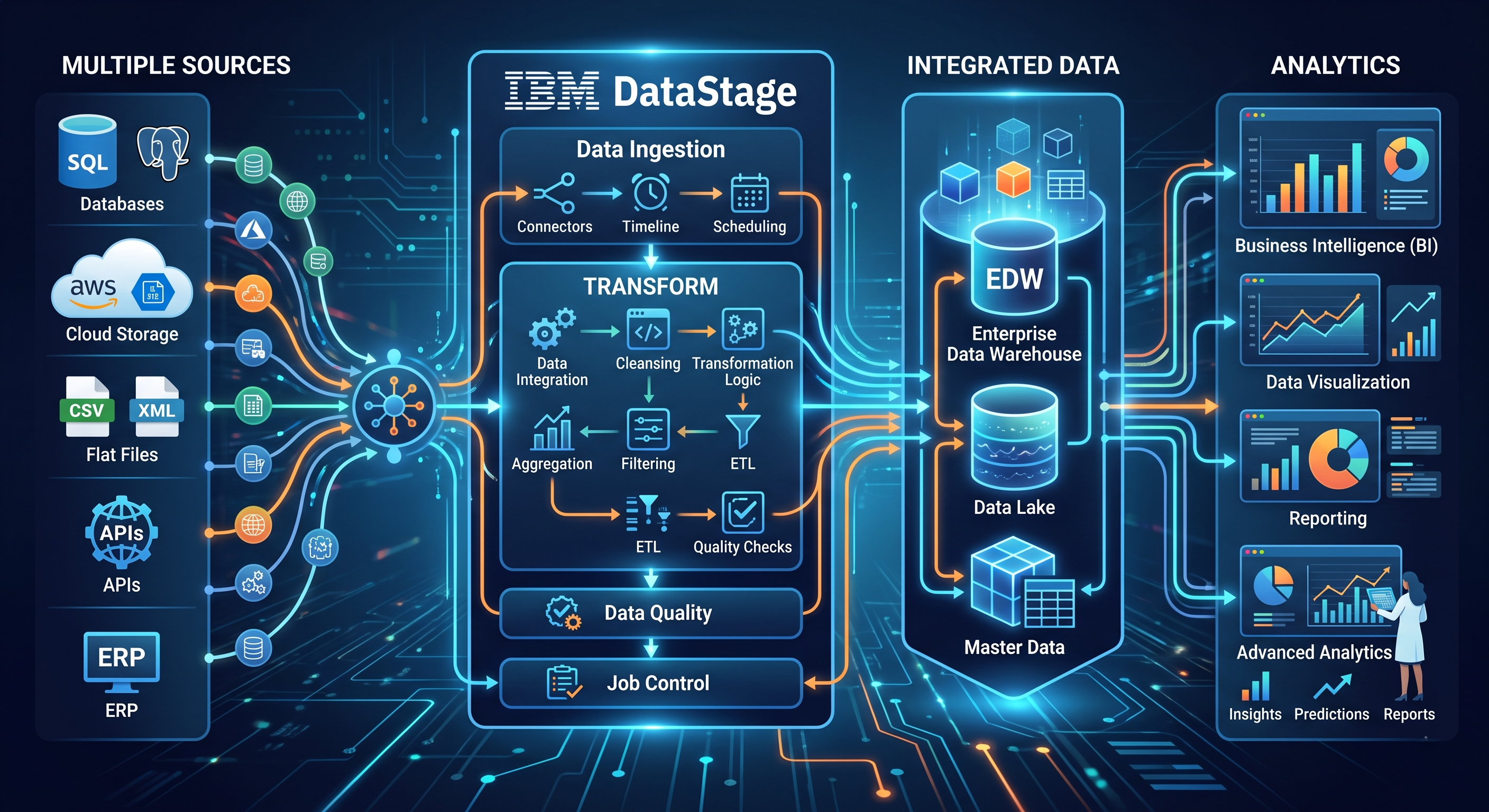
The technology can therefore be viewed as a controlled path between systems that were not necessarily designed to communicate with one another.
That distinction is important for beginners. DataStage is not simply a tool for moving files. It is used to build data pipelines that connect, transform and deliver enterprise information.
From Traditional ETL to Cloud and Hybrid Data Integration
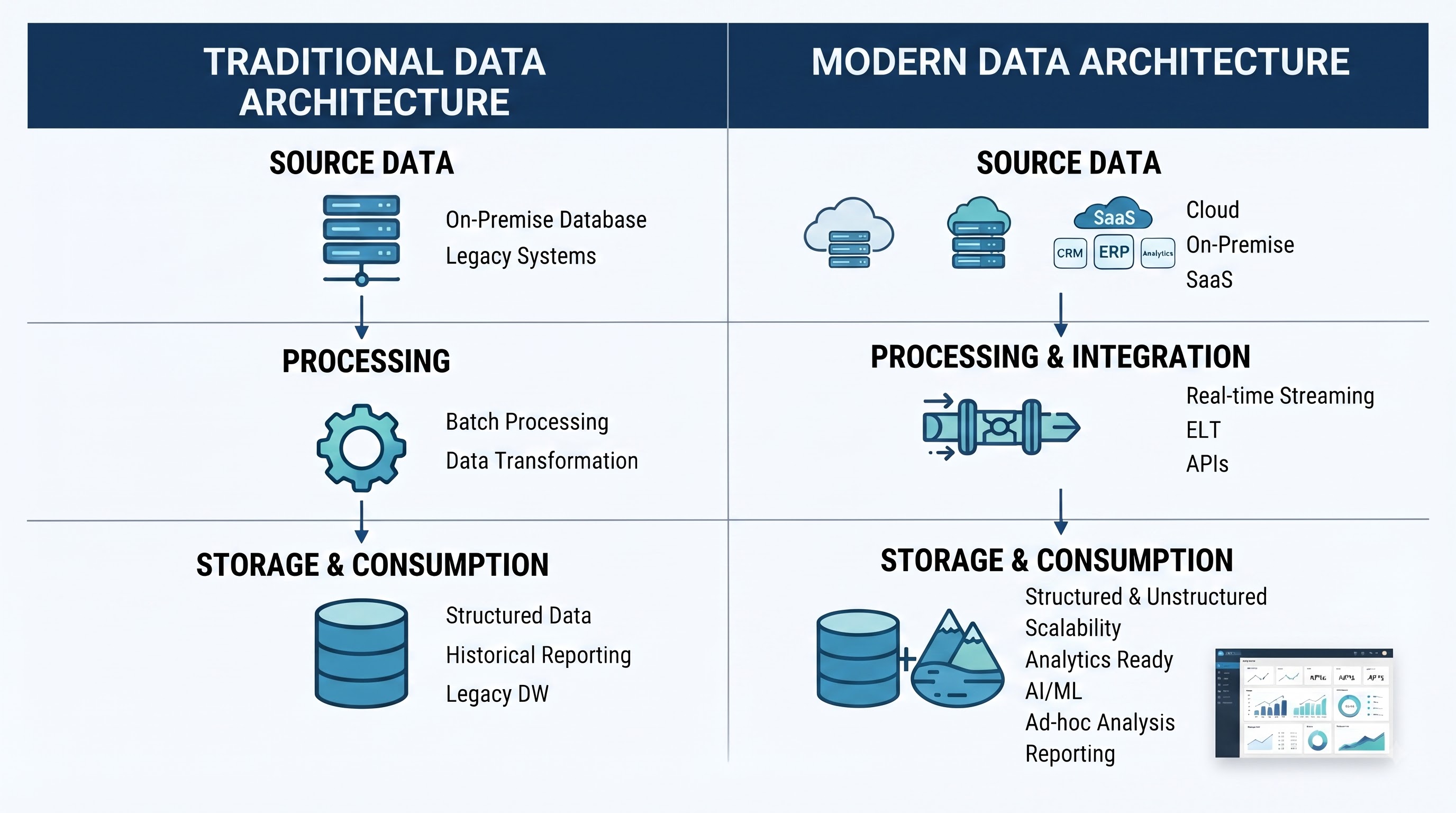
The traditional ETL model assumed a relatively predictable environment: data came from known systems, followed scheduled processes and was delivered into an established data warehouse. Enterprise architecture is no longer that simple.
Organizations may have legacy databases running alongside cloud platforms, SaaS applications, data warehouses, lakehouses and specialized databases. Some workloads remain on-premises because of security, cost or existing infrastructure, while others are increasingly being moved to cloud environments. This creates a hybrid data landscape.
Modern integration therefore needs to work across different environments rather than assuming that every source and destination exists in one location. IBM's current DataStage offering supports hybrid execution and remote runtime environments, allowing integration workloads to operate across cloud and on-premises infrastructure. The type of processing is also changing. Organizations may still run scheduled batch pipelines, but some applications require data to move continuously or with very low latency. DataStage's current positioning includes batch, real-time streaming and replication alongside traditional ETL and ELT.
The modern integration requirement
Batch: Process large volumes on a scheduled basis.
Real-time: Move information while events are happening.
Hybrid: Connect cloud and on-premises environments.
Multisource: Bring together information from different systems.
Scalable: Handle enterprise-level data volumes.
This is where DataStage starts moving beyond its traditional identity as an ETL tool.
The question is no longer simply “How do we transform this data?” It becomes:
“How do we move and prepare the right data across a complex enterprise environment?”
The Bigger Shift: Preparing Data for AI
This is where DataStage becomes particularly interesting. Organizations are investing heavily in generative AI, AI assistants, predictive systems, and increasingly autonomous applications. But these systems still depend on information from the organization itself.
Consider an AI assistant designed to answer questions about customer accounts. If customer information is incomplete, outdated, or spread across disconnected systems, the AI may struggle to provide a reliable answer regardless of how advanced the underlying model is. The problem therefore moves upstream: before AI can produce useful intelligence, the organization needs usable data. This is why IBM's current DataStage positioning emphasizes transforming data silos into AI-ready data and connecting data integration with analytics and AI workloads
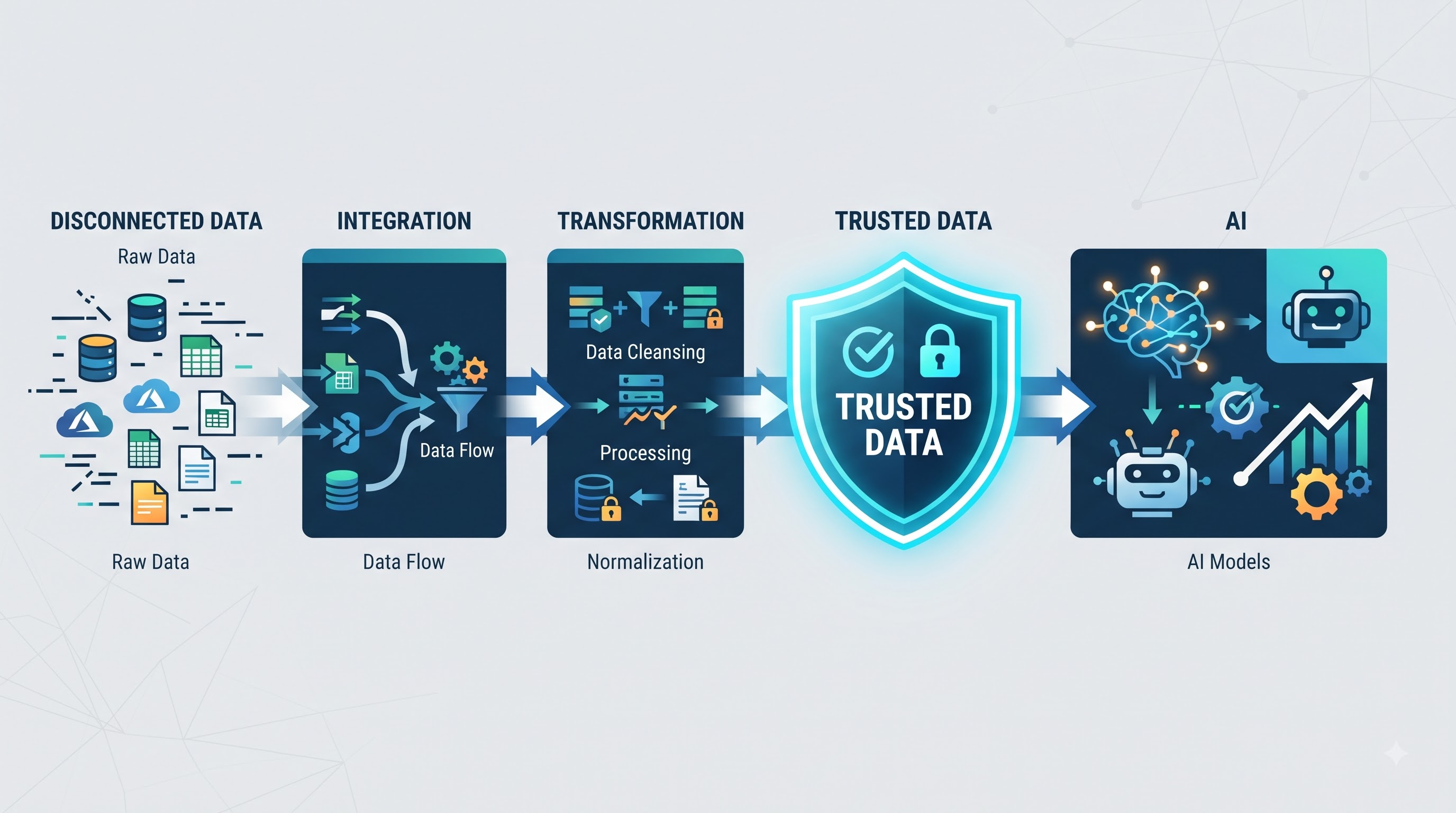
DataStage is part of the middle of that journey. It does not replace an AI model, nor is it itself an AI platform. Its role is more foundational: helping organizations connect and prepare information so other systems can use it. That distinction gives the technology a different relevance in the AI era.
The conversation is no longer only about preparing data for reports. It is increasingly about preparing data for analytics, applications, and intelligent systems. For professionals who want to build practical expertise in this area, DataStage training can help connect DataStage workflows with the broader requirements of modern data integration and AI-ready environments.
Why this matters
An AI system can process information quickly, but it cannot automatically resolve every problem caused by fragmented source systems, inconsistent definitions or poor-quality data.That means the quality of the data pipeline becomes part of the quality of the AI experience.
When AI Starts Building the Data Pipeline
There is another change happening inside the data-engineering workflow itself. AI is not only becoming a consumer of enterprise data. It is also starting to assist the professionals who prepare that data. IBM's DataStage Assistant allows users to interact with DataStage using natural language and supports pipeline development tasks, including generating multi-stage ETL flows and working with Transformer expressions. IBM Research has also published work on the DataStage Assistant and its use in reducing the effort involved in ETL development.
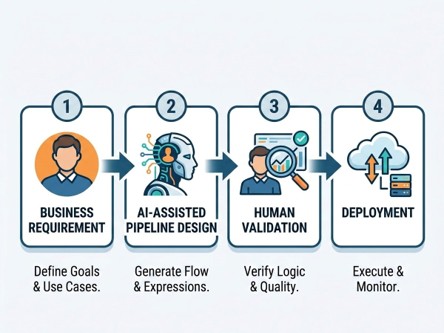
This changes the way some pipeline-development tasks can be approached. Instead of configuring every component manually, a professional may increasingly describe what they want the pipeline to accomplish and use AI assistance to generate or modify parts of the workflow.
But there is an important limitation.
Generating a pipeline is not the same as validating a pipeline. A professional still needs to understand the source data, business requirements, transformation logic, security implications and expected output. If an AI-generated transformation is technically valid but does not reflect the organization's business definition, the resulting data can still be wrong.
This creates an interesting future role for data engineers. AI may reduce some repetitive configuration work, while human expertise becomes more focused on architecture, validation, business logic, and quality control. That is a much more realistic way to think about AI-assisted data engineering than assuming automation will remove the need for data professionals.
Why Trusted Data Matters More Than Ever
Moving data successfully and moving correct data are two different things. Imagine a customer pipeline running every hour. Every job completes successfully, the records arrive at their destination, and there are no technical errors. Later, the business discovers that an upstream system changed the meaning of one field. The pipeline did exactly what it was designed to do. But the resulting information was wrong.
This is why modern data integration needs to consider more than movement and transformation. Data quality, observability, lineage, governance and security become increasingly important when organizations depend on automated systems and AI. IBM's current DataStage positioning includes observability and governance capabilities alongside integration.
The important distinction
Pipeline success ≠ Data quality
A reliable enterprise data environment needs to answer questions such as:
Where did this information come from?
Has the data changed?
Was the transformation successful?
Can the result be trusted?
Who is allowed to access it?
What business definition does the data represent?
These questions become even more important when AI systems consume the information.
An incorrect value in a report might influence one business decision. The same incorrect dataset feeding an automated AI workflow could influence many decisions before the problem is discovered. That is why the future of data integration is not simply about moving information faster.
It is about making that information reliable, observable and trustworthy.
What DataStage Means for Modern Data Engineers
The role of a DataStage professional is also becoming broader. Learning the interface alone is unlikely to be enough for someone who wants to work effectively in modern enterprise data environments. A stronger approach is to understand the technologies and concepts surrounding the integration layer.
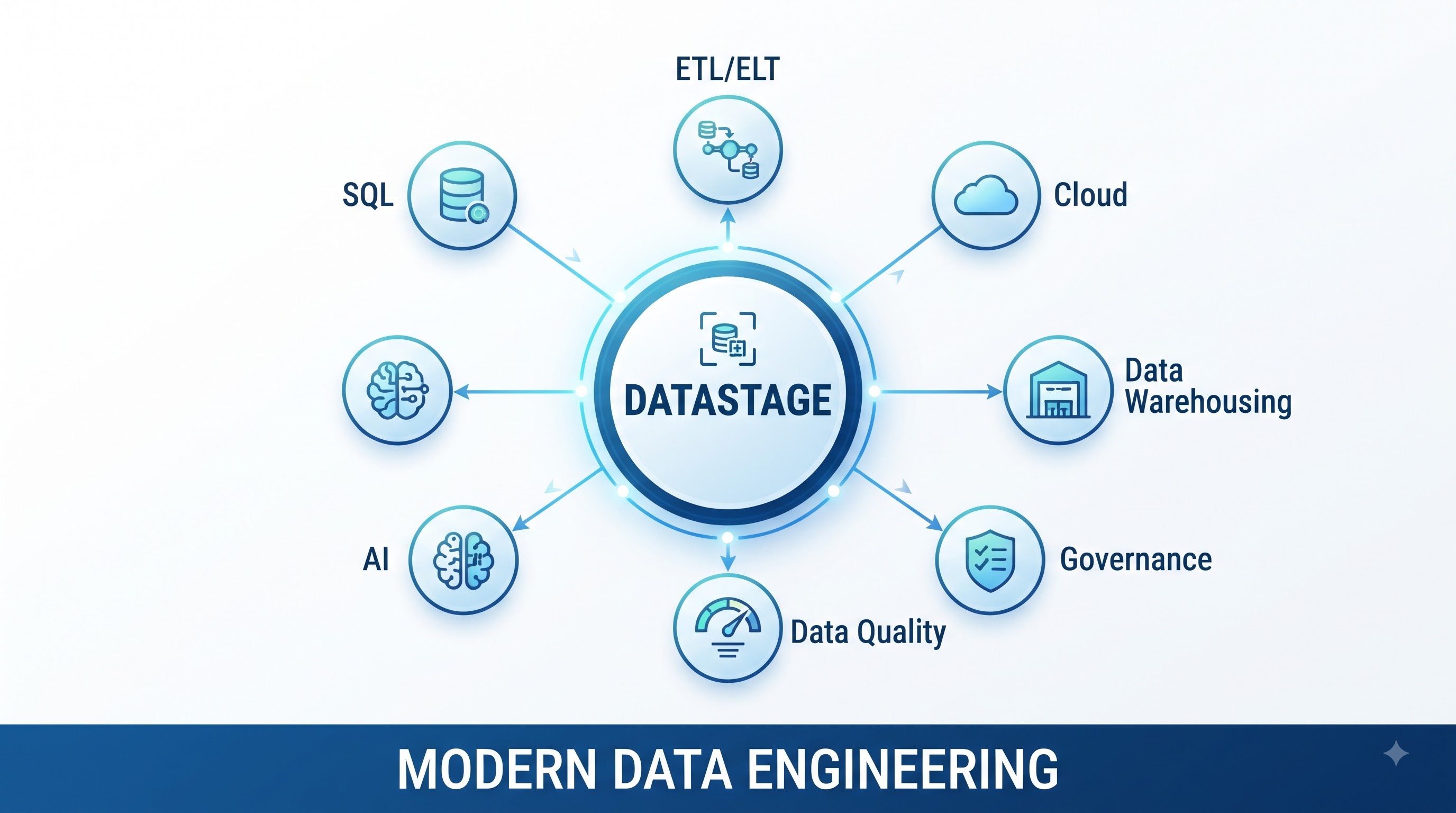
A useful skill combination looks like DataStage + SQL + ETL/ELT + Data Warehousing + Cloud + Data Quality + Governance + Data Engineering. Each capability contributes something different. DataStage provides the integration workflow, SQL helps professionals investigate and understand data, while data-warehousing concepts explain how information is organized for analytical use. Cloud knowledge becomes increasingly relevant as organizations distribute workloads across different environments.
For professionals already working with IBM's enterprise data ecosystem, IBM DataStage training can be considered as part of a wider data-engineering path. The goal should be to understand DataStage alongside architecture, transformation logic, data quality and governance rather than treating the platform as an isolated skill.
The broader career lesson is simple: DataStage can be a valuable specialization, but its strongest value comes when it sits within wider data-engineering knowledge.
Skills that complement DataStage
SQL: Helps query, investigate and validate source and target data.
Data Warehousing: Explains how integrated information is structured for analytics.
Cloud: Helps professionals work with distributed modern data environments.
Data Quality: Helps identify and prevent unreliable information.
Governance: Connects data integration with security, lineage and responsible access.
AI Awareness: Helps professionals understand how integrated data increasingly supports intelligent applications.
This broader combination makes the skill set more adaptable as enterprise technology continues to change.
Is DataStage Still Relevant — and Where Is It Going?
The answer depends on what we mean by relevance. DataStage is not the only data-integration technology available today, and modern data engineering involves a much wider ecosystem than one platform. But that does not make the underlying DataStage skill irrelevant. IBM continues to develop the platform, expand its connectivity, support hybrid and multicloud environments, and position it around ETL/ELT, streaming, replication, observability,
and AI-assisted pipeline development.
The more useful career question is therefore not:
“Can DataStage replace every modern data-engineering technology?”
It is:
“Where can DataStage contribute to a modern enterprise data environment?”
That answer is particularly relevant in organizations dealing with large-scale integration, complex enterprise systems, hybrid infrastructure and existing IBM technology environments.
Where the technology is heading
The direction can be summarized through several connected developments:
AI-ready data: Integration becomes part of the foundation supporting AI workloads.
Hybrid and multicloud: Data pipelines need to work across increasingly distributed environments.
Real-time integration: More applications need information as events happen rather than after scheduled processing.
Observability: Teams need visibility into both pipeline health and data behavior.
AI-assisted development: Professionals can use AI to reduce repetitive pipeline-building tasks.
Governance: As data becomes more valuable, controlling access and maintaining trust becomes increasingly important.
These developments suggest a broader role for data integration. The future is not necessarily about DataStage replacing traditional ETL. It is about DataStage becoming part of a larger data foundation that connects enterprise information with the systems that depend on it.
The Next Chapter for DataStage
DataStage began by solving a practical enterprise problem: moving and transforming information between different systems. That problem has not gone away. If anything, modern technology has made it more complicated. Organizations now operate across legacy infrastructure, cloud platforms, SaaS applications, warehouses, lake houses, and increasingly AI-driven systems. Data has become more distributed, while the expectations placed on it have become higher.
A business no longer wants data to arrive at its destination. It wants that data to be consistent, observable, governed, and ready to support decisions. That is where the future relevance of DataStage becomes clearer. Its role is expanding from traditional ETL toward broader enterprise data integration, while AI is beginning to influence both the data being prepared and the way pipelines themselves are developed. If you want to build a stronger foundation in the platform and understand how it fits into modern enterprise data workflows, an IBM DataStage course can give you a structured starting point.
For professionals, this means the strongest DataStage skill set will not be built around memorizing pipeline components alone. It will come from understanding where data comes from, how it should be transformed, how its quality can be maintained, where it needs to go, and how analytics and AI will eventually use it. That is the real shift behind the technology. DataStage is no longer interesting simply because it can move enterprise data. Its next chapter is about becoming part of the data foundation that helps modern analytics and AI work with enterprise information reliably.