
Why Modern Tech Is Escaping Complexity by Returning to First Principles
Last updated on Oct 10, 2026

Ab Initio Engineering: Somewhere between the fortieth dependency and the four-hundredth microservice, a lot of engineering teams quietly lost the plot. This is the story of how the sharpest ones found it again.
The Monday Morning With Forty Browser Tabs
Picture a data engineer at a mid-sized retail company on a Monday morning. The overnight sales report is wrong. Not disastrously wrong, just wrong enough that the regional managers have stopped trusting it. She starts pulling the thread. The report reads from a warehouse table. The table is fed by a transformation job. The job is kicked off by a scheduler that waits for a file from a vendor, and that file passes through a conversion script somebody wrote in 2017 and nobody has dared to touch since. By lunch she has forty browser tabs open. By evening she finds the culprit: a single misplaced decimal in a lookup file.
Nothing about this story is unusual, and that is exactly the problem. Almost every engineer reading it will recognise some version of their own week. Modern technology has become extraordinarily capable and, at the same time, strangely hard to hold in your head. Every tool in that chain was chosen for a sensible reason. The scheduler solved a timing problem. The conversion script solved a format problem. The warehouse solved a speed problem. Each fix was reasonable on the day it shipped. Added together, they became a machine that no single person fully understands.
Fred Brooks put a name to this tension back in 1986, in his essay "No Silver Bullet". He separated essential complexity, the difficulty that comes from the problem itself, from accidental complexity, the difficulty we introduce through our own tools and choices. A bank really does have to reconcile millions of transactions every night, and that part is essential. The fact that doing so takes six systems and three hand-offs is, more often than not, accidental. The uncomfortable truth of the last two decades is that accidental complexity has grown faster than anyone planned for.
The cost is easy to underestimate because it hides inside ordinary days. It shows up as the new hire who needs three months before touching production, the release that gets postponed because nobody is sure what depends on what, the outage whose root cause turns out to be an assumption made by someone who left the company years ago. Teams begin to spend more time understanding their systems than improving them. Fear of change quietly becomes part of the culture.
But something has started to shift. Instead of reaching for yet another layer to patch the last one, a growing number of engineering teams are asking a much older question: if we were starting from zero, knowing everything we know today, what would this system actually need to be? Philosophers, physicists and lawyers all have a Latin phrase for starting that way. They call it ab initio, from the beginning. This article is about why that phrase has become one of the most useful ideas in modern engineering, how it shapes the way serious data platforms are built, and what it means for anyone who wants to build a career on solid ground.
Two Latin Words and a Very Old Habit
Ab initio simply means "from the beginning," or more loosely, "from first principles." The phrase has lived in several professions for a long time, and each one gives it a slightly different flavour. In law, a contract that is void ab initio is treated as if it never existed at all, with no half-measures and no partial credit. In chemistry and physics, ab initio calculations predict how atoms and molecules behave by working directly from the fundamental laws of quantum mechanics, instead of leaning on measured shortcuts fitted to earlier experiments. Those calculations are demanding and expensive, but they carry a rare kind of honesty. If the answer is wrong, you know the error lives in your foundations and not in some inherited approximation.
The habit of thinking this way is far older than any of those uses. Aristotle described first principles as the basic starting points from which everything else in a field is known, the things you cannot derive from anything simpler. Centuries later, Descartes turned doubt itself into a method: strip away everything that can be questioned and see what is left standing. Engineers have been doing the same thing, usually without the Latin, ever since the first person asked why a bridge had to look the way bridges always looked.
Most of us, most of the time, reason by analogy. We look at what a similar company built, or what worked on the last project, and we copy it with small adjustments. That is efficient, and in day-to-day work it is usually the right call. The risk is that analogy carries its baggage along with its wisdom. When you copy a system, you also copy every assumption its builders made, including the ones that quietly stopped being true years ago.
First-principles thinking works in three moves. First, you write down what you currently believe about the problem and challenge each belief honestly, asking whether it is a law of nature or merely a habit. Second, you reduce the problem to the facts that cannot be argued with. The data has to come from somewhere, it has to be changed in some way, and it has to land somewhere useful. Third, you rebuild upward from those facts, adding only the pieces you can justify.
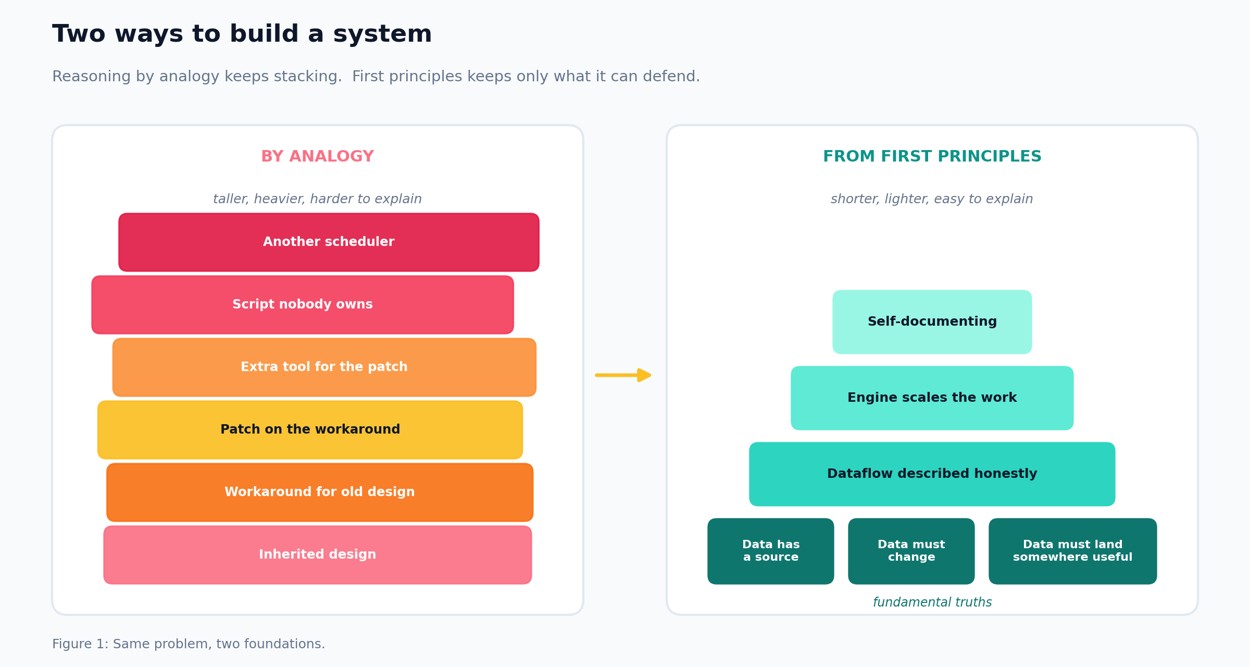
A fair warning belongs here, because the idea is often misread. Starting from first principles is not the same as reinventing the wheel. Nobody serious proposes writing your own operating system for a payroll job. The point is to know which parts of your stack are wheels and which are anchors, and to be able to explain, in plain language, why each piece is there. If you cannot, that is usually the first place complexity is hiding.
First Principles in the Wild: Relations, Pipes and Rockets
The pattern shows up in some of the most celebrated work in the history of engineering, and the examples share a feature worth noticing. Each began by finding the true constraint hiding underneath a convention. Take the database. In the 1960s, storing and finding data meant navigating hard-wired pointers between records. Programs had to know the physical layout of the data to use it, and changing that layout broke everything built on top. In 1970, Edgar Codd, working at IBM, proposed the relational model, which rested on a small piece of mathematics about sets and relations. Instead of asking programmers to chase pointers, he asked them to describe what they wanted and let the system work out how to get it. SQL descends directly from that act of starting over, and half a century later it is still how a large share of the world's information gets queried.
Unix tells a similar story from a different angle. The early designers at Bell Labs were working with small machines and little patience for bloat, so they asked what the smallest useful building block of a program might be. The answer became a philosophy: write programs that do one thing well, and make them cooperate through a simple, universal interface. When Doug McIlroy's idea of pipes arrived in the early 1970s, the shell gained a way to connect small tools into larger ones, with one stream feeding the next. Decades later, the same instinct sits underneath modern data pipelines and many of the tools people use daily without thinking about their lineage.
Then there is spaceflight. For most of its history, a rocket was a staggeringly expensive object designed to be used once and dropped into the ocean. Reusability was not impossible, it was simply not assumed. When SpaceX began landing and re-flying the first stage of its Falcon 9 boosters, it did not do so by inventing new physics. It questioned an assumption that everyone had stopped noticing, and then engineered carefully around the answer. The lesson matches the database and Unix cases. The breakthrough was less about raw cleverness than about permission to ask a question the industry had stopped asking. What links all three stories is the discipline of locating something that does not change and building outward from it. For Codd it was the logic of relations. For the Unix designers it was the stream of bytes. For the rocket engineers it was the physics of landing a mass under thrust. Convention, by contrast, shifts every few years. Systems anchored to a fundamental truth tend to age gracefully, while systems anchored to fashion tend to need rewriting the moment fashion moves on.
Data engineering has its own version of this story, and it begins about thirty years ago with a company that took the Latin phrase literally. Ab Initio Software was founded in 1995 by Sheryl Handler and several former colleagues from Thinking Machines, a pioneer of parallel computing that had gone bankrupt. The name was a statement of intent. The company's bet was that large-scale data processing, stripped of its accumulated clutter, is really about one thing: records flowing through a series of transformations. Build a platform that treats that flow as the fundamental object, and many familiar headaches, from scaling to documentation, begin to look different.
Inside the Platform: Data Flowing Like Water
Imagine explaining a nightly business job to a smart newcomer using only a whiteboard. You would not start by naming servers or schedulers. You would draw boxes and arrows. Customer records come in here, get cleaned there, get joined with transactions over here, get summarised, and finally land in a report or a downstream system. That whiteboard sketch is the first-principles description of the job, and the Ab Initio approach is built on the idea that the sketch should be the program.
In the platform's Graphical Development Environment, engineers build applications as graphs. Each box is a component that does one clear thing: read a dataset, filter, sort, join, roll up, write output. The arrows between them carry records. Beneath the canvas, the Co>Operating System takes responsibility for running that graph on whatever hardware and operating system it has been deployed to. The developer describes what should happen to the data, and the engine worries about how to spread the work across processors and machines.
This division of labour is where first-principles thinking pays off most visibly, because a graph makes the shape of the work explicit, and explicit shapes can be parallelised. Three kinds of parallelism fall naturally out of the picture. Data parallelism splits a large dataset into partitions and runs the same logic on every partition at once, so a job that once crawled along a single stream can finish far sooner across many. Component parallelism runs independent branches of a graph at the same time, since nothing forces them to wait for each other. Pipeline parallelism lets a downstream component start working on records as soon as they arrive, without waiting for the upstream step to finish the whole file.
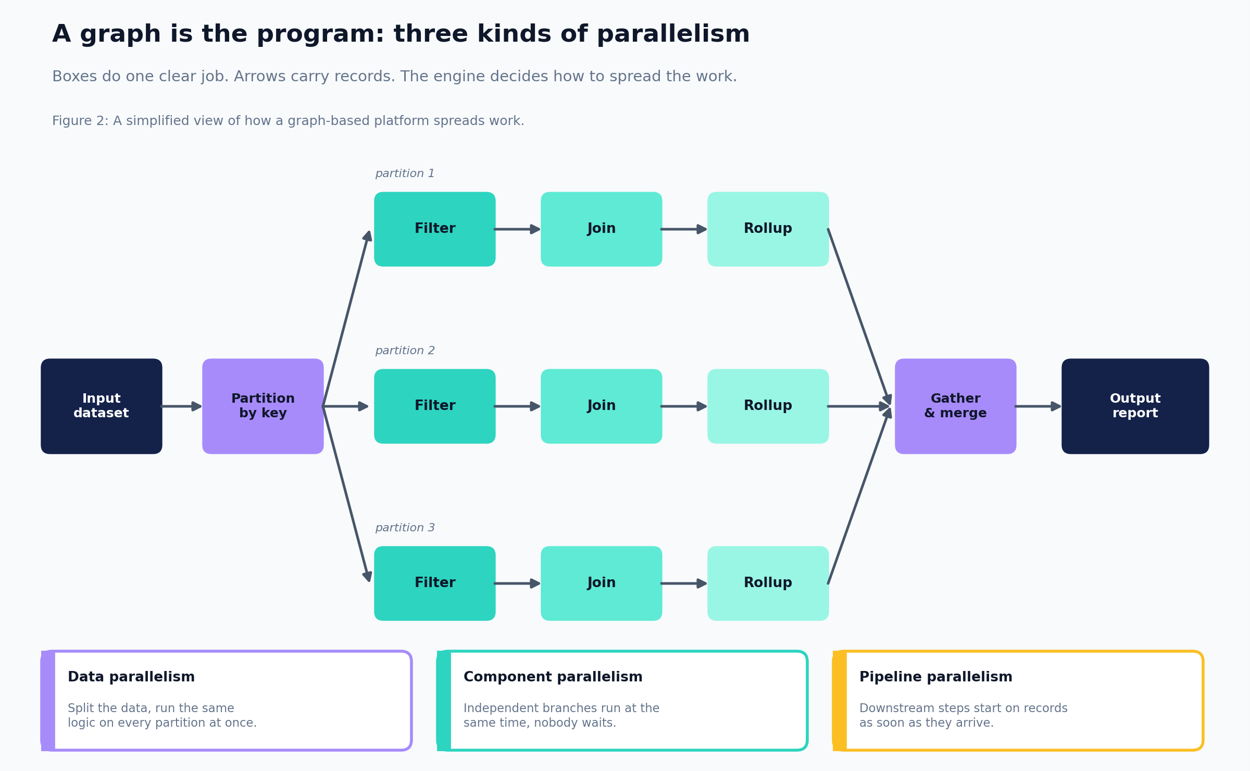
The practical consequence is something engineers learn to appreciate quickly. Scaling becomes a question of configuration rather than rewriting. Because the business logic is separated from the degree of parallelism, a graph designed for a modest volume can often run across more partitions as the data grows, with the rules themselves left untouched. Anyone who has watched a hand-tuned job collapse under next quarter's data will understand why that matters so much.
There is a second, quieter benefit, and it connects straight back to the Monday morning at the start of this article. Because the graph is a literal picture of how data moves, it doubles as documentation that cannot drift out of date, since it is the thing being run. The platform's Enterprise Meta>Environment, usually called the EME, stores graphs and their versions in a central repository and tracks metadata, which makes it possible to ask where a given field came from and what depends on it. Data lineage used to be a painful reconstruction project after something broke. Here it is closer to a by-product of how the work gets built. Our hypothetical engineer, armed with that view, finds her misplaced decimal before lunch instead of after dinner.
None of this means the platform is magic, or that every organisation needs it. It is a commercial, licensed product, and it tends to appear in large enterprises such as banks, telecom operators and retailers, where data volumes and audit requirements are heavy. What makes it interesting for this discussion is less the product itself than the philosophy it shows in action, and it is the reason people who take it up seriously often say it changes how they think. Quality ab Initio training does not begin with a catalogue of components to memorise. It begins with the idea of the graph, with the question of what a piece of data must go through to become useful, and with the habit of reducing every business requirement to inputs, transformations and outputs. Once that mental model is in place, the individual components feel less like trivia and more like natural answers to questions the learner has already learned to ask.
Learning to Think From the Ground Up
Tools change faster than careers. The framework everybody is racing to learn this year is the one a hiring manager will call legacy in a few years, and engineers who have only ever memorised interfaces find themselves starting over each time. Those who understand the layer underneath, such as how data is partitioned, why a join is expensive and what happens when keys are skewed, carry that understanding from one tool to the next. This is the real career case for first-principles thinking, and it holds whether you work with Ab Initio, Spark, or whatever arrives next spring.
For anyone drawn to the Ab Initio ecosystem specifically, the shape of the learning path matters as much as the destination. A well-designed ab Initio course content outline tends to mirror the first-principles ladder. It opens with architecture and the graph model, so the learner knows what the Co>Operating System and the development environment are each responsible for. It moves on to the building blocks: record formats and transforms written in the platform's Data Manipulation Language, then the core components for sorting, joining, rolling up and scanning data. From there it covers parameters and reusable design, the partitioning and departitioning concepts that make parallelism work, and the repository and lineage side of the platform. Performance tuning and troubleshooting usually sit near the end, because they only make sense once the fundamentals feel secure.
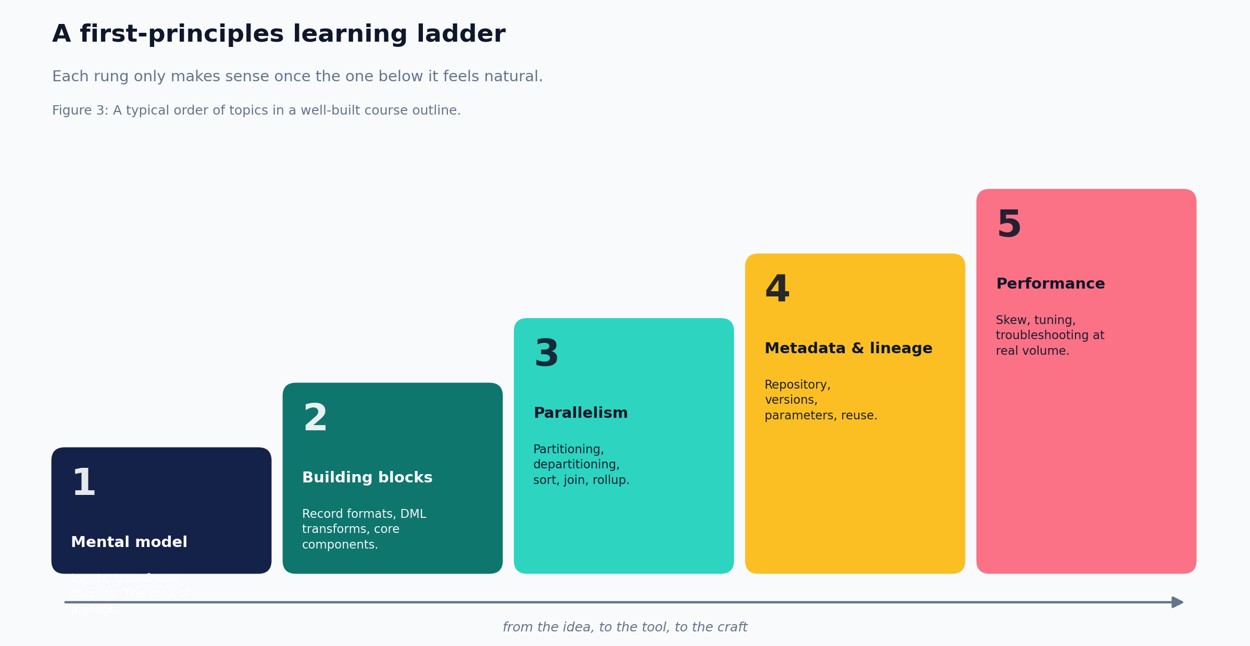
Notice what that ordering says about the philosophy of learning. Nothing is introduced before the learner has a reason to care about it. Partitioning arrives after people have felt the pain of a slow single-stream job. Metadata arrives after they have built enough graphs to wonder how anyone keeps track of them. The sequence follows the logic of the problem and not the layout of a menu, which is exactly what starting from the beginning is supposed to mean.
Whatever you are learning, a few habits turn first-principles thinking from a slogan into a skill. Before touching any tool, sketch the flow of data on paper: where it begins, what must happen to it, and where it ends. When a requirement arrives, restate it in your own words and ask what would have to be true for it to be satisfied. When something is slow or broken, resist the urge to tweak, and ask instead what the work fundamentally requires, then measure where reality departs from that. And when you inherit a design, ask of every component the question that should sit above every architecture review: what would break if this were not here?
The Road Ahead: Why Simplicity Is Becoming an Advantage
Two forces are pushing the industry in this direction whether it likes it or not. The first is cost. Cloud pricing has a way of making inefficiency visible. A wasteful pipeline is no longer a vague annoyance but a line on a monthly invoice, and finance teams have started asking pointed questions about it. Systems built on honest foundations tend to do less redundant work, which means they tend to cost less to run.
The second force is trust. Artificial intelligence has turned data quality into a boardroom topic. A model is only as dependable as the pipeline that feeds it, and organisations are discovering that they cannot confidently deploy AI on data they cannot trace. Regulators in finance, healthcare and elsewhere are asking the same thing from a compliance angle: where did this number come from, and who touched it along the way? Companies that can answer in minutes instead of weeks hold an advantage that is hard to fake. Lineage and clear data flows, once back-office concerns, are turning into strategic assets.
It would be dishonest to present first principles as a cure-all. Starting from scratch is slow, and doing it badly creates its own mess, usually a clever home-grown framework that only its author understands. Plenty of old systems are tangled but working, and rewriting them purely for elegance can be an expensive vanity project. The mature version of the idea is selective. You apply first-principles thinking where complexity is costing you the most, you keep the inherited pieces you can defend, and you let the rest go.
For individual professionals, the practical question is how to start. For working engineers with full-time jobs, the most realistic route is often structured learning that fits around real life. Good ab Initio online training lets you study in the evenings, replay a difficult session on partitioning as many times as you need, and practise on realistic scenarios instead of toy examples. When you compare options, look for hands-on labs, projects that resemble genuine business problems, and instructors who explain why a design works rather than just which button to press. Those are the signs of teaching that follows first principles.
Return, one last time, to our engineer. Months later, a similar Monday arrives and a report is off, but the day goes differently. She opens the graph, follows the arrows, and sees the field in question arriving from the vendor file, passing through two transformations, and landing in the table. The mismatch is visible in minutes. There are no forty tabs, only one clear picture of how data moves. That is the quiet promise of the idea this article has been circling. Complexity will never vanish from technology, and some of it was always essential. But much of what we carry was never necessary, and the way out is often shorter than we fear. Start from the beginning.