
Why MuleSoft is Important in Enterprise Application Integration
Last updated on Oct 5, 2026
The modern enterprise is one of complexity. Organisations deploy hundreds, if not thousands, of disconnected software applications across departments, geographies, and functional divisions. An expansive digital environment comprising customer relationship management suites, enterprise resource planning platforms, cloud storage, human capital management systems, and legacy on-premises databases. Each tool is bought to optimise a specific business function, but their isolation often generates significant operational friction. Siloed data results in disconnected customer experience, operational lag, faulty analytics and slow decision making.
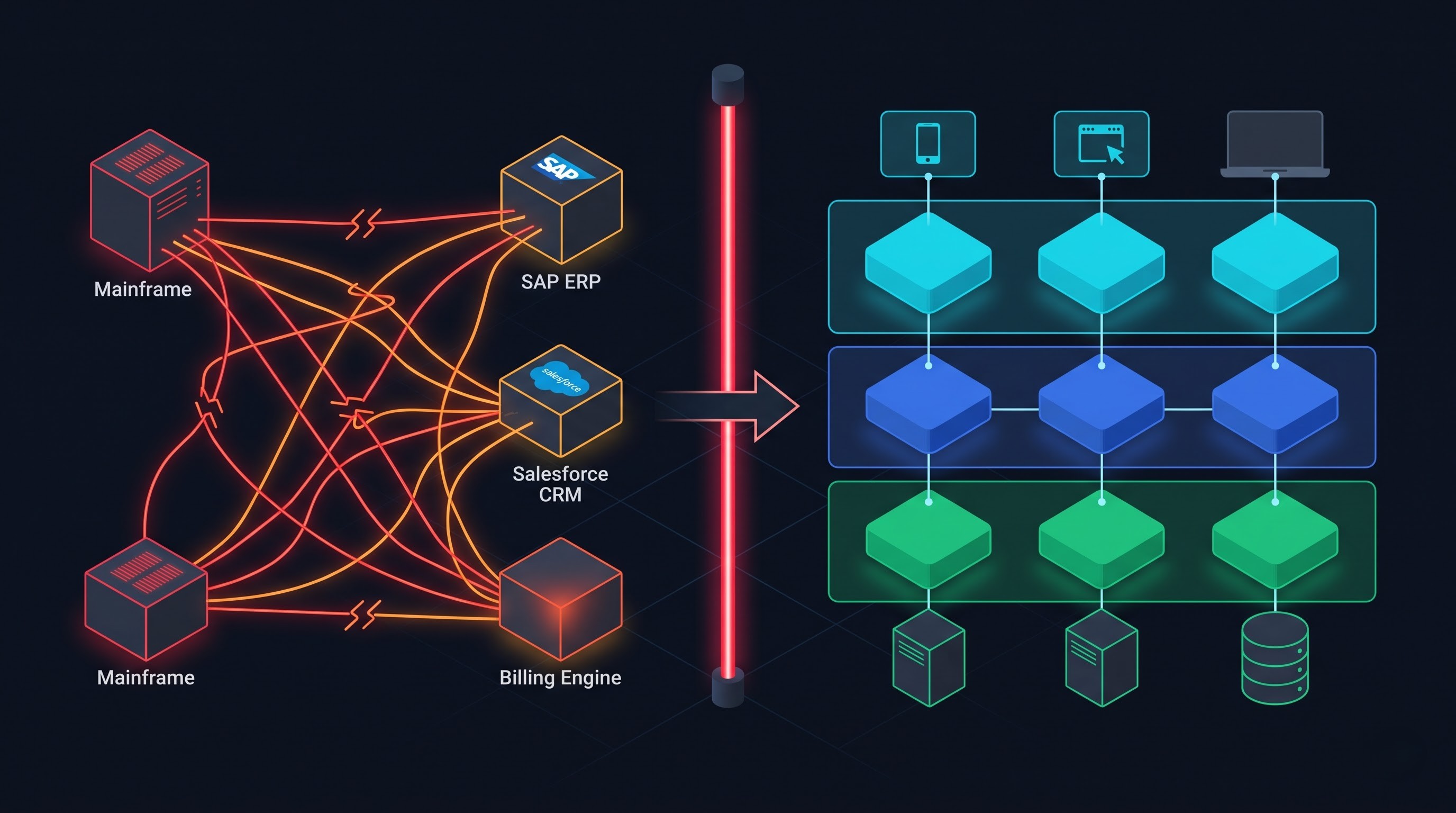
Organisations have traditionally dealt with this problem using point-to-point connections. Developers wrote custom scripts and hand-coded interfaces to connect two applications. As time went on, business needs grew and new tools were introduced, creating an unsustainable web of brittle dependencies often referred to as “spaghetti architecture” in enterprise architecture. In this environment, changing or upgrading a single endpoint risks breaking many downstream processes, increasing technical debt and consuming disproportionate IT resources.
This fragmentation has made Enterprise Application Integration (EAI) a strategic discipline. EAI seeks to unify the workflows, data flows and interfaces between disparate software systems into a single, agile fabric. In this space, MuleSoft has made itself a necessary enterprise platform. MuleSoft’s flagship Anypoint Platform, the pioneering API-led connectivity methodology, and the ability to connect legacy mainframes to modern cloud ecosystems turn enterprise integration from a reactive maintenance burden into a proactive driver of agility and revenue.
The Friction and Landscape of Enterprise Systems
To understand why MuleSoft has become so prominent, one must first grasp the practical reality of large-scale corporate infrastructure. Companies don’t arise in greenfield environments. Their technology footprint instead is the sum of decades of strategic buys, vendor changes and mergers and acquisitions.
A typical Global 2000 enterprise typically operates:
Mainframe computing systems and legacy relational databases holding core transaction data and decades of business logic.
On-premise ERP systems that manage supply chains, physical manufacturing plants, and complex financial accounting.
Existing cloud applications in Software-as-a-Service for customer facing applications, marketing automation, collaboration workflows, and human resource management.
Ephemeral cloud services, serverless compute functions, mobile client apps requiring real-time synchronisation.
When an organization undertakes a cross-functional business initiative – such as a single portal for customers, real-time inventory visibility, or customised automated billing – the data that supports all of these disparate tiers needs to flow seamlessly across each and every one of them.
IT organisations are stuck in point-to-point custom coding without a cohesive integration platform. Custom integrations have their own communication protocols, proprietary data schemas, custom error handling and manual security controls. If the number of connected endpoints increases linearly, the number of possible connections between them increases quadratically. Ten endpoints in a system require forty-five discrete connections; one hundred endpoints require almost five thousand.
In such a world change is dangerous and expensive. IT teams spend up to eighty percent of their operational budgets simply keeping the lights on and fixing brittle integration links. Innovation grinds to a halt and business stakeholders become frustrated with the apparent inertia of technical departments. MuleSoft views this structural failure not just as software but as an architectural discipline.
API-Led Connectivity: Re-Thinking the Integration Architecture
MuleSoft's value proposition is fundamentally built around its conceptual framework: API-led connectivity. Rather than treating an integration as a bespoke pipeline from Point A to Point B, MuleSoft classifies the enterprise assets into a neat, reusable three-tier architecture of System APIs, Process APIs and Experience APIs.
System API’s
System APIs form the bottom layer of the architecture. Their main purpose is to expose raw core systems of record such as mainframes, SAP environments, Oracle databases and legacy billing engines, and to protect the rest of the enterprise from their underlying technical complexity.
Legacy systems are famously inflexible. They often communicate using old protocols, employ obscure data serialisation formats and have performance profiles that cannot handle bursty traffic from modern mobile applications. These underlying platforms are wrapped by a System API that uses standard RESTful or modern interface contracts. It abstracts proprietary database dialects, authentication mechanisms and physical network topologies away. Once a System API is built for a core customer database or inventory system, developers across the enterprise can access that data securely, without needing specialised knowledge of the underlying infrastructure.
API de processus
The Process APIs are in the middle layer and represent the business logic in the enterprise. They consume data from one or more System APIs, transform and filter it, apply operational rules and orchestrate complex business workflows .
For example, an enterprise that is onboarding a corporate customer may need to simultaneously check credit limits in a financial system, create an account record in a CRM system, allocate initial stock in a stock system and file compliance forms with an external regulatory agency. This multi-step sequence is coordinated by the Process API. It separates the business logic from both the underlying storage systems and the user facing consumption channels. If later on the enterprise decides to move from an on-premises ERP to a cloud-native platform, the Process API contains the business logic, and it remains untouched, only the underlying System API has to be changed.
Experience the APIs
Experience APIs are the top-level, purpose-built APIs that power the digital channels by which end users and partners consume enterprise data. The interface requirements at different points of consumption are quite different. A mobile app needs compressed, lightweight payloads that are optimised for low-bandwidth cellular connections. Rich, aggregated datasets are needed to populate multi-faceted dashboards on a desktop web portal. A B2B protocol integration with an external business partner could require strict adherence to industry-standard EDI structures.
The underlying systems do not need to re-write their internal business logic. Experience APIs consume data from Process APIs and format the presentation layer to the specific needs of the target device or audience. This separation enables digital front-end teams to iterate, redesign user interfaces, and launch new digital channels in days or weeks, rather than waiting months for back-end system changes.
Decoupling, Developer Velocity and Reusability
The strategic genius of API-led connectivity is composability. With a traditional point-to-point setup, every project is starting from scratch. Developers write new code, re-implement already solved connectivity problems and add redundant security controls. Every project adds technical debt to the organization.
MuleSoft makes every integration asset a reusable digital building block. Next, a developer builds a robust System API to expose customer address records. That API is published to a shared corporate marketplace. The next project team that needs customer address data, whether they’re building an internal audit tool, a partner distribution portal or a mobile application for the customer, doesn’t go out and build a new connection. They just find and use the already existing API.
This shifts enterprise IT from a delivery bottleneck to an enabler of self-service. As the catalogue of reusable System, Process and Experience APIs grows over time, the time-to-market for subsequent digital initiatives is dramatically reduced. Projects cease to build infrastructure from scratch and begin to assemble pre-tested, secure and governed digital resources. The application of this composable enterprise model facilitates improvements to the velocity of programmers, reduction in the accumulation of excessive code, and increased returns on engineering spending. However, obtaining the benefits of this model necessitates the provision of practical skills related to integration processes. By receiving instruction in specific aspects of mule software training, technical teams learn how to implement API-based design methods and to carry out DataWeave transformations.
The Anypoint Platform: An End-to-End Business Fabric
MuleSoft’s unified Anypoint Platform provides this architecture. Anypoint has a full end-to-end lifecycle, instead of a fragmented integration toolchain where you need to stitch together separate software for API management, message queuing, workflow orchestration, testing, and analytics.
Design & Prototyping
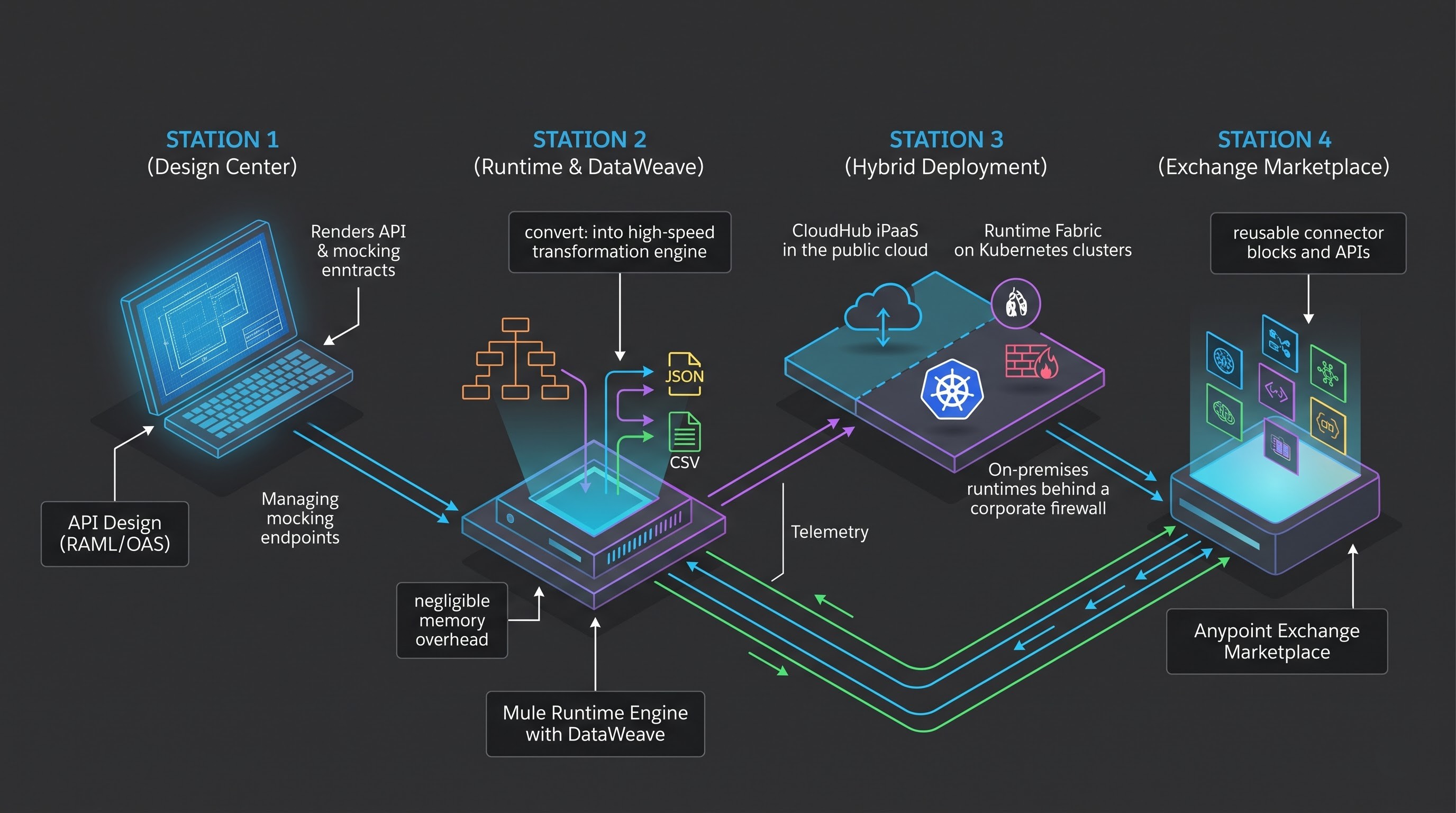
With RAML and OpenAPI as examples of modern interface definition standards, Anypoint provides a powerful visual and code-based environment for the purpose of defining API contracts. Most importantly, MuleSoft adheres to an API-first design philosophy. Developers and business analysts can collaborate on the exact shape of an interface, mock its endpoints and get feedback from stakeholders before writing a single line of backend implementation code. This avoids expensive architectural misunderstandings and aligns business expectations with technical reality early in the delivery lifecycle.
Mule Runtime Engine and Implementation
The Mule Runtime Engine is the heart of the MuleSoft execution layer – a lightweight, scalable enterprise service bus and integration runtime. The Mule Runtime is protocol independent and can mediate interactions over HTTP, JMS, AMQP, FTP, SFTP, WebSockets, and custom messaging layers.
DataWeave is a functional data transformation language built for a purpose. It drives the integration logic in the runtime. Data transformation is often the most laborious and error-prone task in enterprise integration. For example, transforming nested XML schemas from a legacy financial system, mapping them against JSON arrays from a cloud service, and flattening the result for a CSV reporting format. DataWeave takes care of these complicated hierarchical mappings, structural transformations, aggregations and data validations with performance efficiency and minimal memory overhead.
Operational flexibility and hybrid deployment
Enterprises run in heterogeneous physical and virtual hosting environments. Financial services, healthcare, and defence are heavily regulated industries that often have strict data residency and sovereignty requirements which prevent sensitive records from leaving on-premises private data centers. At the same time, these organisations are aggressively adopting public clouds like AWS, Microsoft Azure and Google Cloud Platform for greenfield development.
MuleSoft provides complete deployment flexibility with its runtime architectures:
CloudHub is a fully managed multi-tenant and single-tenant integration platform as a service that lifts all the server provisioning, OS patching, and infrastructure management overhead.
On-Premises Runtime deployments enable organisations to deploy integration engines directly on bare metal servers or private virtualisation clusters behind corporate firewalls.
Anypoint Runtime Fabric simplifies the deployment of containerised integrations to modern enterprise Kubernetes environments, on-premises or across multiple hyperscalers.
They are centrally controlled, monitored and secured regardless of where the actual integration engines are running. This hybrid operational paradigm means enterprise architects never have to compromise operational visibility or governance to meet strict compliance constraints.
Exchange: The Inside Digital Marketplace
If an integration asset is not discoverable, it doesn’t have much value. If developers don’t know an API exists, they will inevitably rebuild it. Anypoint Exchange is the enterprise assets’ central repository and discovery marketplace. Teams can find existing APIs, connectors, workflow templates, and documentation inside Exchange. The interactive testing consoles enable programmers to experiment with real API requests from their browser, greatly shortening the onboarding time for both internal engineering teams and outsiders. To become proficient in this combined system from design to production, one usually takes an extensive mulesoft developer course to have practical skills in constructing real enterprise flows.
Data Integration and Modernisation and Silo Busters
Enterprise data rarely sits still, it lives across transactional systems, analytical warehouses, real-time event streams and unstructured repositories. When systems can’t talk to each other in real time, business operations fall apart. Sales reps are speaking to customers without the ability to see recent billing disputes in an ERP. The call center software doesn’t pull context from the web portal so the customer service agents have to make callers repeat basic account info. Operations teams only discover supply shortages a few hours after they occur because batch processing updates data at midnight.
MuleSoft is the enterprise nervous system. It connects transactional and operational silos. MuleSoft has a huge ecosystem of pre-built certified connectors, providing native connectivity out of the box to hundreds of enterprise platforms from Salesforce, SAP, Oracle, Workday, Microsoft Dynamics, ServiceNow and Snowflake. These connectors shield the complicated, proprietary authentication flows and message formats of each target system, compressing weeks of custom connector development into hours of configuration.
MuleSoft also plays a key role in efforts to modernise legacy systems. Replacing a decades-old mainframe or monolithic core banking platform in its entirety is one of the riskiest and most expensive things an enterprise can do. Many projects fail because they contain undocumented business rules and hidden system dependencies. MuleSoft’s recommended modernisation approach is the Strangler Fig pattern.
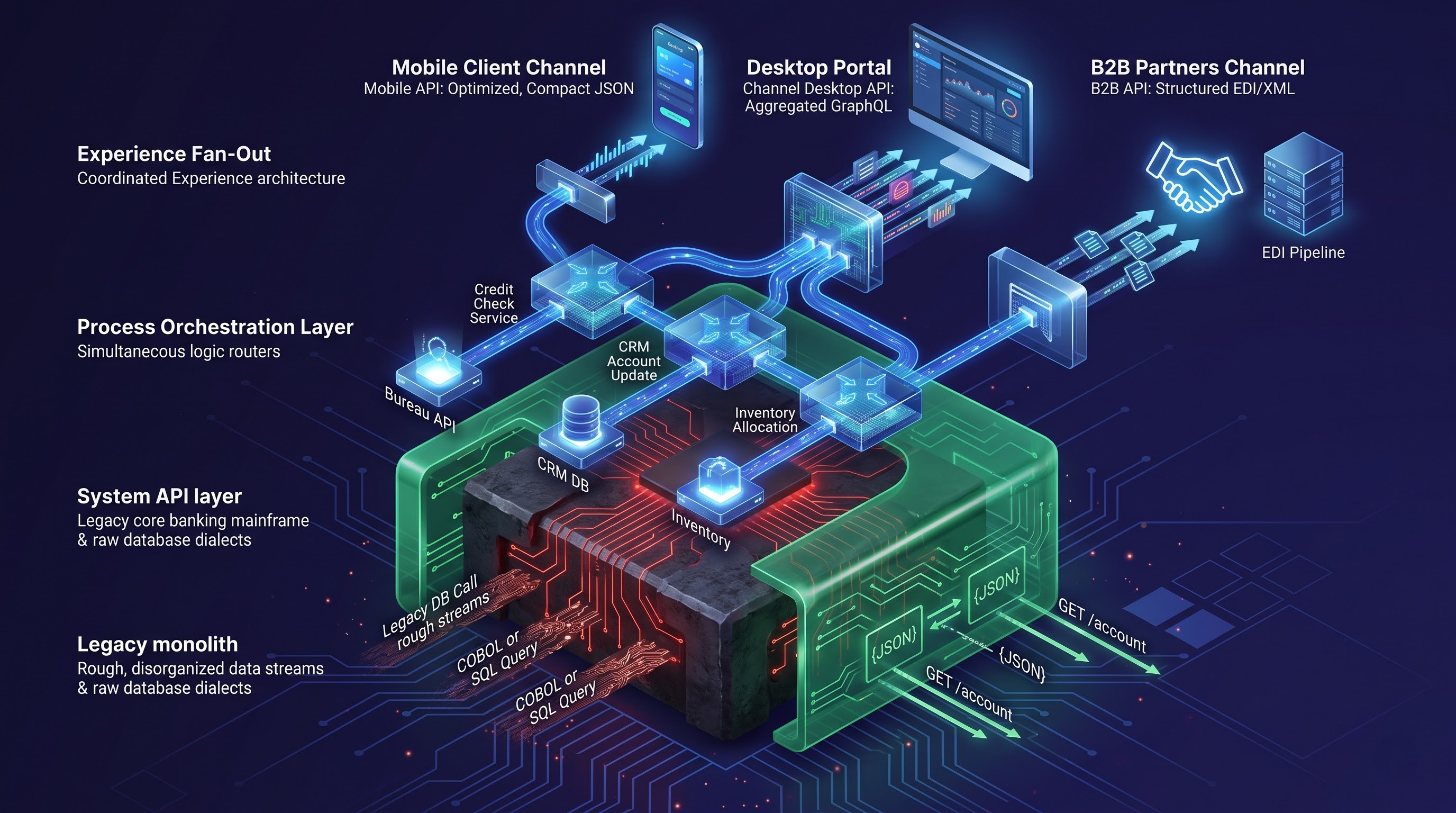
The enterprise is decoupling its front-end applications from the legacy core by wrapping the legacy monolithic system in stable System and Process APIs. After this layer of abstraction is put in place, the organization can gradually peel off specific functional domains, such as payment processing or customer identity, and transition them to modern microservices or cloud databases behind the scenes. For the consumers of the APIs, the interface below the APIs never changes. MuleSoft helps organisations incrementally modernise their critical technical core, reducing financial, technical and operational risk.
Security, governance and compliance for the enterprise
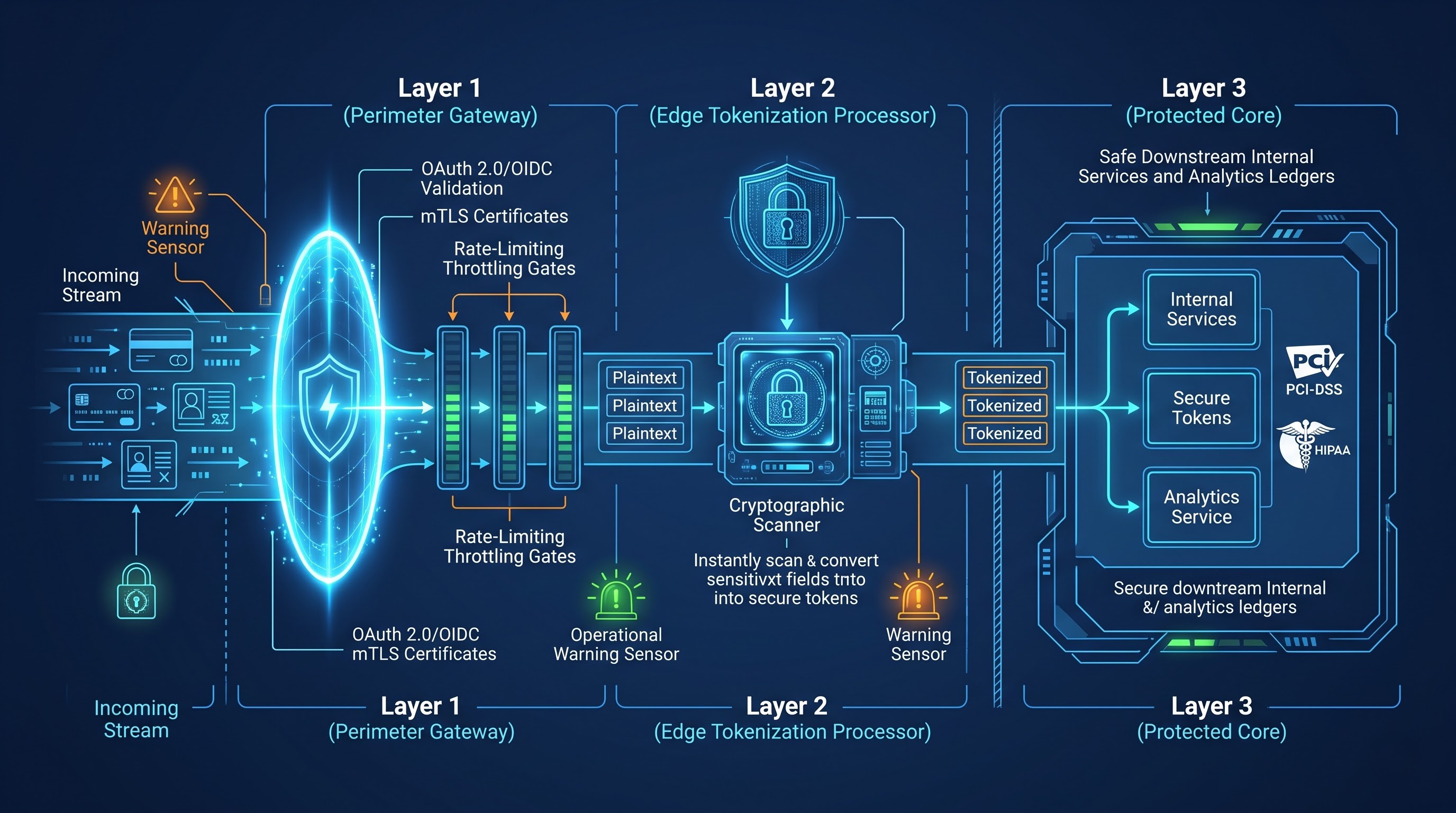
Today’s enterprise architectures carry a high security risk when exposing data access. APIs are increasingly being targeted by bad actors seeking to exploit misconfigured endpoints, execute injection attacks, or orchestrate distributed denial of service campaigns. A collection of disparate gateway appliances and custom scripts cannot enforce consistent security policies across a global organization.
MuleSoft offers a centralized, defense-in-depth security model that works seamlessly across every deployed API and integration flow.
Centralised policy enforcement control
Security administrators can use Anypoint API Manager to apply, update and audit governance policies across the entire API estate without touching underlying application code. These policies are:
OpenID Connect, OAuth 2.0, SAML, and enterprise identity provider authentication and authorisation.
Automated traffic control, rate limiting, spike arresting, client specific throttling, IP address whitelisting or blacklisting.
Validate content and inject protection to clean incoming payloads before they enter internal networks.
Cross-Origin Resource Sharing policy and automated SSL/TLS termination.
These are separate from implementation logic, allowing security teams to remediate vulnerabilities across the globe in minutes. An organization can force the policy from the cloud management console if it wants to rotate security mechanisms or require mutual TLS encryption on all enterprise endpoints and all running runtime engines will automatically change their enforcement state.
Automated tokenisation Data edge protection
MuleSoft natively provides perimeter security and data protection capabilities for large enterprises in highly regulated industries like the Payment Card Industry Data Security Standard, Health Insurance Portability and Accountability Act, and General Data Protection Regulation. You can use the tokenisation capabilities to encrypt and tokenise sensitive records, such as credit card numbers or personally identifiable healthcare data, the moment they enter the enterprise boundary. The underlying process and analytics systems can route and process these tokens without exposing sensitive data in plain text to internal logs, developer tools or unauthenticated users.
Transforming Business and Creating Strategic Value
MuleSoft’s technical capabilities are great but the ultimate value needs to be measured in strategic business outcomes. Technology leaders don’t invest in enterprise integration to simply clean up their architecture; they invest to unlock agility, drive revenue, improve customer retention and accelerate digital transformation.
Designing True Omnichannel Experiences
Today’s consumers and B2B customers want frictionless experiences across every touchpoint. They expect to initiate an application on a mobile device, modify it on the phone with a customer service agent, complete it in a physical shopfront and get automated confirmations through messaging platforms – all in real time.
This type of coherence requires that all channels of interaction depend on one synchronised source of operational truth. By connecting a disparate set of CRM, billing, catalogue and inventory backends, MuleSoft enables organisations to deliver true omnichannel experiences. Customer service reps have a full, real-time view of the client, and self-service portals reflect actions taken across physical and digital properties in real-time.
Speeding merger and acquisition integration
Mergers and acquisitions are standard corporate growth strategies, but many fall short of delivering expected value due to IT integration challenges. When two large companies combine, it usually means merging competing ERP implementations, overlapping CRM instances, and disparate accounting systems.
Attempting to merge these architectures through physical data migration or complete system replacement takes years and causes catastrophic business disruption. With MuleSoft, the acquiring company can rapidly construct integration bridges between the two technology environments. With an API-led integration layer, acquired business units can continue to operate on their existing systems of record while also feeding critical consolidated data into the parent company’s reporting, sales, and supply chain engines on day one.
Making the Real-Time, Event-Driven Enterprise A Reality
Historically, enterprise integration was largely based on batch processing, which is the process of large scheduled data dumps performed overnight or during times of low transactional activity. Batch integration is becoming unacceptable in a highly competitive marketplace. Supply chain disruption, fraud attempts, stock movements and customer activity demand immediate action.
MuleSoft natively marries synchronous request-response API paradigms with asynchronous event-driven architectures. MuleSoft enables real-time event streaming with integration to modern message brokers such as Apache Kafka, RabbitMQ and cloud-native pub/sub systems. MuleSoft integration flows are capable of reacting to events such as a fraudulent credit card transaction or an inventory threshold alert in sub-second intervals and trigger notifications, downstream remediation workflows, and synchronisation of operational databases.
Energising AI & Enterprise Automation
Companies are rushing to use artificial intelligence and large language models in their business processes, but they have a real-time problem: artificial intelligence systems can only be as good as the data they are fed. An AI agent to automate customer claims simply cannot work if it can’t safely pull records from legacy claims databases, check coverage in policy management tools and issue payment authorisations in financial ledgers.
MuleSoft provides the underlying infrastructure for operational AI. MuleSoft exposes enterprise capabilities as clean, well-documented, secure APIs to make every business system a callable tool for modern autonomous agents and automation engines. Leverage MuleSoft RPA (Robotic Process Automation) to close the last gap between modern APIs and legacy user interfaces, lacking programmatic entry points, and enable end-to-end hyperautomation across the enterprise.
Real-Life Applications in Strategic Industries
The transformational power of MuleSoft is evident in every major economic sector where strong integration capabilities are needed to tackle unique business challenges.
Financial Services & Banking
Global banking institutions are experiencing a period of disruption unlike any other. FinTech challengers, open banking regulations and changing consumer expectations mean banks must deliver modern digital experiences, while protecting complex core banking mainframes built decades ago.
MuleSoft lets top financial institutions extend their legacy transaction cores with secure System APIs. They build Process APIs for anti-money laundering checks, credit scoring and account provisioning and deploy Experience APIs to power mobile banking apps and partner FinTech ecosystems. With this architecture, traditional banks can take advantage of open banking standards, offer banking-as-a-service (BaaS) capabilities, and deploy features like instant peer-to-peer payments without changing their brittle underlying mainframes.
Healthcare & Life Science
Healthcare delivery is hampered by data fragmentation. Patient health information is spread across multiple Electronic Health Record (EHR) systems, laboratory databases, pharmacy systems and billing clearinghouses. This fragmentation is detrimental to patient care, increases administrative costs and creates compliance liabilities.
MuleSoft helps healthcare organisations achieve complete interoperability. MuleSoft helps hospitals, insurers and clinical research organisations safely exchange clinical data by supporting industry norms such as Fast Healthcare Interoperability Resources (FHIR) and HL7 messaging formats. Care teams receive a 360-degree view of patient histories from different clinics, and automated workflows accelerate treatment authorisations and reduce redundant paperwork.
Retail & Consumer Goods
In retail, success depends on dynamic supply chains and unified commerce. Retailers have to balance inventory between physical stores, regional distribution centers, third-party logistics providers and drop-ship suppliers, all while pleasing customers who want same-day shipping and in-store returns.
MuleSoft is synchronising point of sale transactions, web shopfronts, enterprise warehouse systems and third party fulfilment services in real-time. An order placed online immediately reserves inventory across the optimal fulfilment node, alerts for supply are pushed to logistics managers and personalised delivery tracking updates are transmitted to the consumer. The continuous flow of data helps to reduce stockouts, lower operational overhead and develop customer loyalty.
Manufacturing and Global Supply Chains
Today’s manufacturing relies on accurate scheduling, predictive maintenance of assets and tight integration with vendors of raw materials. Manufacturing enterprises generally operate dozens of production facilities around the world, each with its own supervisory control and data acquisition systems on top of centralised ERP platforms.
MuleSoft links corporate information technology with the operational technology that powers the factory floor. Operational monitoring of production metrics, machine performance alerts and quality assurance logs enables central operations to predict machine failures before they cause production lines to shut down. Also, the automation of the B2B integration with tier-one suppliers ensures that the raw material shipments are automatically adjusted to fit the real-time throughput of the plants.
With companies transforming traditional technology to ones powered by cloud applications, companies need certified integration experts at the global level. By obtaining mcd level 1 certification can prove he possesses the skills needed to create products, conduct operations, perform checks and manage production APIs during the entire life cycle of Anypoint Platform.