
Why UiPath is Still a Leading RPA Platform in 2026?
Last updated on Jul 25, 2026

The digital environment is constantly changing, and companies are under pressure to be more efficient, to save costs and to deliver a better customer experience. The age of digital transformation is dawning for companies, and in this transition, technology like Robotic Process Automation (RPA) has emerged to help simplify repetitive and rule-based processes. In 2026, there are many automation platforms, but UiPath is one of the most trusted and used.
Organisations of all sizes, from startups to medium-sized businesses to global enterprises, use UiPath to deliver workflow automation, drive business efficiency and increase productivity. With the changing needs of businesses over the years, the platform has evolved to become a popular choice for companies seeking a scalable automation solution.
Understanding the current developments in the field and how they can be used in the future, students and future automation professionals, as well as experienced IT experts, can better understand the changing dynamics of automation and opportunities. If you are looking for online UiPath training or an online UiPath course, learning the platform can definitely improve your odds in the automation space.
In this article, we will look at some of the main reasons why UiPath has been so successful in the RPA space. We also talk about why it is a go-to choice for companies all over the world.
Understand UiPath and its Operation in modern automation
UiPath is a full robotic process automation platform that lets companies automate repetitive processes with minimal coding. It enables firms to design, deploy, manage, and track automated workflows for various business activities.
The primary objective of UiPath automation is to automate manual tasks, reduce human error, improve accuracy, and allow staff to concentrate on more planned processes.
Businesses can use UiPath RPA for the following:
Computer program for data entry.
Processing of Invoices
HR onboarding processes
Customer service activities.
Financial / Accounting Statements
IT services management
Compliance monitoring
Automation of supply chains
As businesses’ digital transformation initiatives are in full swing, the need for intelligent and scalable automation solutions has increased, with UiPath being one of the leading technology providers in this space.
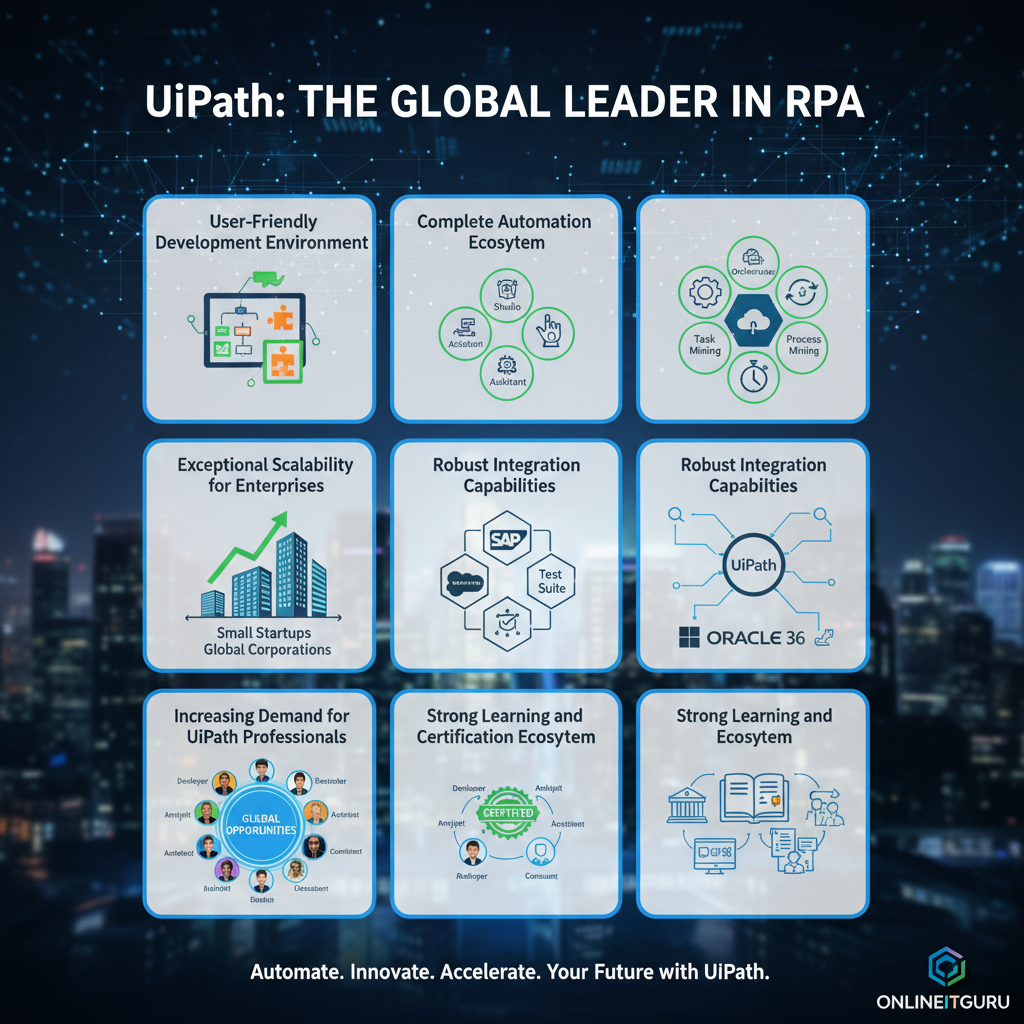
Very good market position and confidence in the industry
One of the main reasons UiPath has established itself as a leading RPA platform is its strong brand presence with a large user base across many industries.
For the past few years, UiPath has been a trusted partner for automation in enterprises across sectors like the following:
Banking & Financial Services
Healthcare
Insurance
Manufacturing
Communications
Government Agencies
Logistics & Retail
The larger the company, the more likely it is to choose UiPath automation. Because it is reliable and scalable and has a wide portfolio of products and services.
The platform has consistently been able to provide measurable business outcomes, such as:
Reduced operating costs
Increased process efficiency
Improved service delivery
Better compliance
More productive employees
Over the years, the enterprise projects have been successful and made UiPath the market leader.
User-Friendly Development Environment
The second reason for UiPath's growth is its easy-to-use and intuitive UI.
In contrast to traditional software development platforms, UiPath enables both technical and non-technical users to develop workflows for automation using visuals and a drag-and-drop interface.
With UiPath Studio, users can:
Design processes visually
Quickly develop automated processes.
Use components of the automation systems.
Test workflows effectively
Categorise automation initiatives.
Structure automation projects.
This convenience has resulted in a lot of interest among those who are new to automation and want to enroll in UiPath training. One of the easiest RPA platforms around today, students learn how to start building automation workflows with minimal coding skills if they join a UiPath course.
Complete Automation Ecosystem
The end-to-end automation platform is one of the best aspects of UiPath. UiPath doesn't just have one tool to automate; it's a full platform for automation that spans the entire automation lifecycle.
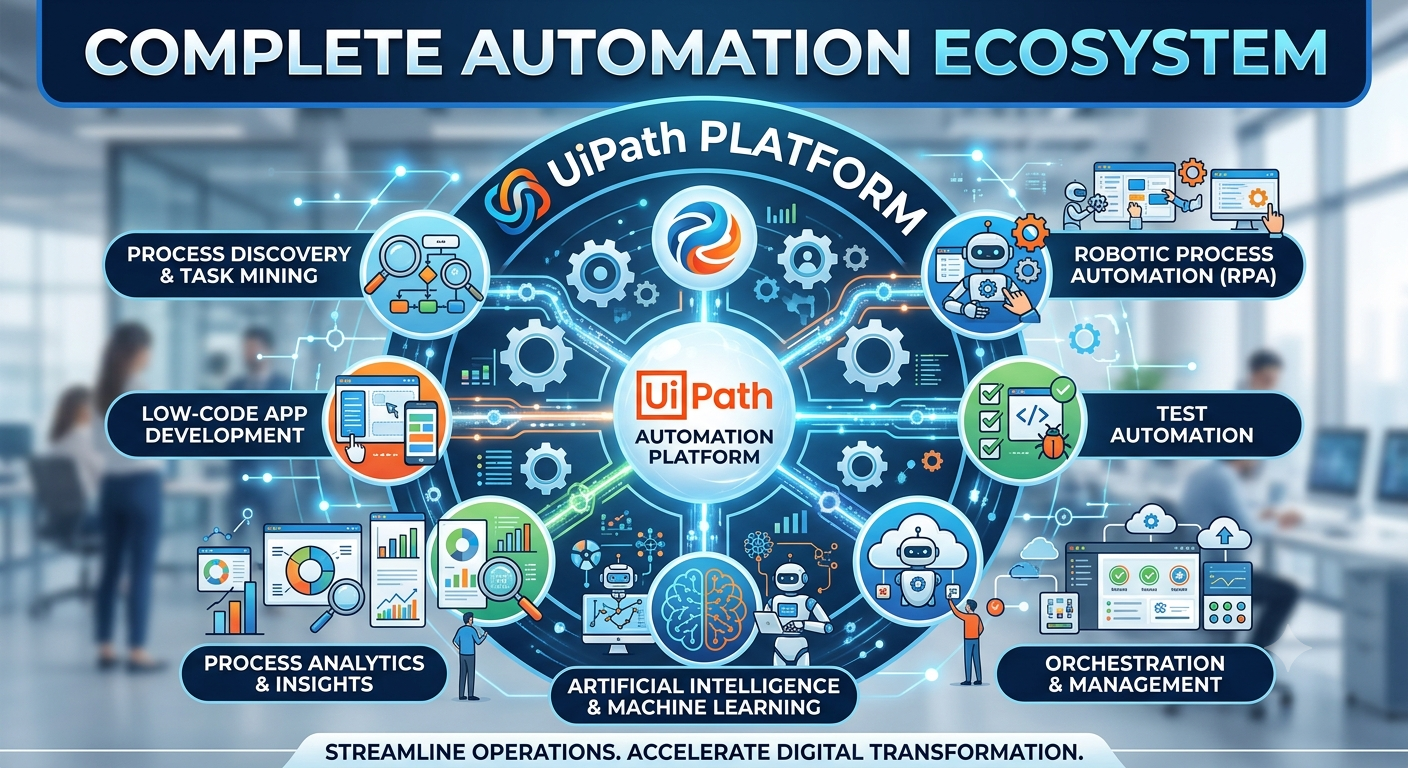
Key components are:
UiPath Studio
Develop and execute workflows with automation.
UiPath Orchestrator
Helps organizations with the deployment, management, planning, and tracking of automation bots.
Assistant UiPath
Makes it easy for employees to communicate with automated processes.
UiPath Test Suite
It aids in automating software testing and quality assurance efforts.
Mining Process in UiPath
Examine business processes to identify opportunities for automation.
UiPath Task Mining
Tracks employee activity to identify repeatable tasks that can be automated.
This rich ecosystem allows organizations to create end-to-end automation strategies without having to deal with multiple vendors.
Exceptional Scalability for Enterprises
As organizations grow, their automation requirements become complex. UiPath automation scales from small departmental projects to large, enterprise-wide automation initiatives.
Organizations may:
Manage hundreds of bots from one central location
Automate thousands of business processes
Track performance across departments
Ensure governance and compliance standards
This makes UiPath RPA especially appealing to global companies with operations in many locations, as it can support large-scale automation initiatives.
Scalability is among the many reasons why businesses are choosing UiPath over competing automation platforms.
Robust integration capabilities
Modern organizations function with a multitude of software applications across their business functions.
UiPath offers smooth integration with popular enterprise systems, including the following:
SAP AG
Salesforce
Oracle
Microsoft Dynamics
ServiceNow
Work Day
G Suite
Microsoft 365
These integration capabilities allow organizations to automate workflows across multiple platforms without major infrastructure changes.
Most real-world automation projects involve the integration of different business applications, so it is critical for professionals taking an online UiPath course to understand integration capabilities.
Increasing demand for UiPath professionals
With the growing adoption of automation technologies, there is a huge demand for skilled UiPath professionals across the globe.
Organizations need experts who can:
Design automation solutions
Create automated workflows
RPA infrastructure management
Automate and optimise.
Control enterprise automation programs
The common UiPath job roles are the following:
UiPath Developer
Responsible for designing and developing automation workflows.
RPA Business Analyst
Identifies new opportunities in automation and documents business requirements.
Automation Solution Architect
Develops enterprise-wide automation strategies and frameworks.
UiPath Consultant
Offers automation implementation and advisory services.
Automation Support Engineer
Keeps automation environments operational and monitors them. Thus, there is a growing trend of employing professionals who complete the UiPath online training programs in the industry.
Strong Learning and Certification Ecosystem
The commitment to professional development is another reason UiPath remains a leader in the automation market.
There are many ways to learn, including the following:
Official UiPath Learning Portal
Corporate Training Courses
Schools and Universities
Professional certification bodies
The UiPath course offers students hands-on experience with automation concepts, designing workflows, and enterprise implementation.
Popular certification paths are the following:
UiPath Certified Associate
UiPath Certified Professional Advanced
Advanced Automation Certifications
Employers often favour candidates who have completed recognized UiPath training programs, as certifications demonstrate technical competence and practical skills.
Great Career Opportunities for Students
As job demand and attractive salary packages make automation careers more viable, students entering the technology sector in 2026 are increasingly exploring these options.
The benefits of learning UiPath are many:
Easier Entry into IT
UiPath is different from many advanced technologies because it does not require a lot of programming knowledge to learn.
High Industry Demand
Automation is making progress in more and more industries.
Multiple Career Paths
Professionals may move into development, consulting, architecture, project management, or business analysis.
Global Employment Opportunities
Automation professionals are in demand globally, with organizations actively hiring.
Students seeking future-proof career options can build a strong foundation for long-term professional growth by enrolling in a UiPath online training program.
Why Do Enterprises Choose UiPath Automation in 2026?
Organizations continue to invest in UiPath automation as it delivers measurable business benefits.
Increased efficiency
Automation replaces repetitive manual jobs so most of the staff can focus on many higher-value tasks.
Lower Cost of Operation
Businesses can reduce labour-intensive processes and operational costs dramatically.
Increased Accuracy
Automated workflows reduce human errors and improve the quality of data.
Faster Execution of Processes
Tasks that once required many hours can often be completed in minutes.
Better compliance
Automation guarantees the unique application of key business rules and governing needs.
These benefits directly help improve organizational performance and competitiveness.
Strong Community Support
A strong professional community is a critical ingredient to the success of any technology platform.
UiPath has built one of the world’s largest communities of automation.
Community members contribute regularly:
Learning
Best practices
Workflow templates
Engineering Solutions
Forums for discussion
Insights from the industry
This collaborative ecosystem can do wonders for the professionals who have enrolled in an online UiPath course and can accelerate their journey to learn and solve problems.
Community resources make it much easier for beginners to overcome learning barriers.
Cloud-Based Automation Adoption
Cloud technologies are still transforming enterprise IT environments. UiPath has successfully mapped its offerings to cloud-first business strategies. Organizations are increasingly preferring cloud-based automation due to the following:
Quick deployment
Lower-cost infrastructure
Better scalability
Better access
Easy to maintain
Its cloud capabilities allow organizations to quickly scale automation initiatives while maintaining operational flexibility.
This flexibility is one of the reasons UiPath remains a leader in 2026.
Emphasize Security and Compliance
Security remains a paramount concern for organizations deploying automation technologies.
UiPath addresses these concerns with strong security features such as
Role-based access control (RBAC)
Data encryption
Audit logging;
Credential management.
Compliance verification
Heavily regulated industries such as banking and healthcare often choose UiPath automation for its strong governance and security framework.
For those taking a UiPath course, knowledge of security best practices has become a must-have skill for enterprise automation projects.
Future-Proof Technology Investments
Organizations seek technology investments that will deliver value over the long term.
With UiPath’s continuous innovations and product development, businesses can be confident that their automation initiatives will evolve with changing market needs.
Key areas that will support future growth are the following:
Discovery of the process
Orchestration automation
Optimizing workflow
“Enterprise integration
Governance of automation
Deployment models for cloud
These capabilities ensure UiPath’s continued relevance and value for organizations looking for sustainable automation strategies.
Skills to Learn with UiPath for Professionals
To maximize the value of a career as an automation professional, UiPath training should be complemented with other technical and business skills.
Recommended areas include:
Business Process Analysis
Understanding workflows helps you better locate chances for automation.
SQL and Databases
Most of the work in automation involves data extraction and processing.
API Connections
Modern automation solutions usually feature multiple system connections.
Project Management
Automation projects often involve cross-functional collaboration.
Documentation of Processes
Clear documentation means more success in implementing automation.
Combining these skills with knowledge from a UiPath online course can significantly increase employability and career growth.
How does UiPath help digital transformation efforts?
Digital change in activities may continue to be a top priority for organizations worldwide.
UiPath is important to help companies modernize operations by
Legacy process automation
Reduced manual intervention
Improving the customer experience
Greater operational visibility
Speeding Business Innovation
Organizations that use UiPath RPA can often realize faster digital transformation outcomes than traditional process improvement approaches.
This strategic value further enhances UiPath’s position as the automation platform leader.
Why Learning UiPath in 2026 Is a Smart Career Decision?
There are many benefits for students, graduates, career changers, and working professionals to learn UiPath.
Some of the strong reasons are the following:
High global demand for automation professionals
Competitive pay opportunities
Job availability (remote and international)
Increasing adoption of RPA technologies by enterprises
Multiple paths to certification
Opportunities across different sectors
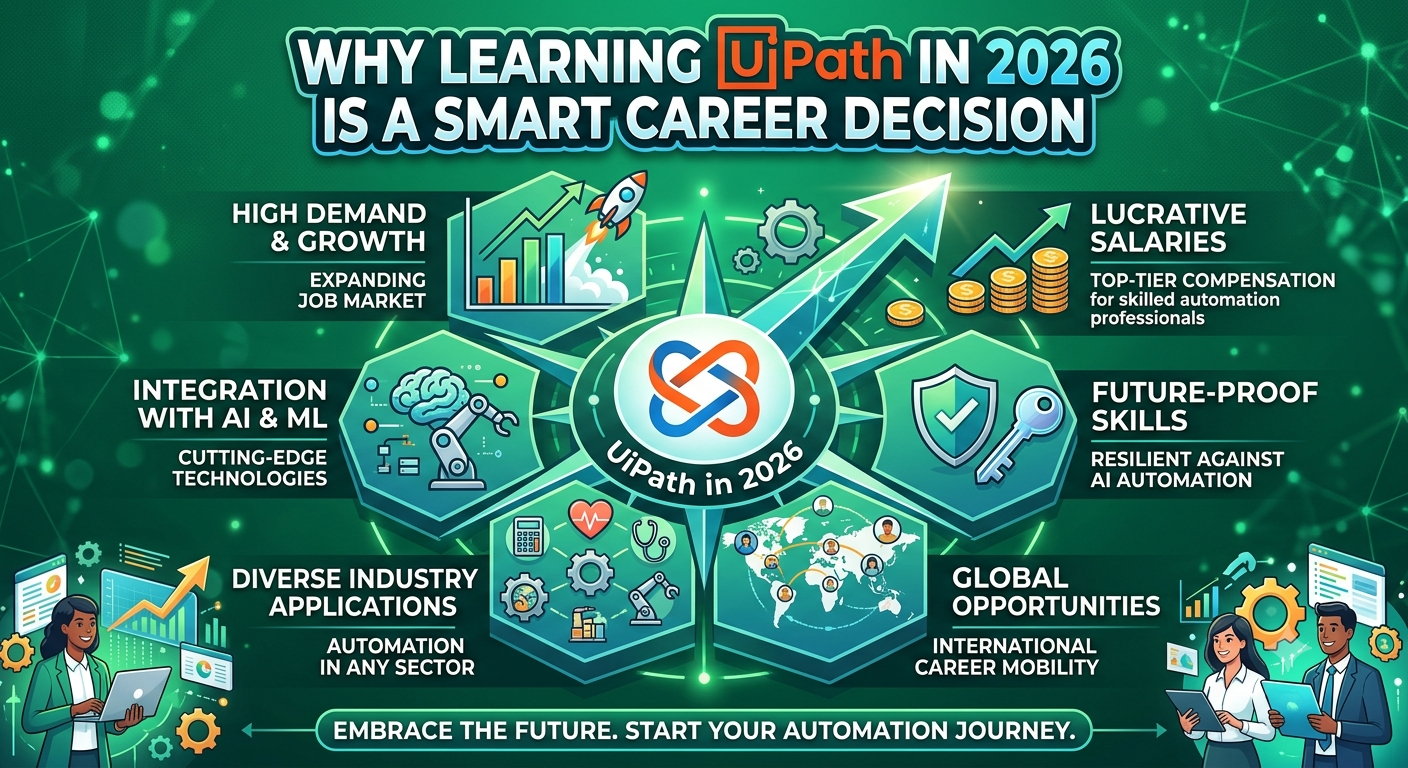
If you are starting your career or looking to advance, investing in a UiPath online course can provide you with practical skills to meet the industry's current and future needs.
As the digital workforce evolves, professionals who take a structured UiPath course and get hands-on project experience will probably continue to be in high demand.
Top UiPath Job Roles in 2026 and Beyond
The increased use of automation technologies in numerous sectors has led to a wide array of career paths for professionals skilled in UiPath. Businesses are adopting enterprise-wide automation strategies rather than restricting automation efforts to a single department. Therefore, companies require professionals with different levels of expertise in UiPath RPA, process analysis, workflow development, governance, and automation management.
Some of the most popular job roles are:
UiPath Developer
A UiPath developer builds, develops, tests, and deploys automation workflows. They work with existing teams to understand the needs and transform manual processes into automated solutions using the UiPath automation tools.
Many professionals who complete a UiPath online course begin their careers as junior developers and progress to senior automation roles.
RPA Business Analyst
An RPA (BA) business analyst finds the opportunities for automation within an enterprise. They review current business processes, collect requirements, and produce documentation that assists development teams in building effective automation solutions.
Therefore, you will find many professionals with business analysis skills who are trained in UiPath and who are valuable assets to the enterprise automation projects.
UiPath Solution Architect
Solution architects design enterprise-wide automation frameworks and make sure that automation projects align with business objectives. They establish the technical architecture, governance standards, security requirements, and scalability strategies.
The role usually demands extensive experience with UiPath RPA implementations and enterprise automation environments.
Automation Consultant
Automation consultants evaluate business needs and guide clients on automation options. They are responsible for automation planning, implementation, process optimization, and change management.
Organizations are increasingly seeking out consultants with strong UiPath automation skills and a deep understanding of business processes.
Automation Support Engineer
Support engineers watch automation environments, troubleshoot issues, and make sure bots are performing at their best. With organizations expanding their automation initiatives, the requirement for specialized support groups continues to increase.
The professional who enters this sector usually starts with a UiPath course and then acquires operational experience.
Why Are Businesses Hiring More Experts in UiPath?
Automation is becoming an industry. Organizations are investigating how to be more efficient and reduce their operating costs. Businesses across banking, healthcare, hospitals, retail, insurance, logistics, manufacturing, etc., sectors are aggressively investing in UiPath automation initiatives.
Companies are hiring more UiPath professionals as automation projects require skilled resources for development, deployment, governance, monitoring, and optimization. Many enterprises are setting up Automation Centres of Excellence (CoEs), creating more opportunities for certified automation experts.
Professionals may gain a competitive edge in today’s technology-driven job market by completing an accredited UiPath online training course.
What is the UiPath professional's salary in India?
One of the prime reasons why professionals are seeking UiPath training is the lucrative salary potential associated with automation careers. Compensation packages remain highly competitive as the demand continues to exceed supply for automation talent.
Entry-Level Professionals at UiPath
The freshers and professionals with less than two years of experience in UiPath RPA earn between ₹4 lakh and ₹8 lakh per annum on average, depending on skills, certifications, project exposure, and location.
Candidates who complete a full UiPath online course and work on real-time projects usually receive better starting opportunities.
Mid-Level UiPath Developers
The average salary for professionals with 3-6 years of experience in automation is roughly ₹8 lakh to ₹18 lakh per year. Often, these people are running sophisticated automation workflows and are involved in automation efforts at the enterprise level.
At this point, fine-tuning advanced UiPath automation skills can greatly increase earning potential.
Automation Specialist Lead
Senior developers, consultants, and solution architects are paid in the range of ₹18 lakh to ₹35 lakh per annum or more, especially if working with large enterprises or big organizations with a multinational presence.
Professionals who keep updating their knowledge with advanced UiPath training programs usually see faster salary growth.
UiPath International Salary: Global Opportunities for Automation Experts
The demand for automation professionals worldwide has created lucrative opportunities even outside India. Organizations in North America, Europe, Australia, and the Middle East continue to spend heavily on UiPath RPA projects.
United States
In the United States, UiPath experts with experience earn an average of $90,000 to $160,000 a year. Senior architects and automation consultants can earn considerably more compensation packages depending on their industry and experience.
United Kingdom
Automation specialist payouts in the UK generally scale from £ 50,000 to £ 100,000 P.A. Demand remains particularly robust in banking, insurance, and financial services.
Canada
Canadian organisations are still developing their automation capabilities, and experienced UiPath experts may earn annual salaries between CAD 80,000 and CAD 140,000.
Europe & Australia
Automation specialists are offered attractive salary packages in countries like Germany, the Netherlands, Switzerland, and Australia. Professionals with solid UiPath automation experience can find great career growth opportunities in these areas.
By completing a known UiPath online training program, professionals may qualify for international automation jobs and global consulting opportunities.
Industries with Massive Demand for UiPath Skills
The adoption of automation is no longer confined to a handful of industries. Today, companies in all industries are using UiPath to achieve better business outcomes and streamline operations.
The following key industries drive demand for UiPath skills:
Banking & Financial Services
Insurance
Medical care
Telecoms
Manufacturing
Retail & E-commerce
Supply Chain and Logistics
Utilities and Energy
Government Institutions
These industries depend on UiPath RPA to automate repetitive processes, improve compliance and increase operational efficiency.
As automation continues to grow, professionals who take a UiPath course can expect a consistent demand for their skills in a variety of industries.
Important Skills that Improve UiPath Skills
Learning UiPath is good, but employers want more technical and business skills.
Other important complementary skills are the following:
Business Process Understanding
Companies want professionals who can identify where automation can be applied and how processes can be improved before implementation.
Requirement Analysis and Documentation
Good documentation skills are a part of successful automation projects and alignment with key stakeholders.
Data Analyses
Many automation workflows involve extracting, processing, and validating business data.
Enterprise Systems Expertise
Knowing ERP, CRM, HRMS, and finance systems is an added advantage in UiPath automation implementations.
Communication Skills
Automation professionals often work with technical teams, management, and business stakeholders. Good communication is crucial for a project to be a success.
The knowledge gained through UiPath online training, along with these skills, creates many career opportunities.
The future of UiPath skills in the global job market
As organizations continue to adopt digital transformation and operational excellence initiatives, the prospects for UiPath skills remain highly optimistic. Automation is becoming a planned business priority, but not a tactical technology investment.
In the next several years, organizations will automate more and more business processes, creating a demand for more professionals who can design, manage, and improve automation programs.
Industry experts expect continued growth in:
Enterprise automation projects
Automation of shared services
Automated accounting & finance
Automated customer support
Automation of Supply Chain
Automated regulatory compliance
Long-term trends in the industry likely favour professionals who invest in UiPath training today.
Future job prospects for UiPath professionals
The automation industry is projected to create thousands of new jobs across the globe in the next 10 years. Organizations increasingly require specialists who can help with automation efforts from the planning stage to implementation and governance.
The following areas are expected to offer job opportunities in the future:
Automation Architecture
RPA Development
Governance of Automation
Process Excellence
Business Analytics
Automation Operations
Consulting & Advisory Services
Enterprise Transformation Program
As more enterprises adopt UiPath automation, the demand for professionals with real-world project experience and industry-leading certifications will continue to be strong.
Graduates, working professionals, and career changers who enroll in a UiPath online course can position themselves for long-term success in one of the fastest-growing segments of enterprise technology.
Why is UiPath a good career choice for the long term?
Things can change quickly in technology careers, so it’s important to choose your skills wisely so they don’t become obsolete. Automation solves a fundamental business problem—making things much more productive and efficient. That is why UiPath is still a highly promising long-term career path.
Businesses will continue to look for ways to enhance accuracy, reduce manual labour, and streamline processes. The ongoing demand makes professionals well-versed in UiPath RPA highly valuable players in business transformation initiatives.
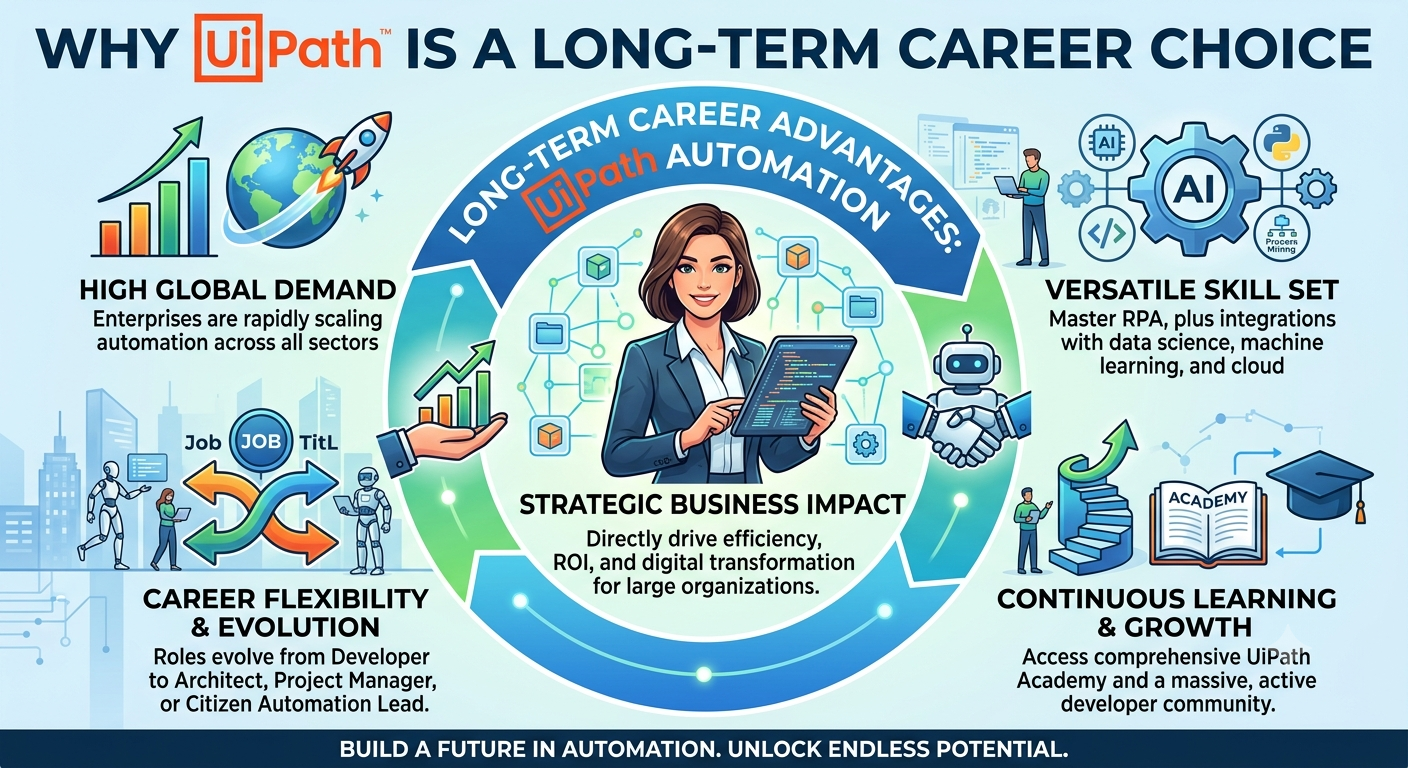
Also, opting for the structured UiPath course and skill development over time via UiPath online training can be beneficial for your career. It's also a great opportunity for students interested in a career in technology, IT professionals aiming to progress, and even business professionals wanting to take a step into automation.
Conclusion
With ongoing automation and digitisation trends in the industry, Ui Path is one of the most trusted and popular RPA platforms in 2026. The platform provides a user-friendly creation environment, a wide range of automation systems, enterprise scalability, a robust security structure, wide integration choices, and a thriving learning community, making it a popular option for businesses around the world.
An online Ui Path course or complete online UiPath training can provide a lot of opportunities for students looking for a career in the technology field, aspiring UiPath developers, or anyone who wants to upskill himself/herself.
In the era of increasingly integrated automation in business, UiPath's focus on innovation and scalability, combined with its value for the enterprise, will sustain its position in the RPA industry for years to come.