
Workday Absence Management: Handling Leave and Employee Absences
Last updated on Oct 13, 2026
The management of employee attendance and absences from work has evolved from a transactional administrative burden to a strategic operational focus in enterprise human resource management today. Global companies face the challenge of juggling the complex demands of local regulations, shifting labour agreements, subtle contractual rights and a rising demand for flexible, humane workplace cultures. Organisations that track absences on legacy systems or disjointed spreadsheets suffer payroll leakages, operational understaffing, compliance exposure, and worker frustration.
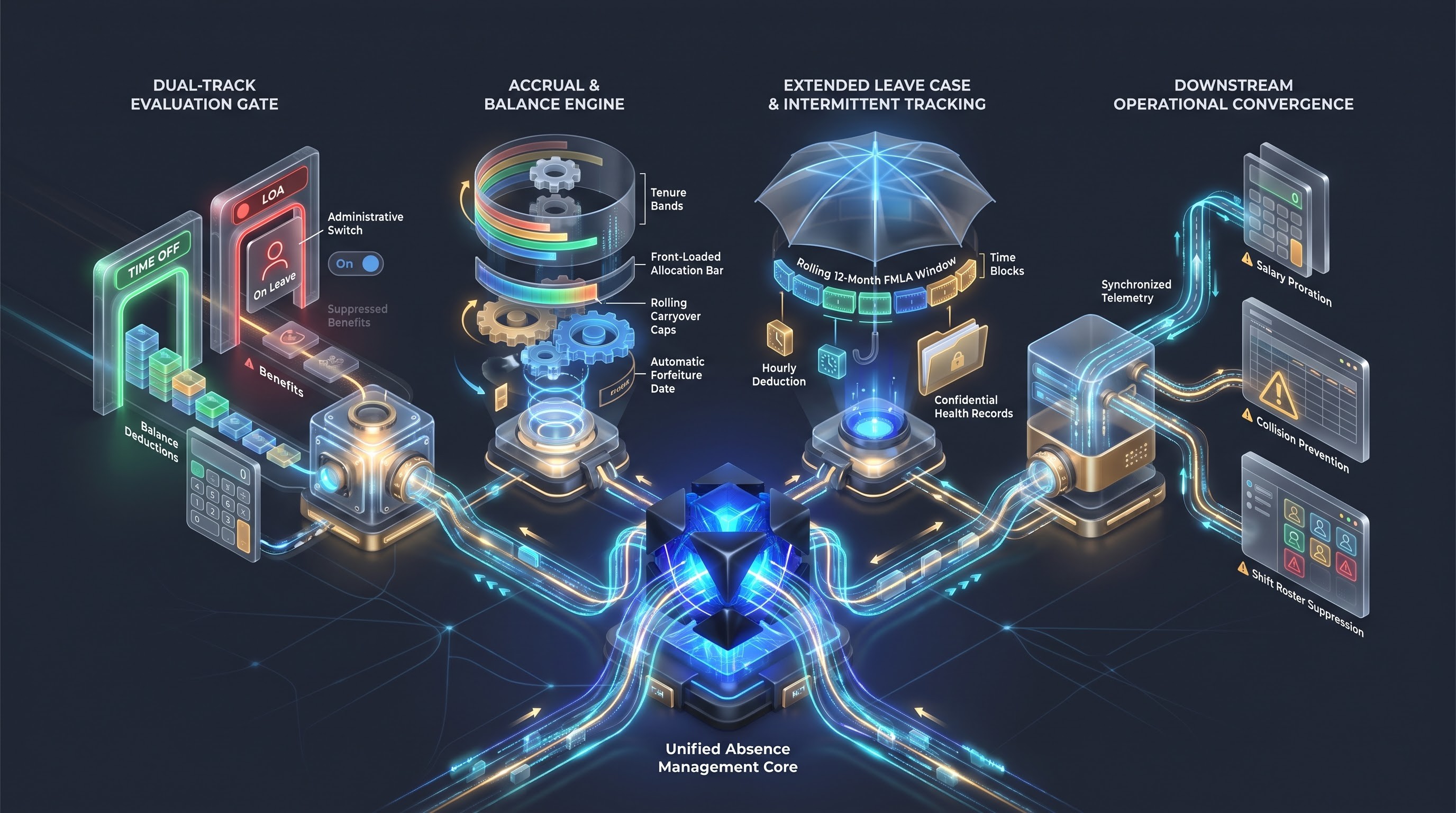
The Workday Absence Management system directly addresses these enterprise issues as an integrated module of the Workday Human Capital Management unified suite. Considering that it is seen as a key part of structured workday hcm training, it combines the elements of vacation, mandatory leaves, accumulation of balance and scheduling within one technological framework. Workday automates, transparently and legally defends, absence administration by harmonising employee self-service, administrative rule builders and deep integrations with payroll and time tracking.
Architectural Philosophy: A Foundation for Unified Data
Workday is differentiated by its single-tenant, multi-tenant cloud architecture that is built on a single data core. In this design, an employee record is never duplicated in different database tables. Instead, you go from being a single worker object to being linked to compensation, benefits, payroll, org charts and talent profiles all at once.
This is by design in absence management. When an employee requests parental leave, for example, human resources must manually notify benefits administrators, update status markers in payroll to stop salary calculations, coordinate coverage with resource managers, and recalculate anniversary accruals. Workday eliminates this operational overhead with its notion of real-time transactional propagation.
When an employee submits a leave request, the underlying object is instantly updated across all modules connected to it. The absence engine pulls employee position, country of employment, scheduled weekly hours, bargaining unit and length of service from Human Capital Management. It qualifies the employee for the second, updates the employee’s visual state in enterprise directories, dynamically suppresses scheduled shift allocations in Workday Scheduling and passes deduction or supplemental pay instructions to Workday Payroll without custom data bridges or batch integrations.
The conceptual difference: Time off vs. leave of absence
One of the main things you need to understand in Workday Absence Management is that it very clearly separates two important concepts: Time Off and Leave of Absence. While these terms are often used interchangeably by non-technical personnel, Workday considers them to be separate computational and operational categories, with their own business processes, calculations, and worker states.
Exit
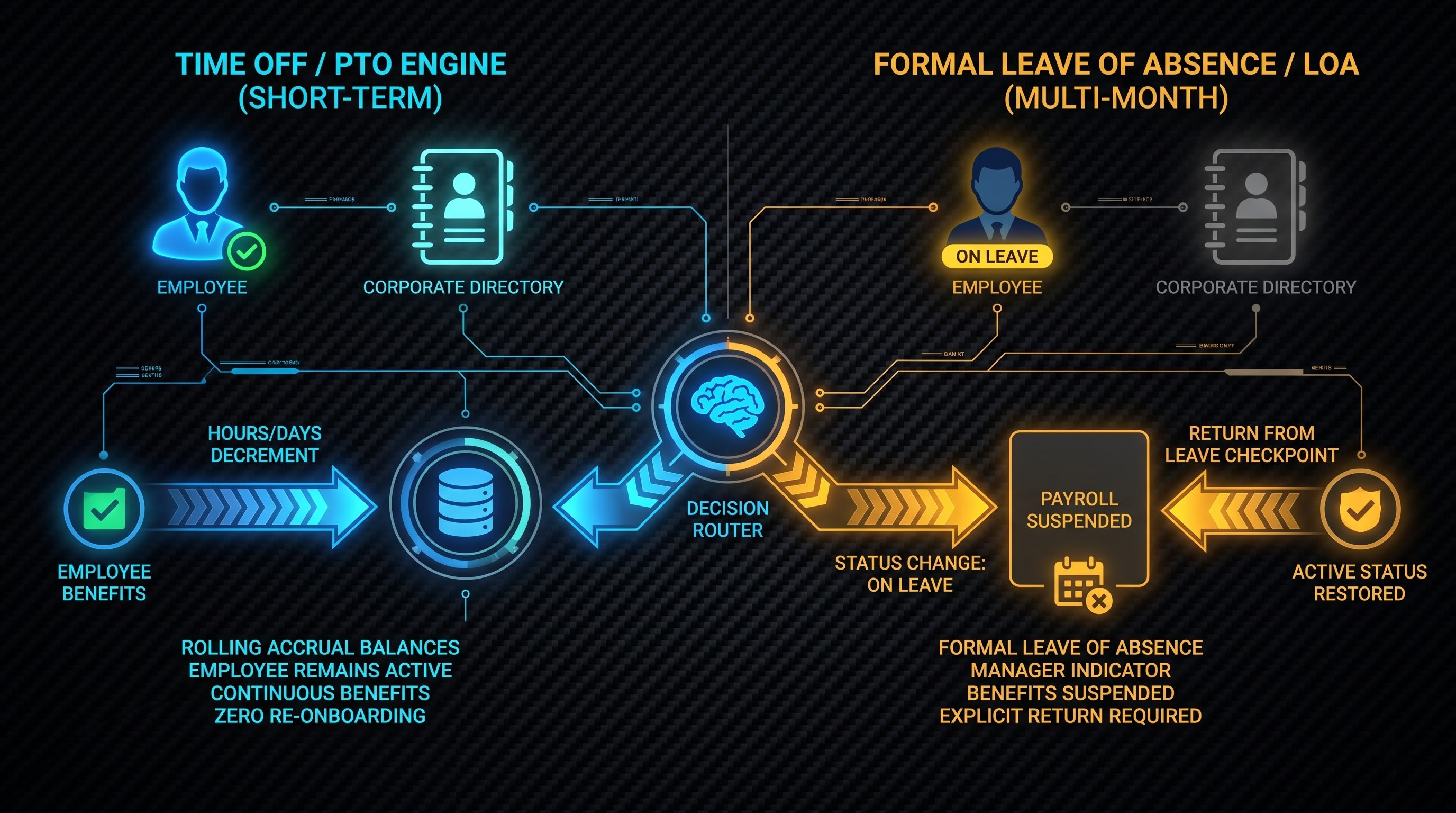
Time Off is a short-term planned or unplanned absence, where the employment status of the worker is unchanged and the worker is expected to return to their duties shortly, without formal re-onboarding. Paid annual vacation, regular sick days, floating holidays, personal days and short-term bereavement are most often cited as examples.
From a system architecture point of view, Time Off is built upon the basis of incremental balances, rolling accruals and transaction consumption. For example, an employee requests an exact increment, such as four hours or two consecutive days, and the system checks whether the employee has accumulated sufficient balance to pay for the absence, whether borrowing against future balance is allowed, or whether unpaid increments need to be created. When an approval route is completed the transaction is immediately removed from the time off plan it is assigned to. Most importantly, an employee on Time Off is still fully active in the corporate directory, can still enroll in benefits as usual, and doesn’t require an administrative workflow to confirm they are back to work.
Leave of Absence
Leave of Absence (LOA) is a long, formal absence from a normal work schedule. LOA’s are usually due to personal health, maternity/paternity, military service, sabbaticals or legal requirements such as the Family and Medical Leave Act. Time Off, unlike LOA, changes the administrative status of the employee record.
Once a LOA is approved and active, the worker is put in an On Leave status. This status is visually communicated on manager dashboards and organization charts in Workday, indicating to cross-functional teams that the employee is unavailable. Since LOAs are often associated with regulatory and legal implications, they work on open-ended or estimated date ranges (not fixed transactional days). Also, Workday provides organisations the ability to suspend automatic benefit deductions, halt normal holiday pay calculations, or stop normal PTO accrual algorithms while an employee is on an extended leave until the employee completes an explicit Return from Leave business process.
Fundamentals Creating Time Off Plans and Accruals
The policy on time off within an organization simplifies complicated regulations in an organization’s human resource handbook into clear and straightforward components. To be able to use the system with ease, an employee should undergo the workday hcm course training since the company has put the system in place and built its logic upon a detailed hierarchy of Time Off Plans, Accrual Rules, and Calculation Engines.
Vacation Types & Plans
The Time Off Type is the top level of structure that organises related absence events for reporting and employee selection. Below the type is the Time Off Plan, the rulebook for how time off is earned, tracked, capped and paid out. A single Time Off Type can have dozens of different Time Off Plans to meet global and demographic differences in a single enterprise. For example, an organization might have a standard Vacation type that maps to one plan for salaried employees in the United States, a completely different plan governed by statutory working weeks for employees in Germany, and a third plan for hourly contingent teams in the United Kingdom.
The Accrual Engine & Balance Tracking
Accruals are how, when and how employees earn time off from work, and by what formula. Workday’s calculation framework supports complex enterprise accrual paradigms such as:
Frequency and Cadence: Accruals can be set up to run on a pay period by pay period, semi-monthly, monthly, annually on the calendar year, or on individual employment anniversary dates.
Front-Loaded vs. Earned: Organisations can choose to front-load annual allocations, issue balances as employees accrue service, or dynamically award balances based on actual hours worked. Workday pulls actual hours worked data from Workday Time Tracking or external time clocks.
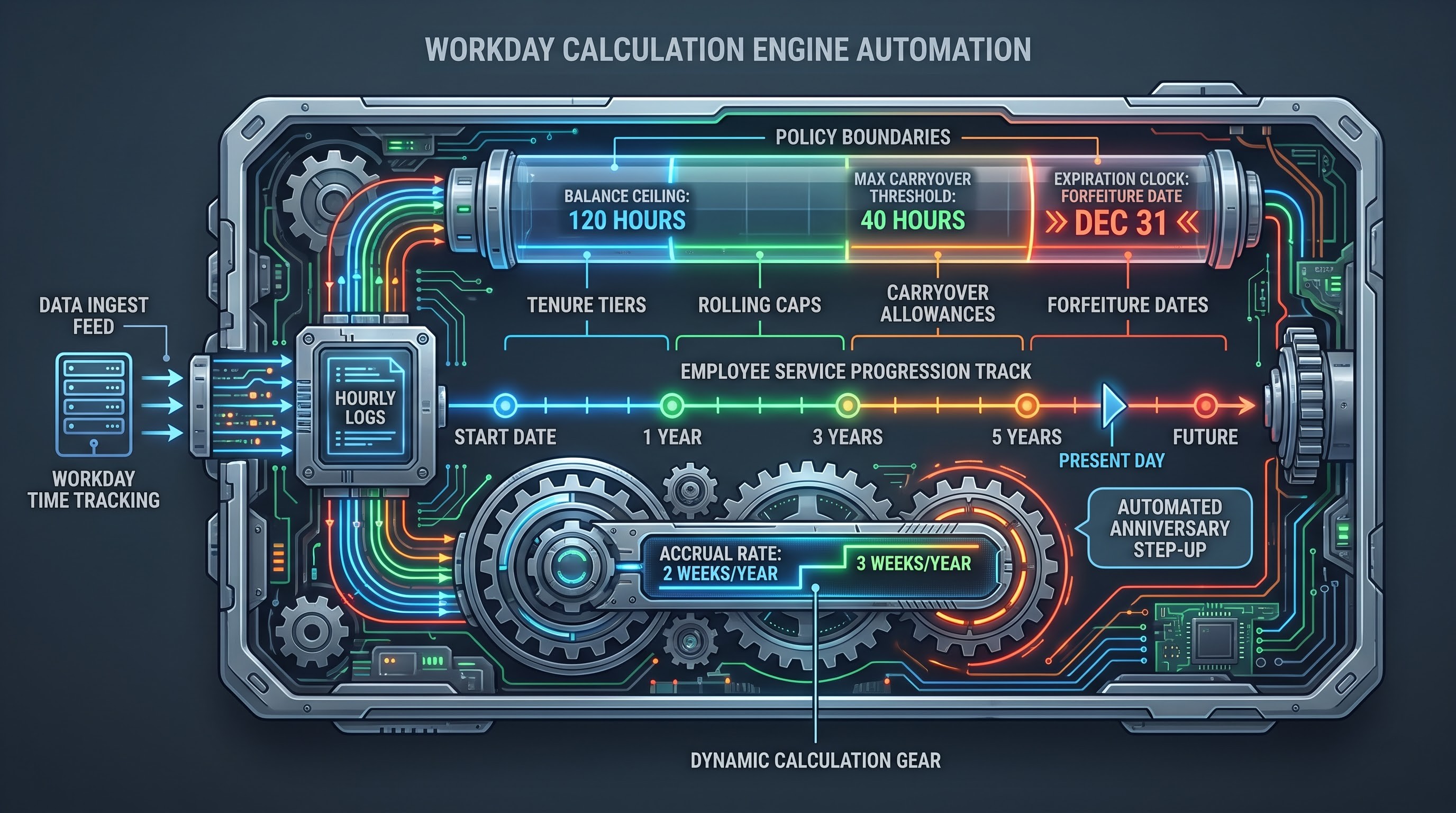
Tenure Tiers: Companies reward employees for staying with increased accrual rates as they hit service milestones. In Workday, service bands are baked into the calculation objects. Thus, when an employee passes their third work anniversary, Workday automatically bumps their accrual rate from two weeks per year to three weeks, without any manual administrative overrides.
Limits, Caps and Carryover Rules: Policy compliance is a function of controlling the fate of unused balances. Using Workday, teams can set up dynamic capping logic, including maximum balance ceilings, rolling limits, and end of year carryover thresholds. They can also specify a forfeiture date, which means employees can roll over unused time from the prior cycle and then it will expire automatically at the start of the new year.
Advanced Extended Leave: Rules and Complex Lifecycle Management
The formal process of a Leave of Absence introduces complex compliance risks, privacy concerns and multi-step processes. Workday has a specialised leave architecture for legal compliance and compassionate operational handling as an extended absence intersects with medical certifications, statutory job protections, and corporate insurance providers.
Families and Entitlement Monitoring Leave
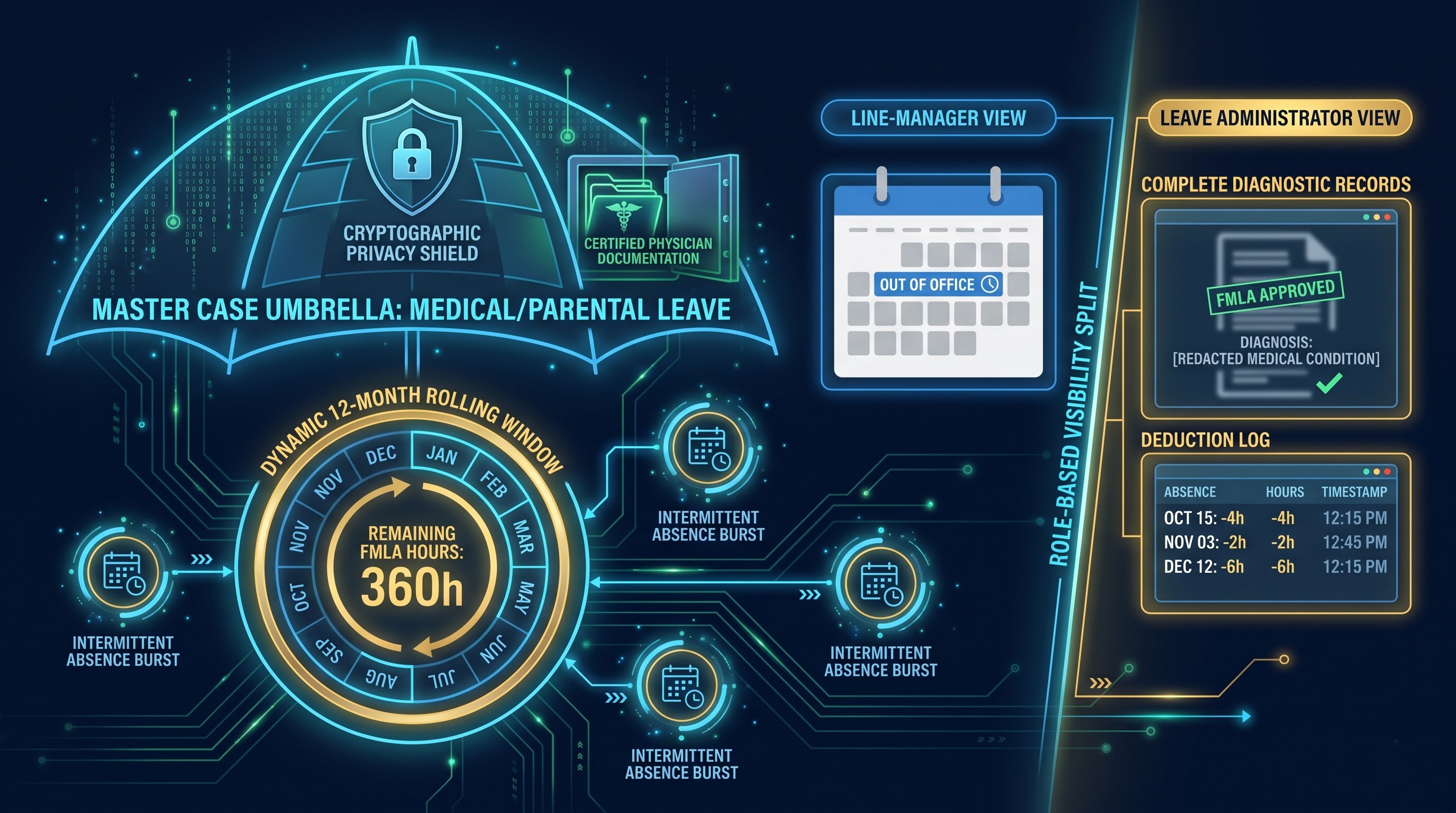
To provide structure for extended leaves, Workday groups leave types into Leave Families. A family groups related leaves under a single umbrella classification, such as Parental, Military, Medical or Study. Entitlement rules in these families set the legal/corporate boundaries that are given to a worker.
Entitlement calculations are recorded by fixed methods, or dynamic rolling windows. For example, under the United States Family and Medical Leave Act, an organization must track whether an employee has used their twelve workweeks within a rolling twelve-month period measured backward from the date leave is taken. Workday automates these rolling calculations on a dynamic basis. The calculation engine looks at the historical leave taken in the trailing twelve months, subtracts that from the statutory entitlement and calculates the exact remaining eligibility down to the hour for the employee.
Case Management and Leaves of Absence
Not all medical leaves are a contiguous block. Employees often miss individual days or partial shifts over several months due to chronic health conditions, specialised treatments or intermittent family caregiving. Manual administration of intermittent leave is error prone and can lead to compliance disputes.
Workday addresses this with integrated absence cases and intermittent leave tracking. A primary leave case is established, with the medical documentation, certified date boundaries and statutory authorisations. The employee will need to take time away on an intermittent basis, so they create discrete absence events that are directly tied to the parent case. The system continuously reduces the total pool of certified entitlements, applies organisational validation rules, and ensures that the intermittent hours are correctly recorded in payroll, thereby removing the need for a separate disruptive Return from Leave workflow for each and every instance.
Security and privacy of data
Leaves of absence routinely discuss protected health information, private domestic issues and legal matters. Standard rules of corporate visibility don't apply here. It is important that a line manager knows that a team member is off work but not that they have a specific medical diagnosis or sensitive personal notes.
Workday resolves this division with Segmented Security and Domain Security Policies. Organisations can design the employee experience so that when an employee requests a medical leave, the manager sees a clean calendar block that shows the employee is Out of Office or On Approved Medical Leave, with the supporting documentation, confidential physician certifications, and the detailed medical reasons visible only to designated enterprise leave administrators.
Business Process Framework: Governance, Routing & Automation
Much of the flexibility in Workday’s configuration is driven by the Business Process Framework, a workflow engine that manages how tasks, approvals, validations, and background integrations fire off across the enterprise. Rather than locking organisations into rigid, pre-coded approval pathways, Workday helps organisations design bespoke absence lifecycles that are tailored to organisational risk tolerances.
Dynamic Routing and Condition Rules
Enterprise workflows are seldom linear. The length of leave, the employee’s status and who is requesting the leave often dictate the level of oversight needed for an absence policy. The Business Process Framework allows administrators to build dynamic condition rules into absence requests.
For example, a simple one-day sick leave request can be configured with an auto-approval rule, completely bypassing management oversight, so as to reduce administrative friction. In contrast, an annual leave request of more than two consecutive weeks can be forwarded first to the direct manager for operational coverage review, and then to a department director for budget impact analysis.
Complex parental or military leaves may initiate parallel action paths in the business process. While the direct manager gets notified on the absence dates, the leave specialist in HR is simultaneously assigned a task to check the eligibility for statutory benefits, review the identification documents or birth certificates and update the enterprise security clearances.
Warnings and Validation
Workday allows for rules to evaluate transactions at entry, rather than after submission, in an effort to ensure policy compliance and avoid administrative errors. There are two main types of checks that administrators configure:
Soft Warnings:: These give the employee or manager an operational consideration, but do not terminate the process. For example, if an employee submits a vacation request during a historically critical company sales cycle, a soft warning can alert the submitter that blackout considerations are in effect, but still allow the transaction to proceed for managerial evaluation.
Hard Errors: These stop invalid submissions right away. If an employee tries to select a bereavement leave reason without selecting an approved family relationship reason or submits an entitlement request that exceeds their available statutory balance, the system will prevent the form from being submitted and flag the policy violation for immediate correction.
Global Compliance and Multi-Country Workforce Operations
A major operational hurdle faced by human resource management is to cope with the various absences of employees within a multinational organisation. Across several borders, the laws related to human resources, legal obligations, collective bargaining agreements and cultures are very different from one another. Using a regional policy in an international company can give rise to many legal problems and conflicts with works councils and even lead to administrative failures. The Workday Absence Management solution solves this issue with its flexibility and localisation.
Company-specific celebration days
The work schedules of the employees must be taken into account when calculating the absence time. If an employee takes five days off during the period of a holiday, he will only be deducted four days from the holiday.
To address this complexity, Workday creates Holiday Calendars, Work Schedules and Shift Patterns on top of time off evaluations. Workday provides a large library of statutory holiday templates by country and region. These calendars are assigned by organisations to particular locations, departments or workers. When an employee submits a request for time off, the calculation engine dynamically cross-checks the employee’s assigned work schedule with statutory holidays, ensuring that non-working days, company shutdown days and designated holidays are not deducted from the absence balance.
Navigating Complex Statutory Frameworks
The philosophies of different countries on how to handle leave for the workforce are radically different:
United States: Federal paid leave regulations are rare, with unparalleled sick pay, paid family leave regulations, FMLA benefits, and special PTO policies at the corporate level. Several of these regulations can be recorded at the same time in Workday and can even overlap with each other. For instance, if an employee is going on leave using corporate pay days, he/she has the right to utilize an unpaid statutory leave and thus, these counters will be displayed in the system.
European Union: The working time and rest period directives are very strict. In countries like France or Germany, statutory days for leave are often combined with contractual rights and controlled by works councils, seniority level and vacation carryover rules determined by courts.
United Kingdom: Keeping track of Statutory Sick Pay and Shared Parental Leave can be quite complicated as it will involve making sure that qualifying days and exclusion periods are observed and that the amounts to be paid are calculated according to the government rules affecting the pay calendars.
Asia-Pacific: Australia and other jurisdictions have complicated long service leave entitlements that vest when an employee reaches specific multi-year tenure milestones and public holiday substitution policies that are strictly regulated.
So how does Workday handle this? Workday allows you to build these various global frameworks into separate leave types, but maintain the reporting at a global, consolidated level for your C-suite. Multinationals can comply locally without sacrificing global oversight.
Technical Ecosystem: HCM, Payroll and Time Tracking Integrations
Workday Absence Management is efficient because it is not a stand-alone utility, but an interactive node within an enterprise technology ecosystem. It has native linkages with Workday Payroll, Workday Time Tracking and Workday Scheduling to create an automated operational pipeline.
The Payroll Crossroad
One of the common manual errors in the legacy environment is the connection between absence management and payroll. When leave adjustments are keyed by hand, underpayments, overpayments, and delayed disbursements erode employee trust and violate wage compliance laws.
Workday integrates these disciplines in a single calculation framework.” When you approve an absence, the transaction immediately creates earnings or deduction instructions that flow directly into the payroll calculation pipeline:
Paid Time Off (PTO) Process: The system tracks the hours taken, determines the employee’s current rate of pay, and automatically makes payments through the correct earnings code within the pay period.
Leave without pay: The program automatically records salary reductions that retroactively prorate regular salary when an employee takes time off without pay, thus allowing the payroll manager not to count working days versus days off.
Supplementary pay and disability allowances: If the law states a certain percentage of a salary should be paid for parental leave or medical leave, and the company adds certain amounts to this, the program calculates the actual payments, allowing for coordination between the company's payments and the expected payments from the government.
Employee termination balances: When an employee goes away, the program calculates the accrued balances, implements either the company's vesting or state forfeiture policies, and generates payment within the payroll cycle.
Scheduling Jobs and Tracking Time
Management of absences has to be integrated with the scheduling of shifts along with time recording for non-exempt and hourly employees. Workday has integrated these features into its system.
If an employee on hourly payment seeks some time off, Workday Time Tracking checks the timesheet submitted and prevents duplicate posts for the employee. A worker cannot log hours worked as well as sick benefits during the same period, but Workday allows an employee going to a doctor in the afternoon to record hours worked for the first half of the day and a medical absence for its second part.
From the resource planning perspective, Workday Scheduling allows seeing the requests for absences in real time. When a manager creates a work roster, the system immediately marks any employee who is on an approved leave or has applied for it and is waiting for its approval as unavailable.