
Workday Career Planning: Architecture, Skills Intelligence, and Operational Strategy
Last updated on Sep 29, 2026
There has been a permanent structural change that has happened in modern enterprise human capital management. Companies have shifted from static and annual performance reviews and the traditional ladder of promotions. Instead, there is an adoption of dynamic ecosystems based on skills that facilitate talent reallocation in real time, real-time talent development plans, and mobility driven by employees. Within such a working environment, the Workday Career and Development Planning does not only serve the purpose of an HR administration function. It is more of a strategy aimed at linking personal ambitions of an individual with evolving business needs.
By combining the elements such as workforce profile, artificial intelligence, skills taxonomy, experiential learning, and succession planning into one cloud-based environment, Workday helps companies achieve the visibility to break down talent silos internally. To understand the workings of such an ecosystem, one needs to delve into the technological aspects, mechanisms of career orchestration by employees, work of people leaders, workforce planning, and governance processes.
The Architectural Shift: From Job Architecture to Skills Intelligence
For many years, careers inside organizations were confined by the traditional system of job architectures and career ladders. Career progression was a linear one; an employee entered an organization at an entry level grade, gained seniority, and waited for the next level to open up. This system of career progression led to friction in the organization, which manifested itself in talent stockpiling by the department managers, unclear succession routes, and skills mismatches, which forced organizations to look elsewhere for new skill sets even though internal employees had closely related skill sets.
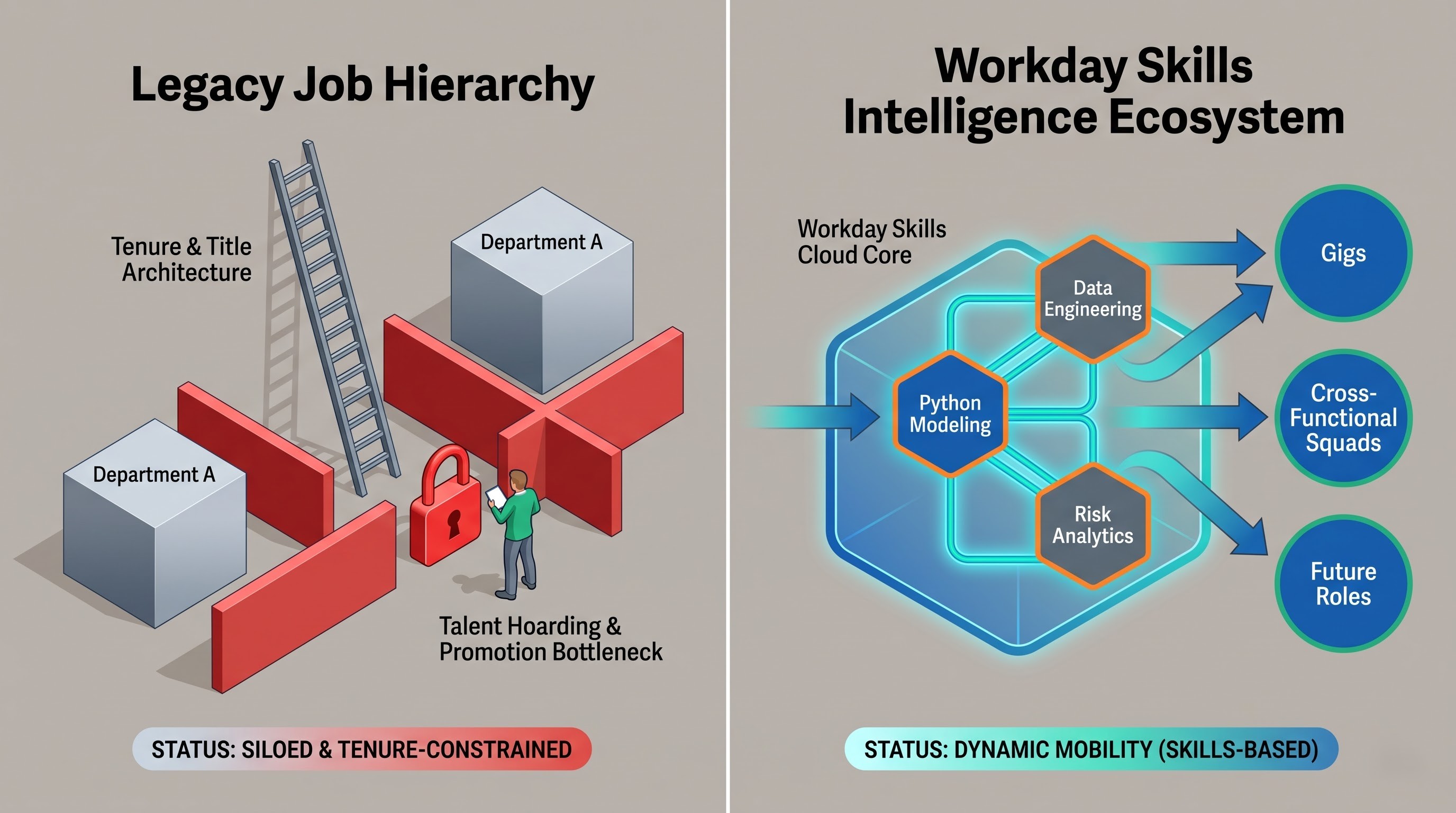
In order to overcome this issue, Workday does away with traditional career architectures, which depend on job titles, in favor of skills intelligence architecture. Workday Skills Cloud is the core component of the architecture. Configuring and setting up the required data pipelines for this type of architecture requires technical expertise that can be acquired through proper workday hcm training offered by OnlineITGuru.
Skills Cloud operates by compiling millions of enterprise data points related to job requisitions, performance appraisal records, workers' profiles, and external labor market indices to create a dynamically evolving repository of skills. Once an enterprise engages Workday Skills Cloud, Workday analyzes the data using natural language processing and semantic relationship mapping.
For instance, if a person is shown to have proven capability in financial modeling in enterprises using Python data structures, then automatically this individual is considered to have adjacent skills in data engineering and algorithmic risk modeling, regardless of the fact that they were not explicitly listed down.
The implication of such a shift in structure is that it changes the process of career development planning. Since competencies are modular in nature, the development process of an individual is no longer limited to a vertical path in their operational area.
Workday Career and Development Planning – Essential Functional Areas
The Workday talent suite is deliberately integrated. Each component does not function as an isolated module but as a continuous telemetry feed into a unified worker profile thus creating an operational loop between individual interest, skill acquisition, experiential application and organisational recognition.
Careers at Workday
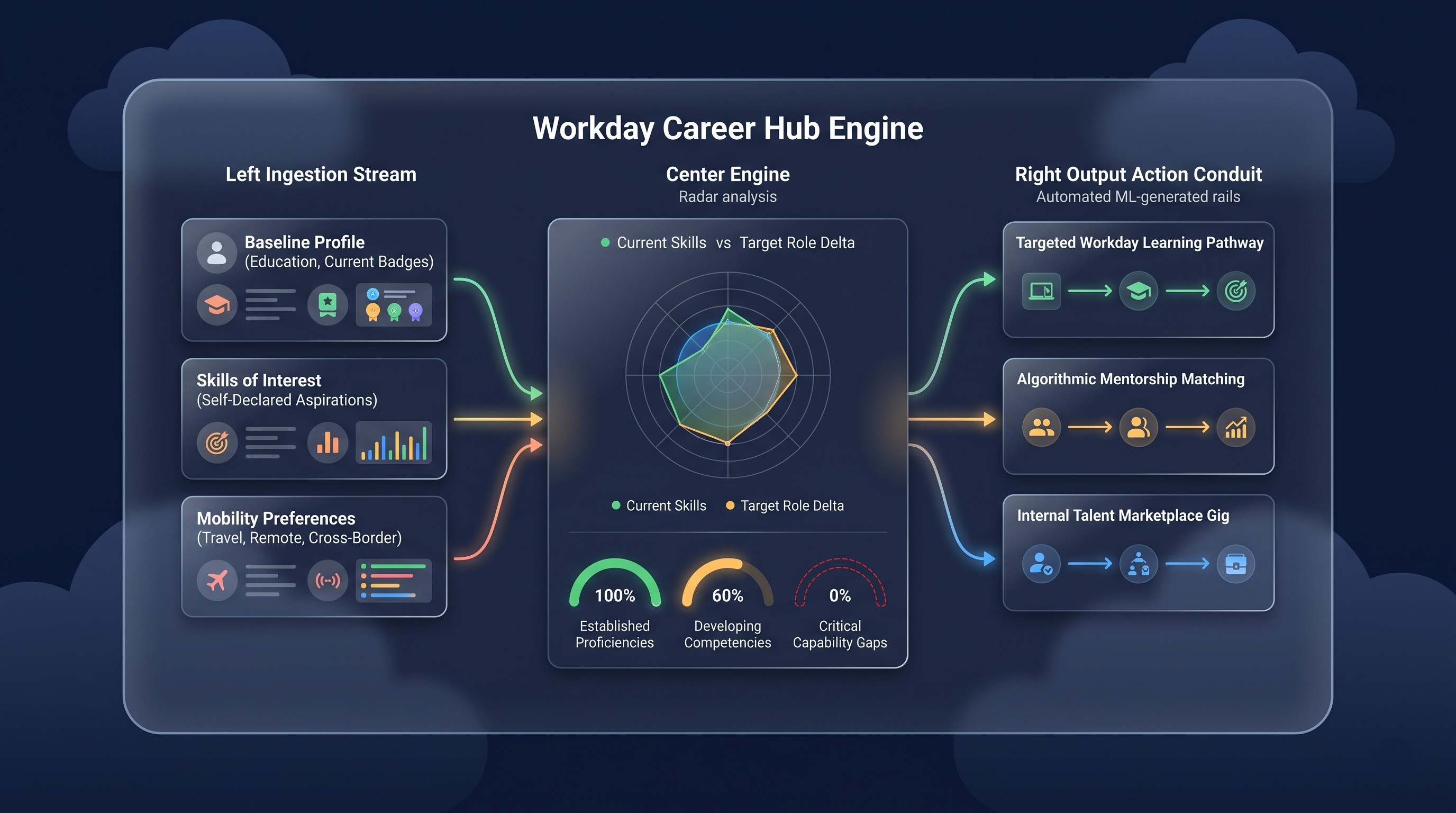
The Career Hub is the main self-service portal that employees use to map out their career paths. It’s run as an intelligent, personalised cockpit and surfaces tailored recommendations by matching the worker’s expressed interests, target roles and baseline skills against enterprise opportunities.
The Career Hub lets workers engage with a number of core capabilities:
Career Exploration and Path Builder: Employees can explore targeted job profiles across the entire enterprise, including jobs outside of their current functional department. The system looks at historic employee movement data to surface possible paths that previous employees have taken to that target role.
Skill gap analysis: Once an employee selects a target position, the platform automatically conducts a comparative skills audit. It lets the worker know about the capabilities that he/she already possesses, what competencies are in the development stage and what skills are lacking to be eligible for the position.
Actionable Development Item Generation: Workers can generate discrete development items to fill identified gaps in skills. They link to machine-learning recommendations that lead directly to the appropriate learning modules, internal mentorships, or short-term project assignments, so that development objectives are actionable rather than theoretical.
Workday Talent Marketplace
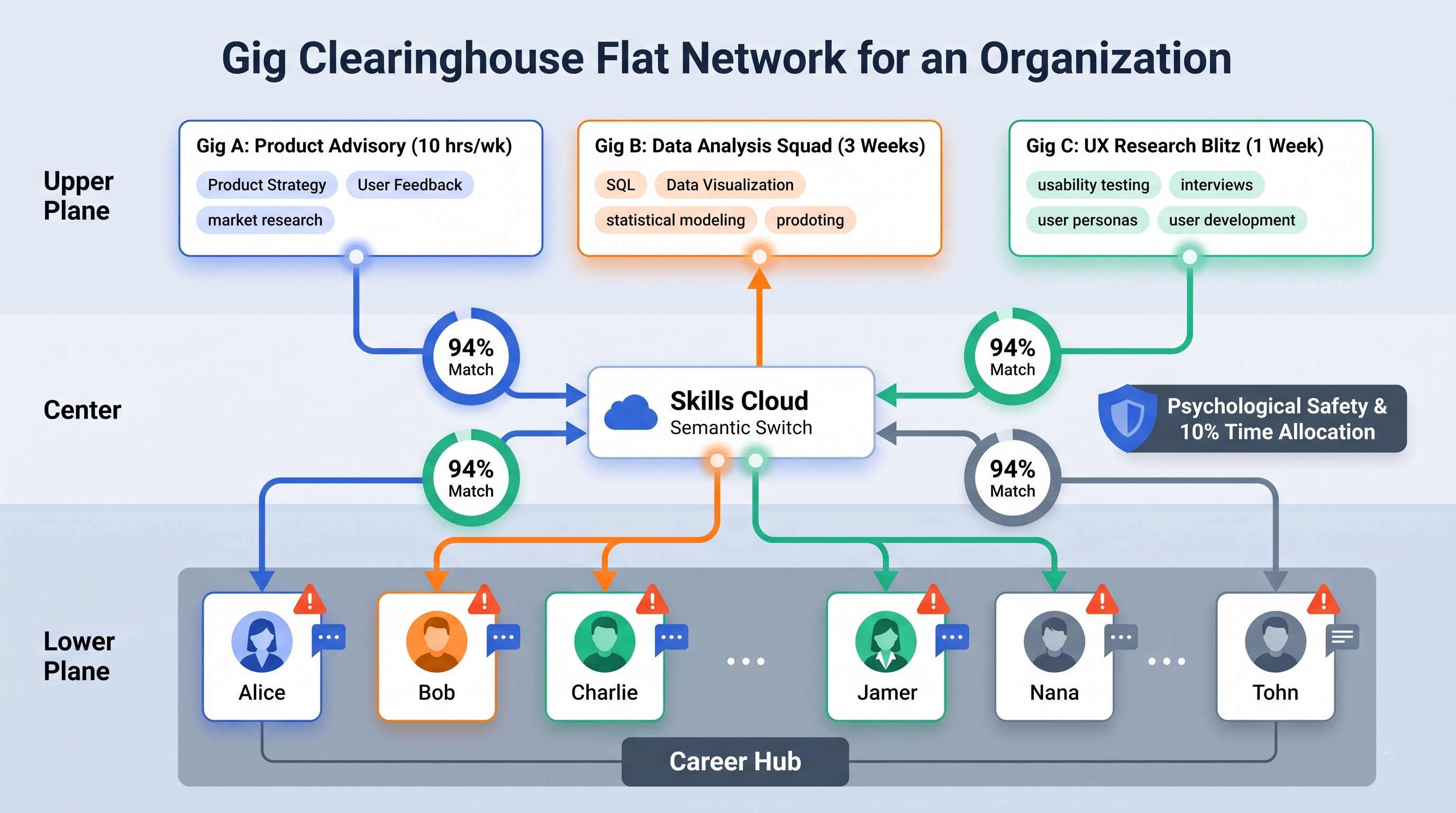
Development planning is a failure when learning is only in the abstract. Theory should be supplemented by practical application. The Workday Talent Marketplace solves this challenge as an internal clearinghouse, connecting employees to short-term project work, flex teams, gigs, and formal job requisitions through real-time skills matching.
Managers throughout the global organization can post short-term gigs (for example, a ten hours per week advisory role on a product launch, a three-week data analysis assignment, or a cross-functional process audit) without opening formal headcounts.
The Talent Marketplace searches employee profiles, identifies employees who have marked those specific skills as development priorities, and automatically surfaces those opportunities to them in their personal Career Hub. “It also helps employees to put new knowledge into practice, to expand their internal relationships and to get ready for lateral or upward moves sooner.”
Workday Mentoring and Professional Connections
In large companies, mentorship is frequently mismanaged, with manual matching spreadsheets and informal networks that favour extroverted or well-connected workers. Workday incorporates algorithmic mentorship pairing into development planning.
Employees can express that they are open to mentoring others in specific areas of expertise, or that they are seeking a mentor to help them develop capabilities they want to acquire. The system matches mentors and mentees according to complementary skill sets, target roles, shared interests, and geographic or business preferences. These links are documented in the employee’s development files which provide the tracking for social learning as a formal developmental intervention, in addition to standard coursework.
Workday Learning
Workday embeds curated digital learning content in career plans, rather than a standalone learning management system that operates outside of daily workflows.
If a development plan identifies a capability gap such as enterprise cloud architecture or regulatory compliance, the system will suggest microlearning modules, external partner courses, peer-created learning campaigns and formal certification tracks directly on the worker’s dashboard. When completed, the corresponding credential or skill level automatically writes back to the worker profile to update their qualification score across the Talent Marketplace and succession pipelines.
The Life Cycle of an Enterprise Development Plan, From Start to Finish
A good Workday development plan is not an annual static document, written during appraisal season and forgotten for eleven months. This is a live, continuous contract between the worker, their people leader and the business.
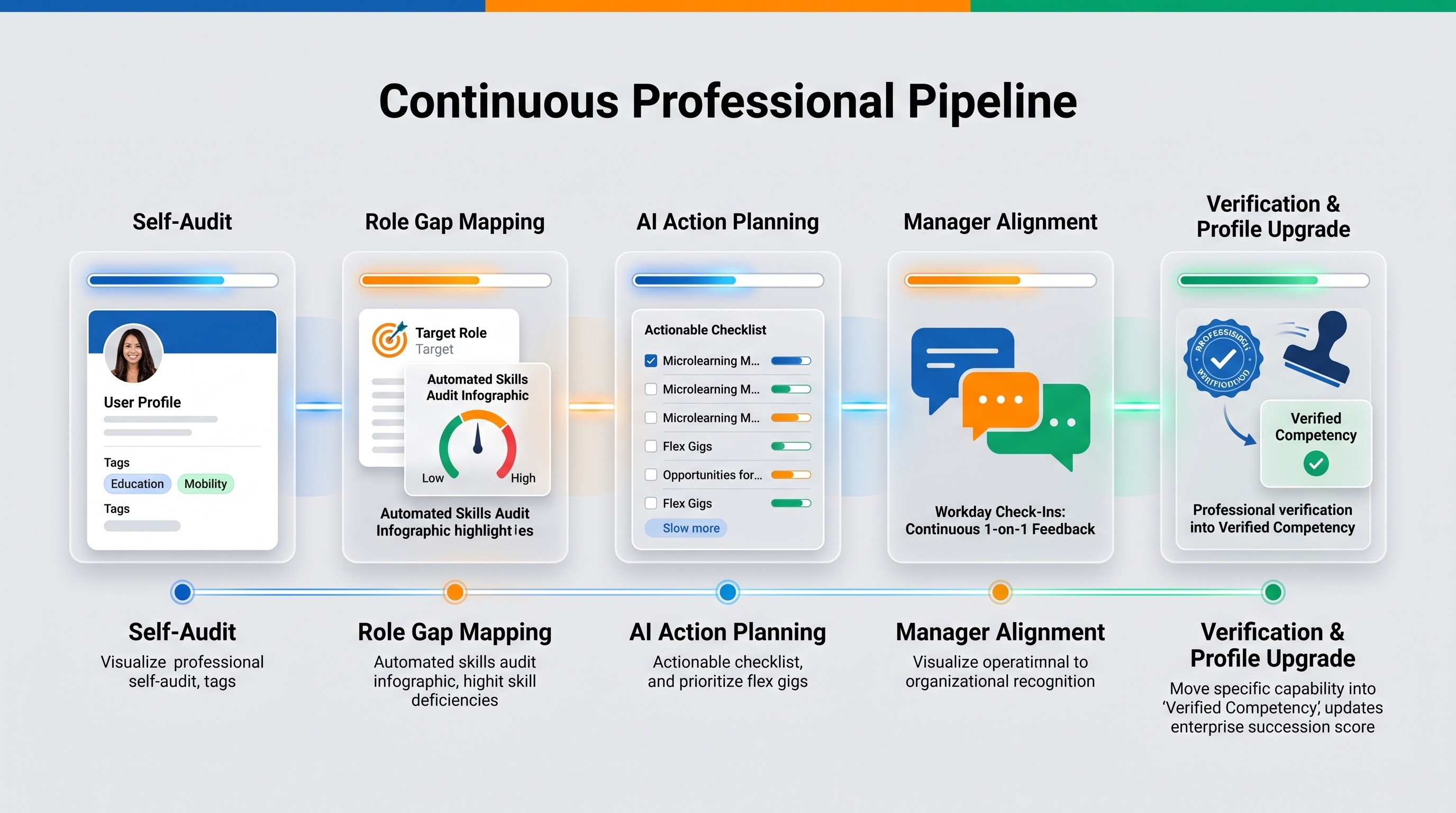
Phase 1: Establish a Baseline Profile and Conduct a Self-Audit
The development cycle starts with the employee creating their baseline profile. Employees log their educational backgrounds, historical work experience, current certifications, verified skills and primary career interests in Workday.
The platform helps workers to distinguish between existing skills and skills of interest that they do not have but want to learn. Workers also have mobility preferences, such as geographic flexibility, willingness to travel, and openness to remote cross-border projects.
Phase 2: Target Role Selection and Algorithmic Skill Mapping
Once the baseline profile is established, the employee selects short-term and long-term career aspirations via the Career Hub. Workday does a complete skill reconciliation by each target role.
The interface splits competencies into established proficiencies, developing capabilities, and critical gaps. Through visualising these delta areas, the employee is not learning in a vacuum, but is targeting their professional growth on the specific capabilities that are required by their targeted trajectory.
Phase 3: Defining Actionable Objectives and AI-Powered Planning
The employee develops development objectives based on the identified gaps. Workday offers native AI help that examines the gap and suggests specific, measurable development activities.
Instead of vague aspirations like "improve cross-functional collaboration," the system recommends calibrated action items: complete a specialised cross-functional negotiation course in Workday Learning, take on an open gig as a product liaison in the Talent Marketplace, and schedule biweekly mentorship sessions with a designated senior program manager.
Phase 4: Manager alignment & regular check-ins
Leadership support is necessary for the success of development plans. Development items are shared with the employee’s line manager in Workday.
The platform replaces the annual, retrospective performance conversations with Workday Check-Ins, a lightweight, continuous feedback framework. In regular 1 on 1s, the manager and employee review active development items, track gig progress, calibrate workloads and adjust timelines as operational priorities shift. Managers can provide structured feedback, endorse newly developed skills, and update proficiency ratings on the fly.
Phase 5: Verification, Capability Calibration and Profile Upgrades
As an employee progresses through courses, completes project gigs, and hits development milestones, the underlying talent data updates automatically.
Skills can be validated via different validation mechanisms depending on the organisational governance configurations, such as formal course completion, manager verification, gig host evaluations or peer endorsements. Once validated, those competencies transition from “skill interest” to “verified capability” on the worker’s profile. This immediately refreshes their visibility across the organization, qualifying them for higher-tier projects, algorithmic succession slates, and open permanent requisitions.
Operational role of the manager: From evaluator to career coach
Manager resistance is a key failure point in corporate talent management. Managers have long been the evaluators and gatekeepers of talent, holding onto the best performers within their units for fear that internal mobility would upset the day-to-day rhythm.
Workday is changing this equation through providing managers with their own cockpit to help them analyze things. It is in the form of Manager Insights Hub and Team Performance Dashboards. These cockpits offer managers real time analysis related to their team’s competencies, health, flight risks, and development speed. The HR teams that go through the workday hr training at OnlineITGuru will be able to configure these supervisor organizations much more efficiently.
Through the Manager Insights Hub, leaders can look at their team as a dynamic portfolio of skills. Managers can follow the path of team members, not just assess them on their current output, to find those who have outgrown their current scope and are ready to take on more responsibilities.
Workday metrics tell us that when managers encourage internal mobility, this presents itself positively in leadership analytics, turning people leaders from administrative taskmasters to active career coaches.
Talent reviews on the platform are also easier for managers to conduct. In traditional settings, managers complete subjective, static nine-box grids annually during succession planning meetings.
Workday’s succession planning is always being refined with live development data. Verified skill proficiencies, recent flex gigs, and tracked development items support a worker’s placement on a succession slate. This greatly reduces the influence of cognitive bias, increases the transparency of promotions, and ensures that succession pipelines reflect real, demonstrated ability, rather than just personal promotion.
Strategic Enterprise Alignment: Linking Corporate Strategy to Individual Career Ambition
Workday Career and Development Planning connects individual career aspirations with the enterprise’s larger strategic workforce planning. Enterprise HR leaders, workforce planning analysts and executive teams may utilise aggregated, anonymised talent data from the Skills Cloud to get a complete picture of organisational readiness.
When an enterprise undertakes a multi-year business transformation, such as the implementation of machine-learning automation in operational divisions, the reorganisation of supply chains, or the entry into new international markets, leadership must decide whether to build, buy, or borrow the talent required. For strategic workforce planners, workday provides the ability to model these future scenarios against the live workforce inventory.
Should the analysis indicate a deficit in cloud security engineering within European operations, the enterprise cannot simply rely on costly, competitive external recruitment. Human Resources can use Workday to find people who are in adjacent infrastructure roles and have core networking skills.
This allows HR to roll out targeted learning campaigns, sponsor gig opportunities in cloud security and prompt these workers in their Career Hub to put cloud security credentials high on their development plans. individual workers identify clear pathways to high demand, higher compensation skill sets; the enterprise systematically builds internal capability, lowering recruitment costs and shortening ramp-up times.
Governance and Change Management, Enterprise Implementation
Workday Career and Development Planning implementation can be described as organizational change rather than software implementation. Advanced talent management systems may end up being mere digital storage facilities devoid of proper governance, clear communication and cultural alignment if they are not managed carefully. The master administrator who is about to implement this system usually takes a full-fledged Workday HCM course through OnlineITGuru.
Designing the Skills Governance Model
Skills Cloud activation requires that organisations establish a functional skills governance model. That is, deciding how skills are built, curated and standardised across business units.
Workday has an ontology of tens of thousands of normalised skills, but organisations will still need to define company-specific technical skills and proprietary competencies. A centralised governance committee of HR technology leaders, business-unit talent leads and operational executives must continually review and rationalise custom skills to keep taxonomy clutter at bay and data integrity intact.
Setting skill verification criteria
Organisations need to determine how to verify skill levels to maintain data credibility.
By letting employees self-declare mastery without validation, the talent marketplace will surface underqualified candidates, eroding managerial trust in algorithmic matching. In contrast, the requirement for formal certification or executive approval for each capability introduces administrative delays that inhibit participation.
The best-in-class organisations use a tiered verification model:
Level One (Foundational/Self-Reported): Introductory awareness as reported by the worker, adequate to track interest and to take entry-level digital courses.
Level Two (Practiced/Peer-Observed): Verified by completion of Workday Learning courses, validated project deliverables, or successful execution of gigs, as determined by project sponsors.
Level Three (Mastery/Certified) Validated by way of accredited external certifications, internal technical assessment boards, or formal manager performance reviews.
Building a Culture of Talent Mobility and Psychological Safety
A culture of talent hoarding does not make for a talent marketplace. Executive leadership must set a clear expectation that talent development for the broader enterprise is a baseline performance metric for all people managers.
If managers punish employees for doing gig projects or exploring lateral opportunities, employees will not turn to the Career Hub and will continue to keep their career plans close to the vest until they leave the company for opportunities elsewhere.
Leading companies remove this friction by standardising gig policies, for example, instituting a policy that any employee in good standing can invest up to ten percent of their monthly working hours in internal flex projects without seeking prior management approval. This normalises the mobility, encourages skills exploration and builds a more cross-trained workforce that is more resilient.”
Continuous Communications and Continuous Change Management
Workers will adopt it only if it has direct value to the individual worker. In change management campaigns, Workday should be positioned as an employee-centric empowerment platform that democratises career growth, not an HR tracking system.
Consistent digital workshops, easy-to-follow walkthroughs and real employee stories of career advancement through the Career Hub help embed platform adoption across all business units.
Metrics & Business Value Realisation
Organisations measure quantifiable operational metrics across the talent lifecycle to determine return on investment from Workday Career and Development Planning:
Internal Fill and Mobility Rates: The ratio of open requisitions filled by internal candidates to external hires. High-performing skills-based organisations tend to see dramatic improvements in internal hiring velocity, significantly reducing third-party recruiter fees and time-to-productivity.
Voluntary Retention of High Performers : Measures voluntary turnover of high potentials or critical contributors. The best retention drivers of high-value talent are clear career paths, visible growth opportunities and internal project mobility.
Talent Marketplace Participation: Measures workforce participation in the marketplace by tracking the number of active development plans, completed gigs, mentor pairings, and skill updates logged in each quarter. This measure reflects the extent to which the workforce is using internal growth channels.
Skill Redundancy & Succession Depth: Measures the number of ready internal backups for critical positions, based on live, validated skill profiles, not speculative talent lists.
Time to Skill Acquisition: This measures the average time it takes an employee to close an identified competency gap by combining learning, mentoring and gig execution. In general, the measure also indicates the organization’s learning agility and ability to adjust to an operational change.
Conclusion: strategic
Workday Career and Development Planning is redefining enterprise talent management to better align the career growth of individual employees with the long-term strategic needs of the business. Organisations achieve the agility needed to navigate market volatility by moving away from rigid, tenure-based career structures and embracing an interconnected model driven by the Skills Cloud, Career Hub and Talent Marketplace.
The platform, when operationalised with defined governance, managerial backing and an open internal mobility culture, allows employees clear pathways for continuous career development. Enterprises, in turn, develop a flexible and future-ready workforce that can redeploy critical capabilities in real time. Ultimately, strategic talent planning turns human capital from a fixed operating expense into a flexible, sustainable competitive advantage.