
Workday Financial Management: Transforming Finance Through Cloud-Based Management
Last updated on Sep 12, 2026

Financial management has become increasingly dependent on how effectively organizations can connect accounting, operations, reporting, compliance, and business decision-making. Traditional financial systems often require multiple applications, manual processes, and disconnected sources of information to manage these activities. As organizations expand, this fragmented approach can make it difficult to maintain accurate data, respond quickly to changing business requirements, and gain a consistent view of financial performance.
Workday Financial Management addresses this challenge by bringing financial and accounting capabilities into a cloud-based environment. Rather than treating accounting as an isolated back-office function, the platform supports financial processes alongside operational activities, business insights, and configurable process management. This integrated approach helps organizations manage financial activities while creating greater visibility into how financial operations relate to broader business performance.
The value of Workday Financial Management is therefore not limited to recording transactions or producing financial reports. Its broader purpose is to provide organizations with a more connected environment for managing financial operations, analyzing information, and adapting processes as business requirements change. Understanding this approach is particularly important for professionals who want to work with modern cloud-based financial management systems.
Understanding Workday Financial Management
Workday Financial Management is a cloud-based financial management solution designed to support a broad range of financial and accounting activities. The platform combines financial management capabilities with business insights and configurable business processes, allowing organizations to manage financial operations within a unified environment.
One of the important characteristics of this approach is the connection between financial data and business activity. Financial information does not exist independently of procurement, expenses, projects, workforce operations, or other organizational processes. When these activities are managed through connected systems, financial teams can work with information that provides greater context for analysis and decision-making. The cloud model also changes how organizations approach financial application management. Instead of relying entirely on traditional on-premises infrastructure, organizations can use a cloud environment where applications and processes can be configured according to business requirements. This can support greater agility as organizations introduce new processes, expand operations, or adapt their financial management practices.
For professionals, this means that learning Workday Financial Management requires more than understanding individual accounting functions. It involves understanding how financial processes operate within the Workday environment, how business processes are configured, how information is used for reporting and insights, and how the platform supports different organizational requirements.
Core Capabilities of Workday Financial Management
A modern financial management platform needs to address more than basic accounting. Organizations require capabilities that support financial operations, reporting, process control, compliance, and business visibility. Workday Financial Management brings these areas together within its financial management environment. Accounting is one of the central components. Financial teams need reliable processes for managing accounting information and maintaining visibility into financial activity. A unified financial environment can help reduce the dependence on disconnected systems and provide a consistent foundation for financial operations.
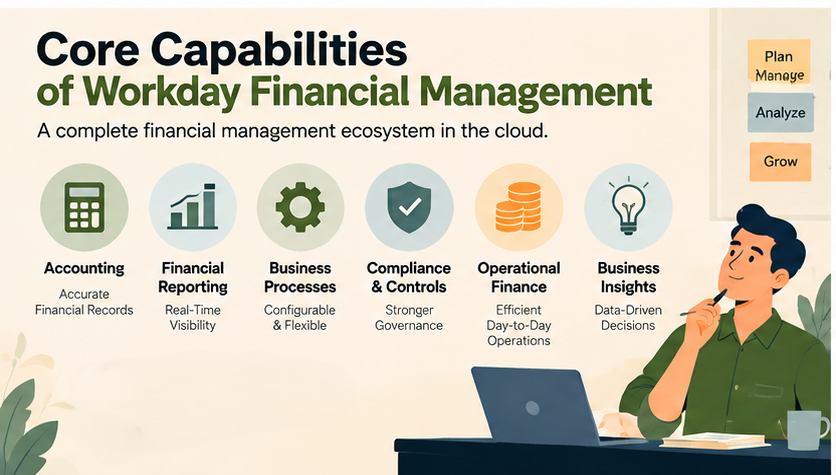
Another important area is business insight. Financial data becomes significantly more valuable when it can be analyzed in the context of organizational activity. Instead of relying exclusively on static reports, organizations can use financial information to understand performance, identify trends, and support business decisions. This creates a closer relationship between financial management and strategic planning.
The platform also emphasizes configurable business processes. Different organizations have different approval structures, operating models, and financial requirements. A configurable approach allows business processes to be aligned with organizational needs rather than forcing every company into an identical workflow. These capabilities collectively demonstrate why Workday Financial Management should be viewed as a broader financial management platform rather than simply an accounting application. Its role extends from managing financial activity to providing information and process structures that support ongoing business operations.
Financial Management in a Cloud Environment
The shift toward cloud-based enterprise applications has changed the expectations organizations have from financial systems. Businesses increasingly require systems that can support distributed operations, evolving business processes, and faster access to information without depending on complex infrastructure management. Workday's cloud environment provides a foundation for this model. Financial applications can be accessed through the cloud while organizations manage their financial processes within the broader Workday ecosystem. This approach is particularly relevant for organizations operating across multiple teams, business units, or geographic locations.
Cloud-based financial management also supports organizational agility. As business requirements change, financial processes may need to be modified, expanded, or reconfigured. A modern platform needs to accommodate those changes while maintaining appropriate process controls and financial visibility. This is one reason cloud financial management has become an important area of professional expertise. Understanding the technology requires professionals to think beyond traditional accounting functions and consider how configuration, processes, data, reporting, and business requirements interact within a cloud platform.
Business Process Management and Configuration
Business processes are an important part of financial management because financial activities frequently involve multiple steps, approvals, validations, and organizational roles. A financial transaction may need to move through a defined process before it is completed, recorded, or approved.
Workday Financial Management provides configurable out-of-the-box business processes that can be adapted to organizational requirements. This configuration-oriented approach allows financial operations to be structured around specific business rules and approval requirements. For example, organizations may have different approaches to financial approvals, expense processing, procurement-related activities, or other operational processes. The ability to configure workflows provides a way to reflect these requirements within the system.
Professionals working with Workday Financial Management therefore need to understand both the business requirement and the system configuration. It is not sufficient to know which feature exists. A strong understanding involves determining how that capability should be configured, how it affects downstream activities, and how it contributes to the organization's overall financial process. This combination of business knowledge and platform knowledge is one of the most important characteristics of working with enterprise financial applications. The objective is not simply to configure a system, but to create processes that are practical, controlled, and aligned with the organization's operating model.
Financial Insights and Data Visibility
Financial information has traditionally been used to document what has already happened. Modern financial management increasingly requires organizations to use that information to understand current performance and support future decisions. Workday Financial Management incorporates business insights into its financial environment, allowing financial information to contribute to a broader understanding of organizational activity. When financial data is connected with operational information, users can examine business performance from multiple perspectives.
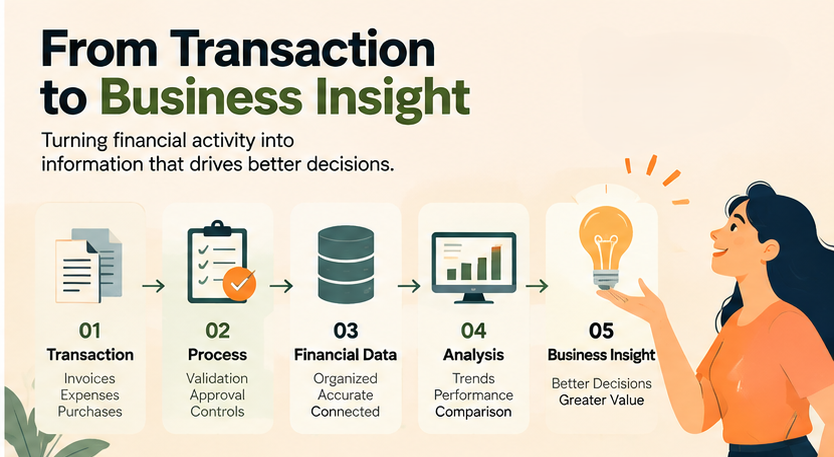
This visibility can be valuable for finance teams as well as business leaders. Finance professionals can use information to monitor financial activity, while decision-makers can use financial insights to evaluate performance and identify areas requiring attention. The significance of this capability is that financial management becomes more closely connected to business strategy. Instead of treating finance as a function that operates primarily after business activities have occurred, organizations can use financial information as part of ongoing planning and decision-making. For professionals learning the platform, understanding this relationship is important. The goal is not only to learn where financial information is stored or how transactions are processed, but also to understand how the resulting information can support operational and strategic decisions.
Workday Financial Management Across Different Business Sectors
Financial management requirements vary considerably between organizations. A large enterprise may need to manage multiple business units, complex approval structures, and extensive financial activity, while another organization may prioritize agility, reporting, or operational efficiency. A cloud-based financial management platform needs to accommodate these differences without requiring every organization to build its own financial application. Workday Financial Management provides configurable capabilities that can be applied to financial operations across different sectors and organizational environments.
This flexibility is also relevant to implementation and consulting projects. Professionals may work with organizations that have different accounting structures, approval requirements, operational processes, and reporting expectations. The ability to understand the platform and adapt its capabilities to specific business requirements becomes essential. Practical exposure is particularly valuable in this area. Working through realistic business use cases helps professionals understand why a particular configuration is required and how one financial process can affect other areas of the system.
The Role of Practical Learning
Learning enterprise financial management technology effectively requires a combination of conceptual understanding and practical application. Reading about features can provide an introduction, but real understanding develops when professionals work through business requirements and see how those requirements are implemented within the platform.
A structured Workday Financial Management Training program can help learners develop this combination by covering financial management concepts alongside practical application. The course overview provided for ITGuru emphasizes live instruction, practical use cases, application of financial management concepts across sectors, and exposure to project-oriented scenarios. This type of learning can help bridge the gap between theoretical platform knowledge and the practical requirements encountered in implementation or support environments.
Practical learning should include more than demonstrations. Learners benefit from understanding how financial requirements are analyzed, how processes are configured, how different capabilities interact, and how changes can influence business operations. This approach creates a stronger foundation for professionals who expect to work on real projects.
Skills Required for Workday Financial Management Professionals
Working with Workday Financial Management involves a combination of financial knowledge, business process understanding, and platform skills. Professionals do not necessarily need to approach the platform exclusively from a technical or accounting perspective. The most useful skill set combines both. A strong foundation in accounting and financial concepts is important because the platform supports financial and accounting activities. Understanding concepts such as financial transactions, organizational structures, reporting requirements, and business controls provides the context needed to configure and work with the system effectively.

Business process knowledge is equally important. Financial processes often involve multiple departments and approval levels, so professionals need to understand how work moves through an organization and how those requirements can be represented within Workday. Platform knowledge then connects these two areas. Professionals should understand the relevant Workday Financial Management capabilities, configuration options, business processes, reporting concepts, and cloud-based application environment. Practical problem-solving is another valuable skill. Enterprise systems rarely operate without exceptions. Professionals may need to investigate configuration issues, understand why a process is behaving differently than expected, or determine how a business requirement can be supported within the platform.
Career Preparation for Workday Financial Management
Then introduce the keyword naturally inside the body:
For professionals entering this field, learning should be approached as a progressive process rather than an attempt to memorize every available feature. Workday Financial Training can provide a structured foundation by combining financial management concepts with Workday-specific processes, configuration, reporting, and practical implementation scenarios.
The rest of the section can continue naturally:
A typical learning progression begins with understanding Workday's financial management environment and its core concepts. From there, learners can study business processes, configuration, reporting, financial operations, and the relationship between financial activities and broader business operations.
Hands-on practice becomes increasingly important as learners move into advanced topics. Practical scenarios help demonstrate how a business requirement is translated into a configured process and how financial information moves through the system. The ITGuru course overview emphasizes live expert instruction, practical use cases, cloud-based Workday applications, financial management capabilities, business insights, and configurable processes. These elements provide a useful framework for developing practical platform knowledge rather than focusing only on theoretical concepts.
Why Understanding Business Impact Matters
One of the most important aspects of financial management technology is understanding the impact of system processes on the wider organization. A configuration decision may affect approvals, reporting, operational processes, data visibility, or other business activities. This is why financial professionals and consultants need to look beyond individual transactions. They need to understand how financial management contributes to business operations and how changes in financial processes can influence organizational performance. Workday's integrated cloud environment supports this broader perspective by bringing financial management, business processes, and insights into a connected platform. Professionals who understand these relationships can contribute more effectively to implementation discussions, process improvement initiatives, and operational decision-making.
This perspective is particularly useful in consulting environments, where professionals are expected to translate business requirements into practical system solutions. The ability to explain not only what a configuration does, but why it is appropriate for the business, is a significant professional advantage.
What to Look for in a Financial Management Learning Program
Selecting an appropriate learning program requires looking beyond the course title. Financial management is a broad subject, so a useful program should provide a logical progression from foundational concepts to practical application. A Workday Financial Management Course can be particularly useful when it combines platform knowledge with realistic business scenarios rather than focusing only on feature-based instruction.
Learners should evaluate whether the program covers major financial management concepts, Workday application capabilities, business process configuration, reporting and insights, and practical project scenarios. Hands-on exposure is especially important because enterprise application knowledge becomes more valuable when learners can apply concepts to actual business requirements and understand how different processes work together.
The learning format also matters. Live instruction can give learners opportunities to ask questions, clarify configuration concepts, and understand how experienced professionals approach practical situations. The ITGuru course overview specifically emphasizes live expert instruction and practical use cases, providing a learning environment focused on applying Workday Financial Management concepts in different business scenarios. Another important consideration is whether the program explains the relationship between individual features and broader business operations. A strong learning program should help learners understand how financial processes, configuration, reporting, business insights, and operational requirements connect within the Workday environment. This broader perspective is more valuable than learning isolated features without understanding their practical purpose.
The Future of Financial Management Skills
Financial management is increasingly connected to cloud technology, data visibility, automation, and integrated business processes. As organizations continue to modernize enterprise applications, professionals who understand both financial operations and cloud-based platforms can play an important role in implementation and transformation initiatives. This does not mean that traditional financial knowledge is becoming less relevant. Instead, the role of financial professionals is expanding. Accounting and financial concepts provide the business foundation, while technology knowledge enables those concepts to be applied within modern enterprise systems.
The same applies to consultants. A consultant who understands business requirements, financial processes, Workday configuration, and the relationship between financial data and organizational operations can provide value across multiple stages of a project. For this reason, financial management skills should increasingly be developed alongside technology skills. The combination creates a more complete understanding of how modern organizations manage financial information and business processes.
Conclusion
Workday Financial Management represents a broader approach to enterprise financial operations in which accounting capabilities, financial processes, business insights, and configurable workflows operate within a cloud-based environment. Its value lies not only in managing financial information but also in connecting financial activity with the operational context in which business decisions are made.
For professionals, learning this platform requires a balanced understanding of finance, business processes, configuration, reporting, and cloud technology. Practical experience is particularly important because the effectiveness of financial management depends on how well system capabilities are aligned with real organizational requirements. The course overview provided for ITGuru emphasizes live expert instruction, practical use cases, financial management capabilities, cloud applications, business insights, and configurable business processes. These elements provide a practical foundation for professionals seeking to understand how Workday Financial Management can be applied across different business environments.
Ultimately, the strongest professionals in this area are not those who simply memorize platform features. They are the ones who understand the business problem, recognize the appropriate Workday capability, configure the process effectively, and understand how the resulting financial information supports broader organizational objectives. That combination of financial knowledge and enterprise technology expertise is what makes Workday Financial Management an increasingly relevant professional skill.