
Workday HCM Interview Questions for Experienced Professional
Last updated on Nov 11, 2026
Candidates preparing for a senior-level Workday Human Capital Management (HCM) interview need to make a major shift in how they think about enterprise architecture, operational governance and strategic platform management. At least the experienced professionals should have standards and basic knowledge of the system. In contrast, for the interviewers from leading consulting firms, multinational corporations, and reputable advisory firms, the standards will be even higher than that. To bridge the gap between theory and practice, the professionals participate in workday hcm training online in office time in order to gain the enterprise level experience.
Today, in the enterprise ecosystem, Workday has moved from a static system of record to the dynamic digital center of gravity for global workforce management, organisational restructuring, cross-border compliance and agile talent operations. Hence interview questions for senior technical positions are often about how the interviewee resolves nuanced architectural challenges, anticipates systemic chokepoints, troubleshoots intricate workflow breakdowns under duress, and integrates technical configurations with broader organisational objectives.
In this complete guide, we explore the foundations of advanced Workday HCM expertise. At the most basic architectural level, senior professionals will have an in-depth understanding of Workday’s unified, in-memory, object-oriented data model. Advanced practitioners have transcended the traditional relational database mindsets to understand how business objects, instances, associations and fields interact within the memory architecture. This knowledge directly translates into building custom reports and complex integrations: data sources are selected efficiently, multi-level object traversals are minimised, and queries that consume a lot of resources do not negatively impact overall tenant performance or cause unexpected transaction timeouts.
Outside of architecture, the nitty-gritty of the Business Process Framework (BPF) is a big interview topic at the senior level. Creative problem solving and strict architectural discipline are required to build robust automated workflows that can manage complex matrix management structures, dotted line reporting hierarchies and conditional multi-tier approval routing. Senior architects need to be able to build dynamic evaluation rules and proactively foresee and prevent process deadlocks, stuck events, and broke upstream data dependencies. When transactions inevitably freeze, seasoned pros use systematic troubleshooting techniques. They audit process histories, validate the security permissions of domains and business processes and safely undertake corrective interventions in both implementation and sandbox environments before promoting changes into production.
And security and governance models are not optional for senior level roles. In advanced interviews, often the ability to create secure tenant-wide policies that are strict to the principle of least privilege is tested in the candidate. Differentiate Domain Security Policies from Business Process Security Policies Identify and reduce the high compliance and data privacy risks of unconstrained security groups. Senior professionals must strictly compartmentalise sensitive personally identifiable information (PII) and compensation data, ensuring it is only visible to those with access rights according to organisational jurisdictions, locations and custom attribute filters.
The other area of advanced Workday competency is around the integration and reporting landscape. It is necessary for the senior architects to be able to define the architectural parameters that help determine the right tool for integration… To get an insight into the more complex integration methods like Workday Studio and calculated fields, one may check out structured workday courses online.
Ultimately, the interviewing process for these high-stakes roles is about developing a holistic, strategic vision that links technical configuration to business transformation. Mastery of these advanced paradigms enables senior professionals to become critical leaders that can drive operational excellence, system resilience and long-term organisational achievement.
Architecture, Object Model and Management of Tenants
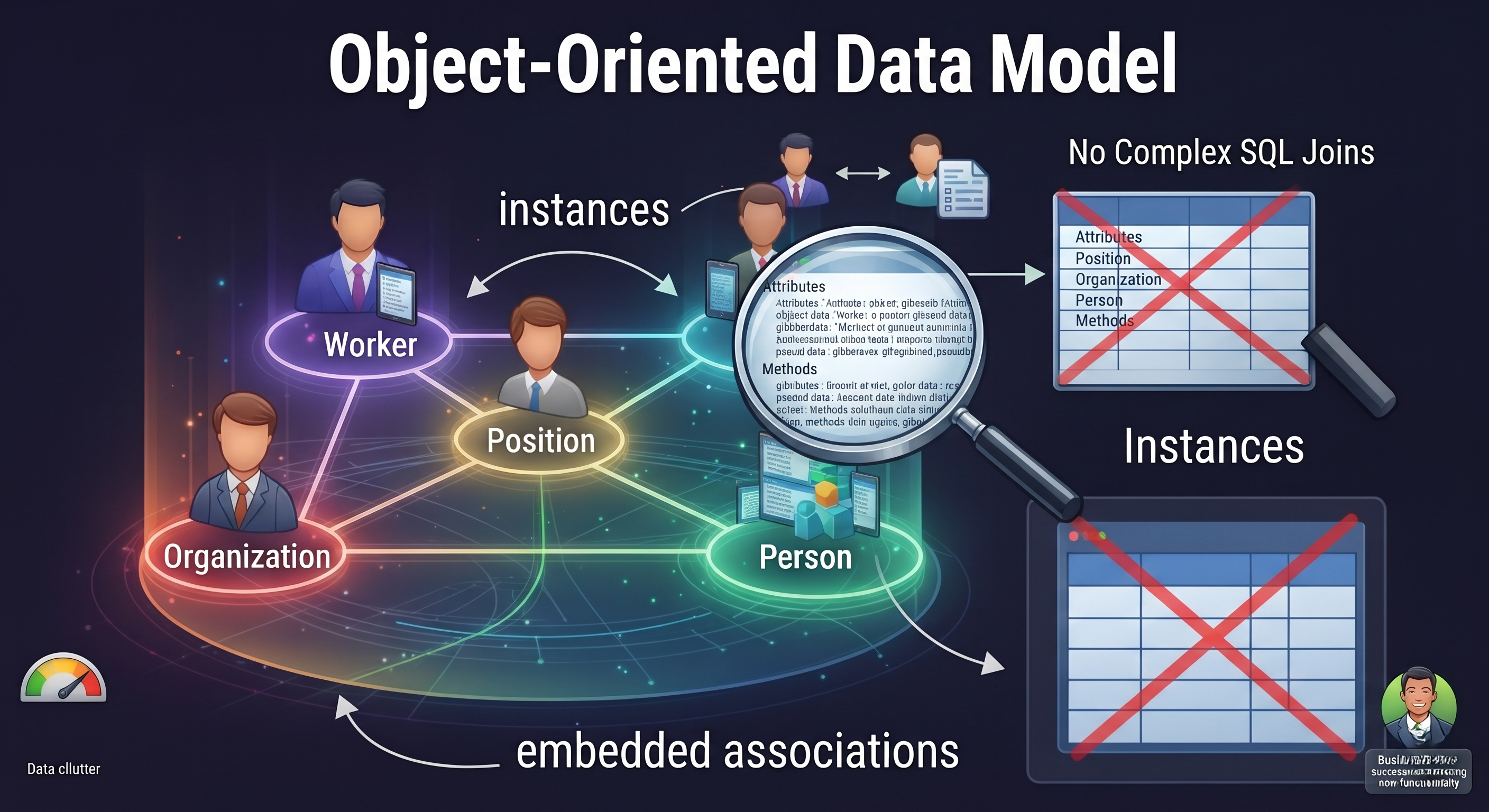
Senior professionals should know Workday doesn’t use old school relational database tables with foreign key joins. Instead, it uses an advanced object-oriented database model with business objects, instances, and fields.
1. The Workday Core Architecture and how object orientated data modelling affects custom reporting and integrations.
Workday is built on a single in-memory object model. Data is modelled with business objects (e.g. Worker, Position, Organization) with fields and instances. Workday’s object model embeds associations and references directly in objects, eliminating the need for complex multi-table SQL joins required by legacy relational database management systems.
For senior professionals this means custom reporting and integrations work off delivered data sources and business object relationships, not raw query writing. Knowing the main business object and related business objects is important as too many levels of navigation or inefficient data sources can lead to high memory consumption resulting in report timeouts or integration performance degradation.
2. What are the different Workday ecosystem tenant types and how can you safely manage configuration migration?
Workday uses specialised tenants such as Implementation (IMPL), Sandbox, Sandbox Preview and Production to support the continuous innovation cycle and bi-annual tenant updates.
Senior Consultants use Tenant-to-Tenant (T2T) Migration tools and Configuration Migration Workbooks to manage configuration migrations. The main problem is to map dependencies. Prior to migrating calculated fields, custom reports or business process updates, admins should ensure that all underlying components (e.g. custom organisations, security policy permissions, reference IDs) are already present in the target tenant. Administrators can use implementation projects to group related configuration changes, manage dependencies between them, and run dry runs in Sandbox environments to catch validation errors before going to production.
Business Process Framework and Advanced Workflow Architecture
Almost all the transactions in Workday are handled by the Business Process Framework (BPF). Senior architects typically design resilient, highly automated workflows to support complex organisational hierarchies and exception handling.
3. Designing a conditional routing workflow for multi-tier matrix management approvals without deadlocking the process.
Advanced approval routing needs a strategic blend of oversight structures, matrix orgs and condition rules. Where organisations have dotted-line or matrix managers in addition to the normal supervisory hierarchy, bottlenecks or the break down of an approval chain can happen.
To solve this, the senior architects built evaluation steps into the business process definition with custom condition rules. These rules are used to dynamically route steps to the correct security groups or levels of management to evaluate worker attributes, cost center allocations or job profiles. Architects design fallback steps and time-based escalation rules to prevent deadlocks.
If the primary approver does not respond within a given time, the transaction is automatically routed to another administrative role or higher tier of management, ensuring the flow of operations is not impeded.
4. Imagine a scenario where due to a misconfiguration of upstream validation / security a critical business process (Change Job for example) is left in active state.
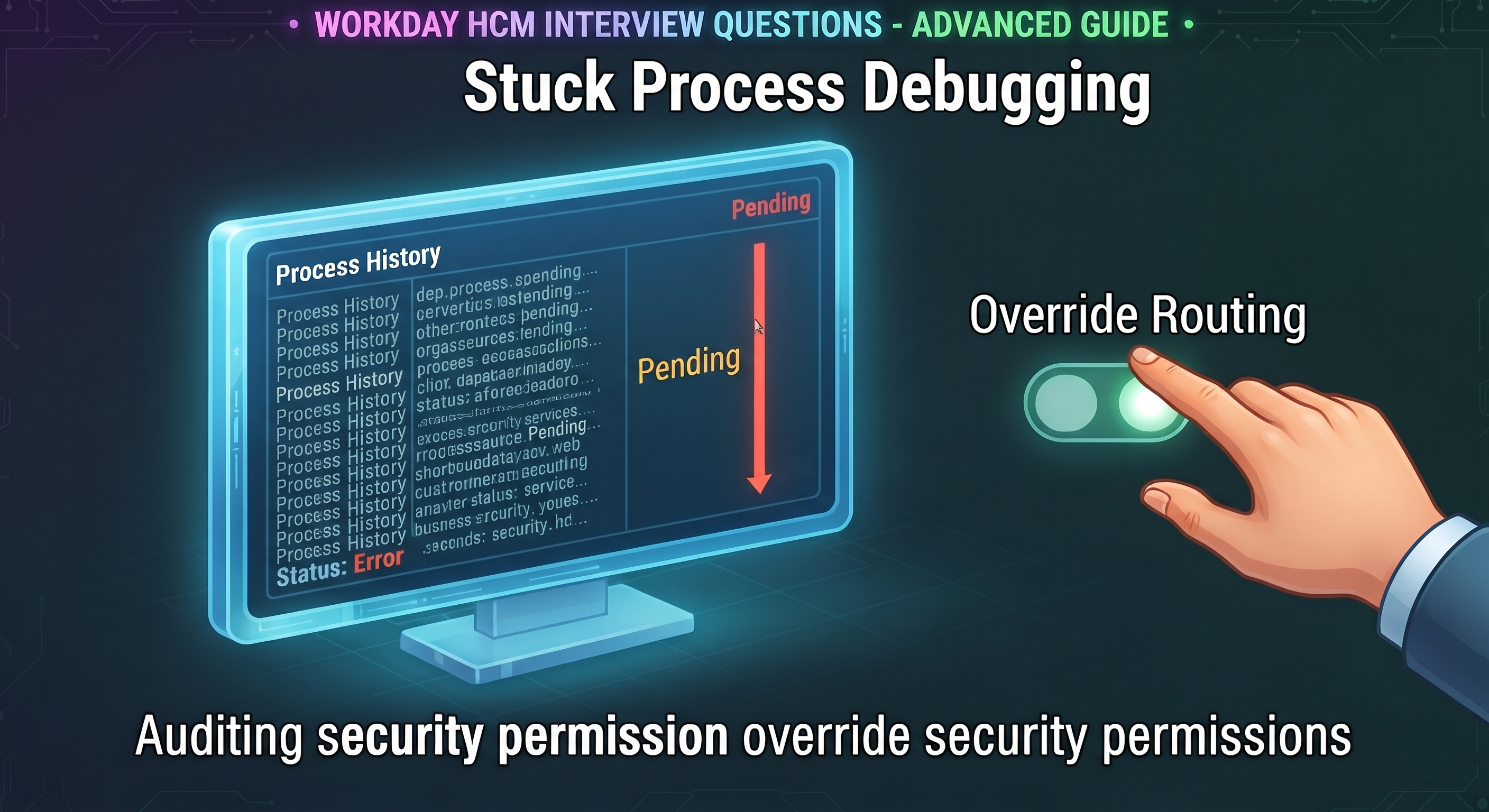
When a business process is stuck, senior consultants first look at the process history to see exactly which step is pending and who is responsible for it. Common root causes include an inactive security group on an approval step, a missing condition rule that evaluates to null, or an upstream data dependency that fails validation.
To debug and correct it:
Search Process History of stuck task by specific worker/event id.
Check that the security policy for the domain of the pending task is correct and that the role or security group associated with the task has active membership and the correct view/modify permission.
If the condition rule is evaluated incorrectly due to changed worker data, cancel or rescind the incorrect step by using the tenant utility tasks, or override the routing by administrative intervention, if permitted by tenant security settings.
Once you’ve fixed it, test the fix in a sandbox before applying corrective patches to production.
Security and Governance Models for Complexity
Workday Security is tenant-wide, role-based and attribute driven. Adherence to strict security principles protecting sensitive employee records and providing adequate visibility to global stakeholders.
5. Explain the difference between Business Process Security Policies and Domain Security Policies. Explain the compliance risks of unrestricted security groups.
Access to functional areas, reports, integration IDs and web service operations is controlled by domain security policies. They control the visibility and modification of some business objects to a user. However, Business Process Security Policies control who initiates, approves, reviews or cancels certain transactional workflows.
Examples of this are unconstrained security groups, i.e. users with wide access, with no regard for organisational or jurisdictional boundaries . A custom security group without constraints could permit a user assigned to it to view sensitive Personally Identifiable Information (PII) or compensation information of employees who are not in their operational area. Senior professionals counter this by strictly applying the principle of least privilege with constrained security groups based on supervisory organisations, locations, cost centers or custom attribute filters.
6. How to audit and troubleshoot permissions when a new custom report is not visible to end-users?
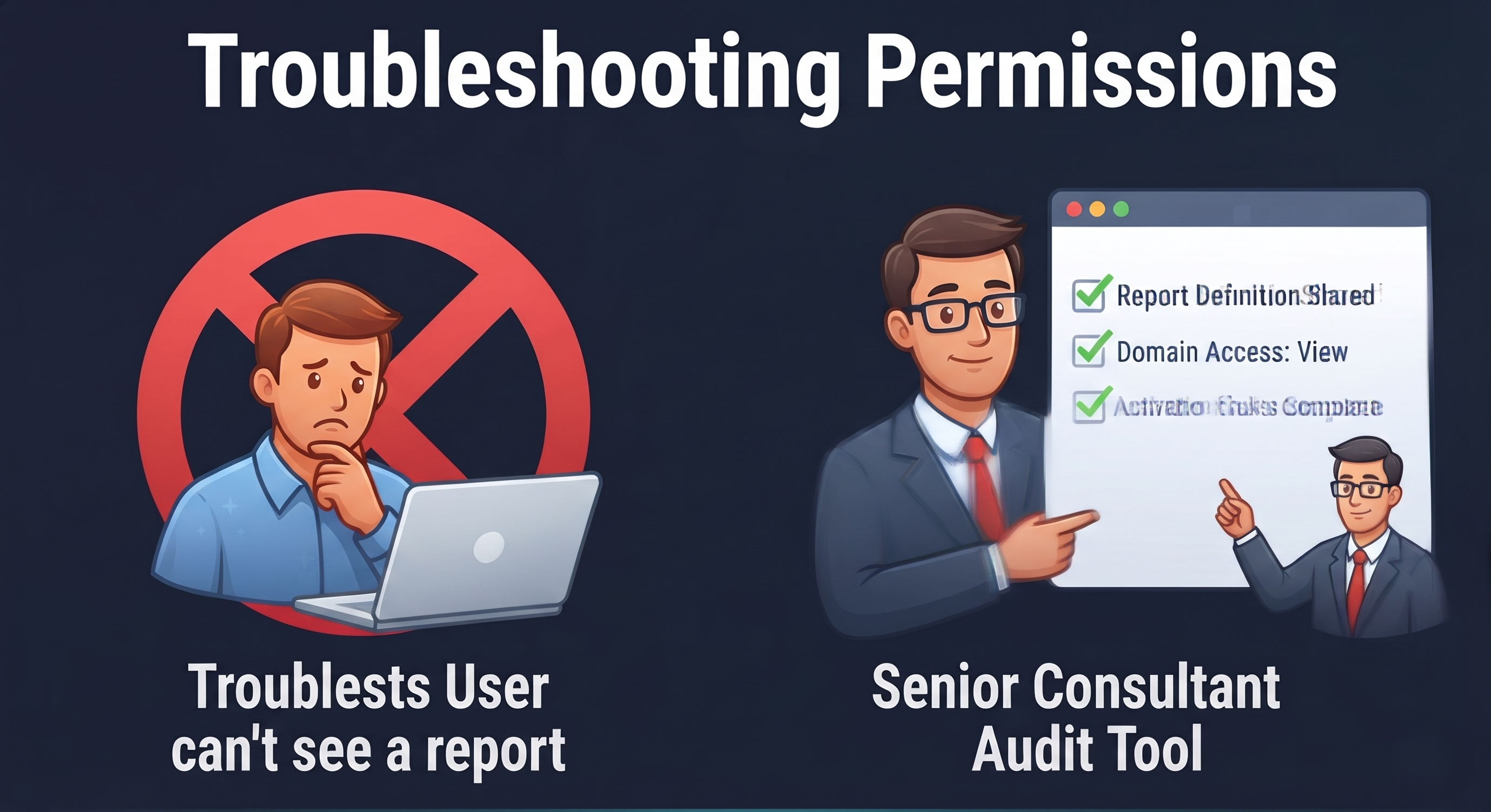
It’s rare that the problem is in the report definition when a custom report does not show up for the audience it is intended for. It's a security constraint nearly every time.
Troubleshooting is a systematic process:
Verify that the custom report’s report definition sharing is shared to the appropriate security groups.
Review secured items in the report such as custom calculated fields, data sources etc. The system hides the data if the report uses a main business object or any of the fields that a user’s security group cannot access due to restrictive domain security policies.
Review the related Domain Security Policies that govern the reporting functional area and verify that the destination security group has been explicitly assigned the “View” or “Modify” permission.
Make the changes to the security policy and verify that the activation tasks are complete.
Data Management & Reporting, Integrations
Senior HCM professionals must maintain data integrity and ensure that data flows seamlessly between Workday and external third-party vendors (e.g., payroll providers, benefits carriers, learning management systems).
7. Explain the scenarios where you would use EIB, Workday Studio and Workday Cloud Connect integration in an enterprise architecture.
The choice of which tool to use in integration will depend on the complexity of the transaction and the transformation of data:
The Enterprise Interface Builder (EIB) integration tool will be the best fit when there are simple transactions that have inbound and outbound bulk data transactions which can be supplied using predefined XML or spreadsheet format.
Cloud Connect integrations are vendor-certified, pre-built templates for common integrations like Workday Core HCM with top payroll or benefits providers. This reduces the maintenance overhead considerably, since Workday updates the templates when regulations change.
Workday Studio is the enterprise grade integration tool for complex multi-source integrations. Studio gives developers the power to build custom sequences, invoke external web services, perform advanced XSLT transformations, sophisticated error logging and process massive data payloads, with complete control over the integration flow.
8. What are some of the techniques you use to optimise custom report performance in a large production tenant?
If you don’t optimise custom reports, they can be a big memory hog and impact the performance of your tenant for all users. Senior architects follow strict performance tuning principles:
Filter Early, Filter Often Use effective date filters and organisational restrictions at the data source level rather than post-processing filters.
Do Not Have Too Many Calculated Fields: If there are a lot of calculated fields, then the system has to calculate the value of the field individually for each record, thus adding more time to generate reports. You could use the standard fields that are already provided or else try to modify the logic of calculations.
You should not have multi-level joins: Multi-level joins require additional processing of the objects that do not belong to the business objects. You should try to minimize your report layout.
Search Indexes and Workday Reports Catalogue: Analyse the slow running report logs provided by the Workday admin tools. Identify resource intensive queries and refactor them.
Global Deployments Mergers, Acquisitions and Change Management
Global enterprises are in constant flux with organisational restructures, mergers, acquisitions and divestitures, which is a heavy demand on the Workday configuration.
9. If two companies merge, you may have to reconfigure the Supervisory Orgs and the assignments of workers, because legal entities are moved from one country to another. How do you make that happen?
Mergers of corporations must be carefully planned to ensure historical continuity, compliance with local labour laws and zero disruption to the processing of payroll.
The plan involves several key steps:
Discovery and Gap Analysis: Map legacy job profiles, compensation grades, cost centers and legal entities to the acquiring organization’s Workday tenant structure.
Organisation Hierarchy Creation: Creation of Organisation Hierarchy and Supervisory Hierarchy in Implementation Tenant and inheriting the definitions of Time Off Plans and Payroll Setup which are specific to Location.
Data Migration: Migration of Worker History using EIBs and Mass Update with proper Effective Dating so that employment history record of the employee is retained.
Global Transfers & Reorganisation: Global Transfers and Mass Job Updates along with automatic update of Compensation Package Definition and Benefit Eligibility and Security Access Profile based on the geographic jurisdiction.
Testing: End to End testing through parallel processing and integration testing in sandbox environment.
10. How do you handle Workday’s bi-annual release cycle and the impact on existing custom configurations and integrations?
Workday has two major feature releases per year, which include new features, and also deprecations or changes in underlying behaviour. There is a formal governance structure around this release life cycle managed by senior professionals:
Review Release Notes Early Review preview documentation released by Workday weeks before the update to identify features impacting existing configurations, new opt-in functionality, and deprecated web service API versions.
Sandbox Testing: Test the integrations, custom reports, and other complex business processes in the Sandbox Preview tenant once it is available.
Regression Testing: It is recommended that automated testing is done for critical business processes like payroll calculation, integration and the automated approval process.
Introduction of new features: Collaboration with the business to enable new features which will be beneficial for the organization.
Conclusion
To master the Advanced Workday Human Capital Management (HCM) interview is not an easy task. It requires a rare and sophisticated mix of deep technical architecture knowledge, rigorous hands-on troubleshooting experience and a strategic, forward-looking enterprise vision. Workday is not just a system of record for modern organizations—it’s the core digital fabric that enables global workforce operations, compliance, talent optimisation and financial alignment. Top consultants at the best firms and multinationals don’t want to hear definitions they’ve memorised. They are looking for senior architects, consultants and leaders who can manage the complex complexities of Workday’s unified object-oriented model whilst balancing business agility with uncompromising data security and system stability.
This guide has walked you through the must-have pillars that define elite Workday HCM expertise. From an architectural standpoint, senior professionals know that Workday’s in-memory object model is a game changer in how data is stored, referenced and queried. “If you understand the implications of business objects, associations and fields then custom reporting and downstream integrations are built for performance and scalability, not memory bottlenecks or tenant degradation.” Tenant management and configuration migrations also require a disciplined approach to dependency mapping, effective-dating preservation and rigorous testing across implementation and sandbox environments.
The Business Process Framework provides the engine of enterprise automation for workflow design and control. We need creative problem solving and architectural foresight to design resilient multi-tier approval routing that can seamlessly handle matrix hierarchies, dotted-line management structures and complex conditional evaluation rules. Senior professionals must know the risk of process deadlocks, set up robust processes to handle the exceptions and perform proactive monitoring to unfreeze the stuck transactions before they affect the payroll processing or employee onboarding. But this technical dexterity needs to be matched with an iron will for security governance. Separate domain and business process security policies and actively manage the compliance risks of unconstrained security groups, ensuring that sensitive personally identifiable information (PII) and compensation data are strongly protected under the principle of least privilege.
The quality of enterprise architecture is as good as its data integration and reporting ecosystem is too. From bulk updates using Enterprise Interface Builders, to standard vendor syncs with out-of-the-box Cloud Connect templates, to complex programmatic transformations using custom Workday Studio integrations, senior professionals must architect solutions that ensure absolute data integrity across disparate global systems. These integrations, along with proactive performance optimisation - such as filtering early, keeping nested calculated fields low and tuning resource-heavy reports - help to safeguard tenant health and user experience.
Eventually, the ultimate boundaries of a consultant’s strategic vision will be tested by the eventual navigation of high-stakes organisational change including cross-border corporate mergers, legal entity transfers and global restructuring. Excellent stakeholder management and attention to statutory compliance to drive enterprise for discovery, gap analysis, historical data migration and parallel testing. The attention to detail, the early testing in a sandbox environment and the thoughtful approach to adopting new, opt-in features are also important to get the most value out of the platform over time, given Workday’s bi-annual release cycle.
In summary, doing well on the Workday HCM interview questions as well as other higher-level jobs requires demonstrating that one has an end-to-end view of the complete Workday ecosystem… Want to move up in your career? Take workday courses and get firsthand experience, mentorship and training.