
Workday HRIS Data Security and Privacy: Best Practices for HR Teams
Last updated on Oct 14, 2026
Human Resources are no longer just keeping personal records of the company’s employees. Their role has evolved into being custodians of the most sensitive personal, financial, and medical information about the company’s staff. Workday Human Capital Management (HCM) is an enterprise cloud application that combines core human resources, compensation, payroll, talent management, benefits, and workforce analytics.
Since Workday HCM serves as an authoritative source of truth about the company’s personnel and their division in the corporate structure, it becomes a significant asset to both external attackers and internal malicious insiders. A wrong security configuration, unchecked integrations, or unauthorized reports could leak critical data about the workers’ national identification numbers, executive compensation, banking details, medical leaves, or performance appraisal in countries of jurisdiction.
It is rare that companies address personnel data security solely through technology and make their IT departments responsible for Workday security alone. There is always a need for human resources, cybersecurity, privacy, and legal teams to collaborate and find solutions that would be acceptable to all sides. Human resources have to understand technology and know the critical aspects of workforce data management, privacy, and compliance.
The Shared Responsibility Model in Cloud HRIS Essay
One of the most common sources of operational vulnerability in a software-as-a-service (SaaS) platform originates in the misinterpretation of the shared responsibility model, particularly regarding the division of ownership. Workday takes care of the security of the cloud (infrastructure), including physical data center security, perimeter security, hypervisor isolation, encryption of the database at rest and in transit, disaster recovery, and system updates. The software giant also ensures the maintenance of its cloud infrastructure’s foundational uptime through third-party audits (SOC 1, SOC 2 Type II, ISO 27001, and FedRAMP authorized).
However, the enterprise that owns the cloud software is responsible for absolute ownership of security in the cloud. Some of the key areas that need an enterprise’s leverage in a SaaS environment like Workday include:
Defining the security architecture (who has access to what fields and domains)
Authentication process auditing, lifetime management, and multifactor enforcement
Business process configuration, segregation of duties, and authorization rule setup
Protection of exported data (reports, spreadsheets, and third-party integrations)
Tenant lifecycle management (user provisioning and access removal), and audit logging
Compliance with regional privacy laws (GDPR, CPRA, and HIPAA).
When employee data is leaked because of too permissive security groups or an unencrypted spreadsheet emailed to a third party, the problem lies in the company’s configuration and governance on the edge, not the software provider’s infrastructure.
As configuring these enterprise-grade applications requires understanding both technical and human factors, people choose to join the workday hris training course every day at OnlineITGuru to learn about tenant architecture, security domains, and compliance management before attempting to configure these systems.
Understanding the Workday Security Engine
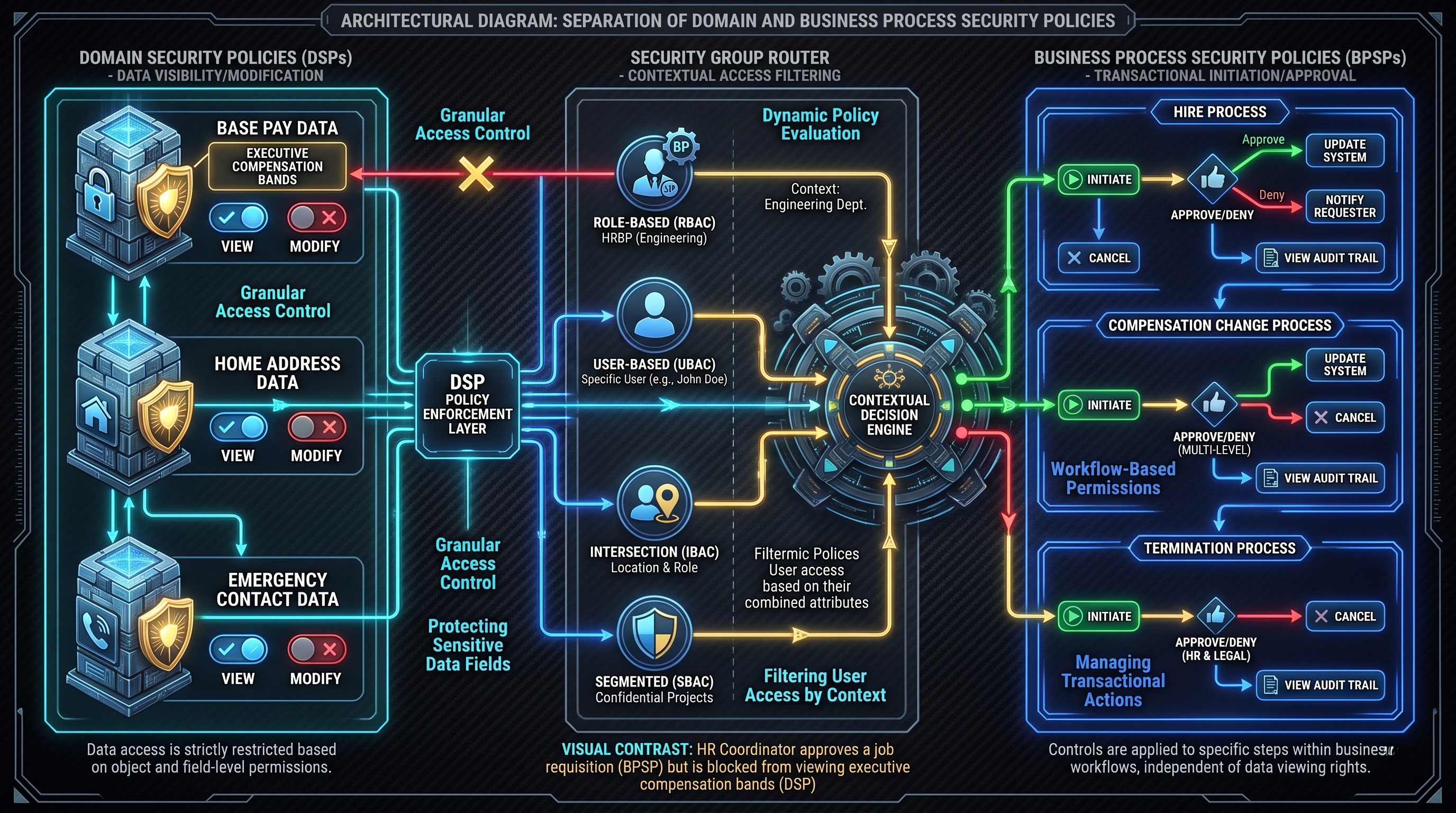
In order to implement access governance, HR leaders and systems administrators must engage with the proprietary Workday security engine to create access governance policies. Workday does not grant permissions to users, but instead has a context-based metadata security architecture governed by security policies and security groups.
Business Process Security Policies Vs Domain Security Policies
Permissions are grouped together into Workday using two types of security policies:
Domain Security Policies (DSPs) Domains are collections of related data items, reports, tasks and functions. A domain security policy controls the visibility and modification of certain classes of data items. For example, certain areas of data may include viewing an employee’s home address, editing an emergency contact, or accessing compensation history. Each domain has View and Modify permissions for creating, editing, and deleting.
Business Process Security Policies (BPSPs): Business processes are a series of steps to perform a specific organizational task, for example, hire a new employee, change the job title, implement a compensation update, or end employment with a worker. BPSPs define the responsible parties to initiate a process, approve or reject a particular action step, void or cancel the transaction, and view the audit trail (process flow across the organization).
A user may have viewing access to a domain (e.g., current base pay) but without the business process permissions to initiate a pay adjustment. At the same time, an HR coordinator may have approval permissions to a job requisition without having access to the executive salary bands. This is why it is necessary to maintain the clear distinction between access to the particular data domains and transactional business processes to avoid unauthorized privileges.
Understanding Security Group Types
Permissions are granted to a set of users called security groups. Individuals are granted permissions directly or by virtue of a working relationship or assignment. HR professionals should be aware of the various security group categories available.
Role-Based Security Groups. Such security groups usually provide access to resources according to the particular role assigned to a worker, organization, cost center, or company. For instance, an HR business partner (HRBP) set to manage the Engineering organization will automatically have permissions over workers in the Engineering hierarchy. Once the said HRBP is transferred to lead Marketing, their access will be changed.
User-Based Security Groups. This category of security groups is normally found in systems accessed by all users in the tenant. The user-based groups are set by system administrators, payroll approvers, or those responsible for connecting the system to external HRIS software. Since the user-based security groups cut across organizational boundaries, their assignments should be handled with great care and given low priority.
Intersection Security Groups. Intersections dictate that a worker must satisfy two or more criteria to gain access to a particular set of data. For instance, intersection groups can be used to ensure that an HRBP has access to all salaries in their assigned division, provided that they have been assigned to a particular geographic region. This is useful in instances where a worker in one region should not have access to certain information pertaining to employees in another region.
Segmented Security Groups. This type of security groups serves to limit the view of a subset of data within a given domain or area. It is normally used to protect certain fields, such as system integration user IDs, compensation structures, or demographic fields.
Aggregation and Job-Based Security Groups. This category of security groups is normally used to give access to resources based on a worker’s job roles. It can also be used to provide access to a large set of data, such as those available to managers and line leads in the managerial self-service business process.
The mastery of the configuration of Domain Security Policies and Business Process Security Policies is a key professional competency in the hris workday training since both policies help in establishing a set of permissions that are granular and avoid granting excessive privileges.
Classifying and Protecting Sensitive HR Data Tiers
Workday contains information that comes in a variety of different types and sizes. Classifying everything as one uniform entity either makes it too restricted to be used or abused. Human resource management teams need to ensure that they have developed a proper classification system for data. This structure should be based on the dictionary fields used by Workday.
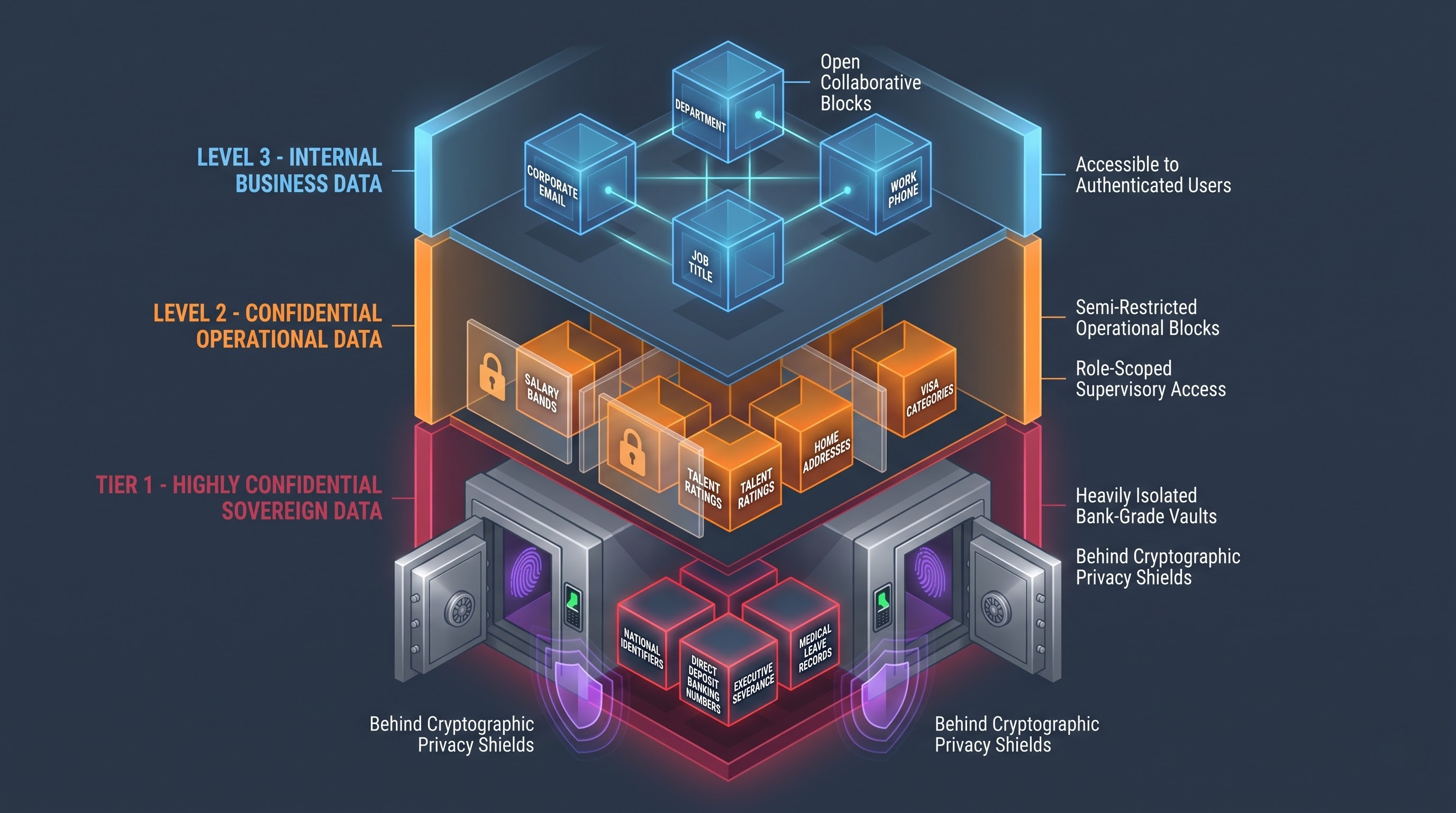
The Most Confidential Data Sets (Data Tier)
It is vital to determine the first-level data sets that should be handled with increased care and assigned a higher security level. Such information, if compromised, may result in legal issues, administrative problems, and reputation damage:
Various identifiers that are connected to national insurance, PAN, Aadhaar, social security numbers, and other forms of banking information.
Medical data, claims, and requests for leave and other special accommodations.
Direct deposits, cheques, and transfers accessible via bank account and routing numbers.
Executive-level compensation, severance agreements, and succession planning information.
Background checks, investigations, and legal charge documentation, including grievances.
The data sets indicated above require masking at the field level, reduced access and administrative rights, and domain isolation to ensure protection. All such entries should only be accessible to specific professionals who have the authority to view or edit them on a need-to-know basis.
Confidential Operational Data (Level 2)
The second level of confidentiality contains the information that helps to operate the main aspects of the business:
employee compensation, targets, bonuses, stock options, and merit raises;
performance ratings, succession planning, and talent calibration levels;
home address, personal phone numbers, and emergency contacts;
date of birth, citizenship, visa category, and authorized work status;
protected classes for diversity, equity, and inclusion.
This level of data should be accessed by a limited number of people. For example, only top-level management can review the information on this level for all employees. The data should be divided into groups according to users’ positions: line managers and regional human resource business partners (HRBPs) should only see the workers they are responsible for.
Internal Business Data (Level 3)
The third level of information is applicable to regular operations of the company, and it may include:
email addresses, worksite locations, and phone numbers;
title, department, supervisor, and cost center;
standard job descriptions, and website directories.
Access to this information is usually provided for everyone in the organization to facilitate communication and cooperation. Such data can also be used to develop tools like the company directory.
Identity Governance, Authentication, and Access Hygiene
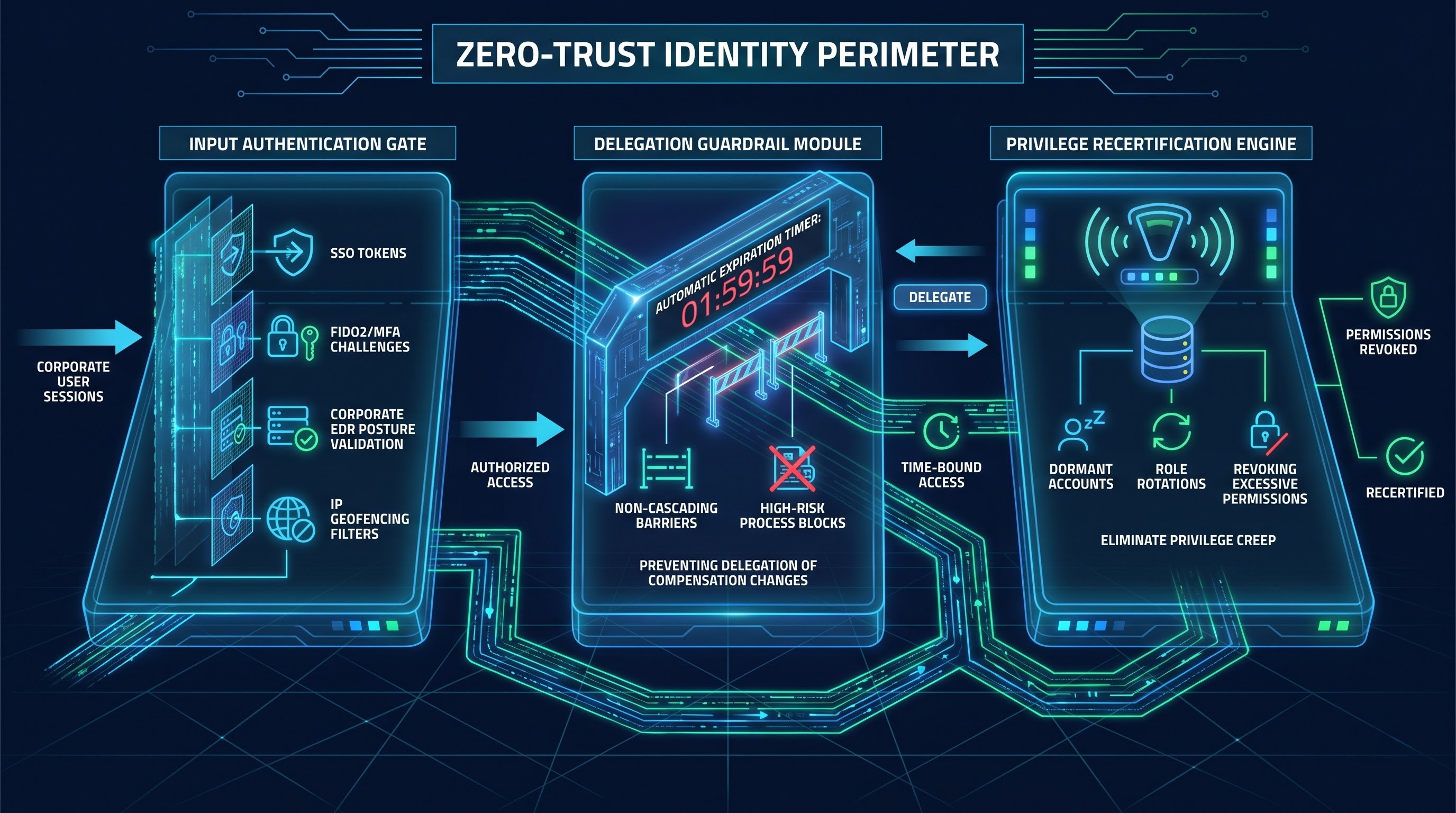
The most sophisticated internal security policies are worthless if the perimeter authentication layer is compromised. As such, given that Workday holds identity authority for the enterprise, credential compromise represents an existential risk.
Enterprise Single Sign-On and Multi-Factor Enforcement
Never allow native, locally-authenticated username-and-password authentication for standard corporate users. Enterprise access must be brokered by an enterprise Identity and Access Management (IAM) platform (such as Okta, Microsoft Entra ID, or Ping Identity) utilizing SAML 2.0 or OpenID Connect identity assertion standards.
Require Mandatory Multi-Factor Authentication (MFA): Every employee, from the front-line workers accessing self-service paystubs to the Chief Human Resources Officer, must be subjected to phishing-resistant MFA.
Native Fallback Protection: Workday provides a native login interface which is utilized for emergency access or certain integration service accounts. The local login pathway must be protected by native Workday MFA, restricted to hardened static IP ranges, or disabled for human interactive sessions entirely.
Adaptive and Contextual Security Policies
Modern workforce mobility requires adaptive authentication controls. Workday allows defining policies that respond to particular risk scenarios:
1. Geographic Fencing/IP Whitelisting – administrative access could be limited to only corporate networks/IPs or local area networks through a virtual private network (VPN) and specific domestic regions. If an HR administrator utilizes an overseas ISP that is not on a permitted list, their access should be denied, or additional out-of-band authentication factors should be required.
2. Device Posture – in combination with enterprise identity and access management (IAM), context-aware session policies should only permit connections from devices that meet corporate endpoint detection and response (EDR) requirements, operating system patch levels, and disk encryption standards. Personal devices not joined to the corporate directory should be prohibited from all domains except for employee self-service with limited reporting download capabilities.
3. Session Timeout – default inactivity timeouts for administrative functions should be short enough to prevent unauthorized access in the case of a walk-away from an unlocked workstation in an open-plan office. Regular employee self-service sessions have less stringent requirements but still need to be configured compared to the default values.
Applying the Principle of Least Privilege
The phenomenon of privilege creep occurs when users are granted excessive access rights beyond the limits required for their current job functions. An HR coordinator may be responsible for recruitment, compensation, and talent acquisition roles in different departments, and, as a result, obtain more access rights with every promotion or rotation. Consequently, within a short period, such a user may possess all administrative privileges over the company’s tenant.
Scope of Role Management and Authorization
The primary rule that all organizations, especially those that run on the Workday platform, must adopt is the default permission rule. This technique requires that access be denied to all users unless their request is granted explicitly according to their clearance level at a specific point in time. By default, one should design role-scoped access according to the organization’s business units.
One should not use user-based security groups to provide access to information or processes more conveniently. If an employee in human resources needs better access to a particular project, one should utilize project-based access rights with limited supervisory organizations or matrix organizations. Once the objective is achieved, such a user will lose access to all authorization settings automatically when the project closes or they transfer to another department.
Reducing Risks Through Delegation
The Workday platform provides robust delegation tools that enable managers to delegate some responsibilities, approvals, and domains to other colleagues. For example, human resource managers can utilize these tools to give access to their domains temporarily when on vacation or maternity leave. The problem with such delegation is that it can create many blind spots concerning the security landscape of an organization.
Restrict Delegation Scope: Do not delegate any high-risk business processes that involve making changes to compensation, termination approvals, or direct deposit details to inexperienced staff that do not routinely have such authority.
Enforce Time-Bound Delegation: Assign automatic expiration dates to all instances of delegation. The delegations that do not have an end date set shall be permanently disabled by default in the application programming code.
Ensure Audit Trail Visibility: When a process requiring delegated authority is approved, the record should show the initial owner of the approval authority and the person who approved the transaction.
Do Not Allow Cascading Delegation: Users should be prohibited from further delegating any process or task that was delegated to them.
Periodic Access Recertification Campaigns
The HR operations team should work with the internal IT compliance department to perform quarterly access recertification scans of user access to systems. The following should be performed:
Users that are associated with user-based security groups should be recertified by the HRIS Director and the Chief Information Security Officer on a quarterly basis.
System administrators should have reports of all users that were inactive during the last quarter, all terminated contractors, and all workers whose role in the past ninety days has changed.
Administrators should also revoke privileges assigned to users that have not exercised their access during the previous sixty days. This practice will ensure that only the necessary applications are used by workers and that the access rights are only granted for the needed time.
Business Process Governance and Segregation of Duties
Compromises to data security could also be manifested in unauthorized fraudulent transactions, such cases of misappropriation of payroll funds or unauthorized augmentation of compensation through poorly governed business processes.
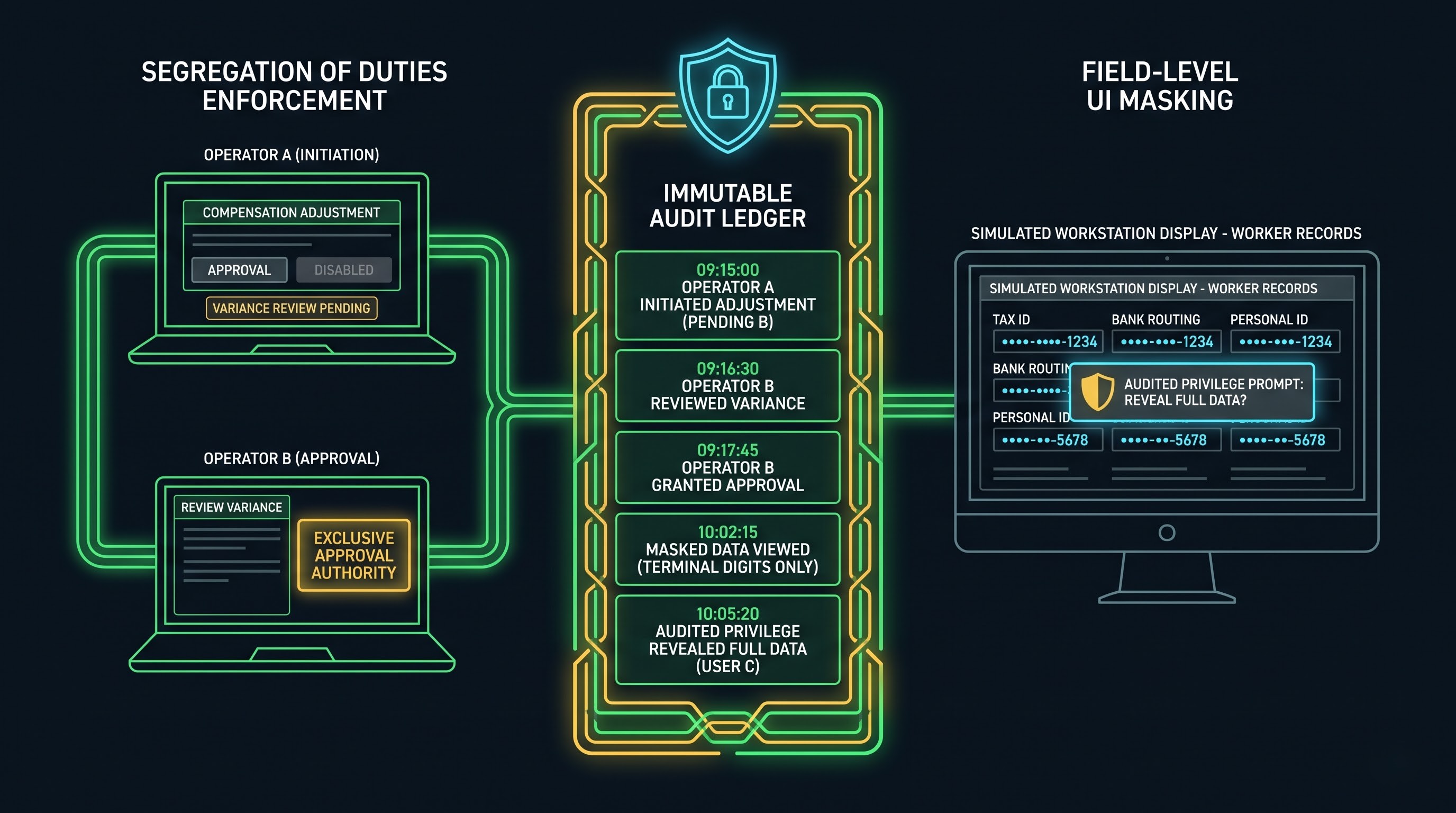
Segregation of Duties (SoD)
Segregation of duties requires that the duties involved in a given business process be distributed among different workers to reduce risks in cases of fraud, errors, and misuse of powers and authority. The following are segregation of duties instances that should be specified in the Workday business process policies.
Initiation vs. Approval: The person authorized to initiate any changes to a worker’s compensation, worker creation, or compensation and promotion should not have the authority to approve the alterations.
Payroll Execution vs. Direct Deposit Modification: The person responsible for maintaining employee’s banking information should be denied the authority to execute or close a payroll or authorize direct deposit payroll disbursements off-cycle.
Compensation Framework Definition vs. Assignment: The person or group of people responsible for defining the company’s compensation framework, grade profiles, and salary bands should be denied the authority to allocate the workers to specific compensation bands in operational supervisory organizations.
Multi-Step Approval Workflows with Conditional Routing
Linear approvals have limited applicability in high-risk HR processes. The HR business process owner should design conditional routing rules that would add extra approvers for compensation-sensitive cases, such as base pay raises of a certain threshold or any off-cycle equity grants. In contrast, sensitive organizational movements like executive exits or involuntary terminations require step-down verifications by legal and compliance before user provisioning revocations can be triggered downstream
Emergency Bypass Governance
Workday allows business process administrators to define transaction cancel, rescission, and advance approvals rules to unlock operational lifelines across critical business processes. However, such opportunities to re-seat completed transactions present significant risk surface expansion opportunities for insider abuse
The ability to rescind transaction approvals should be restricted to a small group of senior HRIS operations personnel and logged as a high-priority event in central operational monitoring tools.
Data Masking, Field-Level Security, and Sensitive Records
Exposure of unmasked sensitive personal data on common workplace displays creates opportunities for unintended observation, illicit photography, and data extraction.
Field-Level Data Masking
The product suite natively enables masking of sensitive personal data strings in the UI for both self-service and managed HR domains. The following fields merit default masking:
Tax ID and Social Security Numbers: Only the terminal four digits should be visible in self-service UIs, HR management consoles, default reports, or ad-hoc queries. Unmasked values should require explicit and auditable disclosure by payroll and compliance personnel.
Bank Routing and Account Numbers: Direct deposit configuration UIs should mask financial account numbers, only exposing the final three or four digits to the employee and payroll functions.
Masking of Compensation Fields in Mobile Apps: In native applications, compensation should be hidden behind biometric authentication or default toggling for executives and managers reviewing records in public settings.
Managing Confidential Workers Records
There are several categories of workers who may need to be concealed from general overview. These include the firm’s board of directors, top-level executive authorities, celebrity stars, undercover operatives in specialized sectors, and workers under investigation.
The Workday software allows designating these workers as confidential. As a result, their default role-based groups (e.g., HRBPs or managerial clusters) cannot search, view, or report these workers’ information. Only the highly restricted group can see the details of such workers reporting lines and compensation schedules.
Securing Essential Documents and Notes
The Workday application is designed to store electronic copies of all documents relevant to a worker’s employment. This includes contract proposals, disciplinary instructions, medical examination clearance papers, and work performance records.
I would segment the document categories according to their nature instead of utilizing the default worker documents segment. For instance, medical reports, disciplinary terms, and offer letters should be in separate segments secured by domain-specific rules. I would also make extensive use of restricted notes to post any sensitive information on workers. Such data include employee-related HR observations, sensitive worker relations notes, and legal issues. The above items should be availed only to internal employee relations experts and authorized legal advisors and not through regular supervisory reporting chains.
Improving Your Human Resource Operations
As enterprises’ cloud platforms develop, ensuring the data governance capabilities are consistently augmented by the staff’s education and operational know-how is critical. Human resource professionals and technical directors who wish to confirm their platform expertise can enroll in related workday hris certification at OnlineITGuru to develop relevant skills, including tenant hardening, audit governance, and workforce privacy across regions.