
Workday Studio simplifies complex enterprise integrations
Last updated on Jul 20, 2026

Enterprise technology has evolved dramatically over the past decade. Organizations are no longer working with a handful of siloed business applications but are part of highly connected digital ecosystems. Information flows continuously between systems. Human resource management platforms, payroll engines, finance applications, procurement environments, reporting tools, analytics platforms, identity management systems and external partner applications drive day-to-day business operations. These technologies, of course, can improve business performance and help organizations grow. But they come with one of the biggest challenges of modern enterprise architecture: complex integrations.
Integration is no longer a background technical activity for infrastructure teams. This is a critical business function impacting operational efficiency, employee experience, reporting accuracy, compliance readiness and strategic decision making. All departments within an organization require accurate information at the right time. The failure of applications to share data efficiently has far more impact than mere technical inconvenience. It leads to delays, duplicated effort, poor visibility and inconsistent business outcomes.
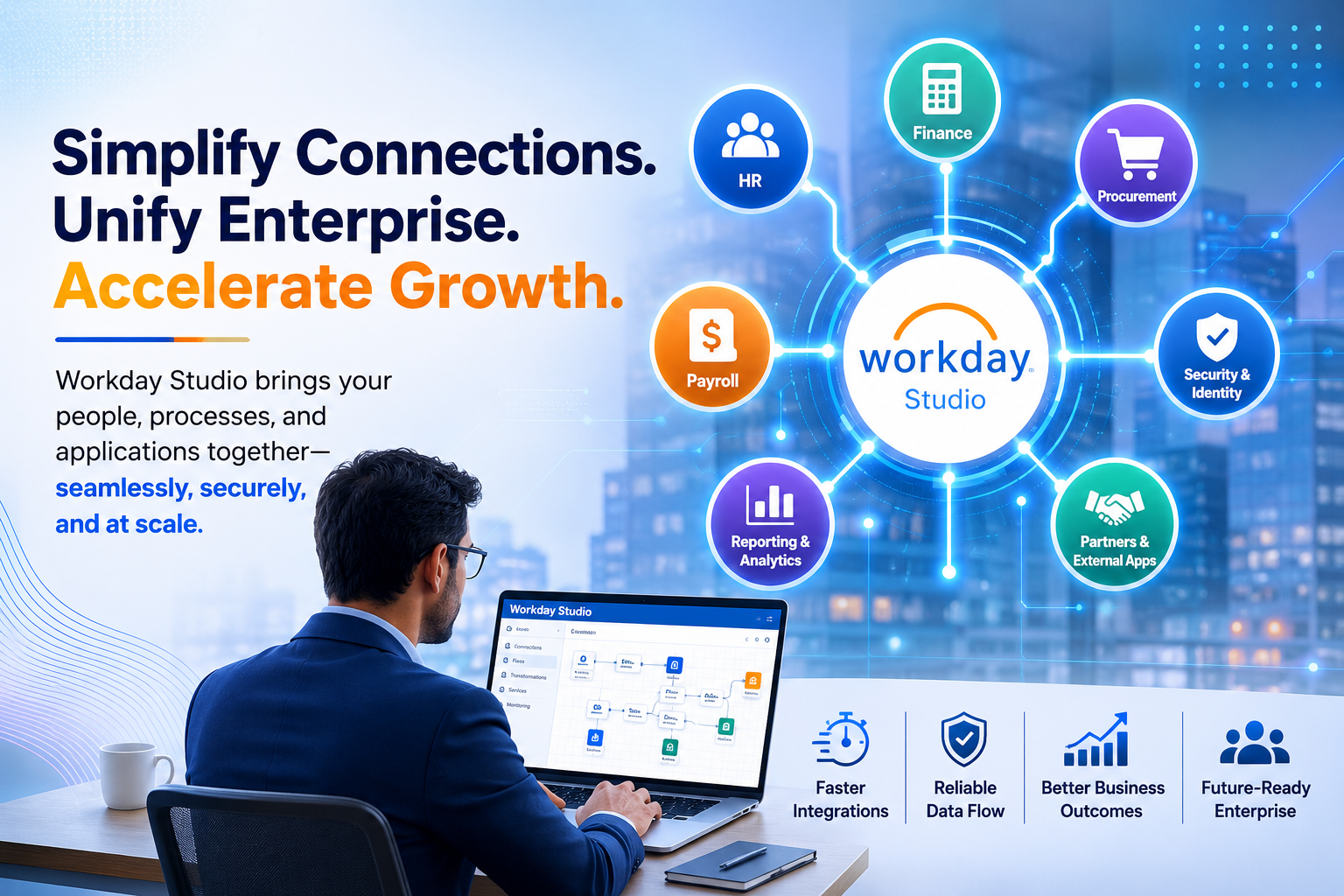
Growth is taking place across the enterprise technology landscape, driven by cloud adoption, mergers and acquisitions, process modernization initiatives and digital transformation programs. With the growing number of platforms in the ecosystem, it is becoming harder to ensure reliable communication between systems. The data structures are different. Security requirements are evolving. Business workflows are changing rapidly. Solutions are needed that can handle these conditions and do so without adding unnecessary complexity.
Workday Studio has become an essential integration platform for organizations looking to simplify enterprise connectivity. It offers a unified environment for developing and managing integrations, allowing companies to decrease fragmentation and improve operational coordination across their business systems.
Complexity Rising in Enterprise Integrations
The diversity of modern business systems makes enterprise integrations complex.
You will rarely find an organization working in a single technology ecosystem. Instead they cobble together multiple cloud services, legacy applications, home-grown tools, external vendor platforms and internal operational systems.
Each platform has a different approach to the creation, processing and consumption of information. Some applications employ API-driven communication models. Some use file-based transfers. Some environments expect XML structures, some require JSON payloads, and others use proprietary messaging formats. So making reliable communication channels is not just the business of sending data.
Enterprise integrations must validate data, transform formats, enforce security controls, enforce business rules and ensure delivery accuracy. The complexity grows with the development of business. As organizations expand their geographic footprint, they have more diverse operating models.The processes might be specific to a region.Reporting requirements differ.More compliance requirements.
We will ask our technology teams to help support these changes while maintaining stability in operations.These conditions often give problems to the traditional methods of integration.Point-to-point integration architectures may seem efficient in the short term because they address immediate business needs.
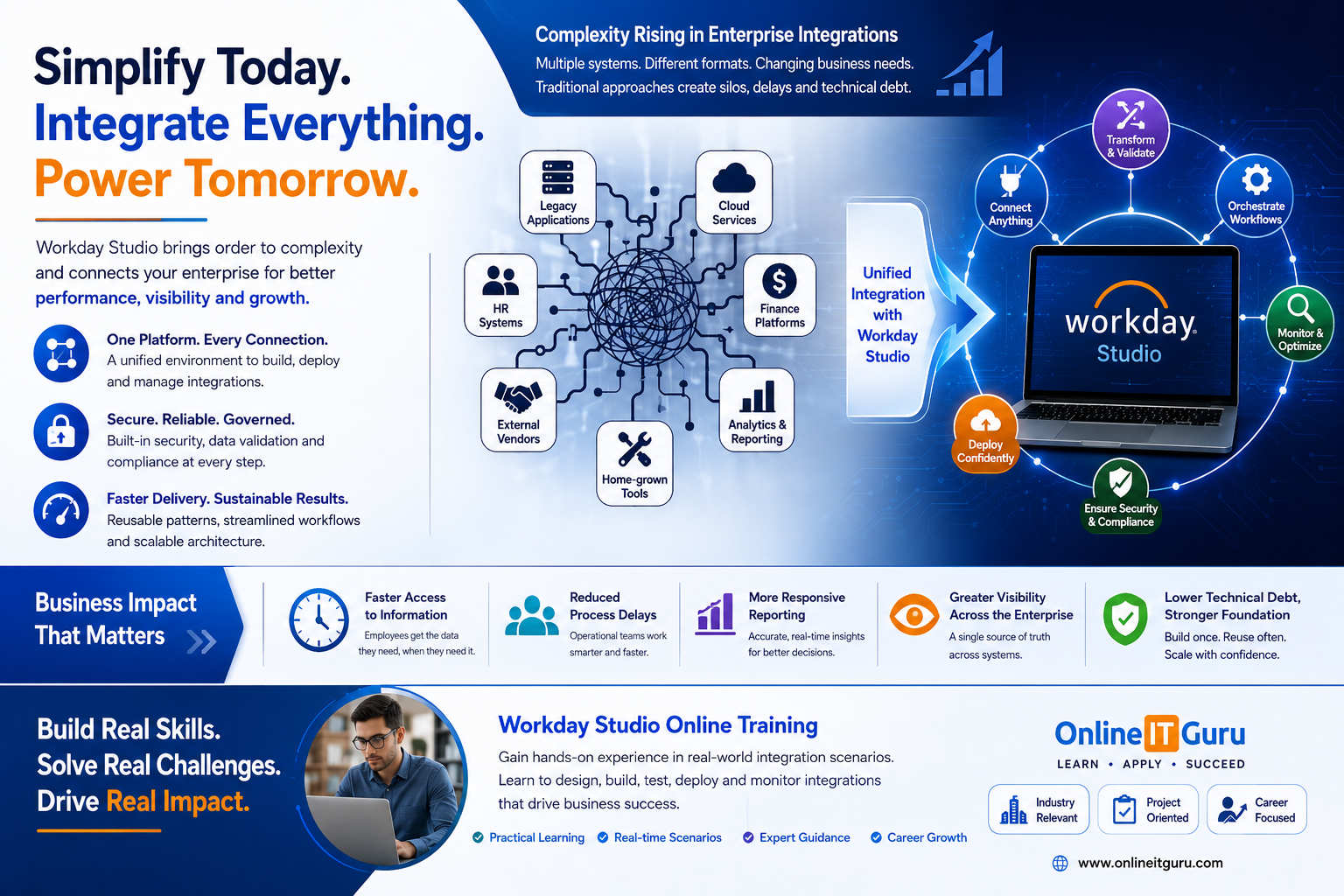
But every new connection builds new dependencies over time.Often a single change to a system causes many integrations to change.The maintenance effort grows rapidly.Operations are not so visible.As organizations grow, they spend more time supporting existing integrations than building new business capabilities.The challenge is to create integration environments that lower the technical overhead and support enterprise-scale operations.The Need for Architecture Integration
One of the most important characteristics of modern integration strategies has been centralized integration.More organizations are starting to see that disconnected development practices are not efficient and increase operational risk.If you have different tools for the integration teams, you have inconsistent standards.There are many ways to test .Documentation is all over the place. The support activities are more difficult.Centralizing the integration environment addresses these points and maintains consistency across implementation life cycles.
That’s where Workday Studio fits in, providing a more efficient, structured environment to build, track, deploy and maintain integrations.It is better to have one environment where things are standardized than to have activities spread across multiple unconnected systems. The centralized architecture leads to a better quality of implementation as teams can build reusable design principles.
The bigger the scale of integration operations of organizations the more important these benefits become.Having a common framework for handling integrations also improves business alignment.The technical teams have more visibility to the needs of the business. Business stakeholders have more confidence in the reliability of the system.Better results in digital transformation follow from this alignment.
Speed up and make integration delivery more sustainable.The demand for speed is rapidly becoming a competitive imperative for enterprise organizations.The business demands quick technology initiatives, but not at the expense of stability and governance.This puts integration teams under constant pressure to deliver solutions quickly, but also to ensure they are supportable in the long run.In traditional integration development, teams waste a lot of time aligning tools, managing configurations and fixing inconsistencies in the environment, which slows down delivery.
Workday Studio helps break down these barriers by offering more structured ways of developing.You can create more consistent integration work flows.Teams can create models for implementation that can be repeated.Less duplicated effort through reusable patterns. The structure provides flexibility and better implementation timelines.The faster you deliver the integration, the greater the benefit to your organization.Access to employee information faster.Reduced process delay for operational teams.Reports are more responsive.More visibility for business performance for decision makers.Sustainable delivery helps to reduce technical debt.This means organizations are building a scalable foundation to grow on, rather than building point-to-point integrations one at a time.
Building Enterprise Integration Skills for the Real WorldTechnology platforms aren’t much good if organizations don’t develop the skills to use them well.Enterprise integration is more than a technical arrangement.Professionals should be knowledgeable about the principles of architecture, business process alignment, deployment coordination, monitoring strategies, governance practices and troubleshooting methodologies.
Workday Studio Courses Training helps many professionals to develop these skills by giving them practical experience on real-world enterprise integration scenarios and implementation practices. Structured learning environments allow people to learn how integrations are built, tested, deployed, monitored and optimized across business ecosystems. Transformation logic, exception handling, workflow orchestration, and integration lifecycle management will be introduced to learners.
Practical learning makes you confident too.Practitioners can connect technical implementation to business objectives, not abstract ideas.The better the quality of implementation, the better the internal capability and the less dependence on the support of outside.As enterprise integration becomes a more mature strategic discipline, practical expertise becomes more valuable.
Building Blocks For scalable enterprise growth
One of the key goals of today’s integration architecture is still scalability.Enterprise platform implementations cannot settle for solutions that require a redesign as transaction volumes increase or operational requirements change.Scalable integration environments enable business to grow and change with less disruption.
Workday Studio supports scale by allowing organizations to develop structured, scalable integration frameworks that can grow over time.Reusable workflows help you avoid duplication.Standardized ways of implementation lead to consistency.Organizations have a good basis of integration to incorporate new technologies and to optimize business processes.Therefore, good integration architecture is an important part of long-term enterprise success.
Workday Studio: Breaking Down Complex Enterprise Integrations
Better Data Conversions in Business Systems
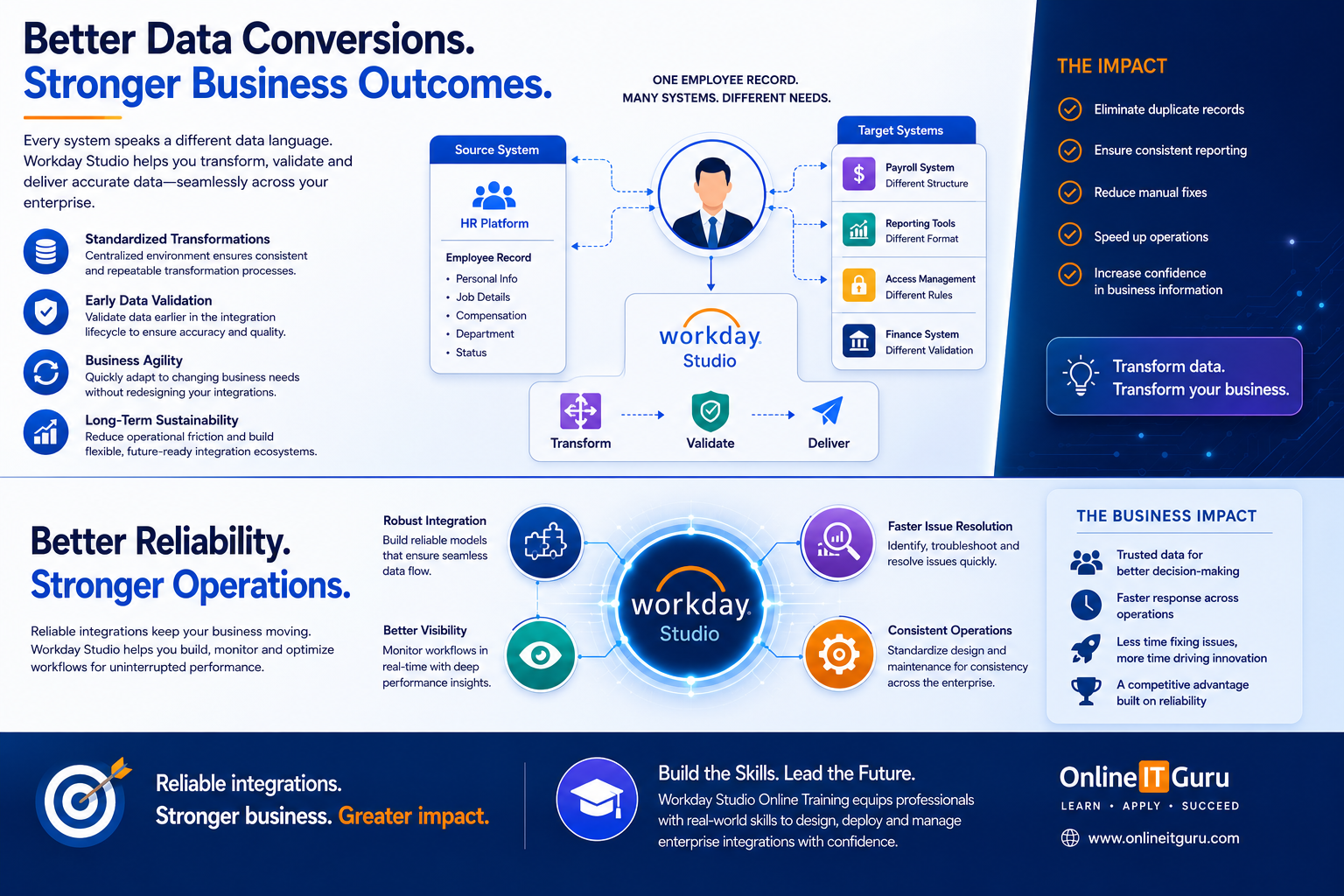
As enterprise environments grow, one of the most important tasks in integration architecture is data transformation. It’s odd that business systems all store or process information the same way. Applications are made for performing different operational tasks and so the data structure, data format, data validation requirements and data communication methods are very different.
For instance, an employee record in a human resource platform might be distributed to payroll applications, reporting environments, access management tools, and financial systems. The same employee could be the underlying information. Different receiving applications can have different structures and rules for processing.
Organizations often face duplicated records, inconsistent reporting, manual fix, delayed operations and lack of confidence in business information without a structured transformation process.This is where Workday Studio comes to the rescue. It allows organizations to handle transformations in a more systematic and controlled manner.
Standardization of transformation processes is easier since technical teams work in a centralized development environment.“Data validation can be done earlier in the integration life cycle.workflows have better consistency controls which improve the quality of information.Organizations are also more nimble in responding to changing business needs.Application and business process changes can be managed more efficiently, without having to redesign integration ecosystems.
This flexibility helps to reduce operational friction and is conducive to long term sustainability.Better Reliability with Improved Integration OperationsEnterprise integration performance drives business continuity.Seamless communication between systems is fundamental to business processes and organizations are increasingly automating these processes.
Accurate information sharing is important for onboarding employees, updating payroll information, reporting activities, purchasing and the approval process.When integrations break down, the business impact is immediately visible.There are delays for users.The reports are wrong.Operations teams spend more time resolving problems.It could impact employee and customer experience.
Workday Studio helps organizations build robust models that run integrations for increased reliability.Monitoring capabilities can give more insight into the performance of workflows.Support teams are better able to see how people process.Problems can be found and fixed more easily.
Organizations can standardize the design and maintenance of integrations, improving consistency across operations.Reliability also helps in achieving the larger goals of the organization.Business data is more trusted by leadership teams.Operational departments have better reaction.Technology teams can spend less time reacting to failures and more time accelerating innovation.As integration environments mature, reliability is an important competitive advantage.
Operational Control & Governance Support
Often, governance is the key to long-term success in enterprise integration initiatives.Many organizations begin with a build for speed of implementation, but discover that the complexity of maintenance increases exponentially when governance practices are not consistent.Where governance is not present, teams have different approaches to development.Deployment varies.Documentation is missing.Operational ownership is not clear.
These problems increase the cost of long term support, and decrease confidence in the business.
Workday Studio provides greater governance through central management and repeatable implementation practices.Organizations can set up common standards for developing and deploying integrations.It helps to keep the documentation up to date.Change management processes get better.You get more insights into the operations.Good governance also contributes to improved compliance readiness.Organizations managing sensitive business data need to show better control over data movement between systems.
Good governance practices foster accountability and minimize operational risk.Governance over time provides a foundation for sustainable growth as organizations build integration ecosystems that can be managed as complexity increases.Framework for Building Advanced Integration Knowledge for Learning
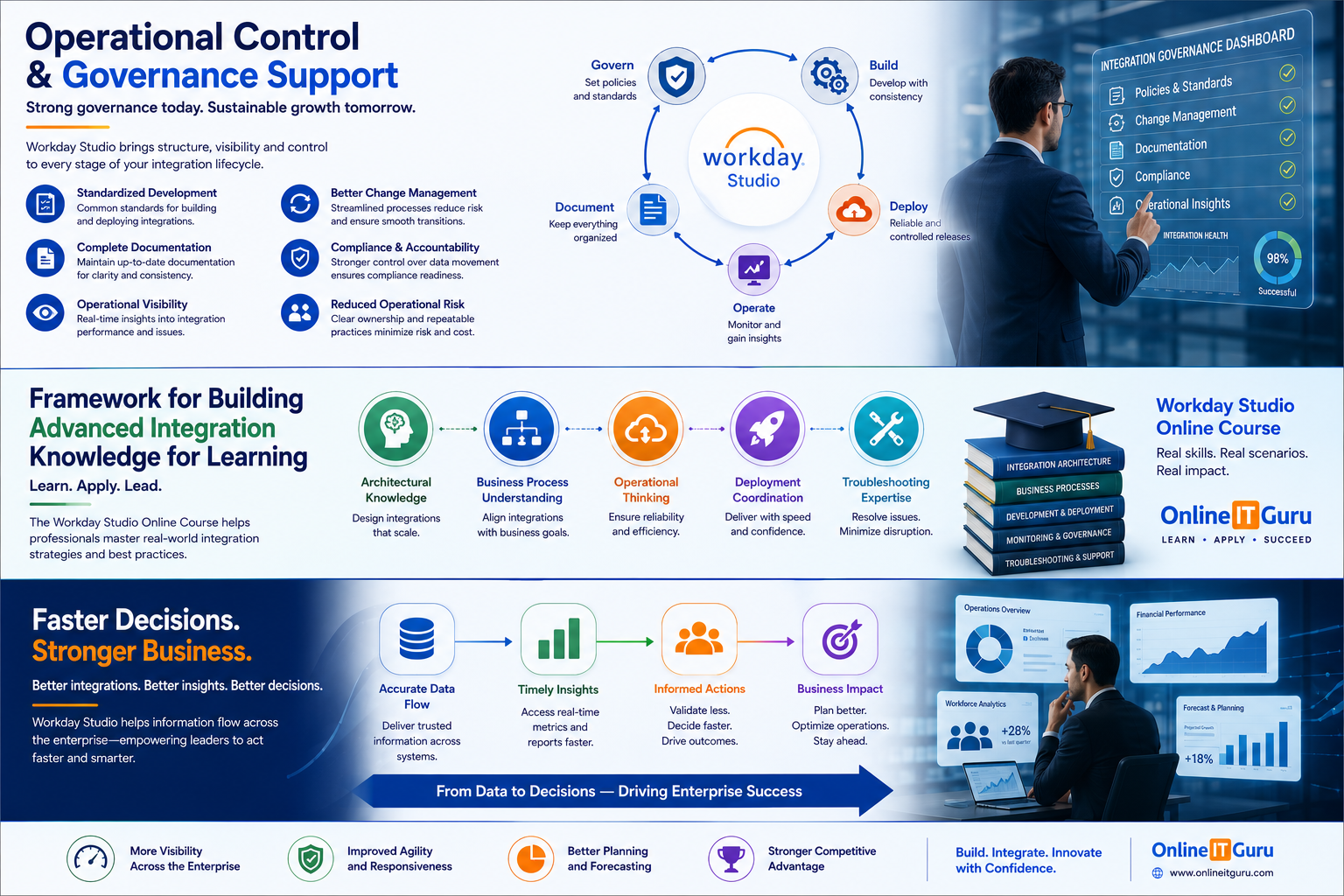
When you do enterprise integration you need to understand many disciplines at once.Technical skills alone are seldom enough.The successful integration professional is a combination of architectural knowledge, business process knowledge, operational thinking, deployment coordination and troubleshooting skills.Thus, learning is a perpetual necessity.
Many professionals who join a Workday Studio Download aim to get more insights into the enterprise integration lifecycles and the tactics for practical implementation. They learn how to align technical implementation with organizational goals by placing professionals in authentic situations and learning paths. They understand how integration decisions impact scalability, maintainability, operational continuity and business performance.
This larger picture enables people to be more effective participants in digital transformation programs.Organizations gain from improved internal capacity and increased quality of execution.As enterprise environments change, those investing in continuous development are better positioned to support changing technology needs.
Innovation is also driven by learning, as teams are more willing to try new ways of integration. Faster Decision Making for the BusinessOne of the benefits of integration maturity that's often overlooked is better decision making.Availability and accuracy of information is critical for organizations.Business leaders require timely operational metrics and reports.Poorly connected applications tend to choke off the flow of information and reduce visibility.
Decision making is affected by the influence integration platforms have on the speed at which information becomes available across the organization.This may help firms to develop more standardized information flows and thus become more responsive.Operational data reaches stakeholders sooner.The reporting environment is becoming more robust.Business teams validate less facts and act quicker.This is better than better reporting.Improved access to information means that it is now possible to plan, forecast, manage the workforce and optimise operations.Firms that can make decisions faster are generally better at capitalising on changes in the market and business opportunities.
Integration Mastery: The Bedrock of Business Agility
Speed is now a strategic objective for companies across all sectors.Businesses are constantly adapting to market conditions, technological change, customer expectations and operational demands.Many organizations are trapped in rigid integration environments that limit what they can do effectively.Workday Studio allows organizations to create flexible integration architectures for agility.Reusable workflows give us agility. Centralized development means quicker updates.Structured implementation also cuts down on the need for ad hoc fixes.An agile integration environment delivers more value to the business.Organizations can change with less disruption .Tech teams accelerate delivery.Business users transition more smoothly.As transformation initiatives accelerate, the need for integration excellence is increasing to enable operational agility and unlock future growth.
Workday Studio makes complex enterprise integrations simple
Sustainable integration in the long term
While enterprise integration is often talked about in terms of implementation velocity and technical connectivity, the real measure of ongoing value from integration efforts is sustainability over time. Organizations that focus on short-term project execution often find that as their technology environments grow, the maintenance effort grows, the operational complexity increases, and visibility decreases.
Integration is more than just integrating applications with other applications. As business processes change, transaction volumes increase and priorities change within organizations, it is important to develop approaches that are sustainable. Workday Studio enables organizations to build sustainable, repeatable and maintainable integration environments.
Rather than creating siloed workflows for each need, organizations can create structured processes that scale in the future.It ensures operational stability and decreases the risk of redoing the integration.Sustainable integration also makes organisations more cost efficient as they use less resources to sustain fragmented architectures.
Integration maturity evolves from a technical necessity to a strategic advantage over time.Enterprises able to sustain integration performance set better foundations for growth and innovation.More collaboration across business functionsEnterprise integration has many stakeholders.Technology teams develop and support workflows.Business users want information as soon as they need it.Leadership teams need accurate reporting.Operations groups need process continuity.
Collaboration is critical because of the number of domains touched by integration efforts.Communication often breaks down and implementation is slow and misunderstood.Business users will describe the outcomes differently than the way technical teams interpret the requirements.Integration platforms often result in better visibility, which often leads to better collaboration.
This is made possible by enabling organizations to build integration processes in a more transparent way – Workday Studio.
More confidence in system performance Simpler workflows make it easier to understand and manage, giving stakeholders greater confidence.Collaboration enhances the quality of implementation.Set higher business expectations.Technical implementation is more consistent with operational priorities.Bettercollaboration across organizations often means easier adoption and better transformation results.Increasingly connected enterprise environments and collaboration is becoming an important aspect of integration success.Support for Cloud Transformation and Enterprise ModernizationContinued cloud adoption is transforming the enterprise technology landscape.Moving business operations to the cloud can help organizations become more flexible, scalable and accessible.
But integrations are part of cloud transformation you can’t ignore. Apps will still have to share data between cloud and hybrid environments. As organizations implement new technologies, they must guarantee business continuity. Workday Studio helps those efforts to modernize by supporting more structured approaches to enterprise connectivity. Organizations have the opportunity to lay the foundation for integration that will enable future growth, not build point solutions for each cloud initiative. The integrations are flexible by design and make modernization less disruptive.
If a cloud transformation initiative is to be successful, integration architecture should be given equal weight to application implementation. Enhance relevance and professional development to industry.IT professionals are starting to realize that the skill of integration is a good career move in the long run.Organizations embarking on digital transformation initiatives need specialists who can connect platforms, oversee workflows and ensure smooth operations.Not only technical setting of demand.
The professionals should be familiar with architecture planning, implementation coordination, principles of governance and business alignment.Therefore, a large number of professionals are investing in Workday Studio Integration Training to get hands-on knowledge on enterprise integration methodologies and operational execution. In the structured learning experiences, professionals are introduced to workflow orchestration, deployment practices, troubleshooting approaches, monitoring strategies and concepts of lifecycle management that are becoming increasingly relevant in the enterprise environments.
As organizations grow their technology ecosystems, professionals with integration expertise are well-positioned for a variety of opportunities in consulting, implementation services, enterprise technology teams and transformation initiatives.
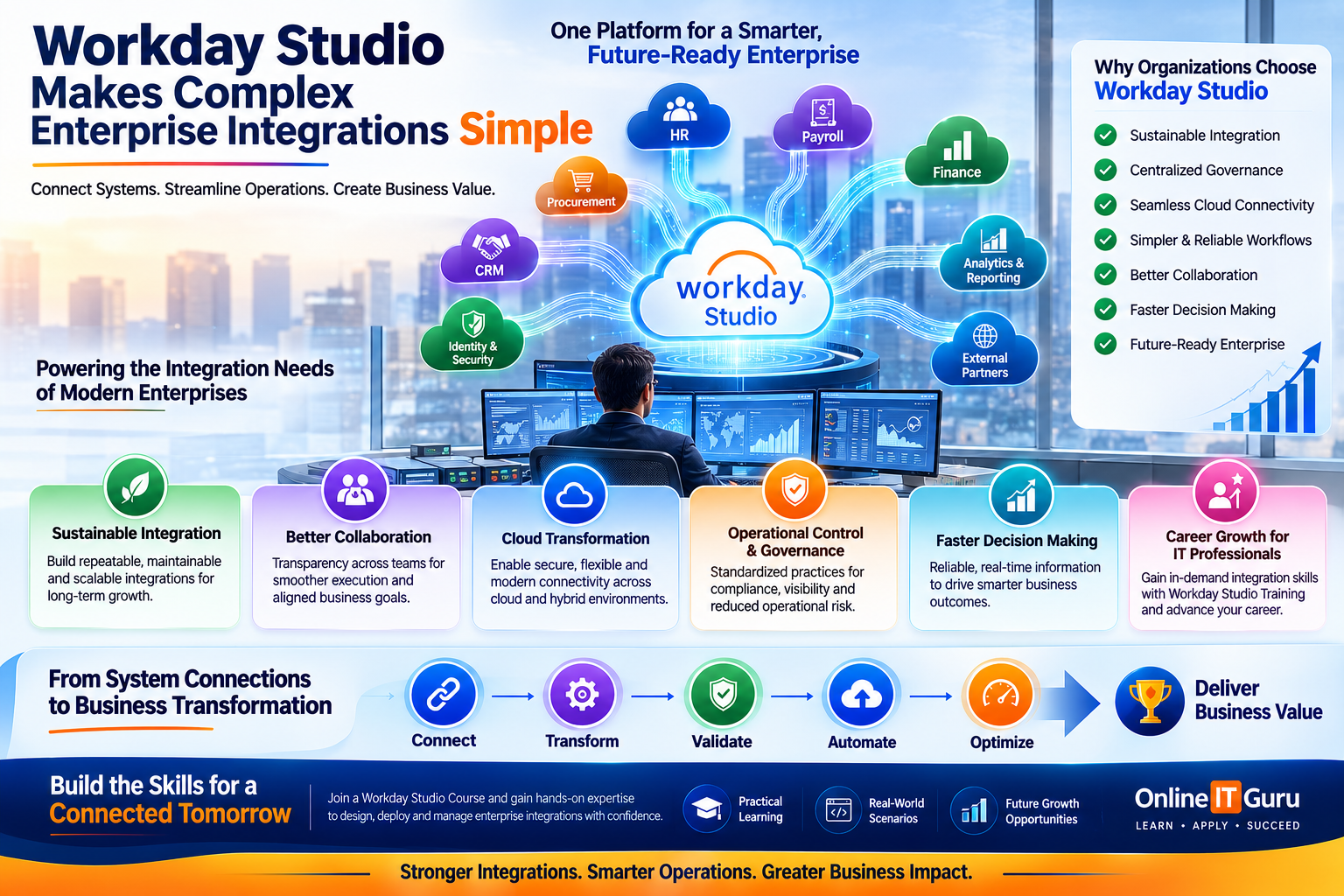
Enterprise technology moves toward hyper-connected models of operation.Applications should continuously exchange information and maintain performance, reliability and security .Therefore, organizations need integration approaches to help them meet future business needs.The architecture we choose today will define our connectivity tomorrow.
Workday Studio enables organizations to build scalable and flexible integration environments to help future-proof.Reusable patterns reduce implementation effort.Governance is the idea of providing consistency in operations.Centralized visibility enables better long-term management.
Organizations and professionals engaging with a Workday Studio Courses want to understand how integration design principles can enable sustainable enterprise connectivity and future operational growth. This better integration capability allows the enterprise to respond better to changing technology landscapes and maintain business agility over time.
Future-ready organizations say digital success depends on integration, not as a support function, but as a core cability. Linking Operations to Create Business Value. Finally, the success of the integration should be measured by business results. When systems talk to each other well, organizations see measurable gains.Your employees get the right information, faster. The processes are more flexible.Fewer delays to operations.The leadership teams are more transparent.
Customers often receive a more uniform level of service delivery.Workday Studio simplifies enterprise connectivity and allows for more structured operational execution to drive those outcomes. By investing in stronger integration foundations, organizations can create environments that promote innovation, operational excellence and long-term competitiveness. Digital transformation is accelerating across industries and the ability to integrate is increasingly linked to business performance.
Conclusion:
Workday Studio enables organizations to easily build complex enterprise integrations for centralized, scalable and sustainable connectivity to business systems. Better orchestration, tighter governance, more reliable information exchange and more flexible integration architecture can all help enterprises reduce operational complexity and improve agility and long term performance. OnlineITGuru offers professionals and organizations a chance to advance on their learning path and acquire practical enterprise integration skills to enhance their implementation readiness.