
Workday Unifies Talent and Learning for Personalized Growth
Last updated on Aug 3, 2026
The conventional rigid model of workplace training and learning with mandatory annual compliance modules and inflexible training catalogs is fundamentally ineffective. For many years, firms believed that the traditional model of training in which employees underwent the same training several times a year was enough to ensure that core competencies of employees remained intact. However, this training model does not take into account the growing speed of business and the rapidly shrinking half-life of skills as well as prerequisites of modern jobs. Static catalogs do not correspond to either everyday working life of a staff member nor their long-term career.
The current organizations need to provide personalized, up-to-date continuous learning experience to the employees according to their specific career aspirations while keeping in mind the overall strategies of the organization. The 21st-century professionals want their organizations to provide career advancement opportunities matching the speed of technology used in personal life. They need to know what the career prospects and required skills are and how they can get access to the required educational materials used in a daily life. If the organizations do not offer personalized development opportunities to their employees, they lose the best specialists to other organizations.
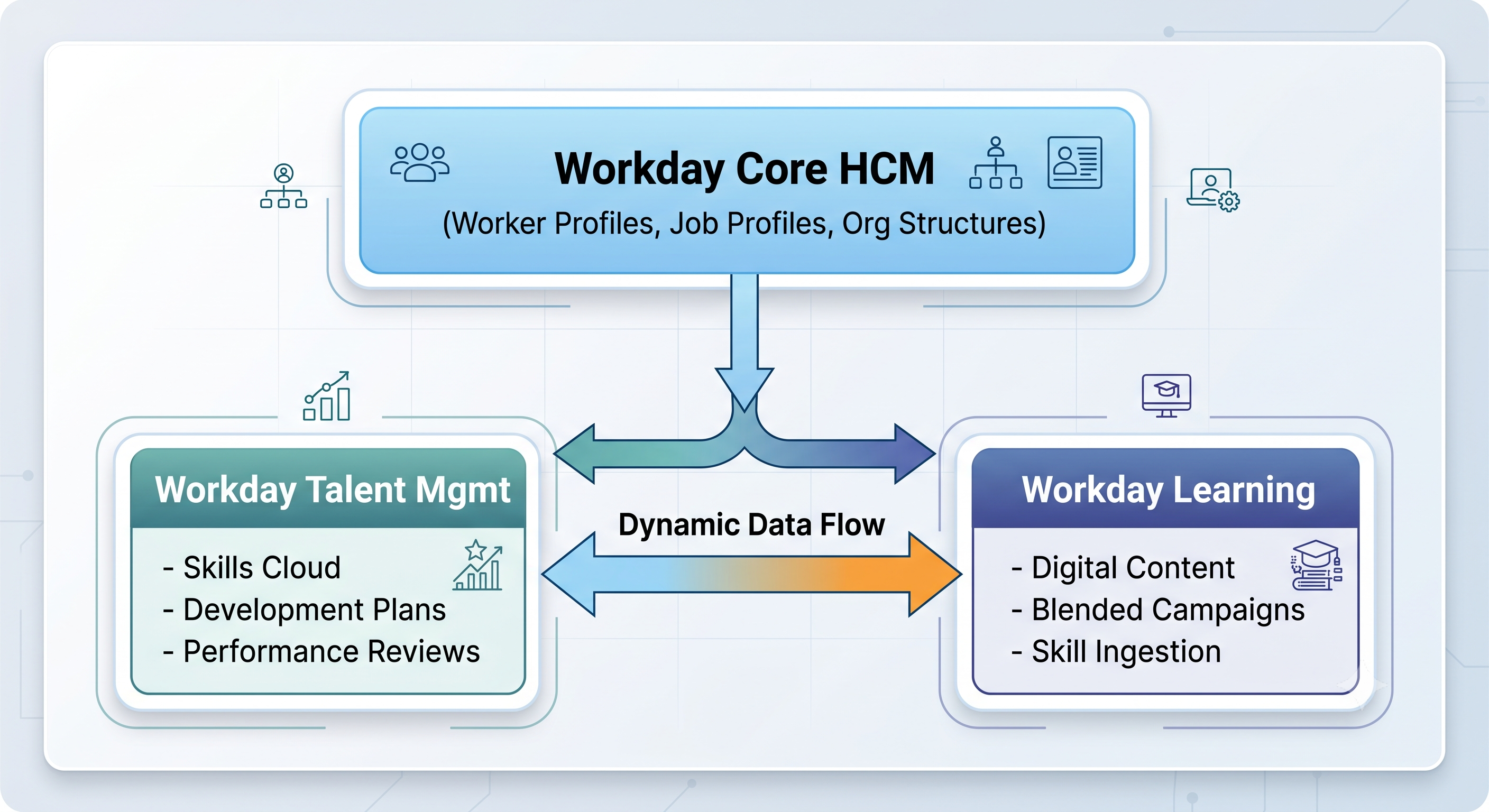
There is Workday HCM located at the crossroads of employee development and performance management within an interdisciplinary environment consisting of Workday Learning and Workday Talent Management. Instead of keeping training and talent management separated as different sectors, Workday combines them under a single cloud-based service. The Workday Core HCM provides the basic data architecture through job profiles, reporting structures, and service periods. At the same time, Talent Management provides real-time evaluations of performance, preferences regarding careers, and gaps in competencies. Finally, Workday Learning uses this contextual information to provide personnel with educational content accordingly.
To manage these interconnected components successfully, professionals spend money on workday hcm training to learn essential configurations. This article analyzes various aspects of how big enterprises use Workday for developing customized training plans for their employees.
By using the system in a combined way, these components make the process of human capital development not just an inconvenient downside, but an effective means of creating a skilled workforce. Instead of being reactive to deficits in personnel capabilities, management professionals are able to benefit from this integrated approach and learning platforms while estimating and addressing all requirements of the pool of employees. Thus, professionals have access to clear career paths and the link between accomplishment of exact tasks assigned and final result in achieving the desired career development goals.
In other words, merging the functions of Workday Learning and Workday Talent Management leads to development of organizational potential. It transforms the format of corporate training into a dynamic process which is interconnected with the business strategy of the company.
This guide dives into various aspects of how large businesses use Workday to create personalized employee development plans and programs.
Necessity of Personalization in Corporate Learning
Community-Learning Programs Unable to Succeed
In the past, L&D mobile devices worked in a very simple way. Human resources departments assigned jobs on the basis of an employee’s job title or only when the position required that. There are major problems with this approach that are as follows:
Poor interaction. People lose interest in the course when they do not see how training applies to their work in the present or in the future.
Skill duplication. Outdated courses are being shown to experienced specialists even if there is some gap that should be filled for newcomers.
Personalized Learning as a Retention & Agility Driver
Personalized learning aims to harmonize personal development with company goals. The individualization of educational programs in accordance with the proficiency level of employees, their future career path, and preferred method of receiving information helps companies to achieve:
Faster time to competence: Employees learn only what is new to them.
Reduced voluntary turnover: The employees are more aware of their career paths and invest in their future.
Increased dynamics and flexibility of companies: If the situation changes on the market, companies can quickly make significant changes in terms of employee competencies.
In order to make personalized learning programs effective, learning cannot be cut off from the core business processes. In this respect, Workday integrated work-based and student information processing systems in the cloud.
Fundamental HCM Data Engine
Workday Core HCM underpins the fundamental layer and spearheads the authoritative master database for each employee in the organization. The main traits such as Job Profile, Management Level, Geographic Location, Organizational Hierarchy, and Tenure act as crucial initial benchmark criteria for targeting content and eligibility rules. The ultimate purpose of linking learning paths to Core HCM is to utilize the minimum anticipated set of competency requirements, geographical norms, and entry-level requirements automatically, without needless administrative tagging.
Workday Skills Cloud
The pivotal element in up-to-date personalization in Workday is Workday Skills Cloud. The platform uses advanced machine learning techniques to develop the globally applicable ontology to classify, transform and associate skills within the organization. Instead of depending on constant human controlled skill system, the platform is functioning dynamically on the basis of three key methods:
Skill Extraction: Constantly assesses unstructured data such as job descriptions, employee portfolios, resumes, and performance records for the purpose of deriving specific skills.
Skill Inference: Uses machine learning technology to find associated abilities. For example, when a worker shows competence in Python, Genesys assumes that the individual has basic skills in related areas, such as Data Analysis and Pandas.
Skill Gap Analysis: Automatically checks the skills of an individual against those that are required either in his/her present position or the one that the individual is targeting in the future.
Talent Management Connectivity
The integration of Workday Talent Management with Workday Learning results in a powerful synergetic effect. Workday Talent Management collects relevant qualitative and quantitative information about people, which includes annual performance scores, calibration scores, declared career interests, talent pool placements and IDPs.
When the manager finds out that there is a gap in the capabilities of the employee during annual evaluation or when the employee indicates their desired career path in their profile, this information instantly enters Workday Learning. The learning software makes use of these events to provide updated recommendations of courses, organize learning campaigns and offer relevant experiences to users. The integration of Workday Talent Management with Workday Learning creates conditions for transforming workforce development from a static process into a responsive data-driven model.
Key elements of the custom development route
Workday’s platform offers a number of key features that can be used to create custom development paths.
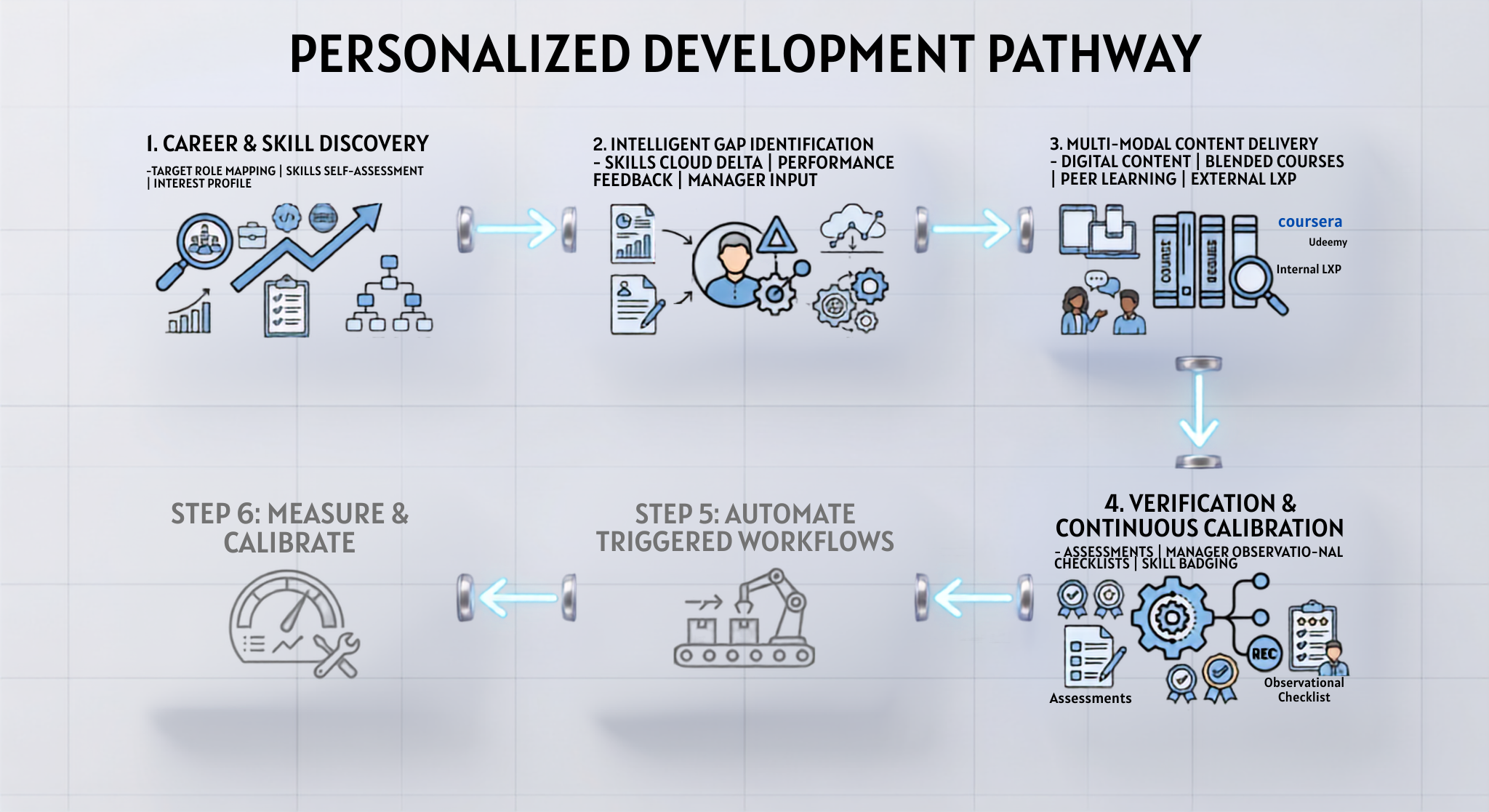
A. Identification of Skills Needs and Self-Assessment
Development begins with introspection and alignment.
Worker Profile and Skill Passports: Workers identify specific skills and their level of proficiency in those skills, and work on their skill set.
Target Role Exploration: Workers use either the Opportunity Marketplace or the Career Hub to analyze possible future job roles. This process allows workers to see a comparison of demanded skills as compared to their own portfolio of skills.
B. Dynamic Content Curation and Campaigns
Instead of using the traditional and linear courses Workday gives the admins the opportunity to create diverse and flexible learning campaigns:
Blended Courses: Combination of digital courses combined with instructor-led courses and external content.
Digital Campaigns: Automatic nudges that transmit certain skills to the employees automatically based on certain events.
External Content Connectors: Ability to use third party providers of the content using Workday Content Cloud or different types of integrations.
C. The Role of the Opportunity Marketplace
The process of personalized learning goes beyond the competition of courses. With the help of machine learning, Opportunity Marketplace helps employees get unique opportunities for learning experiences.
Responsibilities Pertaining to the Internal Gig Assignments: Brief projects for collaboration across disciplines.
Mentorship Matching – Matching workers with internal mentors with specific skill sets.
Job Shadowing and Rotations Planned horizontal experiences embedded in the employee development system.
Implementation: Creating a Custom Learning Pathway
In the tenant, we have a systematic process of installation by the L&D and Talent Departments that allows a personalised learning path in Workday.
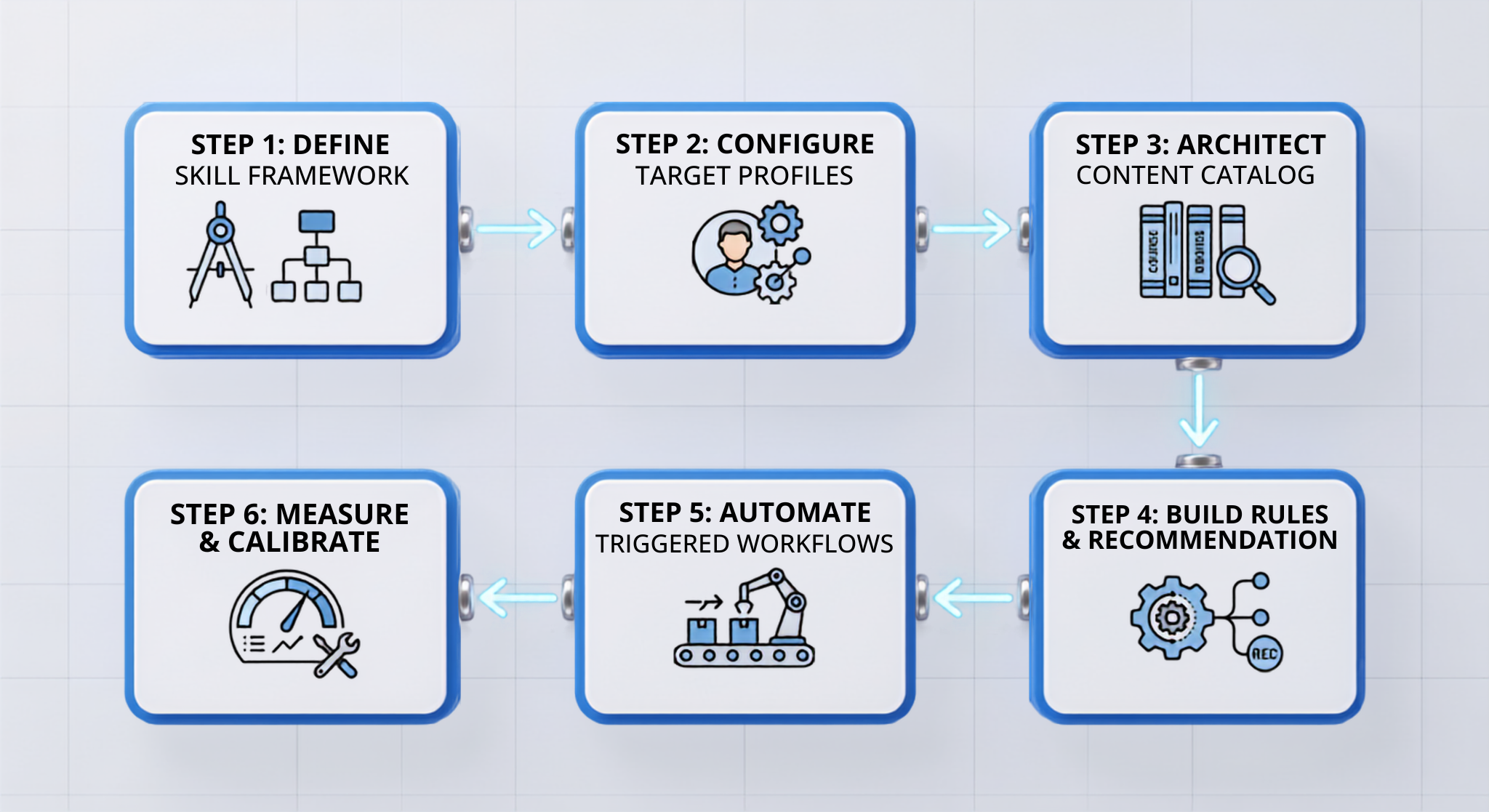
Step 1: Create the Skill Framework in Skills Cloud
Activate Skills Cloud in your Workday configuration.
Standardize and normalize skill terminology across job families, ensuring application of Workday’s established ontology.
Associate the key competencies and skills with specific Job Profiles.
(Important: If your group is preparing the ontology, having the main human resource officials do an organized course on the workday hcm course will help significantly speed up the time taken to configure it).
Step 2: Set Up Target Job Profiles and Talent Models
Define clear job competencies for each level in the job families (e.g., Senior Software Engineer versus Chief Architect).
Create templates of Development Plans in the Talent Management module, defining obligatory and optional milestones in the development.
Create the Career Hub interface to show the paths and skills of the jobs to employees.
Step 3: Establish the Content Catalog and Metadata
Add an index in your organization learning materials (SCORM, AICC, MP4, PDF, and other materials).
Label all learning items with the relevant skills, job profiles, and competencies. It is important to label accurately for theAI-recommendations.
Define the rules of access to content through Learning Security Groups according to the worker’s characteristics.
Step 4: Create Recommendation Engines That Are Based on Rules and Artificial Intelligence
Establish rules in Workday Recommendation Engine:
Provide Content A if Employee Skill Gap has Skill B.
Provide Pathway C if the Employee is in Talent Pool D.
Generate dynamic audiences from Custom Reports or Calculated Fields (e.g., employees working for between 6 and 12 months not carrying out Advanced Leadership training).
Step 5: Automate Workflows (Business Processes)
Modify important Business Processes (BPs) such as Change Job, Hire, or Performance Review to enable automatic targeted learning process activation.
If an employee moves into a management role, they will be enrolled in a required management base course and have access to the advanced leadership electives.
Step 6: Review, Confirm and Change
Integrate post-learning assessment surveys directly into Workday Learning.
Develop Manager Observer Checklists for skill utilisation.
Use advanced Workday reports and dashboards to track training completion, skill attainment and performance improvement.
Enterprise Implementation and Governance Best Practices
For large-scale personalized development pathways projects, proper technical structure and organizational change management must be implemented.
Data Hygiene and Metadata Management
Implement and maintain strict tagging of content: a good AI engine relies on its metadata. Make sure all content writers follow the same scheme of tagging.
Eliminate duplicates: perform audits periodically to ensure synonym terms for the same skills are merged to maintain correct functioning of the system.
Learning and development must be linked to HR Business Partners and senior management. Personalization of learning will fail if it is carried out by the learning and development department only.
Train managers in using the Team Manager dashboard in Workday.
HR Business Partners must have access to talent pipeline reports to identify skill gaps in their organization.
Prepare Managers Train managers on how to navigate the Team Manager Dashboard in Workday and how to review skill profiles, approve development plans, and recommend relevant courses and gigs. We provide specific workday hr training for internal teams so that managers and HRBPs are using these talent pipeline reports properly.
Empower HRBPs: The HRBPs should use talent pipeline reports to identify skills gaps in the organization and work with L&D to create targeted training campaigns.
Enable HRBPs: HRBPs should make use of talent pipeline reports to identify gaps in skills in the organization and collaborate with L&D in creating special training campaigns.
Striking the Balance Between Automation and Human Touch
While the content recommendations offered by Workday’s sophisticated algorithm are automated, human intervention is equally important:
Utilize algorithmic suggestions combined with one-on-one manager mentoring.
Give clients the right to reject, decline or manually include learning options in their development plans.
Measuring the Effectiveness of the Solution in Figures: Key Indicators and Reporting
To measure the effect of personalized learning paths in Workday organizations evaluate the metrics on three levels, which are: operational engagement, talent capability and impact on business overall.
In terms of Operational & Engagement, an organization is always keen on adoption efficiency, which means measuring how learners engage with the used learning tool. Various metrics are monitored like Pathway Completion Rates, the ratio of Voluntary vs. Mandatory Consumption, and Content Engagement Rates respective to Job Family to guarantee that learning materials are interesting and exploited well in the different sections of the company.
At the Capability & Talent level, attention shifts to skill development and improving bench strength. Describing skill gap reduction rates, internal mobility rates (for instance, all promotions and transfers), and skill coverage for important job roles enables HR managers to understand whether the learning policies are closing the gaps in the skills and managing talent.
Finally, Business Impact promotes alignment of learning outcomes with organizational performance and productivity. Executives assess such indicators as Time-to-Proficiency for Newly hired and Transferred employees or the amount of Voluntary Turnover for High-Potential workers.
Using Workday Prism Analytics Effectively
Training HR professionals would be incomplete without Workday HCM data being combined with outside operational data (e.g., Salesforce quota accomplishment, ServiceNow ticket completion dates) through Workday Prism Analytics. This allows the evaluators in charge of talents to have an idea of whether the accomplishment of a tailored training course relates to increase in operating results.
Summary: Creating a Culture of Constant Growth
Creating individualized training plans for employees by means of Workday Learning and Talent Management could be considered as something that goes far beyond an ordinary HR process since it results in a considerable transformation of the approach to human resource management in a modern company. The time of technological progress and uncertainty of the markets make modern companies abandon mass training methods. It is impossible to rely on one-off training sessions any longer.
This strategy hinges on the successful integration of Workday’s ecosystem. Workday connects vital Core HCM information—such as job descriptions, employee history, and organizational structure—with advanced skill ontologies, like the Workday Skills Cloud, providing organizations with a clear, data-based view of existing skills. This system, together with the continuously updated talent profiles and a variety of educational content, creates a self-sufficient feedback system. Talent management applications collect information on performance effectiveness, career aspirations and skills gaps to develop personalised learning paths that are immediately actionable. Digital learning courses, internal assignments and targeted mentoring make learning part of working life.
The interconnected ecosystem changes the concept of corporate education. Organizations move from reactive and compliance-oriented training to proactive systems of professional development. Instead of training employees for their previous jobs, organizations are able to continuously teach needed skills for the future. When market conditions change or when new skills need to be trained urgently, HR managers can find skills lacking in a group of employees without any problem and automatically start a large realization of an urgent upskilling program.
This way of working is no less important for transforming employees’ experience. Once they are provided with transparent information about career development steps, information about the skills to be achieved, and opportunities for professional growth, employees’ perception of the organization changes. They feel appreciated and supported in their career goals and ambitions, which raises employee engagement, improves loyalty, and decreases voluntary turnover of key talents.
The use of Workday for personalized professional development results in two main benefits. First off, the employees would know how to grow in their career. Secondly, it enables the company to create an empowered and flexible workforce that can stand up against market challenges.
Whether you'd like to train your internal HR staff or update your career, taking specialized workday courses offered by OnlineITGuru is the right way to learn how to implement the software and support the ongoing development in the industry.