
Workday vs SAP HCM: Which HR Platform Is Right for Your Business?
Last updated on Oct 5, 2026
There has been a major shift in the human resources technology landscape in the past 10 years. Modern companies no longer consider HR as a purely administrative support role tasked with monitoring leave balances and paying employees. Today, people management is front and center in corporate strategy, guiding operational resilience, organizational agility, compliance, and employee turnover. Thus, opting for an enterprise-class Human Capital Management (HCM) solution is among the most crucial technological choices an organization can make today.
Most global businesses consider two major players in the market while researching: Workday HCM and SAP (either through traditional legacy SAP ERP HCM or its flagship SAP SuccessFactors Human Experience Management). While both solutions offer an opportunity to automate, simplify, and modernize the hire-to-retire process, the principles at the base of these solutions, their structures, operational strengths, and integration capabilities significantly differ. As a result, choosing between them necessitates careful consideration of factors such as underlying architecture, core HR module features, talent management functionalities, payroll and adoption systems, adoption rate, change management options, and the total cost of ownership in the long run.
The Architectural Fundamentals and the Engineering Concepts
To get into the nitty-gritty of how Workday and SAP HCM work in real life, one must first look at how they were built in the first place. The architectural differences affect everything from how updates are done to how reporting support is done, as well as the effort an analyst has to exert when retrieving an ad-hoc headcount report.
A Single Unified Cloud Architecture
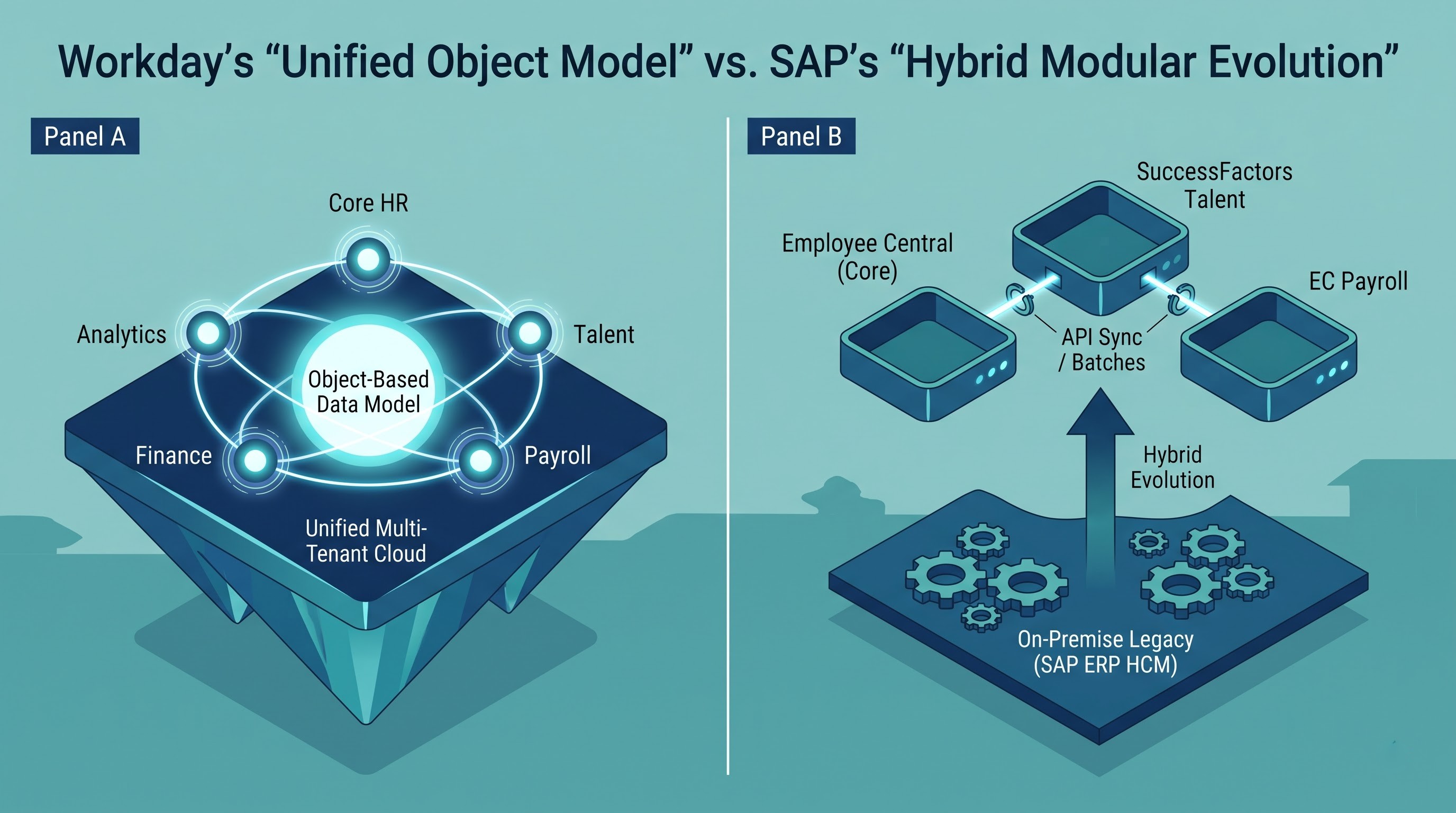
Workday was founded in the mid-2000s so that it could move away from the shackles of legacy enterprise software paradigms. It was conceived as a pure multi-tenant cloud application from day one, sharing one common architecture-a single line of code, a single security model, and a single underlying object-based data model.
In Workday, data is not stored in the form of traditional relational database tables adhered together by intricate SQL scripts, but on a dynamic in-memory object-oriented framework. Here, an employee is an object anytime he is dynamically connected to jobs, supervisory organizations, cost centers, compensation plans, and business processes. Because all customers are running the same software version intermittently in the cloud, bi-annual feature updates are delivered automatically with no panic over years-anticipated upgrades.
What this unified model means is that, with such an integrated solution, if a firm uses Workday for both Human Capital Management and Financial Management, the line between HR and accounting becomes nonexistent: promotions with pay raises become part of operating budgets, departmental forecasts, and payroll ledgers-all without any batch interface or API sync job.
SAP HCM: The Enterprise Powerhouse and Hybrid Evolution
SAP has, over the past couple of decades, had a presence in human resources through SAP R/3 and ECC systems-shell & Skin (SAP ERP HCM) that run on-premise. These ideologies have been created based on conventional relational databases with astonishing transactional strength, modular customizability, and enormous embedded linkages with operations within enterprise supply chains, plants, and production modules.
Over the past decade and a half, SAP recognized the changing market tendencies toward cloud software and, therefore, acquired SuccessFactors, thereafter evolving its entire cloud HR portfolio into what it calls SAP SuccessFactors Human Experience Management (HXM) Suite. As a result, modern enterprises looking to evaluate SAP are primarily caught between legacy installation of SAP HCM moving to SAP S/4HANA or a complete move to SAP SuccessFactors in the cloud.
In contrast to Workday's all-in-one system, SAP features a modular HR structure. While the latest version of SuccessFactors makes use of the SAP Business Technology Platform’s single framework, it utilizes the distinct features of the Employee Central application for core HR, the Employee Central Payroll for calculating salaries, and several specialized modules for recruiting and training functions. The modularity of this system allows companies to implement required tools step by step without migrating the core platform all at once.
Human Resources and Organizational Management
The core HR system is the single source of truth for all personnel data, hierarchies, and employee governance.
Workday Core HCM and Supervisory Organizations
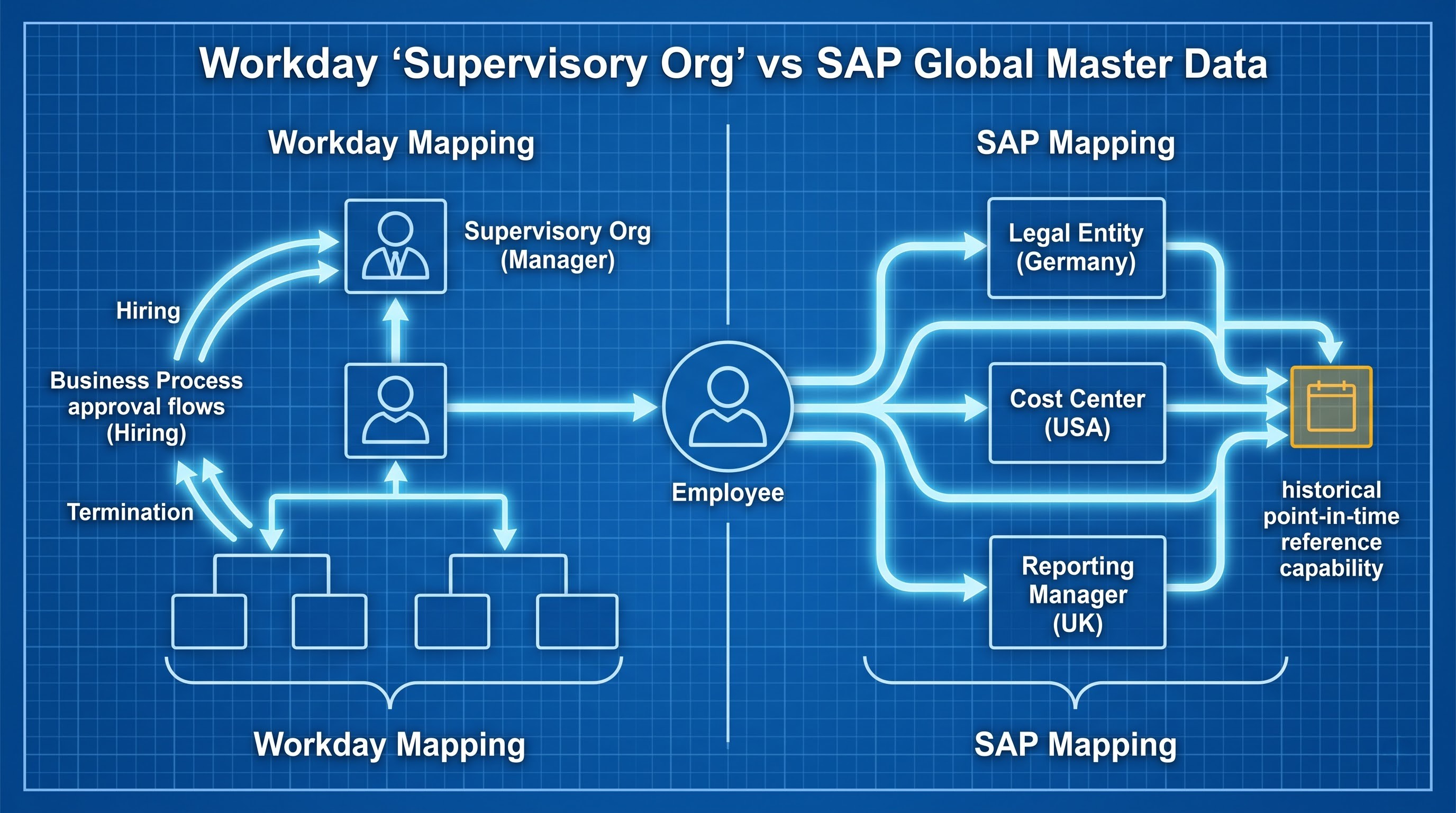
Workday employs a novel concept called “Supervisory Organizations” to develop organizational structures. Unlike traditional HR software solutions, which link employees to legal entities and the organizational structure, Workday considers who manages them in building the hierarchy, which simplifies the process of reorganization and project management considerably.
Workday's Business Process Framework is one of the highlights of its functionalities. It allows human resource professionals to create, modify, and manage complex approval processes concerning hiring, termination, and internal movements, all without any required programming skills. However, the knowledge of staffing models, routing rules, and domain security will usually demand rigorous training in a specialized workday hcm course and its practices.
SAP Core HR and Global Master Data Governance
SAP follows a global compliance-focused model in its core HR systems. What SAP manages effectively is complicated corporate structures in which a single employee might be employed by a particular entity in a specific country, for example, a worker in Germany employed by a Germany-based company but assigned to a cost center in the United States and managed by a team from the UK on a day-to-day basis.
SAP is one of the top performers in the area of administering complicated collective bargaining agreements, works council mandates, and sophisticated public sector position management frameworks. Its data model has an in-built capacity for historical point-in-time reference tracking, allowing HR professionals to obtain information on the past states of the organization while making the necessary adjustments in the future. The rigidity of SAP's data governance can be very beneficial for big conglomerates with multi-layered ownership structures as well as joint ventures.
Talent Acquisition, Onboarding, and Experience
The process of attracting and employing talent has now become a differentiating factor for companies while hiring people. Although both solutions offer sophisticated talent management suites, their processes differ significantly.
Workday Talent Management
The process of recruiting is embedded into the main Workday system. Once the job opening is approved, it gets stored together with information on the salary scale and workforce planning in the core Workday system. Workday Recruiting offers an easy-to-use candidate portal, collaborates on candidate assessment scorecards, and drafts offer letters.
When the candidate accepts the position, the candidate immediately moves into employee records where the onboarding process begins prior to day one. This automated onboarding process ensures that there is no error in data and all processes related to information technology, employee registration, benefits enrollment and orientation take place in the same environment.
The SAP SuccessFactors Talent and Learning Suite
SAP SuccessFactors was well known as a good talent management suite even before the company acquired its human resources management system. As a result, the company provides excellent technology services and is well known for the modules of recruitment, performance management as well as succession planning and learning.
SAP SuccessFactors Learning (LMS) is considered to be a benchmark in the field of enterprise corporate education because it carries out complicated training curricula, external certifications and also needs to take care of compliance and safety training activities for the dispersed teams.
In terms of talent development, SAP has invented its Opportunity Marketplace where employees can find temporary projects according to their skills and career ambitions. SAP’s suite is more mature than Workday’s in terms of professional development programs.
Payroll and Time Tracking: Operational Foundation
If any HR system cannot pay the employees on time and accurately, then all the talent management strategies go to waste. Payroll is considered to be the most challenging operational area of HCM.
Payroll Functionality of Workday
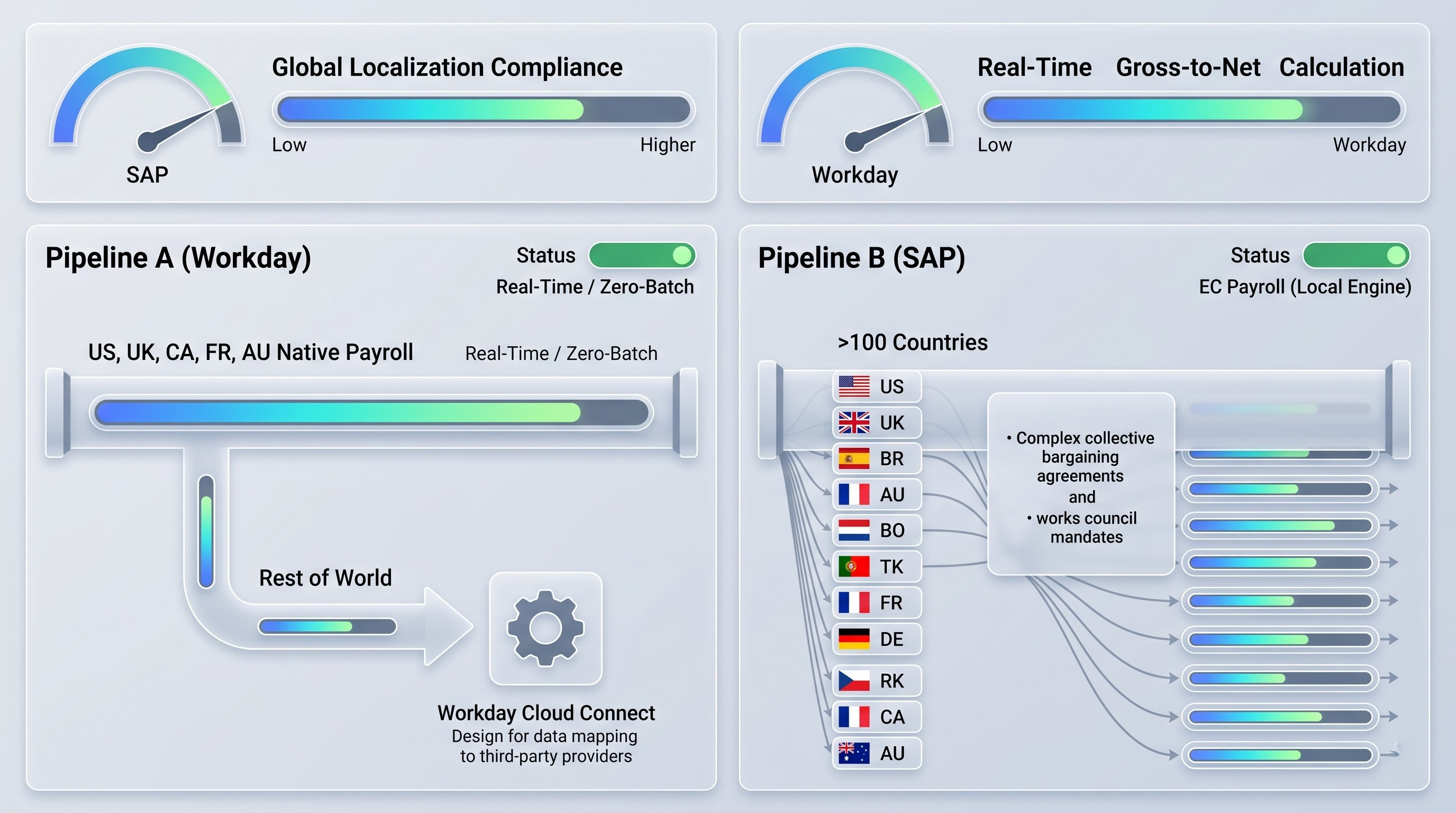
Workday provides built-in and seamlessly integrated payroll processing to select countries, including the US, Canada, UK, France, Ireland, and Australia. For a corporation that does business in the above-mentioned countries, Workday’s payroll solution offers real-time payroll processing or recalculation. Instead of conducting large batch calculations at the end of the payroll period, Workday can compute back pay, withholdings, taxation, and salary changes in the background in real time and help the payroll department to monitor inconsistencies.
For multinationals that have distributed employees in multiple countries around the world outside their primary markets, Workday uses Workday Cloud Connect for Payroll. Therefore, these organizations have to have integrations with local third-party payroll engines (like ADP, CloudPay, or others), meaning that they have to do a lot of data mapping and interface maintenance.
SAP Payroll and Global Localization Dominance
SAP is the leader in payroll around the world by scale, complexity, and localization compliance. SAP's on-premise payroll has been used for decades to handle the payroll of the most complex and numerous companies worldwide. While in the cloud, the SAP SuccessFactors product has been using the SAP Employee Central Payroll (ECP) to provide the same proven SAP payroll calculation engine in the cloud.
SAP has payroll compliance, legal reports, and tax accountabilities for more than 100 countries, and easily competes with local offerings. SAP is tailored-made for such complex tasks as multi-union shifts, various gross-to-net calculations, complex pension schemes for different jurisdictions, retro-calculations for many years, or even the work council regulations compliance.
SAP is the best option for large multinationals with significant operating companies, like heavy machinery manufacturing companies or mining enterprises.
Planning, Reporting, and Workforce Analytics
One main reason for the upgrade of an HR technology system in organizations is that companies want to make decisions based on data. Business leaders expect their HCM to give information on predicting turnover, analyzing labor costs, and evaluating the situation in an organization.
Workday Reporting and People Analytics
One of Workday’s most important competitive advantages is reporting. Thanks to its solid architecture made up of objects, all transactions and some data in Workday can be instantly reported.
Workday supports standard reporting technologies including Matrix Reports, Composite Reports and Discovery Boards which allow HR specialists without technical expertise create reports using drag-and-drop tools. The managers receive the opportunity to check the performance of the employees starting from the reports with charts.
The companies can leverage Workday Adaptive Planning and Workday Prism Analytics allowing them to combine outside data (like point-of-sale information, operational metrics, or external recruitment figures) with HR data.
SAP is using its Workforce Analytics and Stories in SAP Success
Factors system to offer a wide range of reporting options through SAP Analytics Cloud. SAP has already developed hundreds of standardized metrics that comply with global standards.
In the past, obtaining ad-hoc reports from different SAP modules was not easy, as it required specific skills in report development or a central data warehouse. However, the arrival of SAP Datasphere and SAP Analytics Cloud has changed this situation - a unified reporting system has come into existence which integrates HR data from SuccessFactors with financial and operational metrics.
SAP has developed its strategy in such a way as to rely as much as possible on the use of embedded AI tools (Joule, a copilot created by SAP). These tools analyze the behavior of the workforce, facilitate the creation of job descriptions, and offer valuable career development advice.
User Experience, Usability and User Adoption
Complex software solutions often affect the quality of the data, the timing of the deadlines, and the request volume of the HR service desk.
The Workday User Experience
When Workday came on the scene, it quickly became known for creating the standard for usability in modern enterprise software. Instead of having the same bad interface people had come to associate with enterprise resource software, Workday came up with a consumer-grade interface that was praised as a more engaging space.
The user interface remains intuitive, visually appealing, and consistent both on the desktop and mobile platforms. There is practically no need for formal training for most self-service tasks such as taking time off, viewing pay slips, updating personal contact details, and completing annual performance evaluation.
The SAP Experience and Modernization
Older SAP systems were revered for their utility but not their user interface and ease of use. Users had to deal with complicated screen layouts and memorize transaction codes while even casual users were unable to operate without a documented step-by-step guide to follow.
However, everything changed when the new modern SAP SuccessFactors came into being. The new UI is based on SAP Fiori design standards and offers card-based home pages and quick-action buttons.
Nonetheless, because SAP has a vast portfolio of configuration alternatives, advanced localization features, and complicated functional paths, working through complex cases and using backend administrative modules involves higher degrees of learning than Workday. Situations in companies that employ considerable numbers of knowledge workers in the office show that Workday’s UI is frequently regarded as simpler and more consistent.
Integration Ecosystems and Associated Enterprise Stacks
No HCM platform remains completely autonomous. Any HR solution has to be capable of interacting with functioning directories, identity management systems, travel portals, learning suppliers, and ERP systems.
Integrating Workday in Heterogeneous Environment
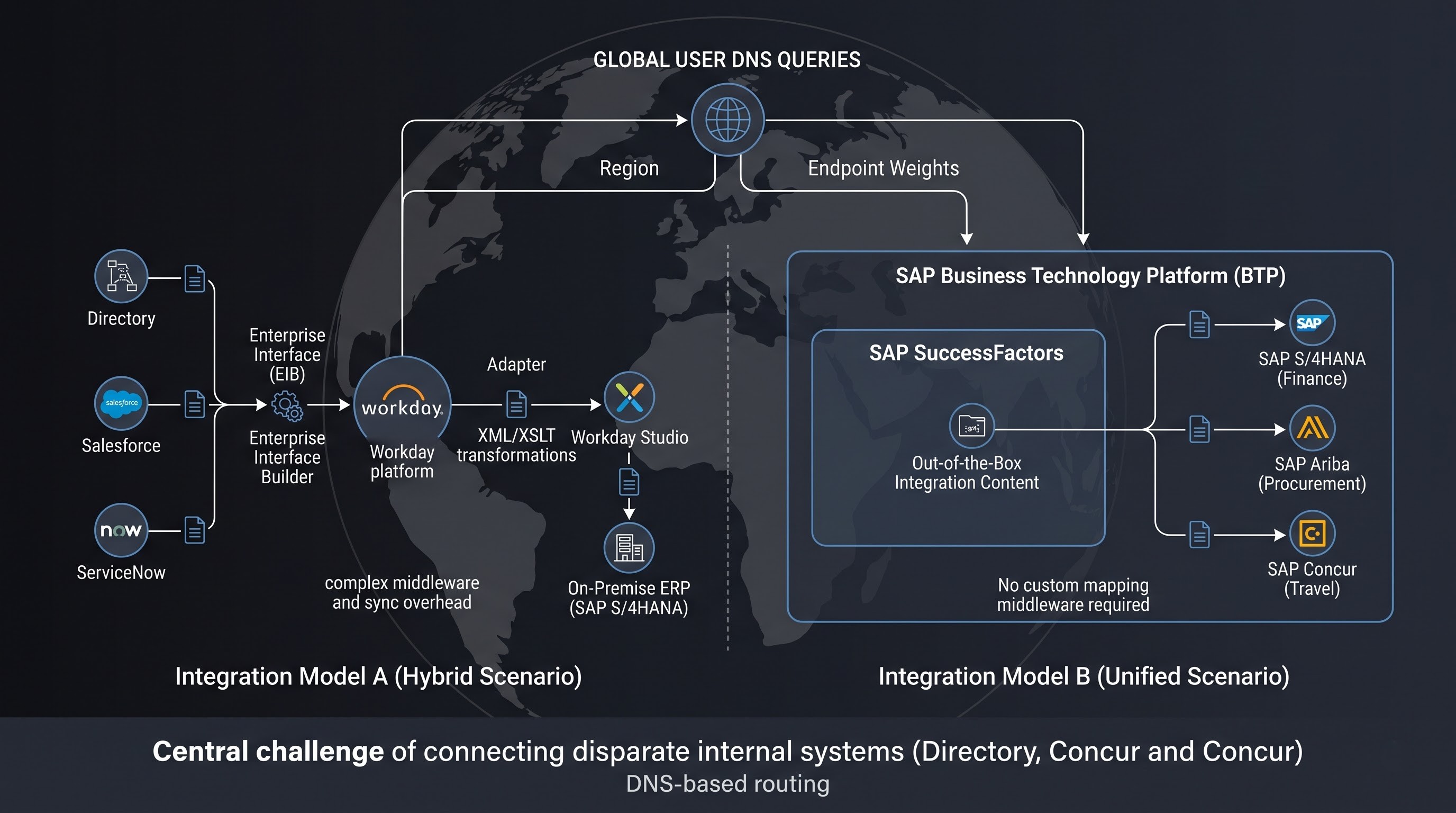
Various integration methodologies are provided by Workday such as Workday Enterprise Interface Builder (EIB) and Workday Studio which allows successful two-way integration. Connecting different enterprise systems requires knowledge of XML/XSLT transformation, Web Services, and business object design schema, that is the reason why many teams seek to utilize workday hcm training online which allows them to gain practical experience before launching important integrations.
Workday excels at integration with specialized solutions (like Salesforce and ServiceNow). It benefits from having a standardized API which obligates third-party companies to develop and support Workday connectors. However, if an organization has a non-Workday ERP solution (like SAP S/4HANA or Oracle Financials) it may need some serious engineering and constant data validation to achieve HR, financial, and procurement synchronization.
SAP's Built-In Advantage in a SAP-Centric Enterprise
If your corporate backbone is already built on SAP – with SAP S/4HANA for finance, SAP Ariba for procurement, SAP Concur for corporate travel, and SAP Extended Warehouse Management for supply chain operations – there is undeniable integration synergy in choosing SAP SuccessFactors.
SAP provides out-of-the-box integration content across its enterprise suite via the SAP Business Technology Platform (BTP). Data entities, cost center assignments, company codes and organisational units map directly between core finance and HR modules without the overhead of custom middleware development .
Introducing Workday into a mature SAP enterprise environment is often a painful proposition: the business is forced to support two separate enterprise architectures, reconcile duplicate organisational structures, and mediate ongoing integration syncs between Workday HCM and SAP Finance.
Implementation Life Cycles, Governance and Change Management
Replacing a global HCM platform is a major undertaking. The complexity of the deployment directly impacts delivery schedules, business disruption and operational continuity.
Workday Deployment
Deployments in Workday are typically much faster and more predictable than legacy on-premise implementations. Because Workday uses a standardized multi-tenant software code line, the project team doesn't spend months installing hardware, managing database instances or writing custom database triggers.
Workday has a very strict implementation methodology and utilises certified partner deployment networks. Projects are based on fixed-scope, pre-configured best-practice templates (such as Workday Launch) that are designed to get core modules live in six to nine months for mid-market firms, or twelve to eighteen months for massive multinationals.
However, because Workday employs standard data models and configuration guardrails, companies must be willing to adapt their internal processes to the standardised approach Workday offers. Configuration workarounds can be complex and costly, if an organization insists on maintaining idiosyncratically tailored legacy processes.
Implementing SAP SuccessFactors and managing hybrid footprints
With SAP SuccessFactors you get a lot of process – and a lot of freedom. The design and configuration phase in SAP has to allow for infinite permutations of corporate structures, global tax jurisdictions, collective agreements and operational scheduling, so discovery and the right system integration skills are key.
For companies moving from legacy on-premise SAP ERP HCM to the cloud, the transition is typically not a switch overnight. SAP supports multiple deployment models:
Talent Hybrid: Core personnel administration and payroll are kept on-premise in SAP ERP or S/4HANA, and modern SuccessFactors cloud modules are used for recruiting, learning and performance.
Core Hybrid: Heavy payroll and time evaluation operations remain on-premise in SAP ERP, while core employee master data is moved to SAP SuccessFactors Employee Central.
Full Cloud HXM: Moving all operational HR, payroll, talent and workforce planning fully in SAP SuccessFactors cloud infrastructure.
This modular flexibility provides risk-averse multinationals the ability to phase their investments without upsetting their business, but it also means that implementations can take several years, require extensive internal IT support and need diligent ongoing governance to keep hybrid systems in sync.
Total Cost of Ownership & Long-Term Economics
When comparing the financial impact of Workday vs. SAP HCM, you need to look much further than the initial quotes for software licenses. Enterprise technology leaders need to evaluate long-term capital and operational expenditures across a number of vectors:
Software subscriptions: Both Workday and SAP SuccessFactors are available as per-employee-per-month (PEPM) or multi-year annual subscriptions, depending on the modules chosen. Both don't publish fixed public rates, pricing is on a scale depending on volume, bundle negotiations and the overall commercial relationship.
Implementation and Advisory Services: Professional services fees are frequently at par with or in excess of the software subscription costs for the initial term of the contract. SAP implementations are typically larger and take longer, especially when dealing with global payroll migrations, complex time evaluations or hybrid architectures, which result in higher professional services costs.
Internal Administrative & Maintenance Overhead: Workday presents a multitenant cloud computing option that comes with significantly reduced maintenance costs. Workday issues new releases biannually, meaning that IT departments are not required to carry out database maintenance following an update. However, companies using Workday must have dedicated functional resources tasked with testing new features twice every year. Investing in workday hcm training is essential in making sure that internal actuators and hris specialists are able to handle periodic updates.
Training and Adoption Costs: Workday’s modern interface usually results in lower ongoing end-user training costs for rank-and-file employees. Such SAP implementations often require a more structured, deliberate change management and end user enablement initiative, especially for blue-collar or shop-floor workers who are using complex operational portals.