
100 OpenShift Clusters Changes Everything: The Hidden Complexity of Managing a Kubernetes Fleet
Last updated on Sep 15, 2026
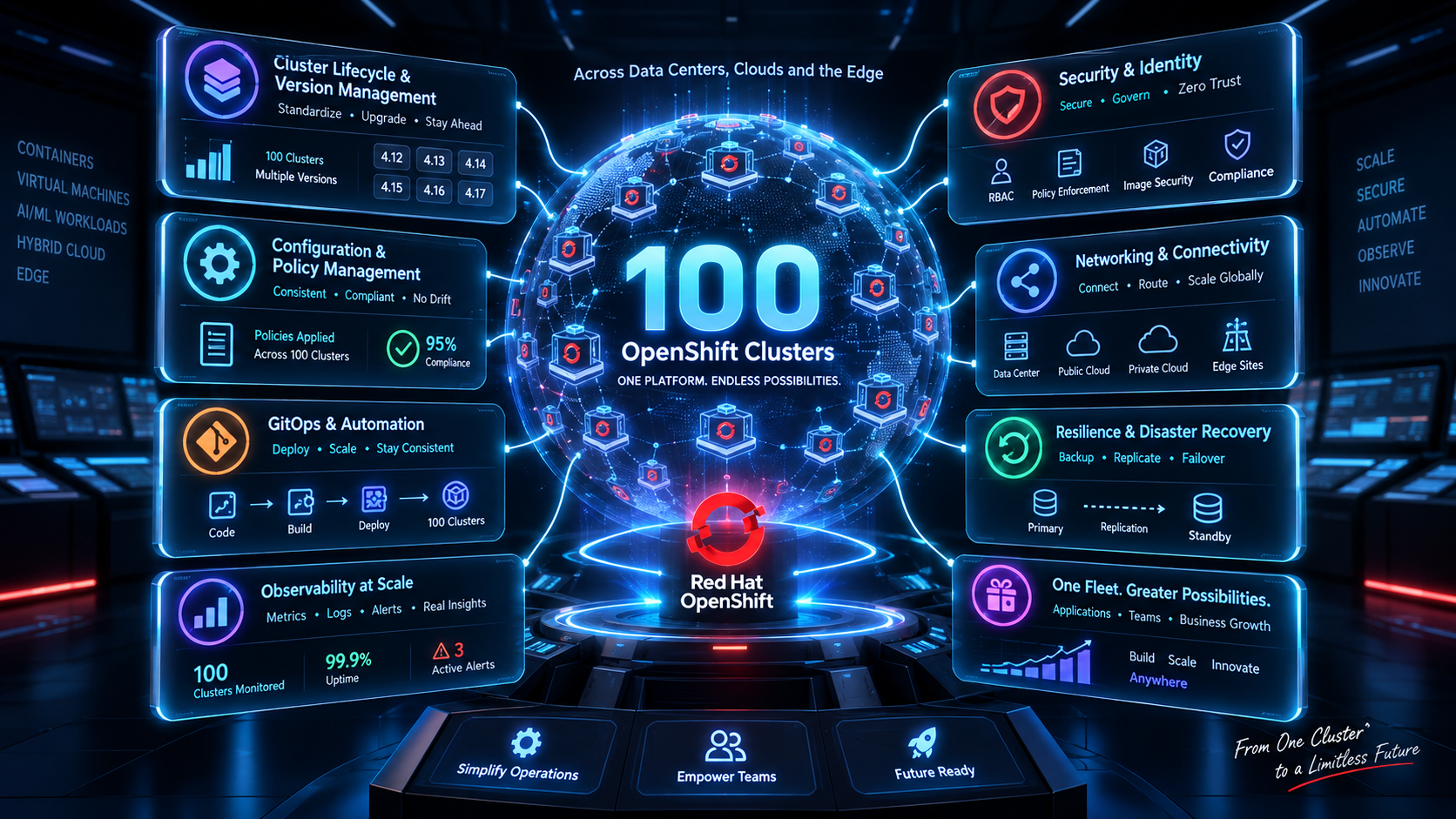
Running one OpenShift cluster is very different from running a fleet of 100. With a single environment, administrators can usually develop a clear understanding of the workloads, nodes, storage, networking, security policies, and configuration decisions inside that cluster. When organizations begin expanding their cloud-native infrastructure, however, new clusters appear for development, testing, production, regional workloads, disaster recovery, edge locations, acquisitions, or applications that require isolation. Each cluster may have a valid reason to exist, but together they create a much larger operational problem.
The difficulty is not simply that there are more nodes or more applications to monitor. The real challenge is keeping all those environments consistent, secure, observable, and predictable while still allowing them to behave differently when business requirements demand it. A production cluster in one region may need stricter policies than a development environment somewhere else. An edge cluster may operate with limited connectivity, while a datacenter cluster may have abundant resources. Some workloads may require specialized infrastructure, while others can run on a standard configuration.
This means 100 clusters cannot realistically be managed as 100 completely independent environments. The organization needs a fleet-level operating model that understands what each cluster is, what it should look like, which policies apply to it, how applications reach it, and what happens when something changes. Red Hat's multicluster technologies are designed around this broader challenge of managing clusters through centralized lifecycle and policy capabilities rather than relying entirely on individual cluster administration.
The interesting part is that the hundredth cluster does not necessarily create the biggest problem. The bigger problem is reaching that hundredth cluster with a hundred different ways of configuring, securing, monitoring, upgrading, and recovering environments. Once that happens, infrastructure scale begins turning into operational complexity.
When One OpenShift Cluster Becomes a Fleet
The move from one OpenShift cluster to a fleet usually does not happen overnight. An organization may start with a single production environment and later add another cluster for development. Then a testing environment appears. A new region requires local workloads. A business unit wants isolation. An edge project requires infrastructure closer to devices. A disaster-recovery environment is added for critical applications. Eventually, what started as a few separate clusters becomes a distributed platform.
At first, this expansion can appear harmless because every new cluster solves a specific problem. The difficulty appears when the platform team needs to manage them collectively. A question such as “Which OpenShift clusters are currently running production workloads?” becomes more complicated when information is spread across different environments. The same is true for questions about OpenShift versions, available capacity, security policies, application locations, network dependencies, and configuration changes.
With one cluster, administrators can often rely on familiarity. They know which namespaces are important and which workloads have unusual requirements. With 100 clusters, that knowledge cannot exist entirely in people's heads. There are simply too many environments and too many possible relationships between them. Even if each cluster is technically healthy, the organization can lose visibility into the overall state of the platform.
This is why fleet management requires a different way of thinking. Instead of asking administrators to repeatedly enter individual clusters and inspect them, organizations can create centralized mechanisms for cluster discovery, lifecycle management, policy application, and application placement. The purpose is not to remove the individual cluster from the architecture. Each cluster still operates its own workloads. The purpose is to create a management layer that allows the organization to understand and control the fleet as a whole.
The important distinction is that centralized management should not mean identical management. Different clusters can have different purposes, and those purposes should influence their configuration. A production environment may require stricter access controls and monitoring than a development cluster. An edge location may need different networking assumptions. A specialized workload may need particular storage or compute capabilities. The objective is therefore controlled variation. Common requirements should be standardized, while legitimate differences should be explicitly defined. When the number of clusters grows, that distinction becomes the foundation of manageable fleet architecture.
Versions and Configuration Drift Become Fleet-Wide Problems
Managing the OpenShift lifecycle of one cluster is already an important operational responsibility. Administrators need to plan upgrades, test workloads, consider compatibility, schedule maintenance, and validate the environment afterward. With 100 clusters, the same process becomes a fleet-wide coordination exercise because the environments may not all be ready for the same change at the same time. Development clusters may be upgraded first so teams can test applications against a newer release. Testing environments can follow after validation, while production clusters may require carefully planned maintenance windows. A highly critical application may have additional requirements that prevent an immediate upgrade. Some clusters may also have infrastructure-specific dependencies that need to be checked before changes are introduced.
This means the platform team needs an accurate picture of the fleet before making lifecycle decisions. It needs to know which version each cluster is running, which environments are ready for an upgrade, which workloads may be affected, and where exceptions exist. The larger the fleet becomes, the more dangerous it is to rely on spreadsheets or manually maintained lists as the primary source of operational truth.
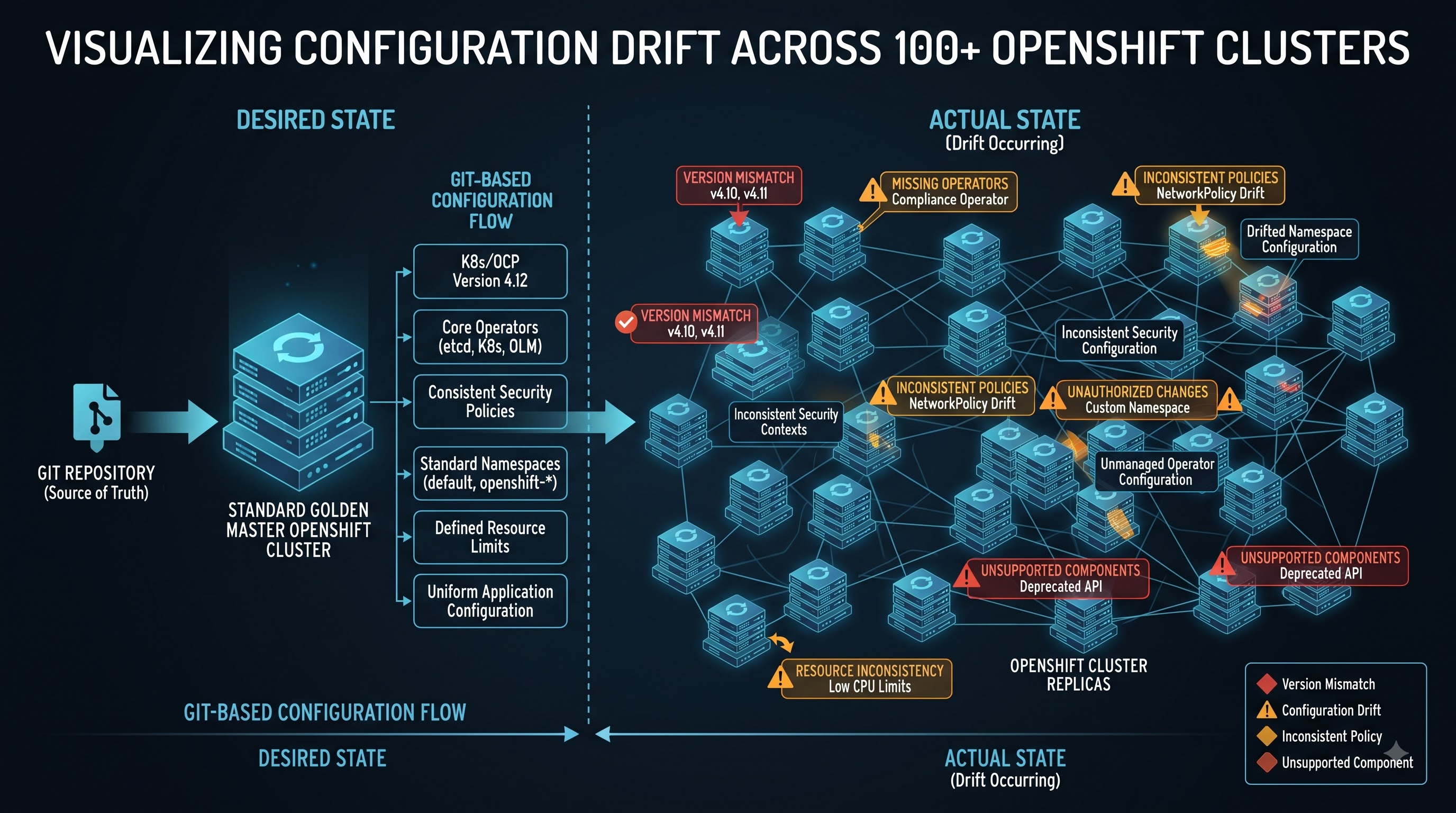
The same issue appears with configuration. Imagine that an organization defines a standard security baseline for production clusters. Over time, administrators make changes to individual environments to solve application issues, accommodate infrastructure differences, or respond to incidents. Some changes are documented, while others are not. Eventually, clusters that were originally created from the same baseline begin to look different. This is configuration drift. Drift can remain invisible because a cluster does not necessarily stop working when its configuration changes. The problem becomes visible later, perhaps during a security audit, an upgrade, an incident, or a troubleshooting exercise. The platform team may discover that an expected policy exists on most clusters but not all of them, or that two environments behave differently because their configurations have quietly diverged.
This is where desired-state management becomes important. Rather than relying on administrators to remember how every environment should be configured, organizations can represent the expected state through policies, declarative configuration, and version-controlled definitions. The platform can then evaluate whether managed environments continue to match that state. This is also where openshift training becomes more useful when it extends beyond basic administration. Understanding operators, policies, declarative resources, GitOps, lifecycle management, security, and multicluster architecture gives administrators the conceptual foundation needed to understand why fleet consistency matters. The goal is not simply to learn how to configure one cluster, but to understand how the configuration of many environments can be controlled systematically.
There is still room for exceptions. A production cluster may legitimately require something that another environment does not. The important point is that the difference should be intentional and identifiable. At scale, an undocumented exception is not just a configuration detail. It can become an operational risk.
GitOps Becomes the Operating Model for Repeatability
Once an organization reaches a large number of clusters, manual deployment becomes increasingly difficult to justify. The problem is not only the time required to perform the same task repeatedly. The bigger concern is whether the same task will be performed consistently. Suppose an application needs to be deployed to 60 production clusters. A manual process requires administrators or application teams to repeat the deployment across multiple environments. Even with careful procedures, there is room for mistakes. A configuration value can be missed, an environment can be skipped, or a change can be applied to the wrong cluster. When the same application is managed across a large fleet, these small differences can become difficult to track.
GitOps provides a different model. Application and configuration definitions can be stored declaratively in version-controlled repositories, allowing the desired state to be reviewed, approved, and synchronized into the appropriate environments. Instead of asking an administrator to remember which commands need to be executed on each cluster, the organization defines what should exist and allows the GitOps system to reconcile that desired state.

The advantage becomes particularly clear when applications are distributed across regions. The same application may need to run in multiple clusters while still having regional differences in replica counts, storage, networking, or resource allocation. A good GitOps structure can maintain a common foundation while representing those controlled differences explicitly. This also creates a record of change. If an application suddenly starts behaving differently, the platform team can investigate the configuration history and determine what changed. If a deployment needs to be rolled back, the team can return to a known version rather than reconstructing the previous state from memory. However, GitOps does not eliminate architecture decisions. Managing five clusters and managing 100 clusters are different problems. Repository organization, application grouping, environment-specific configuration, secret management, synchronization, controller capacity, and promotion strategies all need to be considered. The objective is not to create one enormous repository containing every possible configuration. The objective is to create a structure that makes ownership and desired state understandable.
This is why GitOps becomes more than a deployment technique at fleet scale. It becomes part of the organization's operating model. Platform teams can define common configurations, application teams can manage their workloads through approved workflows, and changes can move through environments in a controlled manner. The result is a shift away from “an administrator changed something on a cluster” toward “the platform's desired state changed, and the relevant clusters reconciled toward it.” That is a much more scalable way of thinking.
Observability Has to Become Fleet Intelligence
Monitoring a single OpenShift cluster can already generate a large amount of information. Administrators may track node health, CPU and memory utilization, storage performance, application errors, pod states, network behavior, cluster events, and other operational signals. When similar information is generated across 100 clusters, collecting everything in one place does not automatically make the environment easier to understand. The real challenge becomes identifying what matters.
Imagine that several clusters suddenly begin showing increased application errors. Looking at each environment independently might lead administrators to treat every incident as a separate problem. Fleet-level observability can reveal that the affected clusters share a common OpenShift version, application release, region, infrastructure provider, or configuration change. That changes the investigation completely. Instead of asking why one workload failed, the team can ask what those environments have in common. The first question becomes whether the issue is local or systemic.
A useful observability architecture therefore needs multiple levels of visibility. At the highest level, the platform team needs to understand overall fleet health. When a problem is detected, administrators need to move into the affected cluster and examine nodes, namespaces, workloads, and application behavior. Application teams may then need even deeper visibility into their own services. This creates a natural hierarchy: fleet, region, cluster, node, namespace, workload, application. Each level answers a different operational question. The purpose of centralized observability is therefore not to create one enormous dashboard containing every metric. That can create another form of information overload. The objective is to make important patterns visible and provide a clear path from a high-level signal to detailed investigation.
This distinction becomes especially valuable during incidents. If one cluster experiences a problem, the platform team can investigate locally. If 30 clusters experience similar symptoms at approximately the same time, the problem may exist in a shared platform component, common configuration, application release, or infrastructure dependency. Without fleet-level visibility, administrators may spend valuable time treating symptoms individually. With the right observability model, they can recognize common causes much earlier. This is where OpenShift fleet management starts to resemble an analytical problem. The organization is no longer simply watching whether clusters are running. It is trying to understand patterns across a constantly changing distributed environment.
Security and Networking Stop Being Local Cluster Concerns
Security becomes more complicated as the number of clusters increases because every environment introduces additional identities, namespaces, workloads, permissions, secrets, network policies, and configuration requirements. The challenge is no longer simply securing each cluster independently. The organization needs to understand and enforce its security posture across the fleet.
A company might require production environments to use approved container sources, restricted permissions, defined network policies, and specific security configurations. Applying those requirements manually to every cluster creates both administrative effort and inconsistency. One environment may receive the latest policy while another continues operating with an older configuration. Centralized policy management can help organizations define controls and apply them to appropriate groups of clusters. But the grouping itself requires careful thought. Development, testing, production, edge, regulated, and specialized environments may not have identical requirements. The same principle applies to networking. Multiple OpenShift clusters rarely operate as isolated islands. Applications can depend on databases, APIs, identity services, message brokers, external systems, or applications running in other clusters. As environments become distributed across datacenters, cloud regions, and edge locations, communication between those environments becomes part of the overall application architecture.
A cluster can be completely healthy internally and still fail to provide a working application because an external dependency is unreachable. A service may be available in one region but unavailable in another. An edge location may experience intermittent connectivity. An application may require traffic to move between clusters during a failure. This means administrators need to understand routing, DNS, ingress, egress, service discovery, segmentation, latency, and failure domains in addition to the internal health of the cluster. For professionals, open shift training becomes particularly relevant when learning moves into these distributed scenarios. Understanding networking in a single cluster provides a foundation, but fleet environments require a broader view of how clusters communicate with enterprise systems and with one another. Troubleshooting can no longer stop at “the pod is running.” The important question is whether the application can actually reach everything it depends on. Security and networking therefore demonstrate the same underlying principle: once an organization has a large fleet, individual clusters become components of a larger system. Their relationships matter as much as their internal configuration.
Disaster Recovery and the Administrator's Role Change at Scale
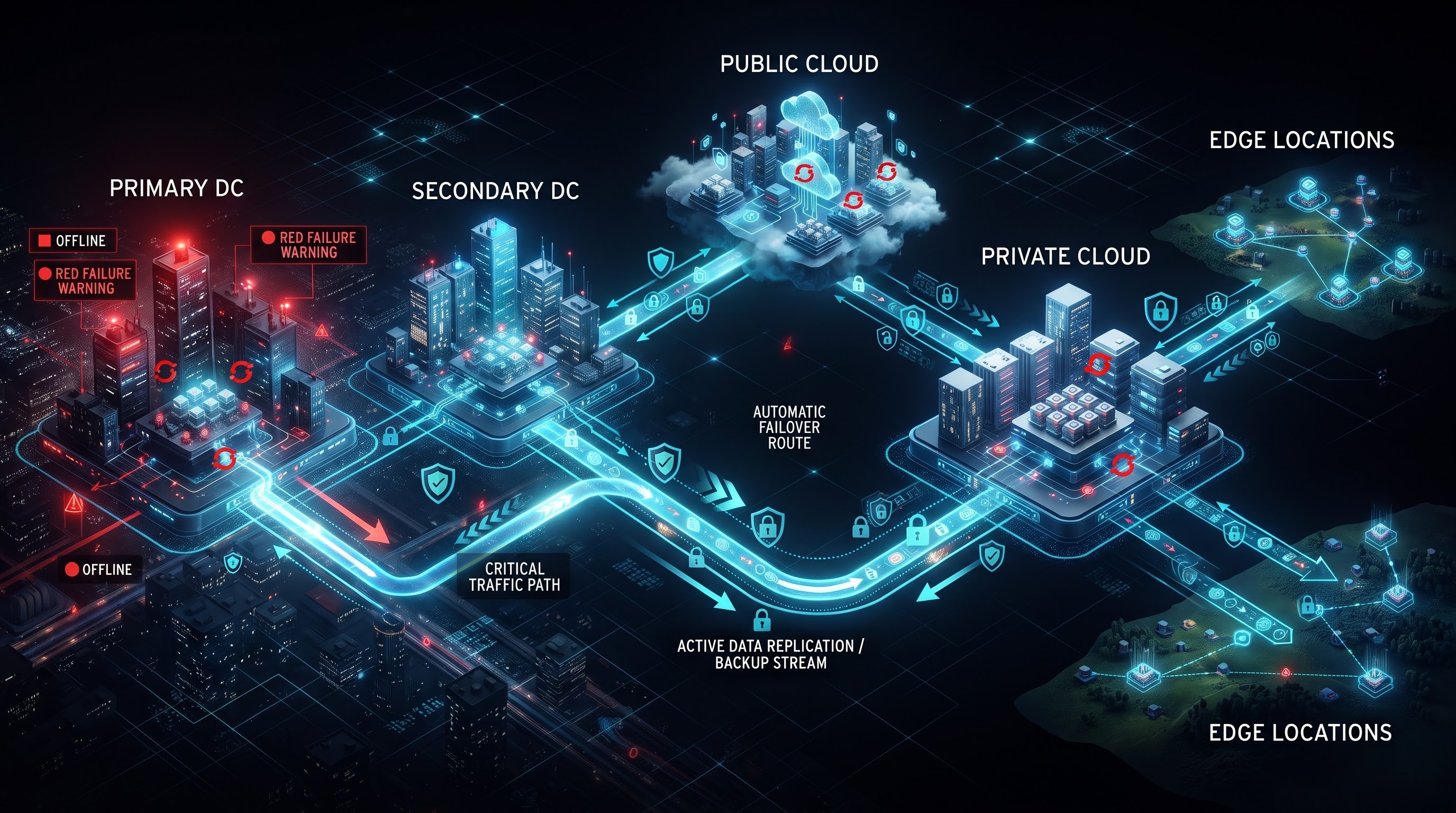
Disaster recovery becomes more complicated when an organization operates many clusters because the possible failure domains become larger. An individual application can fail while its cluster remains healthy. A complete cluster can become unavailable. A datacenter can experience an outage. A regional incident can affect several clusters simultaneously. Each situation may require a different recovery strategy.
The most important requirement is repeatability.
If a critical cluster needs to be rebuilt, the organization should not depend on an administrator remembering every configuration step that was performed months earlier. Infrastructure, policies, applications, and configuration should be reproducible through automation and declarative definitions. The same principles that make fleet management scalable can therefore make recovery more predictable.
A GitOps repository can represent application state. Fleet management can help establish and govern clusters. Policies can provide the expected configuration. Observability can validate whether the recovered environment is healthy. These capabilities become interconnected parts of the recovery process rather than isolated technologies. Not every cluster needs the same recovery strategy. A development environment can often tolerate a longer recovery period than a mission-critical production environment. An edge cluster may have different recovery constraints because of physical location or network availability. A regulated workload may have specific recovery requirements that do not apply elsewhere.
This is why organizations should classify their environments according to business importance and define recovery expectations accordingly. Standardization should provide the common foundation, while recovery requirements should reflect the importance and characteristics of each workload.
The same scale also changes the administrator's role.
Traditional OpenShift administration involves troubleshooting workloads, managing nodes, configuring storage, reviewing logs, maintaining cluster health, and responding to incidents. Those skills remain essential, but large fleets require administrators to think beyond individual resources.
If one pod fails, the immediate investigation may focus on that workload. If similar applications fail across several clusters, the investigation needs to move upward. The administrator has to ask whether a common deployment, platform component, configuration change, infrastructure dependency, or OpenShift release could be responsible. This is where automation and platform engineering become increasingly important. A manual fix may resolve one incident. A reusable automation workflow can prevent the same issue from appearing across dozens of environments. The mindset gradually changes from fixing a cluster to improving the platform that manages clusters. That is a major professional shift. The administrator becomes someone who designs repeatable operational processes, establishes guardrails, improves reliability, and reduces the amount of manual work required from everyone else.
The Real Challenge Is Not 100 Clusters—It Is 100 Different Operating Models
A fleet of 100 OpenShift clusters sounds like an infrastructure-scale problem, but the deeper challenge is operational consistency. If every cluster is provisioned differently, monitored differently, secured differently, upgraded differently, and maintained through individual manual procedures, the organization can become overwhelmed even before reaching 100 environments.
On the other hand, a large fleet can remain manageable when it is built around common foundations.
Cluster provisioning can follow standardized patterns. Security baselines can be defined centrally. Applications can be deployed through repeatable GitOps workflows. Observability can provide fleet-level visibility. Upgrade processes can be controlled through defined stages. Policies can be applied according to cluster classifications. Recovery procedures can be automated and tested. The important word is standardization, but standardization should not be confused with making every cluster identical. A mature fleet allows controlled variation. Production may differ from development. Edge may differ from datacenter. A specialized application may require unique infrastructure. What matters is that these differences are intentional, documented, and managed rather than appearing through uncontrolled drift.
This is ultimately what determines whether an organization can scale OpenShift successfully. Adding another cluster should not require creating another completely independent operating model. The new environment should inherit a proven foundation and receive only the additional configuration required for its particular purpose.
That also changes what professionals should expect from an openshift course. Learning how to deploy applications or troubleshoot individual pods provides an important foundation, but fleet-scale environments require a wider understanding of cluster lifecycle, automation, GitOps, security, observability, networking, policies, workload placement, and platform engineering. The more valuable skill is not memorizing every OpenShift command but understanding how these capabilities interact when infrastructure becomes distributed.
The hundredth cluster, then, is not the real test of scalability.
The real test is what happens after it arrives.
Can the platform team identify its state without manually inspecting everything? Can the organization apply security policies consistently? Can applications be deployed predictably? Can administrators detect configuration drift? Can an upgrade be introduced without turning into a fleet-wide risk? Can a failed environment be reconstructed? Can teams understand whether a problem affects one cluster or dozens? If the answer to those questions is yes, the organization has built more than a collection of OpenShift clusters. It has built an operating platform.
That is the real evolution from cluster administration to fleet engineering. The goal is not simply to make 100 clusters run. It is to make them remain understandable, secure, observable, consistent, and recoverable while they continue to change. At that scale, OpenShift is no longer just the place where applications run. It becomes part of a broader enterprise platform in which automation, governance, infrastructure, applications, and people have to work together. The organizations that handle this complexity successfully will not necessarily be the ones with the most clusters. They will be the ones that have built the strongest system for managing change across all of them.