
A Complete Financial Guide to Workday HCM Implementation Costs
Last updated on Aug 11, 2026
For businesses that are looking into modernizing Human Capital Management, Workday is an accomplished name when it comes to unified, cloud-based technology. Its single-database setup, analytics, and customizable workflow engine can be game-changing for companies worldwide.
Sadly, Finance, HR, and IT decision-makers quickly realize that this seemingly top-notch software appears to be an expensive proposition only during implementation.
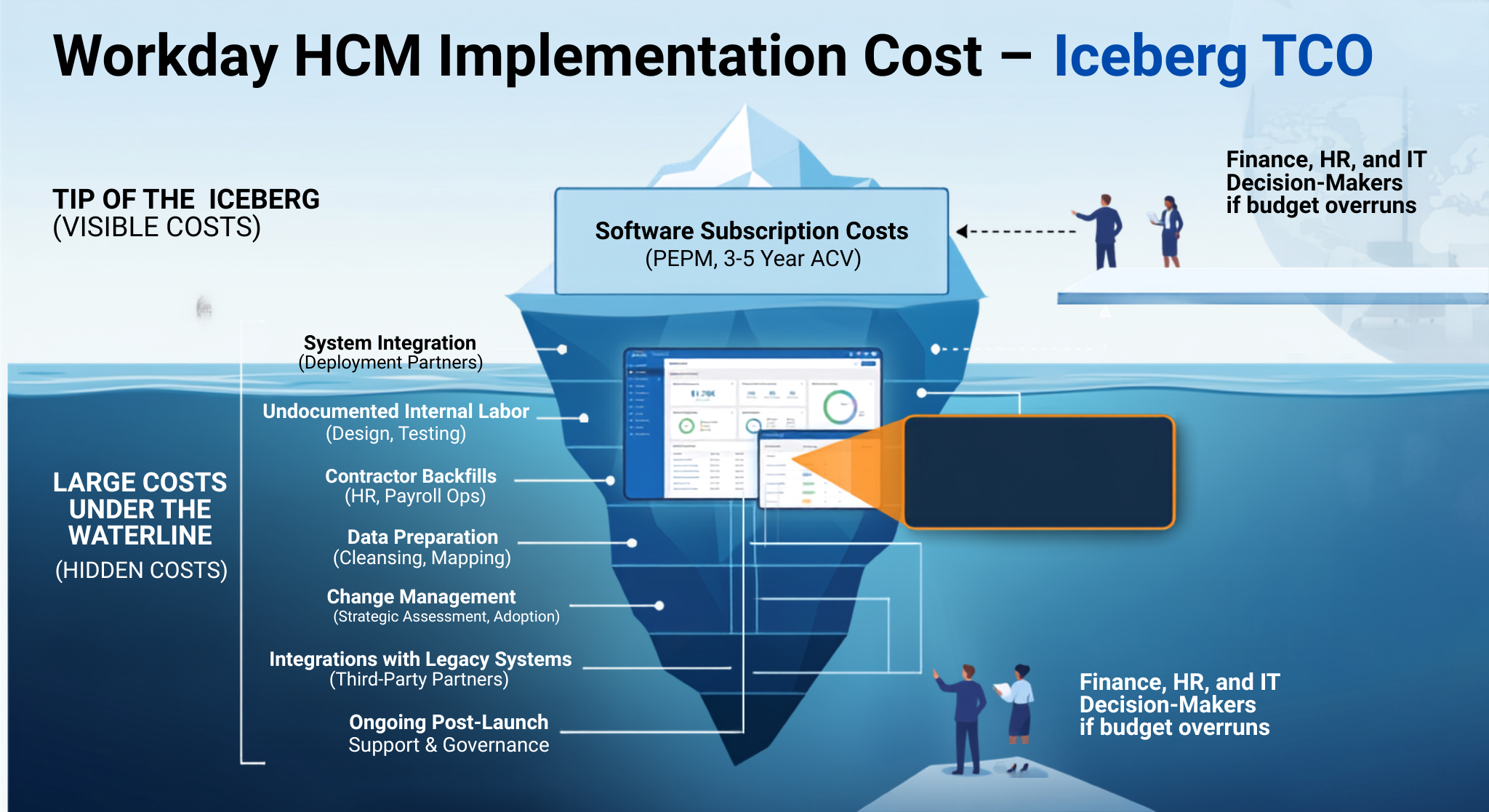
This means that evaluating the rollout of a Workday HCM solution via the Annual Contract Value KPI will result in budget overruns. Indeed, the implementation of a Workday platform is more like an iceberg: we see just the tip of it in the form of software subscription costs while system integration, data preparation, recruiting and filling positions internally, managing the change, etc., form large costs under the waterline.
This guide outlines all costs associated with the implementation of Workday HCM, presenting executives with a real Total Cost of Ownership model, industry benchmarks, and sensible advice to avoid budget overruns. To prepare their internal teams with functional skills needed for a smooth deployment, some companies pursue workday hcm training and put money into hcm training. A complete workday hcm course taken before implementation equips HR and IT leads to contribute efficiently to design, configuration, and user acceptance testing.
Software Subscription Licensing Distinctiveness
In contrast to traditional legacy software that charges based on user licenses or named seats, Workday's main licensing type is Per Employee Per Month subscription. Companies pay for each individual who receives a salary, whether it is a full-time employee, part-time employee, or even contingent worker, regardless of how often they log in to the tenant.
Although Workday offers a custom quote for each of its customers according to their scope, workforce, and contract duration, empirical market data usually sets indisputable standards for Per Employee Per Month. The basic HCM module cost for bigger companies with over 5,000 employees varies from $35-45 per employee per month. The fees for mid-sized companies also depend on module selections, but they are usually within the range of $45-80 per employee per month. In the past, Workday applied rigid minimum annual contract requirements of $250,000, while multi-year contracts from three to five years have become a common practice.
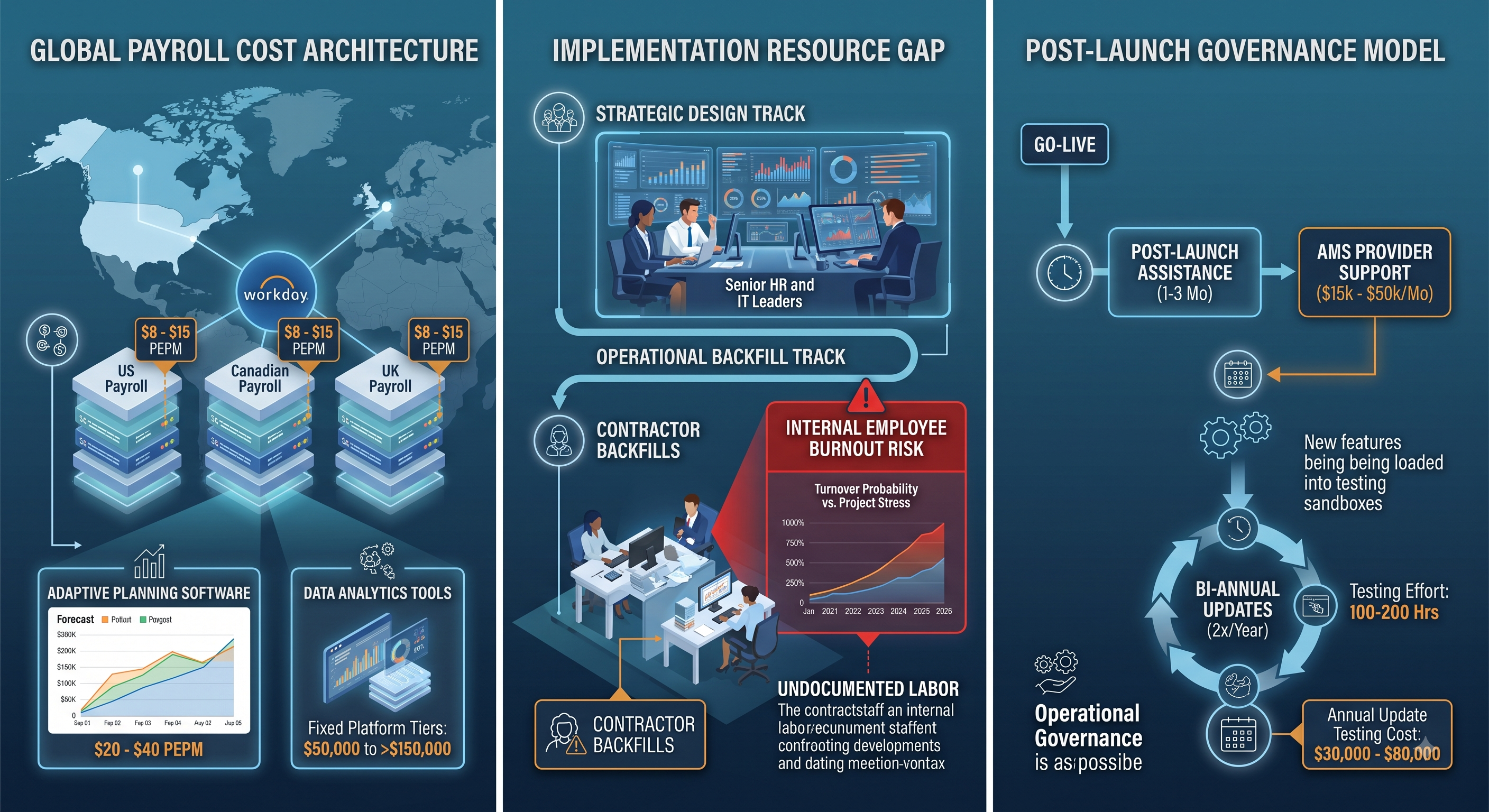
"Core HCM contains basic personnel data control, organizational frameworks, primary reporting, and general onboarding. Meanwhile, corporate transformations do not usually just stop at the core level. Add-on modules boost the initial rate very quickly. Adding US, Canadian, or UK payroll incurs an additional expense of $8-$15 per worker per month. Recruiting and Talent Hiring incurs from $5 to $10 per employee for every month, while Workday Learning costs from $4 to $8. Strategic planning software, e.g. Adaptive Planning, costs $20-$40 per employee a year, and custom software expansions or big data analytics tools include fixed yearly platform tiers of $50,000 to over $150,000.
Consulting and Integrator Expenses
The biggest expense in the first year could be the payment to a Workday Deployment Partner, which may exceed the amount of money spent on software subscription even."
Around 100% to 150% of the Annual Contract Value (ACV) for the first year is the rule of thumb for deployment services throughout various industries. If an organization's annual software cost is $1.5 million, then the usual professional services agreement with the systems integrator will lie in the range of $1.5 to $2.25 million. For international deployments that require a company to implement payroll in multiple countries, comply with local laws in a dozen of countries, and create complex integrations with legacy systems this price ratio can increase to 200% or more.
The cost of working with a partner for a deployment project will determine how quickly the implementation will proceed. Global Systems Integrators including the Big Four are focused on catering to Fortune 500 companies which typically have complex organizations and will be charging clients from $250 hourly for staff consultants to $1000 for partners and subject-matter experts. Smaller companies specializing in solutions for medium-sized customers’ needs and particular state practices are always more lenient and charge considerably less – $150-300 per hour.
Undocumented Labor: Assigning Resources and Filling Gaps
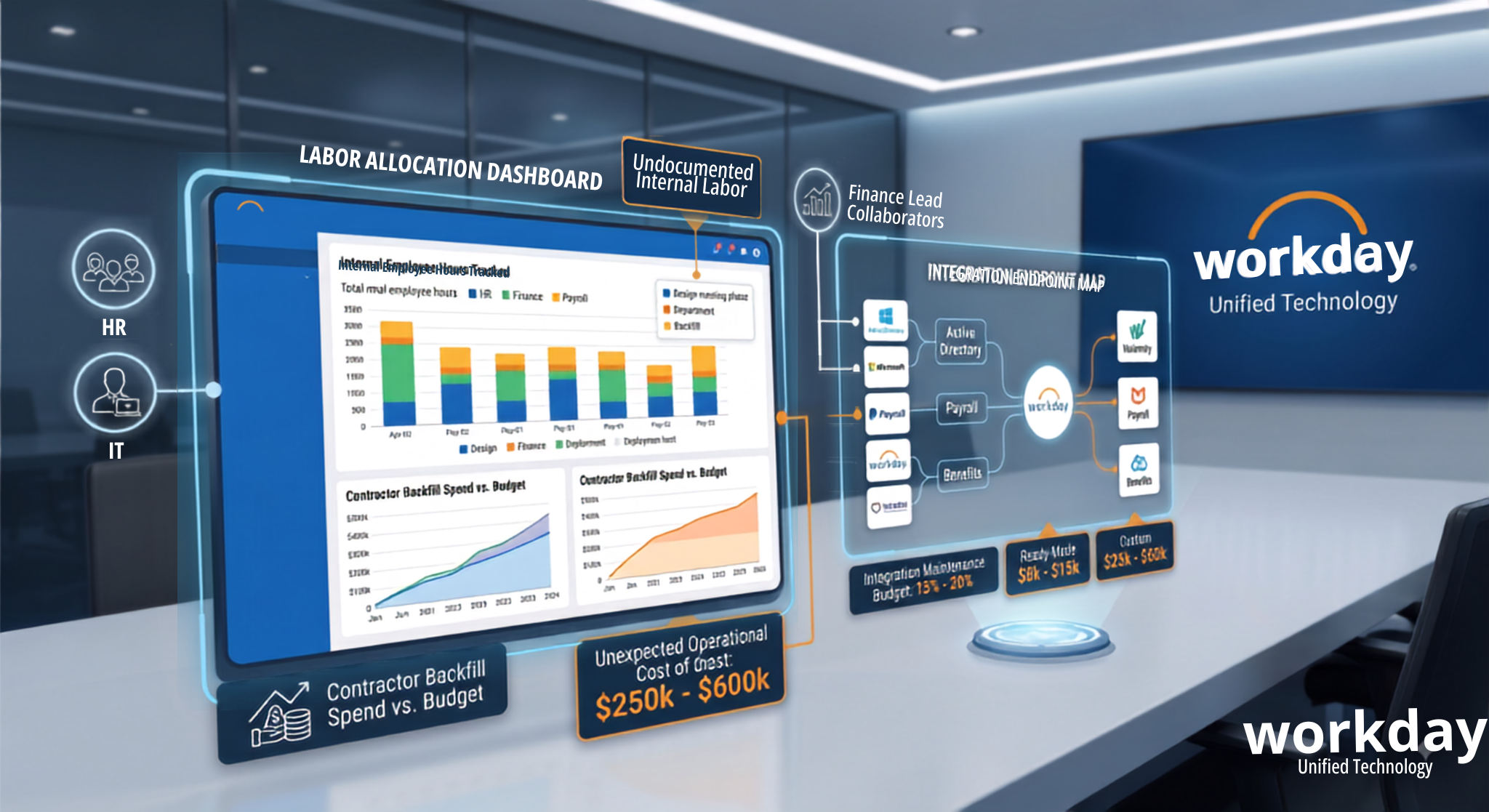
A major contributor to companies exceeding their budgets on projects is lack of accounting for internal employee allocation. Workday provides services to clients according to their needs. The integration partner sets up the Workday tenant according to the specifications of the organization. However, the internal teams of the organizations must identify these requirements, test prototypes, write test scripts, and run complete user acceptance test cycles.
Leaders of the organization’s HR, payroll, and finance departments often spend several months in design meetings full-time. With daily operations needing to be carried out, organizations are left with two choices:
For Contractor Backfills, it is suggested to recruit people temporarily for the operational work in HR and payroll while the core people are working on the implementation of the project. Based on the calculations on the average rates for specialized contractors in HR operations, a replacement of a team of ten people for a time frame of nine months may go up to $250,000-600,000 in unexpected operational costs.
In relation to Burnout and Turnover Threats, not allowing the backfilling process will trigger the internal team members to take responsibilities for two jobs at once which will cause the mistakes in configuration, delayed testing and approval, deployment tiredness, and imposing unnecessary costs on the members of the key platform.
Technical Integration and Data Transfiguration
Although Workday works as the key system of record for staffing, it is required to cooperate with third-party partnerships for the transfer of information.
Constructing and validating solid integrations involves notable expenses. Ready-made connectors are offered at prices between $8,000 and $15,000 for each endpoint, while creating custom application integrations with complex multi directional data transformations costs about $25,000-$60,000 for each endpoint. Continuing maintaining integrations requires between 15% to 20% of annual budget for any integration to follow vendor API updates and legal modifications. Integrating Workday with 25 vendor endpoints may cost between $400,000 and $850,000.
Data migration is another concern worthy of note. In order to move old data from various databases into the solid data architecture of Workday, the process usually requires a lot of data validation, mapping, and cleansing. Also, when moving data from various databases to Workday, the process might take significantly more time, because extensive records need to be extracted, transformed, and loaded. The cost of frequent consulting support in cases of data cleaning amounts to $100,000-$300,000.
Change Management and Training
It is very important for people to understand and utilize the technological resources which are critical for Workday in order to let this technology have an effect on people. Workday implementation involves HR duties moving from traditional methods to self-service implementations of HR processes. Hence, this change will lead to a need for a structured change management approach.
Various industry specialists usually recommend allocating about 10% to 15% of the specified budget only to project management. Not allocating enough budget for project management is one of the main reasons for ignoring it and waiting longer to achieve a positive return on investment, such as too many support tickets, the manager's opposition, and bottlenecks during the operation of the system.
Some of the major changes in project management include strategic change assessments, communication campaigns, and digitally-based tools that can be applied to the interactive interface. Furthermore, through structured workday hcm course, the establishment of expertise within the organization will allow internal teams to manage the necessary reporting and configurations of tenants independently. Nevertheless, while the Workday specialized online courses can cost upward of $3,000 to $5,000 for each certification course track, the companies will also have to budget for assessment of enterprise learning enablement packages designed for advanced users at a cost of $50,000 to $150,000 per year, depending on company size.
Post-launch Assistance, Steering, and Enhancements
Launching does not signify the end; it means entering into operational governance. One of the frequent mistakes in budgeting is to believe that internal teams will take the reins once the implementation partner leaves.
Typically, post-launch support lasts for between a month and three months. Afterwards, organizations tend to hire Application Management Services providers to help with complicated configuration processes and third tier technical issues. The costs for these services range from $15,000 to $50,000 a month, depending upon response times of the provider and hours allocated for solving problems.
Moreover, there are two major updates made by Workday every year. Although these cloud updates are automatic and do not require downtime of the infrastructure, they do require proper evaluation of new functionalities. The team members have to test the workflows and the effectiveness of new features. The time spent on testing the updates falls within the frameworks of approximately 100 to 200 hours, which makes around $30,000-80,000 annually.
Approaches for Minimizing Implementation Costs
The implementation of five structures to maintain the scope of the project and ensure its profitability can start at the procurement stage.
Follow Pre-established Business Models: Avoid modifying Workday to fit existing practices. Every time the organization insists on following existing approval structures or complex conditions, the hours of consulting and expenses for long-term maintenance increase.
Limit the Scope of Integration Functions for the First Stage: Make a list of existing interfaces and make sure that the most important integrations (e.g. with active directory, payroll, and main providers of benefits) take place first, while other connections will wait for the second stage.
Prepare Data in Advance: Start your internal cleansing of the data three-six months before your partner arrives. Make an audit of the addresses, correct working positions of the employees, change management hierarchies, and store old data internally instead of paying for help from consultants.
Negotiate Fixed-Fee Milestones: Where possible and practical, move away from open-ended Time and Materials agreements. Instead, seek Statement of Work provisions associated with transparent milestone approvals and specify defined contingency metrics between 10 to 15 percent.
Begin Investment in Internal Employees’ Training As Early As Possible: Enroll key functional leaders in a comprehensive workday courses at the earliest stage of designing the solution. Providing employees with structured workday hr training remotely permits them to perform custom business process testing, data mapping, and custom report generation in cooperation with implementation specialists and substantially lowers the number of hours spent on external vendors.
Workday HCM is a key strategic technology that has the ability to enhance productivity, improve workforce visibility, and increase operational agility. However, in order to achieve the promised results, a realistic budgeting framework is needed from the very beginning.
By considering the fact that software licensing accounts for less than half of the initial cash demands, management can prepare accurately estimated budgets comprising system integration expenses, technical interfaces, data remediation activities, and change management processes. One brilliant option of decreasing the necessity of relying on foreign consultants is to upskill internal administrators through workday hcm training distance learning. The option of receiving hands-on project experience via specialized workdays courses and targeted workday hr training via distance learning is the guarantee of internal HRIS team achieving self-sufficiency and maximizing ROI of the entire platform.
Regional Regulatory and Global Localization Factors
Implementing Workday HCM in various areas raises numerous legal, regulatory, and expense issues, which are often dismissed by the standard enterprise budgeting practice. Organizations operating globally think that their core cloud migration will fix all local regulatory issues, but in reality, compliance with local labor laws, transfer legislation, and trends in labor regulations in individual countries calls for highly targeted approaches in strategy and configuration as well as for specialized consulting services.
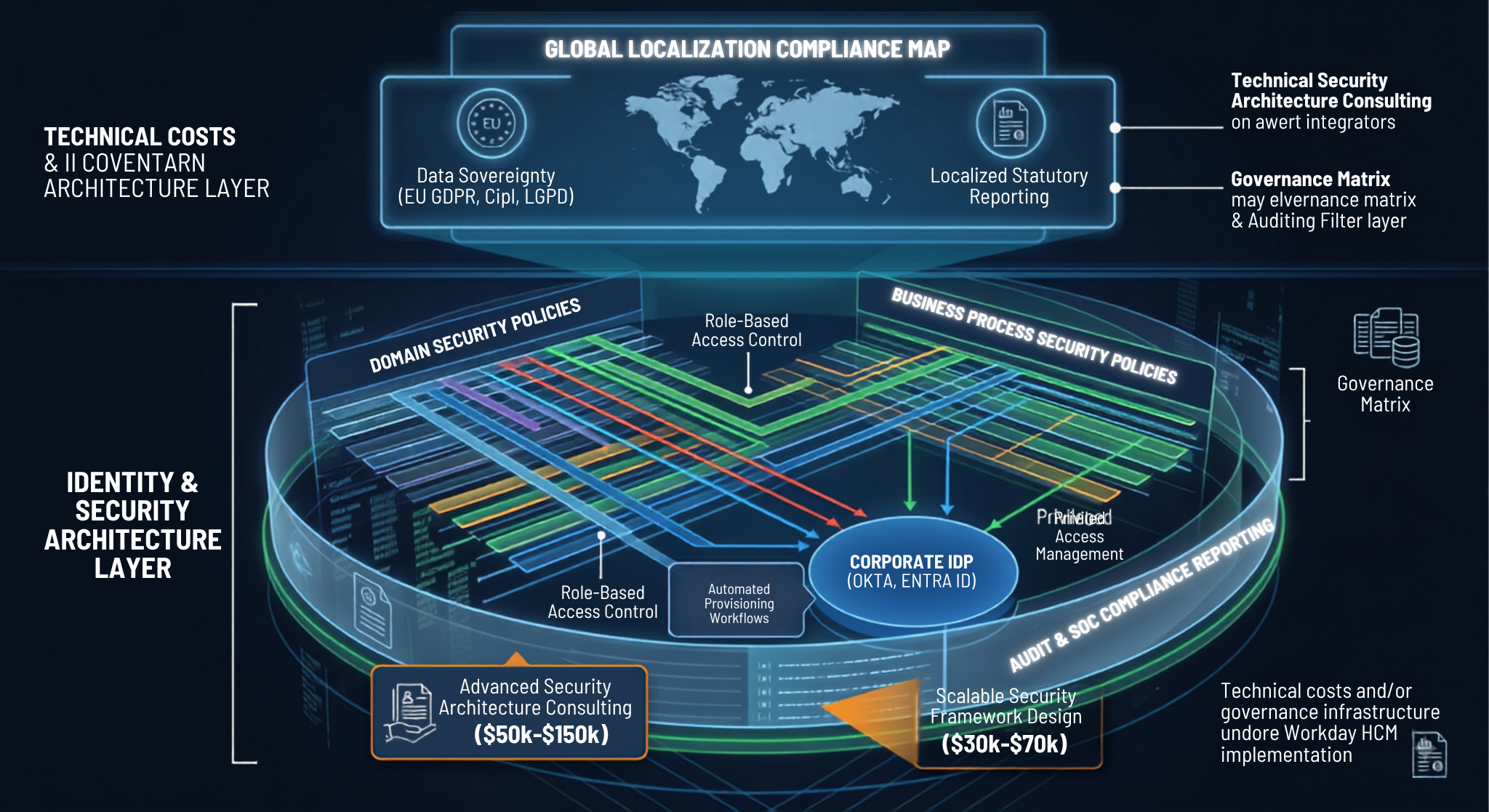
Data sovereignty and international transfers have become very sophisticated areas in terms of regulatory compliance today. To comply with the regulations, e.g., the EU General Data Protection Regulation, China Personal Information Protection Law, and the General Data Protection Law in Brazil, one needs particular tenant architecture that has to be designed and employed together with special controls of localization and management of consents. The correct implementation of controls of data residency and encryption of personal data on the field level along with the organization of legal procedures of international transfers often requires not only expert consulting on privacy regulations but also consulting on the advanced security architecture in the range of $50-150k at the outset.
Integration of Works Councils and Labor Unions: The use of new personnel technology in various European nations like Germany, France, and the Netherlands necessitates seeking formal consultation and acquiring co-determination approval from Works Councils and labor unions beforehand. Usually, a lengthy negotiation process must take place to acquire consent for implementing self-service solutions, performance monitoring systems, and workers’ visibility, which can last from three to nine months. The lengthy nature of negotiations means additional expenses due to consulting fees, additional resources and tailor-made, functional solutions that ensure restrictions in management access to the information related to the project.
Localized Statutory Reporting and Leave Requirements: Despite the fact that Workday offers a plethora of local solutions for major markets, it is still necessary to draw up a unique business process framework for smaller regions to enable compliance with local regulations. Different rules for parental leave accrual, holidays, mandatory governmental report submission, and payments upon dismissal require a tailored solution to be created, which may require additional $60,000-$120,000 for deploying.
The Invisible Infrastructure: Identity Management, Security, and Cloud Architecture
Although Workday is a cloud-based SaaS solution, it also entails significant secondary infrastructure and administrative expenses within the context of the company’s overall information technology and security environment. In order to achieve effective access control systems, automated provisioning, and reliable auditing protocols, constant interaction between human resource information systems and information technology security teams is required.
Single Sign-On and Access Control Management: To integrate Workday with the corporate identity provider, such as Okta, Microsoft Entra ID, or Ping Identity, it is necessary to establish automated user lifecycle management. Indeed, real-time provisioning and de-provisioning on the basis of the worker status modifications in Workday is aimed at avoiding security risks but requires advanced API management. The initial cost of configuring automated identity workflows, implementing access control mechanisms, and accessing privileged access control systems is estimated at twenty to forty-five thousand dollars.
Security Model with Complexity and Governance in Matrixed Way: Workday uses a good-quality and feature-rich security model of domain security policies, security policies regarding business processes, and security groups that are based on a role of the user. Security models are often very complicated as the company grows with the result of problems related to performance, unauthorized access to data, or difficulties in administration. In order to build a scalable security framework with auditing during the implementation phase, one has to have dedicated architects, which adds an amount of money that varies between thirty thousand to seventy thousand dollars to the estimation of the design.
Audit, Compliance, and Reporting Related to SOC: Enterprise risk management requires that cloud computing systems that work with sensitive financial and personal information must be thoroughly recorded and audited. If the organization is subject to Sarbanes-Oxley or other legislative measures, such monitoring, separation of duties, as well as compliance reporting, must be set in Workday. Hiring auditing firms to evaluate the level of security of the environment before going live would add another twenty five thousand to sixty five thousand dollars.
Vendor Lock-In and Contractual Manifestations Following Implementation
Sustainable fiscal management of a Workday ecosystem requires knowledge of contracts and vendor management after implementation concludes. The multiyear agreements of SaaS will normally have provisions regarding escalations, renewals, and licensing which will determine Total Cost of Ownership of a company for a five to ten year period.
Contract escalator clauses: Typical Workday enterprise contracts will normally set the Per Employee Per Month price for a duration of three to five years. However, the renewal provision will normally indicate an annual increase of three to seven percent on the contract expiry date. The failure to negotiate the contract proactively leads to cumulative subscription costs for the software.
Auditing True-Up and Change in the Number of Employees: With the Per Employee per Month license pricing, organizations are required to conduct an audit each year on the number of active employees. An annual true-up audit may result in unforeseen licensing fees for a company if the number of employees grows unexpectedly. It is essential that an organization has an established classification system for workers to know which ones could be classified as inactive workers.
Module Dependency: Incorporation of new features into a platform always involves additional costs. The implementation of advanced analytical tools such as Prism Analytics or talent acquisition solutions such as Peakon Employee Voice usually implies subscription fees and professional services. A contract management consultant could be retained to assess new modules in order to ensure they deliver valuable results for an organization.
Value Realization and ROI Measurement
In order to validate the Total Cost of Ownership of implementing Workday HCM, executives must monitor and evaluate the metrics of value realization with respect to financial projections. The key challenge in achieving a successful implementation is to ensure that the technological capabilities are transformed into value creation in terms of operating efficiency, reduction of risks, and lower costs for the company.
Operational Cost Reduction Metrics: Assessing the ROI of implementing Workday requires monitoring some vital indicators of operational effectiveness. Some metrics are decreased HR processing time, cancellation of the outdated software licenses, lower costs of outsourced payroll, and reduced mistakes in benefit administration. The companies which monitor these metrics report improvement by around 15-25% regarding efficiency within 18 months after the go-live.
Strategic Value Drives Assessment: Beyond operational savings, Workday can create strategic value for organizations due to higher retention of talent, increased visibility of the workforce, and better process of managerial work. The access to the necessary data allows organizations to reform quicker, create better compensation plans, and hire more talented people in a data-driven way. The creation of Value Realization Steering Committee to evaluate the metrics of adoption and operations.