
Automating ServiceNow Incident Classification with ML
Last updated on Nov 26, 2026
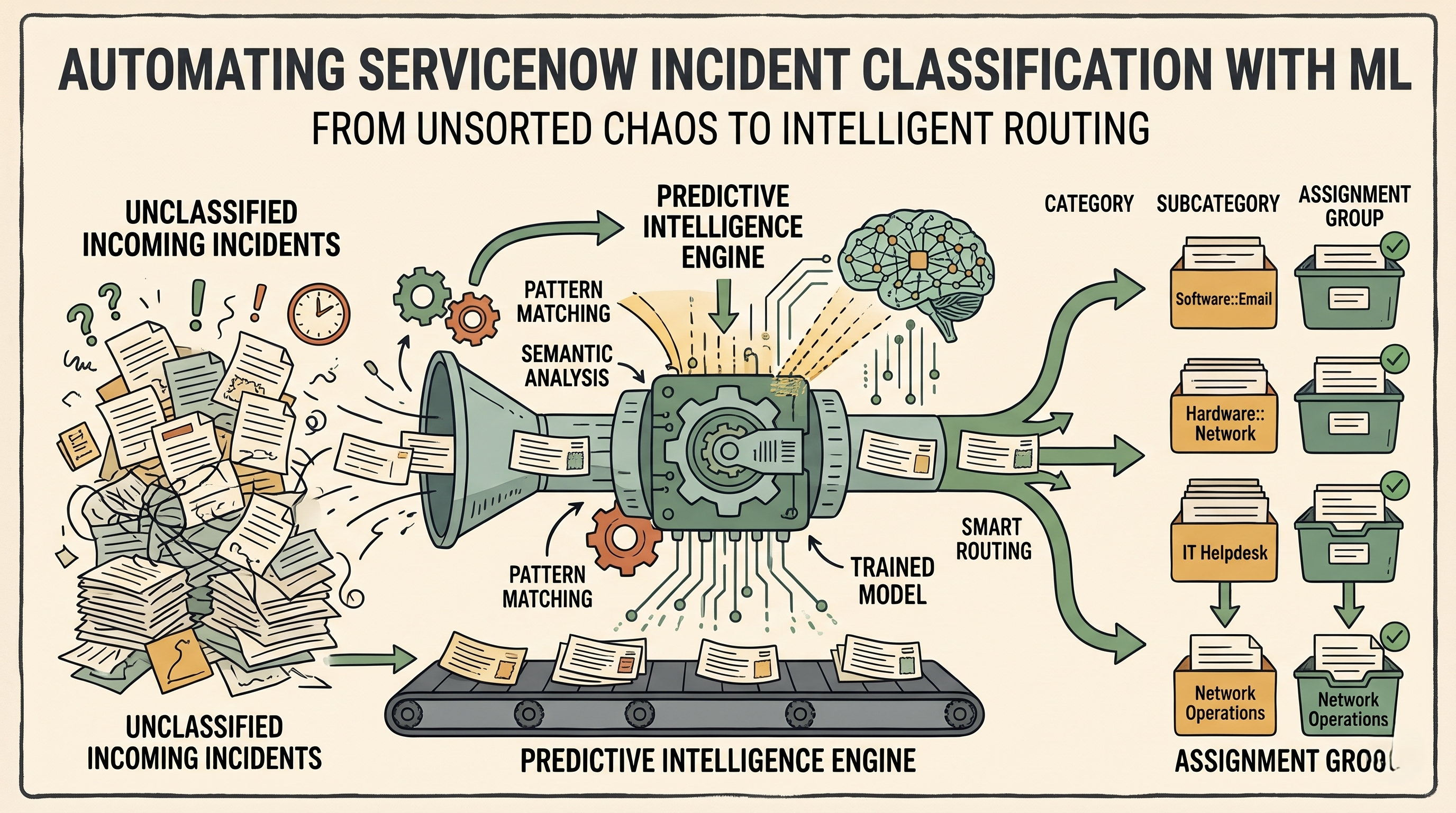
The modern enterprise IT environment experiences thousands of service disruptions every single day. Incoming tickets range from routine password lockouts and VPN connectivity failures to critical database outages and enterprise application failures. The sheer volume of these tickets can easily clog traditional service desk operations. The speed and accuracy in which a ticket is categorised, prioritised and routed directly determines how fast normal operations can be restored when an employee reports an issue. Historically, organisations have relied on manual triage whereby a human agent reads the incoming description, selects category and subcategory values from a dropdown, guesses the correct assignment group, and manually routes the ticket through the system. This works for a small scale, but in a growing enterprise manual incident classification becomes an operational bottleneck quickly. This results in alert fatigue, misrouted tickets, breached service level agreements and frustrated end users.
It's this friction that enterprises are increasingly turning to machine learning to remove in the ServiceNow ecosystem. Native capabilities such as ServiceNow Predictive Intelligence and Task Intelligence can be leveraged by organisations to train supervised ML models on their own historical ticket data. No more brittle, hard-coded keyword rules that break as soon as an employee uses slightly different wording. Machine learning algorithms will read the semantic context of an incident’s short description, detailed description and metadata, and predict the exact category, subcategory, service offering and assignment group in milliseconds. This is an end to end guide on the architecture, lifecycle, approach to implementation, governance and business impact of automating incident classification in ServiceNow using machine learning.
The Bottleneck of Manual Triage Operations
Before we get into the transformative value machine learning can bring to IT Service Management, we need to look at the hidden costs of traditional manual triage. In a typical service desk scenario, an incident is captured in the system via an email, a self-service portal form, a phone call or a monitoring alert. Important classification fields such as Category, Subcategory, Configuration Item, and Assignment Group are frequently left blank or populated with generic defaults such as “Inquiry” or “General Support” when the ticket is submitted by the user via email or a free-text portal entry.
When a Tier 1 service desk analyst opens the ticket they have to mentally translate the user’s narrative, check internal routing matrices and make an educated guess as to which resolver group owns the underlying system. Even the best-trained agents make mistakes, especially in large, complex organisations that have hundreds of microservices, regional support teams, and shared vendor responsibilities. One misclassified ticket results in what industry practitioners call “ticket ping-pong” or multi-hop reassignment. The ticket sits in the wrong queue for hours until an engineer realises it’s in the wrong place, assigns it to a second team and restarts the waiting clock.
Each unnecessary reassignment increases Mean Time to Resolution, reduces end-user productivity and skews operational reporting. If thousands of tickets are mislabeled as “Software,” but are actually “Network” or “Identity Access” issues, IT leadership is blind to the real root causes and can’t deploy engineering resources properly. Moreover, human triage will always introduce inconsistencies between shifts, geographical areas and agent tenure levels. One analyst may record what another analyst calls a high-urgency application bug as a low-priority user training request.
Why Rule Based Automation Doesn’t Work
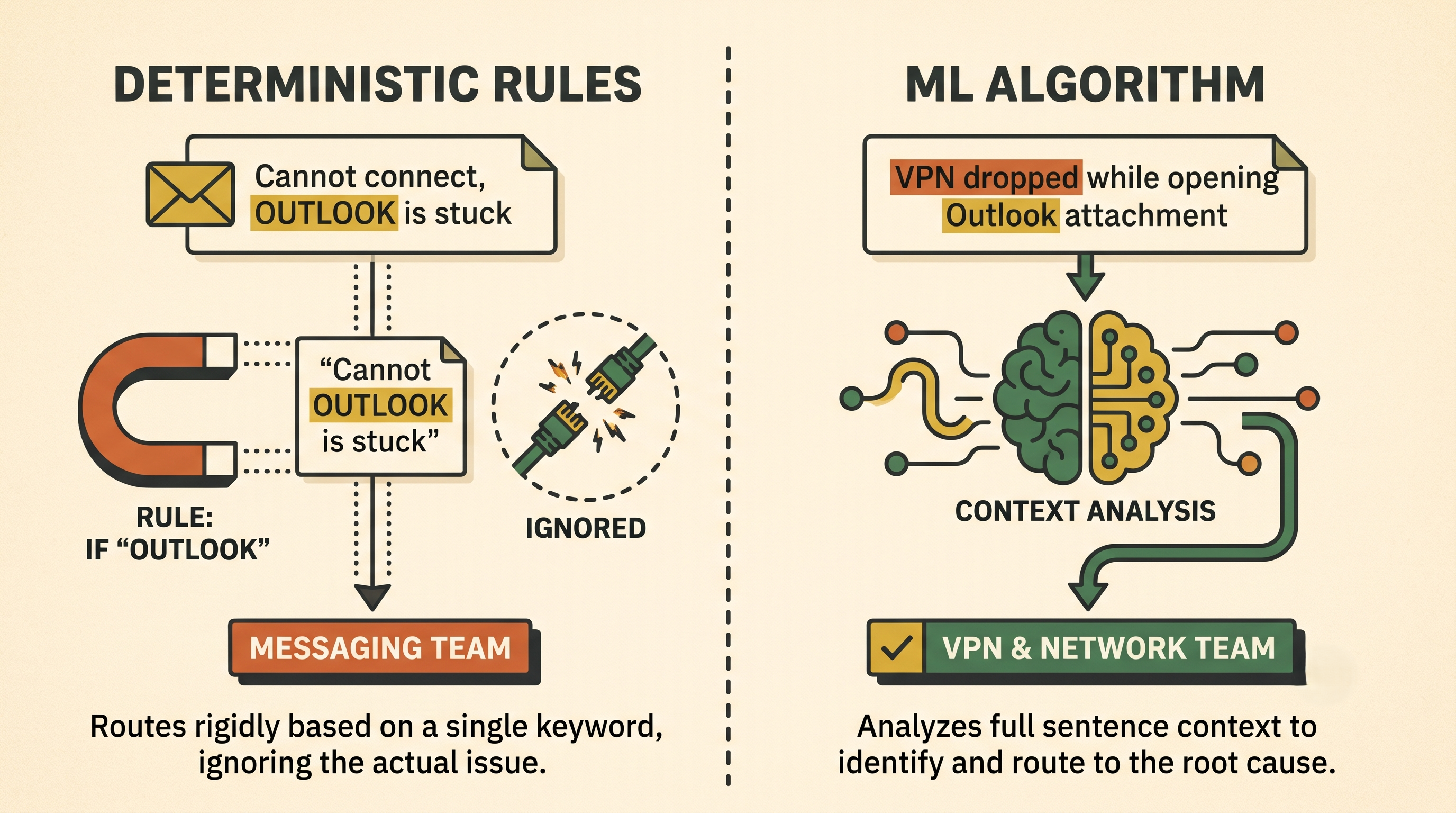
Many ServiceNow admins will first try deterministic business rules, inbound email actions or legacy workflow conditions to solve the classification problem before turning to machine learning. These rules usually look for certain keywords in incoming text, like sending any ticket with the word “Outlook” to the Messaging Support group, or anything with the word “printer” to Desktop Engineering.
Simple rules with keywords are fine in very predictable situations, but in the complexity of the real world, they quickly break down. Natural human language is noisy, ambiguous, and context sensitive. Imagine an employee who says they can’t open an attachment of a spreadsheet in Outlook because their VPN dropped when they tried to access a shared network drive. A naive keyword rule that would catch "Outlook" would send the ticket to the Messaging team, even if the real root cause was VPN infrastructure or network storage.
And deterministic rules require continuous manual maintenance. When an organization adopts a new SaaS platform, reorganises an IT department or rebrands an internal application, administrators must audit and rewrite dozens of nested conditional statements. This creates over several years technical debt, Spaghetti logic of conflicting assignment rules where order of execution is impossible to debug. The machine learning approach addresses both problems simultaneously, dispensing with strict string matching in favour of probabilistic pattern matching learned directly from solved historical incidents.
ServiceNow Machine Learning Architecture
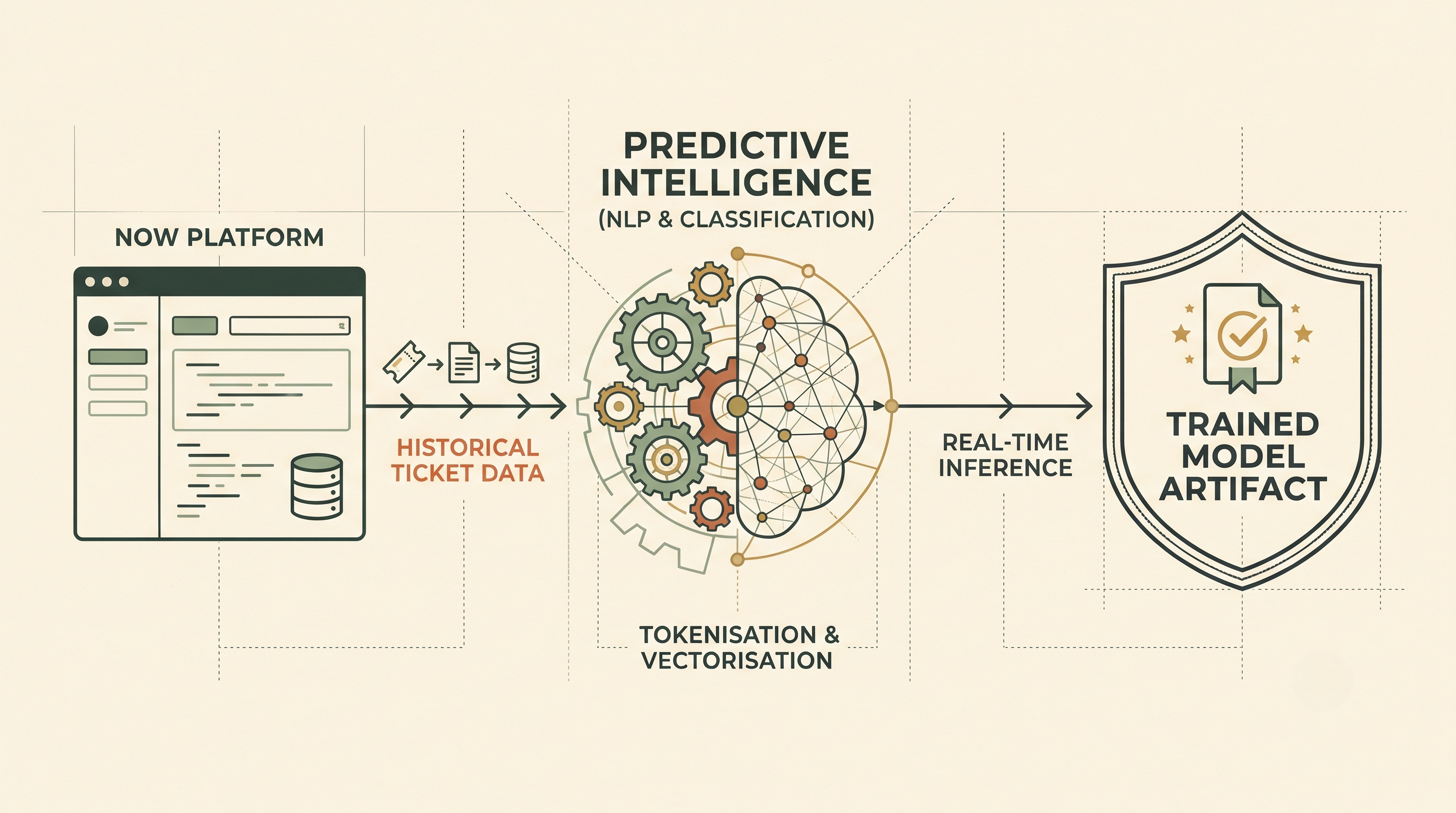
ServiceNow embeds machine learning directly into the Now Platform architecture with Predictive Intelligence and the newer evolution, Task Intelligence. ServiceNow’s native machine learning engine runs inside the platform’s security boundary—not by exporting sensitive corporate data to external cloud buckets, building custom Python pipelines and maintaining fragile REST API webhooks like third-party integrations.
The Classification framework, a supervised machine learning capability that predicts discrete field values on task records, is at the heart of incident classification. When an administrator configures a classification solution, the ServiceNow instance securely packages a sanitised snapshot of historical incident records, with defined input fields and target output fields, and ships that training dataset to ServiceNow’s dedicated machine learning training infrastructure. The unstructured text is processed using natural language processing techniques (e.g., tokenisation, stop-word removal, stemming and term-frequency inverse-document-frequency vectorisation) and structured categorical metadata using specialised algorithms.
The trained model artefact is returned to the ServiceNow instance once the algorithms have tested several candidate models and identified the most statistically accurate representation of the organisation’s data. All inference is real-time, and fast from there on. Every time a new incident is created or updated, business rules or Flow Designer actions call the trained model using lightweight platform APIs and are provided with the predicted field values, along with an accurate confidence score for each prediction.
In addition to the core Classification framework, ServiceNow also offers complementary machine learning capabilities that improve accurate triage. Similarity models look up the history for similar incidents, and open major incidents to trigger relevant knowledge articles or notify the agents of emerging widespread outage. Clustering models use unsupervised learning to analyse uncategorised ticket backlogs, revealing hidden patterns and suggesting new categories or opportunities for automation. Together, these frameworks provide a single layer of intelligence across the incident life cycle.
Cleaning and Preparation of Historical Data
The cardinal rule of enterprise ML is that your model can be only as good as the historical data you train it on. A training organization of a classification model on three years of messy, inconsistently categorised tickets is just going to automate those same historical mistakes, at machine speed. The most important step in any ServiceNow machine learning implementation is rigorous data preparation.
Start with the volume and quality of incidents closed or resolved in the past six to 12 months, administrators should consider. Training datasets generally need at least ten thousand to thirty thousand clean records to build good generalisation over dozens of categories or assignment groups. For narrow and well defined scope high accuracy can be achieved even with smaller data sets. In some cases, using data that is older than eighteen months may degrade performance if the enterprise’s IT landscape, application portfolio or organisational structure has changed significantly during that period.
And it is important to filter out the noise before starting model training. It is also not recommended to add automatically generated monitoring alerts to incident training sets submitted by humans. For instance , the class distributions can be severely skewed by the thousands of identical server ping failures produced by monitoring tools such as SolarWinds or Dynatrace. “We’re already applying deterministic event management rules to monitor integrations. Tickets closed as duplicates, cancelled or resolved with no reassignment history should also take precedence over tickets that bounced around five teams before someone manually corrected the category just in the nick of time.
Data hygiene also applies to the target taxonomy structure. Many organisations have unwieldy category trees with hundreds of old, overlapping or too granular sub-categories. If a given subcategory has only been seen a dozen times in the past year, there are not enough statistical examples for a supervised machine learning algorithm to reliably recognise it. Before heading down the machine learning route, IT process owners should rationalise their categorisation taxonomy. This means consolidating duplicate values, retiring inactive assignment groups and making sure that every remaining class has clear, mutually exclusive definitions.
Develop and Train Classification Solutions
Administrators can configure the classification solutions in ServiceNow Studio or the Predictive Intelligence workbench when the underlying dataset is clean and well-structured. An effective solution needs to select the input features and the output targets carefully.
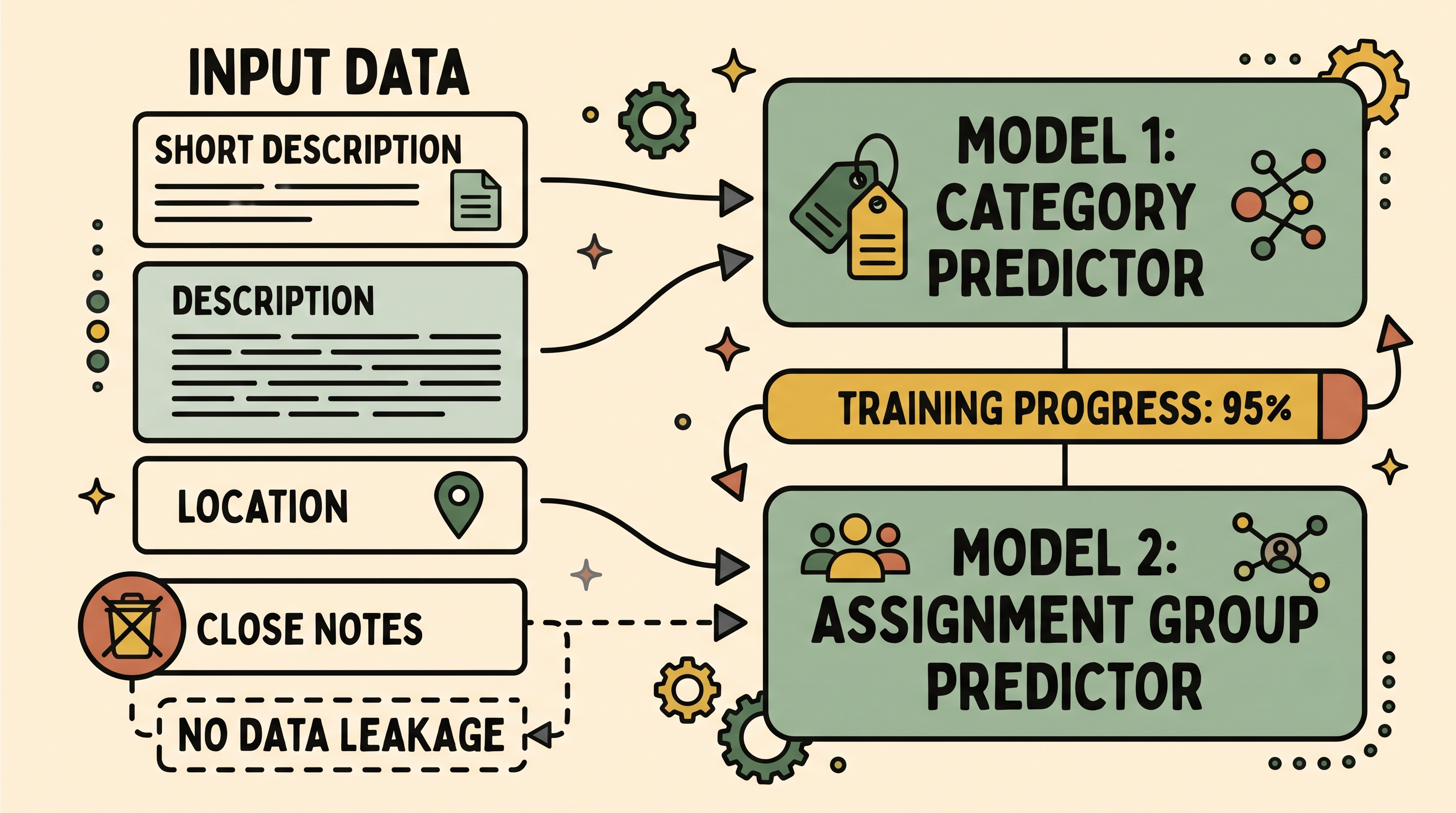
Typical Main Output Targets for Incident Classification The typical main output targets for Incident Classification are the Category field, Subcategory field, Business Service or Configuration Item field, and Assignment Group field. It’s a common architectural mistake to try to predict all of these fields together in one monolithic model. In practice, dedicated classification models trained for each target field provide much higher precision, and a lot more operational flexibility. For example, one model can be trained to predict only the Incident Category based on Short Description and Description. A second model could then be trained to predict the Assignment Group using the Short Description, Description, Location and the newly predicted Category as combined inputs.
The trick is to choose the right input fields. Signal vs noise. The most semantically rich fields are the Short Description and Description fields, which contain the exact wording of the symptom as entered by the user. However, when routing rules depend on geography or organisational division, adding structured contextual fields such as Contact Type, Caller Department, Location or Business Service can dramatically improve accuracy. Instead, administrators need to take care of removing the fields that cause data leakage or post-resolution bias. Please do not include fields such as Close Notes or Resolution Code as training inputs, as these are only populated by an agent when resolving the ticket and will be blank when a new incident is created.
This is where the administrator sets up the input, output and filtering parameters and starts the process of training. ServiceNow divides the historical dataset into the training and validation set, tries out various algorithmic approaches, and evaluates the metrics. The abstraction provided by ServiceNow eliminates all of the mathematics involved in this process and provides the option for the user to control the performance of the system through the system itself rather than forcing the user to become a data scientist and adjust the parameters manually. Many companies looking to develop admin skills of their own find it useful to blend it with servicenow training online at OnlineITGuru.
Understanding precision, coverage, and confidence thresholds
Evaluating a trained machine learning model should not be limited to the single headline accuracy percentage. Standard enterprise IT operations, precision and coverage are two metrics that determine if a classification model is safe to be automated in production.
Precision is the rate at which the model correctly predicts. For example, if the model predicts the assignment group of "Network Infrastructure" one hundred times, and out of those tickets, ninety-two of them are actually Network Infrastructure, then the model has a ninety-two percent precision for that class. High precision matters, as mis-automated routing breaks agent trust and delays incident resolution.
Coverage is similar to recall and is the percentage of total incoming incidents that the model predicts with a given confidence threshold. Every time the model checks out a new ticket, it produces a probability score that indicates how confident it is in its top choice. " I want to be ninety percent confident before I do something , " an administrator might say . This will provide very high precision . But you might only cover 40% of the tickets, and let the other 60% be triaged by humans . In contrast, if we decrease the confidence threshold, we increase coverage and can automate more tickets, but we increase the risk of false positives here and there.
ServiceNow includes interactive threshold tuning tools that enable administrators to see the trade-off between precision and coverage for each category or assignment group. It is best practice to use thresholds per class, not a global threshold for the whole model. For mission-critical teams like Cybersecurity Operations or Major Incident Management, administrators can set high-confidence thresholds to block false positives. For high volume low risk categories such as Password Reset or Printer Support, you can safely use slightly lower thresholds to maximise automation coverage and deflect manual effort.
Deployment Patterns: Agent Assist, Shadow Mode, Full Automation
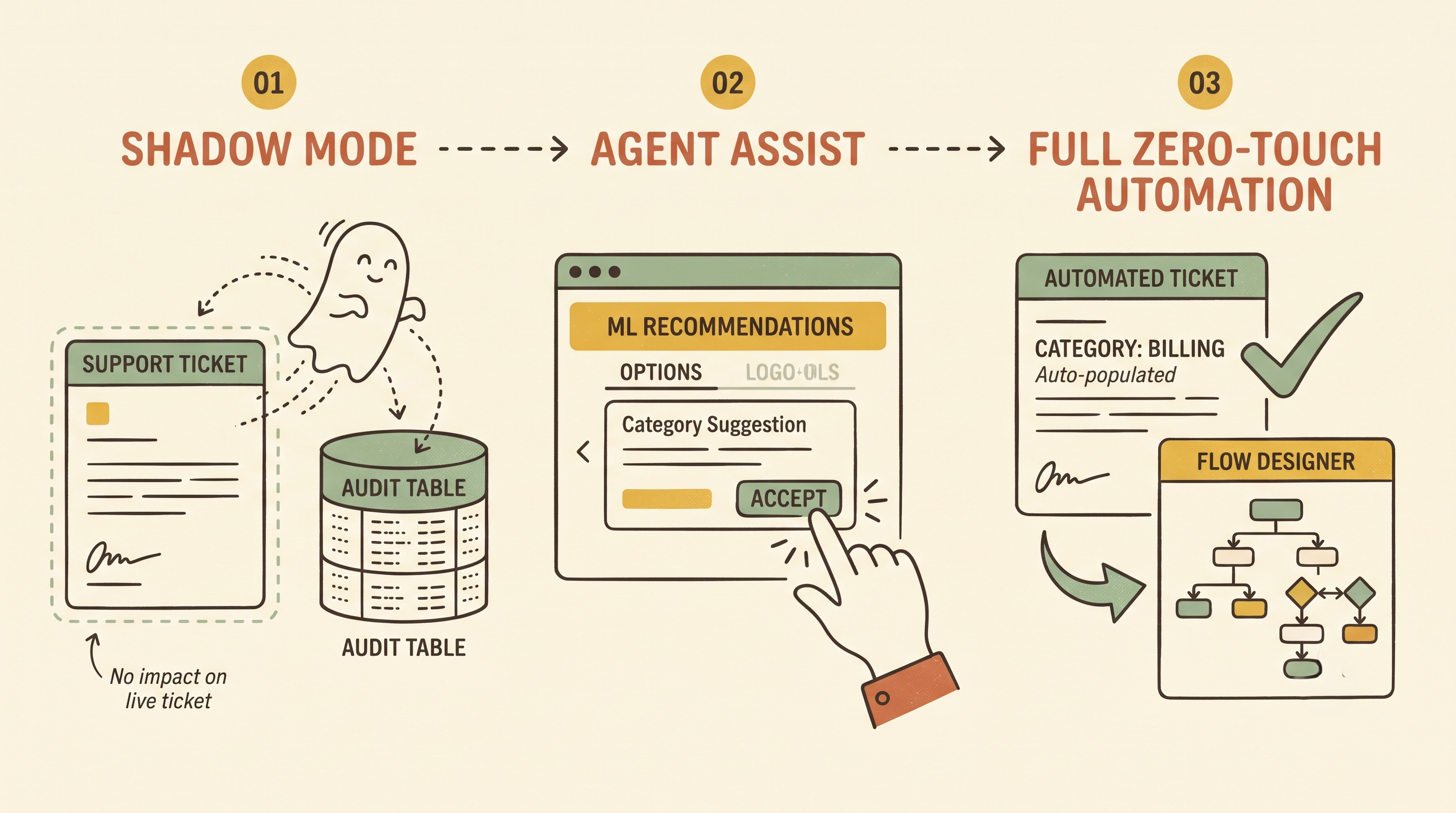
It is not a case of turning on machine learning classification overnight. Successful ServiceNow teams deploy in phases, using a maturity model that validates real-world accuracy, builds stakeholder trust and protects service levels before allowing autonomous updates.
The first step is called Shadow Mode or silent evaluation. In this phase the trained model runs in production for every new incoming incident logging its predicted category, assignment group and confidence score into background audit tables or custom analytics fields, without changing the actual ticket or alerting the user. Administrators compare the silent predictions of the model to the final resolved values entered by human agents, two to four weeks after shadow mode. This validation in the real world shows edge cases, differences in seasonal tickets or newly introduced internal tools which are not available in the historical training data.
Second stage is Agent Assist or Recommendation Mode. When a service desk analyst opens a newly logged incident in the Service Operations Workspace, the platform displays the top predictions of the model as interactive recommendations in the user interface. The agent can accept the suggested category and assignment group with the click of a button, or override them if the model missed some subtle context. The recommendation mode gives instant productivity wins, cutting triage time from minutes to seconds, while keeping a human in the loop to validate edge cases and generate clean feedback data.
The third is Full Zero-Touch Automation, and this is the most mature. If certain categories or assignment groups consistently achieve precision levels above eighty-five or ninety percent in the shadow and recommendation phases, administrators can set up Flow Designer workflows or business rules to automatically apply the high-confidence predictions at the time of ticket creation. An employee raises an issue via self-service portal or email and the system auto populates the category, assigns the exact resolver team, launches automated diagnostic playbooks and notifies the end user, without any Tier 1 triage delays. In the workflow, tickets with an algorithm confidence below a pre-defined threshold are softly routed to a human triage queue for manual review.
Classification for ServiceNow Workflows End to End
When combined with the broader automation capabilities of the ServiceNow platform, automated classification becomes exponentially more powerful. Predicting a category and assignment group is rarely the end destination but rather the intelligent routing switch that kicks off downstream orchestration and self-service experiences.
ServiceNow Virtual Agent and machine learning classification are transforming the conversational intake experience. As the employee types out their issue using natural language in Microsoft Teams, Slack or the Employee Center portal, the underlying classification model is scoring the utterance in real time. The Virtual Agent does not require the user to traverse static menus, but rather immediately identifies the technical area and begins the corresponding guided troubleshooting topic or automated fulfilment flow.
Similarly, real-time accurate classification allows automated remediation through Integration Hub and Flow Designer. If the model is very confident that an incoming ticket is a routine software access issue or a locked Active Directory account, Flow Designer can automatically call an identity management spoke to validate approvals, unlock the account, document the action in the work notes and resolve the incident, all without the ticket ever being touched by a human agent.
Classification also improves Major Incident Management and Problem Management. So when suddenly dozens of employees complain all sorts of connection timeouts, the classification model correctly tags all incoming tickets with the same network service and category. That sudden spike in uniformly classified incidents automatically triggers automated threshold alerts, enabling Major Incident Managers to detect systemic outages early and associate child incidents to a single parent problem record before business disruption escalates.
Continuous Governance, Drift Monitoring and Model Re-training
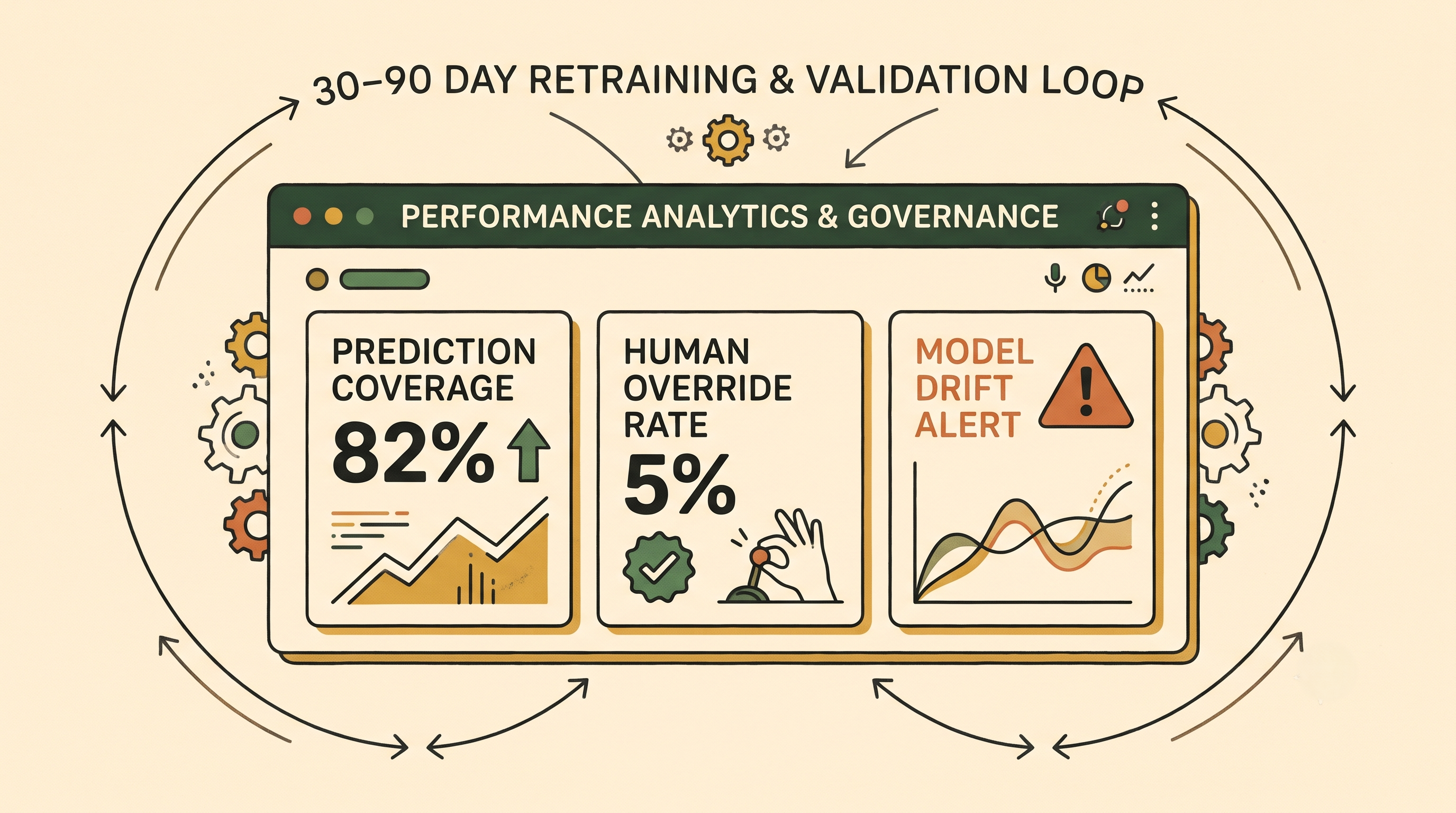
Deploying a machine learning model is not a one off project. It’s an operational capability that continues and needs to be governed continuously.” Enterprise IT environments are dynamic in nature. The vocabulary employees use when reporting issues is always changing due to corporate reorganisations, cloud migrations, software upgrades and new security policies. This is known as concept drift or data drift . A static model will degrade over time, losing precision and coverage.
To prevent silent degradation, ServiceNow administrators should build specialised Performance Analytics dashboards to monitor the health of machine learning. Key operational indicators are: prediction coverage rate, human override rate and number of reassignments on auto-classified tickets. Another is a comparison of Mean Time to Resolution for auto-routed vs. manually-routed incidents. If the human override rate for a particular category jumps from five percent to twenty-five percent within a two week period, it is an immediate early warning that a recent system change or organisational change has confused the model.
With ServiceNow, you have the opportunity to continually update the models to match your evolving enterprise environment. For most enterprises, they set their automated retraining cycle for thirty to ninety days, depending on the number of tickets and the speed of change in the organisation. New resolved incidents, including those resolved by the agents who bypassed the predictions earlier, are added at each retraining phase. Most importantly, it is crucial that the governance workflows be designed to ensure that the validation metrics for any new version of the retrained models be validated by the administrators before promotion into production so that any abnormal batch of tickets does not adversely affect classification accuracy. If your team needs to upskill on platform administration, performance analytics, and governance of workflows, a servicenow online course on OnlineITGuru is recommended.
Common mistakes in implementation and how to avoid them
ServiceNow’s low-code machine-learning tools are not a panacea. Organisations often fall into predictable traps that stall adoption or limit return on investment. Awareness of these traps from the start helps implementation teams design resilient solutions from day one.
The first big pitfall is to try to boil the ocean at launch. In a first release, some teams will try to automate all categories, sub-categories, service offerings and assignment groups in a global enterprise. However, when overall model metrics are dragged down by dozens of obscure, low-volume categories, stakeholders lose confidence in the technology. The far better way is to apply the Pareto principle. Take a look at the historical ticket volume, identify the top ten or twenty high volume categories and assignment groups that make up seventy percent of all incoming incidents, and then build high precision models around those core workflows first.
The second pitfall is the disregard of data privacy and sensitive information in free text descriptions. Employees will occasionally copy and paste passwords, PIN numbers, credit card information or sensitive HR data into the incident description. ServiceNow data anonymisation and sensitive data scrubbing rules should be set up by administrators to remove personally identifiable information and secrets before training datasets are sent out and similarity matches are displayed across teams.
The third mistake is to neglect organisational change management. Service desk analysts may be suspicious of automated classification, worried the system will create messy misrouted queues, or that automation will threaten their jobs. You need to be open in communication. Leaders need to frame machine learning classification as an assistant that eliminates the repetitive drudgery of data entry so analysts can focus on complex technical troubleshooting, proactive problem analysis, and high-touch customer service. Get senior service desk leads involved in shadow mode review and threshold tuning phases to create natural ownership and convert doubtful agents into enthusiastic champions.
Measuring ROI and Business Impact
IT leaders need to translate the technical model metrics into business outcomes to justify the continued investment in ServiceNow machine learning capabilities. Benchmarks should be clearly defined before deployment and ROI should be measured by tracking improvements across dimensions of efficiency, quality and user experience.
The labour saving in triage is the key measure of operational efficiency. Multiply the number of zero-touch auto-classified tickets by the average manual triage time (typically three to five minutes per ticket) and organisations can quantify the return of thousands of engineering hours per year. Even in recommendation mode, shaving sixty seconds off of every ticket across an enterprise that handles fifty thousand incidents a month saves over eight hundred hours of service desk capacity every month.
The most important indicator for the successful implementation of the classification procedure in regards to the quality of service would be the actual decrease in hop counts – the number of times tickets are reassigned. Proper classification and routing of incidents to the proper resolver queue would increase the probability of achieving First Contact Resolution, as well as decrease MTTR drastically. Improved classification data would be used not only in problem management within the lower level of IT architecture but also in IT governance in the upper part of the architecture to help Problem Managers and IT Finance understand exactly how much an incident costs in terms of business services and help to invest in IT infrastructure on factual information, not on assumptions. If you plan on taking any learning paths in relation to ServiceNow Administration, automation and modules courses, check out the servicenow course syllabus on OnlineITGuru.
To put it simply, using ML for automatic incident classification in ServiceNow is a crucial part of moving toward autonomous IT operations. By replacing slow, error-prone manual triage with fast self-improving predictive models, enterprises can build a more resilient service desk, freeing up IT staff to focus on high-value engineering work and deliver the seamless, immediate support experience that today’s digital workplaces demand.